


Abstract
Construction and industrial monitoring often isolate telemetry, images, and inspection records, weakening interpretation when evidence is incomplete. This paper presents evidence-first architecture combining time-aligned sensor windows, image and text embeddings, an ontology-based asset graph, and confidence-gated agents. A controlled replay of 36,000 synthetic episodes across 30 seeds evaluated decision logic using generated feature and embedding prototype spaces; it did not execute learned image/text encoders or deployed agent services. Multimodal fusion increased macro-F1 from 0.617 to 0.816. The reported 100% capture of deliberately injected asset–event incompatibilities tests enforcement of predefined rules, not general ontology validation performance. The agentic gate achieved 0.931 selective macro-F1 at 66.5% automation coverage, with 33.5% of episodes withheld from automation; this reflects selection of decisions rather than an improved underlying classifier. Unsafe automatic decisions fell from 36.1% to 4.2% of high-risk synthetic episodes. These results assess decision policy behavior under the specified simulation assumptions. They do not validate the complete artificial intelligence (AI)/agentic implementation, real-world safety or field performance; Microsoft Azure and Microsoft Foundry provide a proposed deployment mapping.
1. Introduction
Reliable monitoring of structures, construction operations, and automated production assets requires evidence from heterogeneous sources. A transient vibration may be meaningful only for a rotating asset; a humidity excursion may become critical only when it coincides with visual evidence of water ingress; and an image-based surface discontinuity should not be detached from the inspected zone, capture time, camera context, and maintenance history. Deep learning methods have improved structural health monitoring and visual defect recognition, but model outputs remain difficult to operationalize when evidence is fragmented, provenance is weak, or modalities disagree [1,2,3].
Multimodal representation learning provides a useful bridge. Contrastive image–text models demonstrate that images and language can be embedded in a shared semantic space [4], while retrieval-augmented generation shows how non-parametric evidence can ground generated responses [5]. These techniques improve retrieval and interpretation, but similarity alone does not establish whether a candidate finding is compatible with the asset, units, location, operating mode, or required evidence. Knowledge graphs and ontologies supply explicit identities, relations, and constraints [6,7,8,9,10], and provenance vocabularies can connect a recommendation to the activities and sources from which it was derived [11].
The remaining engineering problem is therefore not simply to select a stronger classifier. A monitoring system must synchronize modalities, preserve evidence lineage, validate domain constraints, expose uncertainty, and ensure that an artificial intelligence (AI) agent cannot convert a weak hypothesis into an unsafe action. The central research question is: how much does each layer—multimodal fusion, ontology validation, and confidence-gated agent orchestration—contribute to decision quality and operational safety under controlled noise and missing data conditions?
The paper makes four contributions:
- An evidence-first architecture that binds telemetry, images, inspection text, and asset context through stable event and asset identifiers;
- A lightweight ontology pattern that reuses the Sensor, Observation, Sample, and Actuator/Semantic Sensor Network (SOSA/SSN) ontologies, the Building Topology Ontology (BOT), and the Provenance Ontology (PROV-O), and applies Shapes Constraint Language (SHACL) constraints before agent recommendations are eligible for automation;
- A typed agent workflow in which retrieval and reasoning are probabilistic but validation, confidence thresholds, action permissions, and human approval are deterministic; and
- A controlled 36,000-episode synthetic replay that reports accuracy, automation coverage, and unsafe action rates rather than model accuracy alone.
The novelty is the use of semantic validation as an execution control, not merely as metadata for search. The ontology shapes the decision boundary: incompatible hypotheses and incomplete provenance are rejected or escalated before an agent can propose an operational action. The synthetic experiment is deliberately separated from future field validation so that the evidence claimed here remains auditable.
2. Background and Research Gap
2.1. Multimodal Monitoring
Sensor telemetry is well suited to continuous process variables, but it is vulnerable to drift, dropout, installation effects, and operating regime changes. Images provide rich spatial evidence yet are sensitive to viewpoint, illumination, occlusion, and surface texture. Inspection notes carry expert context but vary in vocabulary and completeness. Public resources such as SDNET2018 and MVTec AD illustrate the scale and diversity of visual defect evidence in construction and manufacturing [2,3]. A practical system should exploit complementary modalities while retaining the original evidence and quality flags.
This work uses late fusion because it accepts independently produced scores from sensor analytics, image embeddings, and text embeddings. Late fusion also allows a missing modality to be removed from the denominator without imputing fictitious evidence. The approach is compatible with domain models deployed through Microsoft Foundry Models, conventional machine learning endpoints, or edge inference. The controlled replay evaluates the fusion logic, not a specific commercial model.
2.2. Ontologies, Knowledge Graphs, and Validation
A knowledge graph represents entities and relations, while an ontology defines shared semantics and constraints for those entities [6]. SOSA/SSN provides concepts for sensors, observations, procedures, features of interest, and observed properties [7,9]. BOT supplies a compact vocabulary for building topology [8]. PROV-O represents entities, activities, and agents involved in producing information [11]. SHACL validates Resource Description Framework (RDF) data graphs against explicit shapes [10]. These standards are complementary: one identifies what was observed, another locates the observation, a third records how evidence was produced, and SHACL tests whether the assembled episode is admissible.
2.3. Retrieval-Augmented and Agentic Workflows
Retrieval-augmented generation grounds a language model in retrieved evidence [5]. Agent patterns extend this idea by allowing a model to select tools and interleave reasoning with actions [12]. In operational monitoring, unconstrained autonomy is inappropriate: a generated explanation must not bypass a sensor quality check, an ontology violation, an approval requirement, or a write permission. The proposed workflow therefore uses narrow typed tools, immutable evidence references, and a deterministic policy gate. The agent produces a recommendation package; it does not directly actuate equipment or certify structural safety.
3. Proposed Architecture
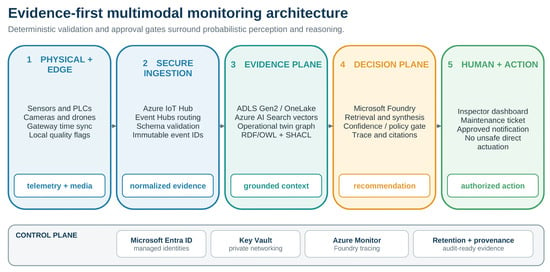
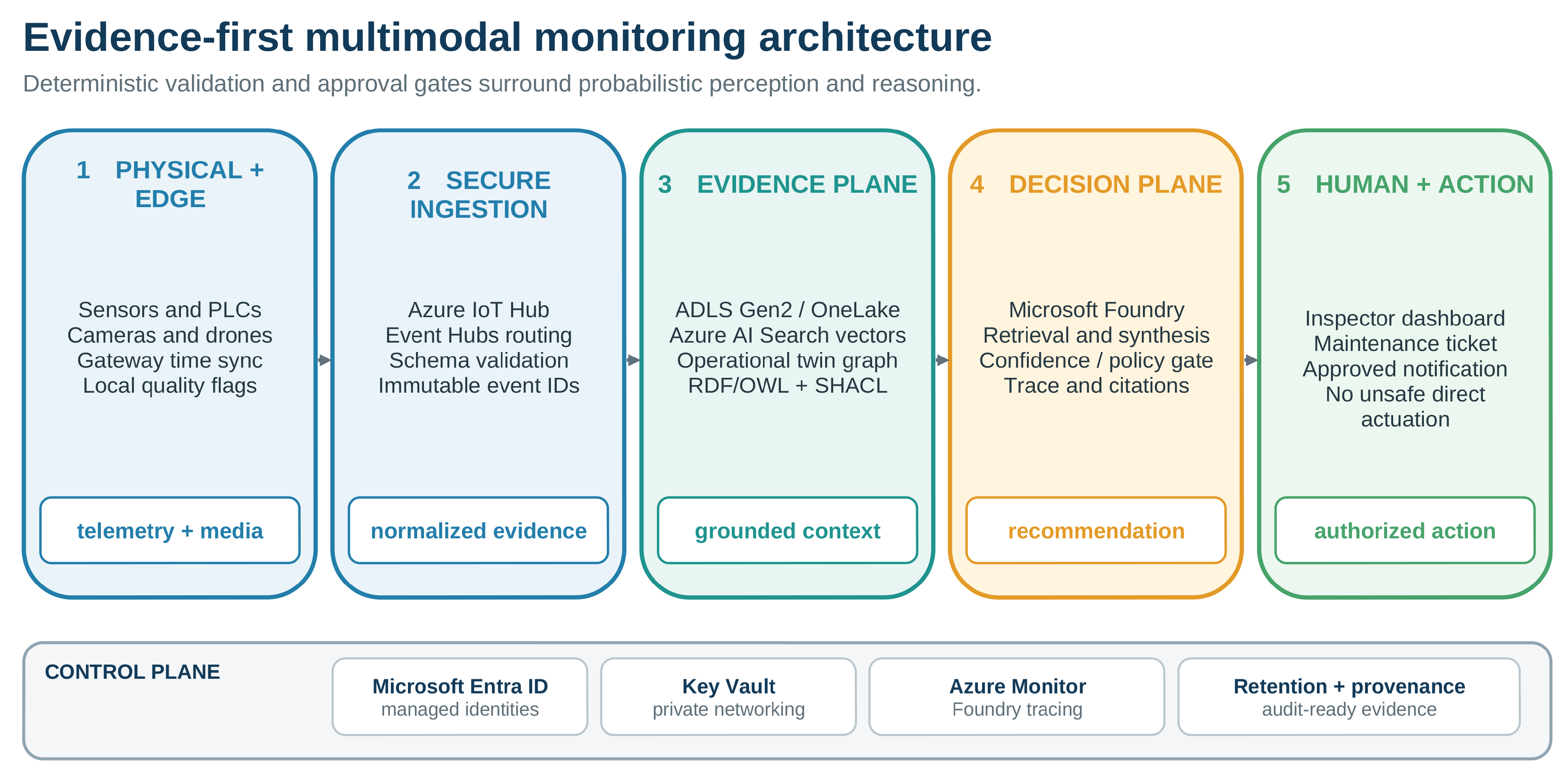
Figure 1 separates the architecture into five functional stages and a cross-cutting control plane. The algorithm layer remains portable, while the proposed reference deployment maps each responsibility to managed Microsoft cloud services. This mapping is architectural; the replay in Section 4 does not benchmark these services.
Figure 1.
Evidence-first multimodal monitoring architecture and Microsoft reference deployment. Probabilistic components are surrounded by schema, semantic, confidence, and approval gates. ADLS Gen2: Azure Data Lake Storage Gen2; AI: artificial intelligence; ID: identifier; IoT: Internet of Things; OWL: Web Ontology Language; PLC: programmable logic controller; RDF: Resource Description Framework; SHACL: Shapes Constraint Language.
3.1. Physical and Edge Acquisition
The physical layer includes environmental, strain, vibration, acoustic, and process sensors, together with fixed cameras, mobile devices, or drones. A gateway assigns a Coordinated Universal Time (UTC) timestamp, asset identifier, sequence number, and quality flags before transmission. Where possible, device clocks are synchronized, and image captures are associated with the nearest telemetry window. Edge processing may redact sensitive regions, calculate compact signal features, or reject corrupt frames, but the original evidence reference is retained.
3.2. Ingestion and Evidence Plane
Azure Internet of Things (IoT) Hub provides authenticated device-to-cloud telemetry and routing to downstream services [13]. Event Hubs or equivalent streaming infrastructure decouples ingestion from consumers. Raw evidence is retained in Azure Data Lake Storage Gen2 or OneLake, while Azure AI Search stores image, text, and event summary vectors alongside filterable asset, time, and quality metadata [14]. Azure Digital Twins supplies an operational twin graph described with Digital Twins Definition Language (DTDL) models [15]. Because RDF/Web Ontology Language (OWL) constraints and SHACL validation are not identical to DTDL, the reference architecture treats the semantic ontology as a canonical validation model and compiles the required operational subset to DTDL using stable shared identifiers. Table 1 specifies the minimum evidence contract and validation requirements.
Table 1.
Minimum evidence contract for a monitoring episode.
3.3. Multimodal Scoring
For each modality m and candidate class c, the system produces a normalized compatibility score. For embedding modalities, cosine similarity is used:
sm,c = (em·μm,c)/(||em||2 ||μm,c||2)
Here, the first vector is the episode embedding for modality m and the second is the prototype or retrieved representation for class c. Sensor scores may instead be derived from distance to a baseline, a supervised classifier, or a domain-specific anomaly model, but they are calibrated in the same direction: larger values indicate stronger support.
Available modality scores are combined by a weighted late-fusion logit:
ℓc = [Σm wm am sm,c]/[Σm wm am] + γ o(c,a)
Here, wm is the weight for modality m, and am is its availability indicator (1 when the modality is usable and 0 otherwise); γ is the ontology-prior strength, and the final term encodes compatibility between class c and asset a. Incompatible candidates receive a prohibitive penalty. Class probabilities are obtained by softmax over the fused logits. This formulation makes missing evidence explicit and prevents a zero vector from being mistaken for negative evidence.
3.4. Ontology-Aligned Evidence Graph
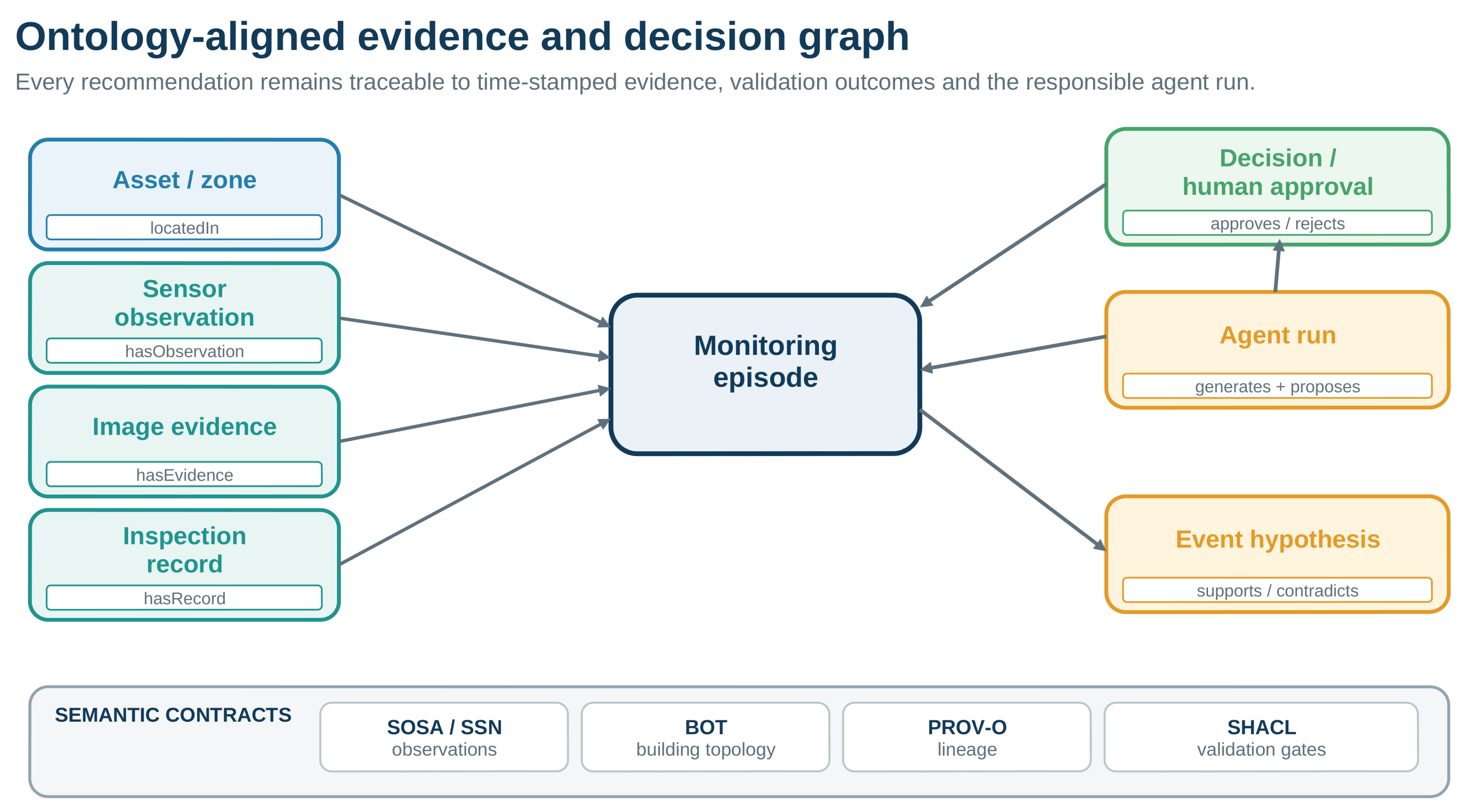
Figure 2 shows the minimum semantic pattern. MonitoringEpisode is the aggregation boundary for one decision. It links an Asset or Zone to SensorObservation, ImageEvidence and InspectionRecord instances, and connects candidate EventHypothesis nodes to the AgentRun and Decision that used them. PROV-O relations record derivation and responsibility; SOSA/SSN terms describe observations; BOT supplies building containment when the monitored asset is a construction object. Table 2 lists the corresponding validation shapes and failure outcomes.
Figure 2.
Ontology-aligned evidence graph. The graph links every hypothesis and decision to asset context, original evidence, validation outcomes, and the responsible agent run. BOT: Building Topology Ontology; PROV-O: Provenance Ontology; SHACL: Shapes Constraint Language; SOSA/SSN: Sensor, Observation, Sample, and Actuator/Semantic Sensor Network ontologies.
Table 2.
Core SHACL validation shapes used by the decision gate.
3.5. Agent Workflow and Human Approval
Microsoft Foundry unifies managed models, tools, agents, evaluation, and observability [16]. Foundry Agent Service can host prompt-based or code-based agents and expose approved tools [17]. In the proposed design, four narrow roles are orchestrated: (1) evidence retrieval, (2) event synthesis, (3) semantic and policy validation, and (4) report and escalation. The validation role is implemented as deterministic code even when invoked as an agent tool.
Let q be the probability margin between the two highest-ranked classes, d the fraction of available modality votes that disagree with the majority, vSHACL a binary SHACL-violation indicator, and nmissing the number of unavailable modalities. The workflow escalates when:
escalate = 1[vSHACL = 1 ∨ q < τq ∨ d > τd ∨ nmissing ≥ 2]
The replay uses a confidence-margin threshold of 0.10 and a disagreement threshold of 0.66. A recommendation that passes the gate may create a notification or draft maintenance ticket. Structural certification, safety-critical control, and machine actuation require a designated human or an independent deterministic controller. Tool permissions are enforced with Microsoft Entra ID, managed identities, network isolation, and least-privilege role assignments; secrets are stored in Key Vault, and model/tool traces are sent to Azure Monitor and Foundry observability.
4. Materials and Methods
4.1. Evaluation Design
The quantitative study is a controlled synthetic replay intended to test fusion, compatibility rules, and abstention logic under known perturbations. It is not a substitute for field trials and does not estimate the accuracy of any particular sensor, camera, or foundation model. Thirty independent seeds (1301–1330) generated 1200 balanced episodes each, yielding 36,000 episodes. The six event classes were normal, thermal excursion, moisture ingress, excessive vibration, surface discontinuity, and component/process anomaly. Each episode was assigned to one of four compatible asset types: concrete zone, mechanical unit, electrical cabinet, or production cell. No learned image/text encoder, language model reasoning process, or deployed agent service was evaluated.
Sensor evidence used a six-dimensional feature vector generated around class prototypes with Gaussian noise. Image and text evidence used independently generated 24-dimensional prototype spaces with additive noise, followed by cosine similarity; these vectors were not extracted from images or text by trained encoders. The experiment injected acquisition and integration failures before inference. An 11% subset received additional distribution shift noise; sensor, image, and text evidence were missing independently at rates of 4%, 12%, and 9%. Deliberately invalid asset–event assertions were also introduced. The invalid assertion was produced by replacing the correct asset type with a type for which the true event class was not permitted. The realized frequency of incompatible assertions is not reported; violation capture is interpreted conditionally on these constructed cases. Table 3 summarizes the replay configuration.
Table 3.
Controlled synthetic replay parameters.
4.2. Compared Variants
Four cumulative variants were evaluated:
- Sensor-only: classification from sensor prototype distance; every episode is automatically decided.
- Multimodal fusion: weighted sensor, image, and text scores with per-episode renormalization for missing evidence.
- Ontology-constrained: multimodal fusion plus asset–class compatibility and escalation of invalid semantic assertions.
- Agentic gated: ontology-constrained scoring plus confidence, disagreement, missing modality, and validation gates; this variant evaluates the deterministic decision policy, not deployed agent execution.
4.3. Metrics
Overall macro-F1 gives equal weight to the six classes. Selective macro-F1 is computed only on automatically decided episodes; it therefore must be interpreted together with automation coverage, the fraction of all episodes automatically decided. Abstained episodes are excluded from selective macro-F1; higher selective macro-F1 does not imply higher full-population classifier accuracy. This follows the selective classification principle of abstaining on low-confidence inputs [18]. High-risk correct-or-escalated rate counts a non-normal episode as correct or escalated when its class is correct, or it is escalated; escalation does not demonstrate successful human resolution. Unsafe automatic action rate is the proportion of non-normal episodes that receive an incorrect automatic decision without escalation. False escalation is the proportion of all episodes escalated even though the underlying classifier prediction is correct. Ontology violation capture is the proportion of injected invalid metadata episodes blocked by the corresponding predefined compatibility rules. It is a rule enforcement check on known violations, not a general semantic detection benchmark. Results are reported as mean ± sample standard deviation across seeds. The paired seed design is retained for all comparisons.
4.4. Use of Generative AI in Manuscript Preparation
OpenAI ChatGPT Work (Codex; exact model version not recorded in the available drafting record; accessed on 17 August and 22 September 2026) assisted with literature organization, language editing, synthetic replay code, original figure preparation, reviewer response drafting, and clarification of evaluation claims. The evaluation uses synthetic data by design and does not use measured field observations. The author is responsible for the architecture, experimental design, interpretation, and final manuscript. The revision clarifies the reported evaluation; it does not introduce a new experiment or an independent replication.
5. Results
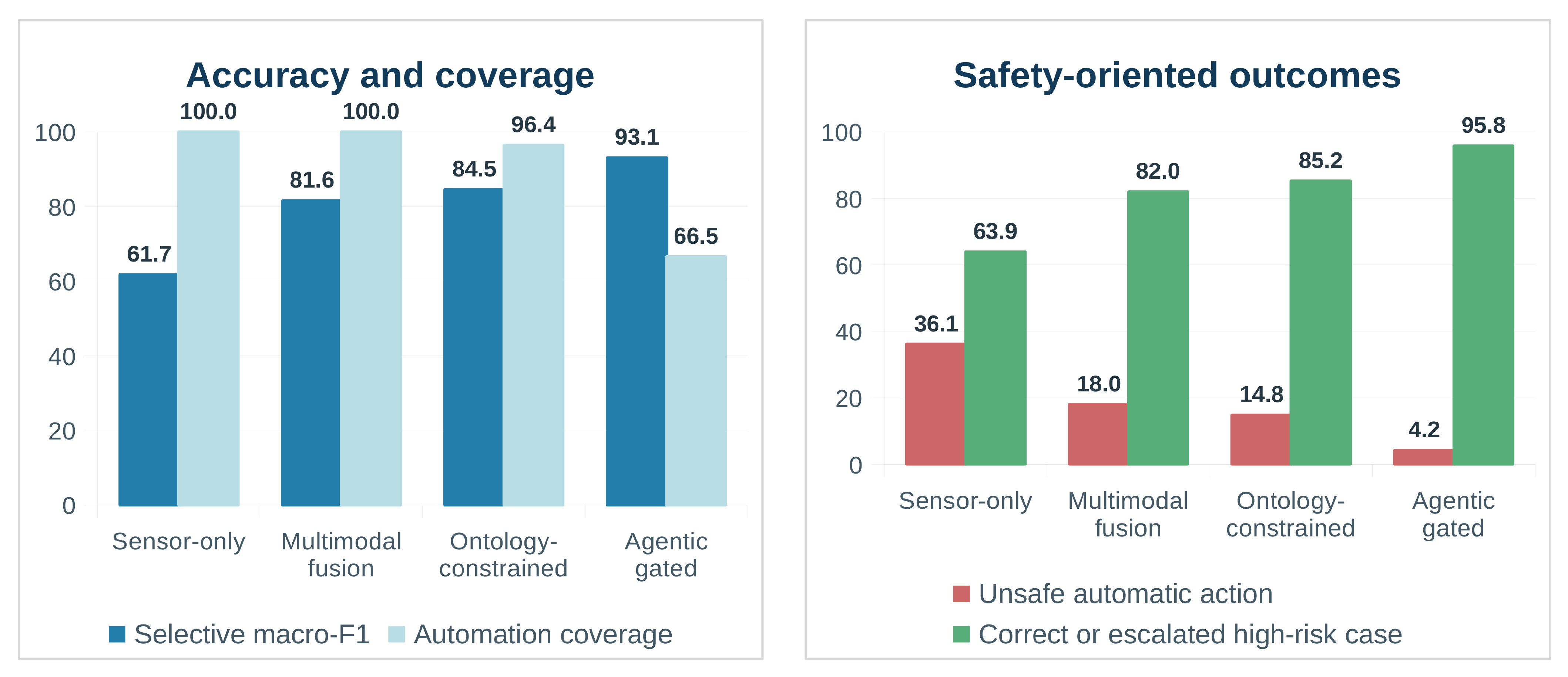
Multimodal fusion improved macro-F1 by 0.199 (from 0.617 to 0.816) and reduced unsafe automatic actions by 18.1 percentage points. The result confirms that the synthetic modalities were complementary: sensor evidence was strongest for thermal, moisture, and vibration events, whereas image and text evidence improved surface and component event separation.
Ontology validation reported 100% capture of the injected asset–event violations. Because the violations were deliberately constructed to contradict the compatibility rules used for checking, this tests correct enforcement of those rules within the replay; it does not estimate detection of unknown or more complex semantic errors in deployment. The ontology-constrained variant reported 96.4% coverage and 0.845 selective macro-F1. The complete decision gate achieved 0.931 selective macro-F1 at 66.5% coverage, withholding 33.5% of episodes from automation. Its unsafe automatic action rate was 4.2% of high-risk synthetic episodes, while the high-risk correct-or-escalated rate was 95.8%. These are simulated decision outcomes, not measured equipment actions or field safety results.
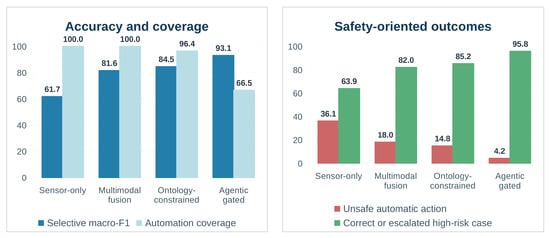
The gain from the agentic gate is selective: the underlying ontology-constrained class ranking is unchanged, but uncertain cases are withheld from automation. The 0.931 selective macro-F1 therefore describes the retained 66.5% of episodes, not all episodes. The remaining 33.5% require review, whose quality, time, and cost were not measured. Figure 3 reports selective macro-F1 and coverage together to expose this trade-off; the result is not evidence of improved underlying classification. Table 4 reports the numerical results for all four variants.
Figure 3.
Selective macro-F1, automation coverage and safety-oriented decision metrics in the controlled synthetic replay. Bars show mean values; standard deviations are reported in Table 4. Gating changes the evaluated subset, not the underlying classifier. Macro-F1 is multiplied by 100 for plotting on the percentage scale.
Table 4.
Decision-policy results in the controlled synthetic replay across 30 independent seeds (mean ± SD).
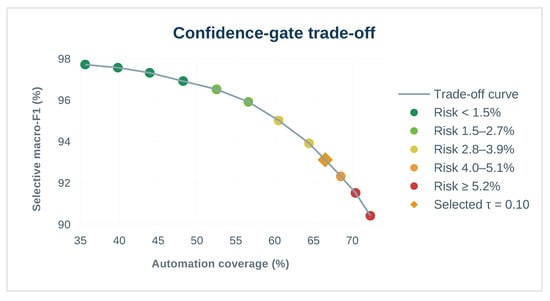
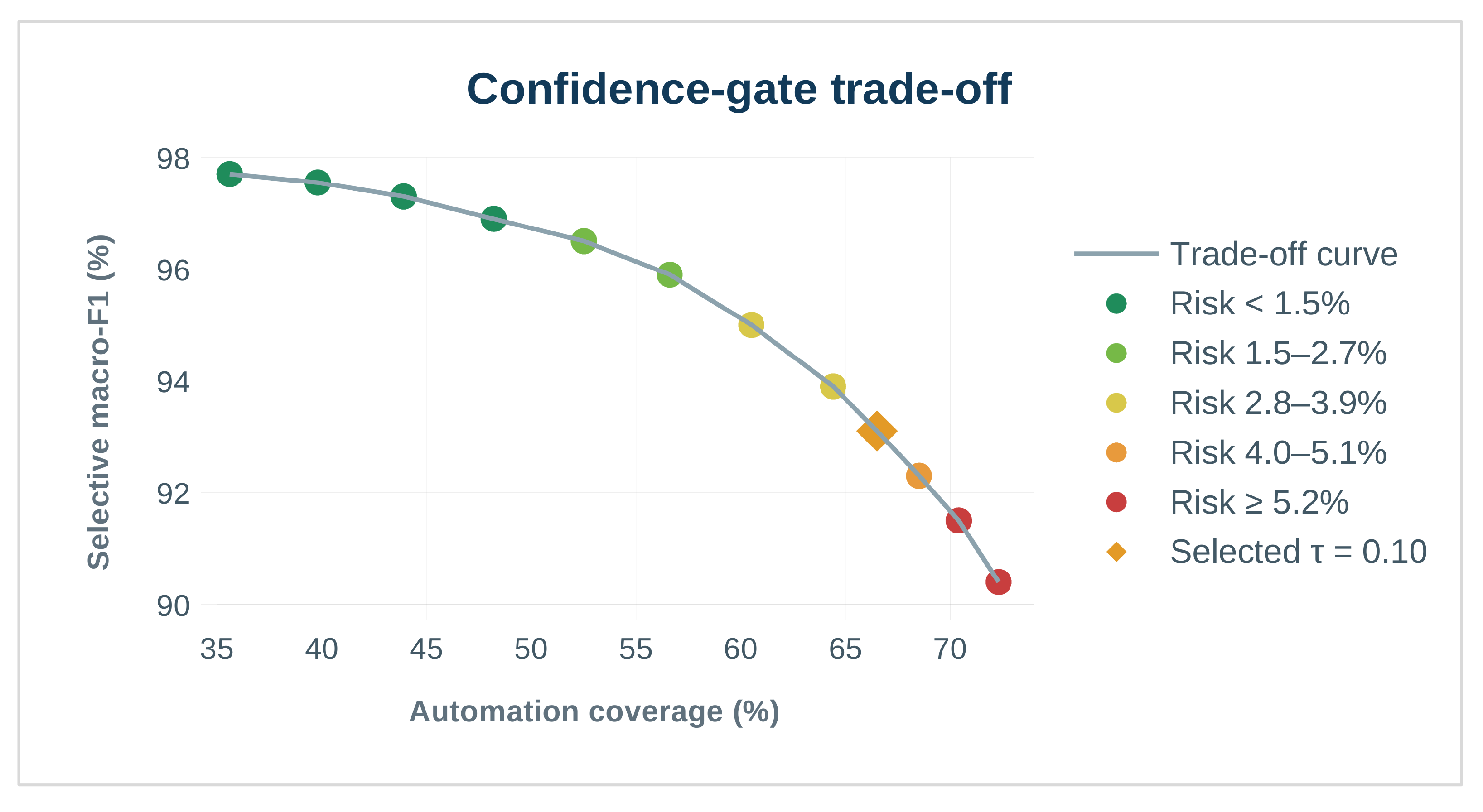
Figure 4 demonstrates the tunable trade-off. Raising the confidence margin threshold increases selective accuracy and lowers unsafe automation, but also sends more cases to human review. The chosen threshold is not universal. A structural safety workflow should generally prefer lower automation coverage than a non-critical visual quality triage, and field deployment should calibrate thresholds by asset type, event severity, and the cost of delayed review.
Figure 4.
Confidence-margin trade-off for the agentic gate. Marker color represents the unsafe automatic action rate; the highlighted diamond marks the selected threshold τ = 0.10.
6. Discussion
6.1. Interpretation of the Research Questions
Research question 1 (RQ1) concerned multimodal fusion. The 0.199 absolute macro-F1 improvement over sensor-only classification shows the effect of complementary generated signals in the controlled setting. The result should not be interpreted as a guaranteed gain for any real dataset; it evaluates fusion under the specified prototype and noise assumptions, not the quality of real image or text embeddings.
RQ2 concerned ontology validation. The replay reported blocking every injected incompatible asset–event assertion with a machine-readable validation report. The violations were generated to conflict with the same predefined compatibility rules used by the validator, so complete capture is an expected rule enforcement result in this controlled setting. It does not establish ontology completeness, detection of unseen violations, or general validation performance in real deployments. The architectural contribution is using semantic admissibility as a gate before automation. DTDL provides the proposed operational twin vocabulary, while RDF/OWL and SHACL provide the canonical semantic constraints.
RQ3 concerned the decision policy for agentic orchestration. The replay reduced the unsafe automatic action rate from 36.1% to 4.2% of high-risk synthetic episodes while automating 66.5% of all episodes. The remaining 33.5% were escalated. The gate preserves the ontology-constrained classifier and improves selective decision quality by withholding uncertain cases; it does not improve the classifier itself. Retrieval, language model synthesis, explanation quality, and deployed agent execution were not measured. Human review is a proposed operating mode, and its outcomes and workload require separate evaluation.
6.2. Deployment Guidance
A production implementation should begin with one bounded asset family and a small event vocabulary. Sensor units, calibration state, operating modes, and evidence-retention rules should be formalized before training or prompting models. Embeddings must store model version and source hash so that re-indexing can be audited. The vector index should expose filterable asset, time, quality, and authorization fields; similarity search alone should never define the final event class.
Microsoft Foundry Agent Service is suitable for managed agent hosting, tool integration, and observability [16,17]. Azure AI Search provides vector and hybrid retrieval [14], Azure Digital Twins represents the operational asset graph [15], and IoT Hub secures device connectivity and routing [13]. The architecture deliberately avoids vendor lock-in at the semantic and scoring layers: SOSA/SSN, BOT, PROV-O, and SHACL remain portable open standards. A different cloud or on-premises stack can implement the same contracts.
6.3. Responsible AI and Security
The monitoring system is decision support, not an expert replacement. Generated reports must cite evidence IDs and distinguish observation, inference, and recommendation. Agents receive only allow-listed tools and minimum context. Prompt text and inspection notes are treated as untrusted input; tool parameters are schema-validated; write operations require independent authorization; and every decision stores the model, prompt/instruction version, retrieved evidence, validation report, and final approver. National Institute of Standards and Technology (NIST) AI Risk Management Framework (RMF) principles provide a complementary governance frame for validity, reliability, transparency, accountability, and risk treatment [19].
6.4. Limitations and Threats to Validity
The principal limitation is the synthetic replay. The generator uses balanced classes, generated feature and embedding prototype spaces, and Gaussian perturbations, without trained encoders or deployed agents; real construction and manufacturing data are imbalanced, non-stationary, and affected by installation, environment, maintenance, and human-label uncertainty. The replay does not measure camera detection accuracy, telemetry latency, cloud throughput, service cost, model hallucination rate, or human review time. The ontology contains only the minimum compatibility rules required by the experiment and does not encode structural mechanics, manufacturing process capability, or regulatory compliance. Rule capture is limited to known injected incompatibilities. Selective macro-F1 excludes abstained cases and does not establish full-population classifier improvement or end-to-end operational safety. The realized count and prevalence of injected incompatible assertions are not reported, limiting exact replication and interpretation of capture against violation frequency. The reported aggregate results do not establish robustness across different violation prevalences.
The specified seed range, configuration, and cumulative variants characterize the controlled comparison; independent replication and external validity require executable artifacts and field evidence, respectively. Future work should evaluate site- and plant-specific datasets, compare learned fusion with calibrated late fusion, measure confidence under distribution shift, validate inter-rater agreement, and conduct prospective human-in-the-loop studies. Safety thresholds should be derived from a documented hazard analysis rather than reused from this replay.
7. Conclusions
This paper presented an evidence-first architecture for combining sensor telemetry, images, inspection text, ontology constraints, and agent workflows in construction and industrial automation monitoring. A controlled replay using generated feature and embedding prototype spaces evaluated the decision logic, not learned image/text encoders or deployed agent services. Multimodal fusion improved classification within the synthetic setting, and predefined compatibility rules captured the deliberately injected violations. Complete capture establishes rule enforcement for these test cases, not general ontology validation performance. The gated policy achieved 0.931 selective macro-F1 at 66.5% coverage, leaving 33.5% of episodes for review and reducing unsafe automatic decisions to 4.2% of high-risk synthetic episodes. This reflects selective decision quality with an unchanged underlying classifier; it does not validate the complete AI/agentic system or field performance.
The practical lesson is that an agent should not be the safety boundary. Embedding retrieval and model reasoning are useful for forming and explaining hypotheses, but eligibility for action must be enforced by explicit schemas, semantic validation, calibrated confidence, least-privilege permissions, and human approval. The next research stage is a prospective pilot using synchronized field telemetry and imagery, expert adjudication, and asset-specific hazard thresholds.
Funding
This research received no external funding.
Institutional Review Board Statement
Not applicable. The study used only synthetically generated monitoring episodes and involved no humans or animals.
Informed Consent Statement
Not applicable.
Data Availability Statement
Acknowledgments
OpenAI ChatGPT Work (Codex; exact model version not recorded in the available drafting record; https://chatgpt.com/, accessed on 17 August and 22 September 2026) assisted with manuscript preparation and revision as described in Section 4.4. The author takes responsibility for the final content.
Conflicts of Interest
The author participates in the Microsoft Regional Director and Microsoft Most Valuable Professional programs. Microsoft had no role in the study design, synthetic data generation, analysis, interpretation, manuscript preparation, or decision to submit. No Microsoft funding or product endorsement is claimed. The author declares no conflict of interest.
Abbreviations
The following abbreviations are used in this manuscript:
| Abbreviation | Meaning |
| ADLS Gen2 | Azure Data Lake Storage Gen2 |
| AI | Artificial intelligence |
| BOT | Building Topology Ontology |
| DTDL | Digital Twins Definition Language |
| IoT | Internet of Things |
| NIST AI RMF | National Institute of Standards and Technology Artificial Intelligence Risk Management Framework |
| OWL | Web Ontology Language |
| PROV-O | Provenance Ontology |
| RDF | Resource Description Framework |
| RQ | Research question |
| SD | Standard deviation |
| SHACL | Shapes Constraint Language |
| SOSA/SSN | Sensor, Observation, Sample, and Actuator/Semantic Sensor Network ontologies |
| URI | Uniform Resource Identifier |
| UTC | Coordinated Universal Time |
References
- Azimi, E.; Eslamlou, A.D.; Pekcan, G. Data-driven structural health monitoring and damage detection through deep learning: State-of-the-art review. Sensors 2020, 20, 2778. [Google Scholar] [CrossRef] [Scilit]
- Dorafshan, S.; Thomas, R.J.; Maguire, M. SDNET2018: An annotated image dataset for non-contact concrete crack detection using deep convolutional neural networks. Data Brief 2018, 21, 1664–1668. [Google Scholar] [CrossRef] [Scilit]
- Bergmann, P.; Fauser, M.; Sattlegger, D.; Steger, C. MVTec AD—A comprehensive real-world dataset for unsupervised anomaly detection. In Proceedings of the IEEE/CVF Conference on Computer Vision and Pattern Recognition, Long Beach, CA, USA, 15–20 June 2019; pp. 9592–9600. [Google Scholar] [CrossRef] [Scilit]
- Radford, A.; Kim, J.W.; Hallacy, C.; Ramesh, A.; Goh, G.; Agarwal, S.; Sastry, G.; Askell, A.; Mishkin, P.; Clark, J.; et al. Learning transferable visual models from natural language supervision. Proc. Mach. Learn. Res. 2021, 139, 8748–8763. [Google Scholar]
- Lewis, P.; Perez, E.; Piktus, A.; Petroni, F.; Karpukhin, V.; Goyal, N.; Kuttler, H.; Lewis, M.; Yih, W.-t.; Rocktaschel, T.; et al. Retrieval-augmented generation for knowledge-intensive NLP tasks. In Advances in Neural Information Processing Systems 33; Curran Associates: Red Hook, NY, USA, 2020; pp. 9459–9474. [Google Scholar]
- Hogan, A.; Blomqvist, E.; Cochez, M.; d’Amato, C.; de Melo, G.; Gutierrez, C.; Kirrane, S.; Labra Gayo, J.E.; Navigli, R.; Neumaier, S.; et al. Knowledge graphs. ACM Comput. Surv. 2021, 54, 71. [Google Scholar] [CrossRef] [Scilit]
- Janowicz, K.; Haller, A.; Cox, S.J.D.; Le Phuoc, D.; Lefrancois, M. SOSA: A lightweight ontology for sensors, observations, samples, and actuators. J. Web Semant. 2019, 56, 1–10. [Google Scholar] [CrossRef] [Scilit]
- Rasmussen, M.H.; Lefrancois, M.; Bonduel, M.; Hviid, C.A.; Karlshoj, J. BOT: The building topology ontology of the W3C Linked Building Data Group. Semant. Web 2021, 12, 143–161. [Google Scholar] [CrossRef] [Scilit]
- World Wide Web Consortium. Semantic Sensor Network Ontology—2023 Edition. Available online: https://www.w3.org/TR/vocab-ssn-2023/ (accessed on 17 August 2026).
- World Wide Web Consortium. Shapes Constraint Language (SHACL). W3C Recommendation. 20 July 2017. Available online: https://www.w3.org/TR/shacl/ (accessed on 17 August 2026).
- Lebo, T.; Sahoo, S.; McGuinness, D. PROV-O: The PROV Ontology. W3C Recommendation. 30 April 2013. Available online: https://www.w3.org/TR/prov-o/ (accessed on 17 August 2026).
- Yao, S.; Zhao, J.; Yu, D.; Du, N.; Shafran, I.; Narasimhan, K.; Cao, Y. ReAct: Synergizing reasoning and acting in language models. In Proceedings of the 11th International Conference on Learning Representations, Kigali, Rwanda, 1–5 May 2023; Available online: https://openreview.net/forum?id=WE_vluYUL-X (accessed on 17 August 2026).
- Microsoft. What Is Azure IoT Hub? Available online: https://learn.microsoft.com/azure/iot-hub/iot-concepts-and-iot-hub (accessed on 17 August 2026).
- Microsoft. Vector Search Overview—Azure AI Search. Available online: https://learn.microsoft.com/azure/search/vector-search-overview (accessed on 17 August 2026).
- Microsoft. DTDL Models—Azure Digital Twins. Available online: https://learn.microsoft.com/azure/digital-twins/concepts-models (accessed on 17 August 2026).
- Microsoft. What Is Microsoft Foundry? Available online: https://learn.microsoft.com/azure/foundry/what-is-foundry (accessed on 17 August 2026).
- Microsoft. What Is Microsoft Foundry Agent Service? Available online: https://learn.microsoft.com/azure/foundry/agents/overview (accessed on 17 August 2026).
- Geifman, Y.; El-Yaniv, R. Selective classification for deep neural networks. In Advances in Neural Information Processing Systems 30; Curran Associates: Red Hook, NY, USA, 2017; pp. 4878–4887. [Google Scholar]
- Tabassi, E. Artificial Intelligence Risk Management Framework (AI RMF 1.0); NIST AI 100-1; National Institute of Standards and Technology: Gaithersburg, MD, USA, 2023. [Google Scholar] [CrossRef] [Scilit]

Disclaimer/Publisher’s Note: The statements, opinions and data contained in all publications are solely those of the individual author(s) and contributor(s) and not of MDPI and/or the editor(s). MDPI and/or the editor(s) disclaim responsibility for any injury to people or property resulting from any ideas, methods, instructions or products referred to in the content. |
© 2026 by the author. Licensee MDPI, Basel, Switzerland. This article is an open access article distributed under the terms and conditions of the Creative Commons Attribution (CC BY) license.