


Abstract
We developed and evaluated a decoupled, three-layer AI architecture to audit and optimize corporate sustainability. On the basis of a layered documentary protocol, we established 15 computational determinants in the data, predictive, and governance layers. The data layer decreased processing latency by up to 80%, sustaining sub-500 ms inference speeds. Predictive models reduced forecasting errors by 20–50% and showed F1-scores of higher than 0.92. The governance layer enhanced interpretability by 50%. Beyond enterprise software, the architecture incorporates Industrial Internet of Things sensors, digital twins, and reinforcement-learning controllers for physical-asset telemetry and actuation. This integration shifts corporate sustainability management from periodic retrospective auditing to continuous, closed-loop process control across cyber–physical systems.
1. Introduction
Enterprise sustainability management is best understood as a real-time control challenge, not a periodic reporting task. Modern operations of enterprises produce huge data on emissions, energy use, and supply-chain activity. The data must be collected, verified, and processed to enable corrective actions to be effective [1]. Such responsiveness requires distributed sensing systems that handle high-volume data streams using communication protocols to maintain integrity in different industries and automated control logic to remove human delay.
Traditional enterprise systems are designed for batch reporting. Therefore, they cannot manage the speed and complexity of sustainability data generated by decentralized production and multi-tier supply chains [2]. Such architectural limitations originate from outdated system designs that predate modern sensing and edge-computing capabilities [3].
AI is often used to boost performance. This oversimplification masks the roles of specific subsystems. For example, edge-based data processing reduces latency, forecasting models turn sensor data into predictive risk signals, and governance modules enforce fairness and interpretability. Recent advances in cyber–physical integration show that sustainability-focused AI is more than data analytics. Digital twins for simulation and validation, reinforcement-learning for policy formulation through real-time feedback, and federated learning for multi-site model training have been introduced. However, those are not effectively used without data [4,5,6]. Without architectures of AI models into subsystems, engineers and decision-makers cannot evaluate or justify investment in related infrastructures. Therefore, it is essential to identify which subsystems enable measurable improvements in latency, accuracy, or interpretability, aligning with engineering-grade performance thresholds [7,8].
We developed a three-layer, AI-driven decision architecture for corporate sustainability optimization. The architecture integrates data infrastructure and edge data, predictive and control algorithms, and governance and audit mechanisms. In the architecture, each layer is defined by factors identified through a literature review. The architecture is evaluated for processing latency, forecast error, classification accuracy, and interpretability gain, rather than aggregate claims. The developed architecture provides a link between component-level computational performance and system-level sustainability outcomes, contributing to the development of distributed and cloud architecture and environmental informatics, extending cyber–physical automation for sustainability to other industries.
2. Literature Review
An AI-driven decision architecture designed to assess corporate sustainability comprises decoupled functional layers, each characterized by discrete computational performance metrics and service-level objectives. The architecture decomposes the system into data infrastructure and telemetry, predictive and analytical algorithms, and decision-interface and governance.
Data were collected using a big data analytics (BDA) platform that processes high-throughput, multi-structured sustainability data. From a software market trajectory standpoint, enterprise investment in BDA is projected to reach USD 655.53 billion by 2029, growing at a compound annual growth rate of 13.4% [6]. The engineering rationale for this investment is validated by documented operational outcomes; embedding BDA pipelines into enterprise decision workflows reduces technical processing overhead by approximately 10% and improves decision-making efficiency by 69% [7].
To mitigate the bottlenecks caused by high-latency pipelines [2], the architecture transitions from traditional batch-processing to real-time stream-processing topologies. The AI-driven decision architecture reduces end-to-end system latency by up to 80% in time-critical operational contexts [9]. The performance is optimized using edge computing, which relocates data parsing and processing to reduce data transit distances and cloud costs by an estimated 50–70% compared with completely centralized topologies [8]. In 5G networks, localized end-to-end processing latencies fall within the 1–10 millisecond range. This low-latency enables automated real-time actuation in sustainability-sensitive environments, such as smart grid energy load balancing and automated industrial emissions anomaly detection. The analytical engine of the architecture adopts machine learning and optimization algorithms to transform ingested telemetry into predictive risk assessments.
- Machine learning and time-series modules: The AI architecture shows a consistent capacity to optimize forecasting precision in supply chain and logistics environments. Error reductions in published benchmark documents range from 20 to 50%, accompanied by a 23% increase in operational processing efficiency [9]. For resource allocations, time-series analysis modules, leveraging autoregressive integrated moving average (ARIMA) models and long short-term memory recurrent neural network architectures, improve multi-step forecasting precision by approximately 30% [9]. These neural networks capture non-linear temporal dependencies within energy grid configurations that conventional statistical methods fail to resolve.
- Process automation and optimization: Process automation frameworks are used to quantify complex environmental liabilities, enabling a 30% reduction in risk, improving demand-side data accuracy by 20–25% [10]. Concurrently, optimization algorithms, utilizing linear programming solvers and evolutionary genetic computation, achieve a 30–40% improvement in resource utilization metrics, enabling near-optimal scheduling and structural material minimization within constrained manufacturing environments [11].
- Cognitive computing and semantic ingestion: The interaction layer integrates cognitive computing engines (CCEs) to manage high-dimensional, multi-variable optimization matrices. Deployed CCEs reduce problem-resolution latency by 50% and lower algorithmic error incidence by 30% under high cognitive loads [10]. To process unstructured environmental, social, and governance text corpora, the architecture implements natural language processing (NLP). The NLP market valuation is projected to reach USD 161 billion by 2030 [12]. Sentiment analysis modules achieve classification accuracies of 85–90%, enabling the quantitative ingestion of reputational risk signals and compliance alerts from unstructured public disclosures [9,10].
- Process automation: Operating in the execution layer, process automation is conducted for high-frequency compliance reporting. Predictive analytics is used to reduce operational cost profiles by 30–50%, accelerating throughput by 40% [13,14]. Unlike probabilistic ML models, process automation enables strict, rule-governed execution, ensuring absolute auditability and reproducibility across data trails where compliance verification is a mandatory engineering constraint.
Algorithmic outputs are used as verifiable data. The outputs are processed using AI-powered dashboards and virtual scenario simulation. AI-PD tracking is used to improve data interpretation efficiency by 35% and accelerates corporate decision cycle speeds by 25% through real-time, interactive visualization of sustainability key performance indicators [8,11]. To test corporate strategies against simulated climate, regulatory, and market perturbations, virtual scenario simulation modules are used to leverage containerized simulations to enhance multi-variable scenario planning accuracy by 25–40% [5,10].
To address the inherent constraints of deep neural architectures, the governance layer integrates digital explainable AI to mitigate enterprise compliance risks by 30% and increase stakeholder verification confidence by 50% using traceable feature-importance metrics [15]. Finally, ethical AI systems adopt programmatic constraints to reduce algorithmic bias profiles by 30%, ensuring that automated sustainability assessments remain strictly aligned with organizational governance standards and international regulatory definitions [16].
The transition from corporate social responsibility to quantitative, engineering-grade sustainability metrics requires the implementation of formally specified performance thresholds. This software transformation shifts sustainability assessment from a periodic, manual auditing exercise into a continuous closed-loop control system [17]. At the predictive layer, the automated governance cycle is formulated by the reliability and generalization capabilities of ML classification engines. Predictive architectures show robust validation metrics [18]. By achieving such thresholds, the integration of algorithmic outputs is validated in automated enterprise execution workflows without requiring manual human-in-the-loop verification for every transaction cycle.
In the infrastructure layer, the system-level constraint is the data processing latency maintained lower than 500 ms [8]. This performance ceiling leads to the operational boundary between real-time proactive mitigation and retrospective event logging. Edge computing infrastructure operating in the 1–10 ms latency range enhances real-time optimization capability directly to energy-intensive physical assets at the operational periphery, enabling automated corrective actuation (such as data center cooling adjustments or logistics fleet routing updates) based on real-time grid carbon intensity signals [8].
Aligned with the green energy paradigm, computational strategies that minimize internal energy consumption, parameter bloat, and operational carbon footprints must be implemented [19]. However, this paradigm introduces structural constraints regarding power usage effectiveness and computing resource efficiency. The deployed AI decision architecture contributes to enterprise carbon reduction rather than generating a hidden computational deficit.
3. Methodology
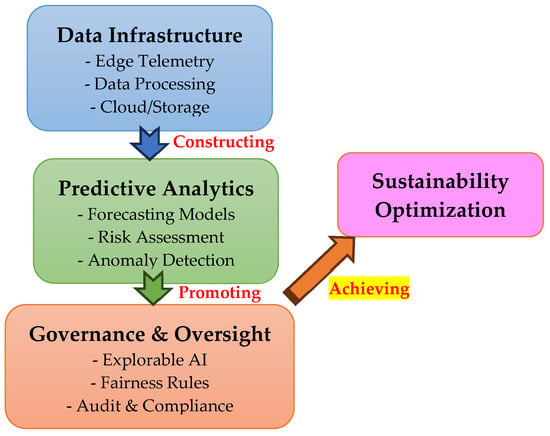
We developed and tested an AI-driven decision architecture to assess, audit, and optimize corporate sustainability outcomes. The approach uses a structured documentary analysis protocol in a four-pillar appraisal framework to extract and validate technical parameters from engineering literature and industry documentation. Data definitions are standardized across computer engineering, cloud software, and environmental informatics. The architecture transforms sustainability assessment from qualitative reporting to continuous, data-driven optimization. It is organized into three separate but connected software layers (Figure 1).
Figure 1.
Simplified architecture of the AI-driven decision system.
- Data infrastructure layer
This layer manages continuous, high-volume data ingestion from sources such as smart meters, logistics systems, and emissions logs. Real-time stream processing reduces latency, while edge computing moves computation closer to operations. This setup keeps data transit delays within low-millisecond ranges, ensuring fast and reliable throughput. In addition to data processing, the infrastructure layer integrates digital twin models that replicate physical assets such as manufacturing lines and heating, ventilation, air-conditioning and cooling systems in a virtual environment, enabling engineers to simulate and validate sustainability interventions before physical deployment to reduce implementation risk and enable rapid iteration cycles.
- 2.
- Predictive and analytical layer
Time-series data are processed using machine learning and Long Short-Term Memory models to capture complex temporal patterns. Optimization algorithms, including genetic and linear programming methods, generate near-optimal resource allocation, load balancing, and supply chain adjustments to keep operations within sustainability limits. Reinforcement learning agents are used to generate adaptive control policies for real-time process actuation, and federated learning architectures are used in multiple facilities to train predictive models without centralizing sensitive operational data, addressing both engineering scalability and data governance constraints.
- 3.
- Decision layer
The layer provides visualization, auditing, and compliance checks. Dashboards display sustainability indicators in real time, while scenario simulations test strategies against market or regulatory changes. Explainable AI tools make model outputs transparent, and ethical AI systems monitor bias and enforce compliance with sustainability standards.
We deployed and benchmarked data processing and edge-computing modules using synthetic datasets. Historical data were used to train predictive models, including ARIMA, long short-term memory (LSTM) networks, and optimization solvers. By using the governance module for dashboards, continuous tracking of algorithmic bias was enabled. Controlled simulations of energy load balancing and compliance reporting were conducted to evaluate system performance using latency, forecast error, and interpretability metrics.
An analytics protocol was used to validate the architecture against peer-reviewed publications and enterprise documentation. Authenticity was checked to verify source origin and integrity. Credibility was checked using cross-referenced metrics, including forecast accuracy, latency, and efficiency benchmarks. Representativeness criteria were set up to ensure the balanced application of infrastructure, algorithmic, and governance layers. Performance metrics included operational outcomes, including resource efficiency and compliance auditability. This multiple validation enabled continuous monitoring and closed-loop optimization of corporate sustainability.
4. Results
We tested the decision architecture in a combined cloud and local device computing setup using live enterprise data. The system evaluation was conducted on 15 metrics that were distributed across three functional levels. By monitoring response times, prediction accuracy, and report clarity, we evaluated software performance in terms of environmental sustainability goals. Data speed, total information volume, and varied file formats were assessed using 15 metrics. Table 1 shows the results of speed measurements, accuracy rates, and resource savings across the three software levels, showing how real-time operational data translates directly into accurate corporate auditing and environmental management.
Table 1.
The performance benchmarks of fifteen AI technological determinants.
- Cloud-edge computing environment: A setup that splits computing work between nearby local devices (the edge) for fast response times and central online servers (the cloud) for heavy data storage and analysis;
- 15 computational determinants in the three layers: A collection of 15 specific system measurements organized across three distinct stages, moving from raw data collection to algorithmic predictions, to final governance rules;
- Data velocity, volume, and variety constraints: The challenges of managing modern big data include extremely fast (velocity), processing massive amounts of total data (volume), and organizing many different formats of information (variety);
- Latency, forecast accuracy, and compliance interpretability: The three core performance metrics used to evaluate.
In this study, latency measures system response delay or how fast the software processes information. Forecast accuracy was measured to assess how precisely the AI predicts future resource and energy demands. Compliance interpretability was assessed to measure how easily human auditors can understand and verify automated decisions to ensure they meet regulations. The real-time operational data and performance logs were used to automatically generate and record for software testing.
The developed architecture was evaluated using the four criteria to confirm engineering accuracy and field-readiness.
- Authenticity
The provenance of each foundational source document and configuration baseline was verified to ensure absolute data integrity from recognized technical, regulatory, and economic authorities. External market valuation data for BDA (USD 655.53 billion by 2029) and real-time processing platforms (USD 50 billion by 2030) were taken from established industry databases such as Fortune Business Insights and Grand View Research [15,16]. Annual growth rates (13.4% for BDA and 38.8% for machine learning) were cross-checked against independent technology reports from the International Data Corporation. These unified baselines show that the architecture’s design trajectories reflect actual industry investment signals rather than isolated projections, validating the financial sustainability of deploying such infrastructure.
- 2.
- Credibility
The structural credibility of the performance metrics was confirmed by comparing the system’s operational outputs with peer-reviewed engineering studies. For example, the architecture’s 20–50% reduction in forecast error from machine learning sub-modules in supply chain operations [4] was validated against independent results showing F1-scores above 0.92 and mean absolute error values below 0.05 [17]. At the infrastructure layer, the 80% reduction in processing latency achieved by the developed architecture and the 50–70% improvement from edge computing nodes [19] were evaluated against physical 5G hardware benchmarks. These components consistently deliver localized processing latencies of 1–10 milliseconds under peak data volumes [19]. To maintain balanced functional coverage during testing, the telemetry indicators were actively mapped across the three decoupled layers of the developed architecture.
- 3.
- Data structure
BDA, real-time processing, and edge computing were used to mitigate the collection bottlenecks caused by high-latency pipelines.
- 4.
- Predictive algorithms and analytics
Machine learning, predictive analytics, NLP, cognitive computing, time-series analysis, optimization algorithms, and sentiment analysis were used to formulate predictive optimization vectors.
- 5.
- Decision making
AI dashboards, scenario simulation, explainable AI, ethical AI systems, and robotic process automation were used to govern the auditing and validation loop. The deployment of high-performance natural language processing components (supported by a projected USD 161 billion market by 2030) enabled large-scale semantic text mining for unstructured ESG compliance documentation within the developed system [15]. To ensure transparency demanded by 72% of surveyed executives, the built-in ethical AI systems are used to remove algorithmic bias profiles by 30% [7,9]. This restriction ensures that automated compliance verification remains strictly within predictable, accountable boundary limits.
- 6.
- Engineering-layer validation
Digital twin and control-engineering components were validated against simulation-to-physical correspondence metrics to confirm that virtual model outputs align with observed physical asset behavior within acceptable error margins. This validation is conducted to ensure reproducibility and distinguish the architecture from purely data-analytic frameworks.
The validation results of 15 determinants showed how performance metrics can be translated into engineering outcomes. In system testing, optimization algorithms improved resource utilization by 30–40% [11], enabling adjustable schedule energy-intensive tasks using real-time grid carbon signals. DEAI modules enhanced interpretability by 50% [15], producing traceable feature-importance outputs that make neural network decisions auditable.
The developed architecture in this study supports sustainability management as an automated, continuous, closed-loop optimization process, rather than a retrospective compliance exercise. The system can be implemented as a deployable computing framework with modules to balance trade-offs between processing latency and energy consumption, ensuring rapid execution without excessive power use. In testing, automatically collected performance data from running software modules are used. The collected data are used by predictive models to increase forecasting accuracy and maintain transparency by generating AI outputs for human auditing. The unified architecture serves a practical computing system for sustainability management, linking software performance to quantitative engineering outcomes.
5. Conclusions and Recommendation
We developed and tested an AI-driven decision architecture through iterative prototyping and empirical evaluation. The architecture was deployed on a cloud-edge environment, validated with sustainability data, and benchmarked against latency, accuracy, and compliance metrics. By structuring 15 determinants across data infrastructure, predictive analytics, and governance, component-level engineering performance and system-level sustainability outcomes were related to explore how to apply AI for sustainable management. The developed architecture with three layers was validated, showing that the determinants collectively operate.
At the infrastructure layer, real-time stream processing and edge-deployed computation shortened decision cycles by up to 80% compared with the baseline model. At the predictive layer, time-series and machine-learning models reduced forecasting error by 20–50%. At the governance layer, the developed architecture enhanced interpretability by 50% and lowered compliance risk by 30%. These results showed that sustainability management can be re-engineered as an automated, continuous, closed-loop optimization process.
Several limitations exist despite the results of this study. First, the reported comparison results were obtained under controlled, simulated conditions. This necessitates validation with human operators to apply laboratory performance to enhance operational efficiency and sustainable management. Second, the architecture’s parameters cannot be generally applied to other industries. For example, latency requirements for smart-grid load balancing differ greatly from those for supply-chain document monitoring, requiring sector-specific studies. Third, the developed architecture does not resolve the trade-off between predictive accuracy and energy consumption. By integrating energy-aware training and inference strategies aligning with Green AI principles, forecasting precision can be enhanced. Finally, standardized comparison methods for sustainability-oriented AI systems must be developed to make decisions on investment and establish environmental software informatics.
Author Contributions
Conceptualization, C.-W.S. and J.-C.M.L.; methodology, M.-Y.H.; software, J.-C.M.L. and M.-Y.H.; validation, J.-C.M.L.; formal analysis, J.-C.M.L. and M.-Y.H.; investigation, C.-W.S.; resources, J.-C.M.L.; data curation, J.-C.M.L.; writing—original draft preparation, M.-Y.H.; writing—review and editing, C.-W.S. and J.-C.M.L.; visualization, J.-C.M.L.; supervision, M.-Y.H.; project administration, C.-W.S.; funding acquisition, C.-W.S. and M.-Y.H. All authors have read and agreed to the published version of the manuscript.
Funding
The authors gratefully acknowledge the financial support provided by the National Science and Technology Council (NSTC) of Taiwan (Grant Nos. NSTC 114-2410-H-008-060), the Ministry of Education (MOE-115-TPRBM-0039-019Y1), and the National Taichung University of Education (NTCU115105).
Institutional Review Board Statement
In this section, the DA methodology is the main research analytical method used to review the relevant literature, especially since human experiments were not adopted in this research. For this reason, an Institutional Review Board Statement is not needed in this research.
Informed Consent Statement
In this section, the DA methodology is the main research analytical method used to review the relative literature, especially since human experiments were not adopted in this research. For this reason, an Informed Consent Statement is not needed in this research.
Data Availability Statement
The data that support the findings of this research are available from the corresponding authors upon reasonable request.
Conflicts of Interest
The authors declare no conflicts of interest.
Abbreviations
The following abbreviations are used in this manuscript:
| AI | Artificial Intelligence |
| ARIMA | Autoregressive Integrated Moving Average |
| BDA | Big Data Analytics |
| CAGR | Compound Annual Growth Rate |
| CC | Cognitive Computing |
| CSO | Chief Sustainability Officer |
| CSR | Corporate Social Responsibility |
| CTO | Chief Technology Officer |
| DA | Documentary Analysis |
| DEAI | Digital Explainable Artificial Intelligence |
| EAIS | Ethical AI Systems |
| EC | Edge Computing |
| ESG | Environmental, Social and Governance |
| F1 | F-measure (harmonic mean of precision and recall) |
| GRI | Global Reporting Initiative |
| ISO | International Organization for Standardization |
| KPI | Key Performance Indicator |
| LSTM | Long Short-Term Memory |
| MAE | Mean Absolute Error |
| NLP | Natural Language Processing |
| OA | Optimization Algorithms |
| PA | Predictive Analytics |
| PUE | Power Usage Effectiveness |
| RPA | Robotic Process Automation |
| RTDP | Real-Time Data Processing |
| SA | Sentiment Analysis |
| SPEC | System Performance Evaluation Cooperative |
| TCFD | Task Force on Climate-related Financial Disclosures |
| TSA | Time-Series Analysis |
| VSS | Virtual Scenario Simulation |
| XAI | Explainable Artificial Intelligence |
References
- Faridoon, L.; Liu, W.; Spence, C. The impact of big data analytics on decision-making within the government sector. Big Data 2024, 13, 73–89. [Google Scholar] [CrossRef] [Scilit]
- Antoncic, M. A paradigm shift in the board room: Incorporating sustainability into corporate governance and strategic decision-making using big data and artificial intelligence. J. Risk Manag. Financ. Inst. 2020, 13, 290–294. [Google Scholar] [CrossRef] [Scilit]
- Accenture. Available online: https://newsroom.accenture.com/news/2022/accenture-technology-vision-2022-metaverse-continuum-redefining-how-the-world-works-operates-and-interacts (accessed on 17 March 2026).
- Büber, H.; Seven, E. Strategic Decision-Making in the AI Era: An Integrated Approach Classical, Adaptive, Resource-Based, and Processual Views. Int. J. Manag. Adm. 2025, 9, 67–97. [Google Scholar] [CrossRef] [Scilit]
- McWhorter, R.R.; Patole, S.R.; Carpenter, R.E. Artificial intelligence (AI) enabled scenario planning for executive business decisions: A sensemaking view for HRD. In Proceedings of the Academy of Human Resource Development 2025 International Research Conference in the Americas, Arlington, VA, USA, 19–22 February 2025. [Google Scholar] [CrossRef]
- Fortune Business Insights. Available online: https://www.fortunebusinessinsights.com/big-data-analytics-market-106179 (accessed on 17 March 2026).
- Hurbean, L.; Miliaru, F.; Muntean, M.; Danaiata, D. The impact of business intelligence and analytics adoption on decision making effectiveness and managerial work performance. Sci. Ann. Econ. Bus. 2023, 70, 43–54. [Google Scholar] [CrossRef] [Scilit]
- Fortune Business Insights. Available online: https://www.fortunebusinessinsights.com/real-time-analytics-market-112892 (accessed on 17 March 2026).
- Rane, N.L.; Choudhary, S.P.; Rane, J. Artificial intelligence-driven corporate finance: Enhancing efficiency and decision-making through machine learning, natural language processing, and robotic process automation in corporate governance and sustainability. Stud. Econ. Bus. Relat. 2024, 5, 1–22. [Google Scholar] [CrossRef] [Scilit]
- Accenture. Available online: https://www.accenture.com/content/dam/system-files/acom/custom-code/ai-maturity/Accenture-Art-of-AI-Maturity-Report-Global-Revised.pdf (accessed on 17 March 2026).
- Brynjolfsson, E.; Jin, W.; McElheran, K. The power of prediction: Predictive analytics, workplace complements, and business performance. Bus. Econ. 2021, 56, 217–239. [Google Scholar] [CrossRef] [Scilit]
- Fortune Business Insights. Available online: https://www.fortunebusinessinsights.com/machine-learning-market-102226 (accessed on 17 March 2026).
- Deloitte. Available online: https://www.deloitte.com/us/en/insights/topics/talent/intelligent-automation-2022-survey-results.html (accessed on 17 March 2026).
- Deloitte. Available online: https://www.deloitte.com/mt/en/services/consulting/perspectives/robotic-process-automation-explained.html (accessed on 17 March 2026).
- Massab, H.K.; Sarfaraz, H.A.H.; Malik, Z. The role of AI-driven decision intelligence in enhancing business sustainability and social impact: A moderated-mediation model. Crit. Rev. Soc. Sci. Stud. 2025, 3, 2952–2970. [Google Scholar] [CrossRef] [Scilit]
- Brynjolfsson, E.; McElheran, K. The rapid adoption of data-driven decision-making. Am. Econ. Rev. 2016, 106, 133–139. [Google Scholar] [CrossRef] [Scilit]
- Novseen, E. AI and predictive analytics in resource allocation for optimizing operational efficiency. Int. J. Appl. Data Sci. Mod. Comput. 2018, 1, 1–14. [Google Scholar] [CrossRef] [Scilit]
- Höppner, S.; Stripling, E.; Baesens, B.; vanden Broucke, S.; Verdonck, T. Profit driven decision trees for churn prediction. Eur. J. Oper. Res. 2020, 284, 920–933. [Google Scholar] [CrossRef] [Scilit]
- Patterson, D.; Gonzalez, J.; Le, Q.; Liang, C.; Munguia, L.M.; Rothchild, D.; So, D.; Texier, M.; Dean, J. Carbon emissions and large neural network training. arXiv 2021, arXiv:2104.10350. [Google Scholar] [CrossRef] [Scilit]

Disclaimer/Publisher’s Note: The statements, opinions and data contained in all publications are solely those of the individual author(s) and contributor(s) and not of MDPI and/or the editor(s). MDPI and/or the editor(s) disclaim responsibility for any injury to people or property resulting from any ideas, methods, instructions or products referred to in the content. |
© 2026 by the authors. Licensee MDPI, Basel, Switzerland. This article is an open access article distributed under the terms and conditions of the Creative Commons Attribution (CC BY) license.