


Abstract
Forensic investigation of concrete deterioration requires transforming macroscopic symptoms into testable hypotheses and combining complementary analytical methods. Two diagnostic case studies are presented. In pre-stressed railway sleepers, pop-out spalling occurred around large yellowish-brown aggregate particles. Thermal analysis and SEM/EDS identified dolomitic limestone and revealed dedolomitization-related microstructural changes, microcracking, and increased local porosity. In a reinforced-concrete silo used for corn gluten feed, carbonation mapping, XRD, thermal analysis, and wet-chemical testing revealed spatially non-uniform degradation, locally deep carbonation, portlandite loss, interaction with acidic organic material, and elevated chloride and sulfate-related indicators. Both cases demonstrate that reliable diagnosis requires a staged methodology linking damage morphology, alternative hypotheses, targeted sampling, and complementary analytical techniques, while recognizing limitations where available samples cannot discriminate between all competing deterioration mechanisms.
1. Introduction
Concrete failure investigations often begin with a visible symptom rather than a known mechanism. Spalling, cracking, discoloration, loss of surface material, or even structural collapse may be compatible with several physical and chemical processes. A reliable diagnosis therefore requires more than a catalogue of test results: it requires a logical chain connecting the observed phenomenon, the questions to be answered, the sampling strategy, the selected analytical methods, and the interpretation of mutually supporting or conflicting evidence.
The present paper develops this logic through two field-based case studies originating from diagnostic expert investigations. The first concerns localized deterioration of pre-stressed prefabricated railway sleepers, where pop-out breakouts were repeatedly associated with large yellowish-brown crushed aggregate particles. The second concerns a reinforced-concrete silo in which post-collapse material samples showed strongly heterogeneous states, including extensive carbonation, organic contamination, and local loss of cementitious binder. The cases differ in scale and consequence, but both demonstrate the value of hypothesis-driven materials characterization [1,2].
The paper is intentionally organized around the diagnostic route rather than around individual test methods. For each case, the observed phenomenon and the initial questions are stated first; the methodological sequence is then explained; finally, the results are discussed in terms of the evidential strength of the proposed deterioration mechanism. Particular attention is paid to the distinction between identifying a material transformation and proving that it was the sole cause of the observed structural damage.
2. Diagnostic Framework
The two investigations can be represented by the same six-step forensic sequence (Table 1).
Table 1.
Representative six-step forensic sequence.
3. Localized Spalling Around Carbonate Aggregate in Pre-Stressed Railway Sleepers (Case Study 1)
3.1. Observed Phenomenon and Diagnostic Questions
The investigated pre-stressed railway sleepers exhibited shell-like, locally yellowish breakouts on the upper surface. The damage zones were consistently associated with relatively large yellowish to yellowish-brown crushed-stone particles. According to the available production information, the concrete contained several sand and quartz-gravel fractions together with a nominal 11/22 mm crushed “limestone” fraction. The largest fraction was therefore both geometrically and petrographically distinct from the other aggregates [1].
The key diagnostic question was whether the characteristic aggregate particles could be identified as a potentially reactive carbonate rock and whether microstructural evidence existed for an expansive aggregate–paste reaction. A frost-related mechanism had also been proposed, based on the possibility that the yellowish aggregate absorbed water and was subsequently damaged by freezing. However, no separate aggregate sample suitable for a direct freeze–thaw or frost-susceptibility test was available. This limitation was retained explicitly in the diagnostic logic [1,3].
3.2. Methodological Route
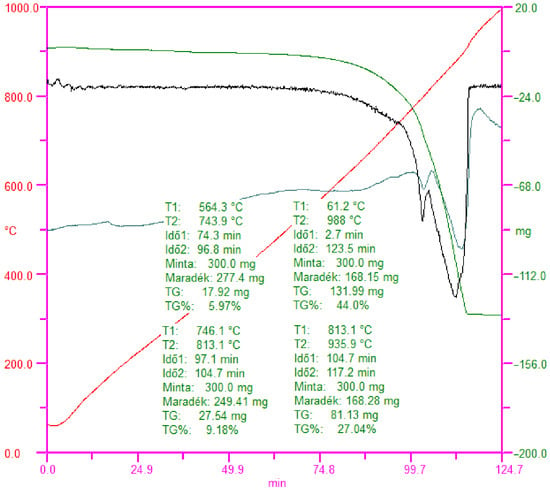
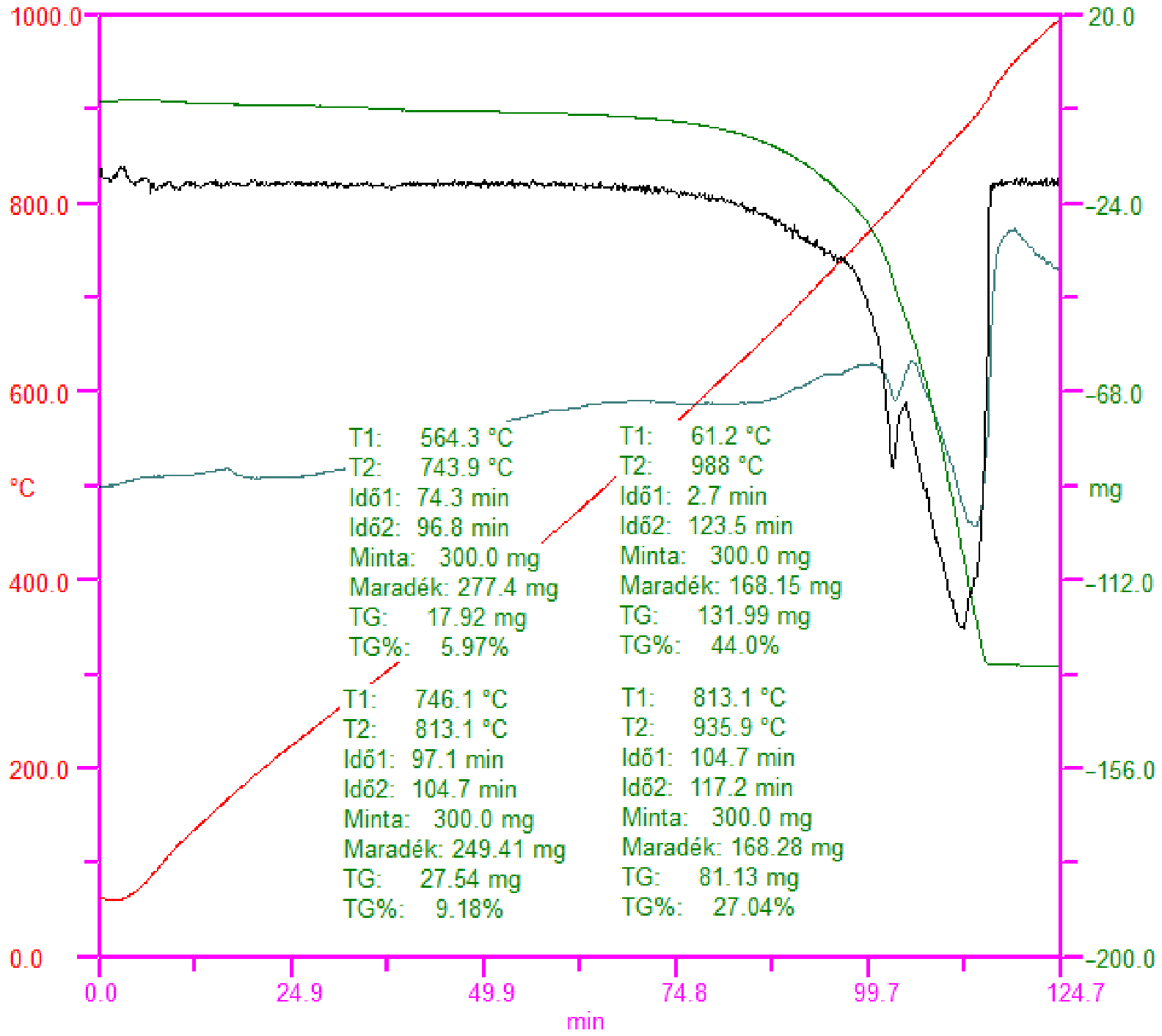
The investigation was designed in two complementary stages. First, yellowish-brown aggregate particles were carefully separated from damaged concrete fragments, and the central part of the particles was ground for simultaneous thermal analysis (TG/DTG/DTA). This step aimed to determine whether the particles were pure limestone or a dolomite-bearing carbonate rock and to estimate the main carbonate proportions from the mass losses associated with thermal decomposition (Figure 1) [1].
Figure 1.
Representative TG/DTG/DTA record as a function of temperature of the yellowish-brown aggregate particle (software: Winder v6.0). The two main high-temperature thermal decomposition events were used to distinguish the Mg-bearing and Ca-bearing carbonate components (test made and evaluated by the author). Legend: red curve is for T (temperature); green curve is for TG (thermogravimetric data); bluish-gray curve is for DTA; black curve is for DTG (first derivative of thermogravimetric data). The figure also presents thermogravimetric calculations (in green), expressed as mass percentage. (Note that decimal signs are used instead of commas in the calculations in the figure).
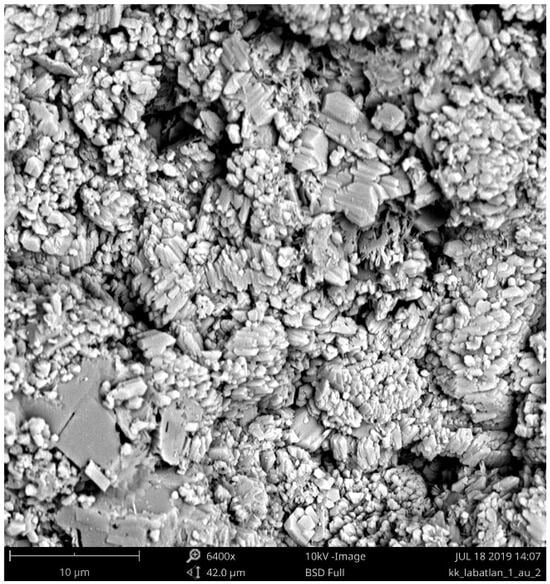
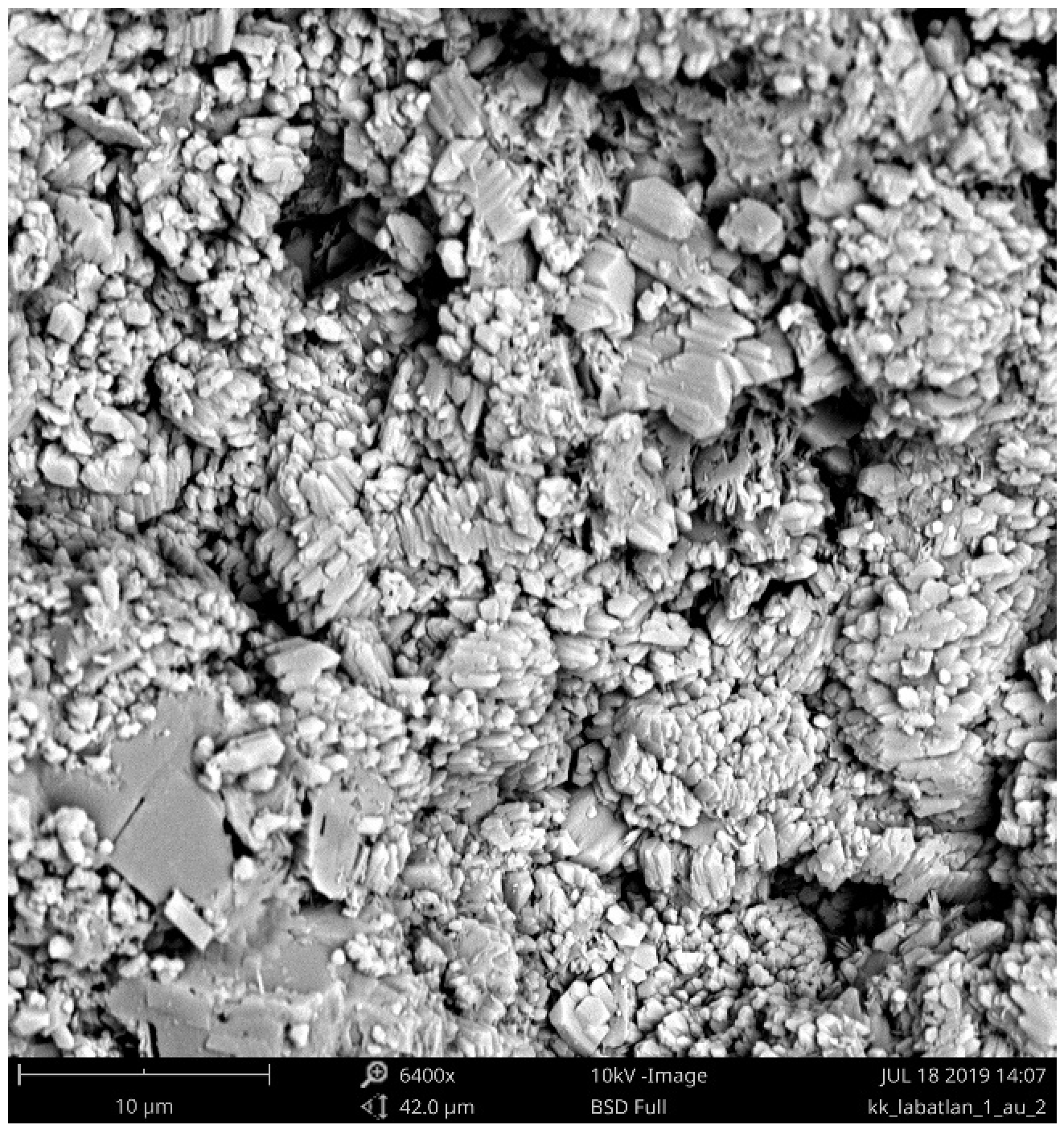
Second, intact pop-out fragments were examined by scanning electron microscopy coupled with energy-dispersive X-ray spectroscopy (SEM/EDS). The fragments were introduced into the microscope without cutting so that preparation-induced microcracking would be minimized. Optical navigation was used to select carbonate aggregate–paste interfacial zones, after which backscattered-electron imaging and local elemental analyses were used to search for compositional changes, recrystallization, and cracks consistent with dedolomitization and internal stress development (Figure 2).
Figure 2.
Representative SEM image from the damaged carbonate aggregate region. The microstructural examination focused on the aggregate and aggregate–paste interfacial zone, where reaction-related textural changes and microcracking were observed. The dedolomitization process can be observed: larger crystals are dolomite, and small crystals are the newly formed calcite crystals (SEM picture taken by the author).
3.3. Results and Discussion
The thermal analysis showed two pronounced endothermic decomposition events, with peak temperatures near 797 °C and 876 °C. The lower-temperature event was attributed primarily to decomposition of the MgCO3 component of dolomite, whereas the higher-temperature event corresponded to CaCO3 decomposition. Before the main dolomite decomposition, a smaller mass loss was also observed and was interpreted as being compatible with minor clay-mineral dehydroxylation and other subordinate phases [1].
Mass-loss calculations gave approximately 38.56 mass% dolomite and 40.54 mass% calcite, i.e., about 79.10 mass% carbonate minerals in total, with the remaining fraction assigned to other minerals. The aggregate at the spalling locations was therefore not a pure limestone but a dolomitic limestone. The remaining approximately 20 mass% assigned to other minerals, including clay- and iron-containing phases [1].
SEM/EDS examination provided the second, independent line of evidence. The dolomitic structure was locally no longer preserved, while newly formed small, newly precipitated calcite crystals and microcracks were observed in the reaction zone. This combination is consistent with dedolomitization, a characteristic transformation associated with the traditional description of an alkali–carbonate reaction (ACR). The microcracks provide a plausible link between the microscale mineralogical transformation and the macroscopic shell-like breakout pattern [1,4,5,6,7,8].
The mechanistic interpretation requires qualification. The literature has long debated whether deleterious expansion in carbonate rocks should be attributed directly to dedolomitization or, in some cases, to associated silica-bearing or clay-bearing constituents and reactions that overlap with alkali–silica reaction mechanisms. Dedolomitization is therefore best treated here as a diagnostic marker of a reactive carbonate system rather than as a stand-alone proof of the complete expansion mechanism. Moreover, frost susceptibility could not be excluded because no representative unbound aggregate fraction was available for direct testing. Increased porosity following mineralogical transformation could also increase sensitivity to freezing (Table 2) [4,5,6,7,8].
Table 2.
Summary of diagnostic evidence supporting the proposed deterioration mechanism.
3.4. Case-Study 1—Summary
The diagnostic sequence successfully narrowed the first case from a visually unusual breakout to a mineralogically defined reactive aggregate. Thermal analysis established that the implicated particles were dolomitic limestone, while SEM/EDS showed dedolomitization-related alteration and microcracking at the relevant microstructural locations. The available evidence therefore supports an alkali-reactive carbonate mechanism as a major contributor to the observed local deterioration, while the role of frost action remains unresolved because the necessary direct aggregate test was not available [1,4,5,6,7,8].
4. Chemical Degradation of Reinforced-Concrete Silo After Structural Collapse (Case Study 2)
4.1. Event Description and Diagnostic Questions
The second case involved a 2000 m3 reinforced-concrete silo used for corn gluten feed (CGF) at an industrial site. The approximately 37 m high, 9 m diameter cylindrical structure had been constructed about five years before the investigated collapse. The post-collapse materials investigation was commissioned to characterize the concrete and to determine whether signs of material degradation were present that could have reduced structural reliability [2].
This case differed fundamentally from the railway-sleeper investigation. The forensic question was not whether one visually distinctive constituent was reactive, but whether the concrete exposed to the stored organic material had undergone chemical changes severe enough to affect the cement matrix. Because much of the structure had already collapsed and partial demolition had occurred before the investigation, the sampling geometry was necessarily incomplete. The material evidence could therefore identify deterioration pathways and affected zones, but it could not, by itself, establish a unique structural collapse mechanism.
4.2. Sampling Logic and Analytical Methodology
The sampling strategy deliberately included material from different heights and wall positions, as well as both apparently intact and visibly degraded material. Core samples were taken for strength testing where intact, reinforcement-free cores could be obtained; irregular samples were used for analytical characterization. Particular attention was paid to zones near construction joints, the internal silo surface, and the side associated with the direction of collapse (Figure 3) [2].
Figure 3.
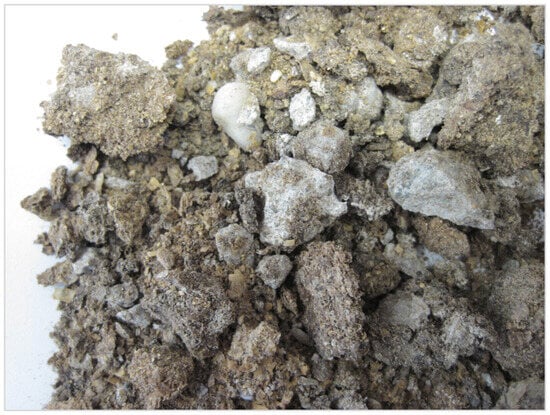
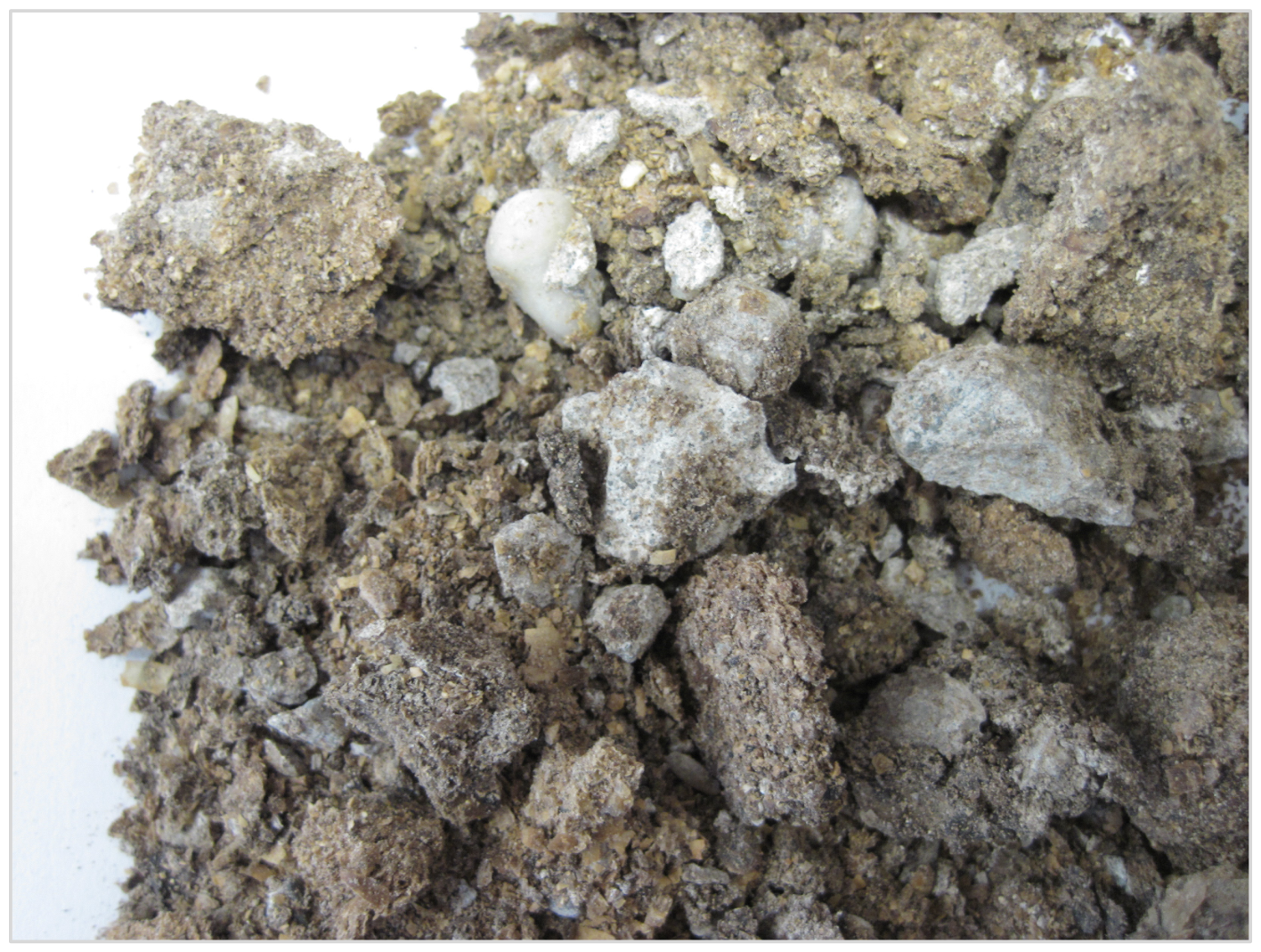
Highly disintegrated material sample (M9) containing exposed coarse aggregate particles and intermingled dry corn gluten feed. The macroscopic condition indicated the loss of cohesion and lack of cementitious matrix (photograph by the author).
The analytical program combined five types of evidence: (i) visual and macroscopic examination; (ii) phenolphthalein mapping of carbonation depth on freshly split surfaces; (iii) X-ray diffraction (XRD) to identify crystalline cementitious and secondary phases; (iv) simultaneous thermal analysis to compare portlandite, carbonate and organic contents; and (v) wet-chemical measurements of pH, chloride and sulfate. A non-carbonated sample (A1) was used as an internal reference for the phase-analytical comparison. This reference-sample concept was essential because the post-collapse samples differed strongly in exposure history and degree of degradation (Figure 4) [2].
Figure 4.
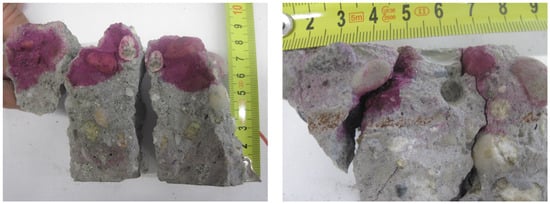
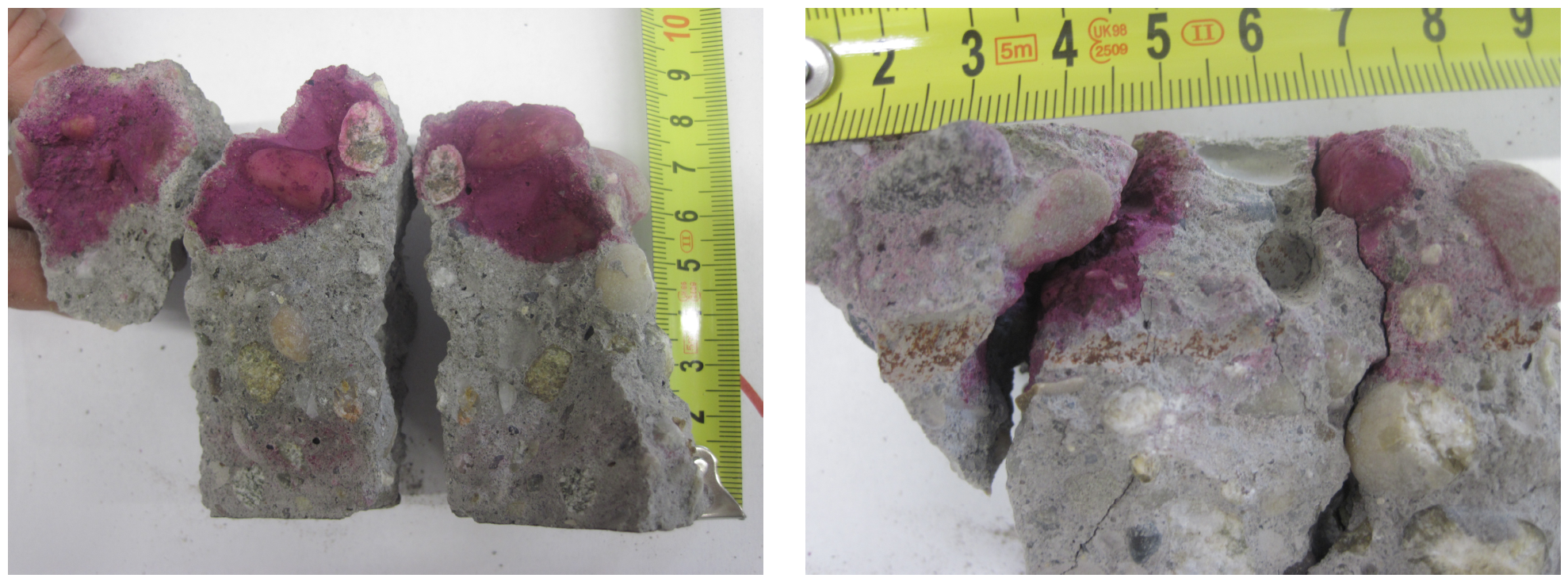
Phenolphthalein test of sample M2. Based on the phenolphthalein test performed on sample M2—collected from test location M2—the carbonation front has penetrated deeply from the inner surface of the silo; this indicates that the alkalinity is partially depleted and was not spatially uniform along the bored sample (photographs by the author).
4.3. Results
The carbonation survey showed strong spatial variability. Some material showed only a very thin carbonated zone, whereas other samples displayed approximately 15–20 mm or 20 mm of carbonation. Near a construction-joint detail, a depth of about 55 mm was measured, and in another upper-wall sample, carbonation approached 30–35 mm from the construction-joint side and about 20 mm from the internal silo surface. In several locations, the carbonation front reached the position indicated by reinforcement impressions, demonstrating local loss of the highly alkaline environment normally associated with steel passivation [2].
The most severely altered samples, M9 and M10, were much more fragmented than the other concrete pieces and contained substantial quantities of organic material. In the debris fraction, coarse aggregate particles could be found essentially free of cementitious binder, with felted feed material occupying spaces where the matrix would normally provide cohesion. This macroscopic feature suggested that the cement paste had undergone substantial chemical weakening rather than simple mechanical fracture alone [2].
XRD comparison reinforced this interpretation. Portlandite was present with high relative intensity in the non-carbonated reference sample, only weakly in the carbonated M2 sample, and was absent from the M9 sample and from the M8 surface crust. Calcite, as expected from carbonation and/or carbonate aggregate, was prominent in the altered samples. The M8 crust contained a particularly strong ettringite signal, substantially higher than in the internal reference sample, indicating that local sulfate supply or redistribution had occurred. An additional crystalline phase in the crust could not be identified using the available inorganic diffraction database and was considered potentially organic in origin [2].
Thermal analysis was consistent with the diffraction results. Quantifiable portlandite was obtained only for the reference A1 material (approximately 2.63 mass%), whereas M9 showed no detectable portlandite. Calculated calcite contents were of the same order in the three analyzed cement-paste samples (approximately 8.65–9.3 mass%), and the M9 sample contained about 3.9 mass% organic matter. The total mass losses measured by derivatography were 12.67 mass% for M2, 16.45 mass% for M9, and 13.66 mass% for A1 [2].
4.4. Discussion
The wet-chemical data define a chemically coherent progression. The internal reference material remained strongly alkaline (pH 11.5), while the altered concrete samples showed progressively lower pH values. The dry feed material recovered from M9 had a pH of approximately 5.0 in distilled-water extract. Thus, an acidic organic material was in direct contact with cement paste whose principal hydrate assemblage is stable only under alkaline conditions. Acid–base interaction provides a plausible explanation for decalcification and loss of stability of cement hydrates, particularly when moisture allows transport between the feed and the concrete [2].
The chloride concentration measured in M9 was 0.05 mass% of concrete. Using the assumptions adopted in the original investigation—300 kg/m3 cement content and 2300 kg/m3 hardened concrete density—this corresponds to approximately 0.38 mass% chloride relative to cement. This estimate exceeds the 0.2 mass% limit for reinforced concrete cited in the then-applicable Hungarian concrete standard. The calculation depends on assumed rather than documented cement content, and corrosion of the reinforcement was outside the scope of the materials investigation; therefore, the result indicates a corrosion risk rather than proving reinforcement corrosion as a collapse cause [2,9].
The sulfate results were less straightforward. Total sulfate contents in the concrete samples were of the same order as the reference material, although M9 gave the highest measured value. More diagnostically important was the very high ettringite intensity in the M8 surface crust and the fact that the stored feed itself contained sulfate. In a wet environment, the organic material could therefore act as an external sulfate source. The observed ettringite enrichment is consistent with a local sulfate-related process, but the available data do not establish the kinetics or spatial extent required to quantify its structural significance [2].
The evidence as a whole supports the presence of significant, spatially heterogeneous chemical deterioration: deep carbonation in selected zones, depletion of portlandite, acidic contact with stored organic material, local matrix disintegration, and secondary-phase changes. These findings are relevant to structural performance because they can reduce matrix cohesion and steel passivation. Nevertheless, the report material does not contain a completed structural causality assessment, and the available samples were taken after collapse and partial demolition. It would therefore be methodologically unsound to state that chemical degradation alone caused the collapse. The defensible conclusion is that the silo contained zones of materially degraded concrete that should be treated as a potentially contributing condition in any complete structural forensic analysis (Table 3) [2].
Table 3.
Selected pH, chloride, and sulfate results reported for the silo samples. Values are reproduced from the original material investigation; chloride and sulfate values are expressed relative to concrete mass unless otherwise noted.
4.5. Case-Study 2—Summary
The second case demonstrates the importance of spatially resolved sampling and internal reference material. No single observation—carbonation, chloride, sulfate, or organic contamination—was sufficient on its own. The diagnostic strength came from convergence: the lower pH, loss of portlandite, macroscopic loss of binder, organic contamination, and local secondary-phase enrichment all pointed toward chemical destabilization of the cement matrix. At the same time, the limitations of post-collapse sampling required a deliberately bounded conclusion regarding structural causality [2].
5. Comparative Discussion: What Made the Diagnostic Process Effective?
Although the two cases involved different structures and different deterioration mechanisms, the successful parts of the investigations followed the same pattern. First, the macroscopic symptom was used to define where the information content was highest. In the sleepers, the repeated association between breakouts and one aggregate type guided sampling directly to the suspected phase. In the silo, the strong spatial heterogeneity required sampling from several heights, wall positions, surfaces, and reference zones [1,2].
Second, the methods were selected to answer different levels of the same question rather than to duplicate one another. Thermal analysis quantified thermally active constituents; XRD identified crystalline phases; SEM/EDS linked phase transformation to local microstructure; phenolphthalein mapped the loss of alkalinity; and wet chemistry quantified environmental indicators. The resulting interpretations are stronger because they are based on orthogonal evidence [1,2].
Third, both cases show why negative or missing evidence must be reported. In the sleeper case, the absence of a suitable unbound aggregate sample prevented direct assessment of frost susceptibility. In the silo case, the post-collapse sampling geometry and the unfinished structural-strength interpretation prevented assignment of a unique collapse cause. These are not weaknesses to hide; they define the boundary between a robust materials diagnosis and an overextended forensic claim (Table 4) [1,2].
Table 4.
Comparative diagnostic framework and key lessons derived from the two case studies.
6. Overall Conclusions and Diagnostic Implications
The two case studies presented in this paper involved markedly different manifestations of concrete deterioration, yet they illustrate the same fundamental diagnostic challenge: visible damage rarely identifies its underlying cause unambiguously. Reliable forensic assessment therefore requires a systematic progression from damage morphology and initial observations to competing hypotheses, targeted sampling, and complementary analytical testing.
The investigations demonstrate how this evidence-based approach can progressively narrow the range of plausible deterioration mechanisms while, equally importantly, defining the limits of the conclusions supported by the available evidence:
- A forensic materials investigation is most effective when structured as a chain linking observed damage to competing hypotheses, discriminating samples, complementary analytical methods, and a bounded causal interpretation.
- In the railway-sleeper case, the systematic association between shell-like breakouts and yellowish-brown aggregate particles provided the starting point for targeted material analysis. Thermal analysis identified the affected particles as dolomitic limestone, while SEM/EDS revealed alteration consistent with dedolomitization, accompanied by microcracking and increased local porosity. The convergence of macroscopic and microstructural evidence supports an alkali-reactive carbonate mechanism as an explanation for the localized deterioration.
- This interpretation does not, however, exclude a possible contribution from frost action. Direct frost-susceptibility testing of representative unbound aggregate was not possible, and the available evidence therefore does not justify eliminating this mechanism entirely.
- In the silo case, the spatial distribution of deterioration was critical to the diagnosis. Locally deep carbonation from the inner surface, loss of portlandite, contact with acidic organic material, matrix disintegration, and altered sulfate- and chloride-related indicators collectively demonstrate substantial chemical deterioration in parts of the concrete exposed to the stored material.
- These material-level findings identify processes capable of reducing concrete matrix cohesion and reinforcement protection, but they do not establish chemical deterioration as the sole cause of the structural collapse. Such a conclusion would require integration of the material evidence with structural analysis, loading history, reinforcement condition, geometry, and relevant construction details.
Across both cases, the principal transferable conclusion is methodological. Diagnostic confidence increases when observations made at different scales and by independent analytical techniques converge on the same mechanism. At the same time, the reliability of a forensic interpretation depends on explicitly distinguishing between mechanisms supported by the evidence, those that can reasonably be excluded based on the available evidence, and those that remain unresolved because the necessary samples or tests are unavailable.
Taken together, the two investigations support a transferable evidence-based diagnostic framework in which damage morphology, hypothesis-driven sampling, and complementary analytical methods are progressively integrated to discriminate between competing deterioration mechanisms. This approach is particularly relevant to complex concrete deterioration cases in which different degradation processes may act simultaneously or produce similar macroscopic symptoms.
Funding
This research received no external funding.
Institutional Review Board Statement
Not applicable.
Informed Consent Statement
Not applicable.
Data Availability Statement
The original contributions presented in this study are included in the article. Further inquiries can be directed to the corresponding author.
Conflicts of Interest
The author declares no conflicts of interest.
References
- Balázs, G.L. (Department of Construction Materials and Engineering Geology, Budapest University of Technology and Economics, Budapest, Hungary); Kopecskó, K. (Department of Construction Materials and Engineering Geology, Budapest University of Technology and Economics, Budapest, Hungary); Stocker, G. (Department of Construction Materials and Engineering Geology, Budapest University of Technology and Economics, Budapest, Hungary). Diagnostic Expert Report on Deterioration of a Precast Pre-Stressed Reinforced-Concrete element, Budapest University of Technology and Economics. Unpublished technical report. 2019. [Google Scholar]
- Madaras, B. (ÉMI-TÜV SÜD Ltd., Szentendre, Hungary); Balázs, G.L. (Department of Construction Materials and Engineering Geology, Budapest University of Technology and Economics, Budapest, Hungary); Arany, P. (Department of Construction Materials and Engineering Geology, Budapest University of Technology and Economics, Budapest, Hungary); Kopecskó, K. (Department of Construction Materials and Engineering Geology, Budapest University of Technology and Economics, Budapest, Hungary). Expert report on material investigations of a 2000 m3 reinforced-concrete silo, Budapest University of Technology and Economics. Unpublished technical report. 2013. [Google Scholar]
- Klieger, P.; Lamond, J.F. (Eds.) Significance of Tests and Properties of Concrete and Concrete-Making Materials; ASTM: West Conshohocken, PA, USA, 1994. [Google Scholar]
- Gillott, J.E.; Swenson, E.G. Mechanism of the alkali-carbonate rock reaction. J. Eng. Geol. 1970, 2, 7–23. [Google Scholar] [CrossRef] [Scilit]
- Grattan-Bellew, P.E.; Mitchell, L.D.; Margeson, J.; Deng, M. Is alkali-carbonate reaction just a variant of alkali-silica reaction, ACR = ASR? Cem. Concr. Res. 2010, 40, 556–562. [Google Scholar] [CrossRef] [Scilit]
- Katayama, T. How to identify carbonate rock reactions in concrete. Mater. Charact. 2004, 53, 85–104. [Google Scholar] [CrossRef] [Scilit]
- Katayama, T. The so-called alkali-carbonate reaction: Mineralogical and geochemical details, with special reference to ASR. Cem. Concr. Res. 2010, 40, 643–675. [Google Scholar] [CrossRef] [Scilit]
- Katayama, T.; Jensen, V.; Rogers, C. The enigma of the ‘so-called’ alkali-carbonate reaction. Proc. Inst. Civ. Eng. Constr. Mater. 2016, 169, 223–232. [Google Scholar] [CrossRef] [Scilit]
- MSZ 4798-1:2004; Concrete—Technical Requirements, Performance, Production and Conformity, and National Application Conditions for MSZ EN 206-1. [Hungarian Standard Cited in the Original Silo Investigation]. Hungarian Standards Institution: Budapest, Hungary, 2004.

Disclaimer/Publisher’s Note: The statements, opinions and data contained in all publications are solely those of the individual author(s) and contributor(s) and not of MDPI and/or the editor(s). MDPI and/or the editor(s) disclaim responsibility for any injury to people or property resulting from any ideas, methods, instructions or products referred to in the content. |
© 2026 by the author. Licensee MDPI, Basel, Switzerland. This article is an open access article distributed under the terms and conditions of the Creative Commons Attribution (CC BY) license.