


Abstract
In this study, the effect of feedback parameters on the effective multiplication factor in the Molten Salt Fast Reactor (MSFR) concept and their cumulative contribution to the uncertainty in calculating the k-eff value were investigated. These sensitivity and uncertainty analyses, performed using the SCALE-TSUNAMI module, were conducted for seven fuel types. The results of these analyses revealed that the (n, fission) reaction dominates in positive sensitivity, while the (n, γ) reaction dominates in negative sensitivity. In addition to this study, it was determined that enriched chlorine salt is a good alternative because it reduces the k-eff uncertainty, while the 252-group nuclear data library is the most reliable cross-section library.
1. Introduction
Analyzing the operational and safety limits of a nuclear reactor is critical to the system’s sustainability. Next-generation nuclear reactors aim to overcome the limitations faced by traditional nuclear reactor technologies in terms of safety and sustainability. In new-generation reactor designs, the clear definition of safety limits is only possible by calculating the cumulative effects of uncertainties in nuclear data on the system output (k-eff) using sensitivity and uncertainty analyses based on forward-backward solutions of the Boltzmann transport equation. In this study, the neutronic reliability of MSFR was examined using seven different fuel compositions available in the literature. To evaluate the effect of alternative carrier salts, Li(Lithium)-Cl(Chlorine) substitutions were modeled in two specific fuels, and the results were presented in the literature.
2. Materials and Methods
2.1. System Description and Fuel Compositions
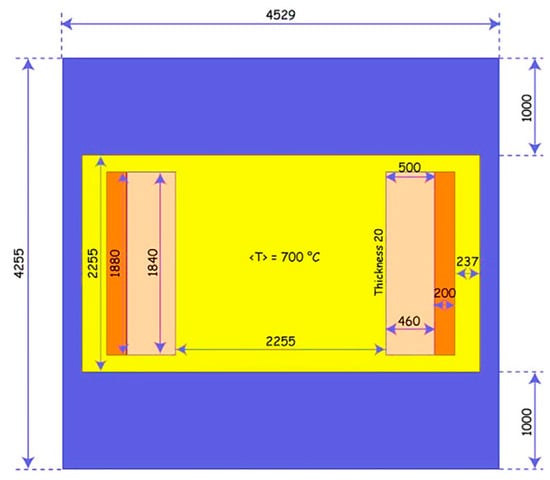
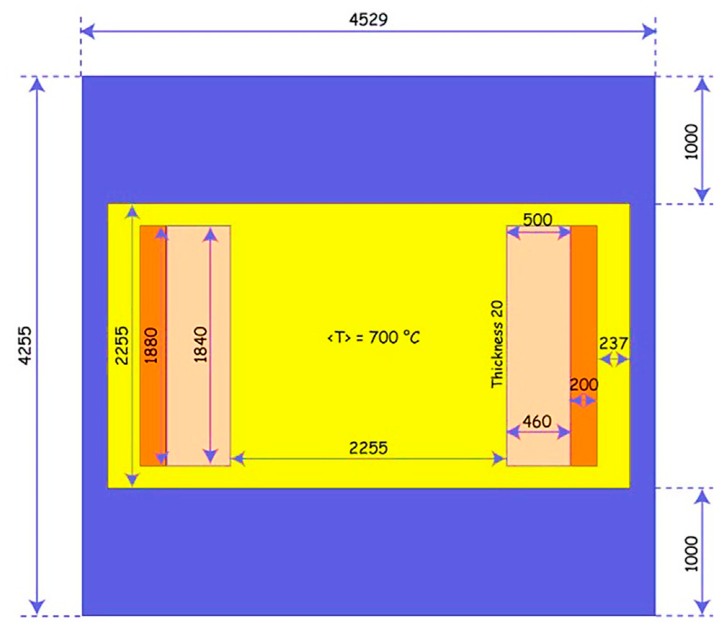
The reactor model used in this study is based on the innovative MSFR reference design developed under the European Union’s EVOL Project. This system features a configuration in which a mixture of liquid fuel and carrier salt circulates homogeneously within the core. The regions and dimensional data (in mm) of this reactor design are shown in Figure 1 [1].
Figure 1.
Fuel salt (yellow), fertile salt (pink), B4C shielding (orange), and the nickel-based alloy reflector zone (blue) [1].
Seven fuel compositions were modeled in Table 1 to test the reactor’s flexibility in fuel utilization and the safety limits in scenarios where these fuels are used.
Table 1.
The isotropic and chemical compositions of fuel salts [1,2,3,4,5,6].
The criticality status of all the fuels analyzed is presented in Table 2.
Table 2.
Fuel types and criticality conditions obtained from the simulation.
In addition, fuels with subcritical and supercritical k-eff values were selected from these fuel compositions, and simulations were conducted to evaluate their performance as alternative carrier salts by replacing the Li-Cl salt in the carrier salt.
2.2. SCALE Code System and TSUNAMI-3D Module
In numerical simulations of neutron transport, the most important system results are the k-eff and reactivity values. Since the accuracy of these values depends directly on the cross sections in nuclear data libraries, the calculations must be performed with great precision. To this end, solutions to the forward and inverse neutron transport equations for a three-dimensional complex MSFR geometry were performed using the Monte Carlo-based KENO V.a module within SCALE6.2.3. The SCALE Code System is a widely-used simulation suite for nuclear safety analysis and design that is developed by Oak Ridge National Laboratory (ORNL), Oak Ridge, TN, USA. To derive the system’s sensitivity to nuclear data and uncertainty values on a specific nuclide-nuclear reaction basis, SCALE’s TSUNAMI-3D [7] analysis module was used as a tool. In the simulation model, the core geometry and detailed isotropic fuel compositions were first defined. Subsequently, energy-dependent cross-section libraries and SAMS inputs were incorporated into the relevant simulation blocks, and sensitivity coefficients for individual nuclear reactions and the associated cumulative uncertainty measurements were derived.
2.3. Sensitivity Analysis
Sensitivity analysis is a quantitative measure of the predicted response in the system output (k-eff) resulting from small changes in the input parameter (nuclear data or cross-section). The fundamental approach used in these analyses is the Adjoint-Based Perturbation Theory, which also forms the basis of the TSUNAMI module [7].
This approach is based on the integration of the forward and adjoint solutions of the steady-state Boltzmann neutron transport equation. These equations, which define the physical system and the “neutron importance” of the system response, are as follows [2].
and represent the operators for non-fission reactions and the fission term, respectively; λ denotes the eigenvalue; denotes the forward neutron flux; and denotes the adjoint neutron flux. Within the framework of linear perturbation theory, the effect of small changes in the operators on the eigenvalue is integrated over the entire phase space (<…>) by neglecting terms of second order and utilizing the adjunction properties of the operators. As a result of this analytical process, the Sensitivity Coefficient Formulation, which gives the sensitivity of k-eff to the macroscopic cross section (∑) dependent on position and energy, is obtained as shown in Equation (3) [3].
2.4. Uncertainty Analysis
Uncertainty analysis involves evaluating the errors in the input parameters used to obtain a calculated result (k-eff). In the second stage, the uncertainty quantification, the cumulative effect of the error margins in nuclear data libraries on k-eff is determined. In this process, covariance libraries—which include uncertainties in nuclear data measurements and correlations between reactions—are used within the SCALE system. The mathematical combination of sensitivity coefficients and covariance matrices is based on the “Sandwich Rule” formulation in Equation (4), which forms the basis of linear error propagation [2].
In the equation, represents the total variance of the system, represents the row vector consisting of nuclide- and reaction-dependent sensitivity coefficients, represents the covariance matrix containing the error terms and cross-correlations obtained from the nuclear data library and ve represents the transpose of the sensitivity vector [2].
2.5. Nuclear Data Libraries
For this study, the 238-group ENDF/B-VII.0 library—commonly used in standard analyses—and the 252-group ENDF/B-VII.1 library, which features a broader energy spectrum and improved covariance matrices, were selected. To eliminate approximation errors arising from energy grouping and achieve the highest computational accuracy, the continuous energy versions of the ENDF/B-VII.0 and ENDF/B-VII.1 libraries were also included in the simulations, and sensitivity coefficients and cumulative uncertainty measurements were systematically compared.
3. Results
This section presents the results of sensitivity and uncertainty analyses conducted for three different fuel compositions used in the EVOL design and for various fuel compositions used in the MSFR reactor type. The fuel types used in this study may differ in terms of enrichment level, molar percentage variation, salt composition, and actinide content.
3.1. Sensitivity Coefficient Analysis
Based on the results of the analysis, in Table 3 the top three dominant nuclear reactions and their positive sensitivity coefficients for all fuels are listed below.
Table 3.
Dominant nuclear reactions and positive sensitivity coefficients for all fuels.
Upon examining Table 4, it is evident that the nubar value and fission reactions have contributed the highest positive sensitivity to the system across all fuel types.
Table 4.
Dominant nuclear reactions and negative sensitivity coefficients for all fuels.
An examination of the negative sensitivity coefficients reveals that the (n, γ) reaction is dominant in all fuel compositions due to its effect resulting from neutron absorption.
3.2. Uncertainty Measurements
An examination of the percentage uncertainty values in Table 5 reveals that, for each fuel composition, the fission and (n, γ) reactions of fissile materials are predominant among the top three nuclide-reaction pairs contributing most to the total uncertainty.
Table 5.
Uncertainty measurement values for all fuels.
3.3. Carrier Salt Exchange and the Influence of Libraries
The k-eff values calculated for the modeled MSFR system based on isotopic enrichment scenarios for lithium and chlorine, along with the cumulative uncertainty percentages derived from nuclear data, are presented in a comparative table in Table 6.
Table 6.
Evaluation of k-eff and total uncertainties for different carrier salt enrichment scenarios.
In the calculated values, enriched Cl has reduced the uncertainty in both subcritical and supercritical fuel.
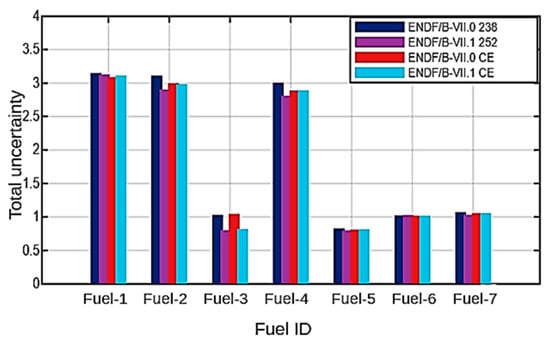
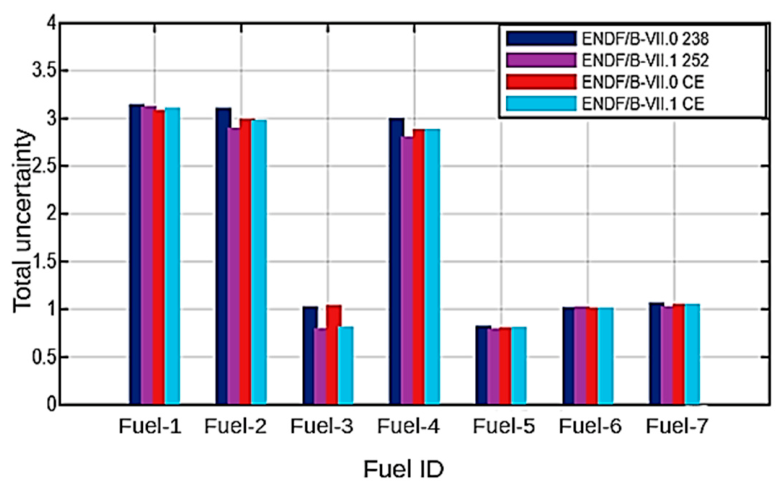
As shown in Figure 2, when fuel compositions are considered as a whole, the total uncertainty percentage on k-eff exhibits variations depending on the covariance structures and energy group sensitivities of the four different nuclear data libraries used.
Figure 2.
Total uncertainty comparison of nuclear data libraries.
4. Discussion and Conclusions
In this study, it was observed that as the proportion of fissile material in the fuel compositions increases, the system reaches its expected criticality level, and that cumulative uncertainties vary depending on the fuel type. In particular, it has been quantitatively demonstrated that the enrichment of 37Cl in the carrier salt significantly narrows the uncertainty margins across all fuel variations by reducing parasitic captures. Among the analyzed libraries, the 252-energy-group ENDF/B-VII.1 library provided results closest to continuous-energy solutions thanks to its up-to-date covariance data. Consequently, chlorine enrichment plays a critical role in enhancing data reliability and neutron economy for different fuel cycles in MSFR designs. The sensitivity coefficients obtained provide a clear reference for future safety analyses and optimized library selections.
Author Contributions
S.K.: Methodology, S.K.; Software, S.K.; Formal analysis, S.K.; Data curation, S.K.; Supervision, H.S.; Validation, H.S.; Writing, S.K. and H.S. All authors have read and agreed to the published version of the manuscript.
Funding
This research received no external funding.
Institutional Review Board Statement
Not applicable.
Informed Consent Statement
Not applicable.
Data Availability Statement
The data supporting the findings of this study are available from the corresponding author upon reasonable request.
Conflicts of Interest
The authors declare no conflict of interest.
Abbreviations
| MSFR | Molten Salt Fast Reactor |
| EVOL | Evaluation and Viability of Liquid Fuel Fast Reactor Systems |
| ENDF | Evaluated Nuclear Data File |
| SCALE | Standardized Computer Analyses for Licensing Evaluation |
| SAMS | Sensitivity Analysis Module for SCALE |
| TSUNAMI | Tools for Sensitivity and Uncertainty Analysis Methodology Implementation |
References
- Brovchenko, M.; Kloosterman, J.; Luzzi, L.; Merle, E.; Heuer, D.; Laureau, A.; Feynberg, O.; Ignatiev, V.; Aufiero, M.; Cammi, A.; et al. Neutronic benchmark of the molten salt fast reactor in the frame of the EVOL and MARS collaborative projects. EPJ Nucl. Sci. Technol. 2019, 5, 2. [Google Scholar] [CrossRef] [Scilit]
- Nasr, M.A.; Zolfaghari, A.; Akbari, R.; Cammi, A.; Amirkhosravi, S. Neutronic and fuel cycle performance analysis of fluoride and chloride fuels in Molten Salt Fast Reactor (MSFR). Nucl. Eng. Des. 2023, 413, 112506. [Google Scholar] [CrossRef] [Scilit]
- Robertson, R.C. Conceptual Design Study of a Single-Fluid Molten-Salt Breeder Reactor; Oak Ridge National Laboratory: Oak Ridge, TN, USA, 1971. [Google Scholar] [CrossRef] [Scilit]
- Park, S.M.; Rykhlevskii, A.; Huff, K.D. Safety analysis of the molten salt fast reactor fuel composition using Moltres. In Proceedings of the GLOBAL International Fuel Cycle Conference, Seattle, WA, USA, 22–27 September 2019; American Nuclear Society: Westmont, IL, USA, 2020; pp. 940–948. [Google Scholar] [CrossRef] [Scilit]
- Dumaire, T.; Ocádiz-Flores, J.A.; Konings, R.J.M.; Smith, A.L. A promising fuel for fast neutron spectrum Molten Salt Reactor: NaCl-ThCl4-PuCl3. Calphad 2022, 79, 102496. [Google Scholar] [CrossRef] [Scilit]
- EVOL Consortium. EVOL (Project No. 249696) Final Report; European Commission, 7th Framework Programme: Brussels, Belgium, 2014; Available online: https://cordis.europa.eu/project/id/249696/reporting (accessed on 25 August 2026).
- Rearden, B.T.; Williams, M.L.; Jessee, M.A.; Mueller, D.E.; Wiarda, D.A. Sensitivity and uncertainty analysis capabilities and data in SCALE. Nucl. Technol. 2011, 174, 236–288. [Google Scholar] [CrossRef] [Scilit]

Disclaimer/Publisher’s Note: The statements, opinions and data contained in all publications are solely those of the individual author(s) and contributor(s) and not of MDPI and/or the editor(s). MDPI and/or the editor(s) disclaim responsibility for any injury to people or property resulting from any ideas, methods, instructions or products referred to in the content. |
© 2026 by the authors. Licensee MDPI, Basel, Switzerland. This article is an open access article distributed under the terms and conditions of the Creative Commons Attribution (CC BY) license.