


Abstract
The Subcritical Nuclear Facility “Neutron Source based on the subcritical assembly driven by the linear electron accelerator” is a state-of-the-art nuclear facility designed and developed to study the properties of ADS systems, to generate neutrons for various applied and fundamental studies, and to train specialists in the field of nuclear physics and energy. The physical start-up of the facility was performed in 2020–2021. This paper describes the results obtained by using the area ratio method for measuring the reactivity of the facility during the physical start-up.
1. Introduction
The Subcritical Nuclear Facility “Neutron Source based on the subcritical assembly driven by the linear electron accelerator” (SNF “Neutron Source”) was designed and constructed over several years at the Kharkiv Institute of Physics and Technology (KIPT, Ukraine) in collaboration with the Argonne National Laboratory (ANL, USA) [1,2].
During 2020–2021, the physical start-up of the SNF “Neutron Source” was performed [3,4]. The pre-loaded dummies of the fuel assemblies were sequentially replaced by fresh nuclear fuel in the form of single-section fuel assemblies (FAs) of the VVR-M2 type. A tungsten neutron-generating target was used in the core during the physical start-up.
According to the IAEA [5,6,7,8], such facilities belong to accelerator-driven subcritical systems (ADS systems) for which the maximum effective neutron multiplication factor is limited to 0.98. However, within the framework of design development and the licensing of SNF “Neutron Source” a conservative operational safety limit of = 0.96 was set by the State Nuclear Regulatory Inspectorate of Ukraine for the core configuration with the tungsten target. This was done due to the possible exceedance of 0.98 in case of the target removal from the core [9].
Below is a brief description of the SNF “Neutron Source” and the main results obtained by using the area ratio method [10,11,12] for reactivity measurement and monitoring during the physical start-up. The appropriate numerical simulations are also presented and were performed with the MCNP 6.2 code [13] and the ENDF/B-VII.1 nuclear data library [14] to verify the accuracy of the area ratio method.
2. Facility Description
The basis of the SNF “Neutron Source” is a subcritical assembly using low-enriched uranium (19.7% of 235U) fuel driven by a linear electron accelerator. The neutron-generating target is used in the core to produce primary neutrons through photonuclear reactions using 100 MeV electrons.
The subcritical assembly (the core geometry and the fissile nuclear material mass) is designed to obtain the highest possible neutron flux intensity with keff equal to or less than 0.98 during normal operation, abnormal operation, and design accidents, which guarantees the safety of the facility.
The main parameters of the SNF “Neutron Source” for the physical start-up are listed in Table 1.
Table 1.
The main parameters of the SNF “Neutron Source” for the physical start-up.
3. Simulation Model
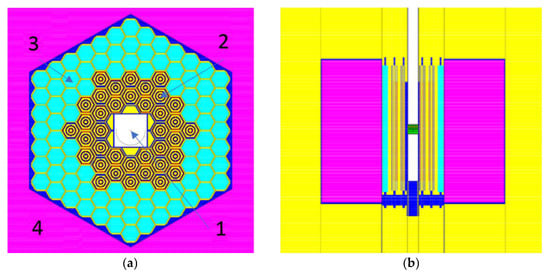
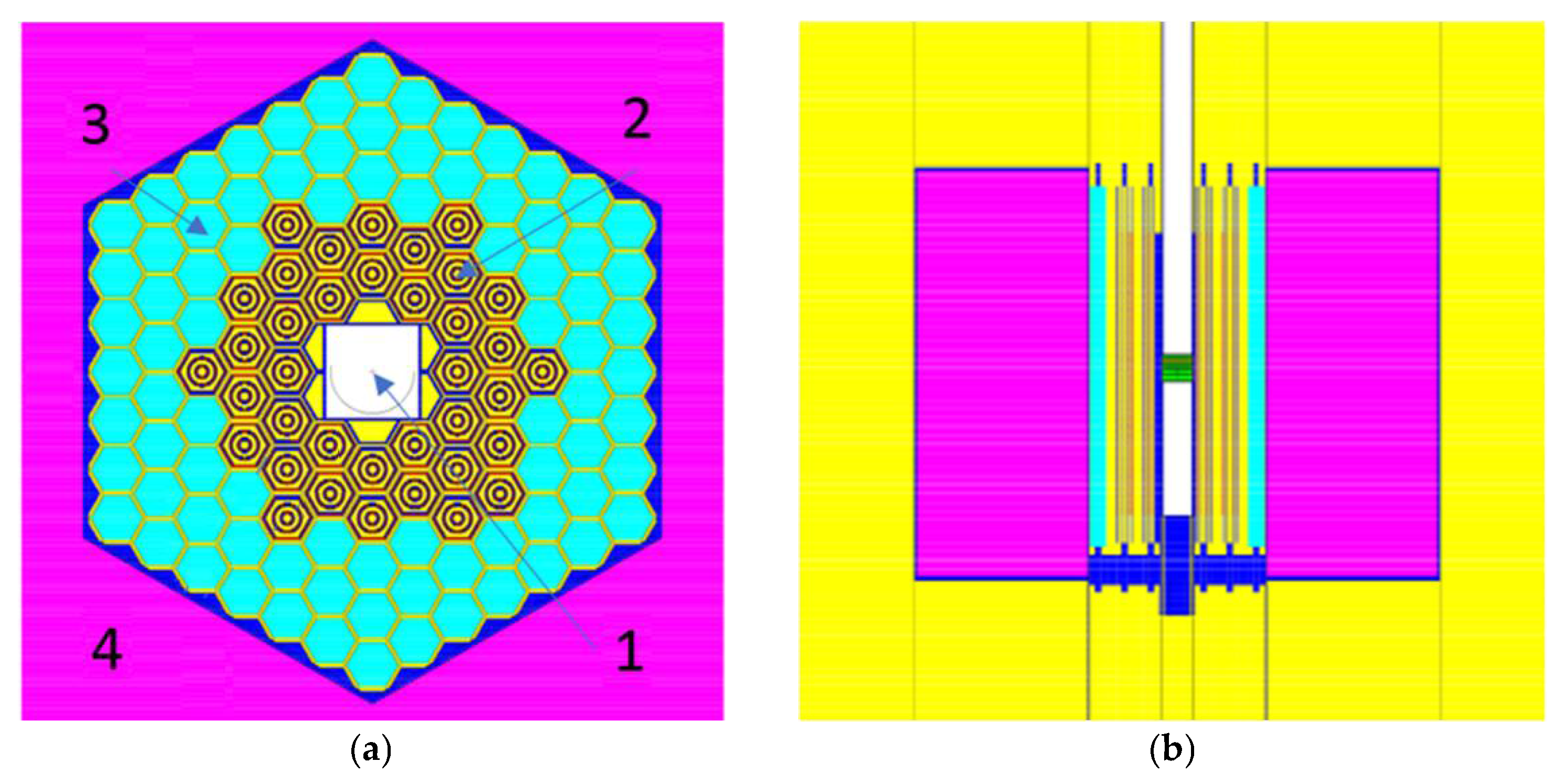
Figure 1 shows a general view of the core simulation model. The neutron-generating target (1) surrounded by fuel assemblies (2) is located in the center of the core. The design configuration of the core with 38 FAs is shown in the figure. The neutron reflector is formed by two types of elements: beryllium elements (3) and a graphite ring reflector (4). All core elements are installed in the tank surrounded by biological shielding.
Figure 1.
Layout of the core simulation model: (a) Horizontal cross section of the model; (b) Vertical cross section of the model.
All parameters of the simulation model used corresponded to the real equipment of the facility core. The accelerated electron beam parameters were as follows:
- −
- The maximum energy Ee = 100 MeV;
- −
- The electron number Ne = 1;
- −
- The pulse repetition rate frep = 20 Hz;
- −
- The time channel duration Δt = 5 μs.
4. Area Ratio Method
In the area ratio method [10,11,12], the time-dependent neutron flux in the core due to a pulsed external neutron source is detected, and the reactivity ρ can be expressed as the ratio of the areas corresponding to the neutron detector counts of prompt and delayed neutrons in the pulse response:
where βeff is the effective fraction of delayed neutrons, Ap is the “prompt area”, and Ad is the “delayed area”.
5. Results and Discussions
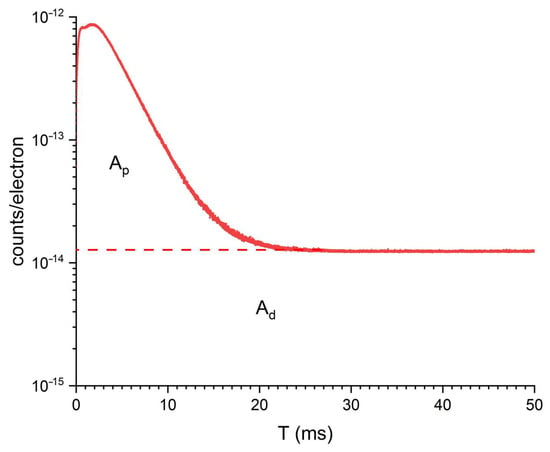
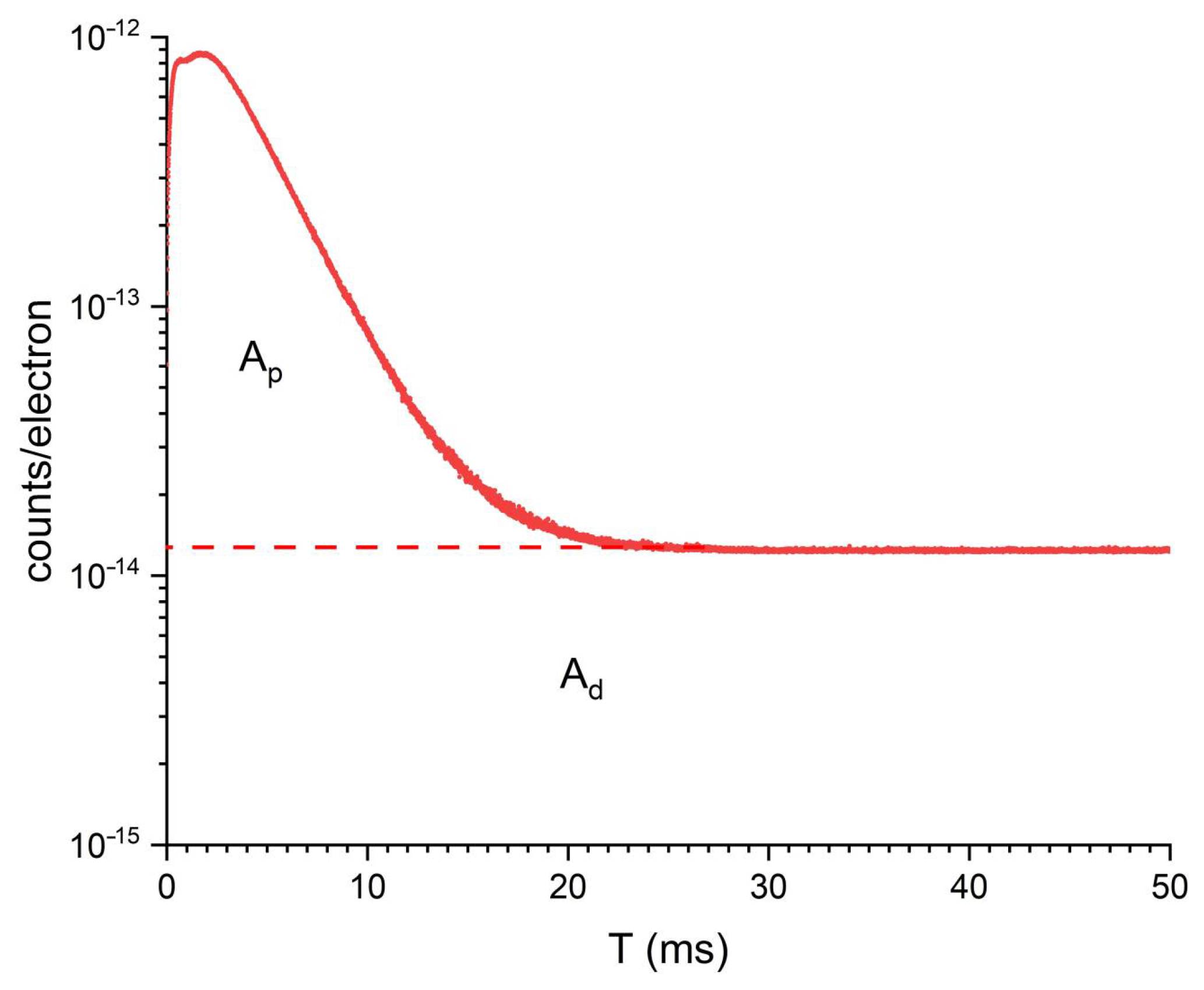
A typical simulated detector response to a pulse of primary neutrons from the external source in the subcritical assembly, indicating the areas corresponding to prompt neutrons Ap and delayed neutrons Ad is shown in Figure 2.
Figure 2.
Simulation of a typical neutron detector response for the core with the tungsten target and 37 fuel assemblies loaded.
Table 2 presents the results of simulations of the reactivity of the subcritical assembly core with the MCNP 6.2 code [13] and the ENDF/B-VII.1 nuclear data library [14] for both the k-code and source (area ratio) modes, compared with experimental values obtained using the area ratio method in the final stages of the facility’s physical start-up. Numerical simulations were performed for two values of the FA aluminum cladding thickness: 0.65 mm and 0.75 mm. The simulation results in both modes are in very close agreement. A strong dependence of the obtained results on the aluminum cladding thickness of FAs is observed. The experimental values obtained by using the area ratio method for reactivity measurement during the physical start-up fall between the simulated values for the two cladding thicknesses of 0.65 mm and 0.75 mm.
Table 2.
Comparison of reactivity values obtained with the area ratio method for different configurations of the core.
Table 2 also presents simulation estimates for the configuration with 38 fuel assemblies planned for loading into the core. The effective neutron multiplication factor keff values, corresponding to the reactivity ρ ones in Table 2, do not exceed 0.96 (Table 1), which guarantees the nuclear safety of the SNF “Neutron Source”.
6. Conclusions
In this paper, a brief description of the SNF “Neutron Source” and the main results obtained by using the area ratio method for reactivity measurement during the physical start-up were presented. The agreement between the simulation results obtained and the experimental data measured is remarkable.
Since the State Nuclear Regulatory Inspectorate of Ukraine has not yet approved the loading of the 38th FA, it was decided to complete the physical start-up after the 37th FA with the possibility of justifying a separate decision and carrying out the loading of the 38th FA during the pilot operation phase of the SNF “Neutron Source”.
Author Contributions
I.K.: conceptualization, project administration, supervision, writing—review and editing. A.Z.: investigation, project administration, writing—review and editing. I.U.: investigation, writing—original draft, writing—review and editing. V.B.: data curation, investigation. P.G.: investigation, software. A.M.: investigation, methodology. All authors have read and agreed to the published version of the manuscript.
Funding
This research was funded by the National Academy of Sciences of Ukraine and the Science and Technology Center in Ukraine, project P671.
Institutional Review Board Statement
Not applicable.
Informed Consent Statement
Not applicable.
Data Availability Statement
The raw data supporting the conclusions of this article will be made available by the authors on request.
Acknowledgments
The authors wish to thank Argonne National Laboratory, USA, for its efforts in supervising the facility construction and personally Y. Gohar (ANL, USA) and I. Bolshinsky (INL, USA) for the fruitful discussions during the facility design development, and also for support of commissioning works.
Conflicts of Interest
The authors declare no conflicts of interest.
Abbreviations
The following abbreviations are used in this manuscript:
| ADS | Accelerator-driven subcritical system |
| SNF | Subcritical nuclear facility |
| FA | Fuel assembly |
| MCNP | Monte Carlo N-Particle transport code |
| ENDF | Evaluated nuclear data file |
References
- Zelinsky, A.; Bezditko, O.; Demchenko, P.O.; Karnaukhov, I.; Oleinik, V.; Peev, F.; Ushakov, I.; Vodin, O.; Gohar, Y. NSC KIPT Neutron Source on the base of subcritical assembly driven with electron linear accelerator. In Proceedings of the 4th International Particle Accelerator Conference (IPAC 2013), JACoW, Shanghai, China, 12–17 May 2013; Volume THPFI080, pp. 3481–3483. [Google Scholar]
- Gohar, Y.; Briggs, L.L.; Cao, Y.; Fischer, R.; Kellogg, R.L.; Kraus, A.; Merzari, E.; Talamo, A.; Zhong, Z. Neutron Source Facility of the National Science Center “Kharkiv Institute of Physics and Technology” at Kharkiv, Ukraine; Technical Report ANL/NSE-22/29; Argonne National Laboratory: Lemont, IL, USA, 2022. [Google Scholar] [CrossRef] [Scilit]
- Bykhun, A.; Gladkikh, P.; Karnaukhov, I.; Lyashchenko, V.; Mytsykov, A.; Ridozub, V.; Selivanov, V.; Stomin, V.; Tertychnyj, A.; Ushakov, I. Reactivity measurement methods and the first results of the physical start-up for the nuclear subcritical facility “Neutron Source”. Ukr. J. Phys. 2023, 68, 147–161. [Google Scholar] [CrossRef] [Scilit]
- Karnaukhov, I.M.; Bezditko, O.P.; Borts, B.V.; Bykhun, O.V.; Bykov, V.T.; Gladkikh, P.I.; Glushchenko, L.I.; Gordienko, O.M.; Grevtsev, V.G.; Karnaukhov, I.I.; et al. Research of Neutron-Physical Characteristics of the Subcritical Nuclear Facility “Neutron Source” of NSC KIPT During the Physical Start-up. Dopov. Nac. Akad. Nauk Ukr. 2024, 2024, 44–59. [Google Scholar]
- IAEA. Review of National Accelerator Driven System Programmes for Partitioning and Transmutation; Technical Report IAEA-TECDOC-1365; IAEA: Vienna, Austria, 1999. [Google Scholar]
- IAEA. Status of Accelerator Driven Systems Research and Technology Development; Technical Report IAEA-TECDOC-1766; IAEA: Vienna, Austria, 2015. [Google Scholar]
- IAEA. Use of Low Enriched Uranium in Accelerator Driven Systems; Technical Report IAEA-TECDOC-1821; IAEA: Vienna, Austria, 2017. [Google Scholar]
- IAEA. Use of Low Enriched Uranium and Applications of Accelerator Driven Systems; Technical Report IAEA-TECDOC-2107; IAEA: Vienna, Austria, 2025. [Google Scholar]
- Kuhotsky, O.; Bilodid, Y.; Klevtsov, O.; Bogorad, V.; Vyshemirsky, M.; Ligotsky, O.; Gumenyuk, D. Licensing of the Subcritical Nuclear Facility "Neutron Source": From the Design to the Physical Start-up; SSTC NRS: Kyiv, Ukraine, 2023; ISBN 978-966-2544-89-3. [Google Scholar]
- Sjöstrand, N.G. Measurement on a subcritical reactor using a pulsed neutron source. Ark. För Fys. 1956, 11, 233–246. [Google Scholar]
- Gozani, T. A modified procedure for the evaluation of pulsed source experiments in sub-critical reactors. Nukleonik 1962, 4, 348–349. [Google Scholar]
- Cao, Y.; Gohar, Y.; Zhong, Z. Measuring and Monitoring KIPT Neutron Source Facility Reactivity; Technical Report ANL-15/15; Argonne National Laboratory: Lemont, IL, USA, 2015. [Google Scholar] [CrossRef] [Scilit]
- Werner, C.J. (Ed.) MCNP User’s Manual Code Version 6.2.; Technical Report LA-UR-17-29981; Los Alamos National Laboratory: Los Alamos, NM, USA, 2017. Available online: https://mcnp.lanl.gov/pdf_files/TechReport_2017_LANL_LA-UR-17-29981_WernerArmstrongEtAl.pdf (accessed on 23 October 2026).
- Chadwick, M.B.; Herman, M.; Obložinský, P.; Dunn, M.E.; Danon, Y.; Kahler, A.C.; Smith, D.L.; Pritychenko, B.; Arbanas, G.; Arcilla, R.; et al. ENDF/B-VII.1 Nuclear Data for Science and Technology: Cross Sections, Covariances, Fission Product Yields and Decay Data. Nucl. Data Sheets 2011, 112, 2887–2996. [Google Scholar] [CrossRef] [Scilit]

Disclaimer/Publisher’s Note: The statements, opinions and data contained in all publications are solely those of the individual author(s) and contributor(s) and not of MDPI and/or the editor(s). MDPI and/or the editor(s) disclaim responsibility for any injury to people or property resulting from any ideas, methods, instructions or products referred to in the content. |
© 2026 by the authors. Licensee MDPI, Basel, Switzerland. This article is an open access article distributed under the terms and conditions of the Creative Commons Attribution (CC BY) license.