


Abstract
Assessing how well-hydrated the outer layer of skin is has really become crucial. This paper proposes a compact, wearable device that monitors surface hydration in real-time by using the Galvanic Skin Response as the main electrical signal, with a flex sensor that supports the mechanical stretchability of the skin. An AD620 instrumentation amplifier boosts the raw GSR signal before it is digitized through the ESP32’s 12-bit ADC. Based on ADC values, which are calibrated experimentally across different skin conditions, the device classifies into three sections—dry, normal and highly hydrated. An alert system is incorporated in the system when dry skin is detected.
1. Introduction
Skin hydration is a basic factor when assessing the skin from a dermatological point of view, as it shows the amount of water that is held in the stratum corneum, which is the outermost layer of the epidermis. It is necessary for the skin to be well hydrated if the skin’s barrier function, elasticity, and general skin health are to be maintained, and long-term dehydration may serve as an early sign of environmental stress, aging, or certain dermatological disorders. Although traditional methods of assessing hydration—such as corneometry, measuring transepidermal water loss (TEWL), and using capacitance-based devices—produce reliable findings, they are mostly used only in clinical or laboratory settings because of their high cost, large size, and the fact that they require controlled conditions. As a result, these methods are not suitable for continuous, real-world, or at-home monitoring [1,2].
Electrical methods of sensing, especially those which rely on skin electrical conductance, have been widely investigated as practical alternatives for assessing hydration levels. The Galvanic Skin Response (GSR), also known as Electrodermal Activity (EDA), records changes in the electrical conductance of the skin; this conductance is affected by the ionic conductivity of sweat and the moisture found in the stratum corneum. Because greater skin moisture enhances ionic conduction and thus reduces electrical resistance, using GSR as a sensing method provides a simple and non-invasive way of estimating the level of hydration. Nevertheless, GSR is not only a response to hydration; it is also affected by other factors such as the activity of the sweat glands, the ambient temperature, the quality of contact between the electrodes, and individual differences in the skin. For these reasons, devices based on GSR sensing should be presented as empirically calibrated monitoring tools and not as instruments that can give absolute or clinically diagnostic hydration measurements [2,3,4,5].
The mechanical properties of the skin, for example its elasticity and response to surface deformation, have also been investigated as additional indicators of the condition of the skin. Since flex sensors change their resistance in proportion to bending or deformation, they offer a simple method of obtaining this mechanical information and can thus act as a second data channel together with the main electrical sensing [6,7].
Most of the current hydration-sensing systems—whether they are based on GSR, capacitive technology, or impedance—either focus on achieving high measurement accuracy in controlled conditions or on portability, at the expense of having established clinical calibration [8,9,10]. There are very few low-cost, wearable systems that combine real-time signal conditioning, on-board classification, and wireless monitoring in a single, compact platform appropriate for continuous or field use. This lack of such a system leads to the need for one that can acquire, amplify, and classify skin hydration levels in real time, while at the same time remaining both inexpensive and non-invasive [11,12,13,14,15,16,17,18].
The prototype for a wearable device designed to monitor skin hydration is based on the use of GSR as the main sensing parameter, with a flex sensor providing additional mechanical data. The GSR signal is amplified using an AD620 instrumentation amplifier and then converted into a digital signal by the 12-bit ADC on the ESP32 microcontroller. The system divides skin hydration into three categories, which have been defined by empirical means—dry/low hydration, normal hydration, and highly hydrated—and gives an audible warning when hydration levels are low together with real-time visual display via a Wi-Fi-enabled local web interface [19,20]. The subsequent sections deal with the sensing method, the circuit-level signal pathway, the experimental classification thresholds, and the results from the prototype.
2. Methodology
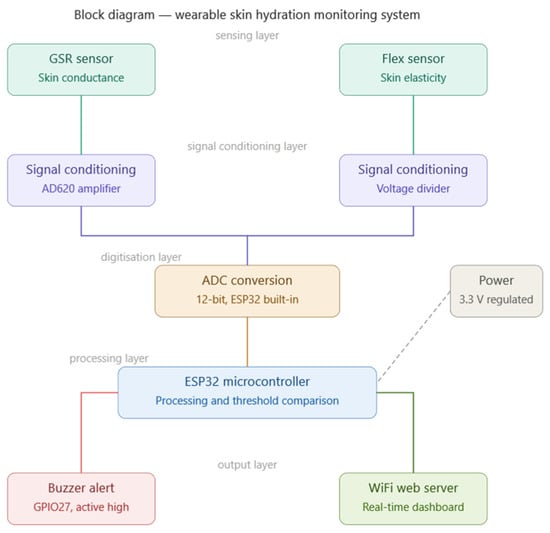
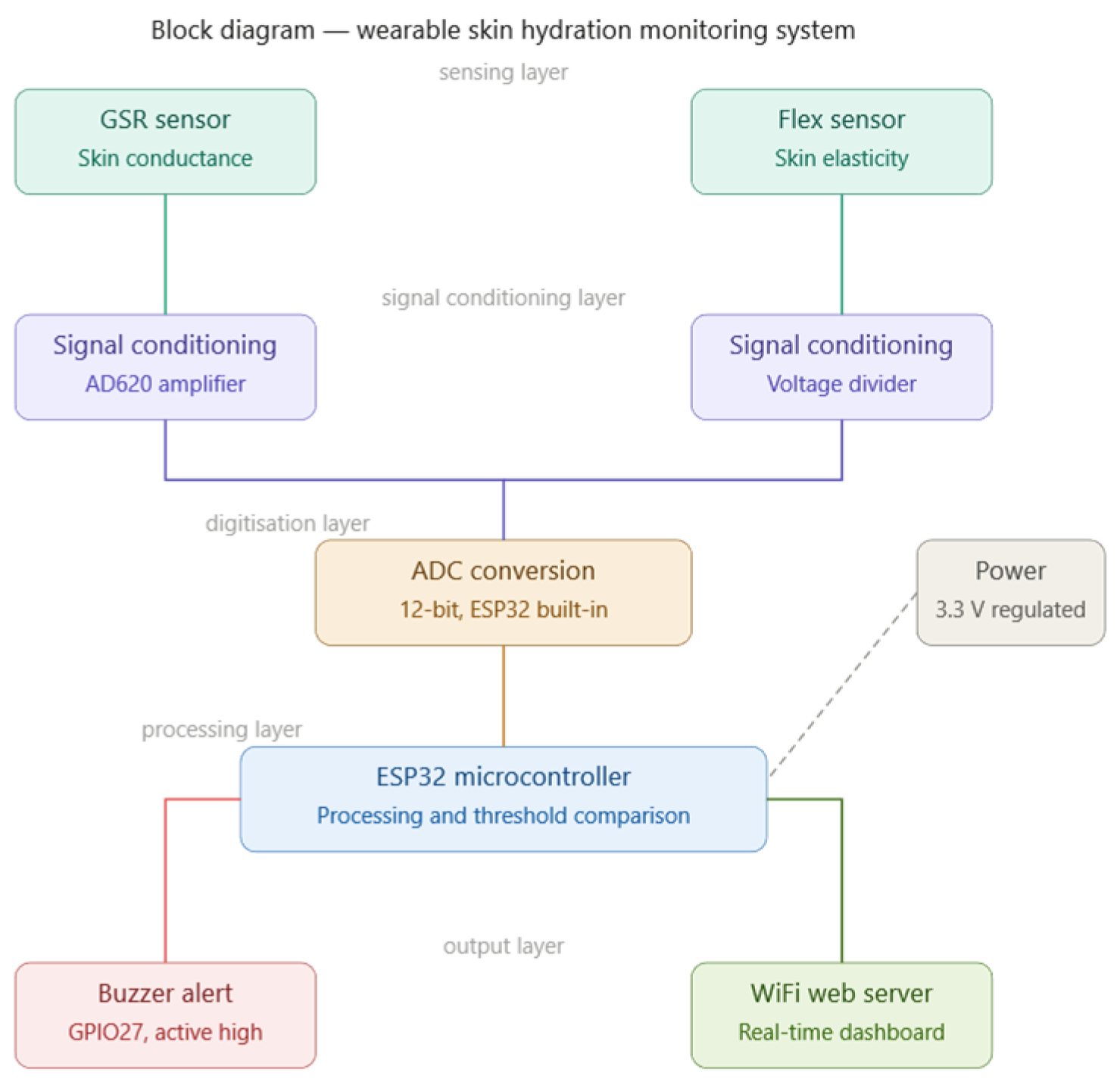
This system is supplied with two sensing channels. The GSR channel is the primary one, and it is electrical in nature, while the flex sensor acts as the secondary channel and is mechanical. Both signals undergo signal conditioning, with the GSR signal being handled specifically by an AD620 instrumentation amplifier before being sent to an ESP32 Dev Module for digitization and processing. The output is generated in two forms: by means of a buzzer for immediate alerts and through a web page that is accessed via Wi-Fi for people who want to monitor the values over time. Figure 1 illustrates how the various components are connected.
Figure 1.
Block diagram of the system.
2.1. GSR Sensing
Two electrodes placed on the skin apply a small excitation voltage and pick up the resulting electrical response. Because the stratum corneum holds water and dissolved ions, greater moisture allows ions to move more freely, which is captured by:
where G is conductance and R is skin resistance [1]. Wetter skin therefore reads as lower resistance and higher conductance; drier skin reads the opposite way. That relationship is the basis for using GSR as the system’s primary hydration indicator. Since GSR also responds to heat, perspiration, electrode pressure, and individual skin characteristics, the system is presented here as an empirically calibrated monitor rather than a device giving an absolute hydration figure.
G = 1/R
2.2. Flex Sensing
The flex sensor’s resistance shifts as it bends. It sits in a voltage-divider arrangement with a fixed resistor:
Vout = Vin × Rfixed/(Rflex + Rfixed)
Output voltage tracks how far the sensor is bent. In the current build, this reading is acquired independently of the GSR value and is not mathematically combined with it for classification—it is displayed as supplementary data only.
2.3. Signal Conditioning
Raw GSR signals are weak and contain noise [12]. An AD620 instrumentation amplifier removes the noise and boosts the raw weak signals into strong signals. Gain follows a standard formula:
G = 1 + 49.4 kΩ/RG
This design uses a gain resistor of 1 kΩ. The amplified output signal leaves through AD620 Pin 6 and enters one more filtering stage before reaching the ESP32.
2.4. Signal Acquisition and Digitization
Both the conditioned GSR signal and Flex signal are taken by GPIO35. Both signals go through an analog-digital converter (ADC) and give an output in the range from 0 to 4095 across a 0–3.3 V input.
Vinput ≈ ADC × 3.3/4095
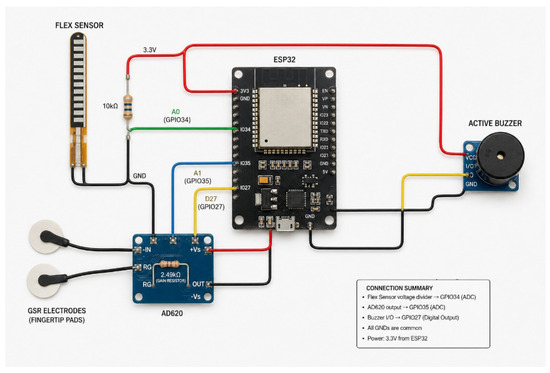
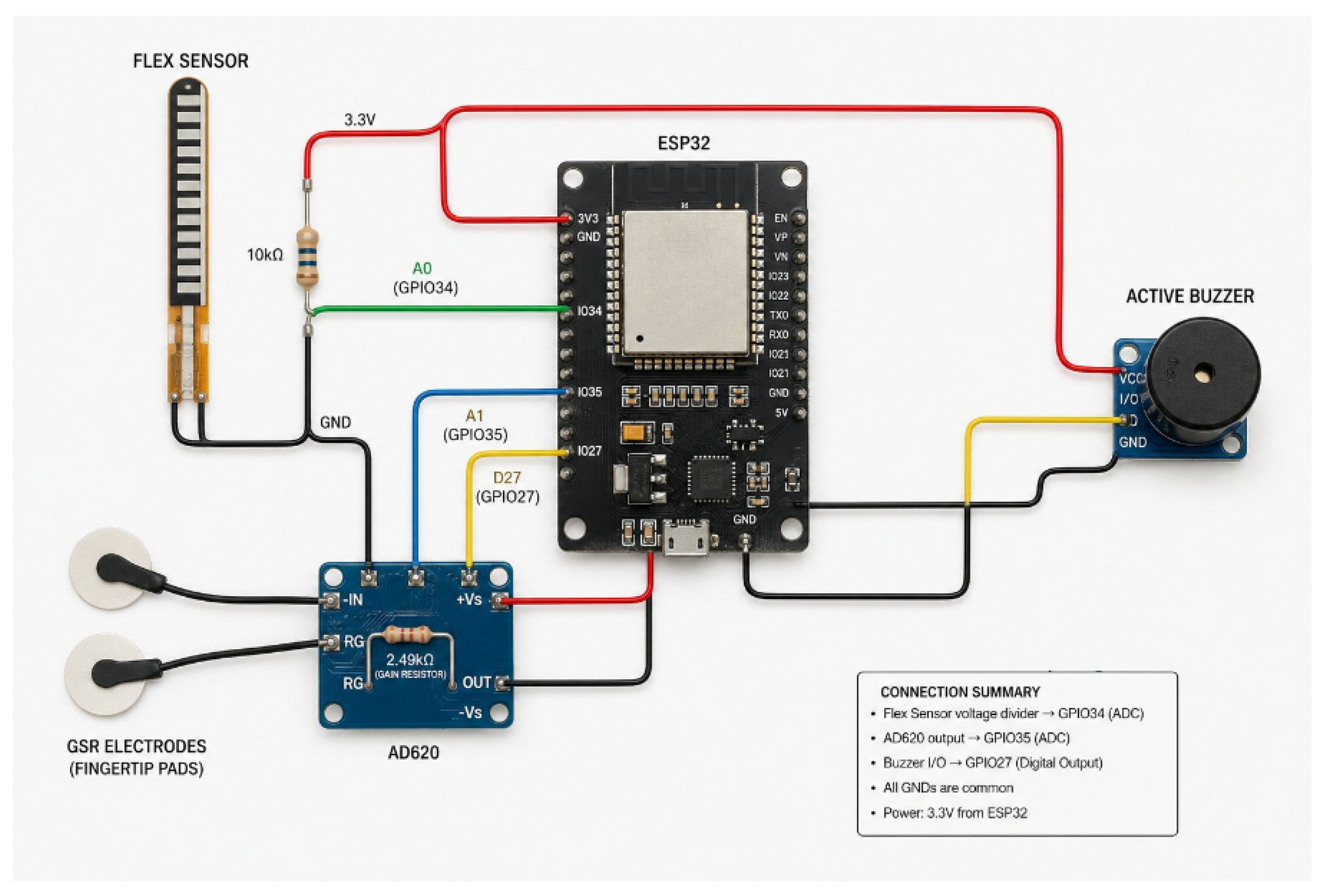
Only the GSR value drives classification. The flex value gets sampled on the same cycle, sure, but it just sits on the dashboard as a number—it has no say in the hydration decision, at least not yet. Figure 2 shows the overall circuit setup.
Figure 2.
The representation of circuit setup.
2.5. Hydration Classification
The system divides skin hydration into three groups using ADC values that were found through experiments. These values come from testing the sensing and signal-processing circuit on people:
- ADC < 800 → Dry Skin/Low Hydration;
- ADC 800–2000 → Normal Hydration;
- ADC > 2000 → Highly Hydrated.
These ADC values are for the circuit that was built. They are not the same as the resistance ranges that doctors use. The resistance ranges are different. Hydrated skin has resistance of less than 100 kΩ. Normal skin has resistance between 100 and 500 kΩ. Low hydration skin has resistance of more than 500 kΩ. The resistance ranges help to create the ADC values; they are not the same as the ADC values.
2.6. Alert and Monitoring Interface
When the GSR ADC value drops below 800, the buzzer on GPIO27 turns ON, signaling a low-hydration condition. The ESP32 runs a Wi-Fi web server that displays the flex sensor value, the GSR value and the hydration classification status, and the webpage refreshes automatically every two seconds. Sensor acquisition in the firmware takes place around every 500 ms, at the webpage refresh rate.
2.7. Experimental Procedure
Testing is conducted on several individuals with different hydration conditions to get accurate thresholds. Recorded GSR ADC values included 342, 336, 240, 70, 86, 204, 883, and 1872—a decent spread across subjects. No percentage hydration value is calculated anywhere in this system. It relies entirely on threshold logic, which matches the way the calibration was designed [18,19,20]. The calibration was built using data not from a theoretical model.
3. Results and Discussion
The prototype was assembled and tested to verify the complete signal chain worked. This included collecting signals from GSR and flex sensor acquisition, then amplification, ADC digitization, threshold-based classification, buzzer alerting, and Wi-Fi-based visualization. The system was evaluated by observing GSR ADC readings across multiple individuals under varying skin conditions.
3.1. Sensor Acquisition and Digitization
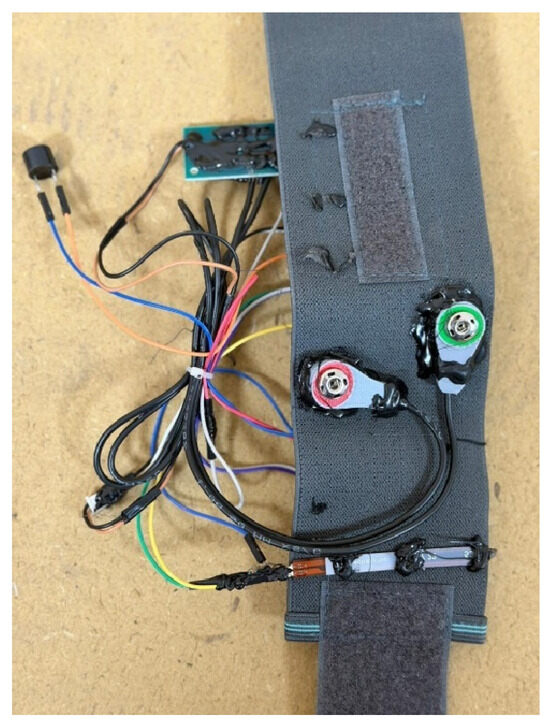
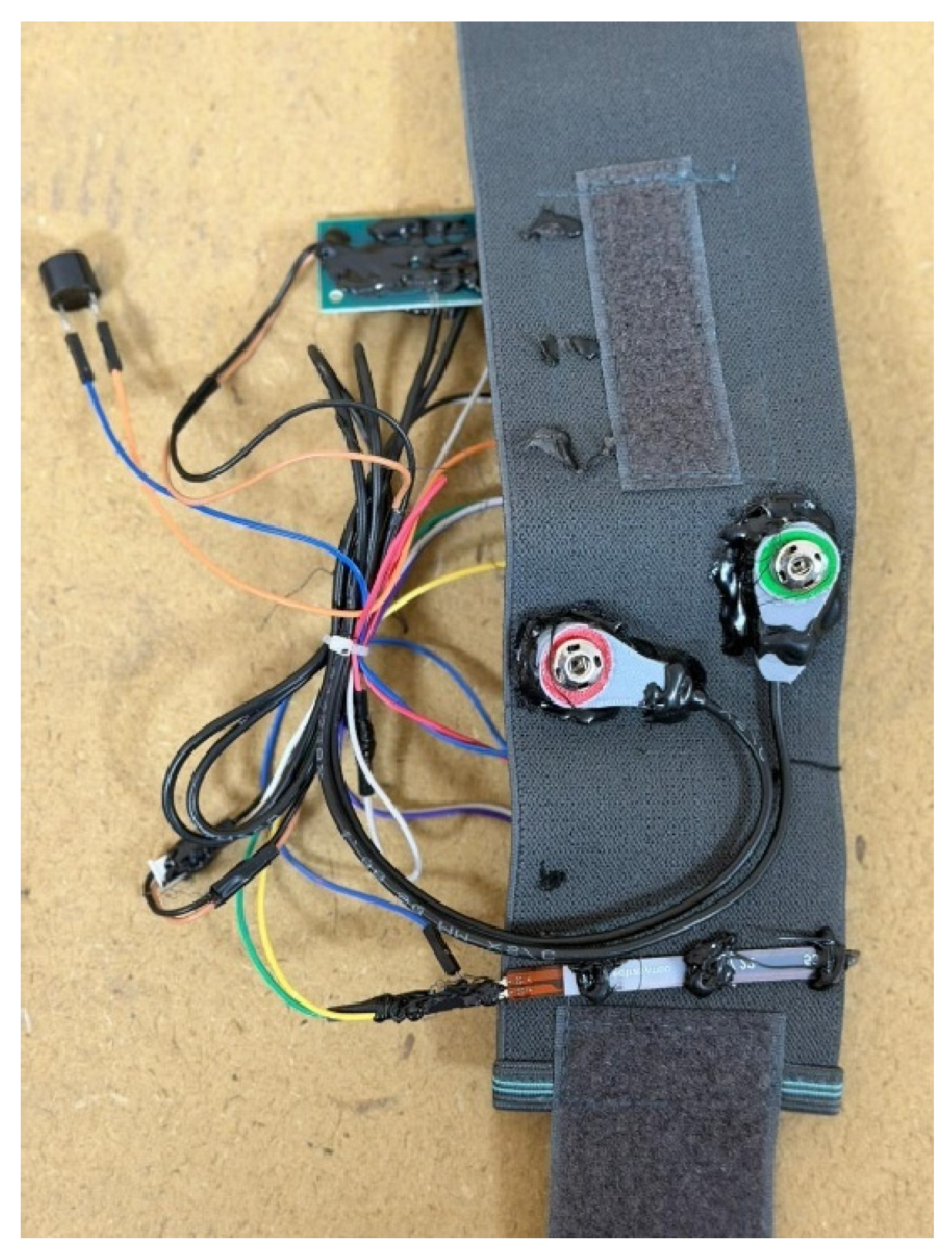
The developed prototype is shown in Figure 3. The ESP32 successfully acquired analog readings from both the GSR sensing circuit (via GPIO35) and the flex sensor (via GPIO34), and converted them into 12-bit digital values within the range of 0–4095. Representative GSR ADC values recorded during testing are shown in Table 1.
Figure 3.
Hardware setup of the proposed system.
Table 1.
Sample GSR ADC readings recorded during testing.
These readings are obtained from different individuals to show that the sensing circuit produced distinguishable ADC ranges corresponding to different hydration conditions. This supports the feasibility of the empirically defined threshold boundaries at 800 and 2000. It is noted that the recorded dataset did not include readings above 2000 (Highly Hydrated range) during this testing phase; classification of that category is therefore based on the defined threshold logic rather than observed experimental instances, and should be verified with additional data collection.
3.2. Classification and Alert Behavior
The threshold-based classification logic operated as intended: values below 800 are properly marked as Dry Skin/Low Hydration. The buzzer connected to GPIO27 turns on when the threshold-based classification logic says the value is below 800 and it stays silent when the threshold-based classification logic says Normal or Highly hydrated. This confirms correct functioning of the alert logic described in the firmware.
3.3. Web-Based Monitoring
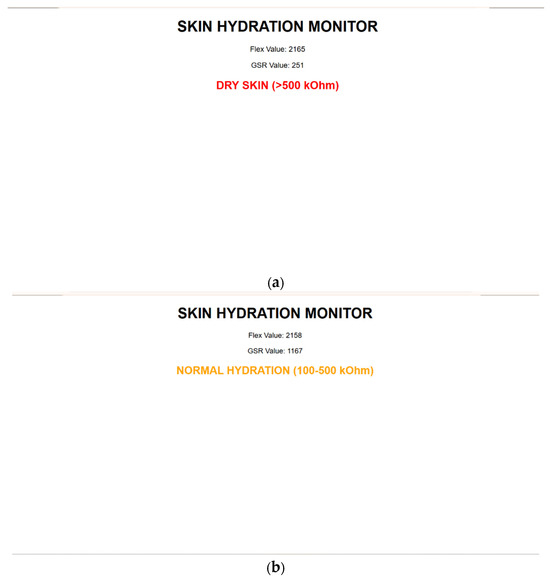
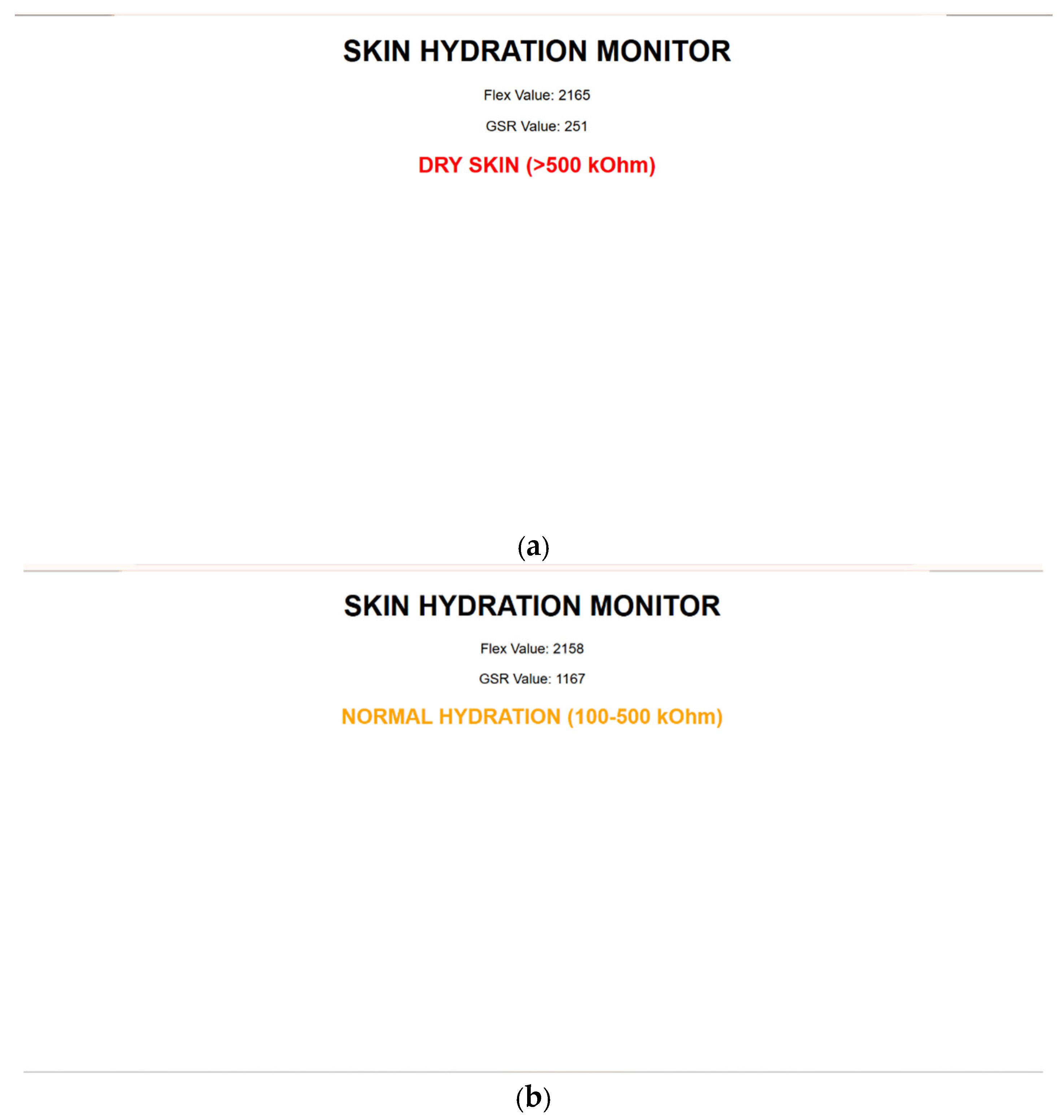
The ESP32-hosted local web server successfully displayed real-time flex sensor values, GSR values, and hydration status, with the page refreshing automatically every 2 s as shown in Figure 4. This was functionally distinct from the underlying sensor acquisition loop, which operated at approximately 500 ms per cycle, confirming that the two intervals operate independently as designed.
Figure 4.
Web interface. (a) Dry skin detected by the system. (b) Normal hydrated skin detected by the system.
3.4. Discussion
The results demonstrate that the GSR sensing circuit, in combination with AD620-based amplification and ESP32 digitization, is capable of producing consistent and distinguishable ADC outputs across different hydration conditions, enabling threshold-based classification without the need for a trained model. The flex sensor, while successfully acquired and displayed, currently functions as a supplementary data channel rather than being mathematically integrated into the hydration classification, consistent with the present firmware design.
It should be emphasized that the ADC thresholds (800 and 2000) are empirical calibration values specific to this sensing and conditioning circuit, and are not directly equivalent to the physiological resistance reference ranges (<100 kΩ, 100–500 kΩ, >500 kΩ) that informed the threshold design. The GSR signal, being influenced by factors such as temperature, sweat, and electrode contact, should be interpreted as a relative and empirically calibrated hydration indicator rather than an absolute or clinically validated measurement.
Overall, the prototype successfully demonstrates the intended functions of sensor acquisition, signal conditioning, threshold-based classification, alerting, and wireless monitoring. However, the limited number of test subjects and absence of readings in the Highly Hydrated range indicate that broader data collection and validation across a larger population would be necessary to more rigorously establish and refine the classification thresholds.
4. Conclusions
A wearable and non-invasive prototype for real-time monitoring of surface skin hydration was developed, with galvanic skin response (GSR) used as the main electrical sensing parameter and a flex sensor providing additional mechanical input. The GSR signal is amplified by an AD620 instrumentation amplifier and then digitized using the 12-bit ADC on the ESP32, allowing the skin condition to be classified into three categories—dry/low, normal, and highly hydrated—based on empirically determined thresholds. A buzzer signal is triggered only when the skin hydration level is low, and the results are shown via a local web interface that is enabled by Wi-Fi. The tests showed that reliable sensor data could be obtained, that threshold-based classification was accurate, and that real-time monitoring functioned as intended, thus proving the feasibility of a low-cost and portable alternative to existing methods of assessing hydration. In future, the research will concentrate on more extensive validation, sensor fusion, and the miniaturization of the wearable device.
Author Contributions
A.P. contributed to the data processing and model development; S.R. supervised the work; K.R. contributed to the preparation of the manuscript and model execution. All authors have read and agreed to the published version of the manuscript.
Funding
This research received no external funding.
Institutional Review Board Statement
Not applicable.
Informed Consent Statement
Not applicable.
Data Availability Statement
The original contributions presented in this study are included in the article. Further inquiries can be directed to the corresponding author.
Conflicts of Interest
The authors declare no conflict of interest.
References
- Baker, H.; Kligman, A.M. Measurement of trans-epidermal water loss by electrical hygrometry. Arch. Dermatol. 1967, 96, 441–452. [Google Scholar] [CrossRef] [Scilit]
- Zhang, Q.; Murawsky, M.; Kasting, G.B. Transepidermal water loss and skin conductance as barrier integrity tests. Skin. Res. Technol. 2018, 24, 181–189. [Google Scholar]
- Serup, J.; Blichmann, C. Epidermal hydration of psoriasis plaques and relation to scaling. Acta Derm.-Venereol. 1987, 67, 357–361. [Google Scholar] [CrossRef] [Scilit]
- Edelberg, R. Electrical activity of the skin: Its measurement and uses in psychophysiology. In Handbook of Psychophysiology; Greenfield, N.S., Sternbach, R.A., Eds.; Holt, Rinehart & Winston: New York, NY, USA, 1972; pp. 367–418. [Google Scholar]
- Blichmann, C.W.; Serup, J. Assessment of skin moisture using electrical conductance and transepidermal water loss. Acta Derm.-Venereol. 1988, 68, 284–290. [Google Scholar] [PubMed]
- Møss, J. The effect of 3 moisturisers on skin surface hydration: Electrical conductance (Skicon-200), capacitance (Corneometer CM420), and transepidermal water loss (TEWL). Skin. Res. Technol. 1996, 2, 32–36. [Google Scholar] [CrossRef] [Scilit] [PubMed]
- Rim, J.H.; Jo, S.J.; Park, J.Y.; Park, B.D.; Youn, J.I. Electrical measurement of moisturizing effect on skin hydration and barrier function in psoriasis patients. Clin. Exp. Dermatol. 2005, 30, 409–413. [Google Scholar] [CrossRef] [Scilit] [PubMed]
- Cheng, H.; Zhang, Y.; Huang, X.; Rogers, J.A.; Huang, Y. Analysis of a concentric coplanar capacitor for epidermal hydration sensing. Sens. Actuators A Phys. 2013, 203, 149–153. [Google Scholar] [CrossRef] [Scilit]
- Garrett, D.C.; Rae, N.; Fletcher, J.R.; Zarnke, S.; Thorson, S.; Hogan, D.B.; Fear, E.C. Engineering approaches to assessing hydration status. IEEE Rev. Biomed. Eng. 2018, 11, 233–248. [Google Scholar] [CrossRef] [Scilit] [PubMed]
- Constantin, M.M.; Poenaru, E.; Poenaru, C.; Constantin, T.; Davila, C. Skin hydration assessment through modern non-invasive bioengineering technologies. Maedica—J. Clin. Med. 2014, 9, 33–38. [Google Scholar]
- Kulkarni, N.; Compton, C.; Luna, J.; Alam, M.A.U. Monitoring My Dehydration: A Non-Invasive Dehydration Alert System Using Electrodermal Activity. In Proceedings of the 22nd International Workshop on Mobile Computing Systems and Applications, Virtual, 24–26 February 2021. [Google Scholar] [CrossRef] [Scilit]
- Rizwan, A.; Abu Ali, N.; Zoha, A.; Ozturk, M.; Alomainy, A.; Imran, M.A.; Abbasi, Q.H. Non-Invasive Hydration Level Estimation in Human Body Using Galvanic Skin Response. IEEE Sens. J. 2020, 20, 4891–4900. [Google Scholar] [CrossRef] [Scilit]
- Jang, M.; Kim, H.-D.; Koo, H.-J.; So, J.-H. Textile-based wearable sensor for skin hydration monitoring. Sensors 2022, 22, 6985. [Google Scholar] [CrossRef] [Scilit] [PubMed]
- Gidado, I.M.; Qassem, M.; Triantis, I.F.; Kyriacou, P.A. Review of advances in the measurement of skin hydration based on sensing of optical and electrical tissue properties. Sensors 2022, 22, 7151. [Google Scholar] [CrossRef] [Scilit] [PubMed]
- Liaqat, S.; Dashtipour, K.; Rizwan, A.; Usman, M.; Shah, S.A.; Arshad, K.; Assaleh, K.; Ramzan, N. Personalized wearable electrodermal sensing-based human skin hydration level detection for sports, health and wellbeing. Sci. Rep. 2022, 12, 3715. [Google Scholar] [CrossRef] [Scilit] [PubMed]
- Kwon, K.; Wang, H.; Lim, J.; Chun, K.S.; Jang, H.; Yoo, I.; Wu, D.; Chen, A.J.; Gu, C.G.; Lipschultz, L.; et al. Wireless, soft electronics for rapid, multisensor measurements of hydration levels in healthy and diseased skin. Proc. Natl. Acad. Sci. USA 2021, 118, e2020398118. [Google Scholar] [CrossRef] [Scilit] [PubMed]
- Huang, X.; Yeo, W.-H.; Liu, Y.; Rogers, J.A. Epidermal Differential Impedance Sensor for Conformal Skin Hydration Monitoring. Biointerphases 2012, 7, 52. [Google Scholar] [CrossRef] [Scilit] [PubMed]
- Rodin, D.; Shapiro, Y.; Pinhasov, A.; Kreinin, A.; Kirby, M. An accurate wearable hydration sensor: Real-world evaluation of practical use. PLoS ONE 2022, 17, e0272646. [Google Scholar] [CrossRef] [Scilit] [PubMed]
- Wu, Y.; Ran, J.; Tanaka, T.; Liu, Q. Quantitative skin surface hydration measurement by visible optical image processing: A pilot study. Skin. Res. Technol. 2024, 30, e13773. [Google Scholar] [CrossRef] [Scilit] [PubMed]
- Qassem, M.; Kyriacou, P.A. Review of Modern Techniques for the Assessment of Skin Hydration. Cosmetics 2019, 6, 19. [Google Scholar] [CrossRef] [Scilit]

Disclaimer/Publisher’s Note: The statements, opinions and data contained in all publications are solely those of the individual author(s) and contributor(s) and not of MDPI and/or the editor(s). MDPI and/or the editor(s) disclaim responsibility for any injury to people or property resulting from any ideas, methods, instructions or products referred to in the content. |
© 2026 by the authors. Licensee MDPI, Basel, Switzerland. This article is an open access article distributed under the terms and conditions of the Creative Commons Attribution (CC BY) license.