


Abstract
Ultra-high-performance concrete (UHPC) has a high mechanical performance, but its large cement content is associated with a high environmental impact. This study evaluates cement replacement strategies for eco-friendly UHPC using a dataset of 610 mixtures collected from the literature. The mixtures were analyzed using typical CO2 emission factors, harmonized compressive strength, and grouped descriptors including the supplementary cementitious materials (SCM) replacement ratio, binder pathway, fiber content, and curing regime. The results show that increasing SCM replacement strongly reduces the binder-related CO2 and generally lowers the total CO2 intensity, while a high compressive strength can still be achieved at higher replacement ratios. Slag-rich and blended SCM systems showed the most promising balance between reducing CO2 and maintaining strength.
1. Introduction
Ultra-high-performance concrete (UHPC) is increasingly used in structural and infrastructure applications due to its high mechanical performance and durability [1]. However, these advantages are commonly achieved with a high cement content, and, in some cases, energy-demanding curing regimes. As a result, UHPC can have a high embodied CO2 that compromises its sustainability. Therefore, reducing the cement content of UHPC is an important step toward improving its environmental performance and supporting its adoption as an efficient solution for sustainable concrete structures [2].
A common approach to reduce the CO2 burden of UHPC is the partial replacement of the cement with supplementary cementitious materials such as silica fume, fly ash, slags, metakaolin, rice husk ash, limestone powder, quartz powder, and other reactive mineral additions [3,4,5]. Previous studies have shown that these materials can reduce cement demand, improve particle packing, and maintain or enhance strength and durability. However, the reported eco-UHPC mixtures vary widely as the composition differs in binder content, fiber dosage, and replacement material, as well as the curing regimes [3,4,6,7,8,9]. Hence, the comparison of cement replacement strategies remains difficult because published UHPC mixtures are designed with different objectives. Some mixtures aim for maximum strength, others for cost reduction, local material use, fiber efficiency, or lower environmental impact. Furthermore, a comparison in terms of CO2 emissions is complicated by regional differences, as local production processes, energy sources, and transportation distances significantly influence the embodied carbon of the constituent materials.
A broader data-based assessment is needed to further understand and quantify the effectiveness of different cement replacement strategies and separate the binder direct effect from other mixture-level influences. In this study, a dataset of 610 UHPC mixtures collected from the literature was analyzed. The Supplementary Cementitious Material (SCM) replacement ratio was used to describe the level of cement substitution, while binder-related CO2, total embodied CO2, compressive strength, and total CO2 intensity were used to correlate mechanical and environmental performance. The analysis also considers the binder pathway, fiber content, and curing regimes to provide further insights and interpret the variability in the collected dataset. The aim of this work is to identify which cement replacement strategies are most effective for eco-UHPC and to evaluate the extend of cement replacement that can be achieved without compromising mechanical performance. The results are intended to support the more practical selection of low-carbon UHPC binder systems.
2. Methodology
This study investigates UHPC mixture design strategies aimed at reducing the CO2 burden of cement through its partial replacement by SCM or other reactive binder substitutes. The materials considered are those that contribute to the binder system through hydraulic or pozzolanic reactivity such as silica fume, fly ash, ground granulated blast-furnace slag (GGBFS), metakaolin, rice husk ash, other slags, and other reactive mineral additions. Limestone powder and quartz powder are also considered in this dataset only when the original study treated them as binder-level replacements rather than inert fillers.
In this study, a total of 610 mixture records were collected and analyzed. The source studies and number of mixtures are listed in Appendix A. In order to enable consistent environmental assessment across all studies, a constituent-level CO2 computation was applied. For each mix constituent, an emission factor was assigned based on typical values reported in the literature, as presented in Table 1. These values reflect cradle-to-gate (A1 to A3) assessment. In addition, curing was incorporated as a separate contributing factor. Reported compressive strengths were harmonized to improve comparability across studies using different specimen geometries and sizes. Standard cylinders were treated as the reference geometry, and cube and low height-to-width-ratio (<2) specimens were adjusted using a conservative factor of 0.95 in accordance with SIA 2052 [10] and ÖBV-Richtlinie “UHPC” [11], whereas values from prisms were retained with a factor of 1.00.
Table 1.
CO2 emission factors for eco-UHPC constituents and curing regimes.
The cement replacement level was quantified using the SCM replacement ratio:
where mSCM is the total mass of reactive supplementary cementitious materials or binder replacements, and mcement is the mass of the Portland cement. This ratio was used as the independent variable for the statistical analysis.
Two environmental indicators were used. First, the binder-related CO2 was calculated to isolate the direct effect of cement replacement:
where mi and EFi are the mass and emission factor of each binder constituent. This CO2,binder indicator includes cement and reactive binder replacements, but excludes fibers, aggregates, inert fillers, and admixtures. Second, the calculated total embodied CO2 is used to represent the total environmental impact of the mixture:
where mj and EFj refer to all mixture constituents including binder materials, aggregates, fillers, fibers, admixtures, and curing-related contributions, where available. To evaluate the combined environmental and mechanical performance, the total CO2 intensity is defined as follows:
where fc,eq is the equivalent converted compressive strength. This indicator expresses the calculated total embodied CO2 required to achieve one MPa of compressive strength.
3. Results and Discussions
3.1. Dataset Characterization and Classification
A statistical analysis of the collected dataset was first performed to account for the observed variability in mixture compositions and SCM usage. Supporting descriptors used to interpret the data were the binder pathway, composition, and replacement range. Binder pathways were classified according to the dominant binder-substitution pathway. The main classes were no/low SCM, silica-fume-rich systems, hybrid or blended SCM systems, fly-ash-based systems, slag-rich systems, limestone or mineral-powder systems, and metakaolin-based systems. These classes were used only as descriptors. They were not treated as independent variables because each pathway includes mixtures with different binder contents, fiber volumes, curing regimes, and mix-design objectives. The no/low SCM class mostly includes reference mixtures reported in the studies.
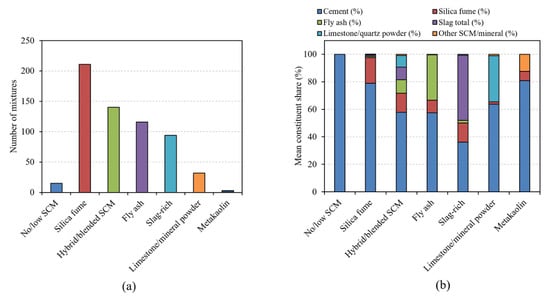
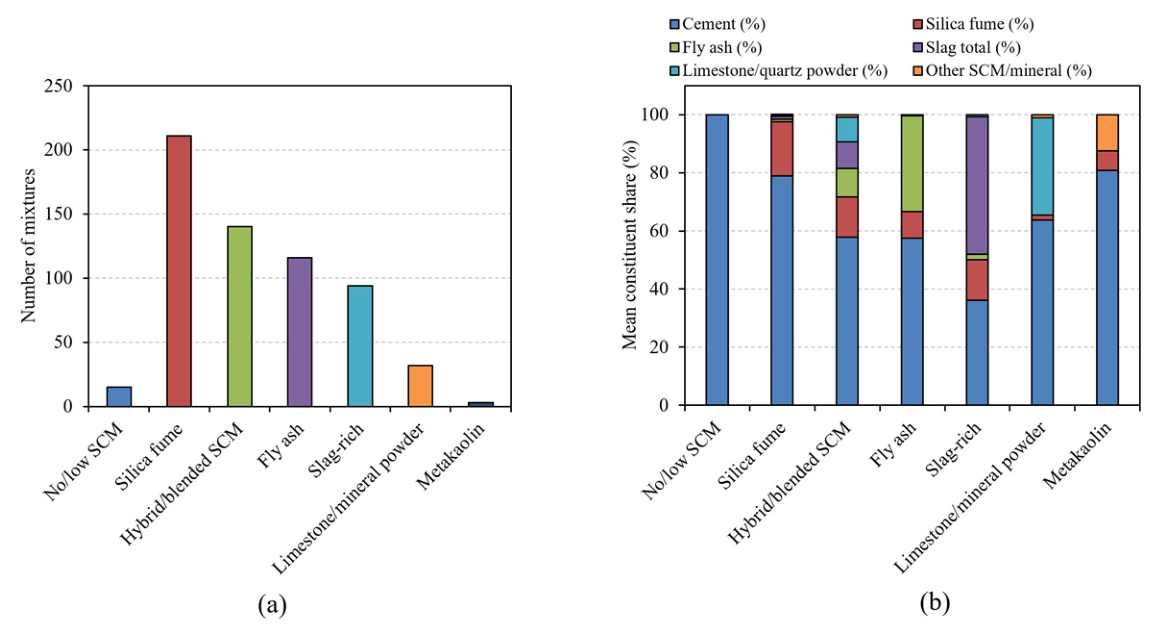
Figure 1a shows the representation of each binder pathway in the dataset. Silica-fume-rich systems are the most represented group, followed by hybrid/blended SCM systems, fly-ash systems, and slag-rich systems. Limestone/mineral-powder systems, no/low SCM mixtures, and metakaolin systems are less represented. This distribution is important because it shows that the statistical evidence is not balanced across binder pathways. Trends observed for silica fume, hybrid SCMs, fly ash, and slag-rich systems are supported by a larger number of mixtures, while conclusions for metakaolin and no/low SCM mixtures should be interpreted more cautiously.
Figure 1.
Binder pathway representation in the dataset: (a) number of mixtures in each main binder pathway; and (b) mean binder composition in each pathway.
The mean binder composition of each pathway is shown in Figure 1b. No/low SCM mixtures are dominated by cement. Silica-fume-rich systems retain a high cement fraction, with silica fume acting mainly as a reactive fine addition rather than a high-volume cement replacement. Fly-ash and hybrid/blended systems show larger reductions in the cement share and more distributed binder compositions. Slag-rich systems show the largest reduction in cement fraction and the highest contribution from slag. Limestone/mineral-powder systems show a distinct composition, with a large fraction of limestone or quartz powder relative to other SCM types. These differences confirm that the same SCM replacement ratio can represent different binder chemistries and different carbon-reduction mechanisms.
3.2. Validation of CO2 Evalution
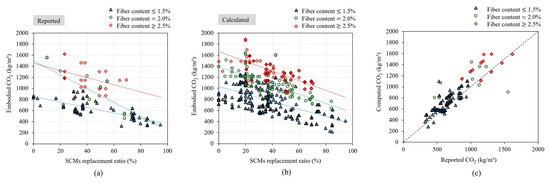
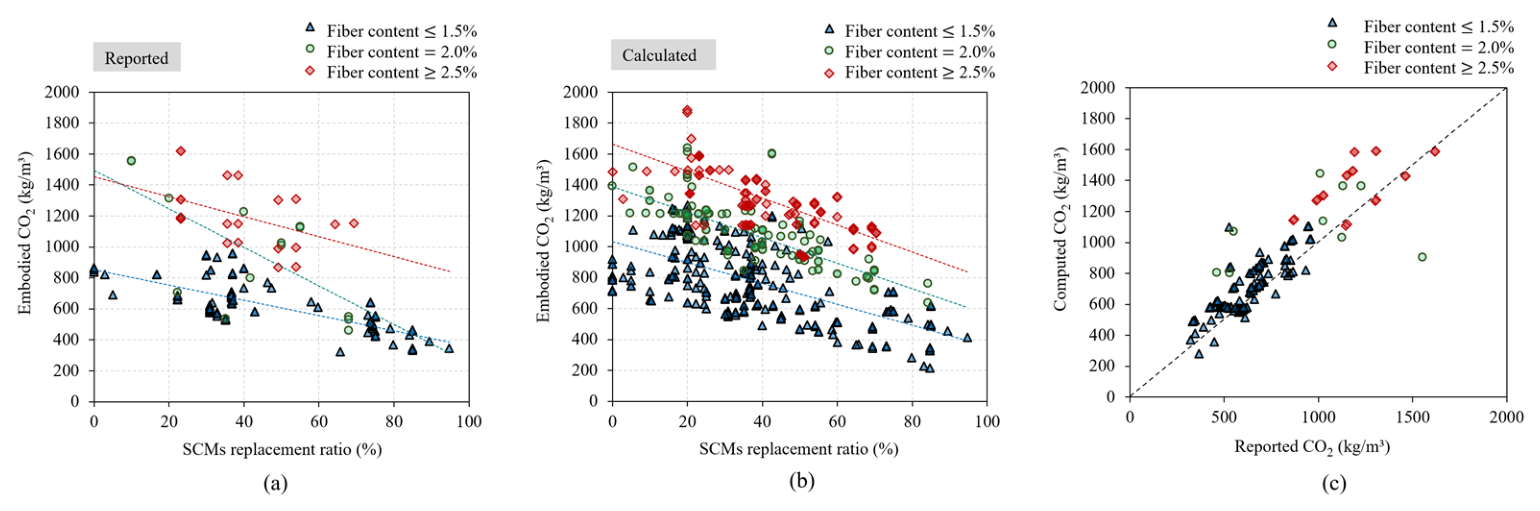
The embodied CO2 values reported in the original studies with the values calculated using the constituent-level method adopted in this work are compared in Figure 2. The reported dataset is substantially smaller as many studies do not provide embodied CO2 values. In contrast, the calculated dataset covers the full compiled dataset, allowing a consistent comparison across mixtures. Despite the difference in data coverage, the reported and calculated datasets show similar trends. In both cases, embodied CO2 decreases as the SCM replacement ratio increases. The set was divided into three representative fiber percentages, as the CO2 emissions from the fibers play a major role in total mix emissions. The relative position of the fiber-content groups is also consistent such that mixtures with a fiber content ≥ 2.5% generally have the highest embodied CO2, followed by mixtures with 2.0% fiber, while mixtures with a fiber content ≤ 1.5% occupy the lower range. The calculated values also reproduce the approximate value of the reported values (Figure 3c). Both datasets show embodied CO2 values mainly within the range of approximately 200–1700 kg CO2/m3. This agreement indicates that the adopted emission factors provide a reasonable basis for estimating embodied CO2 where reported values are unavailable. Therefore, reported CO2 values were used only as a validation subset, while calculated CO2 values were used as the main dataset for regression analysis.
Figure 2.
Comparison between reported and calculated embodied CO2 as a function of SCM replacement ratio: (a) reported embodied CO2; (b) calculated embodied CO2; and (c) reported vs computed CO2.
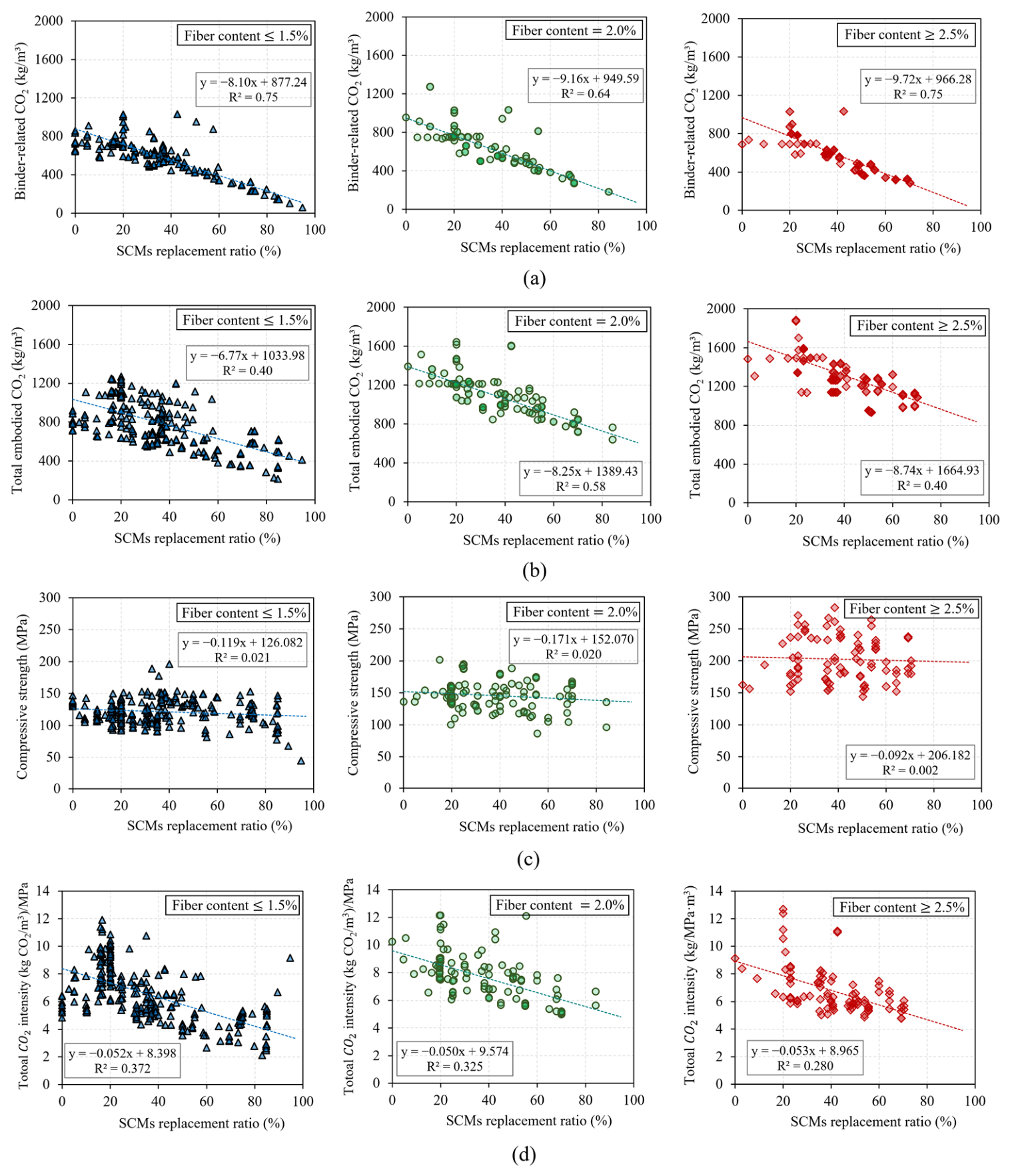
Figure 3.
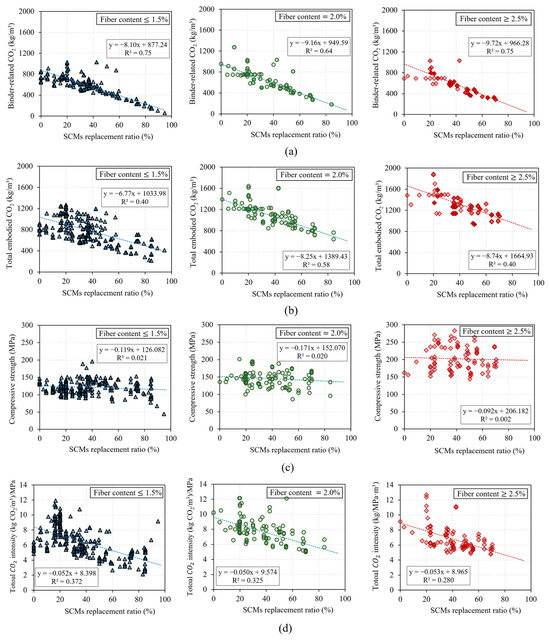
Relationships between SCM replacement ratio and: (a) binder-related CO2; (b) calculated total embodied CO2; (c) compressive strength; and (d) total CO2 intensity.
3.3. Impact of SCM Replacement Ratio
The relationships between SCM replacement ratio and four response variables are presented in Figure 3. The results are separate for three fiber-content classes: ≤1.5%, 2.0%, and ≥2.5% The four response variables include binder-related CO2, calculated total embodied CO2, compressive strength, and total CO2 intensity. The binder-related CO2 decreases strongly with an increasing SCM replacement ratio across all fiber-content classes, as presented in Figure 3a. This confirms that cement substitution directly reduces the carbon burden of the binder system, with data reaching, in some cases, even 90% of binder-CO2 reduction. The regression models show a relatively strong correlation factor (R2), indicating that the SCM replacement ratio is a strong predictor of binder-related CO2 reduction. The total embodied CO2 also decreases with an increasing SCM replacement ratio, as shown in Figure 3b, but the relationship is less direct than for binder-related CO2. This is expected because total embodied CO2 includes fibers and other mixture constituents in addition to the binder. The ratio between the SCM% replacement and total-CO2 reduction is now 6.7–8.4, still very close to the ratio observed when taking into consideration only the binder replacement. The effect of the fiber content is clearly visible in mixtures with ≥2.5% fiber, showing a higher total embodied CO2 than the lower-fiber groups. This confirms the need to separate binder-related CO2 from total embodied CO2 when evaluating cement replacement strategies.
The compressive strength shows only a weak dependence on the SCM replacement ratio, as presented in Figure 3c. The regression slopes are small and the R2 values are low across all fiber-content classes. This indicates that SCM replacement does not control the strength variation in the compiled dataset. Strength is likely controlled by several interacting parameters, including binder composition, particle packing, curing regime, and fiber content. Importantly, high compressive strengths are still achieved at moderate and high SCM replacement ratios, showing that cement reduction can be compatible with a high mechanical performance.
The total CO2 intensity decreases with an increasing SCM replacement ratio in all fiber-content classes, as shown in Figure 3d. This indicates that SCM replacement improves environmental efficiency per unit compressive strength. The decrease in CO2 intensity is more pronounced than the change in compressive strength, meaning that the environmental benefit is mainly driven by CO2 reduction without a compromise of strength loss. The high-fiber group has higher total embodied CO2 even though most of the mixtures in this group were reported with a higher compressive strength. Overall, the results show that SCM replacement is an effective cement-reduction strategy for UHPC. It consistently lowers binder-related CO2 and calculated total embodied CO2 while maintaining compressive strength within the range required for UHPC. The reduction in total CO2 intensity further confirms that cement replacement improves eco-mechanical efficiency.
3.4. Mechanical and Environmental Performance by Binder Pathway
The primary regression analysis presented above shows the overall relationship between the SCM replacement ratio, CO2 reduction, compressive strength, and total CO2 intensity. However, the scatter in the data also indicates that effective low-carbon UHPC design also depends on the main binder pathway.
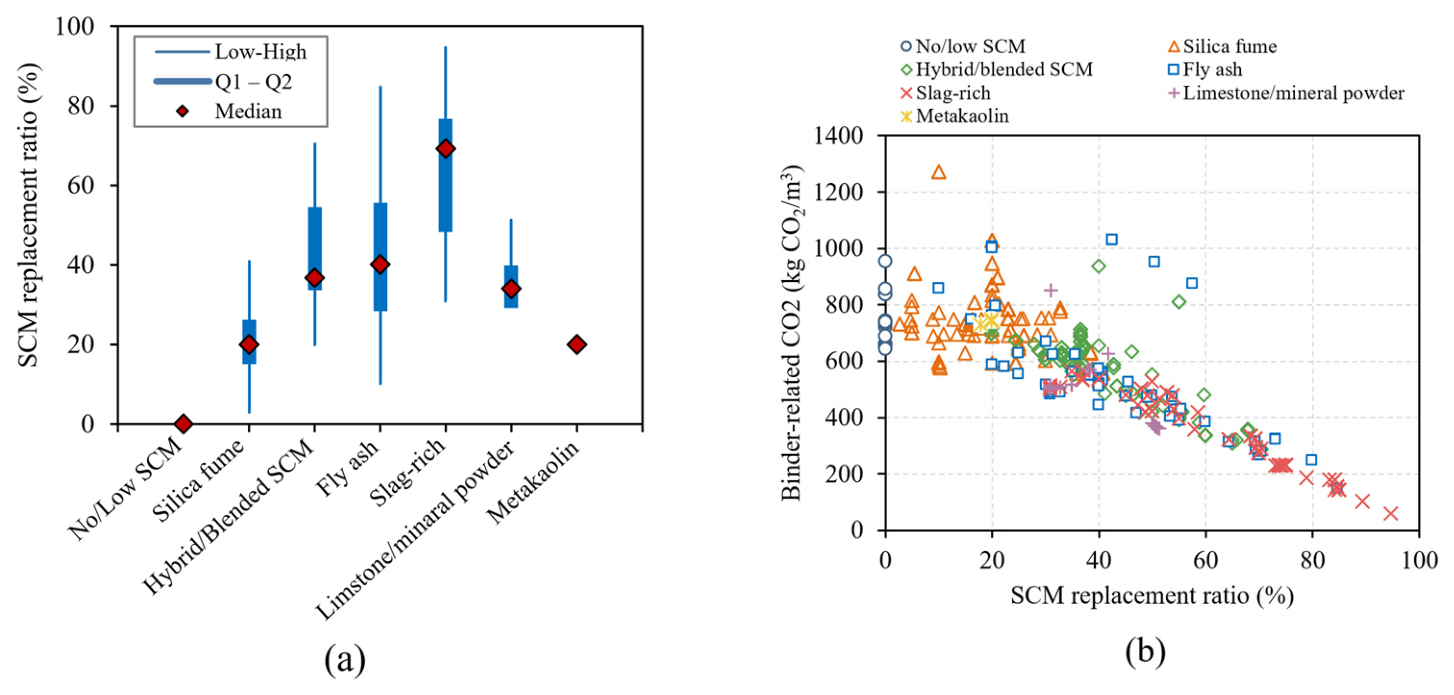
Figure 4a summarizes the SCM replacement range covered by each binder pathway. No/low SCM mixtures are concentrated near zero replacement. Silica-fume-rich systems are mainly located at low to moderate replacement levels, with a median near 20%. Fly-ash and hybrid/blended systems cover wider replacement ranges, extending into moderate and high replacement levels. Slag-rich systems show the highest replacement levels, with a median close to 70% and an upper range approaching 95%. Limestone/mineral-powder systems occupy a narrower moderate replacement range, while metakaolin is represented by very few mixtures.
Figure 4.
Eco-performance efficiency by binder pathway: (a) SCM replacement range by pathway; and (b) binder-related CO2 emissions by pathway.
Figure 4b shows binder-related CO2 as a function of the SCM replacement ratio for each binder pathway. The same general pattern appears across the descriptor classes where the binder-related CO2 decreases as the SCM replacement increases. This confirms that the main trend observed in the main matrix is not limited to one binder type. However, the pathway-level distribution provides additional interpretation. Silica-fume-rich mixtures are mostly located at lower replacement ratios and, therefore, often retain relatively high binder-related CO2. Fly-ash and hybrid systems occupy the intermediate replacement and CO2 ranges. Slag-rich systems extend to the highest replacement ratios and reach the lowest binder-related CO2 values. Limestone/mineral-powder systems are clustered in a narrower region and generally show moderate binder-related CO2. These results show that the strongest binder-level carbon reductions are associated with high-volume replacement pathways, particularly slag-rich and some blended systems.
3.5. Impact of Curing Regime
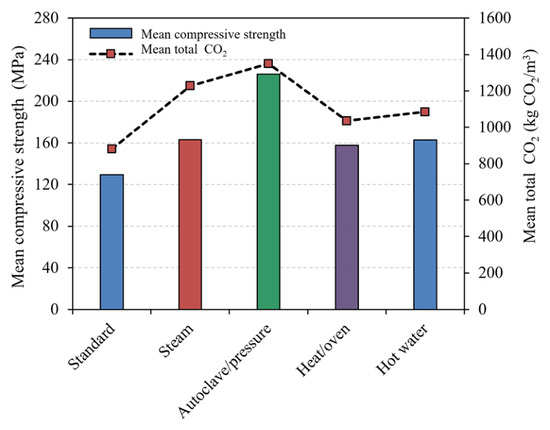
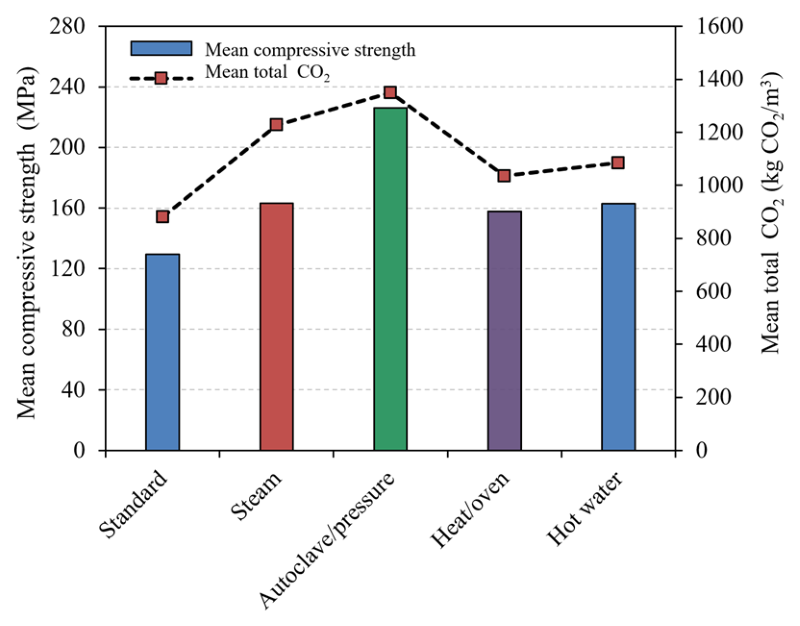
The curing-regime descriptor provides an additional explanation for the scatter observed in the strength and CO2-intensity results. Figure 5 shows that thermally accelerated curing regimes, especially autoclave or pressure-based curing, are associated with a higher mean compressive strength than standard curing. However, they can also increase the calculated total CO2 when curing-related energy is included. Steam, hot-water, and heat/oven curing occupy intermediate positions whereas the standard curing shows the lowest compressive strength and environmental impact. This indicates that curing can improve mechanical performance but may reduce part of the environmental benefit as the additional energy demand is high. Therefore, the curing regime should be treated as a key modifier when interpreting cement replacement strategies.
Figure 5.
Curing regime effect on mechanical and environmental outcomes.
4. Conclusions
In this study, a data-based assessment of cement replacement strategies for eco-UHPC is presented. The following conclusions can be drawn:
- SCM replacement is an effective way to reduce the carbon impact of UHPC. Across the collected dataset, higher SCM replacement ratios led to a clear reduction in binder-related CO2 and a general reduction in total embodied CO2. The effect was strongest at the binder level, confirming that cement reduction directly lowers the main source of emissions in UHPC mixtures.
- The SCM replacement ratio does not negatively affect strength. High compressive strengths were still achieved at moderate and high replacement levels, showing that cement reduction can be compatible with UHPC performance. The scatter in the data indicates that the binder composition, packing, fiber dosage, and curing regime must also be considered when designing eco-UHPC.
- Slag-rich and blended SCM pathways showed the best overall potential. These systems generally provided a lower CO2 intensity while maintaining high strength levels. The results also show that a high fiber content and energy-intensive curing can increase the total CO2, so eco-UHPC design should evaluate the full mixture and curing regime in addition to the cement replacement ratio.
Other performance indicators critical to UHPC applications, such as durability and tensile behavior, were not consistently reported and were therefore excluded from the analysis. Consequently, the findings are limited to the relationship between SCM replacement, compressive strength, and embodied CO2. In addition, the environmental assessment considered only production-stage embodied CO2. While this enables a consistent comparison of mix designs, overall sustainability also depends on factors such as durability, maintenance, service life, and material savings. Future studies should therefore investigate the influence of SCM replacement on long-term performance and incorporate life-cycle and service-life assessments to provide a more comprehensive evaluation of eco-UHPC.
Author Contributions
Conceptualization, M.A. and A.G.; methodology, M.A. and A.G.; validation, M.A. and A.G. and; formal analysis, M.A. and A.G.; data curation, M.A.; writing—original draft preparation, M.A.; writing—review and editing, A.G. and N.R.; supervision, A.G. and N.R.; project administration, A.G. All authors have read and agreed to the published version of the manuscript.
Funding
This research was funded by the European Regional Development Fund (Interreg VI-A Italy–Austria 2021–2027) and the Carinthian Economic Promotion Fund (KWF), grant number Project ITAT-11-028.
Institutional Review Board Statement
Not applicable.
Informed Consent Statement
Not applicable.
Data Availability Statement
The data presented in this study are available upon request from the corresponding author.
Conflicts of Interest
The authors declare no conflicts of interest.
Appendix A
Table A1.
Source studies of the collected dataset.
References
- Mandor, A.; Taie, B. Toward Resilient Infrastructure: A Critical Review and Roadmap for Ultra–High–Performance Concrete (UHPC) Design, Performance and Standards. Discov. Concr. Cem. 2026, 2, 11. [Google Scholar] [CrossRef] [Scilit]
- Zhang, X.; Wu, Z.; Xie, J.; Hu, X.; Shi, C. Trends toward Lower-Carbon Ultra-High Performance Concrete (UHPC)—A Review. Constr. Build. Mater. 2024, 420, 135602. [Google Scholar] [CrossRef] [Scilit]
- Wu, Z.; Shi, C.; He, W. Comparative Study on Flexural Properties of Ultra-High Performance Concrete with Supplementary Cementitious Materials under Different Curing Regimes. Constr. Build. Mater. 2017, 136, 307–313. [Google Scholar] [CrossRef] [Scilit]
- Yu, R.; Spiesz, P.; Brouwers, H.J.H. Development of an Eco-Friendly Ultra-High Performance Concrete (UHPC) with Efficient Cement and Mineral Admixtures Uses. Cem. Concr. Compos. 2015, 55, 383–394. [Google Scholar] [CrossRef] [Scilit]
- Shi, Y.; Long, G.; Ma, C.; Xie, Y.; He, J. Design and Preparation of Ultra-High Performance Concrete with Low Environmental Impact. J. Clean. Prod. 2019, 214, 633–643. [Google Scholar] [CrossRef] [Scilit]
- Randl, N.; Steiner, T.; Ofner, S.; Baumgartner, E.; Mészöly, T. Development of UHPC Mixtures from an Ecological Point of View. Constr. Build. Mater. 2014, 67, 373–378. [Google Scholar] [CrossRef] [Scilit]
- Ahmed, T.; Elchalakani, M.; Karrech, A.; Dong, M.; Mohamed Ali, M.S.; Yang, H. ECO-UHPC with High-Volume Class-F Fly Ash: New Insight into Mechanical and Durability Properties. J. Mater. Civ. Eng. 2021, 33, 04021174. [Google Scholar] [CrossRef] [Scilit]
- Ha, N.S.; Marundrury, S.S.; Pham, T.M.; Pournasiri, E.; Shi, F.; Hao, H. Effect of Grounded Blast Furnace Slag and Rice Husk Ash on Performance of Ultra-High-Performance Concrete (UHPC) Subjected to Impact Loading. Constr. Build. Mater. 2022, 329, 127213. [Google Scholar] [CrossRef] [Scilit]
- Yang, R.; Yu, R.; Shui, Z.; Gao, X.; Xiao, X.; Zhang, X.; Wang, Y.; He, Y. Low Carbon Design of an Ultra-High Performance Concrete (UHPC) Incorporating Phosphorous Slag. J. Clean. Prod. 2019, 240, 118157. [Google Scholar] [CrossRef] [Scilit]
- Lausanne, M.-E. Recommendation: Ultra-High Performance Fibre Reinforced Cement-Based Composites (UHPFRC) Construction Material, Dimensioning and Application; EPFL: Lausanne, Switzerland, 2016; pp. 1–34. [Google Scholar]
- Österreichische Bautechnik Vereinigung. Richtlinie UHPC; Österreichische Bautechnik Vereinigung: Vienna, Austria, 2023. [Google Scholar]
- Long, G.; Gao, Y.; Xie, Y. Designing More Sustainable and Greener Self-Compacting Concrete. Constr. Build. Mater. 2015, 84, 301–306. [Google Scholar] [CrossRef] [Scilit]
- Chiaia, B.; Fantilli, A.P.; Guerini, A.; Volpatti, G.; Zampini, D. Eco-Mechanical Index for Structural Concrete. Constr. Build. Mater. 2014, 67, 386–392. [Google Scholar] [CrossRef] [Scilit]
- Sharma, R.; Khan, R.A. Sustainable Use of Copper Slag in Self Compacting Concrete Containing Supplementary Cementitious Materials. J. Clean. Prod. 2017, 151, 179–192. [Google Scholar] [CrossRef] [Scilit]
- Kathirvel, P.; Sreekumaran, S. Sustainable Development of Ultra High Performance Concrete Using Geopolymer Technology. J. Build. Eng. 2021, 39, 102267. [Google Scholar] [CrossRef] [Scilit]
- Habert, G.; d’Espinose De Lacaillerie, J.B.; Roussel, N. An Environmental Evaluation of Geopolymer Based Concrete Production: Reviewing Current Research Trends. J. Clean. Prod. 2011, 19, 1229–1238. [Google Scholar] [CrossRef] [Scilit]
- Sun, X.; Zhao, Y.; Tian, Y.; Wu, P.; Guo, Z.; Qiu, J.; Xing, J.; Xiaowei, G. Modification of High-Volume Fly Ash Cement with Metakaolin for Its Utilization in Cemented Paste Backfill: The Effects of Metakaolin Content and Particle Size. Powder Technol. 2021, 393, 539–549. [Google Scholar] [CrossRef] [Scilit]
- Hu, L.; He, Z.; Zhang, S. Sustainable Use of Rice Husk Ash in Cement-Based Materials: Environmental Evaluation and Performance Improvement. J. Clean. Prod. 2020, 264, 121744. [Google Scholar] [CrossRef] [Scilit]
- Habert, G.; Denarié, E.; Šajna, A.; Rossi, P. Lowering the Global Warming Impact of Bridge Rehabilitations by Using Ultra High Performance Fibre Reinforced Concretes. Cem. Concr. Compos. 2013, 38, 1–11. [Google Scholar] [CrossRef] [Scilit]
- Heidari, S.M.; Anctil, A. Country-Specific Carbon Footprint and Cumulative Energy Demand of Metallurgical Grade Silicon Production for Silicon Photovoltaics. Resour. Conserv. Recycl. 2022, 180, 106171. [Google Scholar] [CrossRef] [Scilit]
- Gomez, J.M.M. Carbon Footprint of Geomembrane Alvatech HDPE vs Traditional Waterproofing Barrier. In Proceedings of the Advances in Geosynthetics Engineering; Meguid, M., Guler, E., Giroud, J.P., Eds.; Springer International Publishing: Cham, Switzerland, 2019; pp. 243–247. [Google Scholar]
- Turner, L.K.; Collins, F.G. Carbon Dioxide Equivalent (CO2-e) Emissions: A Comparison between Geopolymer and OPC Cement Concrete. Constr. Build. Mater. 2013, 43, 125–130. [Google Scholar] [CrossRef] [Scilit]
- Ghafari, E.; Ghahari, S.A.; Costa, H.; Júlio, E.; Portugal, A.; Durães, L. Effect of Supplementary Cementitious Materials on Autogenous Shrinkage of Ultra-High Performance Concrete. Constr. Build. Mater. 2016, 127, 43–48. [Google Scholar] [CrossRef] [Scilit]
- Luan, C.; Wu, Z.; Han, Z.; Gao, X.; Zhou, Z.; Du, P.; Wu, F.; Du, S.; Huang, Y. The Effects of Calcium Content of Fly Ash on Hydration and Microstructure of Ultra-High Performance Concrete (UHPC). J. Clean. Prod. 2023, 415, 137735. [Google Scholar] [CrossRef] [Scilit]
- Yazıcı, H.; Yardımcı, M.Y.; Yiğiter, H.; Aydın, S.; Türkel, S. Mechanical Properties of Reactive Powder Concrete Containing High Volumes of Ground Granulated Blast Furnace Slag. Cem. Concr. Compos. 2010, 32, 639–648. [Google Scholar] [CrossRef] [Scilit]
- Ganesh, P.; Murthy, A.R. Tensile Behaviour and Durability Aspects of Sustainable Ultra-High Performance Concrete Incorporated with GGBS as Cementitious Material. Constr. Build. Mater. 2019, 197, 667–680. [Google Scholar] [CrossRef] [Scilit]
- Ahmad, S.; Hakeem, I.; Maslehuddin, M. Development of UHPC Mixtures Utilizing Natural and Industrial Waste Materials as Partial Replacements of Silica Fume and Sand. Sci. World J. 2014, 2014, 1–8. [Google Scholar] [CrossRef] [Scilit] [PubMed]
- Peng, Y.; Hu, S.; Ding, Q. Preparation of Reactive Powder Concrete Using Fly Ash and Steel Slag Powder. J. Wuhan Univ. Technol.-Mat. Sci. Ed. 2010, 25, 349–354. [Google Scholar] [CrossRef] [Scilit]
- Yu, R.; Song, Q.; Wang, X.; Zhang, Z.; Shui, Z.; Brouwers, H.J.H. Sustainable Development of Ultra-High Performance Fibre Reinforced Concrete (UHPFRC): Towards to an Optimized Concrete Matrix and Efficient Fibre Application. J. Clean. Prod. 2017, 162, 220–233. [Google Scholar] [CrossRef] [Scilit]
- Meng, W.; Valipour, M.; Khayat, K.H. Optimization and Performance of Cost-Effective Ultra-High Performance Concrete. Mater. Struct. 2017, 50, 29. [Google Scholar] [CrossRef] [Scilit]
- Ghafari, E.; Costa, H.; Júlio, E.; Portugal, A.; Durães, L. Enhanced Durability of Ultra High Performance Concrete by Incorporating Supplementary Cementitious Materials. In Proceedings of the 2nd International Conference on Microstructure Related Durability of Cementitious Composite, Amsterdam, The Netherlands, 11–13 April 2012. [Google Scholar]
- Yu, R.; Spiesz, P.; Brouwers, H.J.H. Effect of Nano-Silica on the Hydration and Microstructure Development of Ultra-High Performance Concrete (UHPC) with a Low Binder Amount. Constr. Build. Mater. 2014, 65, 140–150. [Google Scholar] [CrossRef] [Scilit]
- Hasan, T.M.; Gilbert, L.; Allena, S.; Owusu-Danquah, J.; Torres, A. Development of Non-Proprietary Ultra-High Performance Concrete Mixtures. Buildings 2022, 12, 1865. [Google Scholar] [CrossRef] [Scilit]
- Soliman, N.A.; Tagnit-Hamou, A. Using Particle Packing and Statistical Approach to Optimize Eco-Efficient Ultra-High-Performance Concrete. Mater. J. 2017, 114, 847–858. [Google Scholar] [CrossRef] [Scilit]
- Game, D.; Arce, G.; Hassan, M.M.; Noorvand, H.; Subedi, S.; Rupnow, T. Development of Practical and Cost-Effective Ultra-High-Performance Engineered Cementitious Composites Using Natural Sand and No Silica Fume. Transp. Res. Rec. 2022, 2676, 312–328. [Google Scholar] [CrossRef] [Scilit]
- Ocelić, A.; Baričević, A.; Smrkić, M.F. Synergistic Integration of Waste Fibres and Supplementary Cementitious Materials to Enhance Sustainability of Ultra-High-Performance Concrete (UHPC). Case Stud. Constr. Mater. 2024, 20, e02772. [Google Scholar] [CrossRef] [Scilit]
- Yu, R.; Spiesz, P.; Brouwers, H.J.H. Development of Ultra-High Performance Fibre Reinforced Concrete (UHPFRC): Towards an Efficient Utilization of Binders and Fibres. Constr. Build. Mater. 2015, 79, 273–282. [Google Scholar] [CrossRef] [Scilit]
- Alsalman, A.; Dang, C.N.; Martí-Vargas, J.R.; Micah Hale, W. Mixture-Proportioning of Economical UHPC Mixtures. J. Build. Eng. 2020, 27, 100970. [Google Scholar] [CrossRef] [Scilit]
- Yunsheng, Z.; Wei, S.; Sifeng, L.; Chujie, J.; Jianzhong, L. Preparation of C200 Green Reactive Powder Concrete and Its Static–Dynamic Behaviors. Cem. Concr. Compos. 2008, 30, 831–838. [Google Scholar] [CrossRef] [Scilit]
- Yazıcı, H. The Effect of Curing Conditions on Compressive Strength of Ultra High Strength Concrete with High Volume Mineral Admixtures. Build. Environ. 2007, 42, 2083–2089. [Google Scholar] [CrossRef] [Scilit]
- Graybeal, B.A. Development of Non-Proprietary Ultra-High Performance Concrete for Use in the Highway Bridge Sector: TechBrief; U.S. Department of Transportation: Washington, DC, USA, 2013.
- Song, N.; Huang, Y.; Yang, G.; Liu, X.; You, W. Incorporation of Limestone Calcined Clay Cement (LC3), Seawater and Sea-Sand in Ultra-High-Performance Engineered Cementitious Composites (UHPECC): Mechanical Properties, Hydration and Microstructure. Structures 2025, 75, 108686. [Google Scholar] [CrossRef] [Scilit]
- Alsalman, A.; Dang, C.N.; Micah Hale, W. Development of Ultra-High Performance Concrete with Locally Available Materials. Constr. Build. Mater. 2017, 133, 135–145. [Google Scholar] [CrossRef] [Scilit]
- Sharma, Y.; Yeluri, M.; Allena, S.; Owusu-Danquah, J. Incorporating Limestone Powder and Ground Granulated Blast Furnace Slag in Ultra-High Performance Concrete to Enhance Sustainability. Int. J. Concr. Struct. Mater. 2024, 18, 79. [Google Scholar] [CrossRef] [Scilit]
- Abdulkareem, O.M.; Ben Fraj, A.; Bouasker, M.; Khelidj, A. Effect of Chemical and Thermal Activation on the Microstructural and Mechanical Properties of More Sustainable UHPC. Constr. Build. Mater. 2018, 169, 567–577. [Google Scholar] [CrossRef] [Scilit]
- Yazıcı, H.; Yiğiter, H.; Karabulut, A.Ş.; Baradan, B. Utilization of Fly Ash and Ground Granulated Blast Furnace Slag as an Alternative Silica Source in Reactive Powder Concrete. Fuel 2008, 87, 2401–2407. [Google Scholar] [CrossRef] [Scilit]
- Meng, W.; Khayat, K.H. Effect of Hybrid Fibers on Fresh Properties, Mechanical Properties, and Autogenous Shrinkage of Cost-Effective UHPC. J. Mater. Civ. Eng. 2018, 30, 04018030. [Google Scholar] [CrossRef] [Scilit]
- Shi, Y.; Zhang, H.; Long, G.; Liu, Z.; Xie, Y. Comparative Study on the Chemical and Physical Filling Effects of Binder Materials in Green Ultra-High Performance Concrete and Ultra-High Performance Concrete. Constr. Build. Mater. 2024, 449, 138470. [Google Scholar] [CrossRef] [Scilit]
- Corinaldesi, V. The Study of Using Fly Ash to Produce Ultra High Performance Fibre Reinforced Concrete. AMR 2012, 535–537, 1889–1892. [Google Scholar] [CrossRef] [Scilit]
- Yiğiter, H.; Aydın, S.; Yazıcı, H.; Yardımcı, M.Y. Mechanical Performance of Low Cement Reactive Powder Concrete (LCRPC). Compos. Part B Eng. 2012, 43, 2907–2914. [Google Scholar] [CrossRef] [Scilit]
- Ghafari, E.; Costa, H.; Júlio, E. Statistical Mixture Design Approach for Eco-Efficient UHPC. Cem. Concr. Compos. 2015, 55, 17–25. [Google Scholar] [CrossRef] [Scilit]
- Gesoglu, M.; Güneyisi, E.; Asaad, D.S.; Muhyaddin, G.F. Properties of Low Binder Ultra-High Performance Cementitious Composites: Comparison of Nanosilica and Microsilica. Constr. Build. Mater. 2016, 102, 706–713. [Google Scholar] [CrossRef] [Scilit]
- Ma, R.; Guo, L.; Ye, S.; Sun, W.; Liu, J. Influence of Hybrid Fiber Reinforcement on Mechanical Properties and Autogenous Shrinkage of an Ecological UHPFRCC. J. Mater. Civ. Eng. 2019, 31, 04019032. [Google Scholar] [CrossRef] [Scilit]
- Newtson, C.; Mousavinezhad, S.; Gonzales, G.J.; Toledo, W.K.; Garcia, J.M. Alternative Supplementary Cementitious Materials in Ultra High-Performance Concrete. In AIP Conference Proceedings; New Mexico State University: Las Cruces, NM, USA, 2022. [Google Scholar]

Disclaimer/Publisher’s Note: The statements, opinions and data contained in all publications are solely those of the individual author(s) and contributor(s) and not of MDPI and/or the editor(s). MDPI and/or the editor(s) disclaim responsibility for any injury to people or property resulting from any ideas, methods, instructions or products referred to in the content. |
© 2026 by the authors. Licensee MDPI, Basel, Switzerland. This article is an open access article distributed under the terms and conditions of the Creative Commons Attribution (CC BY) license.