


Abstract
This paper analyses the structural evolution of the Moroccan electricity system under increasing penetration of non-dispatchable renewable energy from 2009 to 2030. Using official data, a set of composite indicators assesses the balance between variable renewable generation and firm capacity. The findings show a rapid expansion of renewable capacity alongside a continued reliance on thermal generation for system flexibility and adequacy. This evolution reveals the emergence of a structural flexibility gap, underscoring the need for low-carbon dispatchable capacity. Results indicate that small modular reactors could address the identified flexibility gap while supporting deep decarbonization.
1. Introduction
Over the past sixteen years, Morocco has significantly increased its electric installed capacity in parallel with the expansion of non-dispatchable renewable energy (NDRE) (solar and wind) in the generation mix [1].
The variability of NDRE introduces additional balancing and adequacy requirements [2,3], increasing the importance of firm controllable capacity in adequacy assessment [4,5].
Despite continued NDRE growth, thermal generation remains central to system balancing and operational reliability, while future renewable expansion is expected to increase flexibility requirements [6]. To represent this evolving imbalance, this paper defines the structural flexibility gap (SFG), applied to Morocco’s electricity system over 2009–2030 to assess long-term structural implications for flexibility and adequacy. The analysis also explores small modular reactors (SMRs) as a source of firm low-carbon capacity that could support system adequacy and operational flexibility.
2. Related Works
System adequacy and flexibility are typically assessed using probabilistic time-series simulations, adequacy risk metrics and structural assessments of generation-mix evolution and firm-capacity availability [7,8]. Recent studies identify a growing gap between flexibility requirements and available balancing resources in highly decarbonized power systems, motivating storage, demand-side management, grid reinforcement, and firm low-carbon generation [2,8,9,10,11].
Nuclear energy is recognized as a firm, low-carbon source supporting flexibility in high-NDRE systems [5,12]. SMRs have attracted attention for modular deployment, load-following capability and integration with renewable energy, hydrogen and storage [5,13,14,15,16,17]. However, evidence remains concentrated on mature electricity systems.
In Morocco, studies mainly address energy strategy and renewable deployment, with limited attention to the evolution of firm capacity and flexibility requirements [18]. Nuclear-infrastructure preparedness has also been examined through the International Atomic Energy Agency (IAEA) Milestones framework, whereas the implications of nuclear deployment for system flexibility and adequacy remain less explored [19].
This study addresses this gap through longitudinal analysis of the Moroccan electricity system over 2009–2030. It focuses on the evolving balance between NDRE penetration and firm controllable capacity and the potential contribution of SMRs.
3. Methodology
3.1. Analytical Approach
This study adopts a structural perspective to examine the long-term evolution of the Moroccan electricity system under increasing NDRE penetration. Unlike probabilistic adequacy or chronological dispatch models, the framework identifies trends in the balance between renewable penetration and firm controllable capacity without quantifying operational adequacy. It also explores the potential contribution of SMRs as firm low-carbon capacity to support long-term system adequacy and flexibility. The calculations and figures were produced using Microsoft Excel 2024 (Microsoft Corporation, Redmond, WA, USA).
3.2. Structural Indicators
The analysis uses three complementary system-level indicators, Variable Renewable Share (VRS), Firm Capacity Ratio (FCR), and SFG, to characterize the evolution of renewable penetration and firm capacity in Morocco’s electricity system. The VRS reflects the share of installed renewable capacity within the national electricity mix.
FCR is the share of controllable capacity supporting system adequacy and flexibility; firm capacity includes thermal generation, hydropower, and storage weighted by an equivalence coefficient η.
where CRENt, CTOTt, CPILt, CTHt, CPHt and CsTt, denote renewable, total, controllable, thermal, hydropower, and storage capacity in year t, respectively; η is the effective storage contribution. Hydropower is included in VRS as renewable capacity and in FCR as controllable capacity.
CPILt = CTHt + CPHt + ηCsTt,
To capture structural evolution, the SFG provides a synthetic measure of the balance between renewable penetration and the availability of firm controllable generation. Higher SFG values indicate that renewable deployment is advancing more rapidly than firm controllable capacity, reflecting increasing structural flexibility requirements.
where SFGt, VRSt and FCRt denote the structural flexibility gap, Variable Renewable Share, and Firm Capacity Ratio in year t, respectively.
For the illustrative SMR scenarios assessing the effect of additional SMR-equivalent firm capacity on the projected SFG, Equation (4) can be equivalently expressed as:
where ΔCSMR denotes the additional SMR-equivalent firm capacity considered in each scenario.
4. Results
4.1. NDRE Expansion and Changes in Morocco’s Electricity Mix
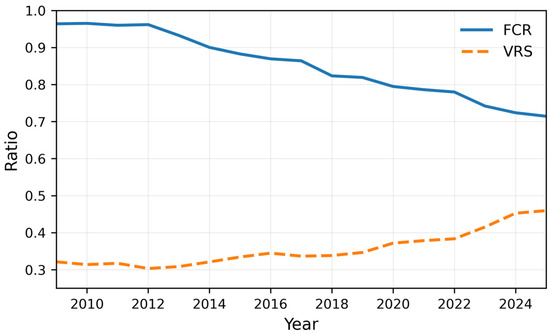
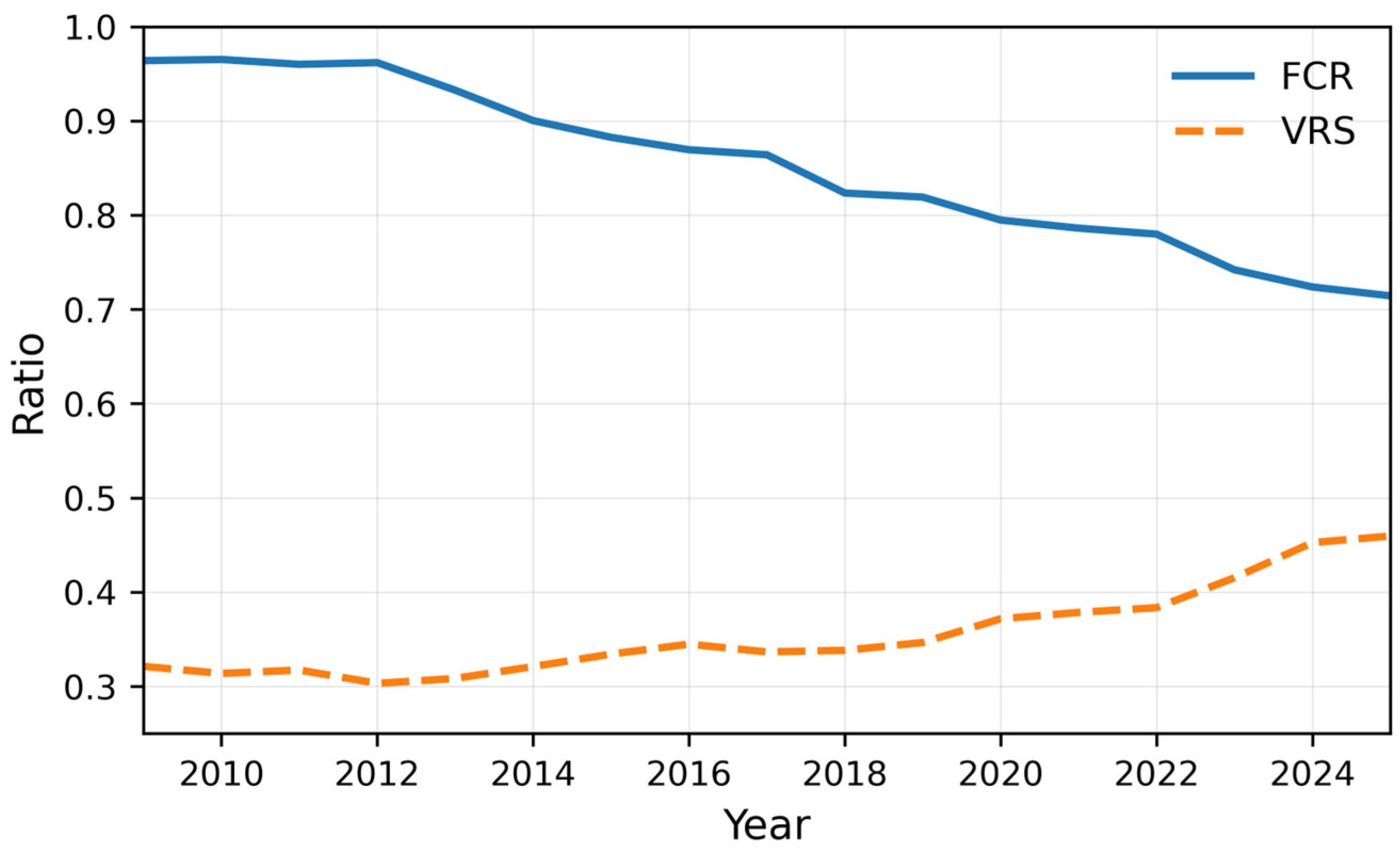
Over 2009–2025, VRS increased from approximately 32% to 46%, reflecting the expansion of wind and solar capacity in Morocco’s electricity mix.
Over the same period, thermal generation remained dominant, particularly coal, despite the rising renewable output. Wind expanded significantly and solar more rapidly in recent years, while hydropower showed marked interannual variability.
FCR declined from approximately 0.96 in 2009 to 0.71 in 2025, indicating a lower share of firm capacity relative to total installed capacity. Recent pumped-storage additions contributed to flexibility but remained limited relative to NDRE growth (Figure 1).
Figure 1.
Evolution of FCR and VRS in Morocco (2009–2025).
4.2. Evolution of the SFG
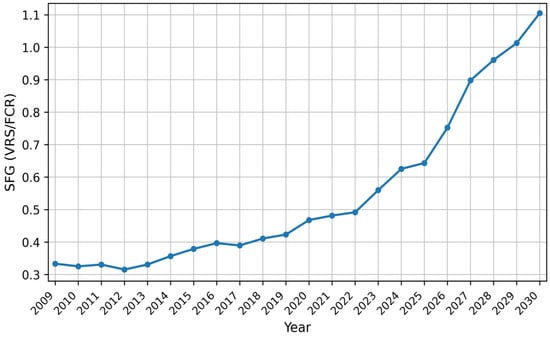
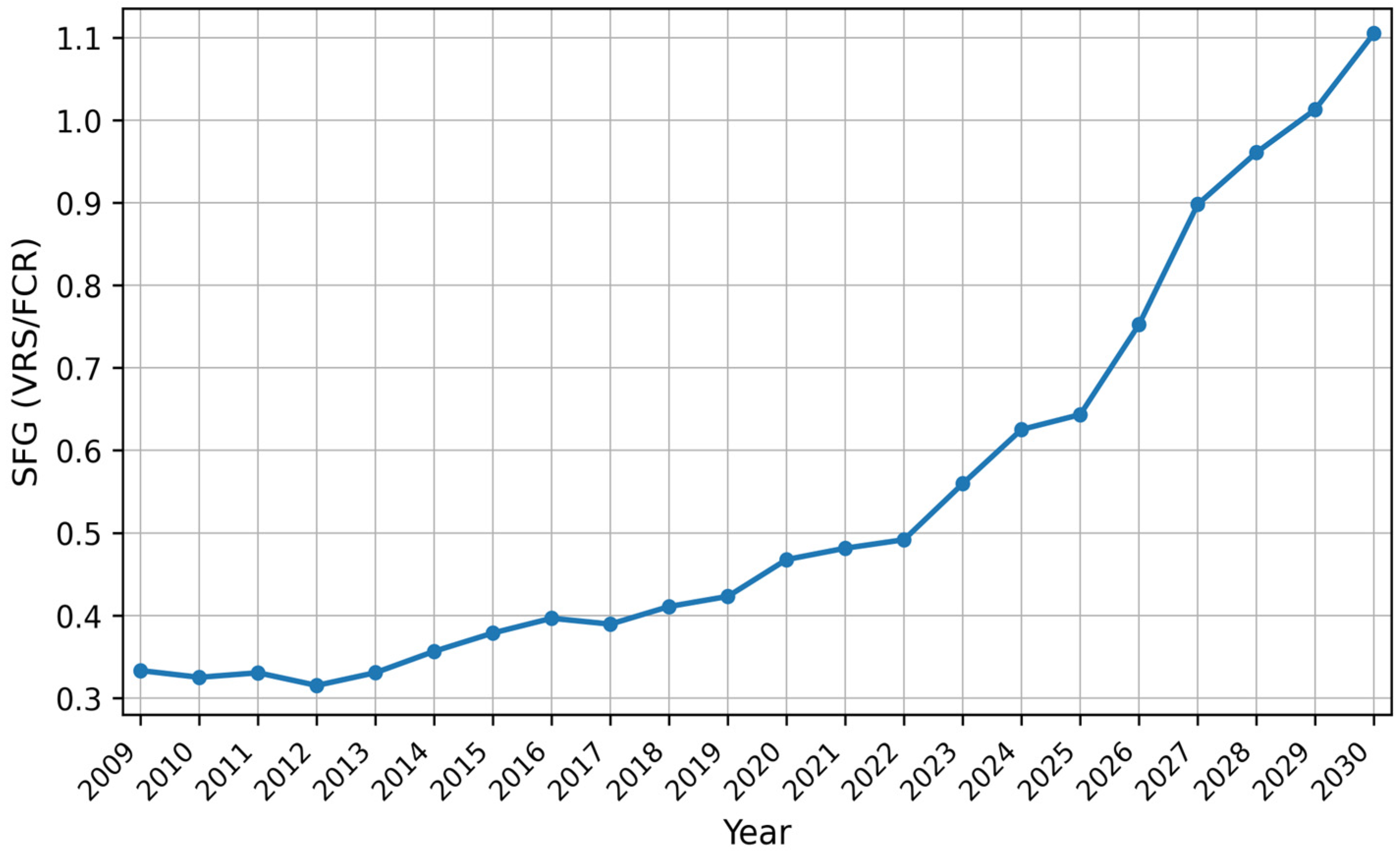
As shown in Figure 2, the SFG increased overall from 0.33 in 2009 to 0.64 in 2025, with a more pronounced rise after 2022. During the projection period, under the storage assumption η = 1.0, the SFG increases from 0.75 in 2026 to 0.90 in 2027 and 0.96 in 2028, before exceeding unity in 2029 (1.01) and reaching 1.11 in 2030. Over the same projected period, VRS increases from 0.46 to 0.55, while FCR decreases from 0.61 to 0.50.
Figure 2.
Evolution of the SFG (2009–2030).
5. Discussion
The rising SFG reflects a structural shift in which NDRE deployment outpaces the growth of firm capacity, thereby increasing flexibility requirements without necessarily implying an immediate adequacy shortfall. Comparable patterns have been reported in high-renewable power systems [3,5,20,21]. In this context, SMRs are considered as a potential firm low-carbon complement.
As an illustrative extension, a simplified 2030 scenario assessment considered the integration of 300 MW and 600 MW of additional SMR-equivalent firm capacity under unchanged renewable deployment assumptions.
As shown in Table 1, the additional firm capacity improves the FCR and moderates the projected SFG increase. Although the SFG remains structurally elevated, the results suggest that SMRs could contribute to reducing flexibility pressures in high-renewable electricity systems.
Table 1.
Illustrative impact of additional SMR capacity on the SFG in 2030.
In the longer term, such deployment pathways could also be considered within broader low-carbon infrastructure and industrial development strategies.
The evolution of VRS and FCR indicates a decreasing share of controllable capacity, increasing reliance on fossil-based backup during critical periods. SMRs offer a stable, weather-independent low-carbon alternative [10,13]. Their contribution can enhance adequacy and limit reliance on fossil generation for peak supply [5,22].
In addition to capacity adequacy, SMRs can support system operation through flexible generation and grid services [15]. Their ability to adjust output can alleviate ramping constraints and reduce dependence on fossil-based flexibility. In Morocco, when solar variability is significant, SMRs could smooth demand–supply transitions, preserve system inertia, and reinforce frequency stability [10].
The projected expansion of gas-based flexibility increases exposure to external risks. Strengthening energy security requires diversification of generation technologies. SMRs can contribute to this objective by providing domestic firm low-carbon capacity and reducing exposure to imported-fuel price volatility and supply disruptions [23]. Their integration into hybrid systems also broadens their role beyond electricity generation. These considerations complement assessments of Morocco’s nuclear-infrastructure preparedness [24] and broader international reviews of SMR development [25].
6. Conclusions
This study investigates the structural evolution of the Moroccan power system under increasing NDRE penetration. The findings reveal a growing imbalance between NDRE variability and limited firm capacity expansion. The proposed SFG provides an indication of the evolving misalignment between renewable penetration and available controllable capacity. The results reveal a persistent structural constraint with potential implications for adequacy, stability, and resilience.
SMRs emerge as a potential source of low-carbon firm capacity supporting system balancing and long-term resilience. Their role should complement other flexibility options rather than serve as a standalone solution.
The proposed framework provides a practical basis for assessing structural flexibility in high-NDRE power systems.
Author Contributions
Conceptualization, K.E.-A.; methodology, K.E.-A.; investigation, K.E.-A.; data curation, K.E.-A. and K.C.; writing—original draft preparation, K.E.-A.; writing—review and editing, K.E.-A. and K.C.; supervision, E.M.C. All authors have read and agreed to the published version of the manuscript.
Funding
This research received no external funding.
Institutional Review Board Statement
Not applicable.
Informed Consent Statement
Not applicable.
Data Availability Statement
The data supporting the findings of this study are available from the corresponding author upon reasonable request.
Conflicts of Interest
The authors declare no conflicts of interest.
References
- Autorité Nationale de Régulation de l’Électricité (ANRE). Annual Report 2024; ANRE: Rabat, Morocco, 2024. [Google Scholar]
- International Energy Agency (IEA). Electricity Grids and Secure Energy Transitions; IEA: Paris, France, 2023. [Google Scholar]
- Hirth, L. The Market Value of Variable Renewables: The Effect of Solar and Wind Power Variability on Their Relative Price. Energy Econ. 2013, 38, 218–236. [Google Scholar] [CrossRef] [Scilit]
- Rahman, M.M.; Dadon, S.H.; He, M.; Giesselmann, M.; Hasan, M.M. An Overview of Power System Flexibility: High Renewable Energy Penetration Scenarios. Energies 2024, 17, 6393. [Google Scholar] [CrossRef] [Scilit]
- Jenkins, J.D.; Zhou, Z.; Ponciroli, R.; Vilim, R.B.; Ganda, F.; de Sisternes, F.; Botterud, A. The Benefits of Nuclear Flexibility in Power System Operations with Renewable Energy. Appl. Energy 2018, 222, 872–884. [Google Scholar] [CrossRef] [Scilit]
- Office National de l’Électricité et de l’Eau Potable (ONEE). Conseil d’Administration de l’ONEE tenu le 21 avril 2025. Communiqué de Presse. 21 April 2025. Available online: https://www.onep.org.ma/news/2025/CDP-CA-ONEE-21-04-2025/CDP-CA.pdf (accessed on 15 December 2025).
- Lew, D.; Miller, N. Reaching New Solar Heights: Integrating High Penetrations of PV into the Power System. IET Renew. Power Gener. 2017, 11, 20–26. [Google Scholar] [CrossRef] [Scilit]
- International Energy Agency (IEA). Integrating Solar and Wind: Global Experience and Emerging Challenges; IEA: Paris, France, 2024. [Google Scholar]
- European Network of Transmission System Operators for Electricity (ENTSO-E). European Resource Adequacy Assessment 2023 Edition: ACER’s Approved and Amended Version; ENTSO-E: Brussels, Belgium, 2024. [Google Scholar]
- Michaelson, D.; Jiang, J. Review of Integration of Small Modular Reactors in Renewable Energy Microgrids. Renew. Sustain. Energy Rev. 2021, 152, 111638. [Google Scholar] [CrossRef] [Scilit]
- International Energy Agency (IEA). Status of Power System Transformation 2019: Power System Flexibility; IEA: Paris, France, 2019. [Google Scholar]
- OECD Nuclear Energy Agency (NEA). The Role of Nuclear Energy in a Low-Carbon Energy Future; OECD Publishing: Paris, France, 2012. [Google Scholar] [CrossRef] [Scilit]
- OECD Nuclear Energy Agency (NEA). Small Modular Reactors: Challenges and Opportunities; OECD Publishing: Paris, France, 2021. [Google Scholar] [CrossRef] [Scilit]
- Locatelli, G.; Fiordaliso, A.; Boarin, S.; Ricotti, M.E. Cogeneration: An Option to Facilitate Load Following in Small Modular Reactors. Prog. Nucl. Energy 2017, 97, 153–161. [Google Scholar] [CrossRef] [Scilit]
- Krūmiņš, J.; Kļaviņš, M. Investigating the Potential of Nuclear Energy in Achieving a Carbon-Free Energy Future. Energies 2023, 16, 3612. [Google Scholar] [CrossRef] [Scilit]
- Han, D.; Zhu, D.Z.; Huang, G.; Gao, S.; Liu, L. Sustainable Power System Transition Pathways: Regional Decarbonization and Resource Conservation Aided by Small Modular Reactors. Resour. Conserv. Recycl. 2026, 226, 108649. [Google Scholar] [CrossRef] [Scilit]
- Rath, M.; Morgan, M.G. Assessment of a Hybrid System That Uses Small Modular Reactors (SMRs) to Back up Intermittent Renewables and Desalinate Water. Prog. Nucl. Energy 2020, 122, 103269. [Google Scholar] [CrossRef] [Scilit]
- Sakhraoui, K.; Agadi, R.; von Hirschhausen, C.; Ege, G.S. Energy Policy in Morocco: Analysis of the National Energy Strategy’s Impact on Sustainable Energy Supply and Transformation. Next Res. 2024, 1, 100072. [Google Scholar] [CrossRef] [Scilit]
- International Atomic Energy Agency (IAEA). Milestones in the Development of a National Infrastructure for Nuclear Power; IAEA Nuclear Energy Series No. NG-G-3.1; IAEA: Vienna, Austria, 2007. [Google Scholar]
- Keane, A.; Milligan, M.; Dent, C.J.; Hasche, B.; D’Annunzio, C.; Dragoon, K.; Holttinen, H.; Samaan, N.; Söder, L.; O’Malley, M. Capacity Value of Wind Power. IEEE Trans. Power Syst. 2011, 26, 564–572. [Google Scholar] [CrossRef] [Scilit]
- Söder, L.; Tómasson, E.; Estanqueiro, A.; Flynn, D.; Hodge, B.-M.; Kiviluoma, J.; Korpås, M.; Neau, E.; Couto, A.; Pudjianto, D.; et al. Review of Wind Generation within Adequacy Calculations and Capacity Markets for Different Power Systems. Renew. Sustain. Energy Rev. 2020, 119, 109540. [Google Scholar] [CrossRef] [Scilit]
- Sepulveda, N.A.; Jenkins, J.D.; de Sisternes, F.J.; Lester, R.K. The Role of Firm Low-Carbon Electricity Resources in Deep Decarbonization of Power Generation. Joule 2018, 2, 2403–2420. [Google Scholar] [CrossRef] [Scilit]
- Schmitz, R.; Flachsbarth, F.; Plaga, L.S.; Braun, M.; Härtel, P. Energy Security and Resilience: Revisiting Concepts and Advancing Planning Perspectives for Transforming Integrated Energy Systems. Energy Policy 2025, 207, 114796. [Google Scholar] [CrossRef] [Scilit]
- Housni, H.; Amrous, N.; Daoudi, N.; Malzi, M.J. Country Profiling through IAEA Milestones Approach: A Comprehensive Analysis of the Moroccan Nuclear Infrastructure. IFAC-PapersOnLine 2024, 58, 751–756. [Google Scholar] [CrossRef] [Scilit]
- International Atomic Energy Agency (IAEA). Small Modular Reactors: Advances in SMR Developments 2024; IAEA: Vienna, Austria, 2024. [Google Scholar] [CrossRef] [Scilit]

Disclaimer/Publisher’s Note: The statements, opinions and data contained in all publications are solely those of the individual author(s) and contributor(s) and not of MDPI and/or the editor(s). MDPI and/or the editor(s) disclaim responsibility for any injury to people or property resulting from any ideas, methods, instructions or products referred to in the content. |
© 2026 by the authors. Licensee MDPI, Basel, Switzerland. This article is an open access article distributed under the terms and conditions of the Creative Commons Attribution (CC BY) license.