


Abstract
To address the conflict between pulsed fusion output and continuous Rankine cycle operation, a decoupled dual-medium energy storage model (molten salt/thermal oil) is established. Results show that coupling low-grade heat reduces Rankine cycle efficiency from 45.08% to 40.82%, yet net power output increases by 9%. Consequently, the global power generation efficiency improves from 26.92% to 29.34%. This confirms the critical role of full-spectrum, cascaded heat source matching in enhancing the economic viability of pulsed fusion reactors.
1. Introduction
Due to plasma instabilities, the power output of a tokamak device is inherently pulsed [1], creating a contradiction with the continuous, stable input required by a Rankine cycle steam turbine. Therefore, an intermediate energy storage system (ESS) must be integrated between the fusion reactor and the power generation block to ensure continuous power output [2]. Furthermore, a tokamak fusion reactor possesses multiple heat sources that differ significantly in temperature grade and power scale, rendering single-loop thermodynamic cycle designs commonly used in conventional fission or fossil fuel power plants unsuitable [3].
Previous studies have typically focused on single-medium energy storage or isolated thermodynamic cycle analyses. Examples include the comparison of WCCB/HCCB blanket concepts by Li et al. [4], and independent investigations of DEMO blanket cycle efficiency and operating conditions by Wang et al. [5] and Bubelis et al. [6]. However, a thorough investigation into the coupling mechanism between high- and low-temperature heat sources and the global energy balance characteristics under specific pulse duty cycles is still lacking. In view of this, this study focuses on the COOL (the supercritical carbon dioxide cooled Lithium–Lead) blanket concept [7], an advanced candidate blanket for the CFEDR (China Fusion Engineering Demonstration Reactor). A holistic thermodynamic model integrating a dual-medium ESS with a Rankine cycle is constructed to analyze the power matching principles among multi-grade heat sources under pulsed operation. Through systematic energy balance calculations, the thermodynamic feasibility of the coupled energy storage and power generation scheme is assessed, and the influence of key parameters on system performance is evaluated. This work aims to provide a theoretical basis for the engineering design of the CFEDR energy conversion system.
2. Methodology
2.1. CFEDR Model Description
The CFEDR employs the COOL blanket. The parameters for each heat source are provided in Table 1.
Table 1.
CFEDR heat source parameters.
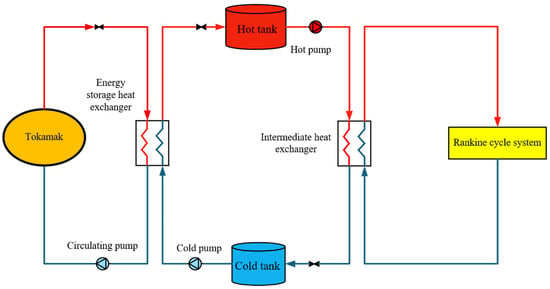
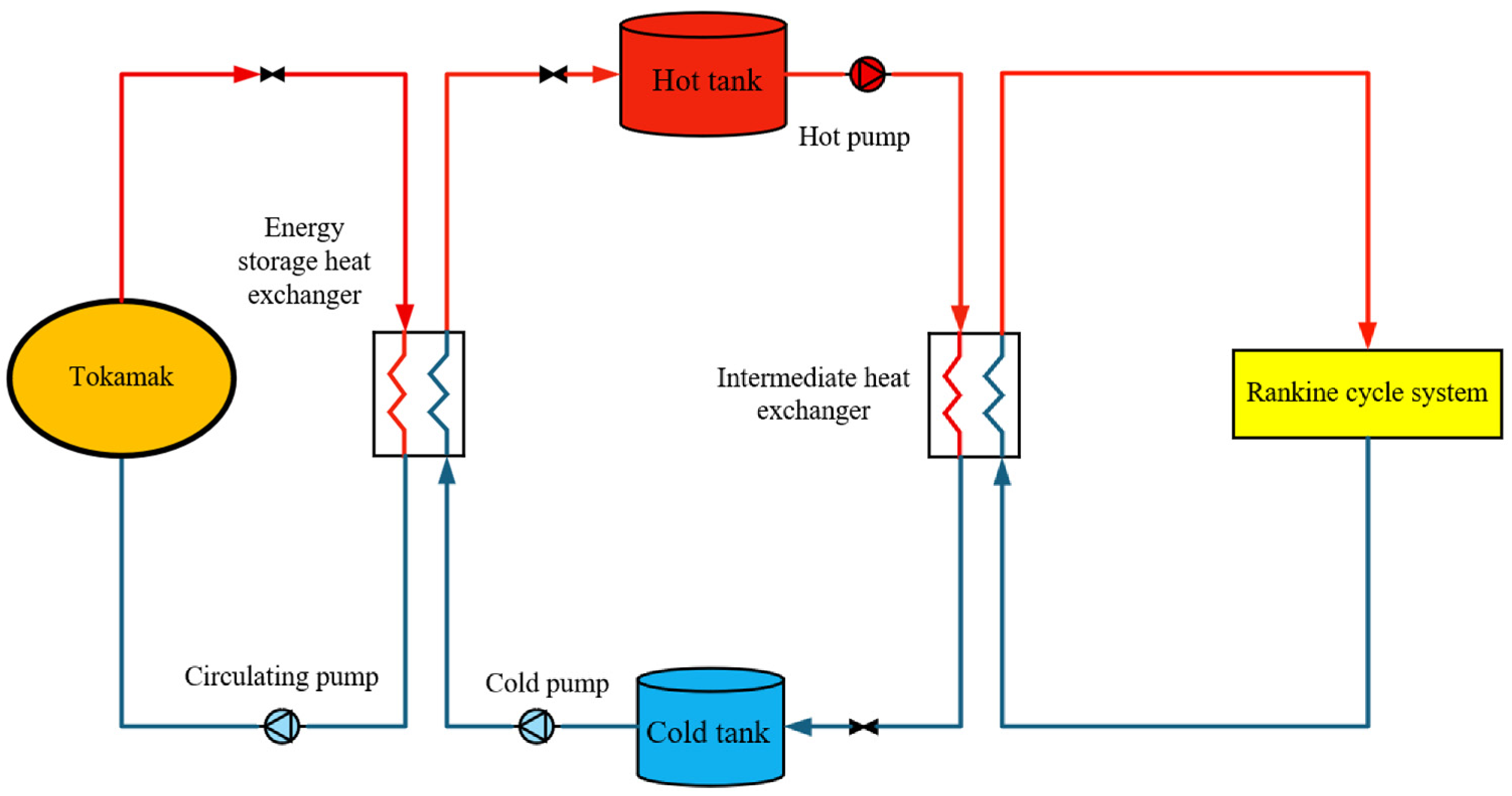
The CFEDR energy conversion system comprises the tokamak cooling loops, energy storage loops, and the Rankine cycle loop, interconnected via heat exchangers. The layout of the CFEDR energy conversion system is illustrated in Figure 1.
Figure 1.
Schematic layout of the CFEDR energy conversion system.
The following assumptions are made:
- The energy storage and discharge processes are treated as quasi-steady-state conditions, with dynamic effects during start-up and shutdown neglected. The fusion reactor is assumed to operate cyclically at full power for 1.5 h, followed by a 0.5 h dwell period.
- Heat dissipation losses are neglected, and all components are treated as adiabatic.
2.2. Energy Storage System Description
The CFEDR blanket heat sources are characterized by high temperatures, making them suitable as the primary heat source for the Rankine cycle. Conversely, the divertor and vacuum vessel heat sources operate at lower temperatures and can be utilized for feedwater preheating. For the blanket heat sources, binary molten salt Solar Salt (operating temperature range: 220–600 °C) is selected as the storage medium [8], with a hot tank temperature of 565 °C and a cold tank temperature of 310 °C [9]. Therminol 66 thermal oil (−3–345 °C) serves as the low-temperature storage medium. The ESS in this study adopts a decoupled dual-tank operational mode. The two blanket heat sources are integrated in series via heat exchangers [10].
During the burn phase, cold salt flows through the S-CO2 and LiPb heat exchangers to absorb blanket heat; part of it is stored in the hot tank, and the rest is supplied to the Rankine cycle. During the dwell period, the hot tank alone discharges to maintain Rankine cycle operation. The divertor and vacuum vessel use the same configuration (hot/cold oil tanks at 190 °C/75 °C).
2.3. Rankine Cycle Description
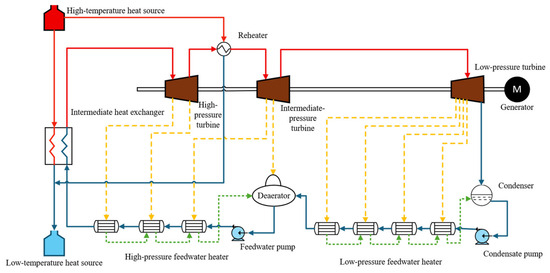
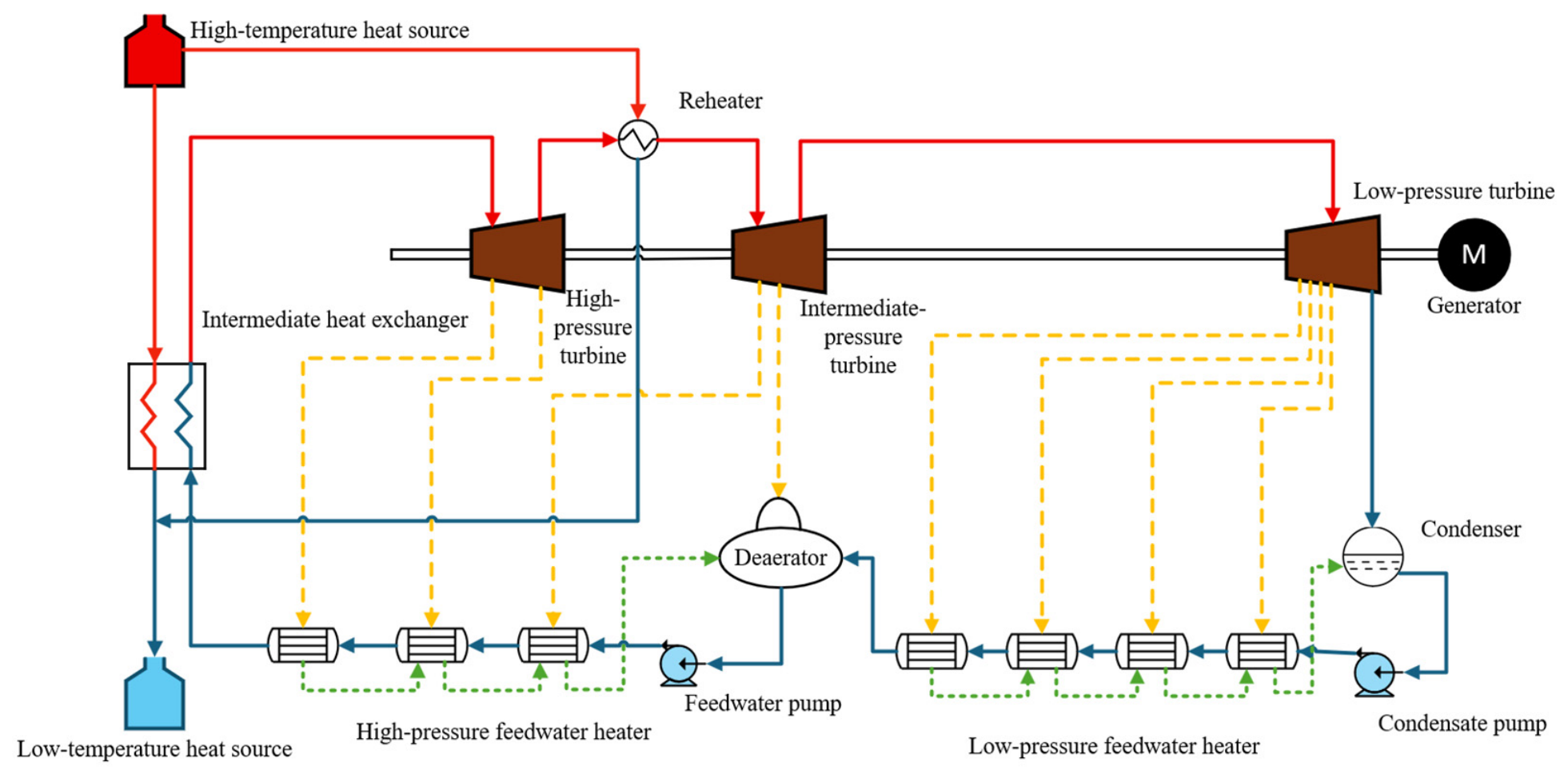
Drawing on experience from coal-fired power plants and concentrated solar power (CSP) stations, a subcritical unit with main steam conditions of 17 MPa/540 °C/540 °C is selected. The cycle features a back pressure of 5 kPa, a feedwater temperature of 278 °C, and a single stage of intermediate reheating. The regenerative heating configuration consists of three high-pressure heaters, one deaerator, and four low-pressure heaters (3HP + 1DEA + 4LP), for a total of eight feedwater heating stages. The schematic is shown in Figure 2.
Figure 2.
Schematic of the Rankine cycle configuration.
To widen the heat exchange temperature window for low-temperature heat sources and thereby enable high-power heat recovery, the low-pressure heaters were eliminated to lower the feedwater inlet temperature.
2.4. ESS Thermodynamic Equilibrium Calculation Model
The CFEDR power output is simplified to a periodic mode: burn phase followed by dwell. A cycle t is defined: 0–t0 at full power P; t0–t at zero power. The ESS delivers constant power P0 to the Rankine cycle over t, giving
Pt0 = P0t
Burn phase (all energy to ESS):
PESS,in = P
Dwell phase (ESS discharge):
PESS,out = P0 = Pt0/t
3. Results and Discussion
3.1. ESS Thermodynamic Equilibrium Analysis
The scheme requires about 5012 t of molten salt, with two tanks each of 3336 m3 (15% dead volume). The thermal oil system requires about 2220 t and two tanks of 2785 m3 each.
3.2. Rankine Cycle Thermodynamic Equilibrium Analysis
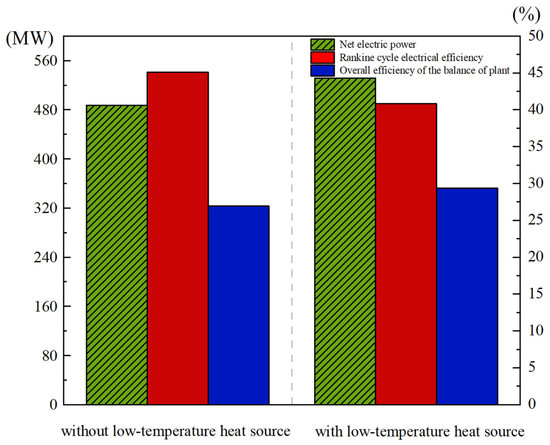
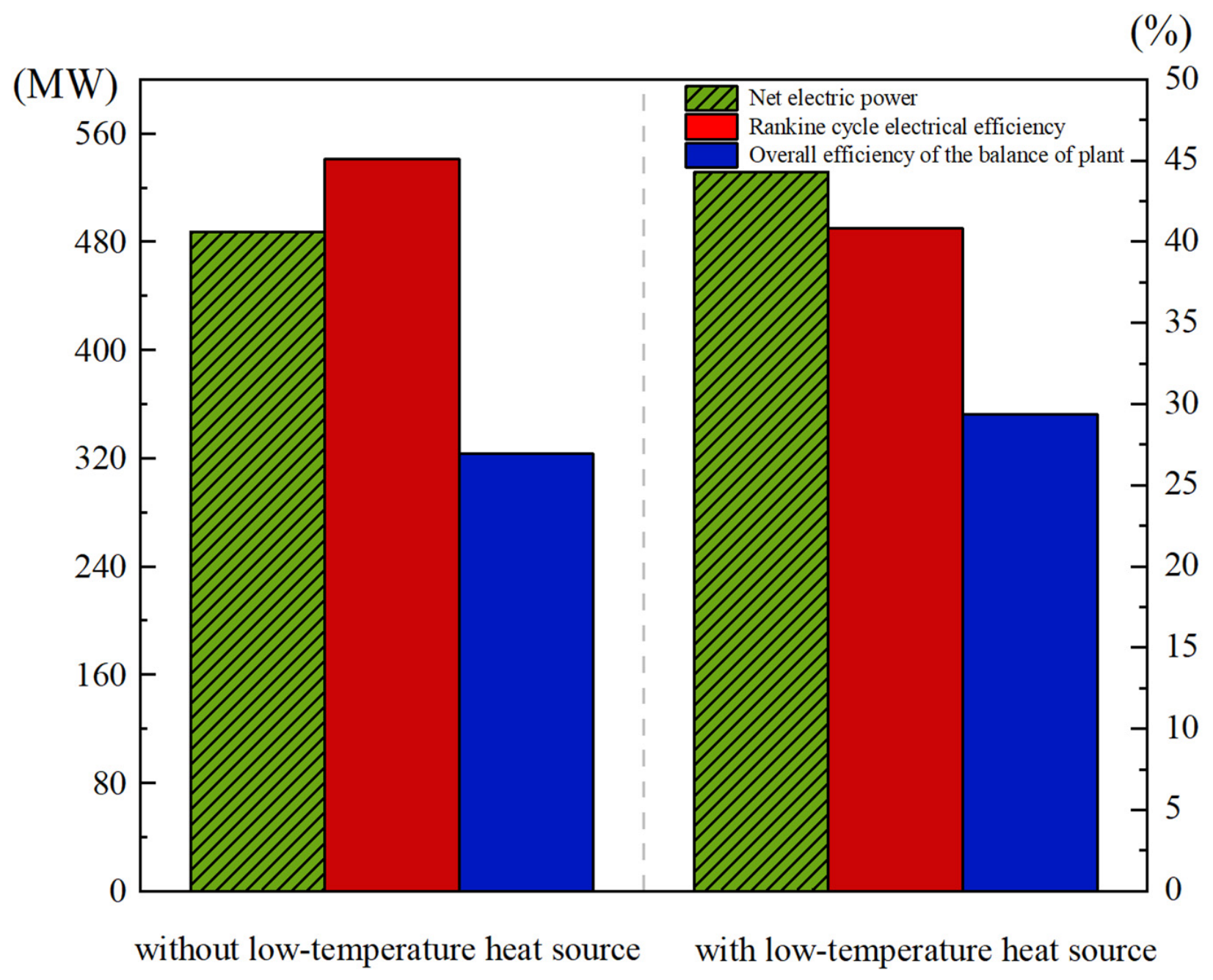
Based on the principles of mass and energy conservation, the power generation performance of the Rankine cycle within the decoupled scheme was evaluated under two scenarios: “utilizing only the high-grade blanket heat source” and “coupling the low-temperature heat source for feedwater preheating.” Constrained by the terminal temperature difference at the hot end of the preheating heat exchanger, the effectively utilizable thermal power from the low-grade heat source is approximately 220 MW. The heat from the divertor could not be fully absorbed, and the vacuum vessel heat remained temporarily untapped. The calculated results for both scenarios are presented in Figure 3. The Rankine cycle power generation efficiency is defined as the ratio of the net generator power output to the total thermal power discharged from the ESS. The energy conversion system generation efficiency is defined as the ratio of the net generator power output to the total thermal power of the fusion heat sources.
Figure 3.
Comparison of results for low-grade heat source utilization schemes.
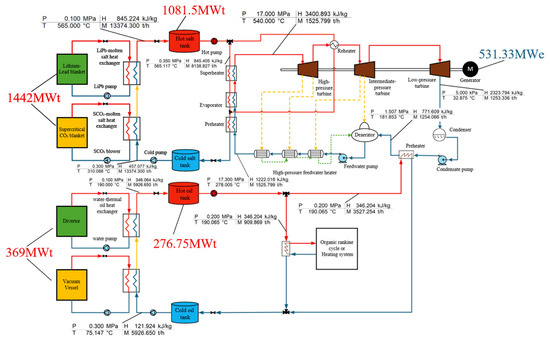
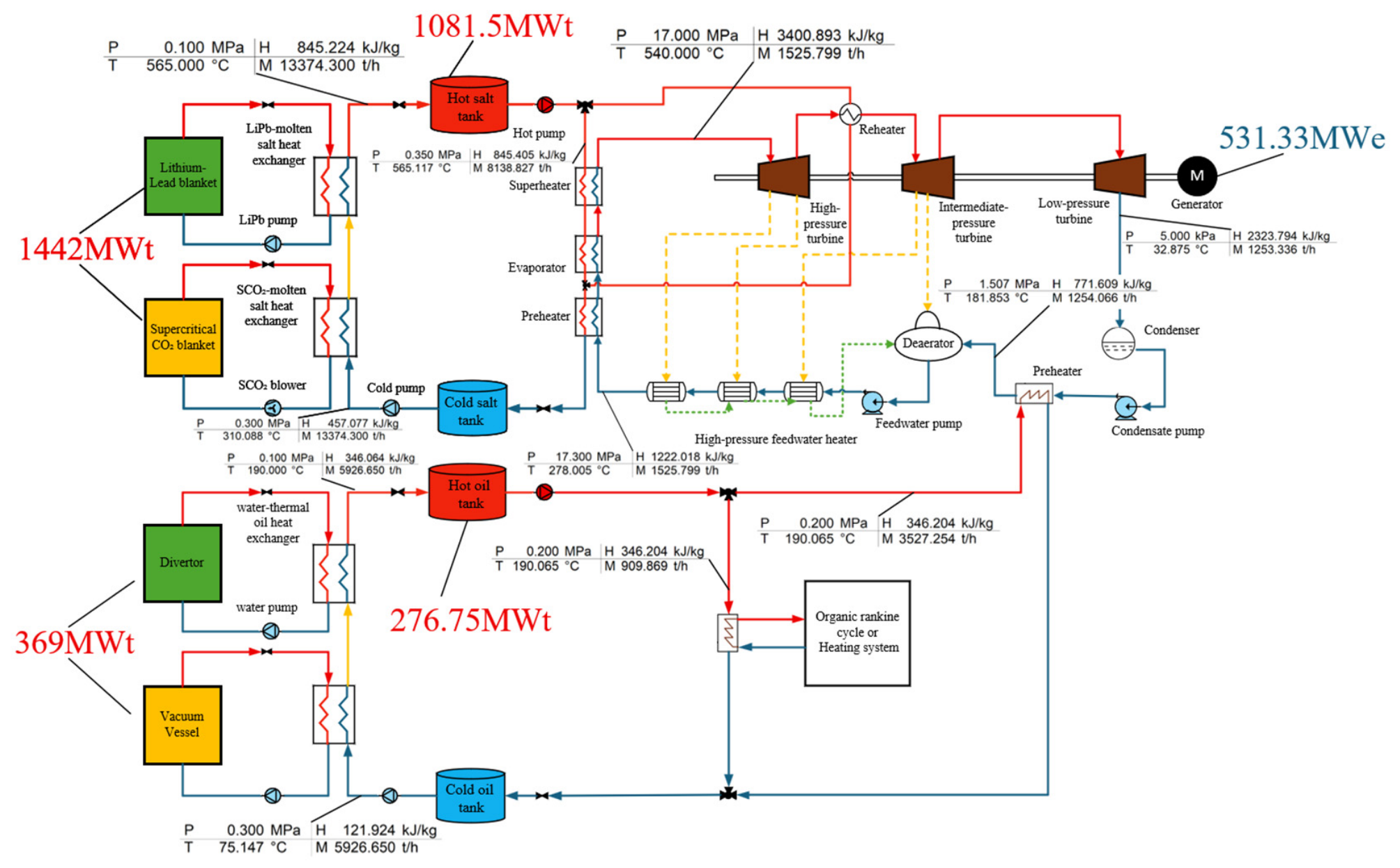
After integrating the low-grade heat source, the net electric power output increased from 487.53 MW to 531.33 MW, boosting the energy conversion system generation efficiency from 26.92% to 29.34%. However, the stand-alone Rankine cycle efficiency decreased from 45.08% to 40.82%. This phenomenon arises because the low-grade heat source has a low temperature but a substantial thermal power. Its integration reduces the weighted average heat absorption temperature of the steam–water cycle, thereby diminishing the Rankine cycle thermal efficiency [11]. Nevertheless, by converting previously wasted low-grade heat into useful energy input, the extraction steam from the low-pressure turbine is reduced, and the available enthalpy drop is increased. Consequently, both net power output and overall plant efficiency are enhanced. The remaining unused low-grade heat could be considered for driving an independent Organic Rankine Cycle (ORC) or for district heating applications to further improve the system’s comprehensive energy efficiency. The overall thermodynamic equilibrium calculation results for the fusion energy conversion system are shown in Figure 4.
Figure 4.
Thermodynamic equilibrium calculation diagram for the CFEDR energy conversion system.
4. Conclusions
This study proposes a dual-medium decoupled energy storage scheme using molten salt and thermal oil to resolve the conflict between the pulsed power output of the CFEDR and the continuous operation requirement of the Rankine cycle. A thermodynamic equilibrium calculation analysis of the energy conversion system was conducted, leading to the following primary conclusions:
- Under a pulse duty cycle of 1.5 h operation/0.5 h dwell, the proposed dual-medium decoupled ESS can effectively buffer the 1442 MW high-grade heat source and the 369 MW low-grade heat source from the fusion reactor. It delivers stable thermal power of 1081.5 MW and 276.75 MW, respectively, to the Rankine cycle, achieving continuous power generation under pulsed operating conditions.
- By utilizing waste heat from the divertor and vacuum vessel to preheat the feedwater, the net electric power output increases from 487.53 MW to 531.33 MW, and the energy conversion system generation efficiency improves from 26.92% to 29.34%. Although the Rankine cycle stand-alone efficiency decreases from 45.08% to 40.82% due to a lower weighted average heat absorption temperature, the global energy utilization efficiency is substantially improved by converting low-grade heat from a waste stream into a valuable input.
- Constrained by the terminal temperature difference of the preheating heat exchanger, only about 220 MW of the low-grade heat can be effectively utilized. It is recommended that the remaining heat be recovered via a coupled independent ORC or used for district heating to further enhance the comprehensive energy efficiency of the system.
Author Contributions
Conceptualization, M.G., R.T. and S.T.; methodology, Y.S. and M.G.; validation, Y.S. and H.J.; formal analysis, Y.S.; investigation, Y.S., M.G., H.J., Z.L. (Zhaojun Li) and Z.L. (Zhaosen Liu).; resources, R.T. and S.T.; data curation, H.J., Z.L. (Zhaojun Li) and Z.L. (Zhaosen Liu); writing—original draft preparation, Y.S.; writing—review and editing, M.G., Y.S. and R.T.; visualization, H.J.; supervision, M.G., R.T. and S.T.; project administration, M.G. and R.T. All authors have read and agreed to the published version of the manuscript.
Funding
This research was funded by the Fundamental Research Funds for the Central Universities, grant number 3072025PT1502.
Institutional Review Board Statement
Not applicable.
Informed Consent Statement
Not applicable.
Data Availability Statement
The raw data supporting the conclusions of this article will be made available by the authors on request.
Acknowledgments
The authors sincerely thank the College of Nuclear Science and Technology at Harbin Engineering University for providing the computational resources and laboratory facilities essential to this study. We also appreciate the valuable discussions with colleagues from the Fusion Energy Technology Co., Ltd. regarding the COOL blanket design parameters.
Conflicts of Interest
Author Zhaojun Li was employed by the company Fusion Energy Technology Co., Ltd. The remaining authors declare that the research was conducted in the absence of any commercial or financial relationships that could be construed as a potential conflict of interest.
Abbreviations
The following abbreviations are used in this manuscript:
| CFEDR | China Fusion Engineering Demonstration Reactor |
| LiPb | Lithium–Lead |
| S-CO2 | Supercritical Carbon Dioxide |
References
- Barucca, L.; Ciattaglia, S.; Chantant, M.; Del Nevo, A.; Hering, W.; Martelli, E.; Moscato, I. Status of EU DEMO Heat Transport and Power Conversion Systems. Fusion Eng. Des. 2018, 136, 1557–1566. [Google Scholar] [CrossRef] [Scilit]
- Barucca, L.; Bubelis, E.; Ciattaglia, S.; D’Alessandro, A.; Del Nevo, A.; Giannetti, F.; Hering, W.; Lorusso, P.; Martelli, E.; Moscato, I.; et al. Pre-Conceptual Design of EU DEMO Balance of Plant Systems: Objectives and Challenges. Fusion Eng. Des. 2021, 169, 112504. [Google Scholar] [CrossRef] [Scilit]
- Khan, M.S.; Guo, B.; Rong, J.; Imran, M.; Fan, X.; Hussian, M.T.; Song, Y. A Comprehensive Review of Primary Heat Transfer and Energy Conversion Systems in Fusion Power Plants. Energy 2026, 344, 139722. [Google Scholar] [CrossRef] [Scilit]
- Li, H.; Liang, Z.; Xiang, K.; Xu, Q.; Su, H.; Song, Z.; Gao, G.; Fu, P. The Energy Output Equilibrium Scheme with Intermediate Energy Storage for Tokamak Fusion Power Plant. Fusion Eng. Des. 2024, 208, 114669. [Google Scholar] [CrossRef] [Scilit]
- Wang, S.; Hernández, F.A.; Bubelis, E.; Chen, H. Comparative Analysis of the Efficiency of a CO2-Cooled and a He-Cooled Pebble Bed Breeding Blanket for the EU DEMO Fusion Reactor. Fusion Eng. Des. 2019, 138, 32–40. [Google Scholar] [CrossRef] [Scilit]
- Bubelis, E.; Ruck, S. Design Update of DEMO BOP for HCPB BB Concept with an Energy Storage System. Fusion Eng. Des. 2024, 206, 114610. [Google Scholar] [CrossRef] [Scilit]
- Jiang, K.; Yu, Y.; Ma, X.; Yu, Y.; Yang, J.; Chen, L.; Huang, K.; Chen, L.; Zhang, N.; Ni, M.; et al. Research on the Thermal Hydraulic Design of COOL Blanket for CFETR. Fusion Eng. Des. 2022, 176, 113053. [Google Scholar] [CrossRef] [Scilit]
- Cihlář, M.; Entler, S.; Loskot, J.; Dostál, V.; Prehradný, J.; Zácha, P. Molten Salts Evaluation for Application in the Fusion Power Plant’s Intermediate Heat Transfer System. Fusion Eng. Des. 2023, 194, 113907. [Google Scholar] [CrossRef] [Scilit]
- Dunn, R.I.; Hearps, P.J.; Wright, M.N. Molten-Salt Power Towers: Newly Commercial Concentrating Solar Storage. Proc. IEEE 2012, 100, 504–515. [Google Scholar] [CrossRef] [Scilit]
- Chen, L.; Jiang, K.; Ma, X.; Wu, Q.; Yu, Y.; Lu, P.; Cheng, X.; Chen, L.; Yang, J.; Zhu, Q.; et al. Conceptual Design of the Supercritical CO2 Cooled Lithium Lead Blanket for CFETR. Fusion Eng. Des. 2021, 173, 112800. [Google Scholar] [CrossRef] [Scilit]
- Moon, S.J.; Moon, H.; Lee, N. Thermo-Economic Analysis of Balance of Plant for Energy Conversion System in Korean DEMO Fusion Power Plant. Energy Convers. Manag. 2025, 336, 119869. [Google Scholar] [CrossRef] [Scilit]

Disclaimer/Publisher’s Note: The statements, opinions and data contained in all publications are solely those of the individual author(s) and contributor(s) and not of MDPI and/or the editor(s). MDPI and/or the editor(s) disclaim responsibility for any injury to people or property resulting from any ideas, methods, instructions or products referred to in the content. |
© 2026 by the authors. Licensee MDPI, Basel, Switzerland. This article is an open access article distributed under the terms and conditions of the Creative Commons Attribution (CC BY) license.