


Abstract
Next-generation reactors and concentrating solar power (CSP) systems require compact heat exchangers operating under extreme conditions. This study evaluates the thermo-hydraulic performance and material compatibility of Gyroid (TPMS) heat exchangers for molten salt applications. The Gyroid structure significantly enhances heat transfer through high surface area and improved fluid mixing. However, this advantage is accompanied by inevitable pressure drops. Therefore, optimizing the heat transfer and hydraulic loss (PEC) balance using Functionally Graded Hybrid (FGH-TPMS) designs and corrosion-resistant materials (Haynes 282, UHTC) is essential. Results indicate that Gyroid heat exchangers are promising candidates for compact thermal systems.
1. Introduction
The efficiency of advanced energy systems operating under extreme regimes, such as aerospace, nuclear, and concentrated solar power (CSP), directly depends on compact thermal management [1,2]. While conventional shell-and-tube heat exchangers face volumetric limits under high power densities, compact Triply Periodic Minimal Surface (TPMS) geometries offer a promising alternative due to their exceptionally high surface area-to-volume ratios.
In high-temperature CSP and nuclear reactors, molten salts are excellent working fluids but are limited by low thermal conductivity. This limitation severely hinders the overall thermal efficiency and crucial charge/discharge transient dynamics of phase change thermal storage systems [3]. To address this challenge, TPMS scaffolds—specifically Gyroid geometries—are ideal solutions, as their complex internal topologies generate secondary vortices that suppress flow separation and dramatically enhance fluid mixing.
This study evaluates the thermo-hydraulic performance and material compatibility of Gyroid and other TPMS configurations in molten salt heat exchangers, integrating literature findings on heat transfer, pressure drop, and corrosion to establish design optimization strategies for industrial-scale thermal systems.
2. Molten Salts
2.1. Advantages and Disadvantages of Molten Salts
In advanced energy systems, particularly in nuclear energy, concentrated solar power (CSP), and thermal energy storage (TES) applications, the ability of the working fluid to operate stably under high-temperature regimes is of critical importance. In this context, molten salts have become a central component of innovative heat exchanger technologies owing to their favorable thermophysical properties and their capability to enable higher volumetric power densities within thermal systems [4]. These fluids play a significant role in the transition from conventional shell-and-tube systems to next-generation compact heat exchanger designs, thereby contributing to improved thermal efficiency. Nevertheless, the high-temperature potential of molten salts also introduces industrial challenges associated with material corrosion, complex flow dynamics, and salt purification requirements [4].
One of the major barriers preventing the widespread industrial implementation of molten salt technology is the corrosion imposed on structural materials. The corrosive attack induced by high-temperature molten salt flow can create substantial design constraints, particularly for advanced heat exchanger components manufactured through additive manufacturing (3D printing) techniques [4]. Corrosion experiments conducted on additively manufactured 316L stainless steel have demonstrated that corrosion severity is strongly dependent on salt composition. Under specific laboratory conditions, chloride-based salts were reported to produce the most severe surface degradation by triggering active oxidation mechanisms, followed by carbonate and nitrate/nitrite-based salts [5]. In carbonate salts, the high activity of lithium ions may lead to the formation of corrosion products such as LiFeO2 and LiCrO2, resulting in the depletion of iron (Fe) and chromium (Cr) elements on the steel surface and the formation of micro-vacancies acting as diffusion pathways. Although nitrate/nitrite-based salts exhibit relatively greater material stability, localized structural deformations associated with the formation of NaFeO2 have also been identified [5].
2.2. Classification and Thermophysical Properties of Molten Salts
A review of recent literature indicates that molten salts are generally classified into three primary categories according to their application fields. These fluids are most commonly utilized as primary heat transfer fluids in concentrated solar power (CSP) plants and as sensible or latent heat storage media in thermal energy storage (TES) systems [2,4]. In addition, they serve a critical role as primary coolants and intermediate heat exchanger fluids in advanced next-generation nuclear reactor concepts, particularly molten salt reactors (MSRs) [4,6]. Beyond these large-scale energy production systems, molten salts are also being investigated as innovative thermal buffering solutions for managing high heat fluxes in confined volumes within advanced thermal management applications such as aerospace systems and high-performance power electronics [1,7].
Achieving the desired thermal performance and system stability across this broad range of applications is directly dependent on the chemical composition of the selected fluid and the operating temperature regime. In accordance with these structural and thermal requirements, molten salts are fundamentally classified according to their dominant anion groups as chlorides, fluorides, nitrates, and carbonates. This chemical classification directly determines the operational limitations of the system. For example, nitrate-based salts provide suitable solutions for CSP systems operating at relatively moderate temperatures [2,5], whereas carbonate, chloride, and fluoride salts are generally preferred for advanced systems requiring high-temperature operation [4,8]. In particular, the thermophysical properties of fluoride-based salts such as the FLiNaK eutectic mixture are of considerable importance for next-generation nuclear reactors and advanced thermal systems. Experimental measurement of properties such as density, viscosity, and thermal conductivity at elevated temperatures is challenging due to corrosion and impurity-control difficulties. Consequently, computational approaches, including Molecular Dynamics (MD) simulations and machine learning-based Moment Tensor Potentials (MTPs), are widely employed to predict the thermophysical behavior of these salts [8]. The general characteristics of the primary molten salt groups investigated in the literature are summarized in Table 1.
Table 1.
Molten salt types and corrosion characteristics [4,5,8].
3. Transition to Compact Molten Salt Heat Exchangers
The efficient transfer of the high-temperature potential and thermal energy storage capability of molten salts to power cycles is directly dependent on the thermo-hydraulic performance of heat exchangers [4]. Structural limitations associated with high operating regimes, together with the increasing demand for volumetric power density, necessitate the transition of heat transfer surfaces from conventional configurations toward ultra-compact geometries [9,10]. In these systems, passive enhancements (e.g., tape inserts, air bubble injection) in conventional shell-and-tube configurations provide limited improvements and remain restricted by large physical dimensions and high pressure drops [9].
This structural bottleneck has accelerated the development of “compact” heat exchanger designs capable of simultaneously providing high-temperature and high-pressure resistance while maximizing heat transfer within restricted volumes. Among these, Printed Circuit Heat Exchangers (PCHEs) with zigzag channel configurations have long been recognized as a standard solution in the literature [9]. Nevertheless, the substantial pressure losses associated with PCHE channel structures have directed recent research toward “ultra-compact” alternatives. Numerical and experimental investigations have demonstrated that TPMS-based heat exchangers can achieve thermal performances comparable to conventional PCHE systems within significantly smaller volumes [10]. Their smooth, continuously branching three-dimensional topologies inherently suppress flow separation and enhance fluid mixing. Under specific boundary conditions, TPMS geometries such as Gyroid and Diamond have been reported to achieve exceptionally high volumetric power densities (e.g., approximately 700 W/cm3 in certain studies) [11]. These findings indicate that TPMS heat exchangers possess substantial potential for next-generation high-energy-density thermal systems.
4. Gyroid (TPMS) Structures in Heat Exchangers
Triply Periodic Minimal Surface (TPMS) geometries possess internal topologies that enable three-dimensional and homogeneous fluid mixing. Previous studies have reported that Gyroid, Diamond, and IWP geometries can achieve higher Nusselt (Nu) numbers in convective heat transfer applications compared to conventional fin-based systems [12]. This enhancement is driven by “merge-split” flow characteristics; specifically, the helical flows and secondary circulations generated within Gyroid geometries significantly intensify mixing and heat transfer [13]. At high flow velocities, solid TPMS structures have also been reported to exhibit stable thermo-hydraulic behavior [14]. Furthermore, the smooth topology of bio-inspired Gyroid structures has been shown to suppress flow separation and provide substantial heat transfer enhancement under specific operating conditions, such as supercritical CO2 (sCO2) cycles [15].
To systematically evaluate the thermo-hydraulic performance and pressure drop penalties of these complex Gyroid geometries, a fundamental theoretical analysis must be established. The core convective heat transfer and hydraulic flow characteristics are governed by the Reynolds number (Re), the Nusselt number (Nu), and the Darcy friction factor (f), which are mathematically defined as [10]:
where ρ is the fluid density, v is the fluid velocity, Dh represents the hydraulic diameter of the TPMS unit cell, μ is the dynamic viscosity, h is the convective heat transfer coefficient, k is the thermal conductivity of the fluid, and ΔP is the pressure drop across the flow length L.
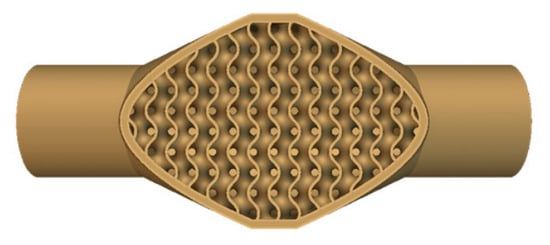
To visualize these intricate internal flow channels and understand how the fluid transitions through the manifolds, the physical CAD model of the designed Gyroid TPMS heat exchanger core is illustrated in Figure 1.
Figure 1.
Cross-sectional CAD view of the Gyroid TPMS heat exchanger.
To optimize these advantages, topology control can increase the convective heat transfer coefficient while reducing the friction factor [16]. Additionally, “combined Gyroid” structures integrating sheet and skeletal designs offer a more balanced compromise between mixing and pressure loss [17]. Furthermore, post-processing techniques like surface polishing are crucial to mitigate additive manufacturing-induced surface roughness, which can otherwise trigger friction losses exceeding theoretical predictions [18].
Advances in manufacturing and design methodologies have also directly improved the compatibility of TPMS structures with high-temperature working fluids. Numerical investigations addressing the operating conditions of intermediate heat exchangers in molten salt reactors have proposed new correlations for the thermal performance of Gyroid and Diamond structures. These studies reported that both TPMS geometries exhibit comparable heat transfer performance, although pressure drop optimization remains a critical issue for Gyroid configurations [6]. Moreover, as conventional alloys degrade in corrosive chloride salts, Ultra-High-Temperature Ceramic (UHTC) TPMS structures fabricated via binder jetting offer a promising alternative, with manufacturing feasibility demonstrated for Schwarz-D structures [19]. These results support the potential of ceramic TPMS heat exchangers for molten salt applications, although their long-term corrosion resistance requires further validation.
5. Design Optimizations
To translate the theoretical advantages of Gyroid and other TPMS structures into industrial-scale applications, comprehensive design optimization strategies are required. The primary limitations of conventional heat exchangers in molten salt systems are associated with thermal inertia and large physical dimensions. Numerical investigations have demonstrated that TPMS structures can significantly enhance heat transfer performance compared to conventional printed circuit heat exchanger (PCHE) designs within specific parameter ranges [20]. Nevertheless, while reducing the hydraulic diameter under high-temperature and high-pressure conditions increases volumetric power density, it introduces challenges related to sealing integrity and mechanical durability due to thinner walls [21].
As pressure losses increase with decreasing hydraulic diameter, the Performance Evaluation Criterion (PEC), which relates heat transfer enhancement to pressure drop penalty, has become the primary metric used in the literature for comparing the thermo-hydraulic efficiency of different designs. As a general synthesis of the existing literature, the advantages, performance metrics, and operating conditions associated with various TPMS geometries relative to conventional configurations (e.g., PCHEs or straight tubes) are summarized in Table 2.
Table 2.
Performance comparison of TPMS heat exchangers.
An examination of the performance metrics summarized in Table 2 indicates that IWP and Diamond structures generally outperform other geometries in terms of pure heat transfer enhancement, whereas Gyroid structures provide superior overall thermo-hydraulic efficiency when pressure-drop balance and PEC values are considered [20]. However, current research trends increasingly favor hybrid configurations that combine the advantages of multiple geometries rather than relying on a single TPMS architecture. Functionally Graded Hybrid TPMS (FGH-TPMS) structures employing Gyroid geometries in the inlet region and Diamond geometries in the outlet region [22], as well as conformal geometric designs proposed to improve manufacturability and reduce leakage risks [23], demonstrate considerable potential for improving flow distribution uniformity.
Beyond topological optimization, overall system efficiency depends on material selection and thermal integration. The use of nickel-based superalloys like Haynes 282 is common for nitrate systems and sCO2/molten salt Brayton cycles [24]. Under certain conditions, optimized Haynes 282 Gyroid heat exchangers enhance heat transfer while partially reducing hydraulic resistance [25]. In aggressive chloride-based environments, UHTC-based ceramic TPMS structures are increasingly proposed. Another effective approach to maximize thermal efficiency is integrating thermal energy storage. For applications involving thermal energy storage (TES) or fluctuating loads, incorporating Phase Change Materials (PCMs) into TPMS matrices is widely recommended. Owing to its high surface area, the Gyroid geometry mitigates PCM low thermal conductivity, shortens melting times compared to conventional foams, and improves system thermal response [7].
6. Conclusions and Future Perspectives
This study evaluated the thermo-hydraulic performance and material compatibility of molten salt TPMS heat exchangers. The synthesis of the literature indicates that Gyroid and Diamond geometries offer innovative alternatives when conventional designs reach volumetric and thermal limits. Specifically, Functionally Graded Hybrid (FGH-TPMS) configurations show great promise in balancing heat transfer enhancement with pumping power. Key thermal–material pairings identified include:
- Haynes 282 designs for low-corrosive nitrate salts;
- UHTC ceramic-based structures for highly corrosive chloride salts;
- PCM–Gyroid integration for thermal buffering.
To advance these designs from laboratory scale to industrial standards and higher Technology Readiness Levels (TRLs), future research should prioritize:
- Dynamic Corrosion Testing: Long-term experimental analysis of corrosion mechanisms under high-velocity flow.
- Fouling and Scaling: Analysis of impurity-driven fouling within complex Gyroid channels in full-scale prototypes.
- Multi-Objective Optimization: Utilizing ANNs and MTPs to simultaneously optimize structural integrity, manufacturing costs, and thermo-hydraulic efficiency.
Author Contributions
Conceptualization, H.M.Ş.; methodology, İ.U. and H.M.Ş.; investigation, İ.U.; writing—original draft preparation, İ.U.; writing—review and editing, H.M.Ş.; supervision, H.M.Ş. All authors have read and agreed to the published version of the manuscript.
Funding
This research received no external funding.
Institutional Review Board Statement
Not applicable.
Informed Consent Statement
Not applicable.
Data Availability Statement
No new data were created or analyzed in this study. Data sharing is not applicable to this article.
Acknowledgments
During the preparation of this study, the authors used artificial intelligence to check the text’s grammar, improving language and readability. After using this tool, the authors reviewed and edited the content as needed and are fully responsible for the content of the published article.
Conflicts of Interest
The authors declare no conflicts of interest.
References
- Rashid, F.L.; Hammoodi, K.A.; Al Maimuri, N.M.L.; Abdalrahem, M.K.; Mohammed, H.I.; Ameen, A.; Agyekum, E.B.; Bouabidi, A. Triply periodic minimal surface heat exchanger: Innovations, mathematical modelling, and performance enhancement-a state-of-the-art review. Int. Commun. Heat Mass Transf. 2026, 175, 111120. [Google Scholar] [CrossRef] [Scilit]
- Alghamdi, A.; Boetcher, S.K.S.; Chen, L.; Diaz, G.; Lee, H.; Li, P.; Melendez, I.; Morgan, K.B.; Mwesigye, A.; Najafi, H.; et al. Review of selected heat transfer topics for solar thermal energy utilization and storage. J. Sol. Energy Eng. 2025, 147, 050801. [Google Scholar] [CrossRef] [Scilit]
- ELSihy, E.S.; Mokheimer, E.M.; Gado, M.G. Melting and solidification characteristics of integrated phase change material/triply periodic minimal surface structures: Toward augmented latent heat thermal energy storage systems. Int. Commun. Heat Mass Transf. 2026, 172, 110503. [Google Scholar] [CrossRef] [Scilit]
- Zheng, C.; Cheng, K.; Han, D. High-temperature molten salt heat exchanger technology: Research advances, challenges, and future perspectives. Energies 2025, 18, 3195. [Google Scholar] [CrossRef] [Scilit]
- Abu-warda, N.; Garcia-Rodriguez, S.; Torres, B.; Utrilla, M.V.; Rams, J. Effect of molten salts composition on the corrosion behavior of additively manufactured 316L stainless steel for concentrating solar power. Metals 2024, 14, 639. [Google Scholar] [CrossRef] [Scilit]
- Renon, C.; Jeanningros, X. A numerical investigation of heat transfer and pressure drop correlations in Gyroid and Diamond TPMS-based heat exchanger channels. Int. J. Heat Mass Transf. 2025, 239, 126599. [Google Scholar] [CrossRef] [Scilit]
- Qureshi, Z.A.; Elnajjar, E.; Al-Ketan, O.; Al-Rub, R.A.; Al-Omari, S.B. Heat transfer performance of a finned metal foam-phase change material (FMF-PCM) system incorporating triply periodic minimal surfaces (TPMS). Int. J. Heat Mass Transf. 2021, 170, 121001. [Google Scholar] [CrossRef] [Scilit]
- Rybin, N.; Maksimov, D.; Zaikov, Y.; Shapeev, A. Thermophysical properties of molten FLiNaK: A moment tensor potential approach. J. Mol. Liq. 2024, 410, 125402. [Google Scholar] [CrossRef] [Scilit]
- Khan, M.A.; Ilyas, M.; Waheed, K.; Haq, I.; Aydogan, F. Advances in passive heat transfer enhancement for heat exchangers: A comprehensive review. J. Therm. Eng. 2025, 11, 1148–1159. [Google Scholar] [CrossRef] [Scilit]
- Wang, J.; Chen, K.; Zeng, M.; Ma, T.; Wang, Q.; Cheng, Z. Assessment of flow and heat transfer of triply periodic minimal surface based heat exchangers. Energy 2023, 282, 128806. [Google Scholar] [CrossRef] [Scilit]
- Qian, C.; Wang, J.; Qiu, X.; Yan, L.; Yu, B.; Shi, J.; Chen, J. Numerical and experimental investigation of ultra-compact triply periodic minimal surface heat exchangers with high efficiency. Int. J. Heat Mass Transf. 2024, 233, 125984. [Google Scholar] [CrossRef] [Scilit]
- Tang, W.; Zhou, H.; Zeng, Y.; Yan, M.; Jiang, C.; Yang, P.; Li, Q.; Li, Z.; Fu, J.; Huang, Y.; et al. Analysis on the convective heat transfer process and performance evaluation of Triply Periodic Minimal Surface (TPMS) based on Diamond, Gyroid and Iwp. Int. J. Heat Mass Transf. 2023, 201, 123642. [Google Scholar] [CrossRef] [Scilit]
- Yan, K.; Wang, J.; Li, L.A.; Deng, H. Numerical investigation into thermo-hydraulic characteristics and mixing performance of triply periodic minimal surface-structured heat exchangers. Appl. Therm. Eng. 2023, 230, 120748. [Google Scholar] [CrossRef] [Scilit]
- Hu, J.; Xu, W.; Liang, H.; Shi, J.; Tang, W.; Guo, B.; Yang, J.; Zhu, L. Flow and heat transfer characteristics of 3D printed sheet and solid triply periodic minimal surfaces porous structures. Sci. Rep. 2025, 15, 29255. [Google Scholar] [CrossRef] [Scilit] [PubMed]
- Li, W.; Yu, G.; Yu, Z. Bioinspired heat exchangers based on triply periodic minimal surfaces for supercritical CO2 cycles. Appl. Therm. Eng. 2020, 179, 115686. [Google Scholar] [CrossRef] [Scilit]
- Tang, W.; Zou, C.; Zhou, H.; Zhang, L.; Zeng, Y.; Sun, L.; Zhao, Y.; Yan, M.; Fu, J.; Hu, J.; et al. A novel convective heat transfer enhancement method based on precise control of Gyroid-type TPMS lattice structure. Appl. Therm. Eng. 2023, 230, 120797. [Google Scholar] [CrossRef] [Scilit]
- Beer, M.; Rybár, R. Optimisation of Heat Exchanger Performance Using Modified Gyroid-Based TPMS Structures. Processes 2024, 12, 2943. [Google Scholar] [CrossRef] [Scilit]
- Yan, K.; Deng, H.; Xiao, Y.; Wang, J.; Luo, Y.; Yan, J. Influence of polishing process on surface morphology and thermo-hydraulic performance of additively manufactured Gyroid-structured heat exchanger. Appl. Therm. Eng. 2024, 253, 123828. [Google Scholar] [CrossRef] [Scilit]
- Kelly, J.P.; Finkenauer, L.R.; Roy, P.; Stolaroff, J.K.; Nguyen, D.T.; Ross, M.S.; Hoff, A.T.; Haslam, J.J. Binder jet additive manufacturing of ceramic heat exchangers for concentrating solar power applications with thermal energy storage in molten chlorides. Addit. Manuf. 2022, 56, 102937. [Google Scholar] [CrossRef] [Scilit]
- Shanmugam, A.R.; Park, K.S. Thermal–hydraulic characteristics of molten salt and supercritical CO2 in triply periodic minimal surface heat exchangers for concentrated solar power applications. Appl. Therm. Eng. 2026, 296, 130745. [Google Scholar] [CrossRef] [Scilit]
- Dharmalingam, L.; O’Malley, B.; Tancabel, J.; Aute, V. Design, optimization, and validation of a triply periodic minimal surface based heat exchanger for extreme temperature applications. Int. J. Heat Mass Transf. 2025, 242, 126797. [Google Scholar] [CrossRef] [Scilit]
- Wang, J.; Qian, C.; Zhang, F.; Qiu, X.; Yu, B.; Shi, J.; Chen, J. Experimental and numerical analysis of functionally graded hybrid TPMS heat exchangers for enhanced flow and thermal performance. Appl. Therm. Eng. 2025, 264, 125528. [Google Scholar] [CrossRef] [Scilit]
- Zhang, Y.; Peng, F.; Jia, H.; Zhao, Z.; Wang, P.; Duan, S.; Lei, H. Conformal geometric design and additive manufacturing for special-shaped TPMS heat exchangers. Int. J. Heat Mass Transf. 2025, 247, 127146. [Google Scholar] [CrossRef] [Scilit]
- Tano, I.N.; Rasouli, E.; Ziev, T.; Wu, Z.; Lamprinakos, N.; Seo, J.; Balhorn, L.S.; Vaishnav, P.; Rollett, A.; Narayanan, V. An additively-manufactured molten salt-to-supercritical carbon di-oxide primary heat exchanger for solar thermal power generation–Design and techno-economic performance. Sol. Energy 2022, 234, 152–169. [Google Scholar] [CrossRef] [Scilit]
- Yu, X.; Moreira, T.A.; Chen, B.; Rankouhi, B.; Thoma, D.J.; Anderson, M.H.; Qian, X. Data-driven optimization, additive manufacturing and thermohydraulic testing of a high-temperature Gyroid-based TPMS heat exchanger. Appl. Therm. Eng. 2025, 280, 128422. [Google Scholar] [CrossRef] [Scilit]

Disclaimer/Publisher’s Note: The statements, opinions and data contained in all publications are solely those of the individual author(s) and contributor(s) and not of MDPI and/or the editor(s). MDPI and/or the editor(s) disclaim responsibility for any injury to people or property resulting from any ideas, methods, instructions or products referred to in the content. |
© 2026 by the authors. Licensee MDPI, Basel, Switzerland. This article is an open access article distributed under the terms and conditions of the Creative Commons Attribution (CC BY) license.