


Abstract
This paper presents an integrated predictive energy-management approach for a hybrid photovoltaic (PV)–battery–supercapacitor system supplying a permanent-magnet synchronous motor (PMSM) drive. The architecture combines maximum power point tracking, bidirectional DC-DC conversion, battery protection, supercapacitor-based transient support, DC-link regulation, and PMSM vector control. A MATLAB/Simulink model assessed power sharing, storage behaviour, DC-link dynamics, drive response, and conversion efficiency. Simulated PV power varied between 1.1 and 4.3 kW, battery state of charge remained near 65%, DC-link voltage stayed close to its reference, and overall efficiency reached approximately 92–97%. The results show that the proposed strategy reduces battery stress, compensates short-term power peaks, and supports stable drive operation under variable generation and load conditions.
1. Introduction
Hybrid renewable-energy systems are increasingly used in applications where generation, storage, conversion, and electromechanical loads must be coordinated under non-stationary operating conditions. Photovoltaic (PV) sources are attractive for autonomous and distributed installations; however, their output depends strongly on irradiance, temperature, and load demand. A PV source alone is therefore insufficient for applications that require a stable DC bus and reliable motor-drive operation. Hybrid energy storage is a practical way to address this limitation. The battery provides energy capacity for longer intervals, whereas the supercapacitor supplies or absorbs short power pulses during rapid transients. Recent studies have separately examined predictive control in microgrids, battery–supercapacitor coordination [1,2,3,4,5], DC-link regulation, and advanced PMSM drive control [6,7,8,9,10]. This study [11] theoretically and numerically investigates heat losses in a flat-plate solar collector for solar water heating under Kazakhstan’s climatic conditions. A mathematical model based on ordinary differential equations was used to evaluate the influence of heat-loss coefficient, Nusselt, Rayleigh, and Prandtl numbers on collector efficiency. Simulation results showed that the water temperature can reach about 70 °C during the daytime. For the Almaty region, efficient system operation can be maintained from April to October, demonstrating the potential of solar water heating to reduce building energy consumption. Nevertheless, these functions are often treated as independent subsystems. In a PV-fed PMSM drive, such separation is restrictive because storage dynamics, DC-link quality, inverter operation, and torque response are coupled. This paper therefore proposes a compact integrated architecture in which predictive energy management coordinates the PV source, battery, supercapacitor, DC-link stabilizer, and PMSM vector-control subsystem. The objective is to improve energy utilization, protect the battery from rapid dynamic stress, maintain the DC-link voltage, and ensure stable PMSM operation during changes in solar generation and mechanical load.
2. Materials and Methods
2.1. Integrated System Architecture
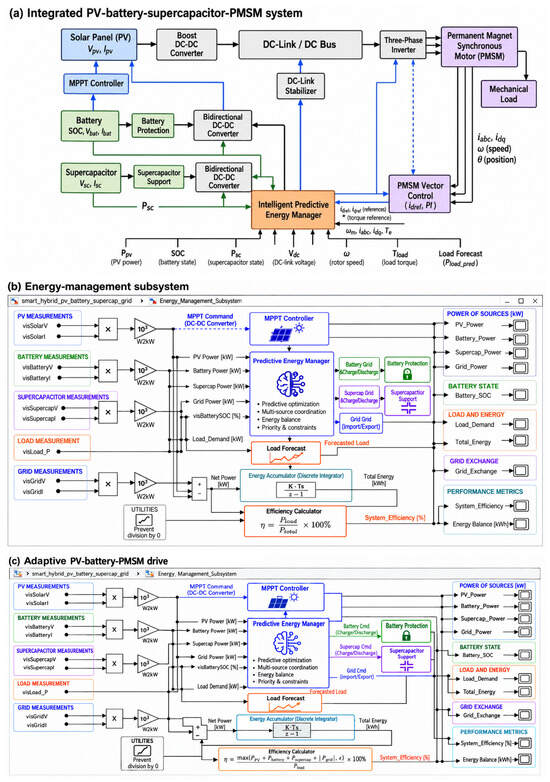
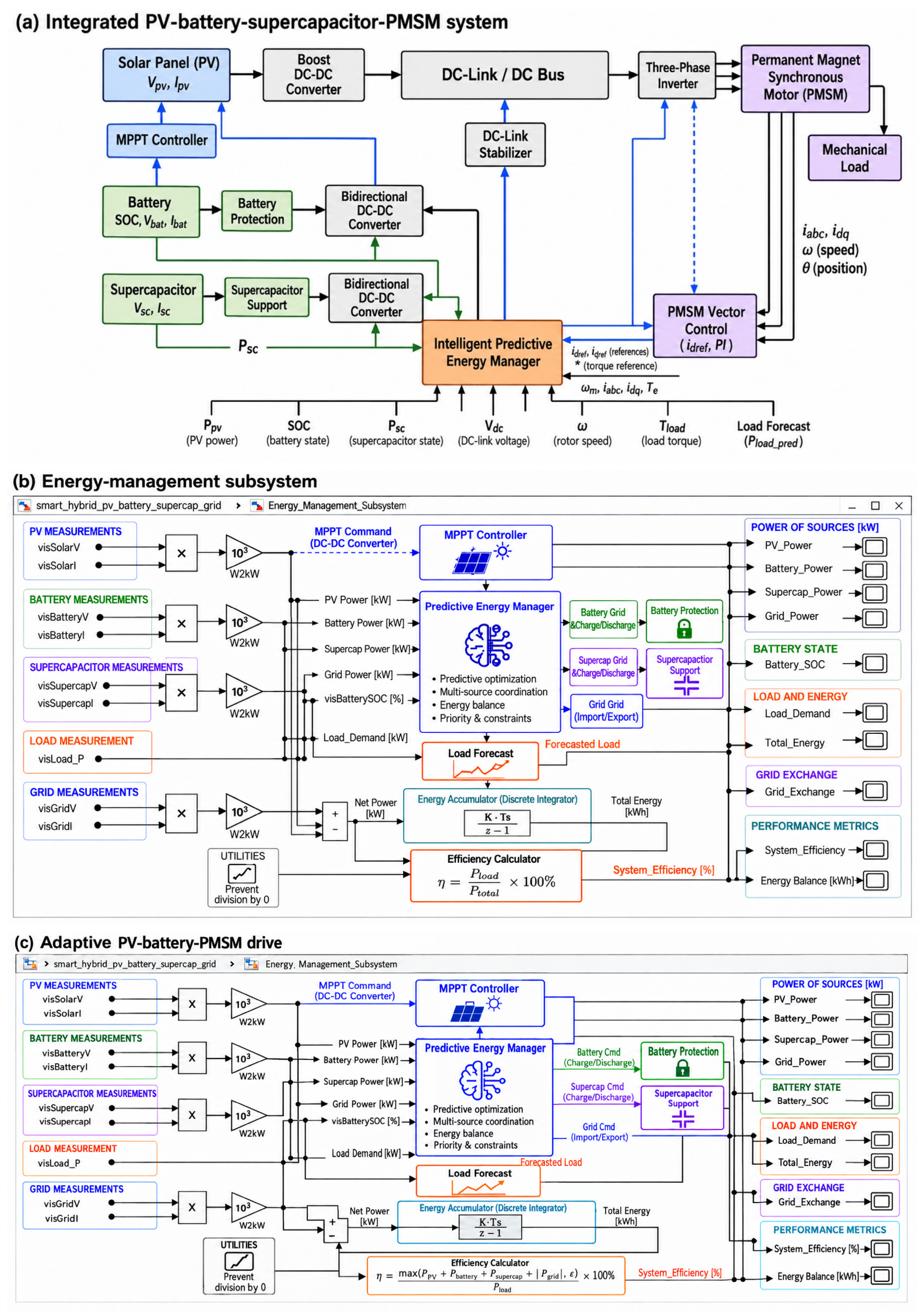
The proposed system consists of a PV array, a battery pack, a supercapacitor bank, bidirectional DC-DC converters, a shared DC-link, a three-phase inverter, and a PMSM drive. The predictive energy manager acts as the supervisory controller. It receives PV power, battery voltage and current, battery state of charge (SOC), supercapacitor power, load demand, grid-exchange information, DC-link voltage, motor speed error, and torque-related feedback. Based on these signals, it issues coordinated commands for battery charging or discharging, supercapacitor support, grid interaction, DC-link stabilization, and torque assistance. This structure differs from configurations oriented toward hydrogen production or a single storage unit. Here, the control objective is the stable supply of an electromechanical load from a variable PV source, while the battery and supercapacitor are used according to their complementary energy and power characteristics (Figure 1).
Figure 1.
Integrated architecture: (a) hybrid PV–battery–supercapacitor system with PMSM drive; (b) energy-management subsystem; (c) adaptive PV–battery–PMSM drive. In (a), the superscript asterisk (*) denotes the reference or commanded value of a control variable. Specifically, isd and isq* represent the reference currents along the d- and q-axes, respectively, while Te* denotes the reference electromagnetic torque of the PMSM. These reference values are used by the motor control system to regulate current and torque. The colors in the block diagrams are used to distinguish the functional components of the proposed energy management system. Blue blocks represent the photovoltaic source, electrical measurements, and control-related signals; green blocks indicate the battery, supercapacitor, and energy storage subsystems; orange blocks denote the predictive energy management controller and power management functions; and purple blocks identify the PMSM drive and motor control components. Solid arrows indicate the direction of power flow and signal transmission between interconnected components, whereas dashed arrows represent feedback signals and information exchange used for system monitoring and control.
2.2. Predictive Energy Management and Converter Control
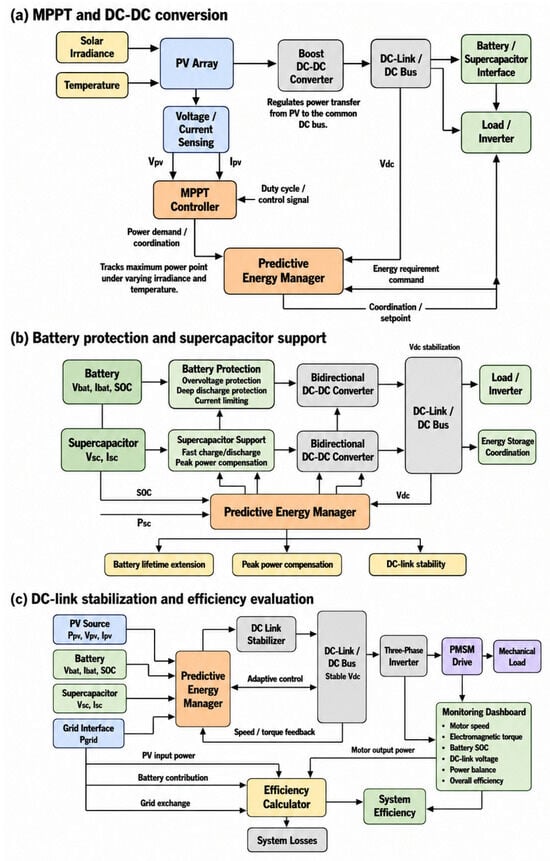
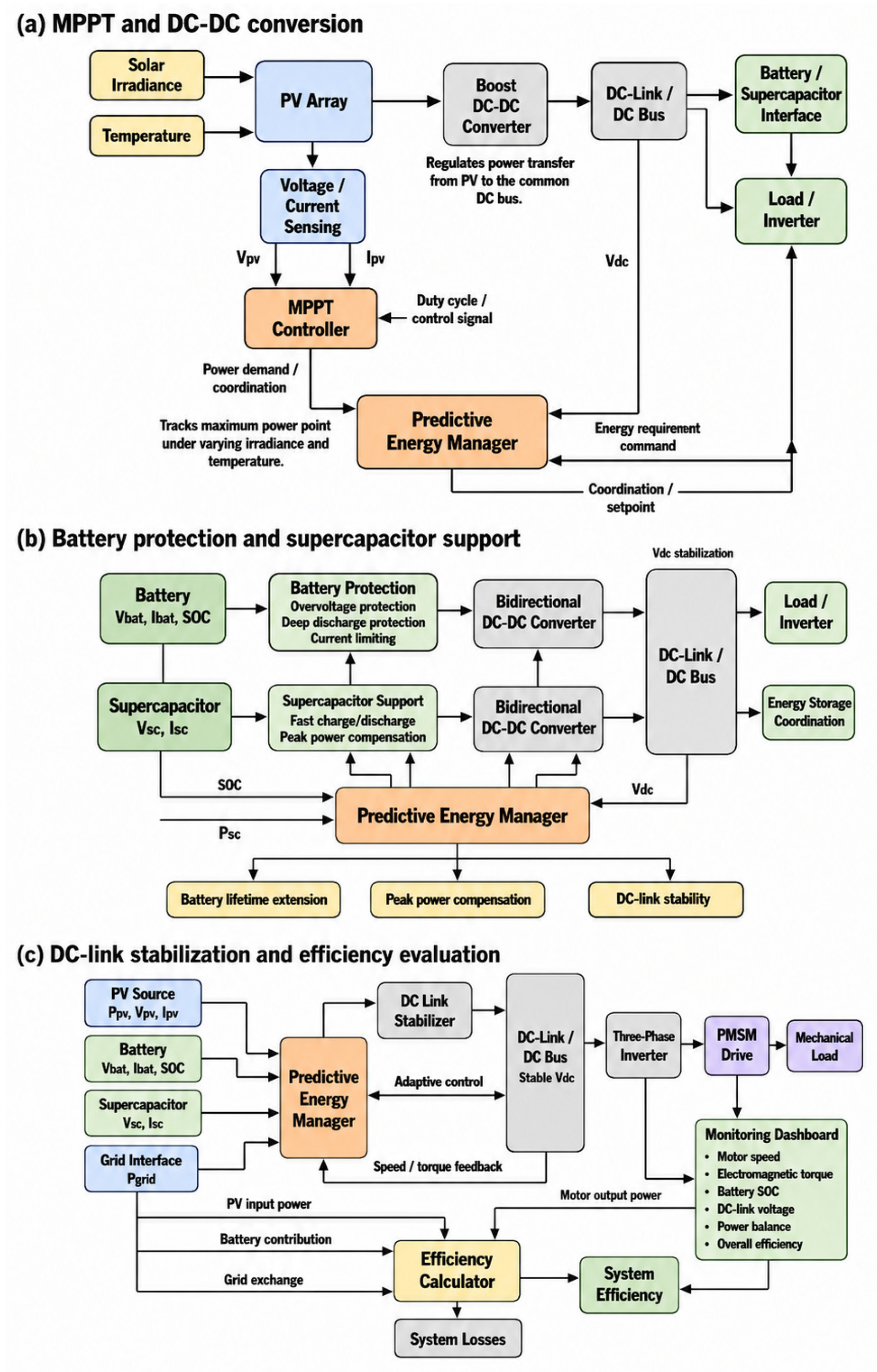
The MPPT controller regulates the PV operating point using measured voltage and current, transferring the maximum available solar power through the boost converter to the DC bus. The battery-protection block supervises voltage, current, and SOC in order to prevent deep discharge, overcharge, and excessive current. The supercapacitor is assigned to short-duration disturbances: it delivers or absorbs power during abrupt load changes and thereby reduces high-frequency battery-current variations. In the PMSM subsystem, field-oriented control is implemented through Clarke and Park transformations. The measured phase currents are transformed into the d-q reference frame, and the Id and Iq PI controllers generate voltage commands for the inverter. The DC-link stabilizer provides an additional coordination layer between the storage converters and the inverter, which is essential when PV generation and motor torque demand change at different time scales (Figure 2) [6].
Figure 2.
Main control blocks: (a) MPPT and DC-DC conversion; (b) battery protection and supercapacitor support; (c) DC-link stabilization and efficiency evaluation. The colors in Figures (a–c) are used to distinguish the functional components of the proposed energy management system. Blue blocks represent photovoltaic sources, electrical measurements, and input signals. Green blocks indicate batteries, supercapacitors, energy storage components, and monitoring functions. Orange blocks represent the MPPT controller, predictive energy manager, and associated control functions. Gray blocks identify DC–DC converters, DC-link components, and power conversion units, while purple blocks represent the PMSM drive. The arrows indicate the direction of power flow, signal transmission, and control interactions between the system components. In particular, the arrows connecting the energy sources, converters, DC-link, and loads represent electrical energy transfer, whereas arrows associated with the predictive energy manager indicate control commands, feedback signals, and coordination setpoints. The corresponding labels specify the transmitted variables, including voltage, current, state of charge (SOC), duty cycle, and power demand.
3. Results
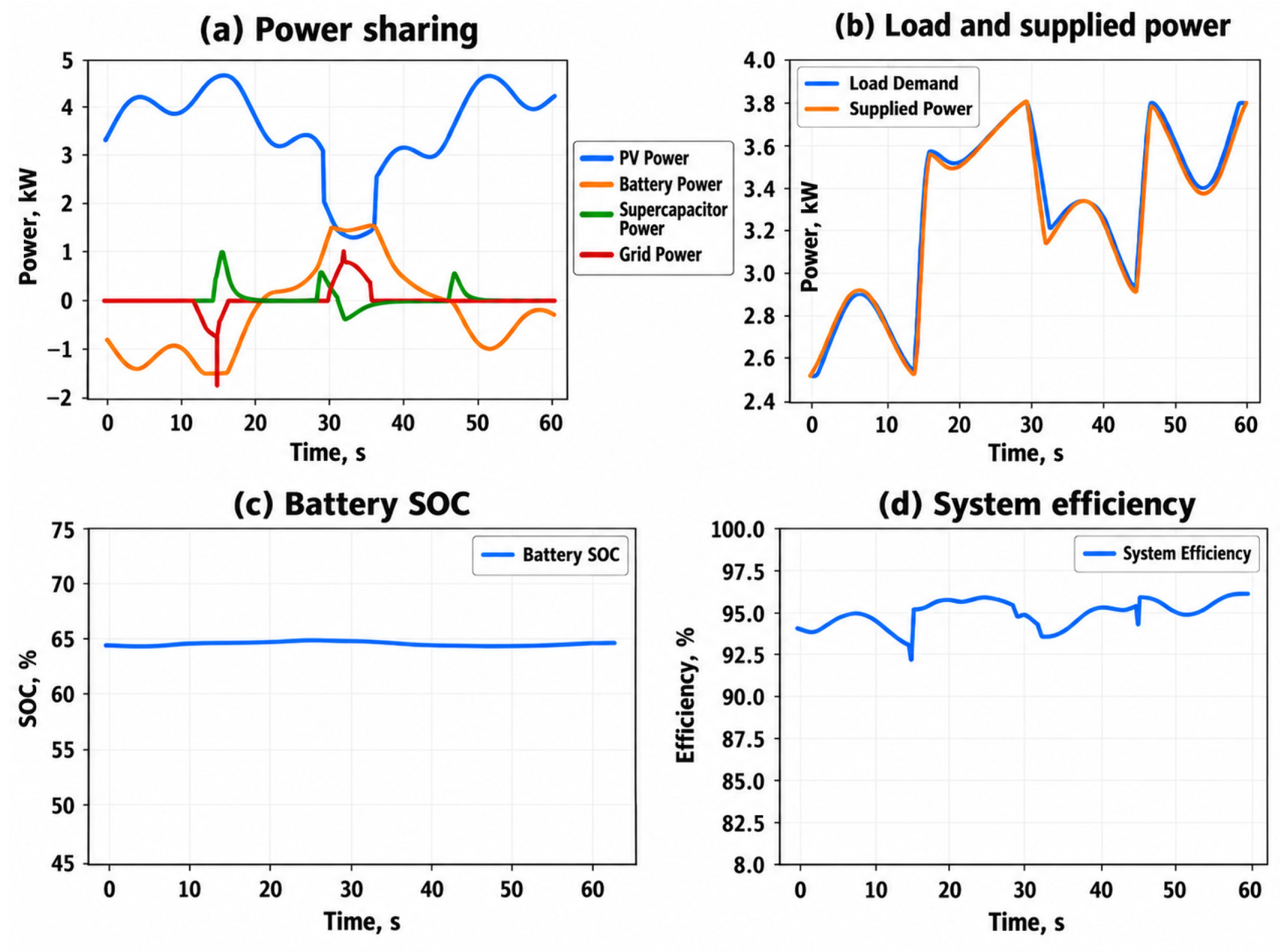
Numerical evaluation was carried out in MATLAB/Simulink (version R2025a, The MathWorks, Inc., Natick, MA, USA).using the developed structural model. The simulation considered PV output power, battery SOC, supercapacitor contribution, DC-link voltage, load power, PMSM speed, electromagnetic torque, and total system efficiency. The scenarios were selected to represent changes in solar generation and mechanical demand rather than a single steady-state operating point. This makes it possible to evaluate not only the energy balance, but also the transient role of the supercapacitor, the quality of DC-link regulation, and the ability of the PMSM controller to follow speed and torque changes. The main performance indicators obtained from the numerical simulation are summarized in Table 1. The average photovoltaic (PV) power was 3.2 kW, while the maximum load reached 4.2 kW, demonstrating the system’s operation under variable load conditions. The minimum battery state of charge (SOC) was 61%, indicating controlled battery discharge. The DC-link voltage deviation remained within approximately ±2–3 V, reflecting effective voltage stabilization. The average system efficiency ranged from 93% to 95%, while the maximum supercapacitor power reached 1.1 kW, confirming its contribution to compensating transient power peaks. These indicators were used to evaluate the effectiveness of the proposed predictive energy management strategy.
Table 1.
Summary indicators obtained from the simulation.
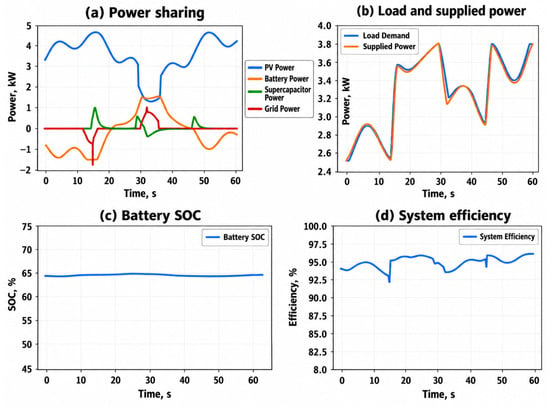
The power-sharing results show that PV generation varied from approximately 1.1 to 4.3 kW (Figure 3). The battery operated as the main energy-storage element, charging during surplus PV production and discharging when generation was insufficient. The supercapacitor was mainly involved during abrupt transitions, particularly around 15, 30, and 45 s, where it compensated short-term power peaks. Grid exchange remained limited and was used only when the internal energy balance could not be maintained. The load-power comparison shows that supplied power closely followed demand despite transient disturbances. Battery SOC remained near 65%, with a minimum value of about 61%, indicating that the storage strategy avoided deep discharge and unnecessary dynamic cycling. The total efficiency stayed within approximately 92–97%, with brief reductions during transitions followed by rapid recovery.
Figure 3.
Energy-management results: (a) power sharing; (b) load and supplied power; (c) battery SOC; (d) total system efficiency.
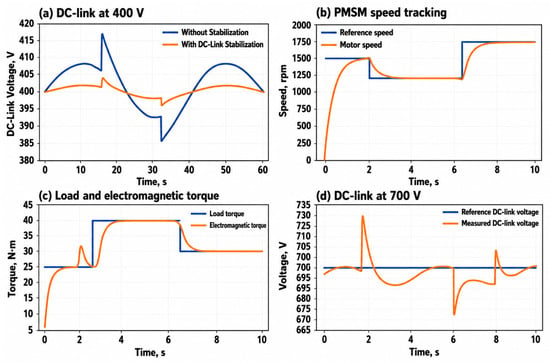
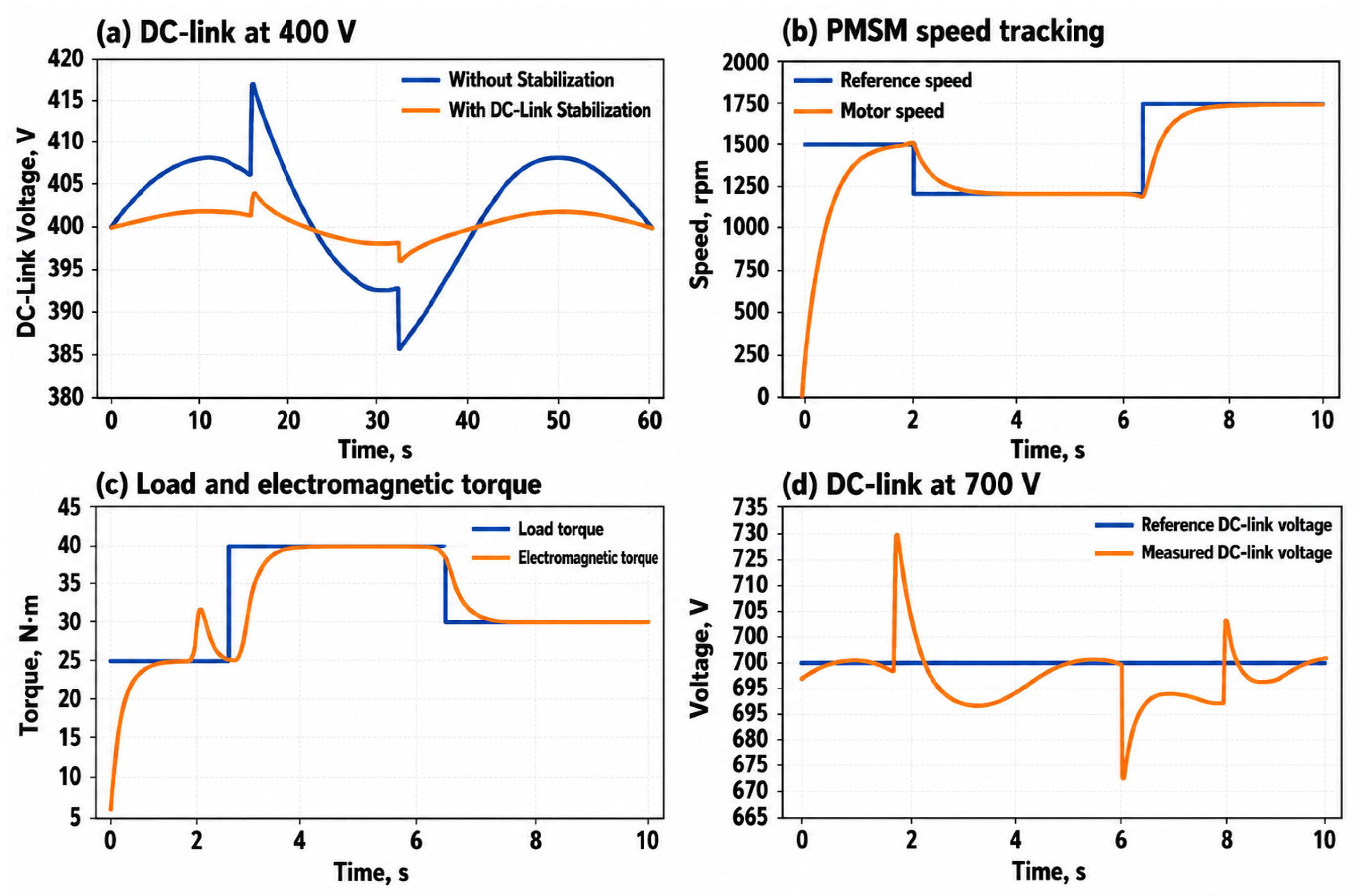
The DC-link results demonstrate the value of the stabilizing layer [Figure 4]. Without stabilization, the DC-link voltage exhibited wider oscillations, whereas the regulated case remained close to the 400 V reference, approximately within 396–404 V. The PMSM drive also showed stable electromechanical behaviour. The motor accelerated to 1500 rpm within about 2 s, then followed reference-speed changes to 1200 rpm and 1800 rpm without pronounced overshoot. The electromagnetic torque adapted to load variations from 25 to 40 N·m and later stabilized near 30 N·m. In a separate 700 V DC-link case, transient deviations occurred during operating changes, with the voltage recovering after a maximum overshoot of about 723 V and a minimum dip of about 687 V. These results suggest that the combined energy-management and drive-control structure can preserve DC-bus quality while supporting variable-speed PMSM operation.
Figure 4.
Drive and DC-link results: (a) DC-link stabilization near 400 V; (b) PMSM speed tracking; (c) load and electromagnetic torque; (d) DC-link response near 700 V.
4. Discussion
The results support the main design assumption of the study: in a PV-fed motor-drive system, energy management and drive control should not be considered independently. The PV source determines the available generation, the hybrid storage system determines the short- and medium-term power reserve, and the DC-link directly affects inverter and PMSM performance [9,10]. By allocating fast transients to the supercapacitor and slower energy support to the battery, the proposed architecture reduces rapid battery-current stress and improves DC-link stability. The approach is therefore relevant for autonomous PV installations, electric-drive systems [5], pumping units, and other applications in which a renewable source supplies a dynamic electromechanical load. At the same time, the present work is limited to numerical simulation. The model does not yet include long-term battery ageing, converter thermal constraints, measurement noise, or experimental validation on a hardware platform. Future work should therefore include real irradiance and load profiles, hardware-in-the-loop testing, and ageing-aware optimization of battery–supercapacitor power allocation.
5. Conclusions
This study presented a predictive energy-management architecture for a hybrid PV–battery–supercapacitor system supplying a PMSM drive. The architecture integrates MPPT control, bidirectional storage conversion, battery protection, supercapacitor peak-power compensation, DC-link stabilization, and PMSM vector control. MATLAB/Simulink results showed that PV power changed between 1.1 and 4.3 kW, battery SOC remained near 65%, overall efficiency was about 92–97%, and the stabilized DC-link stayed close to its reference value. The PMSM drive followed speed references between 1200 and 1800 rpm and adapted its electromagnetic torque to load changes in the range of 25–40 N·m. Overall, the proposed architecture provides a coherent control framework for improving power stability and drive reliability in hybrid PV-based energy systems. Experimental verification and long-term ageing analysis remain necessary for practical deployment.
Author Contributions
Conceptualization, Z.Z. and M.K.; methodology, M.K.; software, D.Z.; validation, A.T. and M.K.; formal analysis, A.S.; investigation, M.K.; resources, Y.Z.; data curation, A.Y.; writing—original draft preparation, M.K.; writing—review and editing, Z.Z.; visualization, D.Z.; supervision, A.T. All authors have read and agreed to the published version of the manuscript.
Funding
This research received no external funding.
Institutional Review Board Statement
Not applicable.
Informed Consent Statement
Not applicable.
Data Availability Statement
The simulation settings and processed numerical results supporting the findings of this study are available from the corresponding author upon reasonable request.
Acknowledgments
The authors acknowledge the technical support received during the preparation and simulation stages of this conference manuscript.
Conflicts of Interest
The authors declare no conflicts of interest.
Abbreviations
The following abbreviations are used in this manuscript:
| DC | Direct-Current |
| DC-link | Direct-Current Link |
| PV | Photovoltaic |
| PMSM | Permanent Magnet Synchronous Motor |
| SOC | State of Charge |
References
- Nassereddine, K.; Turzynski, M.; Bielokha, H.; Strzelecki, R. Simulation of energy management system using model predictive control in AC/DC microgrid. Sci. Rep. 2025, 15, 5388. [Google Scholar] [CrossRef] [Scilit] [PubMed]
- Cabrane, Z.; Choi, D.; Lee, S.H. Coordinated Control Strategy-Based Energy Management of a Hybrid AC-DC Microgrid Using a Battery–Supercapacitor. Batteries 2025, 11, 245. [Google Scholar] [CrossRef] [Scilit]
- Liu, X.; Chen, J.; Suo, Y.; Song, X.; Ju, Y. Active Disturbance Rejection Control Combined with Improved Model Predictive Control for Large-Capacity Hybrid Energy Storage Systems in DC Microgrids. Appl. Sci. 2024, 14, 8617. [Google Scholar] [CrossRef] [Scilit]
- Paulraj, T.; Obulesu, Y.P. Machine learning-based approach for reduction of energy consumption in hybrid energy storage electric vehicle. Sci. Rep. 2025, 15, 29303. [Google Scholar] [CrossRef] [Scilit] [PubMed]
- Albadrani, M.A.; Sayed, R.A.; Allam, S.; Hegazy, H.Y.; Morsalin, M.; Abdelati, M.H.; Fattah, S.A. Performance Comparison of Intelligent Energy Management Strategies for Hybrid Electric Vehicles with Photovoltaic Fuel Cell and Battery Integration. Batteries 2026, 12, 147. [Google Scholar] [CrossRef] [Scilit]
- Tong, Y.; Salhi, I.; Wang, Q.; Lu, G.; Wu, S. Bidirectional DC-DC Converter Topologies for Hybrid Energy Storage Systems in Electric Vehicles: A Comprehensive Review. Energies 2025, 18, 2312. [Google Scholar] [CrossRef] [Scilit]
- Salah, M.; Tawfiq, K.B.; Mansour, A.S.; Farhan, A. Novel Model Predictive Control Strategies for PMSM Drives: Reducing Computational Burden and Enhancing Real-Time Implementation. Machines 2025, 13, 908. [Google Scholar] [CrossRef] [Scilit]
- Wang, R.; Huang, Z.; Yang, Y.; Wen, Y.; Sun, X. A review on robust predictive control of permanent magnet synchronous motor drives: Strategies and future trends. AIP Adv. 2025, 15, 110701. [Google Scholar] [CrossRef] [Scilit]
- Zhou, Y. A robust recursive feasibility-based MPC method for the speed control of uncertain permanent magnet synchronous motors. J. Eng. Appl. Sci. 2025, 72, 155. [Google Scholar] [CrossRef] [Scilit]
- Hassan, A.M.; Metwally, M.E. Improving performance of electric vehicle drive system based a five-phase PMSM under fault using ANN and MPC. Sci. Rep. 2025, 15, 42943. [Google Scholar] [CrossRef] [Scilit] [PubMed]
- Merembayev, T.; Amirgaliyev, Y.; Kunelbayev, M.; Yedilkhan, D. Thermal Loss Analysis of a Flat Plate Solar Collector Using Numerical Simulation. Comput. Mater. Contin. 2022, 73, 4627–4640. [Google Scholar] [CrossRef] [Scilit]

Disclaimer/Publisher’s Note: The statements, opinions and data contained in all publications are solely those of the individual author(s) and contributor(s) and not of MDPI and/or the editor(s). MDPI and/or the editor(s) disclaim responsibility for any injury to people or property resulting from any ideas, methods, instructions or products referred to in the content. |
© 2026 by the authors. Licensee MDPI, Basel, Switzerland. This article is an open access article distributed under the terms and conditions of the Creative Commons Attribution (CC BY) license.