


Abstract
Inadequate solid waste management necessitates efficient automated sorting solutions. This paper presents an automated waste sorting system integrating artificial intelligence and Internet of Things technologies. Guided by CRISP DM and Modular Design principles, the prototype employs a YOLOv11s model deployed on an NVIDIA Jetson Nano alongside an ESP32 microcontroller to classify plastic bottles, paper, organic waste, and electronic waste. Functional testing across fifty operational trials achieved a 90% overall classification accuracy. The integrated physical system effectively synchronizes computer vision with mechanical actuation, offering a viable technological contribution toward source separation and urban sustainability.
1. Introduction
One of the most pressing current environmental and urban challenges is the inadequate management of solid waste, owing to its adverse impacts on soil, air, and water pollution, as well as the saturation of landfills. Population growth, urban expansion, and industrial development have escalated waste generation, demanding more efficient and sustainable collection, sorting, and recovery systems [1]. In Ecuador, approximately 13,000 tons of solid waste are produced daily, of which only 6% to 7% are recovered or recycled [2]. This situation is further exacerbated by low source separation, manual sorting, and limited environmental awareness, factors that impair recycling efficiency and elevate operational costs in waste management [3].
To address these limitations, technologies such as artificial intelligence, computer vision, and the Internet of Things offer viable alternatives for automating and enhancing waste sorting, monitoring, and management processes. Several studies support the effectiveness of these technologies in applications such as smart containers, automated segregation, fill monitoring, route optimization, predictive maintenance, and robotic sorting [1,4]. However, the deployment of computer vision in this field faces complex limitations stemming from waste heterogeneity, light fluctuations, occlusions, geometric deformation, and visual overlap between classes, factors that make experimental validation using mechatronic physical prototypes essential [5].
To address these limitations, the present study proposes the design and integration of an intelligent mechatronic system for the automated sorting of municipal solid waste based on machine vision and the Internet of Things (IoT). The developed platform autonomously classifies four waste streams: plastic, paper, organic matter and electronic components. Its architecture combines a deep detection model, an embedded processing module, electronic control, mechanical actuation and a real-time monitoring interface. This work provides a functional technological solution to strengthen segregation at the source, reduce error rates in material separation, and contribute to urban sustainability.
2. Materials and Methods
Three complementary methodological approaches were used to develop the automated solid waste sorting system. The CRISP-DM methodology [6] guided the development of the artificial intelligence model for image-based waste classification, while Modular Design [7] and Design for Manufacturability (DFM) [8] supported the physical design, fabrication, assembly, and integration of the prototype.
2.1. Development of the Artificial Intelligence Model Using CRISP-DM
The artificial intelligence model was developed following the CRISP-DM phases: problem understanding, data understanding, data preparation, modeling, evaluation, and deployment. The problem analysis identified the need for an automated computer-vision-based system to improve source separation of solid waste. Therefore, convolutional neural network-based object detection architectures were adopted.
The training images were obtained from public waste image datasets and repositories, including TrashNet [9], DoradoReciclaAI/Project_recicla_ai [10], Kaggle Waste Classification Data [11], and Roboflow [12], which was used as a search platform for additional waste image datasets. The images were manually reviewed, filtered, and reorganized into four trained classes: plastic bottles, paper, organic waste, and electronic waste. The final dataset contained 5293 images: 1354 plastic bottle images, 1325 paper images, 1301 organic waste images, and 1313 electronic waste images. The fifth physical container was not considered a trained class but an “others” or rejection container for unrecognized items.
Data preparation included image inspection, filtering, labeling, dataset splitting, and augmentation using Roboflow. Images with poor illumination, unrecognizable objects, or incorrect labels were discarded. After manual review and labeling, the curated dataset was divided into training, validation, and test sets using an 80%, 15%, and 5% distribution, respectively, resulting in approximately 4234 training images, 794 validation images, and 265 test images before augmentation. The split was performed before data augmentation to avoid overlap between subsets and prevent data leakage. Augmentation was applied only to the training set and included rotation, brightness variation, grayscale conversion, noise injection, cropping, saturation adjustment, and horizontal flipping.
Model training was performed in Google Colab Pro using YOLOv8 and YOLOv11 variants. YOLOv8n, YOLOv11n, and YOLOv11s were evaluated using 60, 80, and 120 epochs, while YOLOv8m was trained using 100 epochs. All configurations used a batch size of 64 and an image resolution of 640 × 640 pixels. The models were evaluated using precision, recall, mAP50, mAP50-95, model size, and inference time. Among the YOLOv11s configurations, the model trained for 80 epochs provided the best balance between performance and embedded deployment feasibility.
Finally, the selected weights file, best.pt, was integrated into a Python (version 3.8.18) application deployed on an NVIDIA Jetson Nano. The embedded system processes the camera images, identifies the waste category, and sends the corresponding control signal to the physical sorting mechanism.
2.2. Modular Design and Design for Manufacturability Methodology
The prototype was developed using Modular Design and DFM principles to organize the system into functional subsystems, simplify maintenance, and use locally available components. The system was designed to classify waste into four categories, restrict the size of incoming items, monitor container fill levels, and allow component assembly, disassembly, and replacement.
The system is organized into four modules: processing, mechanical, electronic, and management. The processing module includes the NVIDIA Jetson Nano and a FaceCam 1000X HD camera for image capture and analysis. The mechanical module comprises the frame, rotating platform, containers, stepper motor, driver, servomotor, and gripper mechanism. The electronic module integrates the ESP32 microcontroller, power regulation stages, infrared proximity sensors, and interconnection bus. The ESP32 manages sensor readings and actuator control based on the classification command received from the Jetson Nano.
In the current prototype, the IoT-related functions are limited to local monitoring and control. The management module includes a Flask-based local server and a graphical interface that displays the fill-level status of the storage bins. Cloud connectivity, remote alerts, historical data storage, and integration with waste collection logistics were not implemented in this version and are considered future work.
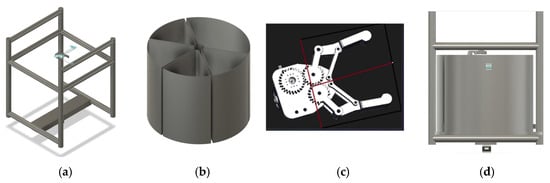
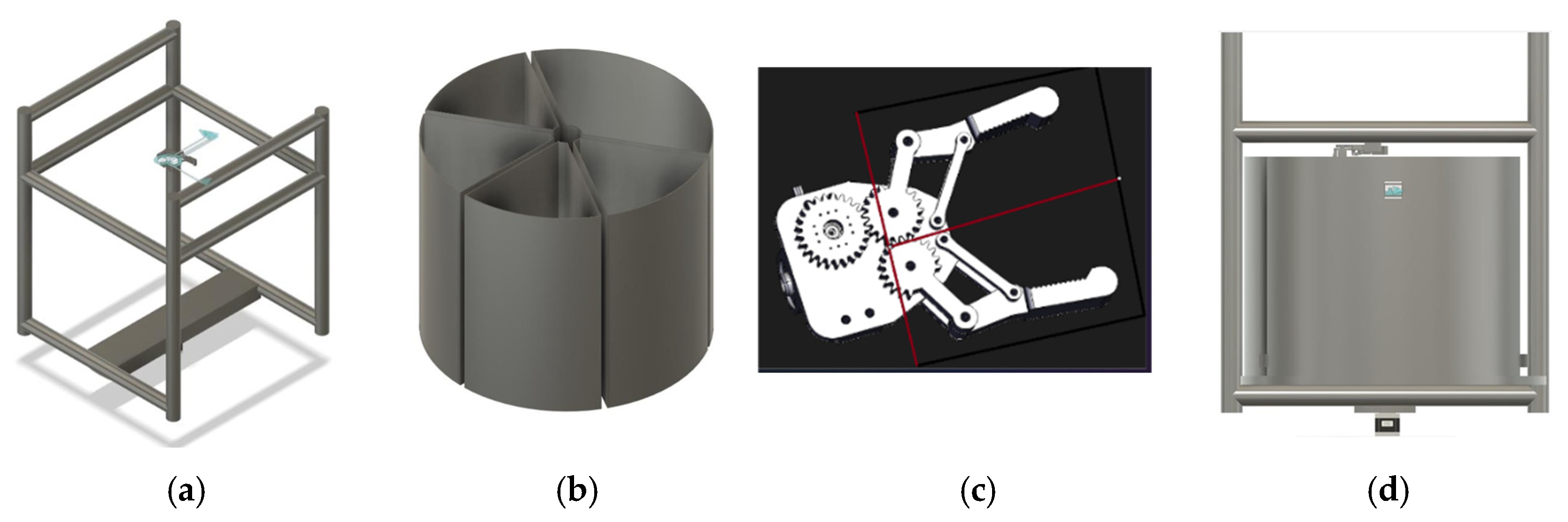
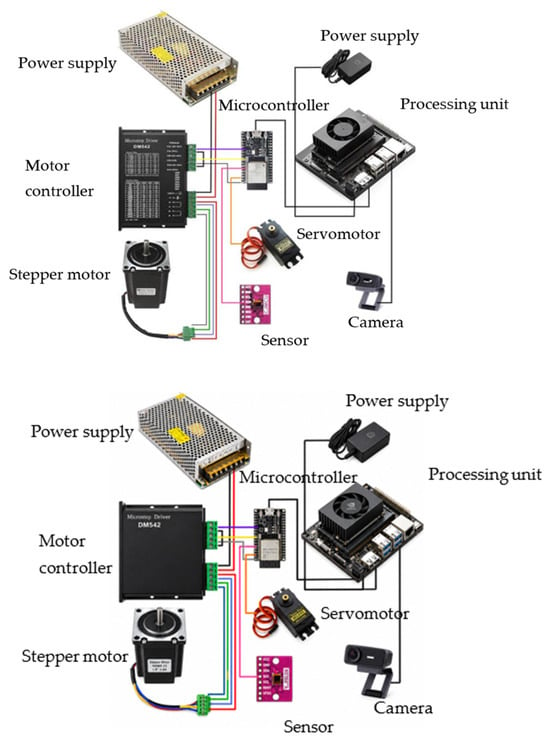
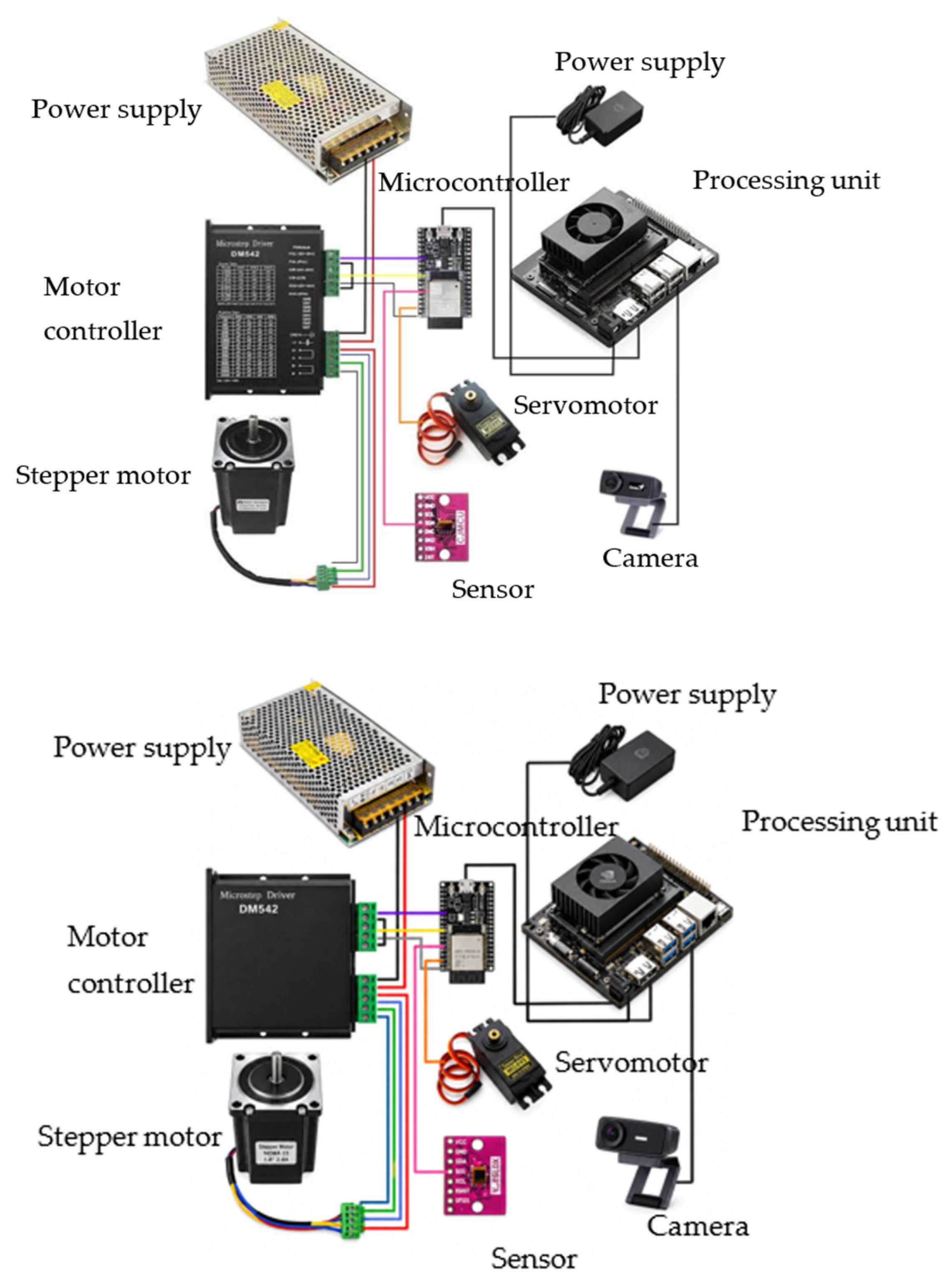
The mechatronic structure was designed in Fusion 360 to optimize the spatial distribution and integration of the subsystems. The prototype includes an input hopper, a rotary selector driven by a stepper motor, modular removable containers, position sensors, and a release actuator. During operation, the rotating mechanism positions the corresponding container according to the category detected by the AI model. If no valid category is detected, the residue is directed to the “others” container, avoiding forced classification into an incorrect trained class. Figure 1 shows the mechanical design and overall system integration. Electronic integration was based on serial communication between the Jetson Nano and the ESP32. The Jetson Nano runs the AI model and processes the images, while the ESP32 controls the sensors and actuators. The system uses a 5 V supply for processing and control and a 24 V supply for the stepper motor and driver. Figure 2 presents the electrical and electronic connections used for control, processing, and actuation.
Figure 1.
Mechanical design of the smart waste bin prototype: (a) main structure, (b) proposed internal containers, (c) gripper-type clamp mechanism, and (d) overall integration of the prototype.
Figure 2.
Connections between electrical and electronic components of the system.
The prototype was fabricated from mechanical and electronic designs. The main structure was built in steel, while the rotating base and containers were manufactured in medium-density fiberboard due to local manufacturing constraints. The gripper components were produced by 3D printing because of their geometric complexity. Finally, the structure, hopper, rotating system, containers, gripper, sensors, actuators, electrical panel, ESP32, Jetson Nano, and Flask interface were assembled to validate the operation of the integrated prototype.
3. Results
The results are presented in two distinct stages. First, the trained artificial intelligence models were evaluated to select the optimal configuration for the prototype. Subsequently, the performance of the fully integrated system was analyzed, considering the interaction among the processing, mechanical, electronic, and monitoring modules.
3.1. Evaluation of the Training of the Artificial Intelligence Algorithm
The model evaluation considered precision, recall, mAP50, mAP50-95, model size, and inference time. YOLOv8n and YOLOv11n exhibited compact sizes and low inference latency with similar performance. YOLOv8n reached a precision of 0.819, a recall of 0.793, and an mAP50 of 0.819, while YOLOv11n achieved 0.823, 0.780, and 0.836, respectively. Although YOLOv8m obtained the highest precision (0.862) and the best mAP values, its size of 52 MB and inference time of 140.6 ms limited its suitability for embedded real-time deployment. In contrast, the YOLOv11s configuration trained for 80 epochs provided the best balance between performance and computational efficiency. This configuration achieved a precision of 0.844, a recall of 0.804, an mAP50 of 0.844, and an mAP50-95 of 0.651, with a size of 19.2 MB and an inference time of 15.4 ms. Therefore, the YOLOv11s model trained for 80 epochs was selected for integration into the physical prototype.
3.2. Prototype Functionality Tests
Following model integration into the NVIDIA Jetson Nano, final assembly of the prototype was executed alongside the operational assessment of the combined processing, control, and physical sorting modules. The operational flow begins with the deposit of the waste into the upper hopper, where an opto-digital capture unit records the image of the object and transfers it to the computer board for inference. After the analytical determination of the waste type, the control unit commands a stepper motor to index the corresponding container, while a servomotor actuates the discharge mechanism to release the material. The occupancy of each compartment is monitored in real time by level sensors, transmitting process telemetry to a graphical user interface.
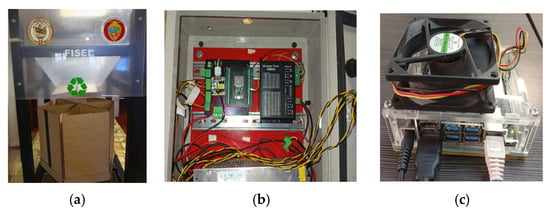
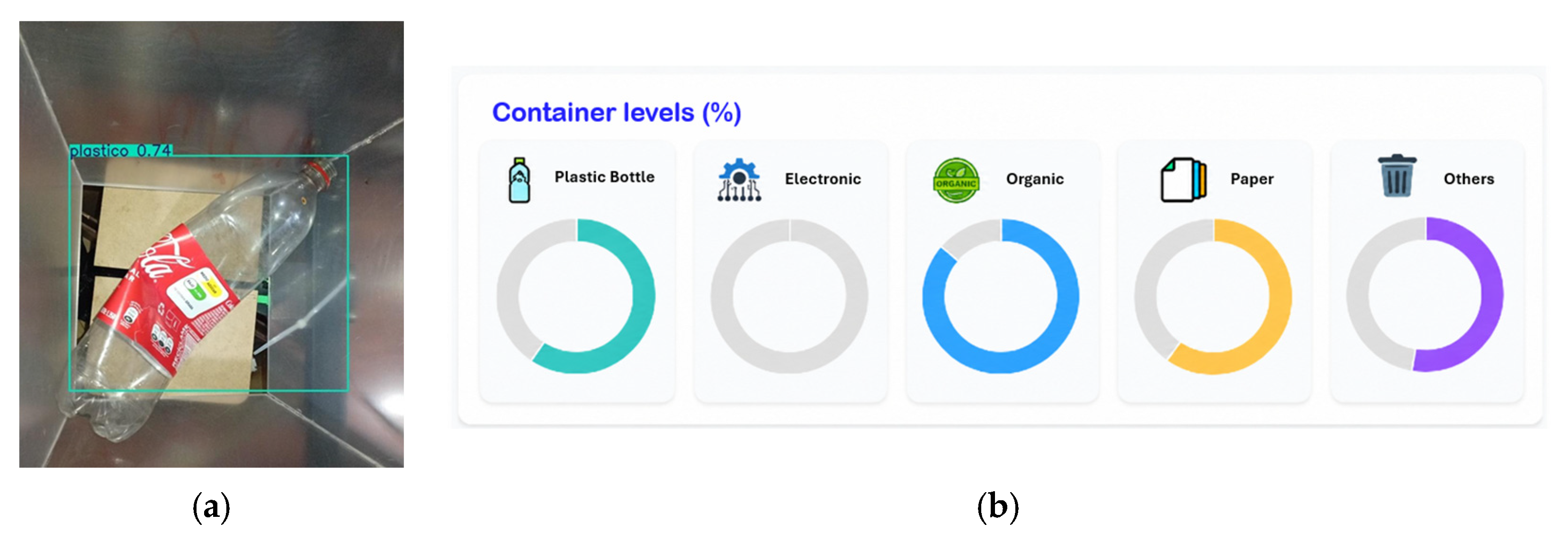
The mechatronic integration and processing architecture in the final physical prototype are illustrated in Figure 3, while Figure 4 details the interface environment designed for visual detection and telemetric monitoring of the storage level.
Figure 3.
Prototype integration: (a) Structural assembly of the smart trash can prototype; (b) electrical panel; (c) NVIDIA Jetson Nano processing unit.
Figure 4.
Automatic sorting system user interface: (a) plastic bottle detection using an artificial intelligence model; (b) container level display interface.
In the functional validation stage, the prototype was evaluated through 50 operational trials distributed across the four trained waste categories. The system correctly classified 45 samples, achieving an overall accuracy of 90%. Organic and electronic waste were correctly classified in all evaluated cases. For plastic bottles, 9 out of 12 samples were correctly classified, two were misclassified as paper, and one was not detected. For paper, 13 out of 15 samples were correctly classified, while two were not detected. Table 1 presents the confusion matrix and the corresponding descriptive performance metrics. Numerical codes were used to reduce table size: 1 = plastic bottle, 2 = paper, 3 = organic waste, 4 = electronic waste, and ND = not detected.
Table 1.
Confusion matrix and performance metrics of the integrated system during functional testing.
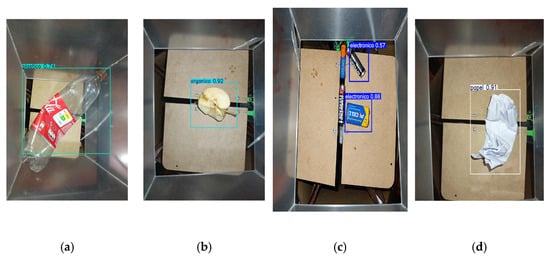
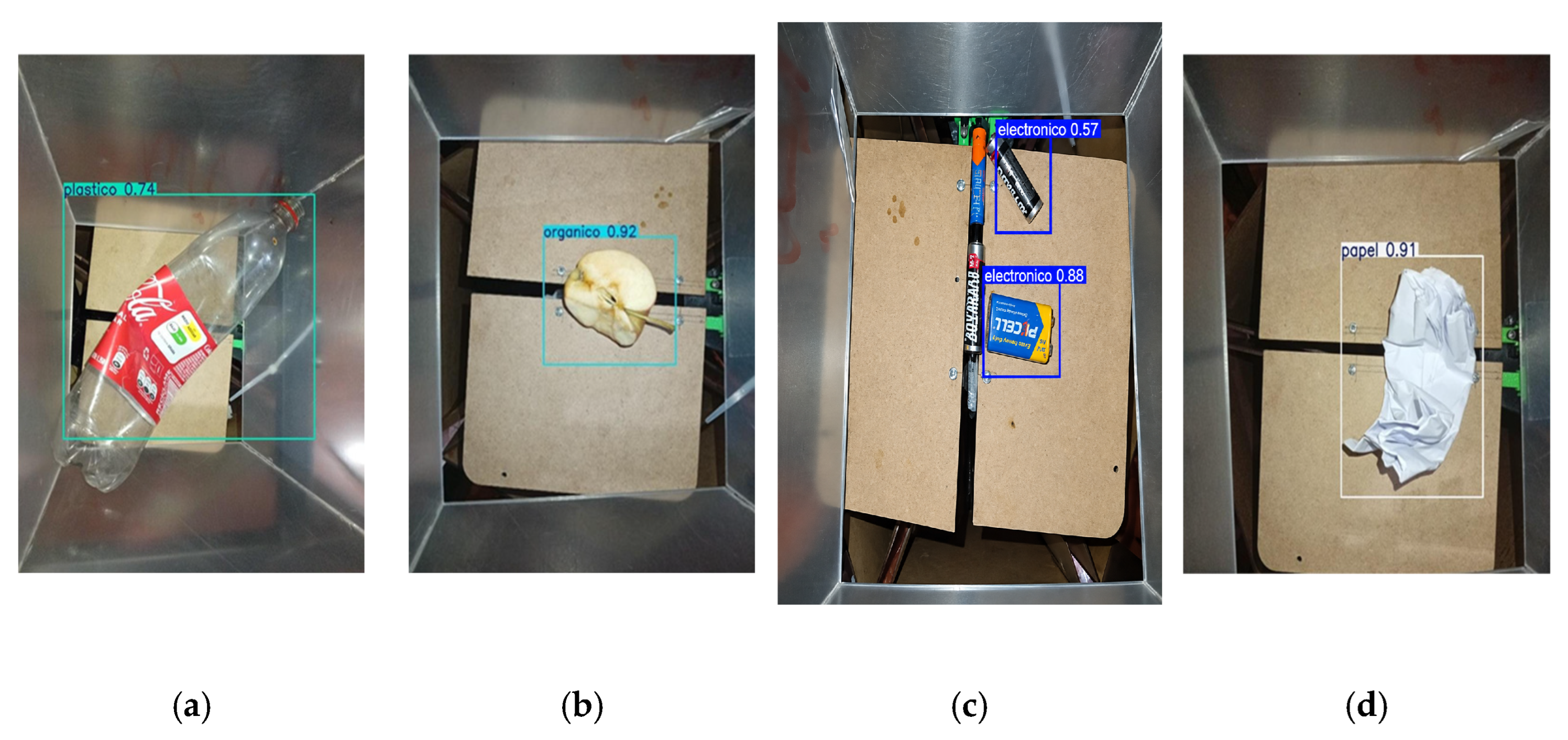
Figure 5 presents representative examples of the detection process performed by the model across the evaluated categories. The bounding boxes indicate the identified class together with the confidence score associated with each prediction.
Figure 5.
Detection of solid waste during functional testing of the prototype: (a) plastic bottle, (b) organic waste, (c) electronic waste and (d) paper.
Overall, the results show that the integration of the artificial intelligence model, the processing unit, the electronic control system and the physical sorting mechanism enabled most of the tests to be completed successfully. Nevertheless, the misclassifications and the undetected cases highlight the need to improve model robustness and to optimize the detection conditions for future deployments in real-world settings. The average inference time recorded during the 50 functional trials was 704.5 ms per item, ranging from 596.3 ms to 898.2 ms. This value represents the computer-vision processing and decision time, not the complete mechanical sorting cycle.
4. Discussion
The obtained results allow prototype performance to be interpreted in terms of artificial intelligence-based classification, functional integration, and contribution to sustainable solid waste management. However, the limited number of operational trials is a limitation; thus, the class-level metrics should be considered preliminary and descriptive. Consistent with Jair Castañeda Meza et al. [13], illumination, image perspective, and waste variability may impair classification performance, highlighting the need for a larger dataset, more trials per category, and validation under real-world conditions.
The overall accuracy of 90% achieved during functional testing indicates favorable performance, comparable to Ji et al. [14] at 92% and Bobulski and Kubanek [15] at 91%. The lower recall for plastic bottles may be associated with optical confusion with paper, caused by glare on clear plastic surfaces, white labels, and geometric deformation of flattened or crumpled bottles under hopper lighting conditions. Unlike these studies, however, the present prototype integrates four waste categories: plastic, paper, organic, and electronic waste, expanding its applicability for source separation. The results also demonstrate that system efficacy depends not only on the artificial intelligence model but also on its seamless integration with sensors, actuators, the mechanical structure, and the control system. This perspective aligns with Chen et al. [16] and Nedjar et al. [17], who integrated computer vision, embedded processing, and physical sorting mechanisms. In this work, the articulation among the NVIDIA Jetson Nano, the ESP32 microcontroller, actuators, storage containers, and the monitoring interface enabled the validation of automated prototype operation.
Unlike Giel et al. [18], who focused on real-time identification of plastic waste streams in a conveyor-based sorting facility environment, this study proposes an integrated smart bin prototype for source-level separation of heterogeneous urban waste. The contribution lies in combining AI-based classification with embedded processing, electronic control, actuation mechanisms, fill-level monitoring, and a physical “others” container for unrecognized waste items.
From an urban sustainability perspective, the proposed system contributes to enhancing source separation and waste recovery, in accordance with Ahmad et al. [19]. Furthermore, incorporating electronic waste is particularly relevant, as Madhav et al. [20] emphasized the necessity of separating such materials from conventional waste streams because of their toxicity and resource recovery potential. Nevertheless, validation was conducted under controlled laboratory conditions, a limitation also noted by Giel et al. [18], who observed that many studies utilize datasets and scenarios that are scarcely representative of operational realities. Consequently, future research should incorporate more diverse waste items, evaluate varying lighting conditions, and perform field testing in real-world environments. Likewise, following the approach outlined by Gupta et al. [21], fill-level monitoring could evolve into a fully connected Internet of Things framework to generate real-time alerts and support waste collection logistics.
5. Conclusions
This study presents the design, implementation, and experimental validation of an automated solid waste sorting system that integrates computer vision and Internet of Things technologies. Guided by the CRISP-DM methodology alongside Modular Design and Design for Manufacturability principles, the prototype successfully combined embedded intelligence with physical sorting mechanisms. Among the evaluated object detection models, the YOLOv11s architecture demonstrated the optimal balance between predictive performance and computational efficiency, enabling real-time deployment on an NVIDIA Jetson Nano processing platform coupled with an ESP32 microcontroller.
The functional characterization of the physical prototype registered an overall accuracy rate of 90% over 50 test cycles, confirming consistent segregation across the four analyzed streams: plastic, paper, organic matter, and electronic waste. Finally, the findings demonstrate that the overall effectiveness of this type of system lies not only in the vision model’s metrics but also in the telemetry coupling and precise synchronization between the processing stages, the sensor network, the actuator response, and the monitoring interface.
By incorporating electronic waste into a multi-category source separation framework, this research offers a practical technological contribution toward urban sustainability and resource recovery. Future work will focus on expanding the training dataset to enhance model generalization under variable illumination and material deformation, conducting field validation in unstructured operational environments, and scaling the Internet of Things framework to interface directly with smart municipal waste collection logistics.
Author Contributions
Conceptualization, A.P.C.-M. and K.C.-T.; methodology, A.P.C.-M. and K.C.-T.; software, K.C.-T.; validation, K.C.-T. and A.P.C.-M.; formal analysis, M.M.-N. and A.P.C.-M.; investigation, K.C.-T.; resources, J.E.-N.; data curation, K.C.-T. and A.P.C.-M.; writing—original draft preparation, J.E.-N. and A.P.C.-M.; writing—review and editing, J.E.-N.; visualization, M.M.-N.; supervision, A.P.C.-M.; project administration, A.P.C.-M.; funding acquisition, K.C.-T. All authors have read and agreed to the published version of the manuscript.
Funding
This research received no external funding.
Institutional Review Board Statement
Not applicable.
Informed Consent Statement
Not applicable.
Data Availability Statement
The original contributions presented in this study are included in the article. Further inquiries can be directed to the corresponding author.
Conflicts of Interest
The authors declare no conflicts of interest.
References
- Fang, B.; Yu, J.; Chen, Z.; Osman, A.I.; Farghali, M.; Ihara, I.; Hamza, E.H.; Rooney, D.W.; Yap, P.-S. Artificial Intelligence for Waste Management in Smart Cities: A Review. Environ. Chem. Lett. 2023, 21, 1959–1989. [Google Scholar] [CrossRef] [Scilit] [PubMed]
- Sistema Nacional de Información Gestión de Residuos Sólidos y Economía Circular Inclusiva (GRECI). Available online: https://www.ambienteyenergia.gob.ec/ambiente/proyecto-gestion-integral-de-residuos-solidos-y-economia-circular-inclusiva-greci/ (accessed on 5 August 2026).
- Fu, B.; Li, S.; Wei, J.; Li, Q.; Wang, Q.; Tu, J. A Novel Intelligent Garbage Classification System Based on Deep Learning and an Embedded Linux System. IEEE Access 2021, 9, 131134–131146. [Google Scholar] [CrossRef] [Scilit]
- Arun, V.; Krishna Rao Patro, E.; Anusuya Devi, V.S.; Nagpal, A.; Kumar Chandra, P.; Albawi, A. AI Based Prediction Algorithms for Enhancing the Waste Management System: A Comparative Analysis. E3S Web Conf. 2024, 552, 01052. [Google Scholar] [CrossRef] [Scilit]
- Cheng, T.; Kojima, D.; Hu, H.; Onoda, H.; Pandyaswargo, A.H. Optimizing Waste Sorting for Sustainability: An AI-Powered Robotic Solution for Beverage Container Recycling. Sustainability 2024, 16, 10155. [Google Scholar] [CrossRef] [Scilit]
- Huber, S.; Wiemer, H.; Schneider, D.; Ihlenfeldt, S. DMME: Data Mining Methodology for Engineering Applications—A Holistic Extension to the CRISP-DM Model. Procedia CIRP 2019, 79, 403–408. [Google Scholar] [CrossRef] [Scilit]
- Luo, X.; Zheng, X.; Liao, C.; Xiao, Y.; Deng, C.; Liu, S.; Chen, Q. Research on the Modular Design Method and Application of Prefabricated Residential Buildings. Buildings 2024, 14, 3014. [Google Scholar] [CrossRef] [Scilit]
- Moeeni, H.; Javadi, M.; Raissi, S. Design for Manufacturing(DFM): A Sustainable Approach to Drive the Design Process from Suitability to Low Cost. Int. J. Interact. Des. Manuf. (IJIDeM) 2022, 16, 1079–1088. [Google Scholar] [CrossRef] [Scilit]
- Thung, G.; Yang, M. TrashNet: Dataset of Images of Trash; Torch-Based CNN for Garbage Image Classification. GitHub Repository. Available online: https://github.com/garythung/trashnet (accessed on 9 July 2025).
- DoradoReciclaAI. Project_recicla_ai: Sistema para Clasificación de Residuos Sólidos Urbanos. GitHub Repository. Available online: https://github.com/DoradoReciclaAI/Project_recicla_ai (accessed on 9 July 2025).
- Techsash. Waste Classification Data. Kaggle Dataset. Available online: https://www.kaggle.com/datasets/techsash/waste-classification-data (accessed on 9 July 2025).
- Roboflow. Roboflow Universe: Free Computer Vision Datasets and Models. Available online: https://universe.roboflow.com/ (accessed on 9 July 2025).
- Meza, A.J.C.; Haro, N.A.L.; Flores-Castañeda, R.O. Artificial Intelligence Based System for Sorting and Detection of Organic and Inorganic Waste. Int. J. Adv. Comput. Sci. Appl. 2025, 16, 9. [Google Scholar] [CrossRef] [Scilit]
- Ji, T.; Fang, H.; Zhang, R.; Yang, J.; Fan, L.; Li, J. Automatic Sorting of Low-Value Recyclable Waste: A Comparative Experimental Study. Clean Technol. Environ. Policy 2023, 25, 949–961. [Google Scholar] [CrossRef] [Scilit]
- Bobulski, J.; Kubanek, M. Project of Sorting System for Plastic Garbage in Sorting Plant Based on Artificial Intelligence. In Proceedings of the Computer Science & Information Technology; AIRCC Publishing Corporation: Toronto, Canada, 2020; pp. 27–35. [Google Scholar]
- Chen, X.; Huang, H.; Liu, Y.; Li, J.; Liu, M. Robot for Automatic Waste Sorting on Construction Sites. Autom. Constr. 2022, 141, 104387. [Google Scholar] [CrossRef] [Scilit]
- Nedjar, I.; M’hamedi, M.; Bekkaoui, M. Real-Time Solid Waste Sorting Machine Based on Deep Learning. Int. J. Electr. Comput. Eng. Syst. 2024, 15, 581–589. [Google Scholar] [CrossRef] [Scilit]
- Giel, R.; Fiedeń, M.; Dąbrowska, A. Real-Time Automatic Identification of Plastic Waste Streams for Advanced Waste Sorting Systems. Sustainability 2025, 17, 2157. [Google Scholar] [CrossRef] [Scilit]
- Ahmad, G.; Aleem, F.M.; Alyas, T.; Abbas, Q.; Nawaz, W.; Ghazal, T.M.; Aziz, A.; Aleem, S.; Tabassum, N.; Ibrahim, A.M. Intelligent Waste Sorting for Urban Sustainability Using Deep Learning. Sci. Rep. 2025, 15, 27078. [Google Scholar] [CrossRef] [Scilit] [PubMed]
- Shreyas Madhav, A.; Rajaraman, R.; Harini, S.; Kiliroor, C.C. Application of Artificial Intelligence to Enhance Collection of E-Waste: A Potential Solution for Household WEEE Collection and Segregation in India. Waste Manag. Res. J. A Sustain. Circ. Econ. 2022, 40, 1047–1053. [Google Scholar] [CrossRef] [Scilit] [PubMed]
- Gupta, P.K.; Shree, V.; Hiremath, L.; Rajendran, S. The Use of Modern Technology in Smart Waste Management and Recycling: Artificial Intelligence and Machine Learning. In Recent Advances in Computational Intelligence; Springer: Cham, Switzerland, 2019; pp. 173–188. [Google Scholar]

Disclaimer/Publisher’s Note: The statements, opinions and data contained in all publications are solely those of the individual author(s) and contributor(s) and not of MDPI and/or the editor(s). MDPI and/or the editor(s) disclaim responsibility for any injury to people or property resulting from any ideas, methods, instructions or products referred to in the content. |
© 2026 by the authors. Licensee MDPI, Basel, Switzerland. This article is an open access article distributed under the terms and conditions of the Creative Commons Attribution (CC BY) license.