


Abstract
This article presents the development of a web application for automated translation of TXT, DOCX, and PDF documents, built with Next.js/React and integrated with OpenAI LLM models. The study investigates the influence of the sampling parameters temperature and Top-P (nucleus sampling) on translation quality between Bulgarian and English. Translation experiments were conducted on a bilingual corpus of popular-science and biographical texts, analysing effects on verb tense, lexical choice, word order, and output stability. Proper tuning of these parameters allows control over style and lexical richness without compromising reliability, and the trends remain relevant in newer model versions.
1. Introduction
Large language models have transformed the way document translation is approached. Large-scale transformer architectures have demonstrated remarkable generative and adaptive capabilities through probabilistic sampling, underscoring the importance of temperature and Top-P in shaping translation behaviour. Broader analyses of GPT-based language models also highlight their implications for linguistic tasks and the limits of generative reasoning. Instead of fixed rules and phraseological tables, today’s systems rely on probabilistic generation that can be adjusted using specific sampling parameters [1,2]. Similar findings have been reported in neural machine translation research, where decoding configurations significantly affect accuracy and stylistic consistency. This shift from deterministic rule-based methods to probabilistic neural generation has been widely documented in neural machine translation research, situating large language models as a natural extension of contemporary NMT frameworks. In practice, these parameters determine the balance between literal accuracy and natural expression and between predictability and creativity. Furthermore, cultural framing remains a key dimension in translation quality, as linguistic choices often reflect deeper “we” versus “I” cultural orientations that influence text cohesion and reader interpretation.
The AI Document Translator web application follows this line of development, enabling control over the translation process and detailed logging. More specifically, through the first version of the application, this study systematizes the impact of the temperature parameter on real texts, isolating linguistic features such as tense, syntax, and synonymy. The second version expands the system with the Top-P parameter to study the interaction between the two and to evaluate whether nucleus sampling can moderate high temperatures while preserving natural expression. Both versions employ a basic translator prompt (the so-called “classic translator”). It is advisable to vary the parameters of the prompt depending on the stylistic characteristics of the text. It may be theoretically assumed that adapting the prompt to the stylistic features of a text will lead to more stylistically accurate translations and consequently fewer errors [3]. While adjusting sampling parameters such as temperature and Top-P can influence generation quality, architectural approaches such as Retrieval-Augmented Generation (RAG) have also been proposed as a way to reduce hallucinations and improve the reliability of LLM outputs in critical tasks [4].
A similar functional implementation has been introduced in the third version of the AI Document Translator application, which extends the software to GPT-5.2 and introduces a different principle of model configuration and user control. In the present article, however, GPT-4o remains the primary empirical basis of the reported experiments, while the GPT-5.2-based implementation is noted as a newer stage in the software’s development. The AI Document Translator is an original software system developed by the authors. For practical demonstration and experimental replication, the application can be accessed at https://davincilab.bg/apps (accessed on 10 May 2026).
2. Parameters Implemented in AI Document Translator
Temperature (T) is a parameter that controls the degree of randomness in the generated text. Technically, it applies to the raw numerical scores (logits) that the neural model computes for each possible word (token) before converting them into probabilities via the softmax function. At low T values, the distribution is more concentrated: one or a few words receive very high probability, and the model almost always selects them. This leads to more predictable and “safe” output. At higher T values, the distribution becomes broader, allowing less frequent words to be selected and thereby increasing lexical and syntactic diversity. For instance, at T ≈ 0.5 the model prefers the most probable translation, while at T ≈ 1.5 it tends to suggest synonyms or alternate word orders. Formally, for a logits vector , softmax turns the logits into probabilities: .
In nucleus (Top-P) sampling, the set of candidate tokens is dynamically adjusted at each generation step to include only those tokens whose cumulative probability mass exceeds a threshold p, providing an adaptive mechanism that balances diversity and relevance in neural text generation [5]. Instead of considering all words, the model forms a “nucleus” of tokens whose cumulative probability is less than or equal to p (e.g., p = 0.9). Sampling then occurs only within this nucleus, with probabilities renormalized inside it. In this way, Top-P limits the output to the most probable continuations, regardless of their number. The combination of the two parameters allows fine-grained control over the style and stability of the generated text [6]. In the present study, the initial experiments tested the parameter T with a fixed Top-P = 1.0 (i.e., without a nucleus restriction). Subsequently, different Top-P values were analysed to trace interactions between the two parameters and to avoid confounding factors. Moreover, recent analyses of hallucination frequency in large language models reinforce the need to constrain semantic drift through careful sampling adjustment.
This aligns with prior research showing that sampling-based decoding tends to increase hallucination risk unless carefully constrained. In the GPT-4o-based versions of the software, this user control is expressed directly through temperature and Top-P, whereas in the newer GPT-5.2-based implementation, the configuration logic follows a different principle. While the present parameter analysis is grounded primarily in the GPT-4o-based experimental setup, the evolution of AI Document Translator toward GPT-5.2 motivates an additional layer of interpretation. In the newer implementation, the research interest is not limited to parameter sensitivity alone but also extends to the behavioural profile of the software as a translation environment: consistency across fragments, preservation of semantic focus, handling of tense transitions, and the balance between idiomatic fluency and factual restraint.
3. Architecture of AI Document Translator
AI Document Translator is implemented as a full-stack web application built with Next.js and React (TypeScript) v.15.5.24, featuring a user interface designed with Tailwind CSS v. 4.3. The backend provides APIs for three main functions: (1) extracting text from TXT, DOCX, and PDF files; (2) sending requests to the LLM; and (3) handling authentication and user sessions. To overcome the model’s context-window limitation, that is, the maximum number of tokens it can retain “in memory” during a single interaction, long documents are divided into semantic fragments using a chunking technique [7,8,9]. This procedure ensures translation stability and enables the processing of larger documents. All requests and their metadata, including selected sampling parameters such as text length, response latency, and other characteristics, are stored in a database. This design guarantees the reproducibility of experiments and provides opportunities for subsequent quantitative analysis.
The approach is particularly important for the GPT-4o model, which features a context window of 128,000 tokens covering both input and output data. According to information from the OpenAI Developer Community and official documentation, however, the standard output (completion) limit is up to 4096 tokens, which has been increased to 16,384 tokens in version gpt-4o-2024-08-06. Version 1 of AI Document Translator is based on the GPT-4o model and offers a single control parameter—temperature. Version 2 broadens its functionality by adding the Top-P (nucleus sampling) parameter, thus enabling a finer balance between predictability and creativity. At the server level, both parameters are passed to the model, and the logs are enriched with detailed traceability for individual fragments: for each chunk, the system records the parameter values, output length, and response time. Both versions employ the same prompt engineering approach designed to simulate a “classical” translator. The complete prompt used in the experiments was as follows: “You are a professional translator with the highest level of professional proficiency in both the source and target languages. Translate the following text from {sourceLanguage} into {targetLanguage}. Preserve the meaning, tone, style, terminology, paragraph structure, and factual content of the original text. Use natural, fluent, and idiomatic expressions appropriate for native speakers of the target language. Do not add new information, explanations, comments, summaries, or interpretations. Do not omit information from the source text. Return only the translated text.” The same prompt structure was used for both Bulgarian-to-English and English-to-Bulgarian translation directions; only the source language, target language, and input text were changed.
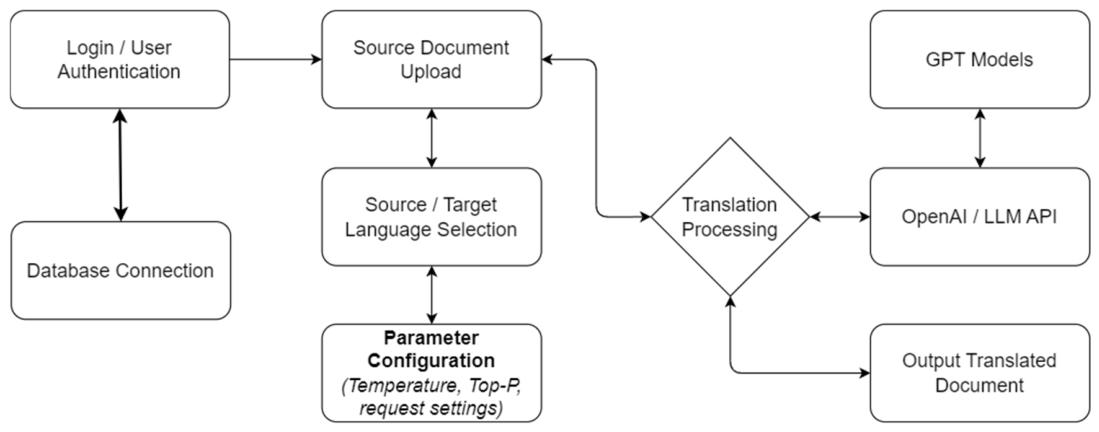
A subsequent software iteration extends the system to GPT-5.2. In this newer implementation, user control is preserved, but it no longer relies exclusively on the same direct parameter logic as in the GPT-4o-based versions. It is therefore relevant to observe how the software’s translation behaviour evolves when moving from GPT-4o to GPT-5.2. In the newer version 3, the focus shifts toward the overall translation behaviour of the application when operating with a newer model generation (Figure 1). This includes the stability of output across semantically segmented fragments, the consistency of tense and aspect rendering, the preservation of semantic boundaries, and the degree to which the model produces fluent but controlled target-language formulations.
Figure 1.
Workflow model of the AI document translator.
In the GPT-5.2-based implementation, the configuration logic shifts from direct control over sampling parameters to the management of reasoning effort and verbosity, that is, to the degree of internal processing and the expected expansiveness of the generated response. For reasoning effort, the model allows values such as none, low, medium, high, and xhigh, while for verbosity the available values are low, medium, and high. Therefore, temperature and Top-P no longer function as universal user settings in the same sense as in GPT-4o but are supported only in the reasoning effort = none mode. This also changes the analytical perspective: instead of focusing solely on sensitivity to sampling parameters, attention is directed toward the way in which the model regulates the depth of processing and the degree of output explicitness.
Therefore, the architecture of the AI Document Translator should be understood not only as a technical implementation for parameter testing but also as a reproducible research environment for observing how successive GPT model generations affect software-level translation behaviour.
4. Method
No human participants were involved in this study. The experimental material consisted exclusively of text data from publicly available sources. Therefore, ethical approval was not required.
4.1. Assessments and Measures
4.1.1. Corpus Description
The experiments were conducted on a corpus of excerpts from popular science and biographical texts. These genres were chosen for their narrative character and frequent references to historical facts, which pose challenges in tense selection and stylistic consistency. The choice of popular science and biographical genres aligns with findings that genre-specific features significantly affect idiomaticity and cohesion in AI-generated translations. Such materials allow for the observation of how the parameters influence the use of English tenses (historical present vs. past simple), synonym choice and lexical variation, and syntactic decisions in relative clauses (which/that).
The controlled experimental corpus consisted of selected popular-science and biographical excerpts with an approximate total volume of 108 pages, 39,382 words, 488 paragraphs, and 4031 lines. These excerpts were used for comparing different temperatures and Top-P configurations. Separately, AI Document Translator was applied to the complete translation of the book Thinkers and Dreamers [10], consisting of 83 pages, 30,294 words, 375 paragraphs, and 3101 lines. This full-book translation served as a practical validation case for applying the system to a larger document and is available in print, electronic, and audio formats.
4.1.2. Experimental Design
The experimental design ensures comparability between the versions of AI Document Translator and the different parameter configurations. In Version 1 (GPT-4o), the experiments present translation differences resulting from variations in the temperature parameter, while Version 2 examines the intersection of temperature and Top-P through a set of representative values. This makes it possible to analyse the interaction between linguistic diversity (temperature) and the range of selection (Top-P). In addition, the article notes a newer GPT-5.2-based implementation of the software, in which user-controlled configuration remains available, although according to a different operating principle that is not yet examined here in full detail.
The experiments with varying parameter values were performed on the same corpus, using identical prompts and the same text segmentation into fragments, which eliminates external influences and ensures comparability.
4.1.3. Parameter Configuration
Each experimental setup included the following stages:
- Preparation of the text corpus;
- Execution of translation according to the predefined parameter configuration;
- Collection of logs for each fragment (parameter values, response time, output length) and human evaluation of the translated text.
For the supplementary GPT-5.2 observations, the same general workflow was retained, including text preparation, segmented processing, log collection, and qualitative assessment of translation output. However, these observations were conducted on a more limited basis and were intended to support comparative interpretation rather than to establish a statistically exhaustive model benchmark.
Recent systematic investigations indicate that optimal temperature selection is dataset- and task-dependent and that multi-sample aggregation (i.e., generating multiple outputs per configuration and aggregating) can stabilize stochastic outputs across runs.
4.1.4. Evaluation Criteria
The quality of translation was evaluated through expert human assessment according to three main criteria: (1) content adequacy, (2) fluency and grammatical accuracy, and (3) stylistic appropriateness to the genre. Particular attention was given to accuracy in the use of verb tenses, consistency in relative clauses (which/that), and output stability, measured by the frequency of newly introduced facts or semantic deviations.
The evaluation is intentionally qualitative and linguistically oriented, because the study focuses on fine-grained phenomena such as tense consistency, lexical nuance, syntactic restructuring, and hallucination-related semantic deviation.
In the supplementary GPT-5.2-oriented analysis, these criteria were complemented by a behavioural perspective focused on the software’s ability to preserve semantic coherence across fragments, maintain tense stability under varying generation conditions, and reduce the introduction of contextually unsupported details. The goal was to characterise the operational behaviour of the application with the newer model rather than to produce a separate large-scale evaluation set.
4.2. Limitations
The methodology has several limitations:
- The corpus includes only popular science and biographical styles;
- The conclusions cannot be directly generalized to other domains (e.g., technical or literary texts);
- The corpus size, while suitable for qualitative analysis, remains limited, which should be considered when interpreting statistical results.
Automatic metrics such as BLEU, METEOR, ROUGE, COMET, or ChrF were not applied in the present study, which limits quantitative comparability; they will be included in future work on a larger and more genre-balanced corpus.
Therefore, the findings should be interpreted mainly in relation to popular science and biographical texts and should not be generalized directly to technical, legal, medical, or regulatory translation without further testing.
The observations concerning GPT-5.2 are preliminary and based on a limited comparative set rather than on a full replication of the GPT-4o experimental matrix. For this reason, the claims regarding GPT-5.2 should be interpreted as indicative of software behaviour and model tendencies, not as definitive benchmark-level conclusions.
5. Results
The results presented below summarize the effects of the sampling parameters temperature and Top-P on translation quality as measured through grammatical accuracy, lexical variety, and syntactic stability. Descriptive and comparative analyses were conducted following the experimental procedures described in the Method section. At the same time, the present study also notes that the newer GPT-5.2-based implementation of the software introduces a different principle of user-controlled configuration, which is not examined here through the same full experimental matrix but remains relevant to the broader development of the system.
5.1. Effects of the Temperature Parameter in Version 1 with GPT-4o
The results of the analysis of the temperature parameter’s influence on translation with the GPT-4o model cover three main dimensions: verb tense, synonymy, and word order.
5.1.1. Effect of the Temperature Parameter on Verb Tense
At lower temperature values (T = 0.0–0.9), the model tends to translate the historical present into the narrative present, indicating greater grammatical predictability. As the parameter increases (T around 1.1), a shift toward the past simple is observed, which ensures a more stable grammatical structure but entails a certain loss of contextual expressiveness. When translating from the Bulgarian past imperfect tense, correspondences with the past continuous emerge at specific temperatures (T around 1.0), showing increased model sensitivity to aspectual distinctions. Constructions involving perfect temporal reference (present perfect) remain relatively stable up to T = 1.3, after which less adequate alternatives appear. The temperature coefficient has a significant impact on the consistency of tense usage: medium values (T = 0.9–1.3) result in more natural and context-sensitive translations, while extremely low or high values lead to mechanical or inconsistent outcomes.
5.1.2. Synonymy and Lexical Choice
The lexical analysis shows a clear correlation between the temperature parameter and the variety of synonyms used. For frequently used adjectives like wealthy, the output stays stable at lower values. As the temperature increases (T ≈ 1.0–1.6), rarer but more expressive alternatives such as prosperous and affluent start to appear. A similar pattern is observed with verb phrases: began his journey (low temperature), embarked on a journey (medium), and set out on a journey (high). This suggests a shift from statistically safe choices to more creative ones. Lower temperatures encourage predictable and frequent expressions, while higher values lead to greater idiomatic richness and variety. This effect illustrates the balance between linguistic accuracy and creative flexibility when translation is guided by parameter settings.
5.1.3. Syntactic Changes and Word Order
The syntactic differences caused by changes in the temperature parameter appear mainly in the choice between which and that in relative clauses, reflecting a shift in how clearly additional information is defined. In rare cases, sentence merging occurs at T = 0.9, which increases syntactic complexity. Word order tends to stay closest to the Bulgarian original at T = 1.1, while at T = 1.2 the output sounds smoother and more natural to a native speaker of English. The effect of temperature on syntax is more moderate compared to its influence on verbs and lexical choice. Still, moderate values help produce smoother, more natural, and stylistically appropriate phrasing.
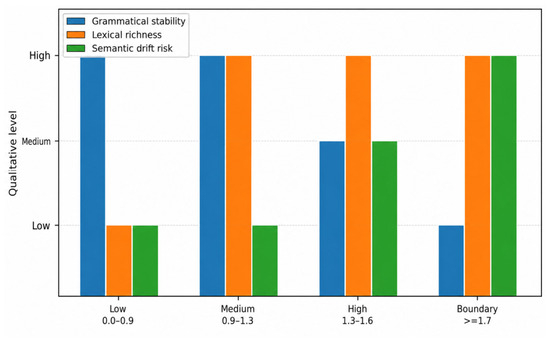
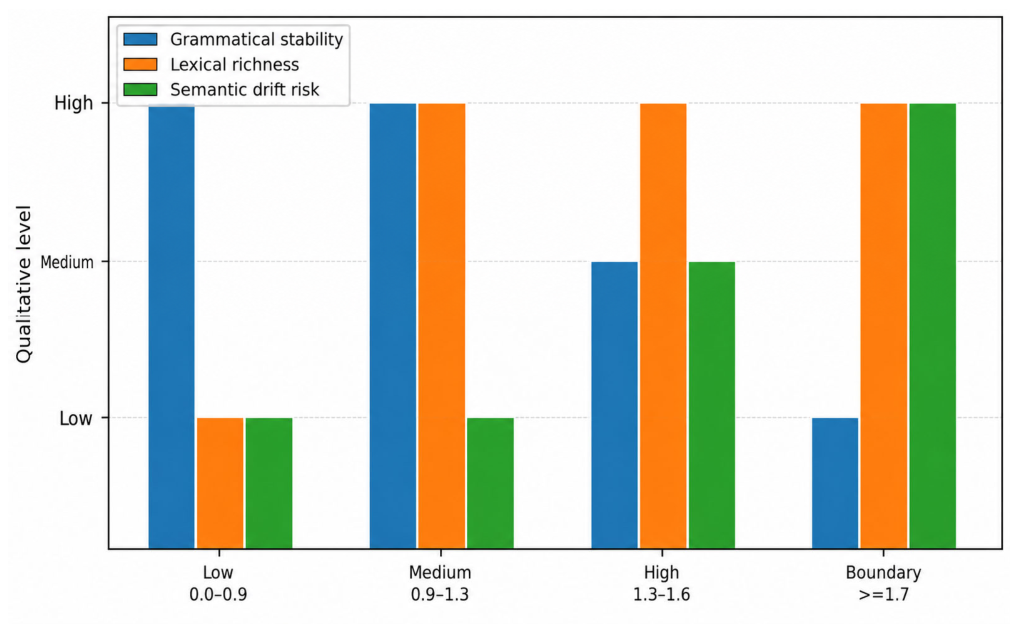
The results indicate that the temperature parameter serves as a crucial regulator of the balance between accuracy and creativity in GPT-4o’s linguistic output. Medium values around 1.0 provide the best combination of grammatical consistency, lexical richness, and natural syntax. Extremely low temperatures lead to mechanical but stable translations, whereas higher values result in freer yet occasionally inconsistent styles. These findings confirm the importance of parameter tuning as a means of achieving an optimal balance between precision and expressiveness in generative language models. The qualitative tendencies observed for the temperature parameter are summarized in Figure 2.
Figure 2.
Qualitative effect of temperature ranges on translation behaviour.
5.1.4. Effects of the Temperature and Top-P Parameters in Version 2 with GPT-4o
At very high temperature settings (1.7–2.0), cases of semantic drift or so-called hallucinations are observed: the model introduces new information absent from the original or shifts the semantic focus. Similar trends have been observed in comparative studies of AI-generated and human translations, where higher creativity parameters often correlate with semantic divergence and factual inconsistencies. This confirms that excessive variability compromises accuracy. Empirical research has shown that increasing sampling temperature in large language models leads to less deterministic outputs with reduced repetition and significantly higher diversity and creativity scores, suggesting that temperature modulates the balance between predictability and variability in text generation [11].
One of the main advantages of the Top-P parameter is that it enables translation at very high temperature values while significantly reducing semantic deviation. Recent sampling innovations (e.g., REAL-Sampling) demonstrate that carefully designed sampling schemes can simultaneously boost factuality and lexical diversity, which supports our observation that Top-P can compensate for elevated temperature levels when properly tuned. Such usage scenarios—high temperature combined with low Top-P—are employed when the goal is to enhance the lexical richness of the translation. Our observations and analysis of translated texts show that the model begins to hallucinate to the point of semantic loss and uncorrectable output at temperatures above 1.7. However, when Top-P is adjusted downward, translation at higher or even maximum temperature levels becomes possible without loss of meaning. Even at maximum temperature and relatively high Top-P values (0.7–0.9), the model can still produce accurate translations without hallucinations. Lexical diversity also increases under these conditions. At these parameter settings, it can be argued that the model achieves both high creativity and lexical variety without a significant degree of hallucination.
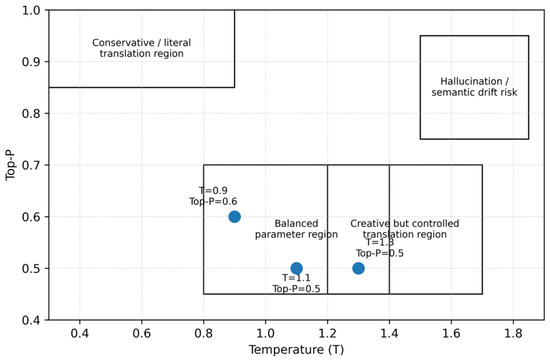
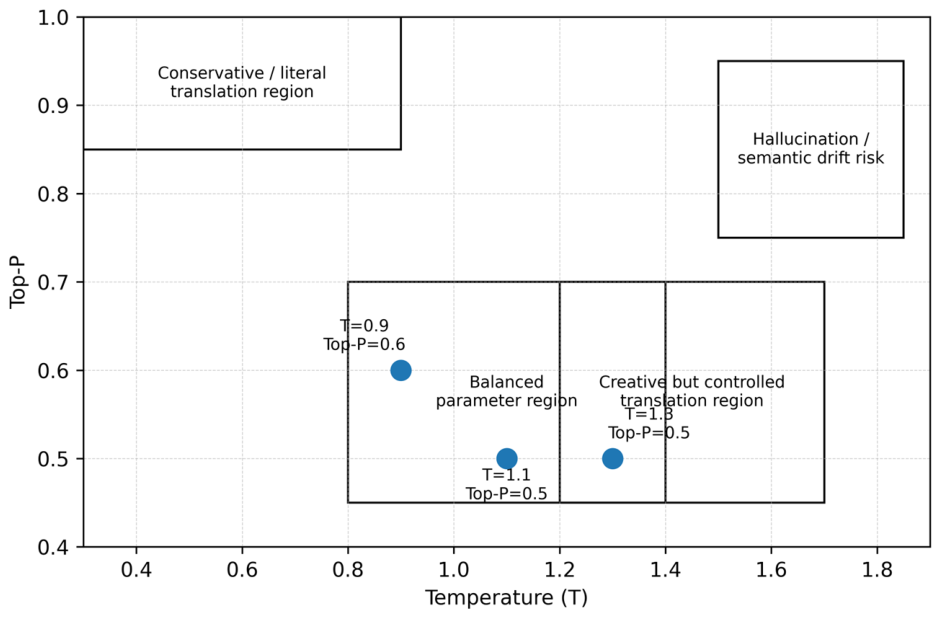
In our experiments, the intermediate combinations that maintain a balance between creativity and diversity are T = 1.1 with Top-P = 0.5, T = 1.3 with Top-P = 0.5, and T = 0.9 with Top-P = 0.6. These balanced parameter combinations are visualized in Figure 3.
Figure 3.
Balanced temperature and Top-P configurations observed in the experiments.
In this way, optimal balancing between diversity and sampling quality is achieved [12]. Initial observations and analysis of translations generated with Version 1 indicate that adjusting the temperature parameter alone does not ensure consistency. In Version 2, the constraints introduced through Top-P reduce hallucinations while preserving lexical diversity.
5.2. Preliminary Observations on Software Behaviour with GPT-5.2
Beyond the two GPT-4o-based experimental versions, the newer GPT-5.2 implementation of AI Document Translator allows an additional perspective on software behaviour in translation tasks. Although the available observations are partial and do not constitute a full experimental series, they indicate that the application preserves its core translation logic while operating with a model that appears to produce more stable outputs in selected contexts.
In the analysed examples, GPT-5.2 tended to maintain tense consistency more reliably, especially in passages where the Bulgarian source text required careful handling of aspectual distinctions and transitions between narrative and reported forms. Compared with the more variable behaviour observed at certain GPT-4o settings, the newer model showed a lower tendency toward semantically extraneous reformulation and a more disciplined preservation of the source-text focus.
At the lexical level, GPT-5.2 retained the capacity for idiomatic and natural phrasing, but in a comparatively more controlled manner. The generated translations appeared less prone to excessive synonymic drift and less likely to introduce stylistic variation at the expense of semantic precision. From the perspective of the software system, this suggests that the newer model may improve the balance between expressive fluency and operational stability.
These observations should be interpreted cautiously. They do not replace the empirical findings obtained with GPT-4o, which remain the core evidence base of the present study. Rather, they extend the article by showing that AI Document Translator, as a software platform, remains analytically relevant when integrated with a newer model generation and that its behaviour under GPT-5.2 merits dedicated future investigation.
6. Discussion
The observations from Version 1 and the comparative analysis with Version 2 highlight several practical implications for parameter adjustment. The findings suggest that optimal settings vary depending on text genre and communicative purpose.
As a baseline configuration, low-temperature translation with Top-P close to 1.0 may be considered the most conservative setting. It produces stable and literal output, but often with reduced lexical richness and weaker stylistic adaptation. Compared with this baseline, medium temperature values combined with controlled Top-P allow more natural phrasing while preserving semantic accuracy.
For narrative genres such as popular science and biographical writing, moderate temperature values (around 0.9–1.2) and Top-P between 0.8 and 0.95 help preserve a natural flow of expression without excessive deviations. For technical and regulatory texts, more conservative configurations, with a temperature of 0.3–0.6 and Top-P close to 1.0, produce the most consistent and accurate results. In contrast, for marketing and other creative tasks, higher temperature values (1.3–1.6) may be beneficial to enhance originality, provided that Top-P remains within 0.7–0.85 to prevent the generation of rare or contextually inappropriate constructions.
These tendencies have direct relevance to professional practice in translation, editing, and content generation, where large language models (LLMs) are increasingly applied across diverse genre contexts [13]. As noted, the integration of AI-based translation tools into educational and research workflows can improve both efficiency and scalability in multilingual content development.
The supplementary observations with GPT-5.2 suggest that the software-level tendencies identified in the GPT-4o analysis remain conceptually relevant in a newer model environment. At the same time, the newer implementation appears to support a more stable relationship between fluency and semantic control, which is especially important in document translation tasks involving long passages, historical references, and stylistic sensitivity. This indicates that the AI Document Translator can be studied not only as a parameter-sensitive system but also as a platform whose behaviour evolves together with the underlying model generation.
At the same time, several methodological limitations should be acknowledged. First, the corpus includes only popular science and biographical texts, which constrains the generalisability of the results to other domains. Second, the observed differences between Versions V1 and V2 reflect a combined effect of the temperature and Top-P parameters rather than their isolated influence. Dynamic temperature strategies such as Monte Carlo Temperature, which vary T across multiple samplings, have been proposed to reduce sensitivity to any single fixed temperature and to provide more reliable uncertainty estimates for generation tasks. Third, the evaluation was performed without the use of automatic metrics such as BLEU, COMET, or ChrF, which limits quantitative comparability [14]. In addition, the translation process was based on a fixed prompt design following the “classical translator” model, without accounting for variations that might arise in other genres, such as regulatory, technical, or literary texts.
7. Conclusions
In this paper, we presented a document translation system (AI Document Translator) used to evaluate the influence of the sampling parameters temperature and Top-P on translation quality in OpenAI’s language models, while also noting a newer GPT-5.2-based implementation of the software that follows a different principle of user-controlled configuration. The experiments conducted with different parameter configurations reveal that their combined adjustment plays a key role in balancing accuracy, naturalness, and creativity in translation.
The results show that the temperature parameter is a primary regulator of stylistic variability and grammatical predictability. Medium values in the range of approximately T ≈ 0.9–1.2 provide the best balance between grammatical correctness, lexical richness, and fluency of expression. At very low values, translations tend to become mechanical and overly literal, whereas excessively high values lead to semantic drift and the so-called “hallucinations.” The introduction of the Top-P parameter in the second version of the application significantly improves output stability at higher temperature levels. Combinations such as T = 1.1–1.3 and Top-P = 0.5–0.7 demonstrate an optimal balance between creativity and accuracy, reducing the frequency of factual errors without loss of naturalness. These findings confirm that Top-P functions as a compensatory mechanism that constrains the likelihood of semantic deviation under high stochasticity.
Thus, the study contributes to a better understanding of how sampling parameters influence translation performance and opens new directions for the use of large language models (LLMs) in multilingual contexts. In future work, it would be useful to include a wider range of genres and models in order to verify the generalisability of the results. At the same time, the present study shows that the relevance of the AI Document Translator extends beyond the initial GPT-4o-based experiments.
The GPT-5.2-oriented implementation represents a subsequent development stage of the software. However, its translation behaviour requires dedicated future evaluation through a larger comparative design.
Author Contributions
H.H. developed the theoretical concept, coordinated the research, co-developed the software, and wrote the paper. G.D. co-developed the software and contributed to the implementation. V.I. contributed to the literature review and methodology. K.Y. provided supervision and critical feedback and wrote the paper. I.I. contributed to the analysis and system architecture. All authors have read and agreed to the published version of the manuscript.
Funding
This research received no external funding.
Institutional Review Board Statement
Not applicable.
Informed Consent Statement
Not applicable.
Data Availability Statement
The dataset is available upon request from the authors.
Acknowledgments
During the preparation of this manuscript, the authors used proprietary software incorporating OpenAI models (GPT-4o and GPT-5.4) via API for text editing and proofreading purposes. Following the use of this software, the authors have reviewed and edited the output and take full responsibility for the content of this publication.
Conflicts of Interest
The authors declare no conflicts of interest.
Abbreviations
The following abbreviations are used in this manuscript:
| RAG | Retrieval-Augmented Generation |
| TXT | Plain Text File |
| DOCX | Office Open XML Document |
| Portable Document Format | |
| LLM | Large Language Model |
| GPT | Generative Pre-trained Transformer |
| AI | Artificial Intelligence |
| CSS | Cascading Style Sheets |
| MLM | Masked Language Model |
References
- Zarrieß, S.; Voigt, H.; Schüz, S. Decoding Methods in Neural Language Generation: A Survey. Information 2021, 12, 355. [Google Scholar] [CrossRef] [Scilit]
- Tarchi, C.; Zaccoletti, S.; Mason, L. Learning from text, video, or subtitles: A comparative analysis. Comput. Educ. 2021, 160, 104034. [Google Scholar] [CrossRef] [Scilit]
- Miranda, S.; Vegliante, R. Leveraging AI-generated virtual speakers to enhance multilingual e-learning experiences. Information 2025, 16, 132. [Google Scholar] [CrossRef] [Scilit]
- Akkaya, A. Reliable Information Access in Intelligent Transportation Systems and Autonomous Driving Protocols: An Experimental Evaluation of the RAG Architecture’s Regulatory Analysis. J. Intell. Transp. Syst. Appl. 2026, 9, 22–41. [Google Scholar] [CrossRef] [Scilit]
- Wiher, G.; Meister, C.; Cotterell, R. On decoding strategies for neural text generators. Trans. Assoc. Comput. Linguist. 2022, 10, 997–1012. [Google Scholar] [CrossRef] [Scilit]
- Meister, C.; Pimentel, T.; Wiher, G.; Cotterell, R. Locally typical sampling. Trans. Assoc. Comput. Linguist. 2023, 11, 102–121. [Google Scholar] [CrossRef] [Scilit]
- Maruf, S.; Saleh, F.; Haffari, G. A survey on document-level neural machine translation: Methods and evaluation. ACM Comput. Surv. 2021, 54, 45. [Google Scholar] [CrossRef] [Scilit]
- Brown, T.B.; Mann, B.; Ryder, N.; Subbiah, M.; Kaplan, J.D.; Dhariwa, P.; Neelakantan, A.; Shyam, P.; Sastry, G.; Askell, A.; et al. Language Models Are Few-Shot Learners. In Proceedings of the 2020 Conference on Neural Information Processing Systems (NeurIPS 33), Virtual, 6–12 December 2020; pp. 1877–1901. [Google Scholar]
- Pierluigi, A.; Linacero Martin, M.; De Santis, A.; Bellini, C.; Minerva, T. An AI-assisted workflow for multilingual accessible video production: The EDUNEXT case study. In Proceedings of the International Conferences E-Learning and Digital Learning 2025 and Sustainability, Technology and Education 2025; IADIS Press: Lisbon, Portugal, 2025; pp. 29–36. [Google Scholar]
- Toshkov, H. Thinkers and Dreamers: Genius and the Evolution of European Thought Between the 16th and 19th Centuries; Da Vinci Lab for Science and Arts Ltd.: Plovdiv, Bulgaria, 2025. [Google Scholar]
- Bellemare-Pepin, A.; Lespinasse, F.; Thölke, P.; Harel, Y.; Mathewson, K.; Olson, J.A.; Bengio, Y.; Jerbi, K. Divergent creativity in humans and large language models. Sci. Rep. 2026, 16, 1279. [Google Scholar] [CrossRef] [Scilit] [PubMed]
- Chang, H.-S.; Peng, N.; Bansal, M.; Ramakrishna, A.; Chung, T. REAL Sampling: Boosting Factuality and Diversity of Open-Ended Generation via Asymptotic Entropy. Trans. Assoc. Comput. Linguist. 2025, 13, 760–783. [Google Scholar] [CrossRef] [Scilit]
- Stahlberg, F. Neural machine translation: A review. J. Artif. Intell. Res. 2020, 69, 343–418. [Google Scholar] [CrossRef] [Scilit]
- Freitag, M.; Foster, G.; Grangier, D.; Ratnakar, V.; Tan, Q.; Macherey, W. Experts, Errors, and Context: A Large-Scale Study of Human Evaluation for Machine Translation. Trans. Assoc. Comput. Linguist. 2021, 9, 1460–1474. [Google Scholar] [CrossRef] [Scilit]
Disclaimer/Publisher’s Note: The statements, opinions and data contained in all publications are solely those of the individual author(s) and contributor(s) and not of MDPI and/or the editor(s). MDPI and/or the editor(s) disclaim responsibility for any injury to people or property resulting from any ideas, methods, instructions or products referred to in the content. |
© 2026 by the authors. Licensee MDPI, Basel, Switzerland. This article is an open access article distributed under the terms and conditions of the Creative Commons Attribution (CC BY) license.