


Abstract
Secure QR-based data transfer requires a careful balance between confidentiality, payload size, decoding reliability, and resistance to visual degradation. This paper presents a reproducible comparative framework for studying secure QR code transmission under controlled distortions. The framework combines protected payload generation, batch experimentation, and comparative visual analysis to examine how payload mode, error-correction level, decoder backend, and image degradation influence transmission success, overhead, QR complexity, and processing time. The results highlight key trade-offs among robustness, efficiency, and symbol density, and provide practical guidance for selecting suitable secure QR transmission settings in distortion-prone environments. Unlike existing evaluation approaches that address security and robustness factors in isolation, the proposed framework offers the first unified experimental environment for their joint reproducible assessment, making it directly applicable to systematic research in secure QR transmission design.
1. Introduction
Quick Response (QR) codes remain one of the most practical machine-readable carriers for compact visual data exchange. Their behavior is defined by a standardized symbol structure, while real-world readability depends on the interaction among payload size, error-correction level, module geometry, printing quality, and scanning conditions. Recent studies on print-quality assessment further show that QR readability is influenced not only by symbol design, but also by the physical realization of the code and the conditions under which it is captured and decoded [1,2].
At the same time, the growing use of QR codes in payments, authentication, logistics, health care, and document access has expanded their security exposure. Recent review literature has shown that QR-based systems are vulnerable to phishing, tampering, information leakage, malware delivery, and code substitution, while newer protection-oriented approaches increasingly address tamper resistance and fraud-aware verification [3,4].
For secure QR-based transmission, the problem extends beyond authenticity alone. Once structured or sensitive data are embedded into QR symbols, security must be balanced against payload overhead, code density, and practical decodability. Recent application-oriented studies have shown that compression, encryption, partitioning, and authentication must be designed jointly to support secure and still scannable QR transfer [5,6].
Another major challenge arises from the imaging channel. Decoding performance can deteriorate because of motion blur, defocus, geometric deformation, difficult surfaces, low effective sampling, perspective distortion, and physical damage. Recent studies have addressed these issues through decoder benchmarking near sampling limits [7], motion-blur recognition pipelines [8,9], deblurring-oriented restoration [10], deformation correction on non-planar surfaces [11], perspective-aware detection in real-world conditions [12], and lightweight restoration of damaged QR and barcode images [13]. Together, these studies show that QR reliability depends not only on the symbol itself, but also on the decoder, the distortion type, and the preprocessing or reconstruction strategy used before decoding.
Despite these advances, the literature remains fragmented. Security-oriented studies and robustness-oriented studies are often evaluated separately, which makes direct comparison difficult. The present study addresses this gap by introducing a reproducible framework for the joint evaluation of secure payload generation, controlled distortions, decoder behavior, and comparative visual analysis under a unified experimental protocol.
The main contributions of this paper are as follows: (i) a unified, reproducible experimental framework that jointly evaluates secure payload generation, controlled distortions, decoder backend selection, and comparative visual analysis—an integration not previously addressed in the literature; (ii) a systematic multi-factor experimental campaign demonstrating the interaction effects among payload representation, error-correction level, message length, distortion type, and decoder choice on secure QR transmission success; and (iii) empirical evidence that decoder selection and payload representation are not neutral implementation details, but experimentally significant factors whose relative importance depends on the dominant distortion mechanism.
2. Related Work
The related literature relevant to the present study can be grouped into several complementary directions. These include research on QR code structure and practical readability, security-oriented QR methods, application-specific secure QR transmission, and robustness under challenging visual conditions. The following subsections summarize these lines of work and highlight the gap addressed by the proposed framework.
2.1. QR Code Structure, Capacity, and Practical Readability
Recent QR research continues to rely on the standardized symbol model defined in ISO/IEC 18004:2024, where symbol version, module arrangement, and error-correction configuration determine the effective relationship between capacity and robustness [1]. More recent experimental work has also shown that readability depends strongly on implementation factors such as module size, contrast, print precision, and the interaction between physical production and scanner behavior [2]. These considerations are directly relevant for secure QR transmission because cryptographic metadata and payload encoding choices can increase symbol density and push the code closer to its practical readability limits [1,2].
2.2. Security-Oriented QR Research
The recent security literature shows that QR systems are no longer treated merely as neutral visual carriers. A systematic review by Njuguna and Ndia identifies phishing, tampering, QR-in-QR attacks, malicious redirection, and information leakage as recurring threat classes, while also grouping the main mitigation directions into cryptographic, machine-learning, authentication, and blockchain-based approaches [3]. More application-specific recent studies have focused on preventive protection at the code level. Alsuhibany proposed a tamper-proof QR generation and verification system based on embedded protection mechanisms for fraud-resistant use cases [4], while San Agustin-Crescencio et al. developed a protection-and-recovery approach that combines encryption with enhanced decoding and retrieval logic [6]. This line of research makes clear that secure QR design increasingly involves integrity control, authenticity assurance, and resistance to manipulation in addition to plain data encoding [3,4,6].
2.3. Secure QR Transmission in Application Settings
A second recent line of work addresses QR codes as carriers for structured secure transmission rather than simple linking or identification. In the health-care domain, Li et al. proposed a QR-based security transmission algorithm for transferring electronic health records across trust boundaries, combining serialization, compression, encryption, partitioning, and authentication into a complete transfer workflow [5]. Their study is especially relevant because it shows that secure QR transmission is constrained by payload size and decoding practicality, not just by security requirements. San Agustin-Crescencio et al. approached the problem from a different angle by coupling encrypted QR content with chromatic multiplexing and wavelength-based recovery [6]. Together, these studies show that secure QR transmission must be evaluated as a systems problem involving security, capacity, symbol complexity, and recoverability at the same time [5,6].
2.4. Robust QR Reading Under Blur, Damage, and Deformation
Another strong recent research direction focuses on maintaining decodability under degraded visual conditions. Li et al. addressed motion-blurred QR images through a feature-extraction and adaptive-thresholding pipeline designed for both blur and uneven illumination [8]. Dong et al. extended this direction with a GAN- and attention-based method for motion-blurred QR recognition [9]. Xu et al. proposed a deblurring method based on a local maximum/minimum intensity prior, targeting both restoration quality and speed for QR code images [10]. In addition, Muallim et al. introduced a lightweight deep-learning restoration model and a synthetic dataset for damaged barcode and QR reconstruction in logistics-oriented scenarios [13]. These studies collectively indicate that blur and physical degradation remain central challenges for robust QR reading, and that recovery-oriented preprocessing is increasingly treated as part of the decoding pipeline itself [8,9,10,13].
2.5. Deformation, Perspective, and Decoder Behavior
Beyond blur and damage, QR codes may also fail under non-planar placement, perspective distortion, and low effective sampling. Benito-Altamirano et al. showed that readability on challenging surfaces can be improved through thin-plate spline-based deformation correction [11]. Corpuz et al. proposed a pipeline combining object detection, edge-based preprocessing, and perspective correction for tilted, distant, and poorly lit scenes [12]. At the decoder level, Skurowski et al. demonstrated that recognition near Nyquist limits varies significantly across libraries, with ZBar and OpenCV showing different strengths depending on scale and boundary conditions [7]. Together, these findings show that decoder choice is not a neutral implementation detail, but an experimental factor that can materially affect comparative conclusions [7,11,12].
2.6. Research Gap
The reviewed recent literature shows substantial progress, but mostly along separate lines. Security-oriented work has concentrated on trustworthy generation, anti-fraud verification, or protected transfer workflows [3,4,5,6], whereas robustness-oriented work has concentrated on blur restoration, surface deformation correction, damaged-code recovery, or decoder behavior under adverse imaging conditions [7,8,9,10,11,12,13]. What remains insufficiently covered is a reproducible experimental environment in which these dimensions are studied together: secure payload configuration, controlled distortions, decoder backend, and comparative visual analytics. The present paper is positioned precisely in that space.
It is also worth noting that commonly used QR tools and libraries—such as ZBar, pyzbar, OpenCV’s QR detector, and Python’s qrcode package—are designed for generation or decoding in isolation and provide no support for security-oriented payload construction, structured distortion injection, or aggregated comparative analysis. The closest academic evaluation work, such as the decoder benchmarking study by Skurowski et al. [7], focuses on recognition behavior near Nyquist sampling limits without incorporating any security-oriented payload layer or batch experimentation infrastructure. No existing tool or study combines all four dimensions—secure payload generation, controlled distortion, multi-decoder comparison, and result visualization—within a single reproducible experimental protocol. The present framework is therefore novel in its integration scope, not merely in its individual components.
Against this background, the next section presents the proposed framework and explains how its main components support the intended comparative evaluation.
3. Research Framework and System Design
Based on the identified research gap, the proposed framework was designed as an integrated environment for secure QR transmission analysis. This section describes its overall structure and the role of its main components in the experimental workflow.
3.1. Overview of the Framework
The proposed system was developed as an integrated environment for studying secure QR code transmission under controlled distortion conditions. Instead of treating QR generation, distortion testing, batch execution, and result analysis as separate tasks, the application brings them together in a single workflow. This makes it possible to move from the generation of a single protected QR symbol to large-scale comparative experiments within the same software environment.
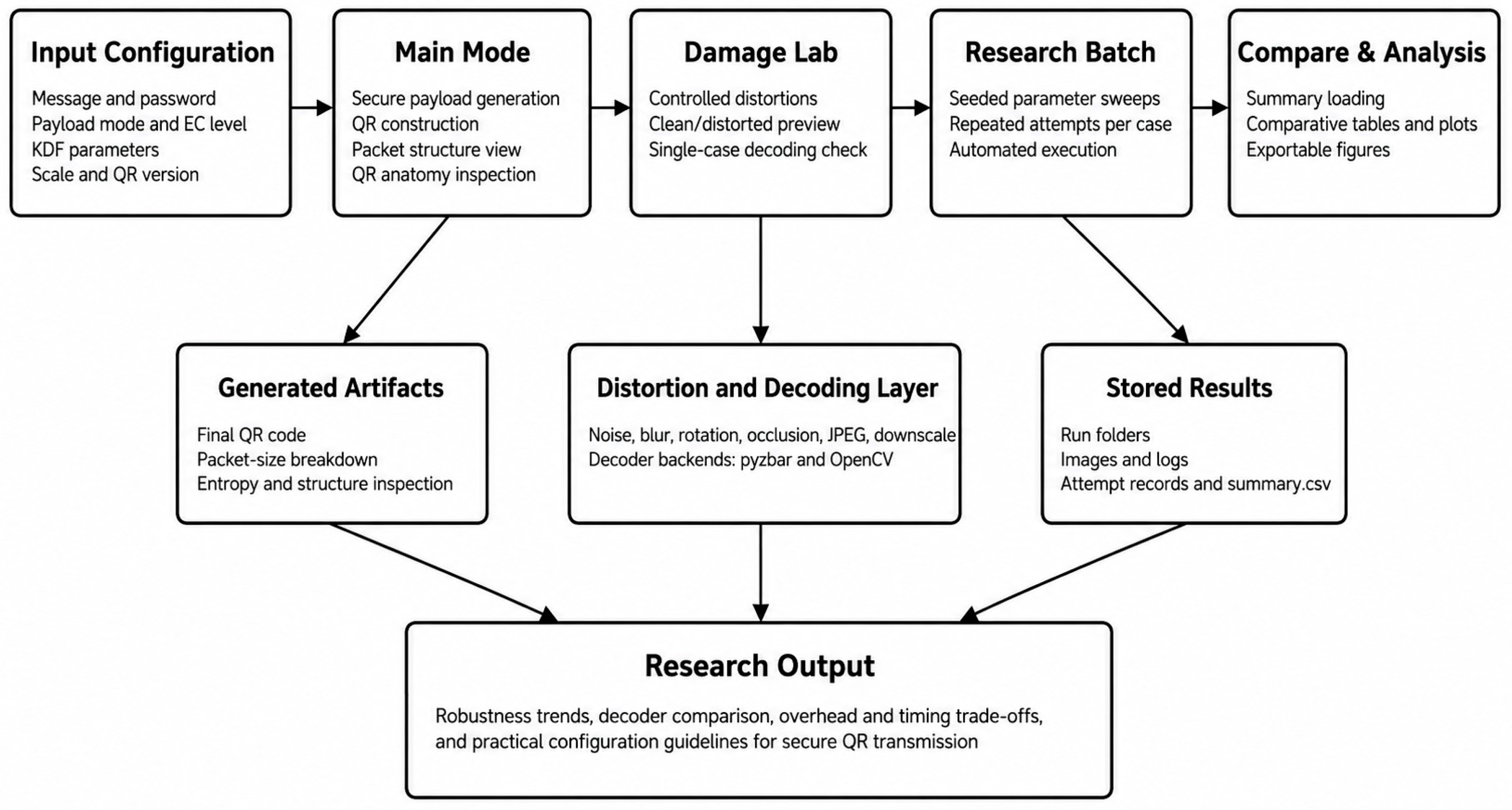
Figure 1 presents the overall architecture and workflow of the framework. The process begins with an input configuration stage, where the message, password, payload mode, error-correction level, key-derivation settings, scale, and optional QR version are defined. These parameters are then used during secure payload generation and QR construction in the Main Mode. From there, the workflow can continue in two directions: interactive inspection through the Damage Lab, or reproducible multi-parameter testing through the Research Batch module.
Figure 1.
Overall architecture and experimental workflow of the proposed framework.
The lower part of Figure 1 highlights the supporting layers of the framework. The generated artifacts include the final QR code and structural information about the encoded packet, while the distortion and decoding layer covers the applied degradations together with the selected decoder backend. Batch outputs are stored in a structured form and are later loaded into the Compare & Analysis module, where they can be examined through tables and comparative plots. In this way, the framework supports the full research cycle, from secure QR generation to the extraction of experimentally grounded conclusions.
3.2. Main Mode: Secure Payload Generation and QR Inspection
The Main Mode provides the baseline workflow for secure QR generation. In this module, the user defines the plaintext message, password, payload representation mode, error-correction level, output scale, and, if needed, a fixed QR version. The interface also supports selection of the key-derivation method and its parameters, enabling protected payload generation under different cryptographic settings.
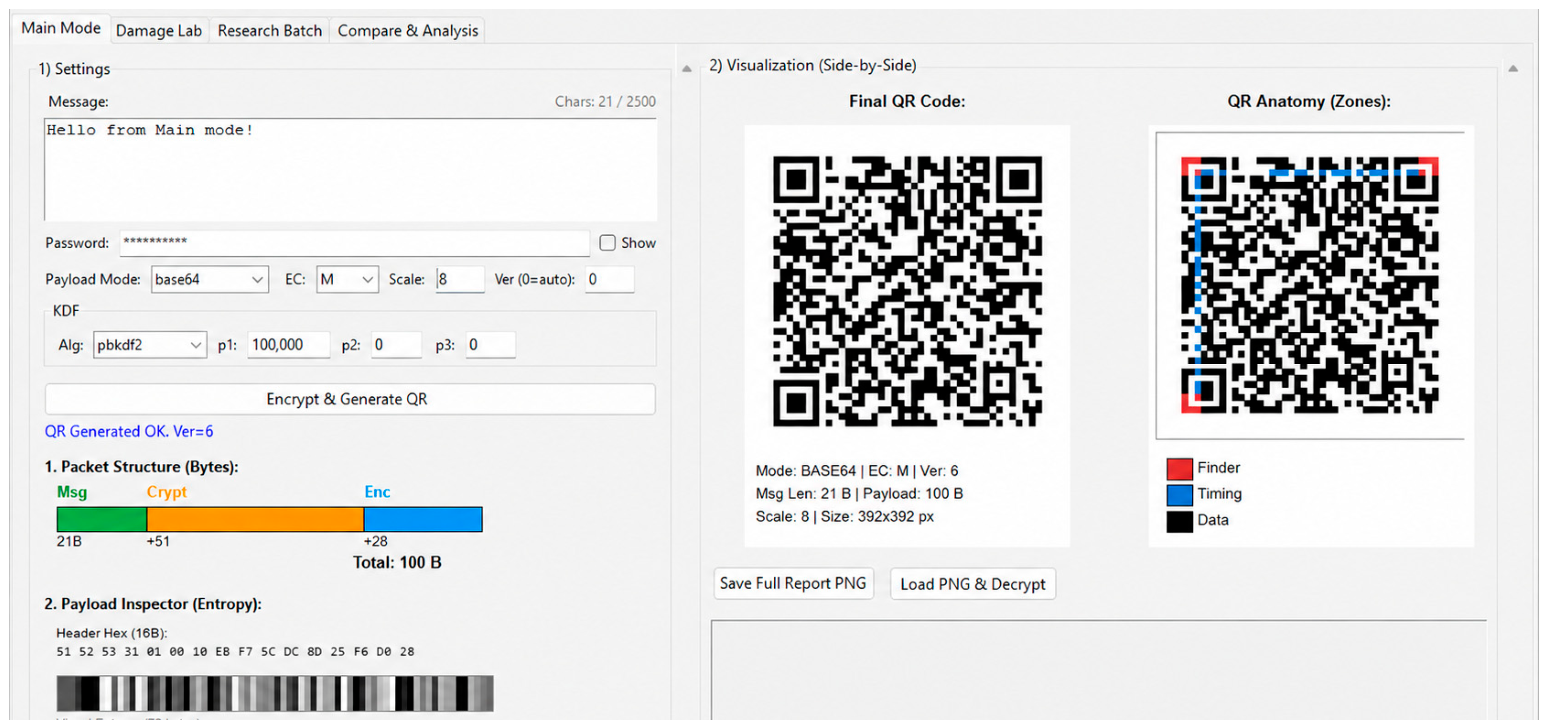
Figure 2 presents a typical view of this module after successful QR generation. The left side contains the main configuration controls together with a packet structure view, while the right side shows the final QR symbol and a visual breakdown of its structural regions. This layout links transmission settings to the resulting visual form of the code.
Figure 2.
Main tab of the simulator—QR generation, packet structure, and QR visualization.
An important feature of this module is the inspection area below the configuration controls. As shown in Figure 2, the application not only generates a scannable symbol, but also reveals how the original message, cryptographic overhead, and encoded representation contribute to the final packet size. This is relevant to the present study because payload overhead and QR complexity directly affect scannability, decoding stability, and tolerance to later distortions.
3.3. Damage Lab: Controlled Distortion Injection
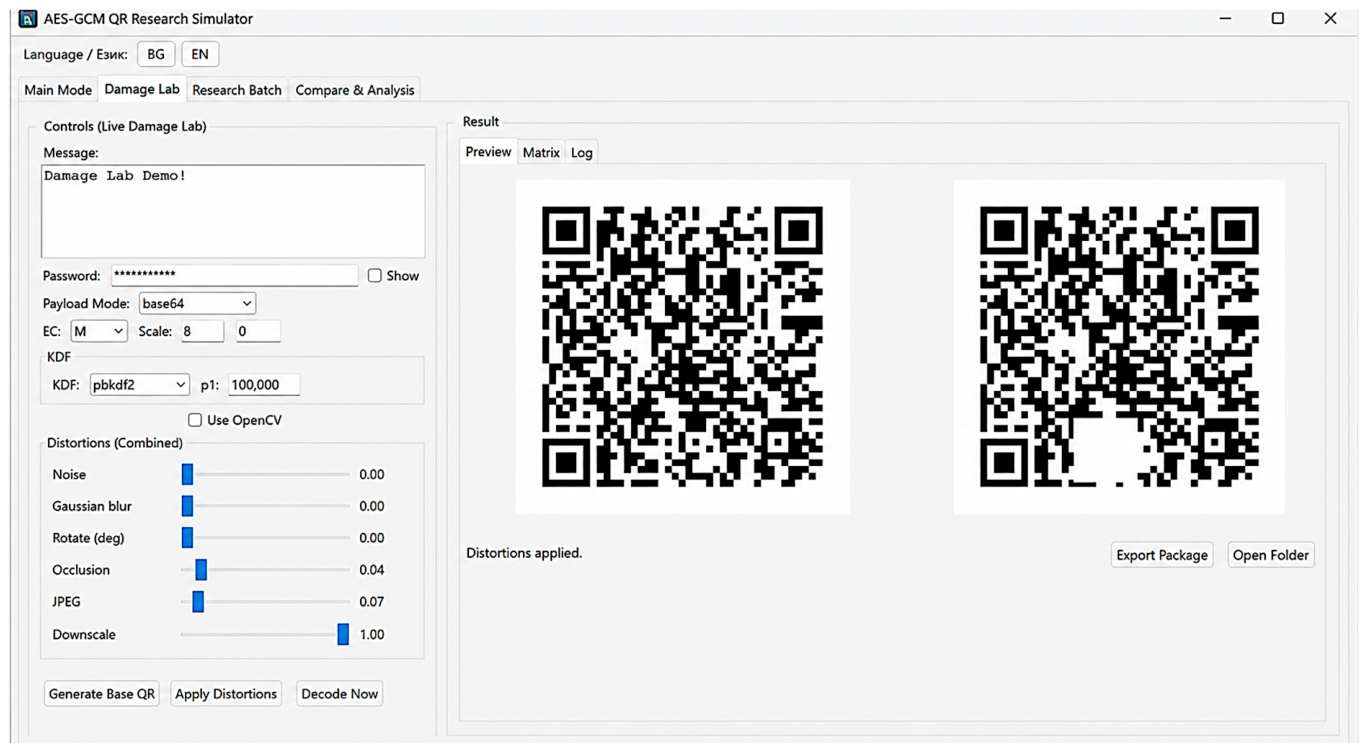
The Damage Lab was designed for interactive testing under controlled visual degradation. It allows a clean QR code to be generated first and then modified through adjustable distortion controls. The implemented distortions include noise, Gaussian blur, rotation, occlusion, JPEG degradation, and downscaling, which together cover several of the most common reasons for QR decoding failure in real conditions.
Figure 3 illustrates this module with a side-by-side comparison between a clean and a distorted QR symbol. This visual setup is useful not only for demonstration purposes, but also for practical parameter tuning. Before launching a full batch experiment, the user can inspect how a given distortion level affects the appearance of the code and whether the selected range is meaningful for further testing.
Figure 3.
Damage Lab interface with clean and distorted QR code with degradation settings (“Език” = “Language”).
The role of the Damage Lab in the framework is therefore twofold. On the one hand, it supports exploratory inspection of individual cases. On the other hand, it serves as a bridge between secure QR generation and automated experimentation. The distortion settings tested interactively in this module can later be transferred to the batch stage, where their effect is evaluated more systematically.
3.4. Research Batch: Reproducible Experiment Configuration
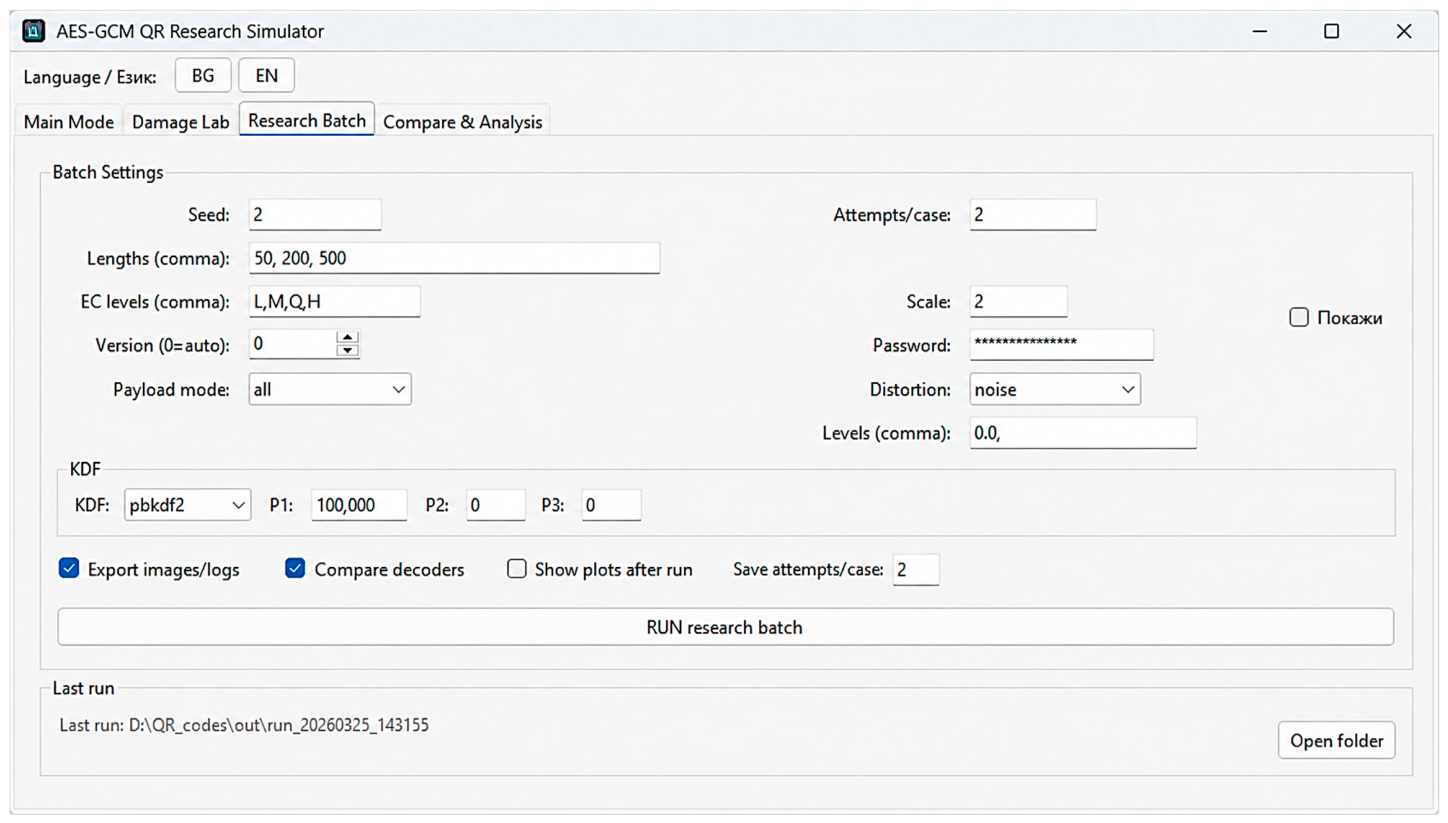
The Research Batch tab is the core experimental component of the framework. It allows the user to define structured test campaigns by specifying the random seed, message lengths, error-correction levels, payload modes, distortion type, distortion levels, number of attempts per case, output scale, and key-derivation parameters. Additional options support decoder comparison, export of images and logs, and post-run visualization.
A representative configuration of this module is shown in Figure 4. Rather than testing isolated examples manually, the batch engine was designed to execute controlled parameter sweeps over many combinations of settings. This is essential for the present work, since the aim is to study how several factors jointly affect decoding success, overhead, QR complexity, and timing behavior.
Figure 4.
Research Batch tab used for defining reproducible automated test runs (“Език” = ”Language”, “Пoкажи” = “Show”).
Another important feature of this module is reproducibility. Because the experiment settings are explicitly defined and the outputs are stored in dedicated run folders, the same configuration can be repeated later under the same protocol. Figure 4 reflects this experimental logic well: the interface is centered not on one-off generation, but on the definition and execution of systematic test campaigns.
3.5. Compare and Analysis: Aggregated Result Inspection and Plot Generation
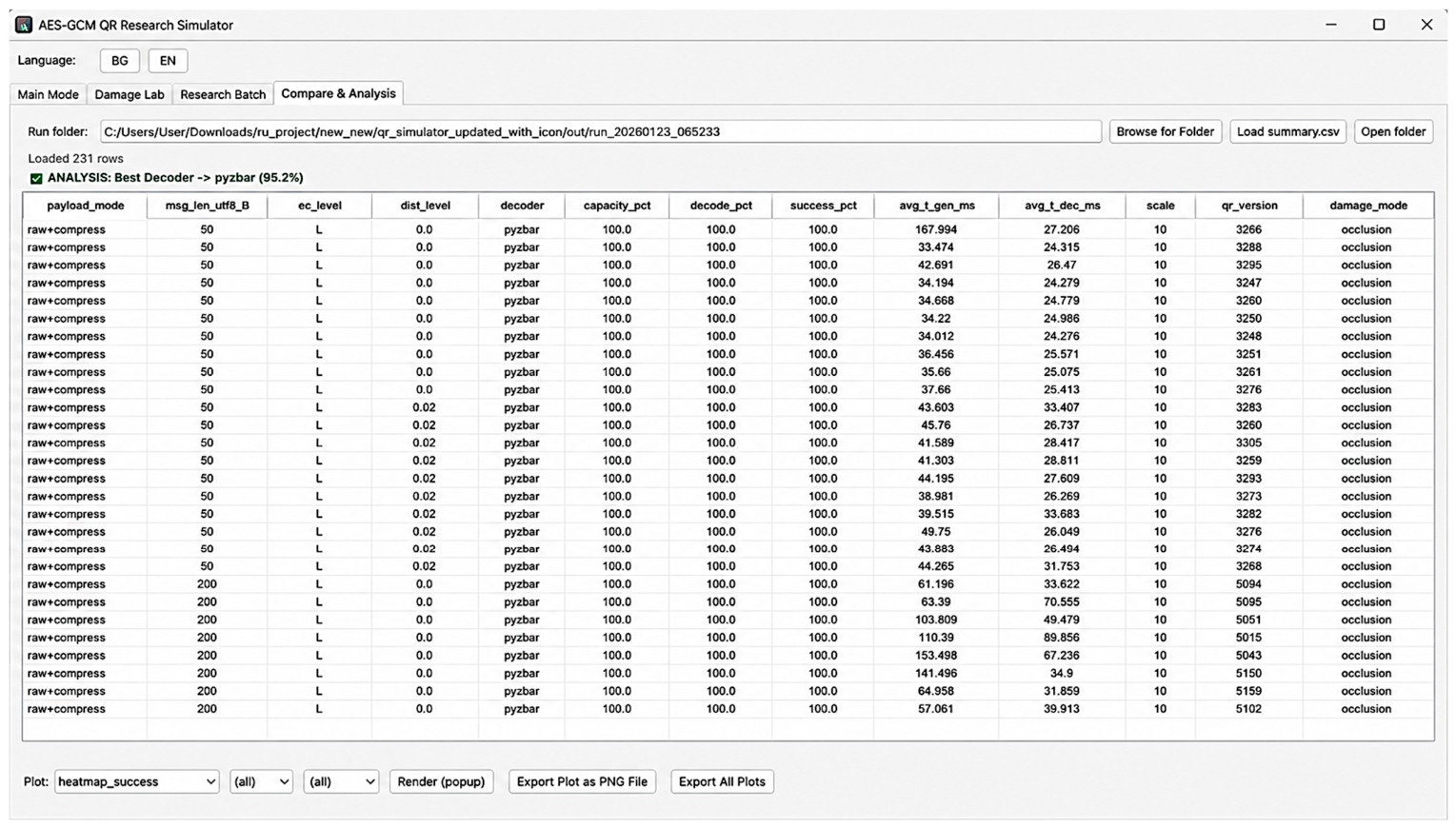
The Compare & Analysis tab provides the analytical layer of the framework. After a batch run has been completed, the generated summary file can be loaded and inspected in tabular form. From there, the user can select different visualization modes and render comparative plots based on the aggregated experiment data.
Figure 5 shows this module after loading a batch summary. The interface exposes the most important recorded variables and performance indicators, making it possible to compare results across different parameters and error-correction configurations. This is where the experimental output becomes useful as research evidence rather than retaining a collection of log files and raw records.
Figure 5.
Compare and analysis tab.
The importance of this module is that it closes the analytical loop of the framework. The earlier stages generate and distort secure QR symbols, while the Compare & Analysis tab turns the resulting measurements into interpretable tables and figures. For the present study, this module is particularly valuable because it supports the extraction of trends and trade-offs that would be difficult to identify from isolated runs alone.
3.6. End-to-End Workflow of the Proposed Environment
Taken together, the components shown in Figure 1, Figure 2, Figure 3, Figure 4 and Figure 5 form a complete workflow for secure QR transmission research. The process starts with secure payload generation and structural inspection in the Main Mode, continues with controlled degradation and exploration testing in the Damage Lab, and then moves to automated multi-parameter experimentation in the Research Batch module. The resulting summaries are finally examined in the Compare & Analysis tab, where the data can be compared visually and quantitatively.
This organization gives the framework value beyond demonstration alone. It supports both interactive exploration and reproducible evaluation, which makes it suitable for systematic studies of secure QR transmission under distortion-prone conditions. In that sense, the application is not only a software tool, but also a research environment designed to connect generation, degradation, experimentation, and analysis within a single consistent workflow.
4. Experimental Methodology
Building on this framework, the following section describes the experimental configuration used to evaluate its performance under baseline and distorted conditions.
The experimental evaluation was designed to examine the behaviour of secure QR code transmission under controlled distortion conditions and to quantify the trade-offs among decoding reliability, payload overhead, QR complexity, and processing time. The analysis focused on five main factors: message length, payload representation mode, error-correction level, distortion configuration, and decoder backend.
The experiments were carried out through the Research Batch module of the proposed framework. Since the batch interface evaluates one distortion category per run, the full experimental campaign was organized as a sequence of separate but structurally identical runs. In contrast, the payload mode parameter was executed in its combined setting, allowing all supported payload representations to be evaluated within the same batch configuration.
The conducted campaign included five runs. One baseline run was performed with no distortion, followed by four distortion-oriented runs for noise, Gaussian blur, JPEG degradation, and occlusion. Across all runs, the tested message lengths were 50, 250, and 1000 characters (equivalent to bytes in the present ASCII-based test set), while the evaluated QR error-correction levels were L, M, Q, and H. The QR version was left in automatic mode (Version = 0), allowing symbol size to adapt to the protected payload and the selected error-correction level.
The key-derivation configuration was fixed to PBKDF2 with parameter p1 = 100,000, while the remaining KDF parameters were kept at their default values used by the application. The rendering scale was set to 10, and decoder comparison was enabled in all runs so that both pyzbar and OpenCV were evaluated under identical conditions. Each parameter combination was tested over 10 attempts using a fixed random seed of 123 to support repeatability.
To support transparency and reproducibility, the experimental environment was implemented in Python 3.11, using pyzbar 0.1.9 and OpenCV 4.9.0 as decoder backends, qrcode 7.4.2 for QR symbol generation, Pillow 10.3.0 for image processing, and cryptography 42.0 for PBKDF2 key derivation and AES-GCM encryption. All distortions were applied programmatically without any hardware capture step, ensuring that the reported results are fully reproducible given the same parameter configuration and random seed. The experiments were executed on a standard workstation under Windows 11 (64-bit); no GPU acceleration was used for any processing step.
The distortion-specific runs were carried out using the following level sets: 0.00, 0.02, 0.04, 0.06, and 0.08 for noise; 0.00, 0.50, 1.00, 1.50, and 2.00 for Gaussian blur; 0.00, 0.05, 0.10, 0.15, and 0.20 for JPEG degradation; and 0.00, 0.05, 0.10, 0.15, and 0.20 for occlusion. These settings were selected to represent a gradual progression from undistorted or mildly degraded conditions to substantially more difficult decoding scenarios.
The recorded metrics covered four main aspects of transmission behavior. First, the experiments tracked whether the protected payload could be successfully embedded into the QR symbol and later recovered after decoding. Second, the framework recorded payload- and symbol-related properties such as encoded payload size and resulting QR version. Third, it measured average generation and decoding times in order to capture the computational cost of each configuration. Finally, because decoder comparison was enabled, the experiments also provided a direct basis for assessing decoder-dependent behavior under the same payload, error-correction, and distortion settings.
The aggregated results were analyzed comparatively to identify how robustness and efficiency changed with payload growth, stronger error correction, different payload representations, and increasing distortion severity. The main outputs considered in the study included success heatmaps, message-length comparison plots, decoder comparison graphs, error-correction impact plots, and payload-overhead summaries. Together, these outputs provide a structured basis for interpreting the practical behavior of secure QR transmission in distortion-prone conditions.
The results obtained from these five runs are presented and discussed in the following section.
5. Results and Discussion
The results of the experimental campaign are presented in this section with a focus on the main trade-offs revealed by the five runs. The discussion is organized around four complementary aspects of secure QR transmission: baseline feasibility and payload overhead, decoder behaviour under noise, computational cost under mild visual degradation, and robustness under structural masking. Taken together, these results provide a comparative view of how payload representation, decoder backend, message length, and distortion type jointly affect the practical performance of secure QR transmission.
5.1. Baseline Feasibility and Payload Overhead
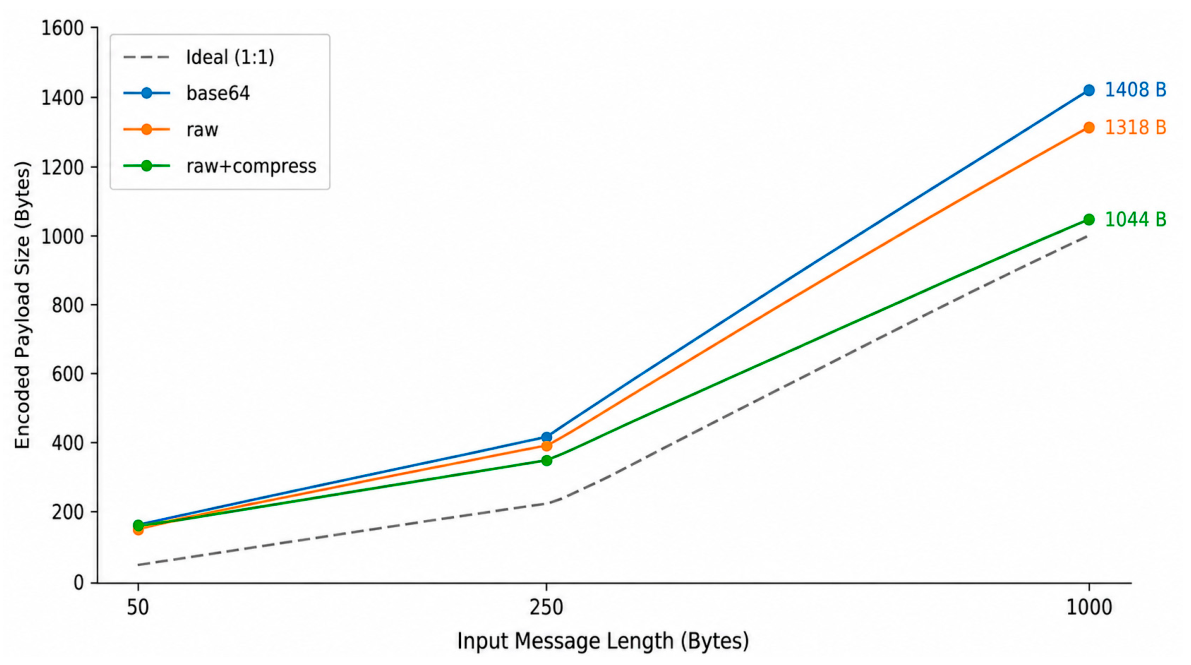
The baseline run was first used to examine the feasibility of secure QR transmission in the absence of visual degradation and to compare the overhead introduced by the supported payload modes. The most informative result in this respect is shown in Figure 6, where the encoded payload size is plotted against the input message length for the three tested payload representations.
Figure 6.
Protocol overhead as a function of input message length for the tested payload modes.
As expected, all three modes show increasing overhead as the message length grows. However, the differences between them become much more pronounced for larger inputs. The Base64-based representation produces the largest encoded payload across the tested message lengths, while the raw mode remains somewhat more compact. The most favourable behaviour is observed for the raw+compress mode, whose advantage becomes especially clear for the longest message. This confirms that payload representation is not a minor implementation detail, but a factor that directly affects QR symbol density and practical transmission feasibility.
The baseline results also reveal an important limit of the system. For the 1000-byte message at the highest error-correction level, the base64 and raw modes fail to produce a valid QR symbol, whereas raw+compress remains feasible. This is one of the most important observations of the study, because it shows that the choice of payload representation can determine not only performance but also whether a given secure transmission configuration is possible at all.
Taken together, the baseline results suggest that raw+compress provides the best overall balance between compactness and scalability. This finding is consistent with the later distortion runs, where the same mode also tends to remain among the most reliable configurations.
5.2. Decoder Behavior Under Noise
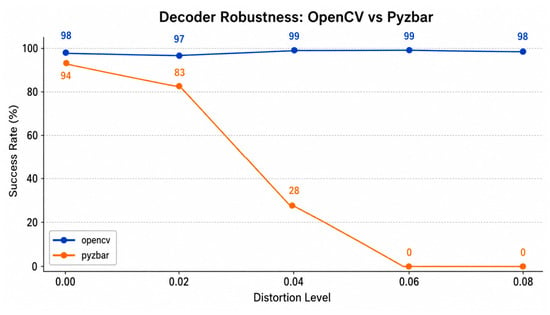
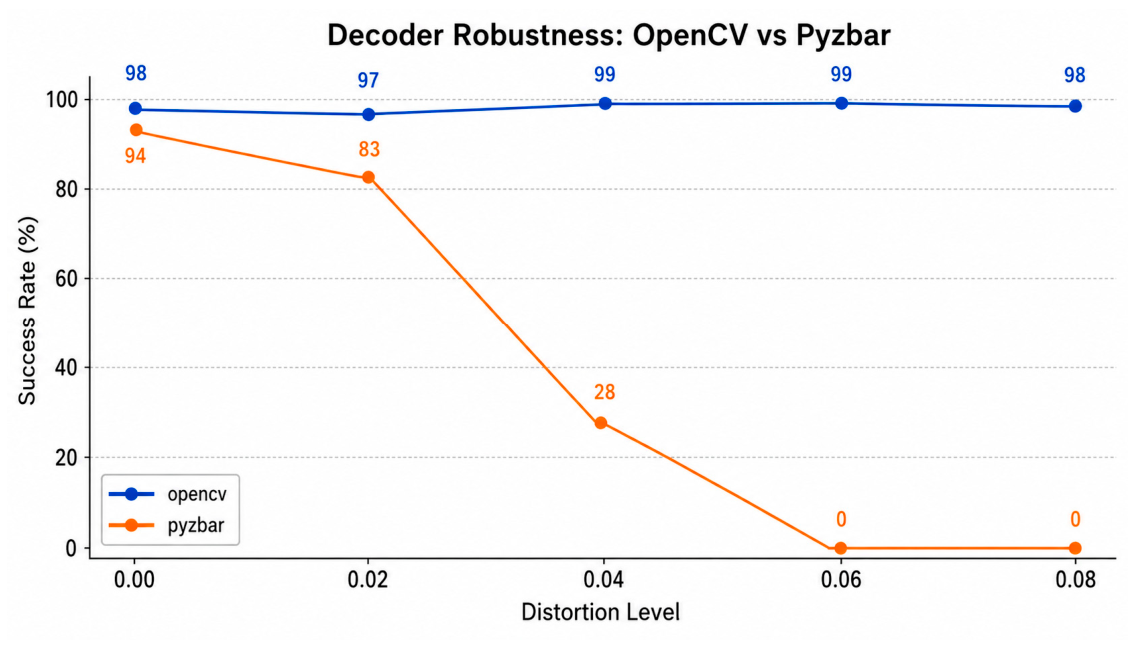
The most pronounced decoder contrast in the experimental campaign appears under additive noise. As shown in Figure 7, OpenCV remains highly stable across the tested noise levels, while pyzbar degrades rapidly as the disturbance increases. The difference is not marginal. OpenCV preserves a very high success rate throughout the evaluated range, whereas pyzbar drops sharply after the lower noise levels and eventually fails completely in the more severe cases.
Figure 7.
Decoder comparison under noise distortion.
This result is particularly important because it shows that decoder selection is strongly distortion-dependent. In other words, the decoder cannot be treated as a neutral implementation choice. Under noisy conditions, OpenCV clearly offers a substantial robustness advantage. By contrast, pyzbar appears to be much more sensitive to pixel-level corruption, even when the underlying QR configuration remains unchanged.
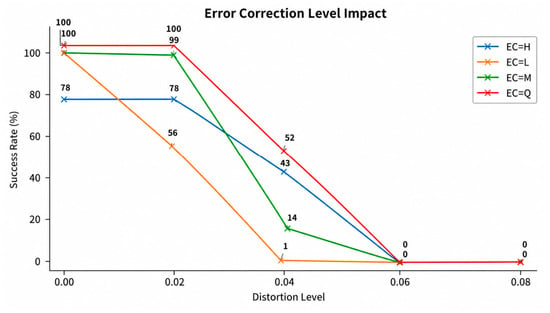
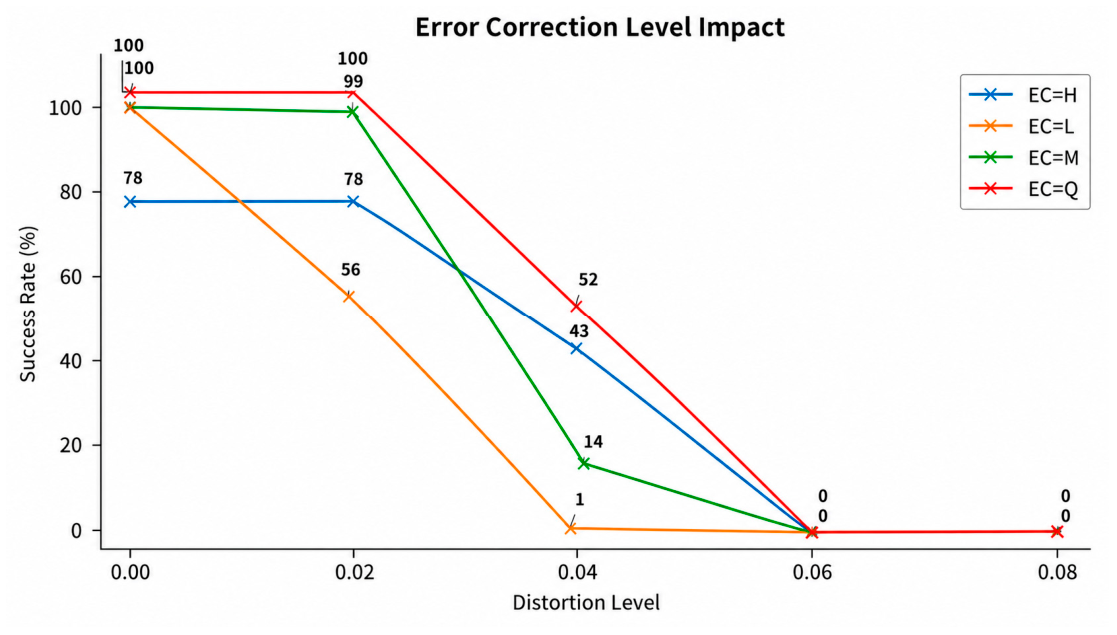
A more detailed view of this behavior is provided in Figure 8, which shows the impact of error-correction level under noise for pyzbar. The figure indicates that stronger error correction improves resistance to noise to some extent, but the improvement is not sufficient to fully compensate for decoder sensitivity. In practical terms, this means that simply increasing the QR error-correction level is not enough to guarantee stable decoding when the reading backend itself is vulnerable to the dominant form of degradation.
Figure 8.
Effect of error-correction level under noise for pyzbar.
These results have two implications. First, they confirm that noise is a highly decoder-specific distortion. Second, they suggest that, in noisy environments, decoder choice may have a larger effect on transmission success than moderate changes in the QR encoding parameters themselves.
5.3. Computational Cost Under Mild Visual Degradation
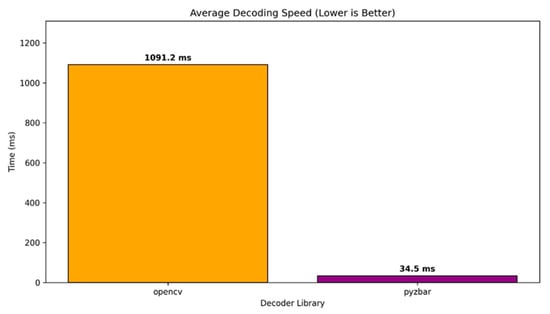
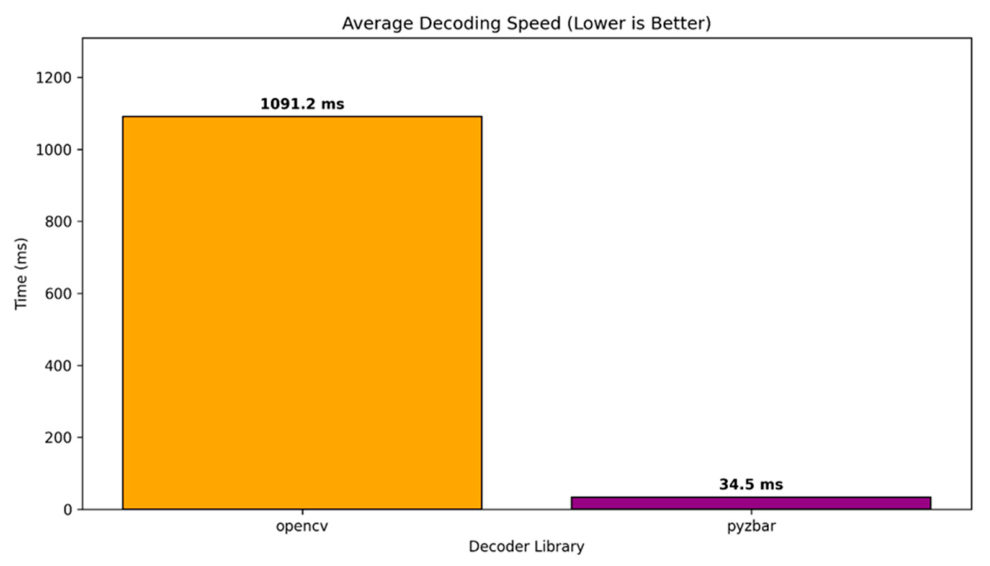
Although Gaussian blur did not produce dramatic reliability losses in the present experiments, it proved useful for examining the performance cost of the decoder backends. As shown in Figure 9, OpenCV is substantially slower than pyzbar in this scenario. The difference is not subtle: the average decoding time of OpenCV is roughly an order of magnitude larger, even though both decoders maintain high success rates overall.
Figure 9.
Average decoding time under Gaussian blur.
This is an important trade-off for the interpretation of the results. In the previous subsection, OpenCV appeared clearly preferable under noise because of its much higher robustness. Under Gaussian blur, however, the advantage in success rate is much smaller, while the time penalty remains large. This suggests that the most suitable decoder is not necessarily the one with the highest average success across all scenarios, but the one that offers the best balance between robustness and computational cost for the expected distortion type.
The same general pattern is also visible in the JPEG run, where both decoders remain largely reliable but OpenCV continues to require more decoding time. For this reason, only the Gaussian-blur speed comparison is retained in the main text, while the JPEG results are treated as supporting evidence for the same broader tendency. This also helps keep the visual narrative focused on the most discriminative scenarios while still acknowledging the consistency of the JPEG results.
5.4. Robustness Under Occlusion
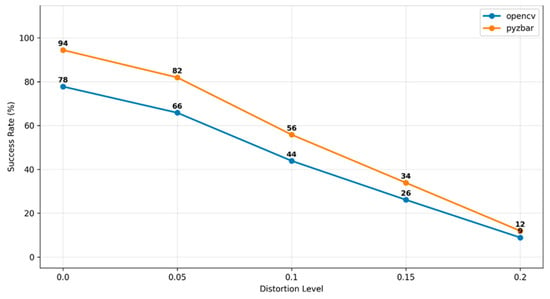
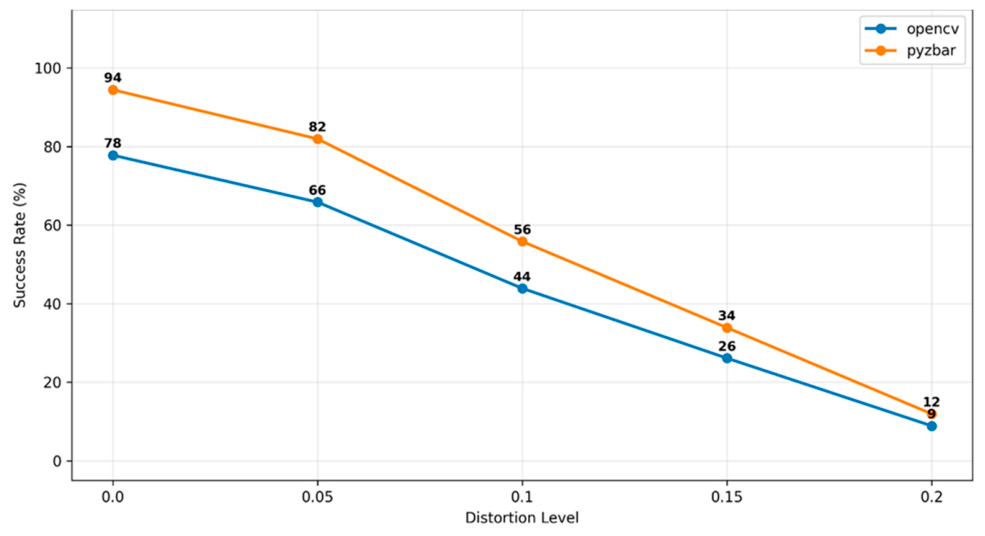
Among the tested distortion types, occlusion produced the clearest overall degradation trend. This can be seen in Figure 10, where both decoders lose reliability as the covered area increases. In contrast to the noise case, however, the relative ranking of the decoders changes: under occlusion, pyzbar performs better than OpenCV throughout most of the tested range. This result is especially valuable because it reinforces the conclusion that decoder superiority depends on the distortion mechanism rather than on a single global notion of “better” performance.
Figure 10.
Decoder comparison under occlusion.
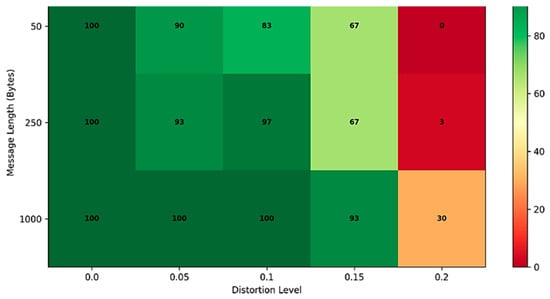
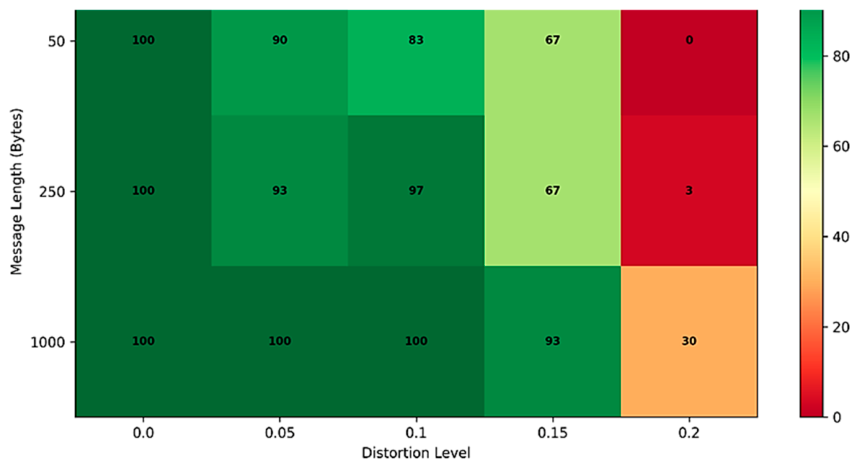
The same distortion is examined in more detail in Figure 11, which presents a heatmap of success rates across occlusion levels and message lengths. The heatmap shows that the effect of occlusion is not uniform. Shorter messages remain relatively stable at the lower levels, but the success rate decreases as the covered area grows. At the same time, the larger message length becomes increasingly sensitive once the occlusion reaches the higher end of the tested range. This indicates that structural damage interacts with symbol complexity in a meaningful way: denser or larger symbols have less tolerance to partial masking, even when the decoder remains otherwise capable.
Figure 11.
Success-rate heatmap under occlusion for pyzbar.
From a practical perspective, the occlusion results are useful because they describe a form of degradation that is common in real usage, such as partial obstruction, physical wear, or local printing defects. The observed pattern also explains why payload mode and message length continue to matter even after the QR symbol has already been generated: once the code becomes visually denser, partial loss of area becomes more damaging.
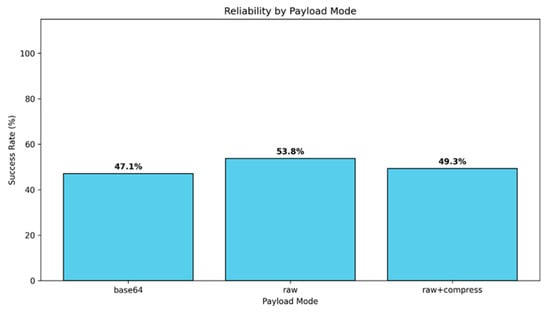
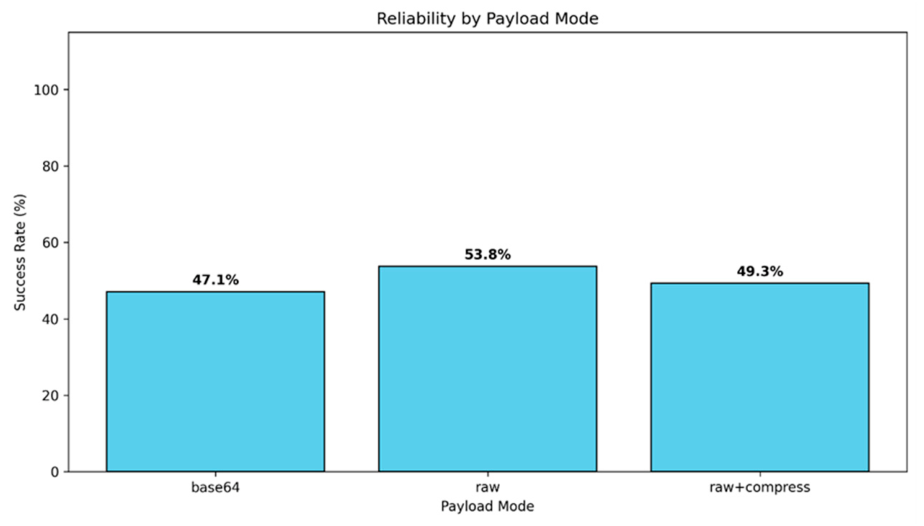
A further observation from the occlusion run is that the raw mode performs slightly better on average than the other two payload representations, as shown in Figure 12. This does not overturn the broader scalability advantage of raw+compress, but it does suggest that payload compactness alone does not fully determine robustness once structural masking becomes the dominant source of failure. In other words, the most efficient encoding is not necessarily the one that performs best under every type of degradation.
Figure 12.
Average success rate by payload mode under occlusion.
5.5. Cross-Run Interpretation
When the five runs are considered together, several broader trends become clear. First, payload representation has a direct effect on feasibility, not only on overhead. The raw+compress mode is the only one that remains feasible in the most demanding baseline configuration involving the largest message and the strongest error correction. Second, decoder behavior is highly dependent on the distortion type. OpenCV is clearly preferable under noise, whereas pyzbar performs better under occlusion and remains much faster in several non-noise scenarios. Third, message length acts as a strong limiting factor across nearly all runs, especially when it interacts with high error-correction settings and denser symbols.
Another important observation is that not all distortions are equally harmful. In the present experiments, Gaussian blur and JPEG degradation are comparatively well tolerated, while occlusion is the most destructive distortion overall. Noise occupies a special position because its effect is highly asymmetric across decoders: it is devastating for pyzbar at moderate and high levels, but far less harmful for OpenCV.
Taken together, these results support the main argument of the paper: secure QR transmission cannot be evaluated adequately through a single success metric or a single experimental condition. The practical behavior of the system emerges from the interaction among payload representation, decoder backend, distortion type, message size, and QR error-correction setting. This is precisely why a comparative and reproducible framework is needed.
These cross-run observations provide the basis for the concluding remarks presented in the next section.
6. Conclusions
This paper presented a reproducible comparative framework for the study of secure QR code transmission under controlled distortion conditions. The proposed environment integrates secure payload generation, distortion-based testing, batch experimentation, and comparative visual analysis within a single workflow, making it suitable both for interactive inspection and for systematic experimental evaluation.
The reported results show that secure QR transmission is governed by a multi-factor trade-off rather than by a single dominant parameter. Payload representation was found to have a direct effect on both overhead and feasibility, with raw+compress providing the most favorable scalability for larger messages. Decoder’s behavior proved to be strongly distortion-dependent: OpenCV was markedly more robust under noise, whereas pyzbar performed better under occlusion and remained substantially faster in several non-noise scenarios. The experiments also confirmed that message length is a critical limiting factor, especially when combined with stronger error correction and denser QR symbols.
Another important outcome of the study is that different types of degradation lead to very different failure patterns. Gaussian blur and JPEG compression were comparatively well tolerated in the tested range, while occlusion produced the clearest overall degradation trend. This further supports the main motivation behind the framework, namely that secure QR transmission should be evaluated comparatively and under controlled conditions rather than through isolated test cases.
Overall, the study demonstrates that the practical design of secure QR-based transmission systems requires the joint consideration of payload compactness, decoder behavior, symbol complexity, and expected visual degradation. In this sense, the proposed framework is not only a software tool, but also a methodological basis for reproducible research in this area.
The study also has several limitations that should be acknowledged. First, all distortions were applied programmatically and not through physical image capture, which means that real-world factors such as environmental lighting variation, optical lens aberrations, and substrate surface effects are not represented in the current results. Second, only two decoder backends (pyzbar and OpenCV) were compared; other libraries such as ZXing, WeChat QR, or hardware-accelerated readers may exhibit substantially different robustness profiles under the same distortion conditions. Third, the experimental payload consisted exclusively of ASCII-encoded text strings; the behavior of the framework under Unicode content, binary data, or structured cryptographic tokens was not investigated. Finally, scalability to high-density QR symbol versions (Version 25 and above) and to configurations near the theoretical capacity limits of the QR standard was not systematically explored. These aspects represent natural directions for future validation and generalization of the framework.
Future work may extend the current study in several directions, including a more detailed comparison of decoder strategies, broader investigation of additional distortion categories, and more focused analysis of high-density QR configurations and runtime-related trade-offs under demanding transmission scenarios.
Author Contributions
Conceptualization, D.D. and G.S.; methodology, D.D. and G.S.; validation, D.D. and G.S.; investigation, D.D. and G.S.; data curation, D.D. and G.S.; writing—original draft preparation, D.D. and G.S.; writing—review and editing, D.D. and G.S.; visualization, D.D. and G.S. All authors have read and agreed to the published version of the manuscript.
Funding
This research received no external funding.
Institutional Review Board Statement
Not applicable.
Informed Consent Statement
Not applicable.
Data Availability Statement
No new data were created or analyzed in this study. Data sharing is not applicable to this article.
Conflicts of Interest
The authors declare no conflicts of interest.
References
- ISO/IEC 18004:2024; Information Technology—Automatic Identification and Data Capture Techniques—QR Code Bar Code Symbology Specification. International Organization for Standardization: Geneva, Switzerland, 2024.
- Majnarić, I.; Jelkić, M.; Morić, M.; Hajdek, K. Print Quality Assessment of QR Code Elements Achieved by the Digital Thermal Transfer Process. J. Imaging 2026, 12, 86. [Google Scholar] [CrossRef] [Scilit] [PubMed]
- Njuguna, D.; Ndia, J. Quick Response Code Security Attacks and Countermeasures: A Systematic Literature Review. J. Cyber Secur. 2025, 7, 1–20. [Google Scholar] [CrossRef] [Scilit]
- Alsuhibany, S.A. Innovative QR Code System for Tamper-Proof Generation and Fraud-Resistant Verification. Sensors 2025, 25, 3855. [Google Scholar] [CrossRef] [Scilit] [PubMed]
- Li, C.; Jin, Z.; Wang, F.; Zhang, Z.; Liu, B.; Guo, Y. A Novel QR Code–Based Solution for Secure Electronic Health Record Transfer in Venous Thromboembolism Home Rehabilitation Management: Algorithm Development and Validation. JMIR Rehabil. Assist. Technol. 2025, 12, e69230. [Google Scholar] [CrossRef] [Scilit] [PubMed]
- San Agustin-Crescencio, P.N.; Hernandez-Gonzalez, L.; Guevara-Lopez, P.; Juarez-Sandoval, O.U.; Ramirez-Hernandez, J.; Estevez-Encarnacion, E.S. A Comprehensive QR Code Protection and Recovery System Using Secure Encryption, Chromatic Multiplexing, and Wavelength-Based Decoding. Appl. Sci. 2025, 15, 9708. [Google Scholar] [CrossRef] [Scilit]
- Skurowski, P.; Nurzyńska, K.; Pawlyta, M.; Cyran, K.A. Performance of QR Code Detectors near Nyquist Limits. Sensors 2022, 22, 7230. [Google Scholar] [CrossRef] [Scilit] [PubMed]
- Li, J.; Zhang, D.; Zhou, M.C.; Cao, Z. A Motion Blur QR Code Identification Algorithm Based on Feature Extracting and Improved Adaptive Thresholding. Neurocomputing 2022, 493, 351–361. [Google Scholar] [CrossRef] [Scilit]
- Dong, H.; Liu, H.; Li, M.; Ren, F.; Xie, F. An Algorithm for the Recognition of Motion-Blurred QR Codes Based on Generative Adversarial Networks and Attention Mechanisms. Int. J. Comput. Intell. Syst. 2024, 17, 83. [Google Scholar] [CrossRef] [Scilit]
- Xu, B.; Jin, R.; Li, J.; Zhang, B.; Liu, K. Robust and Fast QR Code Images Deblurring via Local Maximum and Minimum Intensity Prior. Vis. Comput. 2024, 40, 8809–8823. [Google Scholar] [CrossRef] [Scilit]
- Benito-Altamirano, I.; Martínez-Carpena, D.; Lizarzaburu-Aguilar, H.; Fàbrega, C.; Prades, J.D. Reading QR Codes on Challenging Surfaces Using Thin-Plate Splines. Pattern Recognit. Lett. 2024, 184, 37–43. [Google Scholar] [CrossRef] [Scilit]
- Corpuz, D.J.; Rosario, L.V.; Cempron, J.P.; Lozano, P.L.; Ilao, J.L. QR Code Detection with Perspective Correction and Decoding in Real-World Conditions Using Deep Learning and Enhanced Image Processing. In Proceedings of the 20th International Joint Conference on Computer Vision, Imaging and Computer Graphics Theory and Applications (VISAPP 2025), Porto, Portugal, 26–28 February 2025; pp. 685–690. [Google Scholar] [CrossRef] [Scilit]
- Muallim, T.; Kucuk, H.; Bareket, M.; Kahraman, M. Lightweight Deep Learning Model and Novel Dataset for Restoring Damaged Barcodes and QR Codes in Logistics Applications. Comput. Model. Eng. Sci. 2025, 143, 3557–3581. [Google Scholar] [CrossRef] [Scilit]
Disclaimer/Publisher’s Note: The statements, opinions and data contained in all publications are solely those of the individual author(s) and contributor(s) and not of MDPI and/or the editor(s). MDPI and/or the editor(s) disclaim responsibility for any injury to people or property resulting from any ideas, methods, instructions or products referred to in the content. |
© 2026 by the authors. Licensee MDPI, Basel, Switzerland. This article is an open access article distributed under the terms and conditions of the Creative Commons Attribution (CC BY) license.