


Abstract
The study focuses on the influence of airflow on the separation of the three primary materials under investigation: sand, sawdust, and ash. These materials were selected to facilitate a comparative analysis between two distinct airflows. The primary objective of the research is to increase the separation yield while maintaining the original design of the 2A mechanical cyclone model. The model utilized in this study was designed using SolidWorks 2025 and fabricated via a Raise3D Pro2 3D printer (Raise3D Technologies, Inc. 2019, Nantong, China, Е2). The purpose of the experiment is to determine how variations in flow affect the separation of fine particulate matter under 3 μm.
1. Introduction
The emergence of mechanical cyclones dates back to the early 20th century. While initial designs featured simpler configurations and lacked rigorous structural analysis, they have since been optimized to enhance separation efficiency and reduce surface friction resistance. The operational principles of mechanical cyclones rely on centrifugal force generated by the velocity of the airflow.
In this paper, the airflow characteristics and particle dynamics within the conical cyclone are governed by centrifugal force. This phenomenon induces an additional inertial effect, facilitating the separation of particles from the air stream [1,2,3,4,5,6]. The reduction in diameter toward the lower section of the cyclone results in a concentration of centrifugal forces [7,8,9,10,11]. This structural feature, combined with the aforementioned inertial effects, leads to a shorter residence time for small particles (under 2 mm) within the airflow. Consequently, this minimizes the potential for particle re-entrainment into the air stream, thereby improving separation efficiency.
The research objective involves analyzing the particle separation rate and the mass of the separated materials. The subject of the study is the influence of airflow on the separation process of the investigated materials. The aim of this research is to evaluate how airflow variations impact separation efficiency while maintaining a constant structural design. To achieve this aim, the following tasks were addressed:
- To analyze the influence of the cyclone geometry on centrifugal forces;
- To conduct laboratory experiments using the selected design across varying airflow velocities;
- To formulate recommendations regarding the construction and the impact of airflow on the quantity of separated particles.
2. Materials and Methods
In our previous experimental studies conducted in 2025 using the Model 2A mechanical cyclone, data were collected regarding the separation of the following materials:
- Ash;
- Wood particles (sawdust);
- Sand.
The experimental setup utilized an HG09959B electronic scale (OWIM GmbH & Co. KG, Stiftsbergstraße 1, 74167 Neckarsulm, Germany) and a Karcher T7/1 Classic vacuum unit (Alfred-Kärcher-Straße 28–40, 71364 Winnenden, Germany) characterized by the following technical specifications: a vacuum pressure of 235 mbar, an airflow rate of 40 L/s, and a container capacity of 7 L. A Nuodwell digital stopwatch (Shenzhen Nuodwell Technology Co., Ltd., Shenzhen, China) was employed for temporal measurements.
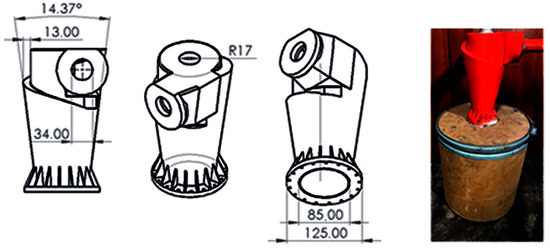
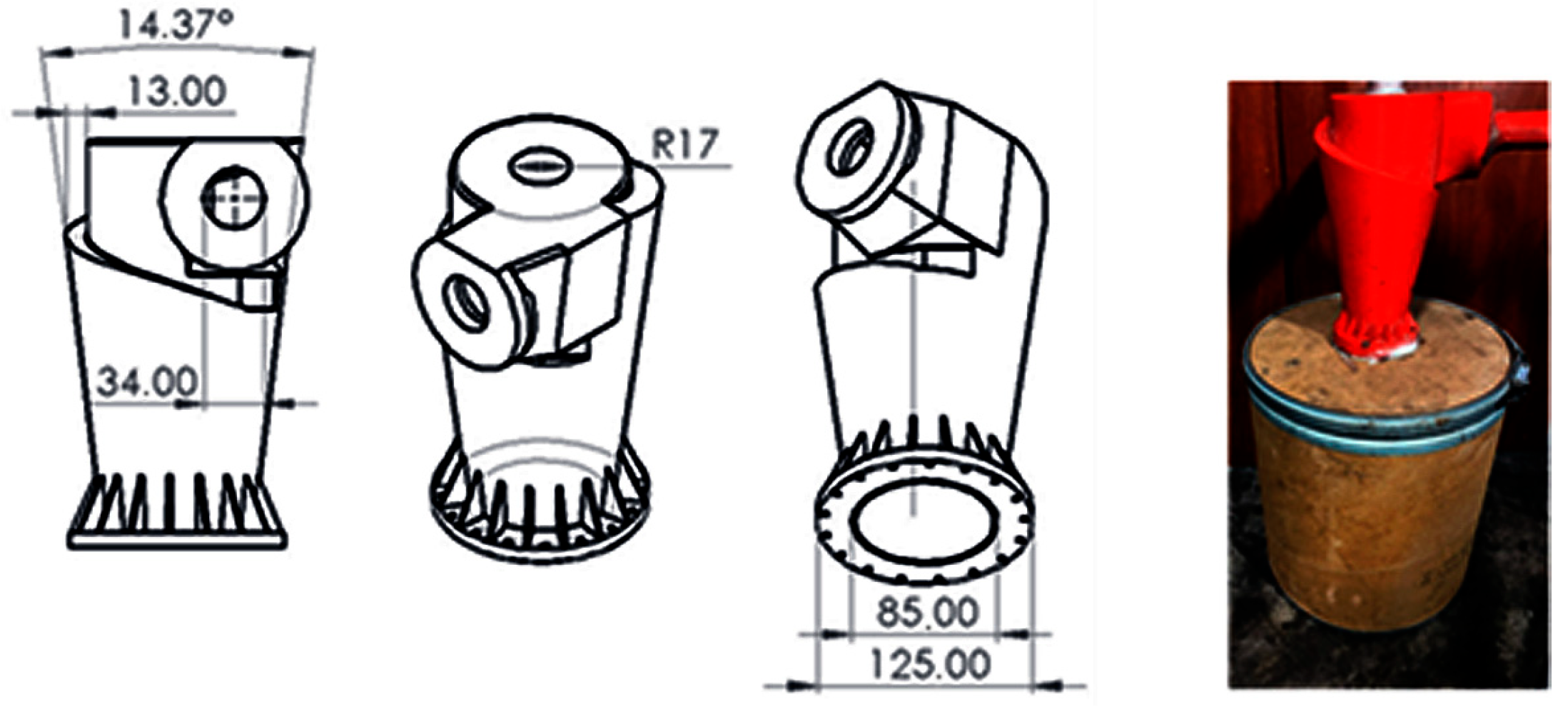
The cyclone configuration utilized in the aforementioned study is illustrated in Figure 1.
Figure 1.
Model 2A Cyclone.
The experiment was conducted under uniform conditions across all separated materials. The total mass of the material processed during each experimental trial was 500 g. Additionally, the separation duration for each individual material was monitored and analyzed throughout the process.
Table 1 demonstrates that sand exhibits the highest density and low aerodynamic resistance. Its rapid passage and high separation efficiency indicate that the airflow easily overcomes its inertia, without the particles experiencing significant ‘vortex entrainment’ or deceleration due to air friction.
Table 1.
Results obtained using the Karcher vacuum unit.
In contrast, the wood particles (sawdust) possess low density but a high specific surface area and irregular morphology. These characteristics induce substantial aerodynamic drag and turbulence. The observed low separation yield suggests that a significant portion of the material likely remains suspended in the air stream or is bypassed from the collection zone due to its buoyancy.
Ash is a fine-dispersed material. Although lightweight, it tends to settle more homogeneously than wood shavings, albeit slower than sand. The observed duration (nearly double that of sand) indicates that fine particles are strongly influenced by air currents, leading to a more protracted separation from the airflow.
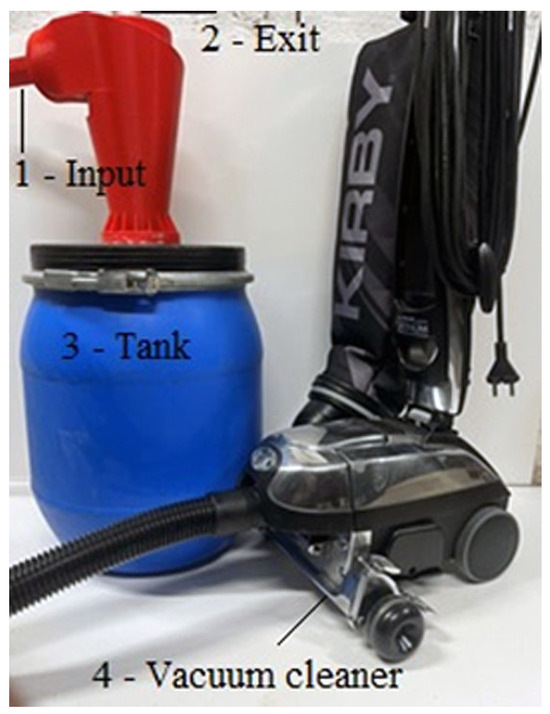
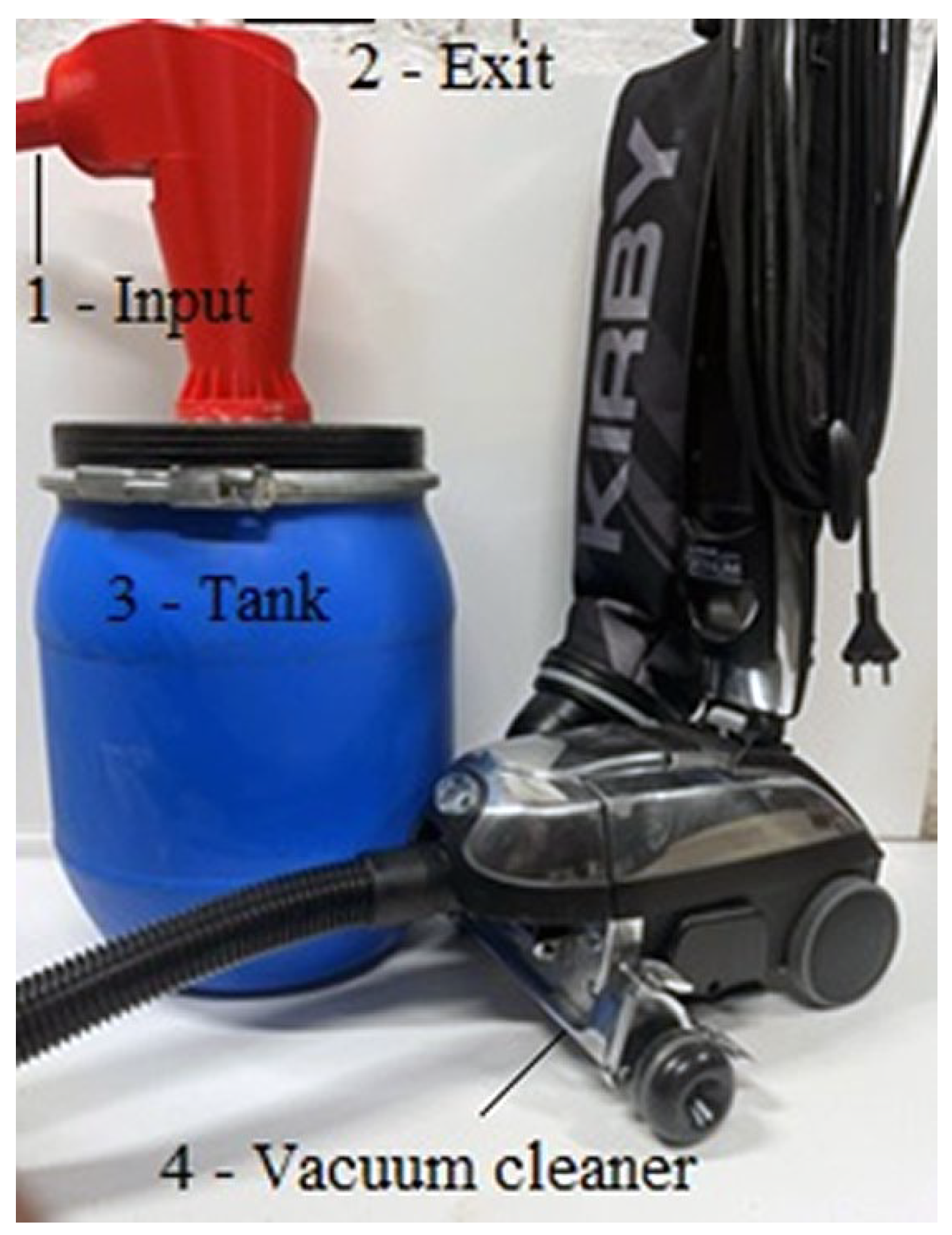
The present study examines the same cyclone (Model 2A) but introduces variations in airflow velocity. Specifically, the separation capacity of the cyclone is analyzed under an increased airflow rate of approximately 55%. The measurement instrumentation utilized in this research includes a KIRBY G10ECO vacuum unit (Kirby Opco, LLC, Cleveland, OH, USA) (vacuum pressure of 7 kPa, airflow rate of 62 L/s, and a 7-L container capacity), a NUODWELL digital stopwatch (Shenzhen Nuodwell Technology Co., Ltd., Shenzhen, China), and an HG09959B electronic scale (OWIM GmbH & Co. KG, Stiftsbergstraße 1, 74167 Neckarsulm, Germany).
The experimental setup of the investigated cyclone, including the particle collection container, is illustrated in Figure 2.
Figure 2.
Experimental setup utilizing the Kirby vacuum unit.
- The primary objective of the laboratory experiments is to determine the efficiency of the cyclone in separating the airflow from the particulate matter (materials). It is well-established that mechanical cyclones exhibit three distinct velocity-based separation zones:
- Inlet zone;
- Particle distribution and separation zone;
- Outlet zone (bottom) [12].
In mechanical cyclones, maximizing the volumetric airflow rate is of paramount importance. Merely enhancing the separation efficiency is insufficient, even when employing sequential separation with two distinct cyclone models. Throughout the separation process, it is critical to monitor the pressure drop. Exceeding a specific threshold for pressure drop results in a degradation of the separation efficiency for individual particles [13]. Manometric pressure measurements were not conducted within the scope of these specific laboratory experiments; however, they are planned for future studies aimed at optimizing energy efficiency.
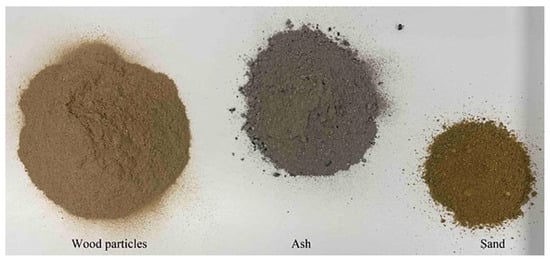
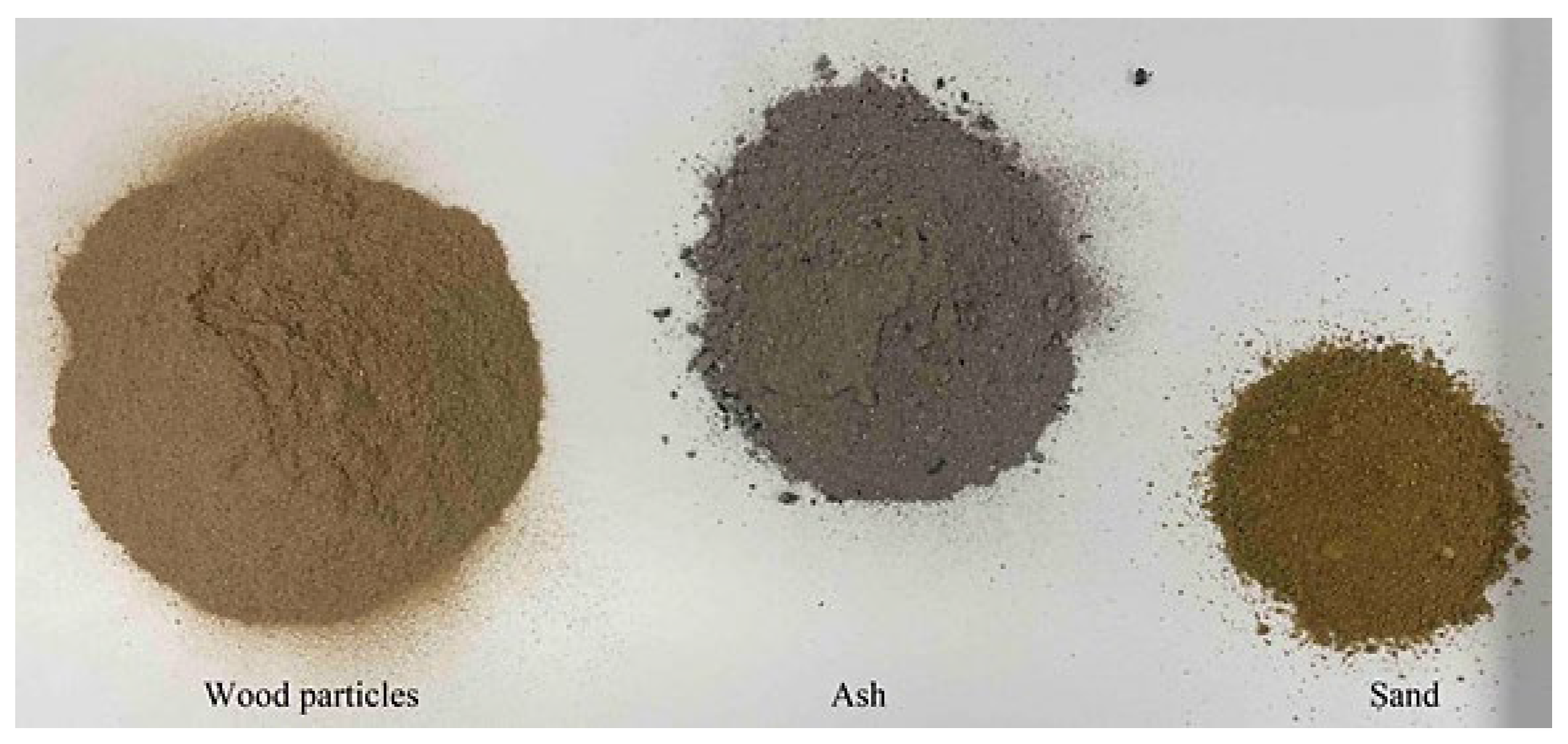
To establish a consistent baseline for comparison, the same materials and experimental conditions as in the previous study were maintained. The materials utilized for separation are visualized in Figure 3. A standardized mass of 500 g was used for each respective material type.
Figure 3.
Separated materials.
3. Results
The experimental results demonstrate the influence of the airflow rate on the particle separation efficiency. Table 2 presents the values obtained from the trials conducted with the increased airflow rate of 62 L/s.
Table 2.
Experimental results obtained using the Kirby vacuum unit.
When utilizing a higher airflow rate, the sand particles rapidly reach their terminal velocity. Increasing the airflow beyond a specific threshold does not result in a proportional acceleration of the process for heavy particles, as their substantial mass and inertia dominate the centrifugal forces.
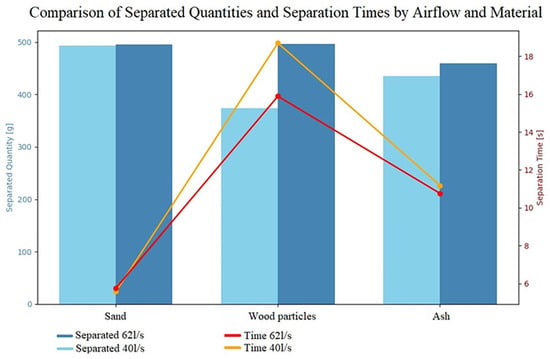
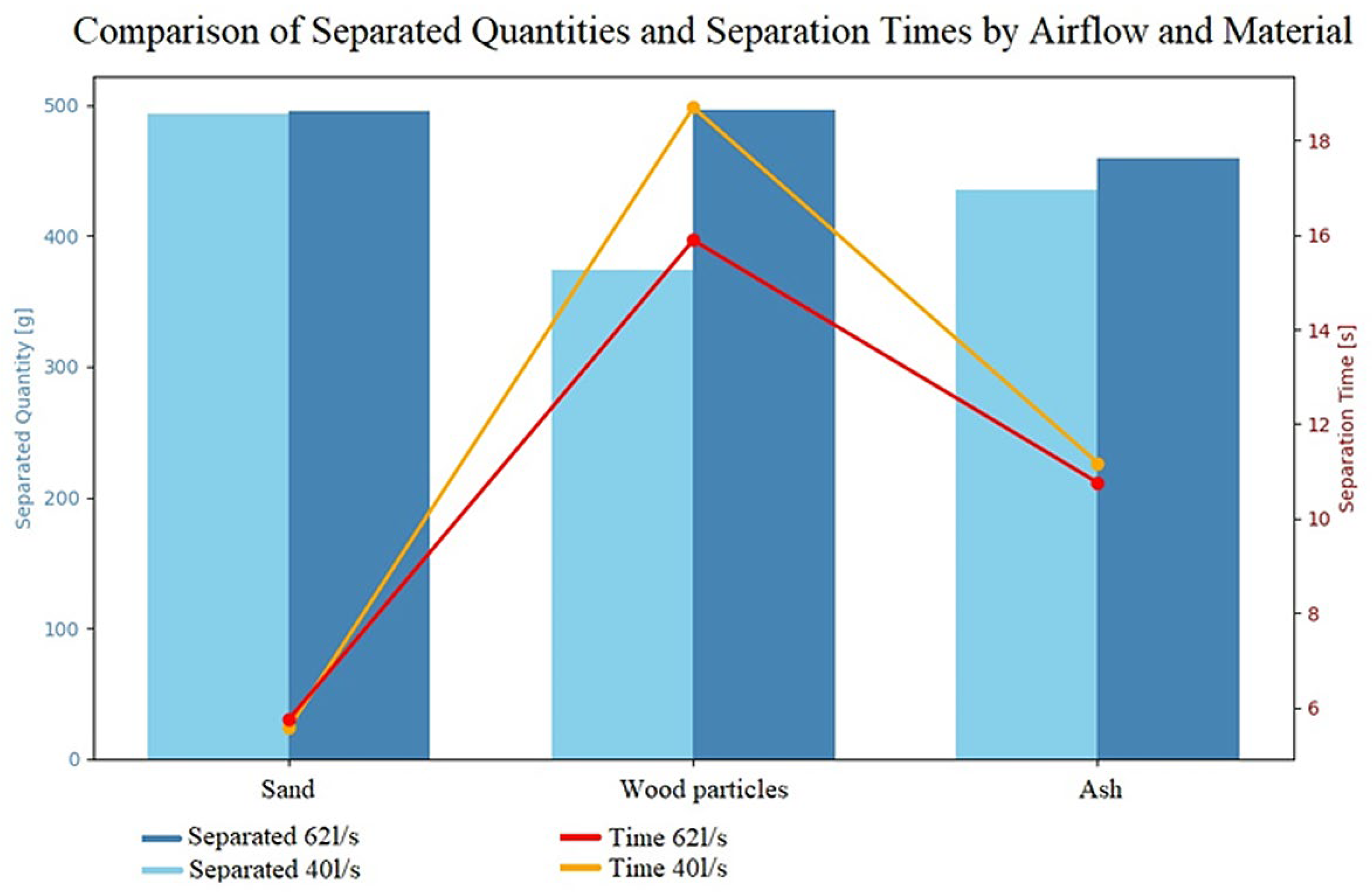
Characteristically, at lower flow rates, wood particles are typically difficult to separate due to their large specific surface area and low density. In this instance, however, the powerful 62 L/s flow successfully entrains and conveys nearly the entire mass of 497 g to the particle collection container (Figure 4).
Figure 4.
Comparison of separated mass and particle separation duration.
At a high air velocity of 62 L/s, a strong turbulent flow is generated. Consequently, the fine ash remains suspended in the air stream for a more protracted duration instead of settling.
4. Discussion
The analysis of the results incorporates the two most critical indicators: mass (separation efficiency) and velocity (separation duration). Increasing the airflow rate from 40 L/s to 62 L/s leads to a higher recovery rate across all investigated materials; however, the most significant variance is observed in the lightest and most voluminous material:
Wood Shavings: At the lower flow rate, only 374 g (74.8%) were separated, whereas at the higher flow rate, the amount increased to 497 g (99.4%). This demonstrates that wood shavings require a more robust flow for effective entrainment and transport.
Ash: An improvement from 435 g to 459 g was observed. Ash remains the most challenging material for complete separation under both regimes, likely due to its fine structure and susceptibility to vortex turbulence or adhesion.
Sand: The results were nearly identical (493 g vs. 495 g). Sand is characterized by high mass and inertia, meaning that even the lower flow rate is sufficient for near-total separation.
Notably, the increased airflow rate does not always result in a directly proportional reduction in separation time:
Wood Particles: The duration decreased significantly from 18.70 s to 15.89 s. The higher air velocity overcomes the aerodynamic resistance of the shavings more efficiently.
Ash: The separation time also decreased slightly (from 11.18 s to 10.76 s).
Sand: A marginal increase in time was observed (from 5.57 s to 5.75 s). This phenomenon may be attributed to increased turbulence at 62 L/s, which causes particle dispersion and hinders their directed linear motion.
5. Conclusions
The conducted research demonstrates a direct correlation between airflow rate and separation efficiency, while revealing that the physical characteristics of the materials (density, volume, and morphology) respond differently to aerodynamic variations. The primary conclusions are as follows:
Material-Specific Process Optimization: Increasing the airflow rate is justified and critical only for lightweight, voluminous materials (such as wood shavings). For these materials, a significant leap in efficiency (from 74.8% to 99.4%) and a substantial reduction in processing time were observed.
Energy Efficiency Thresholds: For heavy, inert materials (such as sand), increasing the flow rate from 40 L/s to 62 L/s is economically suboptimal. The improvement in separated mass is negligible (0.4%), while the heightened turbulence at high air velocities actually impedes the process.
Behavior of Fine Particulate Matter: Ash remains the most challenging material to manage. Its fine structure renders it less sensitive to flow velocity variations compared to wood shavings, suggesting that complete separation requires alternative technical solutions beyond merely increasing suction power.
To achieve maximum productivity with minimal energy consumption, the separation system should operate in an adaptive mode. It is recommended to employ a lower flow rate (approximately 40 L/s) for heavy fractions and switch to a higher flow rate (exceeding 60 L/s) only when processing lightweight, high-volume waste to overcome aerodynamic drag without inducing unnecessary turbulent disturbances.
In conclusion, achieving high-efficiency separation for diverse materials necessitates the design of specialized cyclone models. A universal structural design capable of separating distinct materials with consistently high efficiency is practically unattainable.
Author Contributions
Conceptualization, I.M., Z.T., D.D. and M.T.; methodology, I.M., Z.T. and M.T.; validation, I.M., Z.T., D.D. and M.T.; formal analysis, Z.T. and M.T.; investigation, I.M., Z.T., D.D. and M.T.; resources, I.M.; writing—original draft preparation, I.M., Z.T. and M.T.; writing—review and editing, I.M. and Z.T. All authors have read and agreed to the published version of the manuscript.
Funding
This research received no external funding.
Institutional Review Board Statement
Not applicable.
Informed Consent Statement
Not applicable.
Data Availability Statement
The data supporting the findings of this study are available from the corresponding author upon reasonable request.
Conflicts of Interest
The authors declare no conflicts of interest.
References
- Luciano, R.D.; Silva, B.L.; Rosa, L.M.; Meier, H.F. Multi-objective optimization of cyclone separators in series based on computational fluid dynamics. Powder Technol. 2018, 325, 452–466. [Google Scholar] [CrossRef] [Scilit]
- Bogodage, S.G.; Leung, A.Y. CFD simulation of cyclone separators to reduce air pollution. Powder Technol. 2015, 286, 488–506. [Google Scholar] [CrossRef] [Scilit]
- Balestrin, E.; Decker, R.K.; Noriler, D.; Bastos, J.C.S.C.; Meier, H.F. An alternative for the collection of small particles in cyclones: Experimental analysis and CFD modeling. Sep. Purif. Technol. 2017, 184, 54–65. [Google Scholar] [CrossRef] [Scilit]
- Brar, L.S.; Sharma, R.P.; Elsayed, K. The effect of the cyclone length on the performance of Stairmand high-efficiency cyclone. Powder Technol. 2015, 286, 668–677. [Google Scholar] [CrossRef] [Scilit]
- Mehmedov, I. Influence of Cyclone Design on the Separation of Various Particles. Knowledge. Int. J. 2025, 71, 347–351. [Google Scholar]
- Chu, L.Y.; Chen, W.M.; Lee, X.Z. Enhancement of hydrocyclone performance by controlling the inside turbulence structure. Chem. Eng. Sci. 2002, 57, 207–212. [Google Scholar] [CrossRef] [Scilit]
- Huang, A.N.; Ito, K.; Fukasawa, T.; Fukui, K.; Kuo, H.P. Effects of particle mass loading on the hydrodynamics and separation efficiency of a cyclone separator. J. Taiwan Inst. Chem. Eng. 2018, 90, 61–67. [Google Scholar] [CrossRef] [Scilit]
- Mazyan, W.I.; Ahmadi, A.; Ahmed, H.; Hoorfar, M. Increasing efficiency of natural gas cyclones through addition of tangential chambers. J. Aerosol Sci. 2017, 110, 36–42. [Google Scholar] [CrossRef] [Scilit]
- Wang, H.; Nie, W.; Cheng, W.; Liu, Q.; Jin, H. Effects of air volume ratio parameters on air curtain dust suppression in a rock tunnel’s fully-mechanized working face. Adv. Powder Technol. 2018, 29, 230–244. [Google Scholar] [CrossRef] [Scilit]
- Demir, S. A practical model for estimating pressure drop in cyclone separators: An experimental study. Powder Technol. 2014, 268, 329–338. [Google Scholar] [CrossRef] [Scilit]
- Wu, K.; Li, B.; Gao, L.; Yuan, Z.; Luo, D.; Guan, L.; Gu, C. Study on the distribution characteristics of flexible filamentous particle clusters in a fluidized bed dryer. Powder Technol. 2018, 331, 7–19. [Google Scholar] [CrossRef] [Scilit]
- Jiao, J.; Zheng, Y.; Sun, G.; Wang, J. Study of the separation efficiency and the flow field of a dynamic cyclone. Sep. Purif. Technol. 2006, 49, 157–166. [Google Scholar] [CrossRef] [Scilit]
- Chen, J.; Jiang, Z.A.; Chen, J. Effect of Inlet Air Volumetric Flow Rate on the Performance of a Two-Stage Cyclone Separator. ACS Omega 2018, 3, 13219–13226. [Google Scholar] [CrossRef] [Scilit] [PubMed]

Disclaimer/Publisher’s Note: The statements, opinions and data contained in all publications are solely those of the individual author(s) and contributor(s) and not of MDPI and/or the editor(s). MDPI and/or the editor(s) disclaim responsibility for any injury to people or property resulting from any ideas, methods, instructions or products referred to in the content. |
© 2026 by the authors. Licensee MDPI, Basel, Switzerland. This article is an open access article distributed under the terms and conditions of the Creative Commons Attribution (CC BY) license.