


Abstract
This paper presents a secure data transmission framework for intelligent IoT sensor networks, specifically designed for an electronic nose system used in food quality analysis. The proposed architecture integrates a heterogeneous sensor array with an ESP32-based processing unit and GSM/GPRS communication module. To ensure data confidentiality over public mobile networks, a hybrid security scheme combining cryptographic encryption (ChaCha20) and chaotic modulation (Brusselator + DCSK) is introduced. The data packet is first encrypted using the ChaCha20 stream cipher, then converted into a bipolar bit stream. The chaotic system used to generate a chaotic signal is a nonlinear Brusselator model. The system was implemented on a LILYGO TTGO T-Call V1.4 (ESP32 + SIM800L) and tested for discrimination of olive oil and sunflower oil mixtures. Experimental results demonstrate 98.7% classification accuracy using a neural network, 96% first-try transmission success rate over GPRS with 2.3 s average packet transmission time, and 99% overall reliability under RSSI above −85 dBm.
1. Introduction
The widespread adoption of Internet of Things (IoT) and Wireless Sensor Network (WSN) technologies in industry has led to a sharp increase in the number of connected devices, a significant proportion of which process confidential data. Ensuring communication security under strict resource constraints is considered one of the major challenges in this field. Although conventional cryptographic methods, such as AES, ChaCha20, and others, are regarded as reliable, they are often excessively resource-intensive and impose a considerable computational and energy burden on processor- and energy-constrained IoT devices. An alternative approach is represented by chaotic signal encoding, in which the interception of the transmitted signal does not allow the information to be easily recovered without knowledge of the chaotic system being used. By applying this approach, the computational complexity can be significantly reduced without compromising the level of security [1].
Several methods for superimposing information oscillations onto chaotic oscillations have been proposed [1,2] and may be summarized as follows. The first method, known as chaotic masking [3,4], is based on the direct summation of the information oscillation with the chaotic one. In the second method [5], the information signal is directly involved in the formation of the chaotic behaviour of the chaotic system by being introduced into it. As a result, the information oscillation modifies the form of the output chaotic process. The third method, known as nonlinear embedding [6], combines the two approaches described above: the information oscillation is introduced into the chaotic system and is additionally summed with the output chaotic process. In this way, enhanced protection of the transmitted information is achieved. Another method that provides a high level of information security is chaotic switching [7], which is used for the transmission of digital information.
Furthermore, the contemporary development of communication systems is also associated with the use of chaotic signals in multichannel and multi-access Code Division Multiple Access (CDMA) systems [8], as well as in Wireless Spread Spectrum communication systems [9]. In these systems, chaotic sequences are employed as an alternative to pseudorandom spreading signals. Such sequences are characterized by favourable auto-correlation and cross-correlation properties, as well as by relatively simple software and hardware implementation [10].
2. System Architecture and Design
2.1. General System Overview
The developed system represents an autonomous multisensor node of the electronic nose type, designed for the acquisition, preliminary processing, and secure transmission of data related to the gaseous composition of the investigated environment to a remote server via a mobile communication network.
The main objective of the proposed architecture is to ensure:
- Independence from local network infrastructure;
- Low energy consumption;
- Reliable operation under variable GSM communication conditions;
- Secure transmission of measurement data.
A complete operational cycle is implemented by the system as follows:
measurement → processing → chaotic transformation → transmission → remote control.
2.2. Hardware Architecture of the Electronic Nose
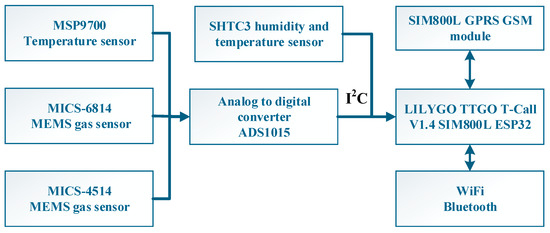
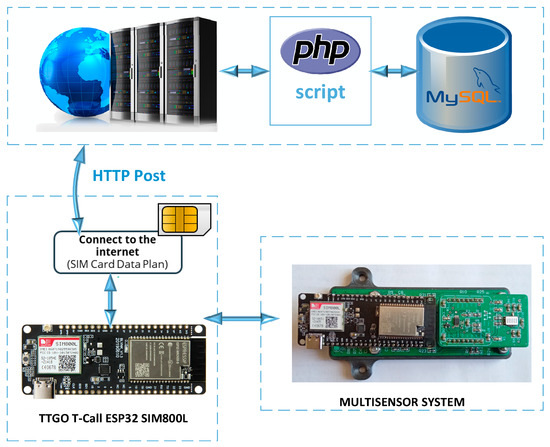
The hardware architecture has been developed on a modular basis, as shown in Figure 1, in order to provide flexibility, low power consumption, and scalability. The architecture integrates a sensor array, a signal conversion unit, a control module, and a communication interface within a compact embedded system.
Figure 1.
Block diagram of multisensor system based on ESP32.
The core element of the system is the LILYGO TTGO T-Call V1.4 SIM800L ESP32 development board (Shenzhen Xinyuan Electronic Technology Co., Ltd., Shenzhen, China), which integrates the ESP32 microcontroller and the SIM800L GSM/GPRS module. The microcontroller provides the computational resources required for real-time data acquisition and preliminary data processing, as well as support for various communication interfaces, including I2C and analogue inputs. The integrated GSM module enables the remote transmission of the measured information, thereby making the system suitable for IoT-based applications.
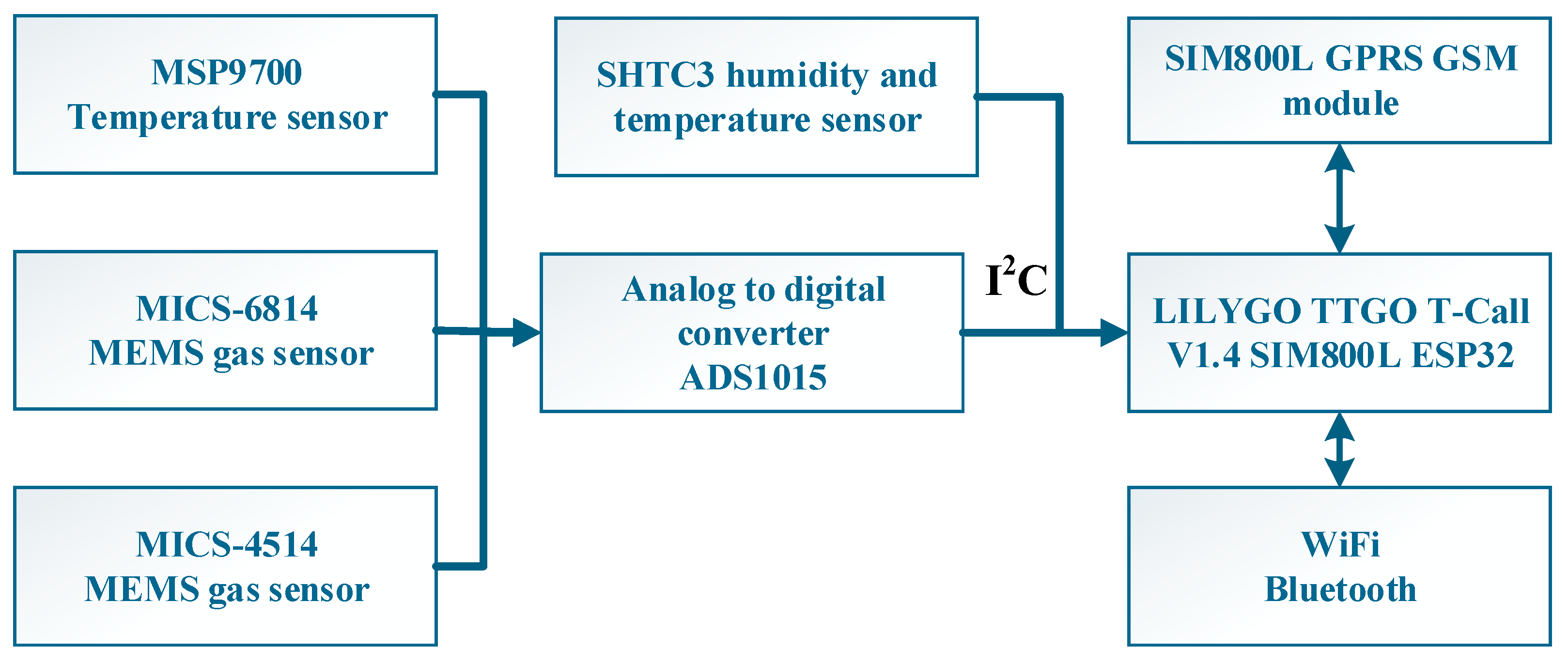
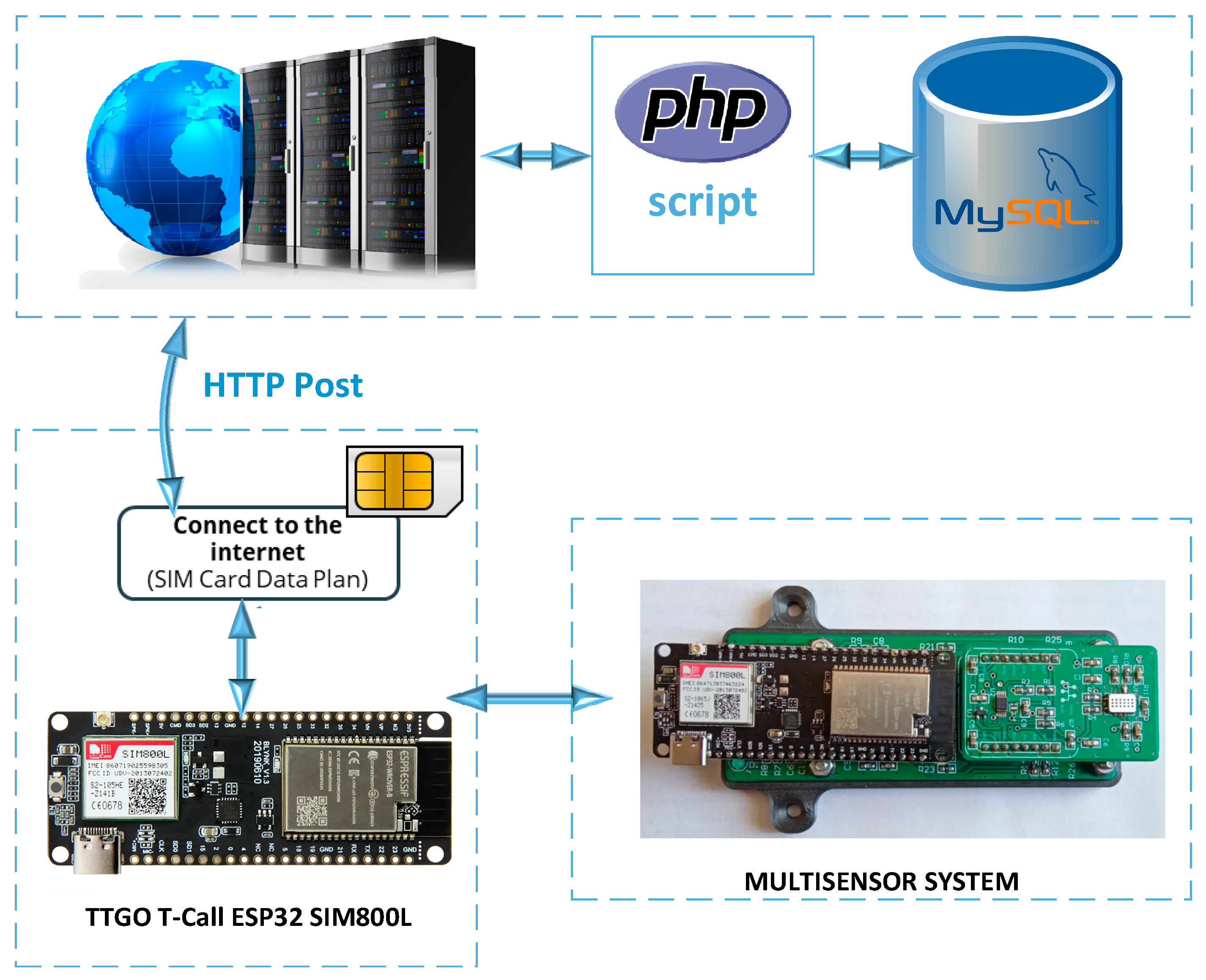
The sensing layer is implemented by means of a heterogeneous array of analogue and digital sensors, as shown in Figure 2. Gas analysis is performed using MICS-6814 and MICS-4514 sensors (Amphenol SGX Sensortech, Neuchâtel, Switzerland). The MICS-6814 is a three-component gas sensor comprising separate sensing elements for reducing gases, such as CO, H2, CH4, and volatile organic compounds (VOCs), ammonia (NH3), and oxidising gases. The MICS-4514 is a two-component module designed for the detection of nitrogen dioxide (NO2) and carbon monoxide (CO). Both sensors generate analogue output signals that depend on the gas concentration, thus forming characteristic multidimensional signal patterns for different gas mixtures.
Figure 2.
Generalized architecture of the proposed multisensor system.
In the context of food product analysis, the response of the sensors can be interpreted on the basis of the chemical composition of the volatile compounds released from the corresponding samples. The MICS-6814 sensor exhibits high sensitivity to volatile organic compounds and ammonia, which makes it suitable for the detection of processes such as fermentation and spoilage. For example, in alcoholic products, such as wine and spirits, a response to ethanol and other VOCs is observed. In fermented foods, such as yoghurt, cheese, and sauerkraut, a combination of ammonia, organic acids, and alcohols is detected by the sensor. In spoiled foods, such as meat and fish, increased sensitivity to NH3 and sulphur compounds is observed, the latter being indirectly detected through the reducing-gas channel. In addition, characteristic VOC profiles, including aldehydes and ketones, are registered in fats and oils, such as olive oil, whereas the presence of CO and various volatile organic compounds is observed in thermally processed foods.
The MICS-4514 sensor complements the acquired information through its sensitivity to gases associated with oxidation processes and combustion. During the thermal processing of food products, such as roasting, baking, or frying, the presence of CO generated by incomplete combustion is detected. During spoilage and oxidation processes, changes related to the oxidative environment are observed, which may indirectly affect the signal obtained from the NO2 channel. In smoked products, such as meat and fish, CO and other combustion products are registered, while increased CO levels may be detected as a by-product during cooking with a gas flame.
The combined use of the two sensors provides extended sensitivity to different groups of gases and enables the formation of informative signal vectors suitable for subsequent processing by pattern recognition methods.
For temperature compensation, the analogue MSP9700 temperature sensor (Microchip Technology Inc., Chandler, AZ, USA) is employed, which provides a linear relationship between the output voltage and temperature. In addition, the environmental parameters are measured by means of the SHTC3 digital sensor (Sensirion AG, Stäfa, Switzerland), which determines temperature and relative humidity via an I2C interface. These quantities are of essential importance for improving measurement accuracy and compensating for the influence of external conditions on the gas sensors.
Due to the limitations of the built-in analogue-to-digital converter of the ESP32, an external ADC, namely the ADS1015 (Texas Instruments, Dallas, TX, USA), is integrated into the system. It is a 12-bit converter with an I2C interface and up to four input channels, allowing precise measurement of the analogue signals generated by the sensors and improving both accuracy and noise immunity.
The communication architecture is implemented through a common I2C bus, to which the ADS1015 and SHTC3 modules are connected. The analogue sensors, including the gas sensors and the temperature sensor, are interfaced with the inputs of the analogue-to-digital converter. After digitization, the data are processed by the ESP32 microcontroller and transmitted to a remote database, such as InfluxDB, PostgreSQL, or Firebase, through one of the available communication channels, with the selection being determined by current availability and priority. The supported communication interfaces are Wi-Fi (802.11 b/g/n), GSM/GPRS (SIM800L) and Bluetooth Low Energy (BLE).
To improve transmission reliability, QoS logic is implemented, including timestamping, a retransmission mechanism, and packet loss control. Each measurement record is assigned a timestamp synchronized via an NTP server, thereby enabling the correct ordering and analysis of the data regardless of transmission delays.
In the event of unsuccessful data transmission, a retry mechanism is activated. A limited number of retransmission attempts is used, with progressively increasing time intervals, i.e., exponential backoff, in order to reduce both network load and energy consumption. If no acknowledgment is received from the server, the packets are considered undelivered and are stored for subsequent transmission.
Packet loss is managed through sequential numbering of the records and verification of missing identifiers upon data reception. This approach enables missing measurements to be detected and, when necessary, retransmitted from the local buffer.
In the absence of an active communication link, the measured data are buffered in the internal flash memory, with a capacity of up to 200 records, while a First-In, First-Out (FIFO) mechanism is maintained. Once the connection is restored, the data are transmitted automatically in chronological order, thereby preserving their temporal sequence.
The proposed hardware architecture ensures reliable acquisition of multidimensional sensor data, which provides the basis for the subsequent application of pattern recognition and classification algorithms characteristic of electronic nose systems.
2.3. Operation (Working Cycle)
- Initialization—The ESP32-S3 configures the bus, the ADS1015 module, including input selection, gain, and continuous or single-shot conversion mode, as well as the SHTC3 sensor and the wireless interfaces. The most recently stored calibration parameters are loaded from the flash memory.
- Warm-up of the MOS sensors—Upon start-up or following a measurement command, the heaters of the MICS-6814 and MICS-4514 sensors are activated by the ESP32-S3 for 30–60 s in order to stabilise the sensitive layer.
- Measurement—The values from the ADS1015 are read via the interface. These include the analogue channels corresponding to the MICS-6814 sensor, channel 1 and channel 2 of the MICS-4514 sensor, and the MSP9700 temperature sensor. Simultaneously, the current temperature and relative humidity are acquired from the SHTC3 sensor.The measurement process is repeated several times, for example over 10–20 samples, and the mean values are calculated by the ESP32-S3.
- Processing and calibration—Compensation algorithms are applied, including temperature and humidity correction of the gas sensor responses. Approximate gas concentrations are calculated in ppm or ppb on the basis of predefined calibration curves.
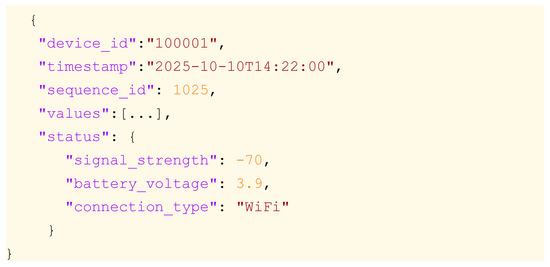
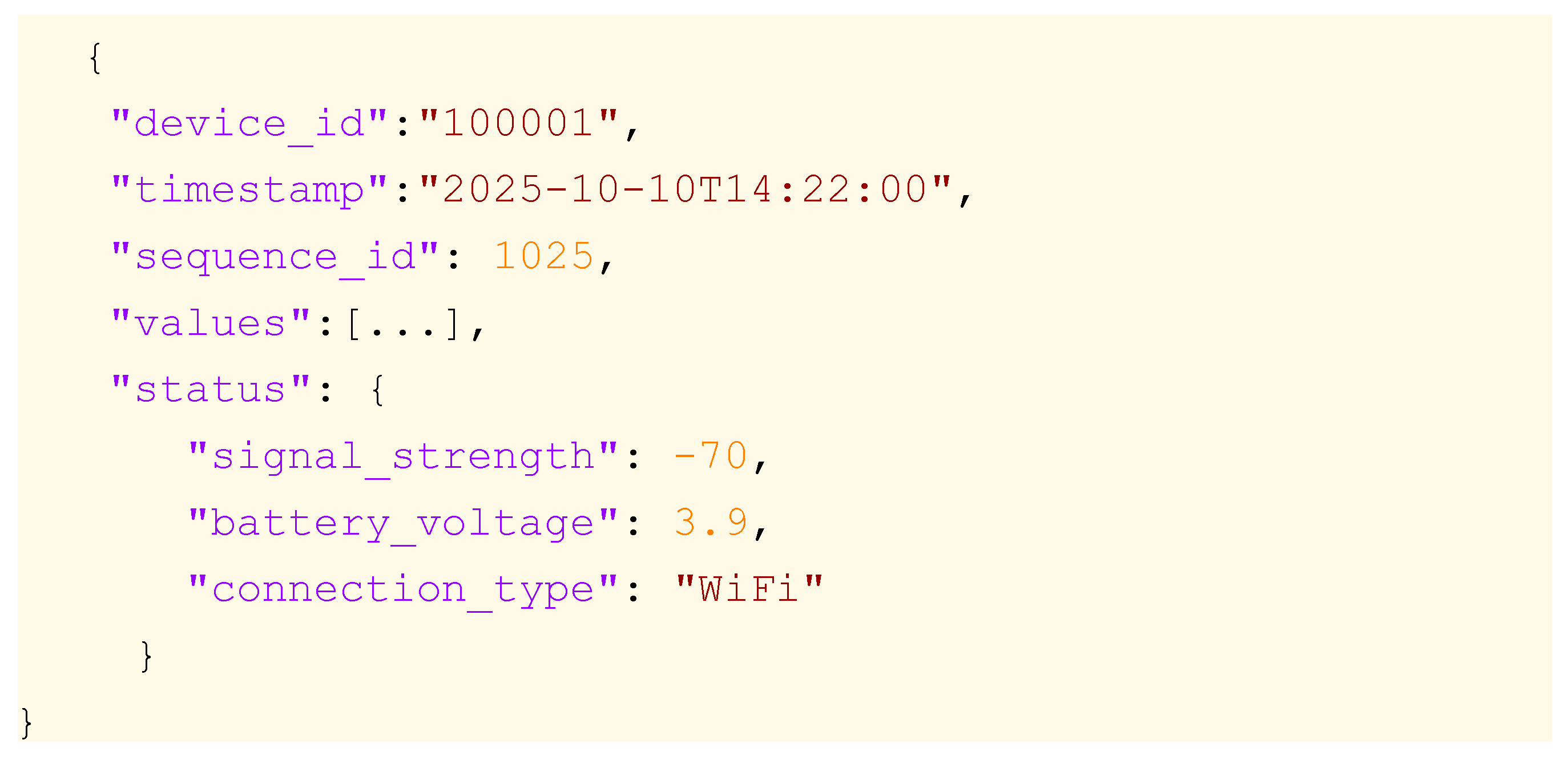
In order to standardise the data exchange process, a lightweight communication packet format based on a JSON structure is defined. An example structure of the transmitted packet is presented in Figure 3.
Figure 3.
Structure of the transmitted packet.
In the presented structure, the device_id field identifies the measurement node, timestamp contains the timestamp, and sequence_id is used for the detection of lost packets. The values section includes the measured values from all sensors, with the data organised as an array of real numbers. The status field provides additional information regarding the state of the system and the communication channel.
In order to reduce the volume of transmitted data when GSM/GPRS communication via the SIM800L module is used, an alternative binary format of the communication packet is implemented. This format is optimised for low-bandwidth transmission and reduced energy consumption, since the textual representation is eliminated and compact fixed-length field encoding is applied.
The proposed binary packet structure is presented in Table 1.
Table 1.
Structure of the binary packet.
The total packet size is 21 bytes, which represents a significant reduction compared with the equivalent JSON format, which typically exceeds 200 bytes. Consequently, both the transmission time and the energy consumption of the system are reduced.
For additional reliability, a checksum, CRC16, is included, enabling transmission errors to be detected. In the case of a checksum mismatch, the packet is discarded and retransmission is initiated in accordance with the QoS logic described above.
Normalization of the sensor data is performed by scaling the measured values to a 16-bit integer range, from 0 to 65,535. This enables efficient representation of the analogue measurements while preserving sufficient resolution. Temperature and humidity values are encoded using fixed-point representation, thereby eliminating the need for floating-point operations.
The selection between the JSON and binary formats is performed dynamically, depending on the active communication channel. The JSON format is used for Wi-Fi and BLE connections in order to facilitate integration and readability, whereas the binary format is preferred for GSM/GPRS communication in order to optimise traffic volume.
2.4. Necessity for Protection of the Wi-Fi/GSM Channel
Although the GSM/GPRS infrastructure provides a basic level of protection, data transmission through HTTP requests remains vulnerable to traffic interception, or packet sniffing, replay attacks, data manipulation, and device cloning based on the device_id.
Since the developed electronic nose system operates autonomously and transmits measurements over a public mobile network, protection must be implemented at the application layer, independently of the telecommunications operator.
The proposed solution is based on the chaotic transformation of the transmitted data, which represents a physical–mathematical method for information concealment through nonlinear dynamical systems.
3. Communications Based on Deterministic Chaos and Information Protection Methods
The development of communication systems based on deterministic chaos received considerable impetus after the possibility of synchronising chaotic systems had been demonstrated by Louis Pecora and Thomas Carroll. This discovery laid the foundation for the use of chaotic signals as information carriers, in which nonlinear dynamics is employed for message concealment and transmission.
Chaotic signals are characterised by a wide frequency bandwidth, noise-like behaviour, and high sensitivity to initial conditions, which makes them suitable for information masking. Several major methods for embedding an information signal into a chaotic carrier have been established in the literature.
Several approaches for superimposing information oscillations onto chaotic oscillations have been reported [11] and may be summarized as follows: chaotic masking, Chaos Shift Keying (CSK), and Differential Chaos Shift Keying (DCSK) [11,12]. DCSK is distinguished by the fact that synchronization between two independent chaotic generators is not required. Instead, a time-delayed version of the same chaotic signal is used as a reference.
The simplest approach is chaotic masking (CM), in which the information signal is added to the chaotic signal. Although this method can be easily implemented, it is sensitive to noise and requires a high degree of synchronization accuracy.
Another widely used approach is Chaos Shift Keying (CSK), in which different information symbols, such as ‘0’ and ‘1’, are encoded by means of different chaotic regimes or system parameters, i.e., attractors. This method enables the transmission of digital information; however, in its coherent form, an identical chaotic signal must be generated at the receiver, which is difficult to achieve under real operating conditions.
In this method, two different chaotic sequences are generated, each consisting of N samples. At the receiver, correlation with the reference templates is calculated, and a decision is made as to which bit has been transmitted. In this case, phase synchronisation is not required, since energy-based detection is applied. However, the achievable data rate is lower, as only one bit is transmitted per N samples.
Another method is Differential Chaos Shift Keying (DCSK). This approach is particularly attractive for Wireless Sensor Networks (WSNs), since non-coherent detection is employed. In DCSK, each bit is encoded into two chips: a reference chip and an information-bearing chip. The bit is then recovered at the receiver by calculating the correlation between them. In this way, the complex and noise-sensitive synchronisation of two independent chaotic oscillators is completely avoided, and only a simple delay line applied to the same chaotic signal is required. DCSK is also characterised by strong resistance to multipath propagation, i.e., anti-fading capabilities, as well as improved resilience to the near–far problem compared with coherent CSK. These advantages make it a promising candidate for low-power and low-complexity applications, including Wireless Personal Area Networks (WPANs) and Wireless Sensor Networks (WSNs).
Recent studies have focused on the application of DCSK and its variants in the Ultra-Wideband (UWB) spectrum, as well as in challenging environments such as underwater acoustic communication [3,6].
A practical hybrid approach suitable for IoT applications includes three levels [13]. First, at the sensor level, a pseudo-chaotic sequence is generated, for example by means of a logistic map implemented with 16-bit fixed-point arithmetic, and the data are XORed with this sequence. Second, for synchronisation purposes, each packet begins with 32 chaotic samples used as a prefix, which is detected by the receiver through autocorrelation. Third, for additional security, the chaotic generator is reinitialised with a new initial condition for each packet, while this condition is transmitted in encrypted form, for example using AES-128, through a secure channel during the association procedure.
Separately, the chaotic spread spectrum method replaces the conventional pseudonoise (PN) code with a chaotic sequence. Each bit is multiplied by a long chaotic sequence, with a chip rate much higher than the bit rate, thereby providing resistance to jamming, low spectral density, and low probability of detection. A practical implementation may be realised by means of a logistic-map generator, whose output is normalised to ±1 and used as the spreading code.
The application of chaos in modern communication technologies has also been extended to multichannel and multi-user Code Division Multiple Access (CDMA) systems [14] and Wireless Spread Spectrum communication schemes [15,16]. In such applications, chaos-generated sequences can replace conventional pseudorandom spreading codes. Their suitability for this purpose stems from their advantageous autocorrelation and cross-correlation characteristics, combined with the possibility of comparatively straightforward implementation in both software- and hardware-based communication platforms.
It should be noted that chaotic communication is not equivalent to cryptography. Under sufficiently long observation and with the use of modern phase-space reconstruction techniques, such as embedding-based attacks, the signal may be recovered. Therefore, when a high level of security is required, chaotic communication may be combined with conventional packet-level encryption methods, such as ChaCha20 or AES-GCM.
3.1. Hybrid Communication Scheme Based on ChaCha20, the Brusselator, and DCSK
The proposed system implements a multilayer data transmission approach in which three key mechanisms are combined: cryptographic protection, chaotic signal generation, and Differential Chaos Shift Keying (DCSK). The main concept is that structured information, such as a JSON packet generated by a sensor system, is transformed into a noise-like signal that is both protected and robust against disturbances in a wireless environment.
- Data preparation
The communication process begins with the formation of an information packet
where denotes a set of measured quantities. This packet is then converted into a textual format, such as JSON, which enables universal representation and straightforward processing
- 2.
- Cryptographic layer
To enhance information security, symmetric encryption based on the ChaCha20 stream cipher is introduced prior to chaotic modulation. In this way, cryptographic indistinguishability is combined with dynamic chaotic masking.
Before transmission, the serialized string is encrypted using the ChaCha20 stream cipher
where K denotes a 256-bit key, IV is the nonce, or initialization vector, and C represents the ciphertext, expressed as a byte stream.
The encrypted stream C exhibits a pseudorandom character and does not reveal information about the original data, even under partial observation. Thus, the first level of protection, namely cryptographic confidentiality, is provided.
- 3.
- Preparation for modulation
The ciphertext is converted into a bit sequence
For the purposes of chaotic modulation, the bits are represented in bipolar form
This transformation facilitates multiplication by the carrier signal and is commonly used in correlation-based methods.
- 4.
- Generation of the chaotic carrier signal
Instead of a conventional sinusoidal carrier, a chaotic signal generated by a nonlinear dynamical system of the Brusselator type is used. The Brusselator was proposed by Ilya Prigogine and René Lefever [17] and is described by the following system of ordinary differential equations:
The model describes an autocatalytic chemical reaction, in which the variables and represent the concentrations of intermediate reactants, while the parameter determines the operating regime of the system and is related to the concentration of an externally sustained reactant.
The phase portrait of the system reveals a significant dependence on the parameter μ:
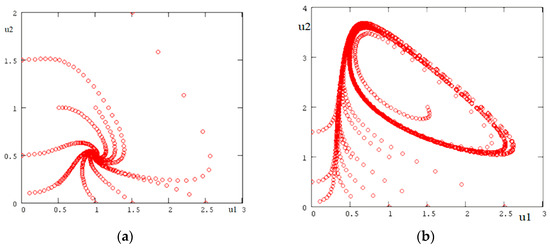
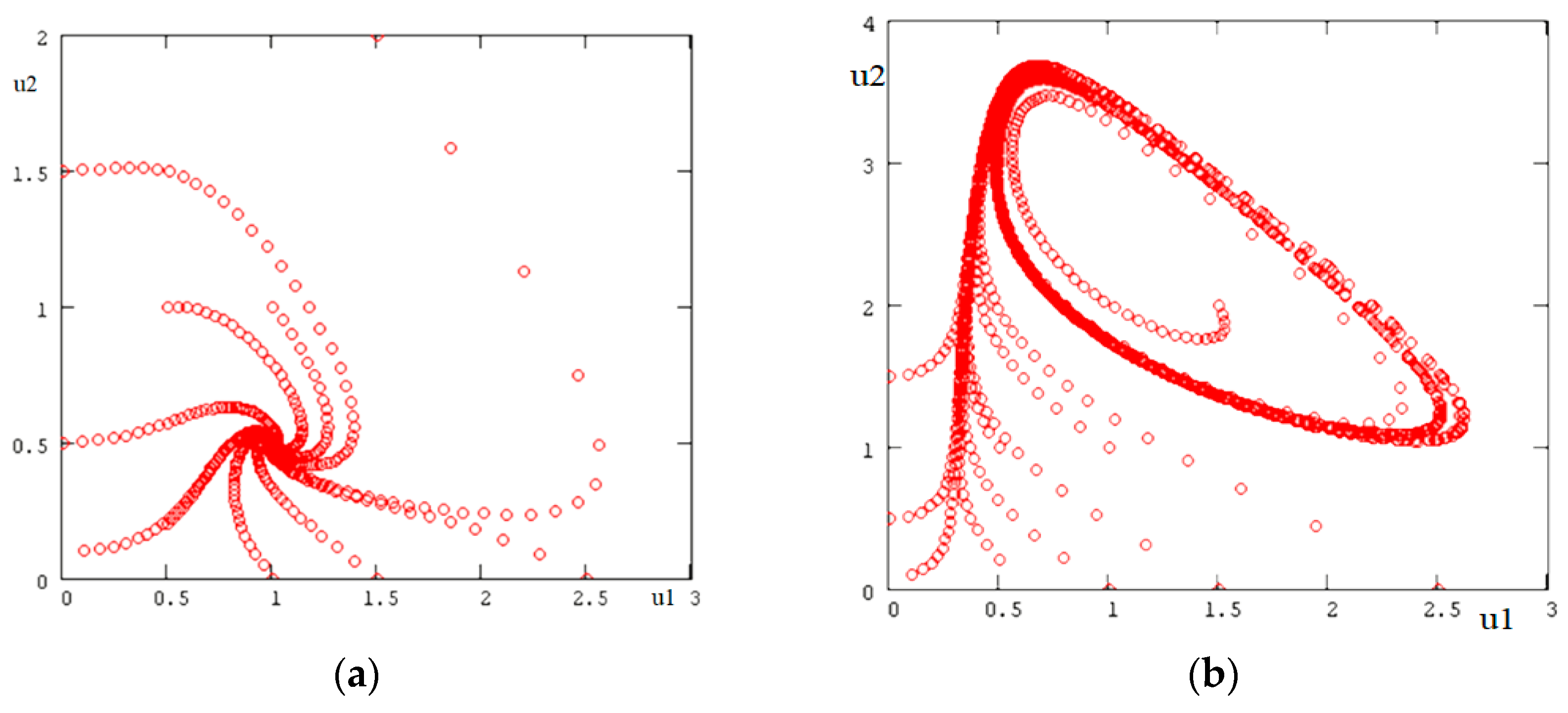
- For the system has a stable stationary point, or node, as shown in Figure 4a, toward which all trajectories asymptotically converge. For example, at , all solutions converge to equilibrium. This regime is not suitable for encoding.
- For a Hopf-type bifurcation is observed, in which the stationary point loses stability and a limit cycle emerges, as shown in Figure 4b. For example, at , the system exhibits stable self-sustained oscillations.
Figure 4.
Phase portraits of the Brusselator for different values of : (a) ; (b) .
This change in behavior indicates that the Brusselator can generate both stable and oscillatory regimes, depending on the selected parameters. As μ increases, the characteristics of the limit cycle, namely its amplitude and frequency, are modified without loss of stability.
It is important that a wide range of initial conditions be considered, since nonlinear systems may possess multiple attractors and a complex phase-space structure.
With an appropriate choice of the parameter μ, quasi-chaotic or strongly nonlinear oscillations can be generated by the system and used as a carrier signal.
After discretization
a digital sequence with noise-like behavior and a favorable autocorrelation structure is obtained.
The possible encoding approaches include the following:
- Amplitude encoding (Chaos Masking)—The information signal is superimposed onto the chaotic signal
- Parametric encoding (Chaos Shift Keying)—The information is encoded by varying the parameter
- DCSK-based encoding—The chaotic sequence is used as a reference signal, while the information bit is encoded through the sign
This system generates complex nonlinear dynamics that are highly sensitive to the initial conditions.
Since the ESP32 operates in discrete time, the system is solved numerically using Euler integration
where Δt is the time step, and the index k denotes the iteration number. The initial conditions serve as a secret key.
After discretization, the following sequence is obtained:
This signal exhibits noise-like behavior and favorable autocorrelation properties, which makes it suitable for communication purposes.
- 5.
- DCSK modulation
Each information bit is encoded by means of two consecutive segments. The first segment is the reference segment, which is a direct copy of the chaotic signal, whereas the second segment is the information-bearing segment, in which the same signal is multiplied by .
Thus, for one bit, the transmitted signal is obtained as
This structure is essential because the need for synchronization between the transmitter and the receiver is eliminated; the reference signal is transmitted together with the information-bearing signal.
The complete signal is formed by concatenating all such blocks sequentially
- 6.
- Transmission
The signal is transmitted through a wireless medium, such as Wi-Fi, in which noise and distortions are introduced
- 7.
- Reception and demodulation
The receiver is not required to reconstruct the chaotic generator. Instead, correlation between the two segments is used
The sign of the resulting value determines the received bit
This is a non-coherent method that is robust against noise and phase distortions.
- 8.
- Data recovery
After demodulation, the bit stream is recovered and converted back into bytes
Subsequently, decryption is performed
Finally, the original packet is reconstructed
- 9.
- Overall system overview
The entire process can be regarded as a sequential transformation
- 10.
- Interpretation and advantages
This scheme provides two-layer protection: at the logical level through encryption, and at the physical level through chaotic masking and DCSK modulation.
As a result of this combination, a signal is obtained that appears noise-like and is difficult to analyse without the corresponding key. In addition, the signal is robust against channel disturbances and does not require complex synchronisation.
3.2. Server Infrastructure
The server-side infrastructure is implemented using PHP and MySQL. The receive.php script receives the transmitted data, decodes them, and stores them in the sensor_readings table, which contains the fields id, device_id, timestamp, sensors_count, and samples_count. The measured values are normalised and stored in an additional table, sensor_values.
The command.php script enables commands to be written and read for a specific device, thereby allowing measurements or data transmissions to be started remotely.
The ping.php script confirms server availability by returning the response {“ok”: true}.
The server was tested under Apache 2.4, PHP 8.1, and MySQL 8.0. The database was optimised by means of indexes on the device_id and timestamp.
4. Experimental Results and Statistical Analysis
To verify the operation of the system, a series of experiments was conducted in which real measurement and data transmission conditions via a mobile network were simulated.
The average transmission time of a single JSON packet, approximately 250 bytes, over GPRS was 2.3 ± 0.4 s, including DNS resolution and server acknowledgment. This time included, on average, 0.8 s for GPRS initialization and 1.5 s for HTTP transmission.
Out of 100 consecutive transmission cycles, 96 were successful on the first attempt, while the remaining four were transmitted during an automatic retry after 10 s. This resulted in an overall reliability of 99% under coverage conditions above −85 dBm RSSI.
A comparison between the measurements stored locally and those received by the server showed agreement of the values with an error below 0.2%, thereby confirming the correctness of the transmission and processing procedures.
The data collected through the GSM module were used to train the neural network described in [18]. A classification accuracy of 98.7% was achieved in distinguishing olive oil from mixtures with sunflower oil, which was identical to the results obtained in local tests without wireless communication.
4.1. Validation of the Developed ESP32 + GSM E-Nose Platform for the Detection of Sunflower Oil in Olive Oil
In the experiment, different sources, or brands, of extra virgin olive oil and three sources of sunflower oil were used in order to cover natural variability. Mixtures with the following sunflower oil concentrations were prepared: 0% as the control sample, 1%, 2%, 5%, 10%, 20%, 50%, and 100%. For each concentration and each source repetitions were performed.
The sampling conditions included headspace sampling at a controlled temperature, for example 40 ± 0.5 °C, and a fixed stabilization time, for example 10 min for stabilization of the vapor phase. The sample flow was fixed using a small pump, for example at 200 mL/min. Purging with air was performed for 2 min before each sample and was used as the baseline.
For each measurement, averaging was applied by acquiring 20 samples per channel, as implemented in the firmware. The raw ADC values, voltage values, and time series, represented as packets of N points, were recorded. Temperature, relative humidity, and RSSI values for the GSM connection were also logged.
4.2. Data Preprocessing
Data preprocessing included baseline correction, whereby the baseline recorded before the sample was subtracted
Detrending was then applied by removing slow drift through local linear subtraction. Normalization was performed using either channel-wise z-score transformation, based on the mean and standard deviation, or min–max scaling. Annotation was also carried out, with each record being assigned a label corresponding to the concentration and class, i.e., pure olive oil or olive oil–sunflower oil mixture.
4.3. Statistical Analysis
To evaluate the classification accuracy of the developed neural network, the classical metrics Accuracy, Precision, Recall, and F1-score were used, providing an objective quantitative assessment of the obtained results.
Accuracy measures the overall proportion of correctly classified samples relative to all test data. Precision indicates the reliability of positive predictions and is calculated as the ratio between correctly identified positive cases and all cases predicted as positive. Recall, also referred to as sensitivity, evaluates the ability of the model to detect all actual positive samples. The F1-score represents the harmonic mean of Precision and Recall and provides a balanced evaluation in the presence of imbalanced classes.
The processing of the experimental data and the calculation of the evaluation metrics were performed in Python 3.11. The NumPy library was used for numerical computations, Pandas was employed for tabular data processing and analysis, and scikit-learn was used to apply standard evaluation functions for classification models.
4.4. Experimental Studies
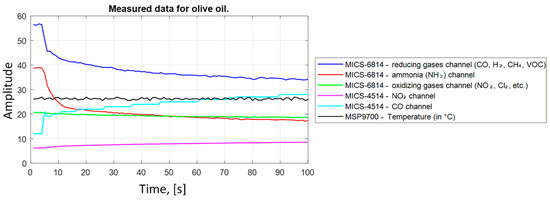
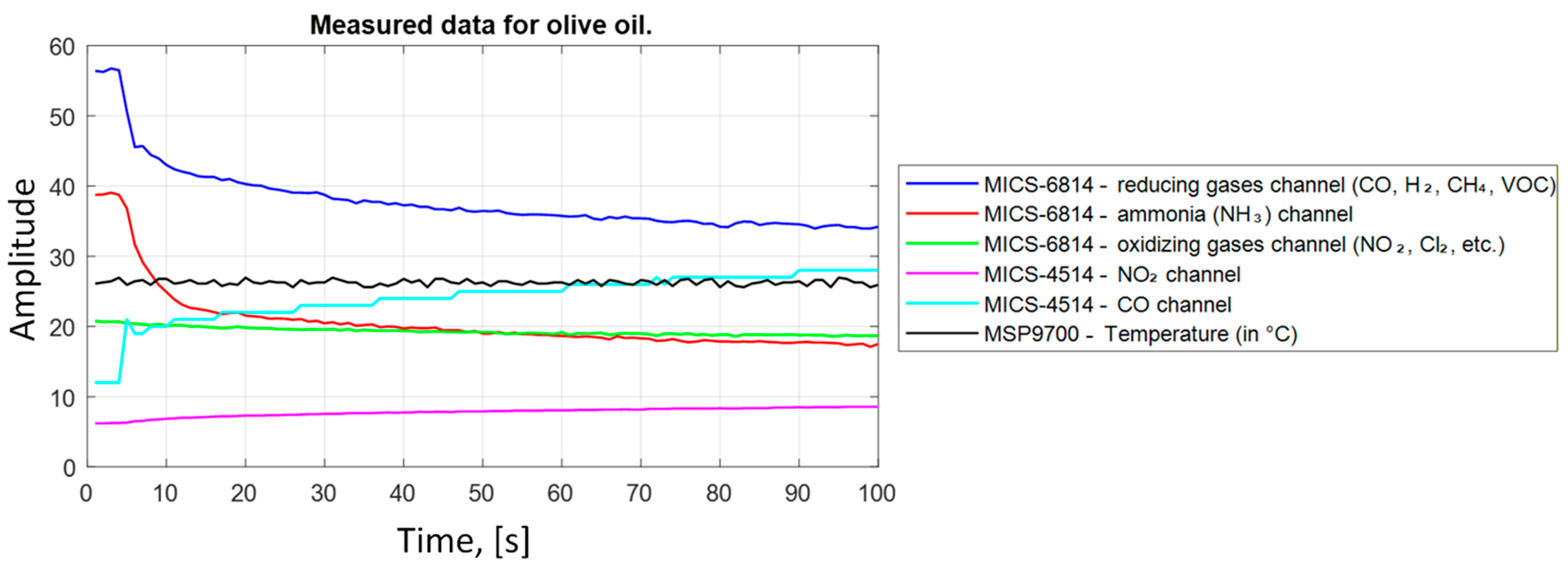
Experimental data from the developed communication system were obtained during the investigation of olive oil. Figure 5 presents real measurement data for olive oil, recorded by the system using the MICS-6814, MICS-4514, and MSP9700 sensors.
Figure 5.
Measured data for different gases during the quality assessment of olive oil.
Note: For better visualization of the results, the values of Channels 1, 2, and 4 were divided by 20, while the values of Channel 3 were divided by 100.
Table 2 presents the sensors and the measured physical quantities, the trends of the values shown in Figure 5, and the physical interpretation of these quantities with respect to the specific investigated substance.
Table 2.
Data observations for olive oil.
The interpretation of the obtained results for the olive oil vector is presented in Table 3.
Table 3.
Interpretation of the olive oil vector.
4.4.1. Experimental Evaluation of the Robustness of the Communication Scheme Under Noise and Interference
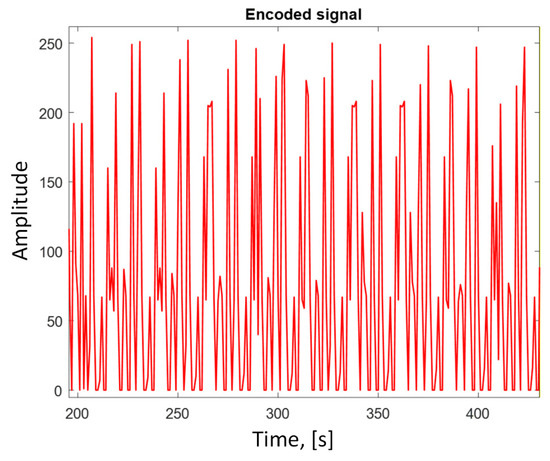
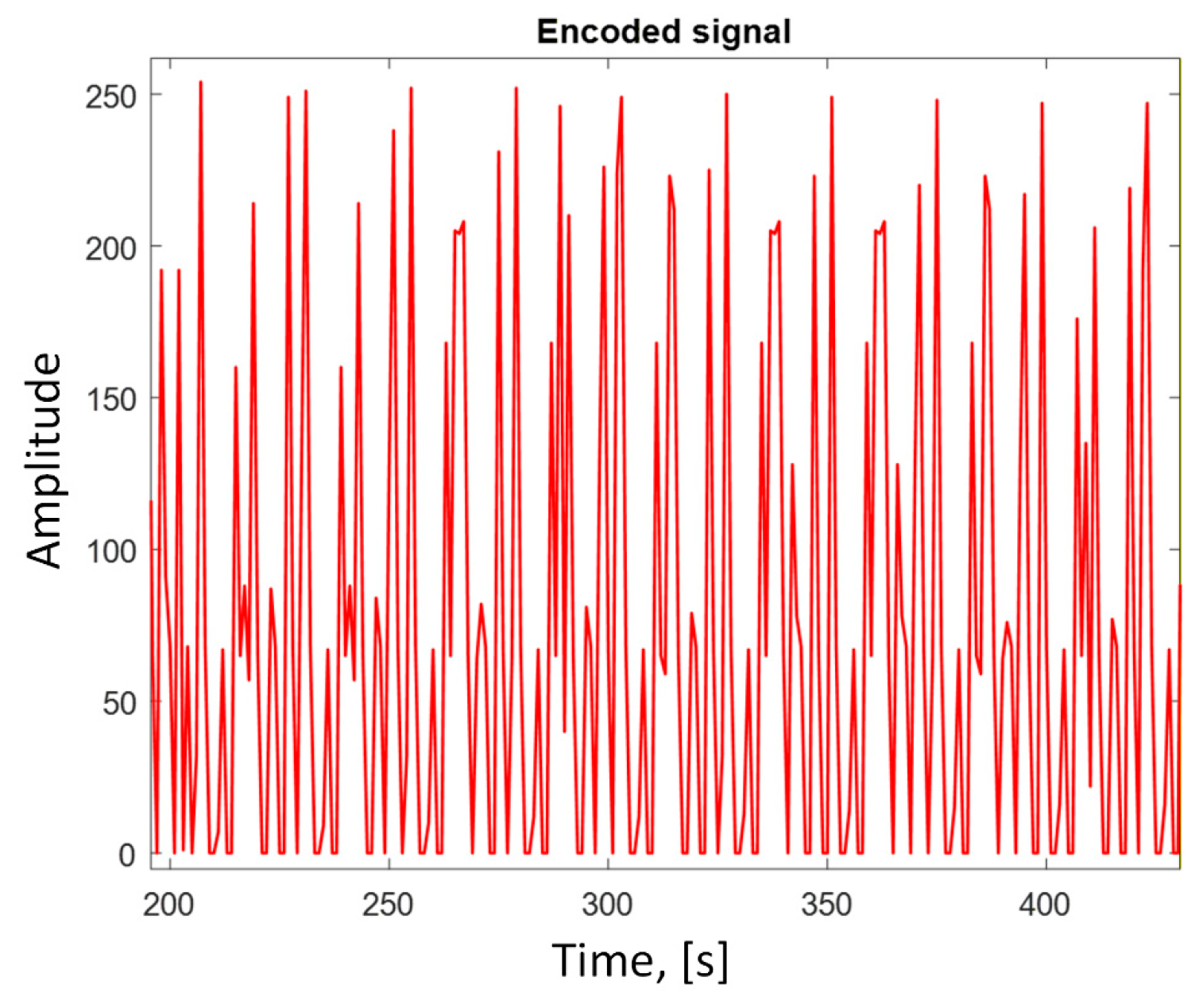
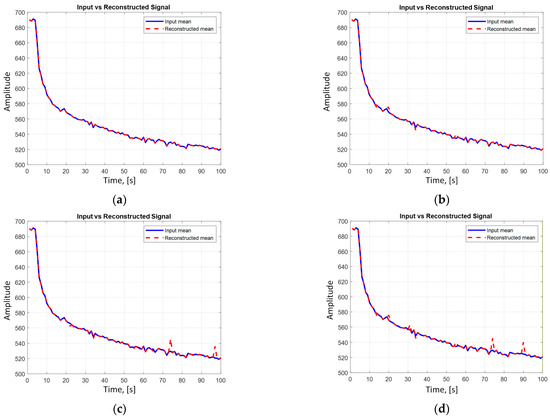
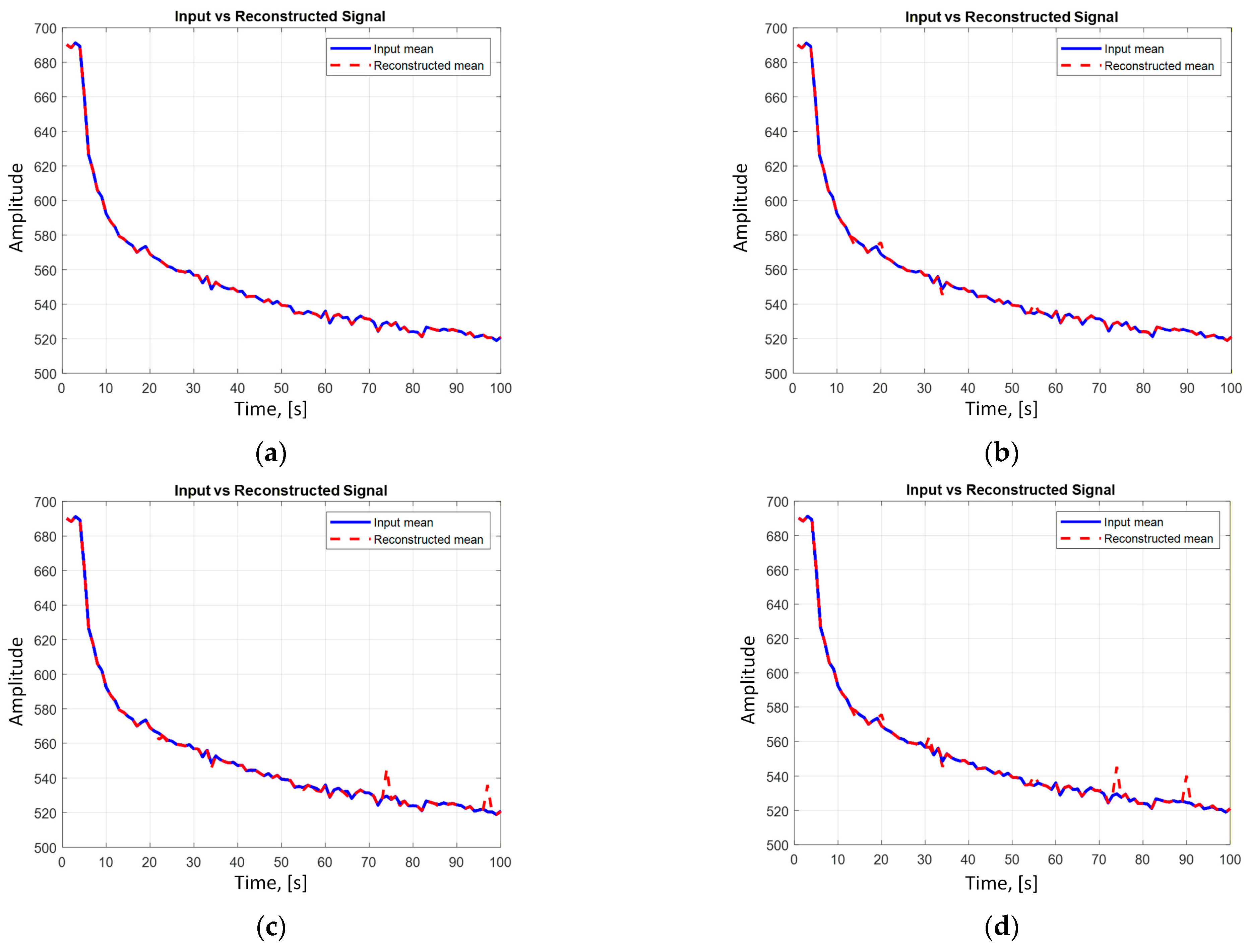
For additional validation of the proposed hybrid communication architecture, based on ChaCha20 + Brusselator + DCSK, a simulation study was carried out to evaluate the robustness of the system in the presence of bit errors in the communication channel (Figure 6). The main objective was to assess the impact of noise-induced disturbances on the correct reconstruction of the original sensor data, represented as a matrix of size 6 × N, where 6 denotes the number of sensors in the measurement head and N denotes the number of measurements.
Figure 6.
Segment of the encoded signal containing the measurements from the MICS-6814 sensor—reducing gases channel (CO, H2, CH4, VOCs).
The communication stream was modelled by introducing random bit inversions, i.e., bit-flip noise, into the transmitted packet. The bit error probability was set within the range of 0.1–5%. This model reflects realistic conditions in GSM/GPRS-based transmission, where impulse errors, packet losses, and distortions at the bit-stream level may occur.
The obtained results (Figure 7) show that the system maintains high robustness under low and moderate noise levels. For a bit error probability of up to 1%, the reconstructed sensor values remain practically identical to the original ones, with a mean relative error below 1.5%. When the noise level increases to 3–5%, partial distortion of individual measurements is observed. This appears as local anomalies in the reconstructed matrix, but without systematic degradation of the entire signal.
Figure 7.
Comparison between the transmitted and received signals for: (a)—BER = 0%; (b)—BER = 1%; (c)—BER = 3%; (d)—BER = 5%.
It is particularly important to note that the proposed DCSK-based modulation demonstrates high robustness against random bit inversions due to the correlation-based demodulation principle. Since the information recovery process is based on the sign of the correlation integral, isolated bit errors do not lead to catastrophic error propagation throughout the entire packet. This represents a significant advantage compared with conventional binary modulation schemes.
The cryptographic layer based on ChaCha20 further limits the interpretability of partially corrupted bit streams by ensuring that local disturbances cannot be exploited to extract structural information about the original sensor data. In combination with the chaotic carrier generated by the Brusselator system, an additional spreading of the disturbances is observed in the time–frequency representation of the signal.
As a result, the proposed system demonstrates stable behaviour under noisy conditions typical of low-power IoT communications, while preserving its functionality even in the presence of a degraded communication channel.
4.4.2. Quantitative Simulation Results
To evaluate the reconstruction accuracy, the mean absolute error (MAE) between the original and the reconstructed matrix was used as a performance metric
where X denotes the original sensor data matrix, denotes the reconstructed matrix, 6 is the number of sensor channels, and N is the number of measurements.
The following results were obtained from the simulations:
- BER = 0% → MAE ≈ 0;
- BER = 1% → MAE ≈ 0.01–0.02;
- BER = 3% → MAE ≈ 0.03–0.07;
- BER = 5% → MAE ≈ 0.08–0.15.
An approximately linear relationship between the bit error rate and the reconstruction error can be observed. This confirms the predictable behaviour of the system under progressively degraded channel conditions.
The obtained results indicate that the proposed hybrid architecture provides a balance between communication security and robustness. In contrast to conventional cryptographic schemes, where a bit error may lead to complete decryption failure, in the proposed approach the errors remain localized and do not destroy the overall structure of the measurement packet.
This makes the system suitable for real IoT applications operating under unstable GSM/GPRS connectivity, including industrial monitoring, food analysis, and remote sensor-network deployments.
5. Conclusions
This work demonstrates the successful integration of a Brusselator-based chaotic generator with DCSK modulation and cryptographic encryption (ChaCha20) for secure data transmission in IoT sensor networks. The proposed electronic nose system reliably collects multidimensional gas sensor data, preprocesses it, and transmits it via GSM/GPRS to a remote server. The hybrid security approach offers several advantages: (i) elimination of complex chaotic synchronization between transmitter and receiver, (ii) non-coherent correlation-based detection robust to multipath fading and near-far interference, (iii) low computational overhead suitable for ESP32-class devices, and (iv) two-layer protection where compromise of one layer does not expose plaintext data. Experimental validation using olive oil—sunflower oil mixtures confirms that the system achieves high classification accuracy (98.7%) comparable to local processing without wireless transmission. The average GPRS transmission time of 2.3 s per JSON packet and 99% reliability under typical signal conditions demonstrate practical viability. Future work may explore adaptive parameter selection for the Brusselator to enhance security, integration of lightweight machine learning for on-device classification, and extension to multi-node WSN deployments with time-varying channel conditions. The proposed framework provides a balanced trade-off between security, energy efficiency, and implementation complexity, making it a promising candidate for remote environmental monitoring and food quality assurance applications.
Author Contributions
Conceptualization, H.S. and S.Y.; methodology, S.Y.; software, G.M.; validation, S.I., H.S. and S.Y.; formal analysis, S.Y.; investigation, G.M.; resources, G.M.; data curation, S.Y.; writing—original draft preparation, S.Y., G.M., S.I. and H.S.; writing—review and editing, H.S. and G.M.; visualization, S.Y.; supervision, G.M.; All authors have read and agreed to the published version of the manuscript.
Funding
This research received no external funding.
Institutional Review Board Statement
Not applicable.
Informed Consent Statement
Not applicable.
Data Availability Statement
The data are available from the corresponding author upon request.
Conflicts of Interest
The authors declare no conflicts of interest.
Abbreviations
The following abbreviations are used in this manuscript:
| WSN | Wireless Sensor Network |
| FBG | Fiber Bragg Grating |
| NARX | Nonlinear Autoregressive with Exogenous inputs |
| LoRaWAN | Long Range Wide Area Network |
References
- Kaddoum, G. Wireless Chaos-Based Communication Systems: A Comprehensive Survey. IEEE Access 2016, 4, 2621–2670. [Google Scholar] [CrossRef] [Scilit]
- Sheela, S.J.; Sonu, S.Y.; Dalal, V.; Patil, S. MIMO and Chaotic Communication: Systematic Literature Review. In Innovative Computing and Communications. ICICC 2024; Lecture Notes in Networks and Systems; Hassanien, A.E., Anand, S., Jaiswal, A., Kumar, P., Eds.; Springer: Singapore, 2024; Volume 1043. [Google Scholar] [CrossRef] [Scilit]
- Fagan, P.D. Keyed Chaotic Masking: A Functional Privacy Framework for Neural Inference. arXiv 2025, arXiv:2505.12345. [Google Scholar]
- Xia, J.; Chen, L.; Ma, H.-F. Enhanced chaotic communication with machine learning. AIP Adv. 2024, 14, 115026. [Google Scholar] [CrossRef] [Scilit]
- Busawon, K.; Canyelles-Pericas, P.; Binns, R.; Elliott, I.D.; Ghassemlooy, Z. A brief survey and some discussions on chaos-based communication schemes. In Proceedings of the 11th International Symposium on Communication Systems, Networks & Digital Signal Processing (CSNDSP), Budapest, Hungary, 18–20 July 2018; pp. 1–5. [Google Scholar] [CrossRef] [Scilit]
- Huang, T.; Chen, J.; Zeng, H.; Cai, G.; Zhou, H. Design of an M-ary Chaos Shift Keying System Using Combined Chaotic Systems. arXiv 2025, arXiv:2510.12345. [Google Scholar]
- Stoycheva, H. Secure communication scheme based on chaotic switching between non-identical systems. In Proceedings of the International Conference Automatics and Informatics (ICAI), Varna, Bulgaria, 9–11 October 2025. [Google Scholar]
- Yuningsih, S.H.; Supian, S.; Sukono, S.; Subiyanto, S. Wireless Chaos-Based Communication System: Literature Review. J. Phys. Conf. Ser. 2021, 1722, 012046. [Google Scholar] [CrossRef] [Scilit]
- Bensalah, N.; Mahfoudia, O. Performance analysis of spread spectrum techniques for laser remote sensing multiple input multiple output systems. Opt. Express 2020, 28, 234–245. [Google Scholar] [CrossRef] [Scilit]
- Sahnoune, A.; Berkani, D. On Statistical Properties of Chaotic Signals Generated by Negative Sawtooth Maps. Chaos Solitons Fractals 2022, 155, 111678. [Google Scholar] [CrossRef] [Scilit]
- Dmitriev, A.S.; Ryzhov, A.I. Trends in the Development of Ultra-Wideband Direct Chaotic Communications. Infocommun. Radio Technol. 2023, 1, 1–14. [Google Scholar]
- Karagiorgos, N.F.; Stavrinides, S.G.; Benito, C.D.; Nikolaidis, S.; Picos, R. Unconventional Security for IoT: Hardware and Software Implementation of a Digital Chaotic Encrypted Communication Scheme. IEEE Internet Things J. 2024, 11, 19914–19925. [Google Scholar] [CrossRef] [Scilit]
- Belei, O.; Svatiuk, O. Development of an Algorithm for Message Encryption in Wireless Sensor Networks. Electron. Prof. Sci. J. Cybersecur. Educ. Sci. Technol. 2020, 1, 69–84. (In Russian) [Google Scholar] [CrossRef] [Scilit]
- Dmitriev, A.; Ryzhov, A.; Sierra-Teran, C. Statistical Characteristics of Differential Communication Scheme Based on Chaotic Radio Pulses. Electronics 2023, 12, 1495. [Google Scholar] [CrossRef] [Scilit]
- Feng, J.; Wang, J.; Zhu, Y.; Han, K. A Hybrid Chaotic Encryption ASIC With Dynamic Precision for Internet of Things. IEEE Internet Things J. 2024, 11, 1148–1163. [Google Scholar] [CrossRef] [Scilit]
- Eisencraft, M.; Attux, R.; Suyama, R. Chaotic Signals in Digital Communications; CRC Press: Boca Raton, FL, USA, 2025. [Google Scholar]
- Prigogine, I.; Nicolis, G. On symmetry-breaking instabilities in dissipative systems. J. Chem. Phys. 1967, 46, 3542–3550. [Google Scholar] [CrossRef] [Scilit]
- Yordanov, S.; Ivanov, S.; Todorov, T.; Mihalev, G. Intelligent system for qualification of food products based on esp32 and gass sensors. J. Inform. Innov. Technol. 2019, 2–3, 53–63. [Google Scholar]

Disclaimer/Publisher’s Note: The statements, opinions and data contained in all publications are solely those of the individual author(s) and contributor(s) and not of MDPI and/or the editor(s). MDPI and/or the editor(s) disclaim responsibility for any injury to people or property resulting from any ideas, methods, instructions or products referred to in the content. |
© 2026 by the authors. Licensee MDPI, Basel, Switzerland. This article is an open access article distributed under the terms and conditions of the Creative Commons Attribution (CC BY) license.