


Abstract
This study explores a simple free-falling problem, focusing on the determination of the coefficient of restitution for a steel ball through virtual and physical experiment evaluation. Different effects influencing the dynamic behavior and accuracy of the experiment are explored through variation in the physical objects’ diameters. Physical testing results were obtained through high-speed capturing and visual-tracking software in a series of physical experiments. This allowed us to correctly determine the main dynamic parameters of the system and to compare them to the results obtained by numerical simulation of the virtual model. Detected differences and the level of correspondence of the virtual model with the physical one are reviewed and discussed. Further recommendations for virtual prototyping of drop tests are presented.
1. Introduction
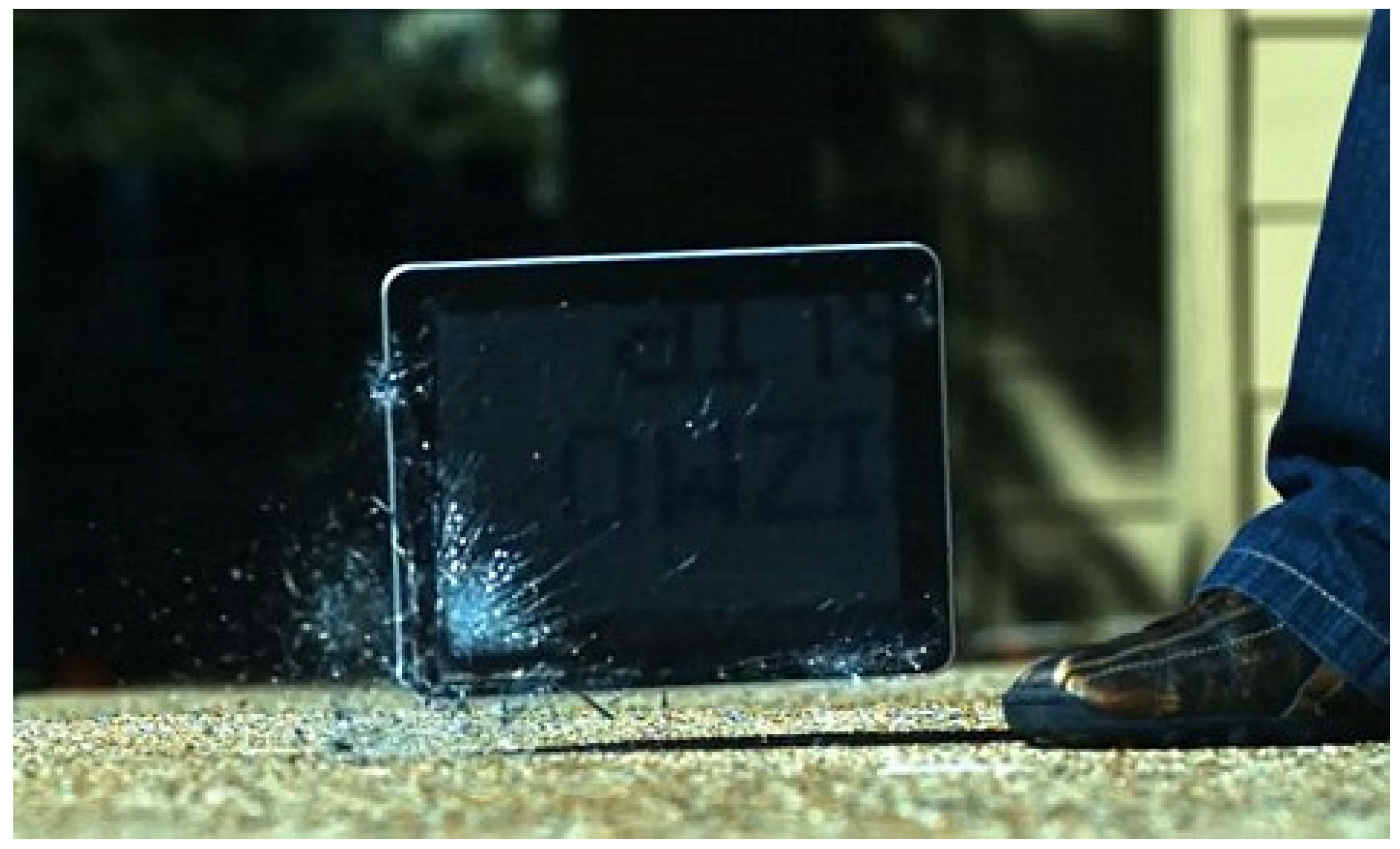
In recent years, with advancements in technology, the usage of different handheld devices and products has been on the rise, introducing new obstacles and raising different concerns. Among these, an increased risk of dropping a device can, in some cases, pose risks to the device user, as any portable or handheld devices are significantly prone to being dropped (free falling from height and other forms of mechanical damage) during regular use [1]. Droppable items include electronic devices, glass and ceramic items, chemicals and cleaning products, household items, tools and hardware, etc. Broken objects and devices can present sharp pieces (as seen on Figure 1), which could be dangerous for and injure the user [2] during or after a drop-fall impact. Release from chemical containers and other objects such as batteries could also pose a danger for the user in the event of a dynamic shock or drop. As safety concerns are a main part of the development of consumer products, introducing measures for risk evaluation and mitigation is useful in this context. Comprehensively understanding how a dynamic shock in the case of free fall influences different objects is crucial for improving the design of handheld products. Hence, a useful approach for the evaluation of these risks can be the use of drop testing, as its application prospects can be broad, with different purposes in accordance with the specific goals. This approach can also be used to verify devices’ compliance with the corresponding standards, the durability of products, the influence of transportation and handling operations, etc. [3] Virtual modelling of drop test experiments can represent the tested body’s behavior and the influence of the dynamic shock; however, the level of accuracy is often not determined until a part or the whole system has been validated through physical experiments or analytical approaches [4]. Different methods and approaches for virtual validation are known and reviewed in existing articles [3,5], and according to their applicability and level of accuracy, they were used in the preparation of this study.
Figure 1.
Dangerous glass shards produced after an electronic device was dropped.
In this paper, a simple free-fall problem is introduced in order to evaluate the objects’ dynamic behaviors and extract knowledge and introduce guidelines for further and more complex structures. In order to precisely analyze stress and strain values of the test object and evaluate its behavior under the influence of the dynamic stresses of free fall, an analytical and experimental validation approach will be used to adjust the FE model. A simple test subject was selected, namely, a steel ball, which was chosen due to its geometrical simplicity, orientation indifference during contact, lack of part interactions and applicability with respect to the experiment. A drop test machine has been utilized, ensuring equal drop height for each iteration, and different contact plates for evaluating their influence on rebound height.
2. Study Methodology
This study is composed of three main parts, and it draws conclusions from comparing these parts, presenting a hybrid approach to addressing a simple dynamic problem. The three parts involve a physical experiment, an analytical calculation, and finite-element model (FEM) computation, all conducted under the same initial conditions. By using these different methods, this study ensures redundancy, allowing direct comparison of results to form robust conclusions.
Each method can independently solve the problem, but the FEM can be particularly influenced by the results of analytical calculations and physical experiments. These two methods act as validation tools for the FEM in this study. By considering the unique aspects of each approach, we conducted a physical experiment, performed analytical calculations, and executed FEM computation. The results from these methods were then compared and analyzed to draw comprehensive conclusions.
A steel sphere from a ball bearing assembly was used as a test object. This geometry was selected due to its simplicity, lack of interaction between parts, indifference with respect to contact orientation, and non-complex material properties. These selections are a prerequisite for better correspondence between the three approaches, as one of the goals of this study is to derive insights for optimal preparation of a virtual model.
3. Physical Experiment
In the physical experiment, the aforementioned test object was used. The steel sphere, with a nominal diameter of 20 mm, is composed of 100 Cr6, which has a hardness of around 60 HRC. Two steel contact plates were used in the experiments: one is softer, with a hardness of around 30 HRC, and the second one is harder, with a hardness of around 50–55 HRC. Similar different impact target surfaces and their implications have been compared by Adli et al. [6]. Regarding the experimental setup, determination of COR can be conducted with a sphere and a plane or two spheres from the same material. A standard drop test machine without guides in compliance with ISO2248 was used for the experiments, resulting in good repeatability between different tests. A high-speed camera was used to record the rebound speed and, where applicable, the rebound height of the test object.
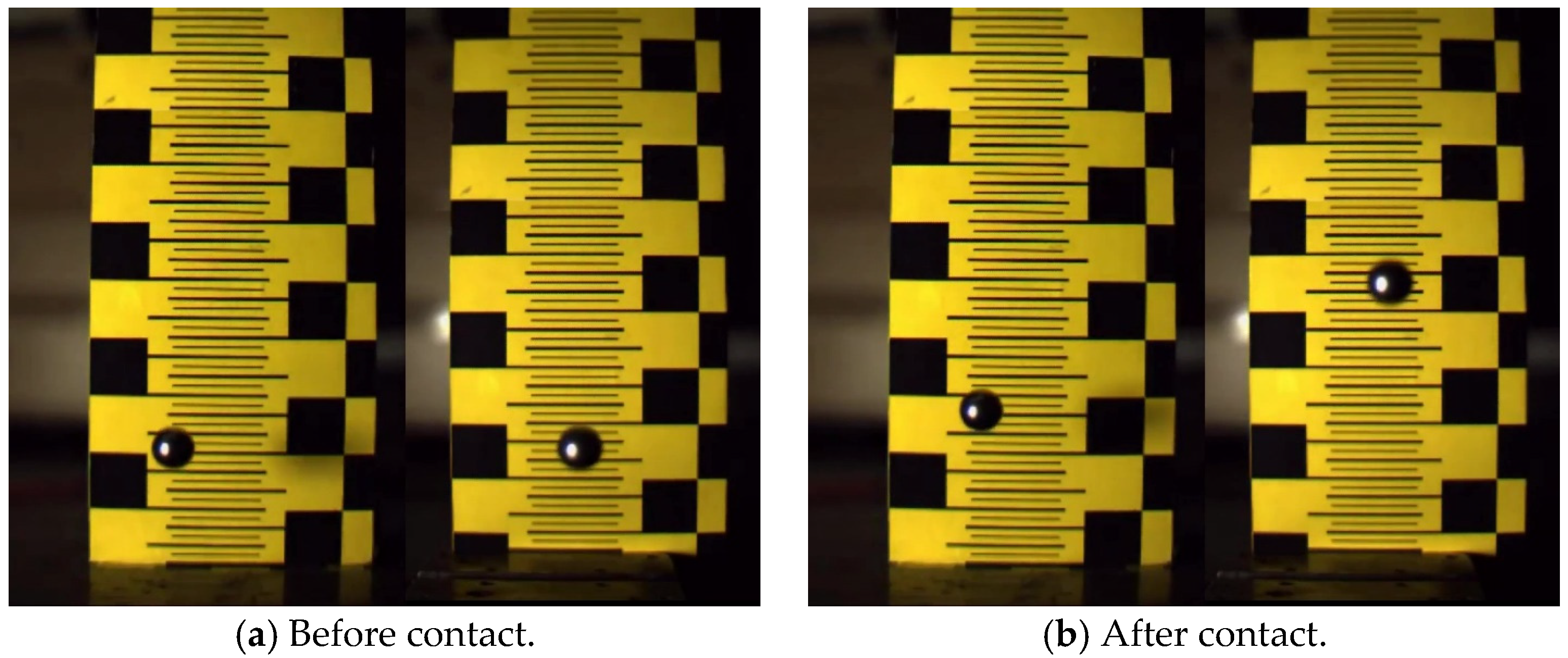
The drop height for the experiment was 1 m, corresponding to an impact velocity of 4.43 m/s. The drop arm of the test machine accelerates faster than under free-fall conditions, ensuring high repeatability of the contact position. This is particularly important for high-speed imaging because of the camera’s shallow depth of field, as even small variations in the impact position may cause the specimen to appear out of focus. The capture speed is 1500 fps for this case study, with a portrait orientation for the field of view, allowing capture of the rebound height for the softer baseplate experiment and the rebound speed immediately after contact with the harder baseplate, as shown on Figure 2.
Figure 2.
Comparison of before and after contact between the softer and harder baseplates.
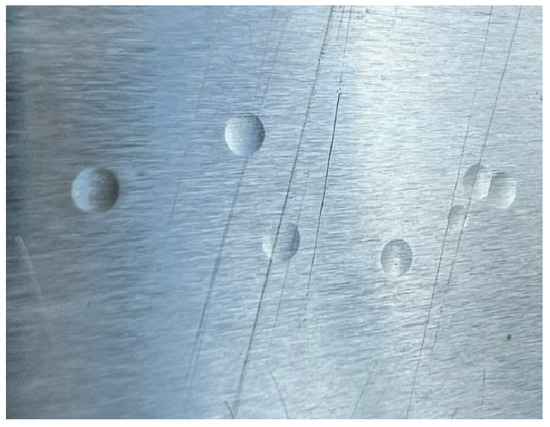
The results of the tests conducted are a rebound height of 85 cm for the harder baseplate and 32 cm for the softer one. This shows the significant influence of the specific properties of the material. Plastic deformation can be visually observed in the softer baseplate on Figure 3. The results obtained with the harder baseplate were used for comparison with the analytical model proposed by Weir and Tallon, as the model was developed for impacting bodies made of the same material. Of the two tested baseplates, the harder one had material properties closer to those of the steel sphere and therefore provided the more appropriate approximation. Hence, a COR (coefficient of restitution) of 0.85 was obtained for this material.
Figure 3.
Plastic deformation in the soft baseplate.
4. Analytical Approach
An analytical estimate of the COR for the impact between the steel sphere and a baseplate with similar material properties was obtained using the model, used by Jackson et al. [7] and proposed by Weir and Tallon [8]:
5. Virtual Analysis
An explicit analysis with FEM was conducted in order to gain an insight into the impact’s influence on the tested body. Stresses and elastic and plastic strain are of interest in this study, while upwards velocity after impact is used for validation of the virtual analysis.
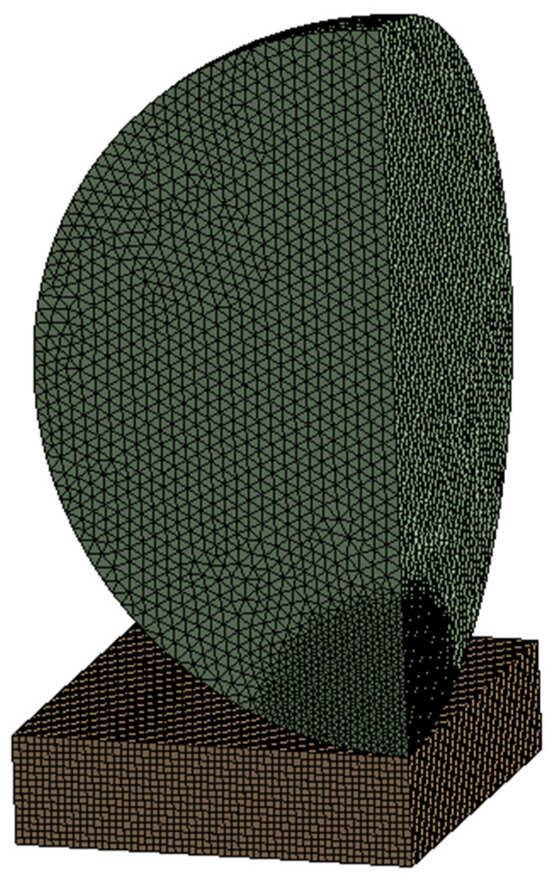
A 3D simplified geometry was constructed and optimized, with two plains of symmetry, giving us a quarter model. Similar simplifications are observed in other research papers exploring virtual analysis of drop tests–[9,10]. This brings down the total number of elements, hence increasing the stability of the explicit analysis and lowering computation time. The test object was placed at a distance of 0.1 mm from the contact plate, with an initial velocity of 4.43 m/s based on the drop height. Similar boundary conditions have been used in other associated scenarios [11,12]. Additionally, the lower face of the baseplate was defined as a fixed support, and the effect of gravity was introduced. Finer mesh in the region of influence of the impact has been developed, as shown on Figure 4, resulting in 216,077 and 81,635 nodes, and adequate boundary conditions and analysis settings were employed. An explicit analysis has been used, based on the process physics and other similar presented cases [13]. Two time steps were defined: The first explores the impact, where the substep is finer than in the second one, and it is based on the time it takes the object takes to hit the plate—0.22 × 10⁻⁵ s. In the second time step, the body returns to its original shape, so all elastic deformation is gone, and it reaches its peak velocity, based on which the height of rebound and COR can be calculated.
Figure 4.
FE model discretization.
A bilinear isotropic hardening model was defined for the materials in the model due to the high local stresses in the contact point, representing the physical relation as precisely as possible. After adjustment of the FEA, a rebound height of 84 cm was achieved, meaning that the validated virtual analysis can be used for further reference.
6. Conclusions
Good agreement with the results was achieved:
- Analytical e = 0.844;
- Experimental e = 0.85;
- FEM e = 0.84.
Thus, this approach is suitable for drop-test validation and object behavior review. Through FEA, the influence of the impact can be traced, and conclusions regarding the test object’s behavior can be drawn.
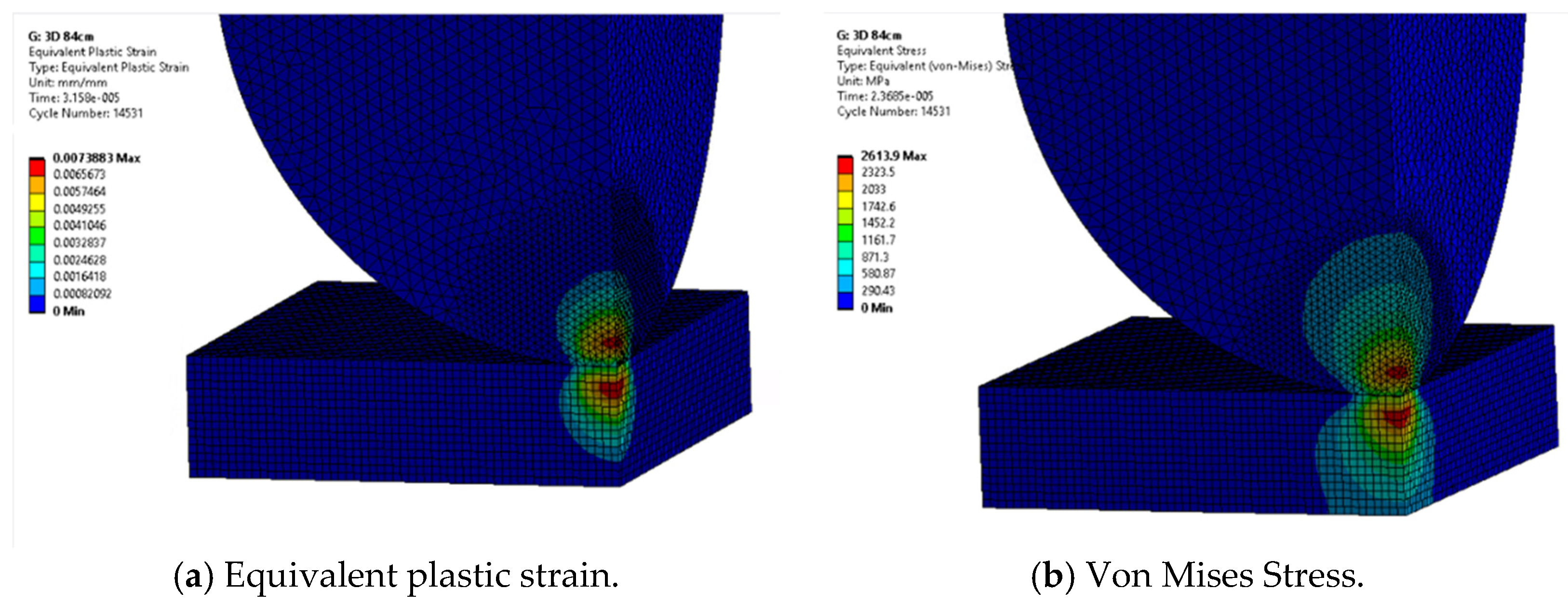
Based on the results derived from FEA, stresses and strains can be extracted, as shown on Figure 5. It was observed that the plastic strain values are similar in both contacting objects, but they are unnoticeable without the virtual analysis. Stress values are high due to the small contact point, which, due to deformation, transforms into a contact spot. Conclusions for the preparation for this type of FEA can also be drawn:.
Figure 5.
Results from the virtual simulation.
- Plasticity is mandatory for this type of analysis;
- 2D simplifications for this case study are not feasible;
- Micro plasticity and damping can be taken into consideration during testing but are challenging to model.
General conclusions can also be drawn from this study:
- The presented study compares analytical, virtual, and physical approaches for COR determination on the basis of a steel ball free-fall test object;
- Good correspondence between the three examined approaches was reached;
- Insights into optimal preparation and correction of virtual prototype construction were obtained;
- Validation of an FEM model for deformation and stress behavior observation was attained.
Author Contributions
Conceptualization, G.T. and K.K.; methodology, K.K.; software, K.D. validation, K.K. and K.D.; writing—original draft preparation, K.D.; writing—review and editing, K.K.; supervision, K.K.; project administration, G.T.; funding acquisition, G.T. All authors have read and agreed to the published version of the manuscript.
Funding
This study was financed by the European Union-NextGenerationEU through the National Recovery and Resilience Plan of the Republic of Bulgaria, project № BG-RRP-2.004-0005.
Institutional Review Board Statement
Not applicable.
Informed Consent Statement
Not applicable.
Data Availability Statement
The data supporting the findings of this study are available from the corresponding author upon reasonable request.
Conflicts of Interest
The authors declare no conflict of interest.
Abbreviations
The following abbreviations are used in this manuscript:
| FEA | Finite-Element Analysis |
| FEM | Finite-Element Method |
| COR | Coefficient of Restitution |
| HRC | Hardness Rockwell C |
References
- Bhattacharjee, A.; Loghmani, M.T.; Anwar, S. Finite Element Simulation and Analysis of Drop Tests to Improve the Mechanical Design of a Handheld QSTM Medical Device. In Proceedings of the ASME 2022 International Mechanical Engineering Congress and Exposition, Columbus, OH, USA, 30 October–3 November 2022. [Google Scholar]
- Tuncer, S.; Ozcelik, I.B.; Mersa, B.; Kabakas, F.; Ozkan, T. Evaluation of Patients Undergoing Removal of Glass Fragments. Hand Surg. Microsurg. 2011, 67, 114–118. [Google Scholar] [CrossRef] [Scilit] [PubMed]
- Todorov, G.; Kamberov, K.; Dimitrov, K. Approaches To Virtual Prototype Validation of Drop Tests. AIP Conf. Proc. 2025, 3274, 050009. [Google Scholar] [CrossRef] [Scilit]
- Todorov, G.; Kamberov, K. Virtual Prototyping Of Drop Test Using Explicit Analysis. AIP Conf. Proc. 2017, 1910, 020013. [Google Scholar] [CrossRef] [Scilit]
- Qiao, L.; Zencker, U.Z.; Völzke, H.; Wille, F.; Musolff, A. Validation of Numerical Simulation Models for Transport and Storage Casks using Drop Test Results. In Proceedings of the Eleventh International Conference on Computational Structures Technology, Dubrovnik, Croatia, 4–7 September 2012. [Google Scholar]
- Adli, H.; Ismail, K.A. Coefficient of restitution of sports balls. IOP Conf. Ser. Mater. Sci. Eng. 2012, 36, 012038. [Google Scholar] [CrossRef] [Scilit]
- Jackson, R.L.; Green, I.; Marghitu, D.B. Predicting the coefficient of restitution of impacing elastic-perfectly plastic spheres. Nonlinear Dyn. 2010, 60, 217–229. [Google Scholar] [CrossRef] [Scilit]
- Graham, W.; Tallon, S. The coefficient of restitution for normal incident, low velocity particle impacts. Chem. Eng. Sci. 2005, 60, 3637–3647. [Google Scholar] [CrossRef] [Scilit]
- Todorov, G.; Romanov, B.; Kamberov, K.; Stoev, S. Drop test of electronic device by virtual prototype simulation. Proc. Manuf. Syst. 2012, 7, 149–152. [Google Scholar]
- Zaal, J.; Driel, W.; Kessels, F.; Zhang, G. Correlating Drop Impact Simulations With Drop Impact Testing Using High-Speed Camera Measurements. In Proceedings of the EuroSimE 2008-International Conference on Thermal, Mechanical and Multi-Physics Simulation and Experiments in Microelectronics and Micro-Systems, Freiburg im Breisgau, Germany, 20–23 April 2008. [Google Scholar]
- Mulkoglu, O.; Guler, M.; Demirbag, H. Drop Test Simulation And Verification of a Dishwasher Mechanical Structure. In Proceedings of the 10th European LS-DYNA Conference, Würzburg, Germany, 15–17 June 2015. [Google Scholar]
- Lim, C.T.; Low, Y.J. Investigating the drop impact of portable electronic products. In Proceedings of the Electronic Components and Technology Conference, Proceedings. 52nd, San Diego, CA, USA, 28–31 May 2002. [Google Scholar]
- Balakrishan, K.; Sharma, A.; Rajib, A. Comparison of Explicit and Implicit Finite Element Methods and its Effectiveness for Drop Test of Electronic Control Unit. Procedia Eng. 2017, 173, 424–431. [Google Scholar] [CrossRef] [Scilit]
Disclaimer/Publisher’s Note: The statements, opinions and data contained in all publications are solely those of the individual author(s) and contributor(s) and not of MDPI and/or the editor(s). MDPI and/or the editor(s) disclaim responsibility for any injury to people or property resulting from any ideas, methods, instructions or products referred to in the content. |
© 2026 by the authors. Licensee MDPI, Basel, Switzerland. This article is an open access article distributed under the terms and conditions of the Creative Commons Attribution (CC BY) license.