


Abstract
This paper presents an eye-tracking cursor-control prototype for users with motor disabilities, built using a webcam and open-source software (MediaPipe, OpenCV, PyAutoGUI). The system integrates Face Mesh with iris refinement, proportional linear mapping, and dwell-click. Evaluation included functional verification and exploratory testing with four users with cerebral palsy and multiple disabilities at two Ecuadorian foundations, using an ad hoc Likert scale and structured qualitative observation. This work differs from the recent corpus by incorporating target users in real-world institutional settings in the Global South, a first step toward verification with populations that require accessibility.
1. Introduction
Motor disability in the upper limbs restricts access to standard computing interfaces—keyboard, mouse, and touchscreen—thereby limiting participation in educational, occupational, and social activities that rely on digital technologies. This disability results from conditions such as cerebral palsy, high-level spinal cord injury, and muscular dystrophy, among others, which affect manipulation and fine motor skills, thereby affecting digital autonomy [1]. The Convention on the Rights of Persons with Disabilities recognizes accessibility to information and communication technologies as a fundamental right [2]; consequently, assistive technologies for human–computer interaction (HCI) constitute a key component of digital inclusion, particularly in Global South countries where effective access to these resources remains limited [3].
Among the main alternative interaction modalities for users with motor disabilities are sip-and-puff control devices, adaptive switches, foot-operated mice [4], head-tracking systems for cursor control [5], brain–computer interfaces (BCI), and eye-tracking [6,7]. The latter offers suitable characteristics for users with upper-limb motor impairment: it requires no limb manipulation and enables continuous control of spatial coordinates, analogous to a conventional mouse. Its documented HCI applications include cursor control, assisted typing through virtual keyboards, graphical interface navigation, and immersive environments [8], among others.
Commercial eye-tracking systems offer robust accuracy and consolidated clinical support, but their cost—reported to range from USD 1000 to 70,000 depending on the segment, from consumer-grade gaming devices to stationary research systems—constitutes a significant barrier to adoption in resource-limited contexts [9,10]. In response, eye-tracking alternatives based on conventional webcams and open-source libraries have emerged, with hardware costs below USD 100 per unit, enabling their deployment in institutions with budgetary constraints. Two of these, WebGazer [11] and MediaPipe [12], are relevant for the development of cursor control systems. WebGazer, a pioneering JavaScript library in the field, operates in the browser via implicit calibration derived from user interaction, making it suitable for behavioral studies in web environments but not for controlling the operating system cursor outside the browser. MediaPipe includes models for real-time facial and ocular detection, such as Face Mesh for facial landmark identification and the Iris module for per-eye point detection; it is optimized for consumer hardware, cross-platform (Python, JavaScript, mobile), and actively developed with periodic updates. These characteristics position it as one of the most widely used options in low-cost systems [10], suitable for operating-system-level cursor control and for the development of assistive technologies.
Several studies have developed eye-tracking cursor control systems based on MediaPipe and other open-source libraries, such as OpenCV and PyAutoGUI, with an emphasis on accessibility [13,14,15]. However, limitations are observed across this corpus. Most studies report functional verification with the developers themselves or with volunteers without motor disabilities, rather than with target users in institutional settings [13,14]. Moreover, documented advances are predominantly concentrated in European and Asian countries [8]. At the same time, developments situated in Global South contexts remain scarce—contexts where the gap in access to assistive technologies is particularly pronounced [3] and where access to hardware and technological infrastructure differs from that of high-income countries.
This work does not propose an algorithmic advancement: it combines established libraries (MediaPipe, OpenCV, PyAutoGUI) using conventional proportional linear mapping, without novel calibration or machine learning. As summarized in Table 1, the distinction from the body of similar systems [13,14,15,16] is not technical but contextual: operational simplicity and low cost are prioritized, and the system is evaluated early on with real target users in an institutional setting in the Global South—a dimension absent from the body of work presented. The prototype documents this process from an applied, interdisciplinary perspective, is implemented in an Ecuadorian university setting, and aims to address the accessibility gap.
Table 1.
Comparison of low-cost eye-tracking cursor control systems: calibration, target users, and hardware cost.
Validation comprises two phases: functional verification and an exploratory evaluation with users with motor disabilities at two partner foundations, one working with children and the other with adults. Prototyping and early evaluation in real institutional settings allow the end user to be incorporated from the earliest stages of the project. Unlike approaches focused solely on algorithmic development, this methodological strategy prioritizes the design and evaluation of assistive technologies for vulnerable populations in resource-limited environments.
2. Materials and Methods
The study was conducted in two phases. The first phase consisted of developing and functionally verifying the prototype. The second phase involved an exploratory evaluation with four users with motor disabilities served by two Ecuadorian nongovernmental organizations with over two decades of experience specializing in disability: one focused on the educational, social, and occupational inclusion of youth and adults; and another focused on comprehensive care for children and adolescents with neurodevelopmental disorders and cerebral palsy. Interinstitutional collaboration agreements were established with the two organizations and formalized at different levels, in accordance with each entity’s regulatory frameworks. This model of coordination between the university and the collaborating organizations is consistent with established practices in assistive technology research, where partnerships between universities, service centers, and user communities contribute to a situated and ethically grounded evaluation [17].
2.1. System Components
The prototype is based on code developed by the research team to integrate open-source libraries (MediaPipe, OpenCV, and PyAutoGUI) and uses a desktop webcam (Table 2) or, when applicable, the built-in camera on a laptop as the data acquisition device.
Table 2.
Camera characteristics.
2.2. System Architecture
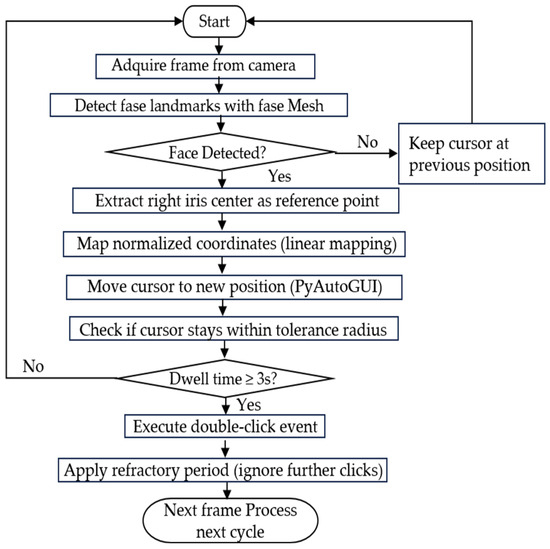
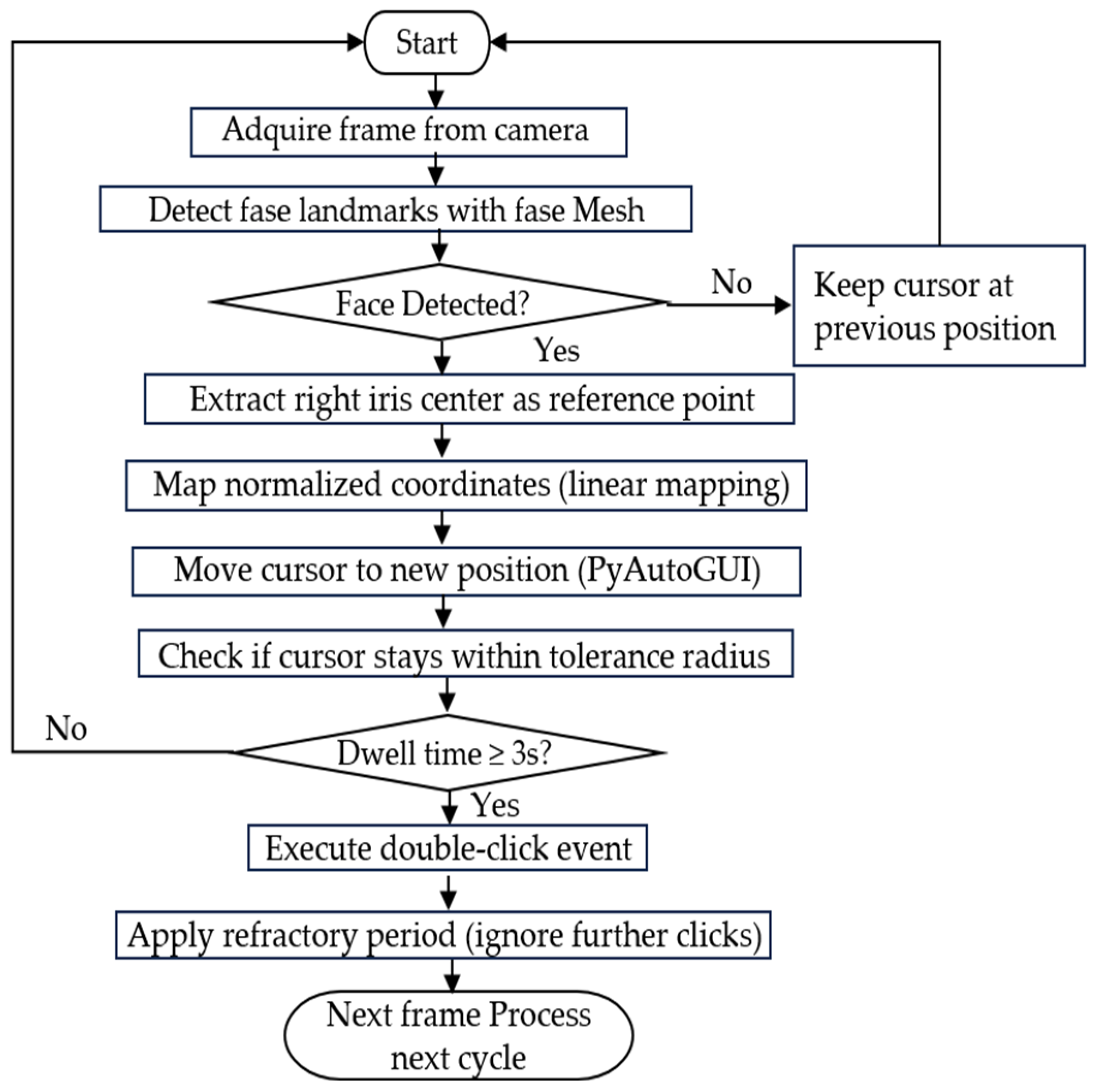
The system operates as a continuous processing pipeline applied to each camera-captured frame. In every iteration, it acquires a frame and uses MediaPipe’s Face Mesh model with iris refinement to obtain 478 landmarks; if face detection is lost, the cursor remains in its last position. From the detected landmarks, the system uses the center of the right iris as the control reference point, whose normalized coordinates are mapped to screen coordinates via a proportional linear transformation and used to position the cursor using PyAutoGUI. Finally, the system evaluates whether the cursor remains within a tolerance radius for three seconds to trigger a double-click event, followed by a refractory period, and returns to the beginning of the loop to process the next cycle, as shown in Figure 1.
Figure 1.
System flowchart of the eye and head-controlled cursor with dwell-click activation.
To avoid terminological ambiguity, it is specified that the cursor operates through a hybrid scheme of two decoupled axes: the horizontal axis is controlled by gaze, estimated from the relative position of the pupil iris within each eye, while the vertical axis is controlled by head pose, derived from the displacement of the nose tip. Consequently, cursor movement does not rely exclusively on eye motion: the horizontal component reflects gaze direction, and the vertical component reflects head movement, both of which also depend on camera positioning and facial alignment relative to it. The term eye-tracking is used throughout the manuscript as a general designation of the system, given its gaze component in the horizontal axis; however, the descriptions of each axis, the figures, and the conclusions explicitly distinguish between the gaze component (ocular) and the head component (cephalic).
The operating distance between the camera and the user’s face was set to approximately 50–70 cm, consistent with findings from studies of webcam-based eye tracking [18]. To reflect real-world deployment conditions in resource-limited settings, the computing equipment used consisted of the hardware available at each institution. In Phase 1 of the functional verification, an HP laptop with an Intel Core i5 processor, 8 GB of RAM, 1 TB of storage, and Microsoft Windows 10 was used. In Phase 2 of the evaluation with target users, the equipment available at each collaborating institution was used: a laptop at the institution serving youth and adults and a desktop computer at the institution serving children and adolescents, both with specifications equivalent to those used in Phase 1.
The software stack was implemented using Python 3.12.7 and integrated three open-source libraries: MediaPipe 0.10.18 [12]; OpenCV 4.10 [19]; and PyAutoGUI 0.9.54 [20]. The cost of the prototype’s specific hardware per installation unit is approximately USD 90, covering the webcam and acquisition costs. The software is open-source and license-free, and the computing equipment matches what is available at each institution, with no additional investment required. The local availability of equivalent models in the Ecuadorian domestic market and other regional markets may reduce this figure, expanding the possibilities for replicating the prototype in resource-constrained contexts.
2.3. Eye-Tracking and Cursor Control Pipeline
The webcam captures images at 1920 × 1080 pixels, while video stream processing runs at 600 × 600 pixels, a choice that reduces computational load without affecting facial landmark detection quality. This configuration provides a frame rate sufficient for continuous video stream processing without compromising facial landmark detection quality. Each frame is processed using MediaPipe Face Mesh, with the iris refinement module enabled (refine_landmarks = True), producing 478 landmarks per frame: 468 facial points and five points per iris [12]. From this set, the system uses a single landmark as the control reference: the center of the right iris (landmark 473 of the MediaPipe Face Mesh refined model). The normalized coordinates of this landmark are converted to pixel positions within the processed frame, and a 100 × 100-pixel active control region is defined, centered on the facial area. When the iris falls within this region, both horizontal and vertical displacements are mapped proportionally to the corresponding screen coordinates. The choice of a single control landmark prioritizes operational simplicity, reduces sensitivity to spurious oscillations in detection, and avoids the need for additional processing steps. Landmarks associated with other facial regions (eyebrows, mouth, eyelid contours, or general facial contour) are not processed.
The cursor position is computed from the right iris landmark within the 100 × 100 pixel active control region. The normalized coordinates of the iris are first converted to pixel positions in the processed frame; the position within the active region is then mapped proportionally to the screen dimensions through a linear transformation of the form x = (x_r/100) · W and y = (y_r/100) · H, where x_r and y_r denote the iris position within the active region, and W and H correspond to the screen width and height obtained via the pyautogui.size() function. The system did not incorporate a formal multipoint calibration procedure, prioritizing operational simplicity and immediate use without requiring prior user training.
The selection mechanism is implemented using a dwell-click, a technique established in eye-tracking interfaces for users with motor disabilities [21]. A double-click event is triggered when the cursor remains within a spatial tolerance of ±20 pixels around a fixed point for approximately 3 s; the choice of double-click threshold depends on the type of main task being evaluated, which requires opening a file at the operating system level. After each activation, a refractory period of approximately 1 s is established, preventing unwanted consecutive activations of the same interface element.
The proposed cursor mapping follows PyAutoGUI screen coordinates, with the origin at the top-left (0,0), ranges x ∈ [0, W−1], y ∈ [0, H−1], and resolution (W,H) obtained via pyautogui.size(). Each frame is horizontally flipped (mirror view) and processed in this coordinate space. A hybrid control scheme is used: horizontal movement is driven by gaze estimation from the relative iris position within each eye, averaged binocularly (h = (h_L + h_R)/2), while vertical movement is derived from head pose using nose tip displacement relative to an initial reference, v = clip(0.5 + 5(n_y − n_y^0), 0, 1). Screen coordinates are computed as x = h · W and y = v · H. Cursor jitter is reduced using exponential smoothing (α = 0.3). The system uses MediaPipe Face Mesh with a single-face constraint (max_num_faces = 1); additional faces are ignored. Eye validity is assessed via Eye Aspect Ratio (EAR), pausing horizontal updates during occlusion or eye closure. Tracking loss triggers automatic reinitialization, freezing the cursor until recovery. Glasses are supported, though reflective or tinted lenses may reduce iris-tracking accuracy.
The system processes data locally and in real time, with no internet connection or cloud services; no video or landmarks are stored, and data are discarded at the close of each task with no further retention. The reduction to a single control landmark also functions as a data-minimization measure. The informed consent obtained (see Informed Consent Statement) covered the biometric nature of these data. Access to the equipment was managed through institutional credentials administered by support staff, not individualized per participant—consistent with the mediation model described in Section 2.4—implying institutional rather than end-user access control, an aspect to strengthen in deployments oriented toward greater individual autonomy.
2.4. Participants and Evaluation Procedure
Phase 1 consisted of functional verification of the prototype by members of the research team without motor disabilities, to confirm the pipeline’s operation under controlled conditions. It was conducted in an enclosed space under constant artificial lighting. Phase 2 consisted of an exploratory evaluation involving four users with motor disabilities at the two collaborating institutions. These users were selected through purposive sampling, conducted by the directors and therapeutic staff of each institution in accordance with the criteria established for the study: motor disability affecting the upper limbs; sufficient ocular function to fix their gaze on the screen; cognitive ability to understand the procedure; and willingness to participate with informed consent. Age criteria varied according to the population served by each institution: ages 6 to 18 at the foundation serving children and adolescents, and ages 10 to 65 at the foundation serving youth and adults. This phase was conducted in the usual care settings of each collaborating institution, under the lighting conditions typical of each therapeutic space, a factor recognized as critical for webcam-based eye tracking [9,18].
The final sample consisted of four participants. Two were children—a 10-year-old girl and a 12-year-old boy—both diagnosed with cerebral palsy and receiving care at the foundation’s pediatric and adolescent unit. Two were adults—a 35-year-old woman and a 42-year-old man—both diagnosed with multiple disabilities and receiving care at the foundation’s youth and adult unit. In all four cases, the participants had difficulty moving their upper limbs.
The sessions were conducted individually by the primary tutors and caregivers at each institution, with the research team serving as observers and recorders. This methodological decision was based on ethical considerations and the need to protect participants, as well as to reduce any mistrust that might arise from direct interaction with external figures; the model of institutional mediation with trusted staff, rather than direct facilitation by the research team, is a documented practice in inclusive research involving people with disabilities [22]. The tutors explained the procedure, assisted in approaching the equipment, pointed out the relevant positions on the screen, and addressed any signs of discomfort.
To more accurately characterize participants’ interaction with the prototype when supported by tutors, the level of assistance required during task execution was recorded. The observed levels of tutor assistance and participants’ autonomy are summarized in Table 3.
Table 3.
Level of Tutor Assistance Provided to Users.
The main task involved using the system to select and open a file on the desktop, in an environment with approximately 8 visible files; each participant performed 3 repetitions of this task. As a supplement, the “Shape Hunt” module from the Ludominga platform [23] was used, a playful tool for visual and cognitive stimulation in which stimuli appear on the screen following the visual sequence of reading and are selected by the user shifting their gaze.
The evaluation combined structured qualitative observations by the tutors and the research team with a five-point ad hoc Likert scale, developed specifically for this study, to assess three dimensions of the user experience. Usability assesses the system’s operability and the user’s ability to perform the required tasks; comfort reflects the absence of physical or cognitive discomfort during the session, a relevant factor in assistive technologies where fatigue can limit adoption; and satisfaction approximates the user’s subjective attitude toward the device, associated with acceptance and sustained use of the resource. The combination of ad hoc questionnaires with qualitative methods is a practice documented as predominant in usability and acceptance studies of assistive technology for motor disabilities, particularly in pilot studies with small samples [7].
3. Results
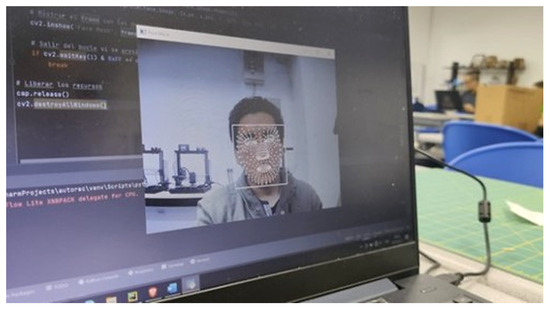
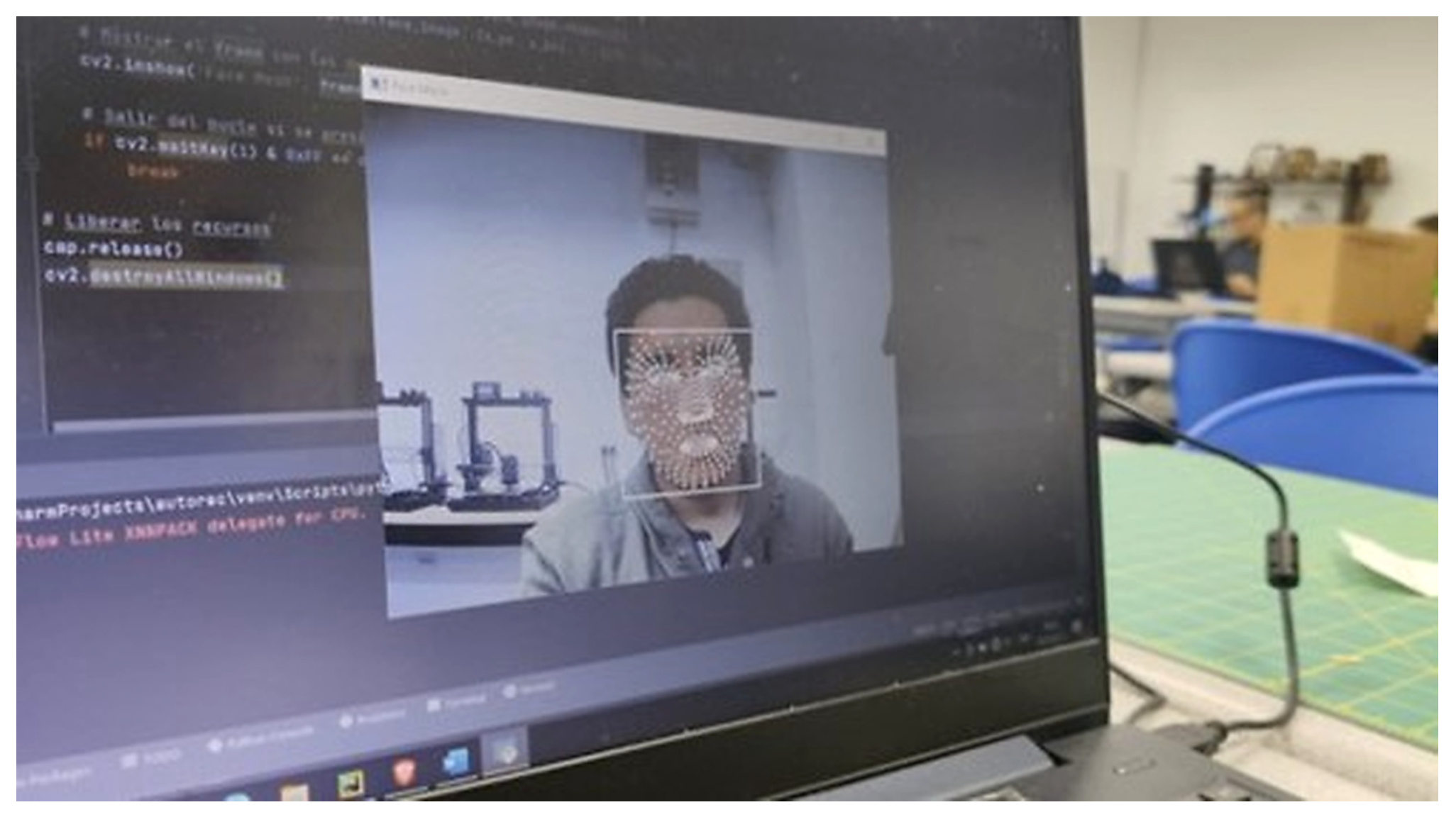
During the functional verification phase, as shown in Figure 2, the system executed the pipeline functions without any observed errors. Facial and ocular landmark detection using MediaPipe Face Mesh operated continuously on the video stream, coordinate mapping was applied according to the linear proportional transformation described in Section 2.3, and the dwell-click mechanism triggered double-click events within the three-second time threshold and the defined spatial radius. In this phase, no quantitative metrics for frame rate, latency, or absolute spatial accuracy were recorded; observations were limited to the system’s functional operation as a preliminary step for Phase 2.
Figure 2.
Eye-tracking prototype during functional verification showing MediaPipe Face Mesh landmarks and the active control region.
In the second phase of the exploratory evaluation, participants performed three repetitions of the main task—selecting and opening a file from the desktop using the system in an environment with approximately 8 visible files—with assistance from the tutor or caregiver. The supplementary task using the “Cazando Figuras” module of the Ludominga platform [23] was performed without any observed technical issues. No interruptions due to physical discomfort or fatigue were reported during the sessions.
Table 4 presents the results of the ad hoc five-point Likert scale (1 = lowest rating; 5 = highest rating), administered to the four participants (U1–U4). Individual scores ranged from 3 to 5 for ease of use (median 4.5), from 4 to 5 for comfort level (median 4.5), and from 3 to 5 for satisfaction (median 4.5). The qualitative observations recorded in each case included expressions of motivation and rapid adaptation in two participants (U1 and U3) and reports of initial difficulty in the other two (U2 and U4).
Table 4.
Results of the ad hoc Likert scale administered to the four participants during Phase 2.
4. Discussion, Limitations and Future Work
The results of the two phases show that the prototype functions effectively on consumer-grade hardware and enables four users with motor disabilities to perform basic computer interaction tasks. Median scores of 4.5 out of 5 across the three dimensions of the ad hoc Likert scale suggest a positive preliminary assessment, consistent with findings from pilot studies on the acceptance of assistive technology for motor disabilities [7]. This assessment should be interpreted with caution: the small sample size (n = 4) and the ad hoc nature of the instrumentation preclude statistical inference or generalization; the data provide only an initial characterization of the prototype’s interaction with diverse user profiles in real institutional settings. The observation regarding User 4—initial difficulty associated with a lack of head control—highlights a specific design limitation. The system requires the user’s iris to remain within the active control region, which in practice presupposes a degree of voluntary head stability for the face to stay within the camera’s working frame; this capability is not present in all forms of motor disability. The case illustrates that the diversity of motor disability profiles requires tailored configurations rather than one-size-fits-all solutions. Early identification of this limitation guides future work toward alternative configurations that compensate for involuntary head movement and toward control mechanisms that do not require sustained head stability.
This work differs from the recent body of work on accessibility-oriented systems based on MediaPipe, OpenCV, and PyAutoGUI [13,14,15,16] in two respects. First, the evaluation includes users with motor disabilities in real institutional settings, rather than solely developers. Second, the development is explicitly situated in a Global South context—where the access gap to assistive technologies is pronounced [3]—and was deployed on pre-existing institutional equipment at the collaborating foundations, not on controlled laboratory hardware. This combination, although limited by the sample size, establishes a methodological model of functional prototyping with early evaluation in real-world contexts, which may be valid for assistive technologies intended for vulnerable populations in resource-limited settings, where development, isolated from the end user, can produce systems that are technically correct but contextually unfeasible [24]. The contribution, therefore, is not restricted to the prototype itself, but extends to the documentation of a replicable process that brings together the university, collaborating organizations, and target users [17].
The study’s limitations are consistent with its exploratory nature. The sample exhibits a bias inherent to the purposive sampling conducted by administrators and therapeutic staff. During the evaluation sessions, user task completion was observed, along with occasional unintended activations and the need for tutor support in some cases. However, objective metrics such as task success rate, task completion time, number of unintended clicks, cursor corrections, and detection interruptions were not systematically recorded. For this reason, the obtained results should be interpreted as preliminary evidence of the prototype’s feasibility and usability, rather than as a quantitative evaluation of its performance.
The methodology combined qualitative observation with an ad hoc Likert scale, without using standardized psychometric instruments such as the System Usability Scale (SUS) or the NASA Task Load Index (NASA-TLX), widely used in usability and workload assessment of eye-tracking interfaces for assistive control [25]—a decision consistent with the exploratory phase of the study but one that limits the comparability of the results with other validated systems. Task completion was achieved with the support of tutors and caregivers: an aspect that can be interpreted in two ways. On the one hand, the records do not constitute an assessment of fully autonomous use, and the results correspond to assisted performance; on the other hand, institutional mediation with trusted staff, far from being an experimental artifact, constitutes a robust ethical practice for research with vulnerable populations that protects participants and respects their pace of adaptation.
The system performed as expected under controlled lighting conditions (Phase 1) and operated under the typical conditions of each institution (Phase 2); its sensitivity to lighting is a well-documented factor in the literature on webcam-based eye tracking [9,18] and should be taken into account in future developments. Finally, the system did not implement formal multipoint calibration and instead operates using a direct proportional linear mapping, a decision that prioritizes deployment simplicity at the expense of absolute spatial accuracy—in resource-limited contexts, this may be preferable to a level of accuracy that requires training before use.
Future lines of work include the development of alternative vertical control mechanisms independent of head movement, the integration of additional gestures such as intentional blinking, the incorporation of voice commands, an optional multi-point calibration procedure, and the inclusion of standardized psychometric instruments in evaluations involving larger and more diverse samples in terms of age, diagnosis, and institutional context. Expanding collaborations with organizations in the Global South and documenting the adaptation process across diverse user profiles constitute relevant future directions toward assistive technologies that are more representative of the populations they serve.
5. Conclusions
This work presents the design, implementation, and exploratory evaluation of an eye-tracking cursor control prototype based on a standard webcam and open-source software, oriented toward users with upper-limb motor disabilities. The contribution focuses on four complementary dimensions: (i) the integration of existing open-source libraries (MediaPipe, OpenCV, and PyAutoGUI) through code developed by the research team, in a functional system verified across two phases; (ii) the incorporation of actual target users in the exploratory evaluation, with four participants with cerebral palsy and multiple disabilities supported at two partner foundations; (iii) the documentation of the process developed from an applied, interdisciplinary research perspective, realized in an Ecuadorian university setting; and (iv) the open publication of the prototype code through a public GitHub repository (release v1.0.1) and its archived version in Zenodo (version v1.0.1), enabling replication of the system and its adaptation to other institutional contexts in the Global South.
Conducting this study within a Global South context, where the gap in access to assistive technologies is particularly pronounced [3], has implications that exceed the technical dimension. Working with vulnerable populations—children and adults with disabilities—requires formalized ethical frameworks, institutional mediation with therapeutic personnel, and respect for the pace and needs of the participants; conditions that this study incorporated as a structural component of its methodological design. The recognized limitations—small sample size, absence of standardized psychometric instruments, task completion with mediated support—do not weaken the contribution but rather guide future directions for the work: larger and more diversified samples, incorporation of validated instruments, evaluation of autonomous use, and alternative control mechanisms for users with limited head control. Future work will extend this project, in continued dialog with a field that requires the sustained and effective incorporation of the populations that assistive technologies seek to benefit.
Author Contributions
Conceptualization, C.G.-M., V.M.-G. and E.A.; methodology, C.G.-M., V.M.-G. and J.G.A.A.; software, J.G.A.A.; verification, C.G.-M., V.M.-G. and J.G.A.A.; formal analysis, C.G.-M. and V.M.-G.; investigation, C.G.-M., V.M.-G. and J.G.A.A.; resources, C.G.-M.; data curation, C.G.-M. and J.G.A.A.; writing—original draft preparation, C.G.-M.; writing—review and editing, C.G.-M., V.M.-G., J.G.A.A. and E.A.; visualization, J.G.A.A.; supervision, C.G.-M.; project administration, V.M.-G.; funding acquisition, C.G.-M., V.M.-G. All authors have read and agreed to the published version of the manuscript.
Funding
This study was funded by the Pontifical Catholic University of Ecuador through the project “Adapted Mouse for People with Reduced Mobility” (Project Code: 137-UIO). The Article Processing Charges (APCs) were covered by the authors.
Institutional Review Board Statement
The study was conducted in accordance with the Declaration of Helsinki and approved by the Ethics Committee of the Pontifical Catholic University of Ecuador (approval code EO-083-2025 V2).
Informed Consent Statement
Informed consent was obtained from all participants or their legal guardians.
Data Availability Statement
The source code is publicly available on GitHub and archived in Zenodo, https://doi.org/10.5281/zenodo.20467239.
Acknowledgments
The authors thank the collaborating foundations, participants, families, and professional staff for their support during the evaluation sessions. In preparing this manuscript, Claude Sonnet 5 (Anthropic) was used for editorial assistance and language refinement. The authors reviewed all outputs and take full responsibility for the content of this publication.
Conflicts of Interest
The authors declare no conflicts of interest.
References
- World Health Organization. Global Report on Health Equity for Persons with Disabilities; WHO: Geneva, Switzerland, 2022; Available online: https://www.who.int/publications/i/item/9789240063600 (accessed on 1 March 2026).
- United Nations. Convention on the Rights of Persons with Disabilities; UN General Assembly Resolution A/RES/61/106; UN: New York, NY, USA, 2006; Available online: https://www.un.org/development/desa/disabilities/convention-on-the-rights-of-persons-with-disabilities.html (accessed on 1 March 2026).
- World Health Organization; United Nations Children’s Fund. Global Report on Assistive Technology; WHO: Geneva, Switzerland, 2022; Available online: https://www.who.int/publications/i/item/9789240049451 (accessed on 10 April 2026).
- Gonzalez-Maldonado, C.; Maldonado-Garcés, V.; Orozco, E. Peripheral Device for Marginalized Bodies: Assistive Technology from Academic Innovation. In Emerging Research in Intelligent Systems (CIT 2025); Olmedo Cifuentes, G.F., Arcos Avilés, D.G., Lara Padilla, H.V., Eds.; Lecture Notes in Networks and Systems; Springer: Cham, Switzerland, 2026; Volume 1881. [Google Scholar] [CrossRef] [Scilit]
- Gonzalez-Maldonado, C.; Maldonado-Garcés, V.; Arias, J.G.A.; Araujo, E. Engineering Inclusive: Head-Controlled Electronic Device for Human-Computer Interaction. In Proceedings of the 9th Ecuador Technical Chapters Meeting (ETCM), Quito, Ecuador, 21–24 October 2025. [Google Scholar] [CrossRef] [Scilit]
- Enríquez, J.G.; Soria Morillo, L.M.; García-García, J.A.; Álvarez-García, J.A. Two decades of assistive technologies to empower people with disability: A systematic mapping study. Disabil. Rehabil. Assist. Technol. 2024, 19, 2095–2112. [Google Scholar] [CrossRef] [Scilit] [PubMed]
- Ventura, S.; Ottoboni, G.; Pappadà, A.; Tessari, A. Acceptance of Assistive Technology by Users with Motor Disabilities Due to Spinal Cord or Acquired Brain Injuries: A Systematic Review. J. Clin. Med. 2023, 12, 2962. [Google Scholar] [CrossRef] [Scilit] [PubMed]
- Korkmaz, A. Mapping Eye-Tracking Research in Human–Computer Interaction: A Science-Mapping and Content-Analysis Study. J. Eye Mov. Res. 2026, 19, 23. [Google Scholar] [CrossRef] [Scilit] [PubMed]
- Brandstetter, J.; Knoch, E.-M.; Gauterin, F. Low-Cost Eye-Tracking Fixation Analysis for Driver Monitoring Systems Using Kalman Filtering and OPTICS Clustering. Sensors 2025, 25, 7028. [Google Scholar] [CrossRef] [Scilit] [PubMed]
- Khaleel, A.H.; Abbas, T.H.; Ibrahim, A.-W.S. Best low-cost methods for real-time detection of the eye and gaze tracking. i-com 2024, 23, 79–94. [Google Scholar] [CrossRef] [Scilit]
- Papoutsaki, A.; Sangkloy, P.; Laskey, J.; Daskalova, N.; Huang, J.; Hays, J. WebGazer: Scalable Webcam Eye Tracking Using User Interactions. In Proceedings of the 25th International Joint Conference on Artificial Intelligence (IJCAI 2016), New York, NY, USA, 9–15 July 2016; pp. 3839–3845. Available online: https://www.ijcai.org/proceedings/2016/ (accessed on 1 March 2026).
- Lugaresi, C.; Tang, J.; Nash, H.; McClanahan, C.; Uboweja, E.; Hays, M.; Zhang, F.; Chang, C.-L.; Yong, M.G.; Lee, J.; et al. MediaPipe: A Framework for Building Perception Pipelines. arXiv 2019. [Google Scholar] [CrossRef] [Scilit]
- Mari Shankar, C.; Indra, P.; Shriharipriya, K.C.; Mary, G.I.; Perumal, S. Real-Time Eye-Tracking-Based Cursor Control for Intelligent Human-Computer Interaction. In Proceedings of the 2025 International Conference on Sensors and Related Networks (SENNET) Special Focus on Digital Healthcare (64220), Vellore, India, 24–27 July 2025; pp. 1–5. Available online: https://ieeexplore.ieee.org/document/11136013 (accessed on 10 May 2026).
- Mohamed, N. Eye-gesture control of computer systems via artificial intelligence. F1000Research 2025, 13, 109. [Google Scholar] [CrossRef] [Scilit] [PubMed]
- Chhimpa, G.R.; Kumar, A.; Garhwal, S.; Dhiraj. Empowering individuals with disabilities: A real-time, cost-effective, calibration-free assistive system utilizing eye tracking. J. Real-Time Image Proc. 2024, 21, 97. [Google Scholar] [CrossRef] [Scilit]
- Sunil, A.; Sabu, G.; Parvin, M.N.; Abraham, J.P.; Shibu, R. Webcam-Based Eye Tracking for Hands-Free Navigation. Int. J. Res. Appl. Sci. Eng. Technol. 2025, 13, 445–450. [Google Scholar] [CrossRef] [Scilit]
- Jeyakumaran, T.; Eggiman-Ketter, J.; Spadzinski, A.; Wolfe, D.L. Identifying strategies and related principles supporting a co-design approach in an assistive device service delivery and research platform. Front. Rehabil. Sci. 2024, 5, 1364016. [Google Scholar] [CrossRef] [Scilit] [PubMed]
- Kaduk, T.; Goeke, C.; Finger, H.; König, P. Webcam eye tracking close to laboratory standards: Comparing a new webcam-based system and the EyeLink 1000. Behav. Res. 2024, 56, 5002–5022. [Google Scholar] [CrossRef] [Scilit] [PubMed]
- Bradski, G. The OpenCV Library. Dr. Dobb’s J. Softw. Tools 2000, 120, 122–125. [Google Scholar]
- Sweigart, A. PyAutoGUI: Cross-Platform GUI Automation Python Module. Documentation. Available online: https://pyautogui.readthedocs.io (accessed on 11 February 2026).
- Burnham, S.P.L.; Bonar, S.; Collins, M.L.; Davies, T.C. The effects of dynamic dwell time systems on the usability of eye-tracking technology: A systematic review and meta-analyses. Hum.-Comput. Interact. 2025, 41, 320–344. [Google Scholar] [CrossRef] [Scilit]
- Layton, N.; Bould, E.; Buchanan, R.; Bredin, J.; Callaway, L. Inclusive research in health, rehabilitation and assistive technology: Beyond the binary of the ‘Researcher’ and the ‘researched’. Soc. Sci. 2022, 11, 233. [Google Scholar] [CrossRef] [Scilit]
- Ludominga: Plataforma de Estimulación Visual y Cognitiva. Disponible en. Available online: https://ludominga-aff09.firebaseapp.com/ (accessed on 5 April 2026).
- Joskow, R.; Patel, D.; Landre, A.; Mattick, K.; Holloway, C.; Danemayer, J.; Austin, V. Understanding the Impact of Assistive Technology on Users’ Lives in England: A Capability Approach. Bioengineering 2025, 12, 750. [Google Scholar] [CrossRef] [Scilit] [PubMed]
- Loke, L.Y.C.; Barsoum, D.R.; Murphey, T.D.; Argall, B.D. Characterizing eye gaze and mental workload for assistive device control. Wearable Technol. 2025, 6, e13. [Google Scholar] [CrossRef] [Scilit] [PubMed]

Disclaimer/Publisher’s Note: The statements, opinions and data contained in all publications are solely those of the individual author(s) and contributor(s) and not of MDPI and/or the editor(s). MDPI and/or the editor(s) disclaim responsibility for any injury to people or property resulting from any ideas, methods, instructions or products referred to in the content. |
© 2026 by the authors. Licensee MDPI, Basel, Switzerland. This article is an open access article distributed under the terms and conditions of the Creative Commons Attribution (CC BY) license.