


Abstract
Decarbonizing shipping requires reducing emissions without compromising the performance of large commercial vessels. Nuclear propulsion using small modular reactors (SMRs) has recently attracted renewed interest as a long-term alternative to fossil-fuel engines for large container ships. This study provides a technical, environmental, and economic assessment of SMR propulsion for a typical 15,000-TEU container ship, compared to conventional heavy fuel oil (HFO) propulsion. The analysis covers propulsion power requirements, energy conversion efficiency, additional electrical power needs, operational emissions, and total costs over 25 years. Under the study’s assumptions, the conventional system consumes about 50,400 tonnes of HFO annually, resulting in approximately 156,940 tonnes of CO2 emissions per year, along with significant NOx, SOx, particulate, and CO emissions. A 70 MWe SMR-based propulsion design is then evaluated, considering energy conversion losses and the ship’s auxiliary power needs. The power balance indicates that the proposed SMR system can meet propulsion demands and provide surplus electrical capacity. Economically, the estimated 25-year total cost for the SMR option is about USD 376.7 million, compared to USD 452.0 million for the HFO case. Sensitivity analysis shows that this economic advantage depends on HFO prices, SMR capital costs, the discount rate, and operating life. Overall, SMR propulsion appears to be a technically and economically viable option for large container ships, though its adoption will depend on regulatory requirements, safety standards, infrastructure, and further advancements in marine nuclear technology.
1. Introduction
Maritime transport represents one of the paramount components of international trade, with more than 80% of global goods conveyed by sea. The sector is now undergoing an accelerated energy transition fueled by the need to reduce harmful greenhouse gas (GHG) emissions and international aims of decarbonization. Fossil fuel dependence, especially residual fuels used in commercial ship propulsion, makes emissions reduction not only a regulatory issue but also a technological and economic challenge. In this regard, a plethora of alternative solutions are assessed, like low-emission fuels, hydrogen, ammonia, biofuels, electric propulsion, and propulsion systems assisted by renewable sources—wind-assisted propulsion systems [1,2,3,4,5,6].
Among these alternatives, nuclear energy stands out for its very high energy density and long-term operation without frequent refueling. Compared with conventional propulsion systems, where the ship’s range of operation (autonomy) is related to the amount of fuel carried onboard and the bunkering infrastructure, nuclear propulsion can provide greater operational range and reduce the ship’s dependence on conventional bunker infrastructure. These features have renewed interest in energy in maritime commercial transport, especially for large ships with high energy consumption and long periods of operation [7,8].
The use of nuclear energy in the maritime domain is not a new experimental concept; nuclear maritime reactors were used for decades in submarines, warships, icebreakers, and some demonstrator civilian applications. The accrued experience proved the technical feasibility of using nuclear reactors for naval propulsion but also highlighted that the technical success of a nuclear ship does not automatically guarantee its commercial viability. Past experiences with nuclear commercial ships and icebreakers are an important base for assessing the opportunity and possibility of developing a new generation of nuclear ships [9].
The reevaluation of nuclear propulsion in commercial maritime transport is currently favored due to the development of advanced reactors, especially small modular reactors (SMRs). Unlike past nuclear maritime projects for military purposes or demonstration, the new technologies aim to reduce dimensions, increase passive safety, improve modular construction, and better adapt to commercial applications.
Recent studies analyze the possibility of utilizing small modular reactors, high-temperature reactors, and molten salt reactors for commercial vessel propulsion, highlighting energetic density, operational autonomy, energetic efficiency, and close-to-zero emissions [10].
Despite accumulated experience in military nuclear propulsion, it cannot simply be devoted to commercial shipping. Military nuclear reactors were developed for specific operational requirements, prioritizing energy density, autonomy, system availability, and security features over economic and commercial criteria. For a merchant ship, the nuclear system should also be estimated from the perspective of installation mass and volume, capital expenditure (CAPEX), operating cost (operational expenditure—OPEX), maintenance, licensing, insurance, port access, and public acceptance. Thus, the transfer of naval nuclear experience to the merchant shipping sector requires a substantial technological, economic and institutional adaptation [11].
The recent literature has shown that nuclear maritime propulsion is debated from multiple approaches, including reactor technology, safety, regulations, economy, and environmental impact. Although these dimensions are scrutinized separately, an integrated evaluation of a large ship compared with a conventional ship based on fossil HFO remains a complex challenge. Particularly, the advantages linked to energetic density and nuclear autonomy should be analyzed along with initial investment, lifecycle expenditure, operational performance, air emissions, port access, safety, and regulatory framework requirements [12].
In this regard, the paper explores the potential of nuclear propulsion for an oceangoing container ship of the 15,000 TEU class as a reference ship for a comparative analysis between fossil HFO propulsion and a nuclear propulsion solution based on a small modular reactor (SMR). Choosing this ship category is supported by previous research on integrating SMR technology into container ships of 15,000 TEUs, which highlighted both the technical strengths and the economic intricacies of such a solution [13].
Further, the study, through the proposed methods, comparatively assesses the energy requirements and propulsion performance, the capital and operational expenditure (CAPEX and OPEX), fuel consumption, lifecycle costs, and harmful atmospheric emissions, along with the impact on the environment, nuclear safety, and the consequences of potential maritime accidents. The analysis also includes technical and operational constraints on SMR onboard integration, port infrastructure, ship preparation and operation, nuclear fuel and radioactive waste management, and regulations and responsibilities related to the operation of a nuclear-propelled maritime merchant vessel.
With this approach, the study aims to determine the conditions in which nuclear propulsion using a single SMR represents a technically viable, economically justified solution with a low impact on the marine and atmospheric environment. The analysis is not an a priori pro-nuclear solution and aims to identify advantages, limitations, and necessary conditions related to its implementation in comparison with a conventional propulsion solution.
What makes the current study novel is that it carries out an integrated technical, environmental, and lifecycle-economic assessment of small modular reactor (SMR) propulsion for a 15,000-TEU containership, incorporating an explicit balance of reactor power to propulsion power, a quantitative comparison of the atmospheric emissions associated with HFO, a consistent 25-year lifecycle cost framework, some of the marine environmental-risk aspects that have been selected, and a sensitivity analysis of the main economic parameters.
2. Method
For the comparative analysis, we consider the reference ship to be a class of container ship of 15,000 TEUs built by Hyundai Heavy Industries, represented by the ship M/V Al Jasrah; this ship is used as a base for defining the parameters used within the current study. The features of the reference ship are depicted in Table 1.
Table 1.
Reference ship features [13,14].
The reference ship is assumed to operate 300 days per year, with 65 days for maintenance, repairs, inspections, and periods when the ship is not operating. We adopt the average speed of 21 knots with a load factor of ME of 75% against a nominal power of ME 54,900 kW. For conventional propulsion, a 2-stroke ME is used, fueled with HFO. The annual consumption is assessed based on specific ME fuel consumption with the considered load factor, expressed in g/kWh, as in relation (1):
To estimate SFOC as in reference [14], corresponding to a load factor of 75% for an engine MAN B&W S90ME-C used in a containership, we used 170 g/kWh.
The authors estimated air emissions for conventional propulsion based on HFO consumption and emission factors used in previous studies [2,3]. For each pollutant i, the emitted quantity was determined using the general Equation (2), and the factors for all pollutants considered are shown in Table 2. At the same time, the resulting values are presented in Section 3.
Table 2.
HFO emission factors [2,3].
The economic analysis spans 25 years of exploitation for both nuclear and HFO configurations to allow a direct comparison of lifecycle cost. We evaluated CAPEX and OPEX, including costs related to the propulsion system, fuel, maintenance, crew, and other ship operation costs for the HFO configuration; for the nuclear configuration, we additionally assessed nuclear system and nuclear fuel management. The lifecycle cost of the HFO propulsion system is evaluated based on capital expenditure (CAPEX) and annual operating expenditure (OPEX), updated during the economic lifetime of the equipment, as in Equation (3). The total cost is determined through (3), while the annual OPEX is depicted by (4). The values corresponding to the two configurations are discussed in Section 3.
In Equations (3) and (4), the meaning of the terms is as follows: CLC is lifecycle cost; CCAPEX is the initial investment; COPEX,annual, stands for the annual operating expenditure; and r is the discount rate assumed to be 8% [15], while N is the economic lifetime, set to 25 years. Other operating expenditure includes maintenance and repairs, dry docking/inspections, lubricants, manning, and insurance costs.
The nuclear propulsion mathematical model becomes
In Equations (5)–(7), the meaning of the terms is similar to the HFO concept and is presented in the abbreviations para.
In Table 3, we present the main assumptions used to assess, from economical point of view, the feasibility of nuclear propulsion.
Table 3.
Main assumptions used in the economic assessment [2,3].
In the nuclear setup, we use a single 70 MWe SMR as described in [13]. This reactor is expected to provide most of the energy for both propulsion and auxiliary systems, including life support on the ship. To check if this approach works, we compare the reactor’s available power with the ship’s total energy needs.
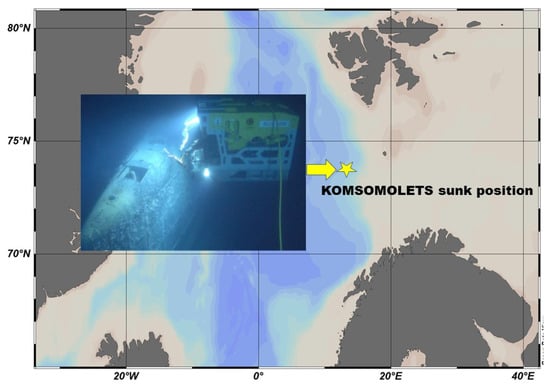
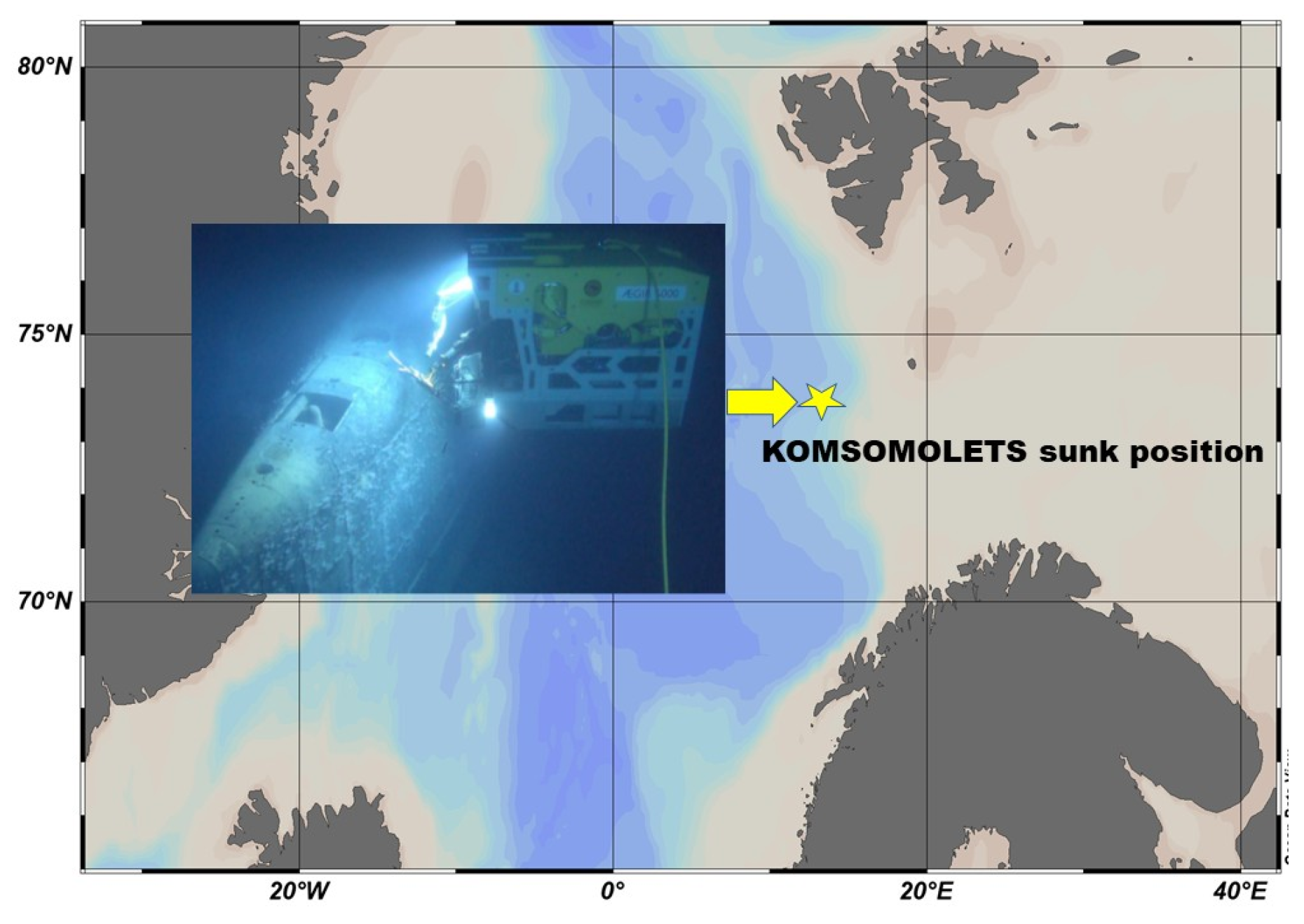
The evaluation of nuclear solutions also includes the analysis of potential consequences on the environment in case of an accident. In this regard, the case of the K-278 nuclear submarine Komsomolets, sunk in the Norwegian Sea in 1989, the sunk position displayed in Figure 1, is used as a historical reference and not a full technological equivalent of a 70 MWe SMR when discussing the long-term behavior of radioactive materials in the marine environment [16]. Differences in power level, reactor technology, propulsion system configuration, safety requirements, and the ship’s destination are taken into account when interpreting the comparison.
Figure 1.
Komsomolets submarine sunk position [17,18].
In Section 3, the study analyzes the environmental intricacies in this case and their relevance for risks associated with a nuclear-propelled ship.
3. Results and Discussion
Based on the assumptions adopted, the ME of 54,900 kW runs at an average load factor of 75% for an annual effective period of 7200 h. With an SFOC of 170 g/kWh, this results in an annual consumption of 50,398 t HFO. This value is the basis for estimating the air emissions for a conventional HFO propulsion array.
The results, presented in Table 4, underline the very high energetic needs of a container ship of 15,000 TEUs propelled with fossil fuel. The annual consumption of about 50,400 t HFO leads to air emissions of CO2 of about 157,000 t/year as direct operational emissions; this is the benchmark for the comparison with the nuclear configuration. In the nuclear configuration, HFO consumption is eliminated, leading to the elimination of emissions associated with the ship’s propulsion. However, this comparison cannot be interpreted as a total elimination of harmful impact on the environment because of the nuclear fuel cycle, manufacturing and installation, management of used nuclear fuel, and risks associated with nuclear installation, which have to be analyzed separately.
Table 4.
HFO emissions.
For the nuclear configuration, we consider a single SMR with an active power of 70 MWe, in accordance with the analyzed configuration for container ships of 15,000 TEUs. The mean power required for propulsion, for the adopted conventional regime, is 41,175 MW—mechanical power without conversion. We note that 70 MW ofMW of electrical power must be converted into mechanical rotation to actuate the screw propeller, with a conversion factor η = 0.9. Thus, the power requirements are 45.75 MWe, 5 MWe auxiliary power requirement for such a container ship, and the remaining available electrical power is 19.25 MWe.
With the assumptions set, the results show that a configuration with a single SMR of 70 MWe is technically compatible with the estimated energy needs for this type of ship.
The outcome is relevant because it proves that choosing a single 70 MWe reactor does not lead to overloading the reactor. However, the available 19.25 MWe cannot be considered as “free” power; they have to cover the auxiliary consumption, board consumption, and power reserve, so the final feasibility of this array depends on maintaining these consumptions below the available power limit.
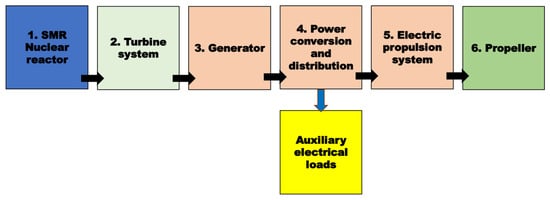
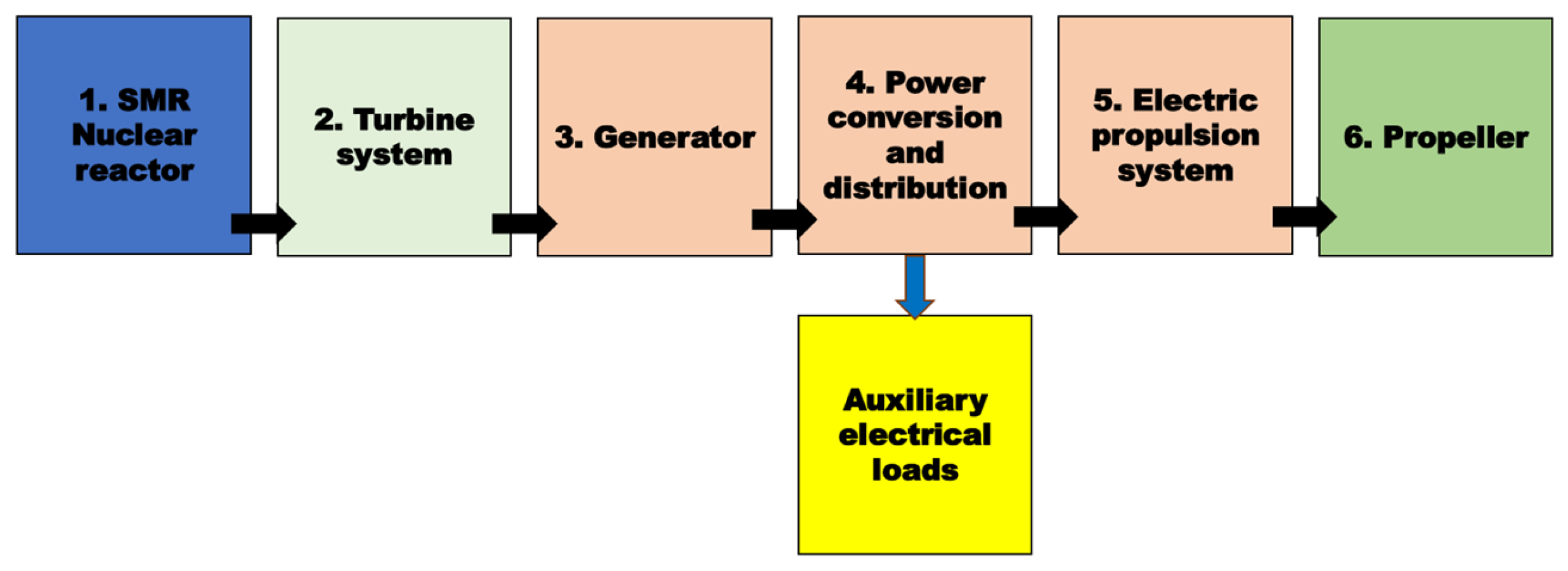
Figure 2 shows the proposed energy-conversion chain from the SMR to the propeller. This includes the secondary steam system, electrical generation, power conversion and distribution, electric propulsion motor, and propulsion system. The design also considers auxiliary electrical loads, so the full 70 MWe reactor output is not used only for propulsion. Based on the current assumptions, the power balance shows that the reactor can supply the needed propulsion power and still have extra electrical capacity for other operational and reserve needs.
Figure 2.
SMR energy conversion chain.
Using the methodology previously presented, with an annual consumption of 50,400 t HFO at 528 USD/t, in accordance with IFO 380 in Rotterdam harbor [19], the annual cost is 26.6 million USD. During the 25-year exploitation period, cumulative HFO costs alone reach 665 million USD, excluding capital expenditure, maintenance, crew, and other operational costs.
Table 5.
Lifecycle cost comparison HFO vs. SMR.
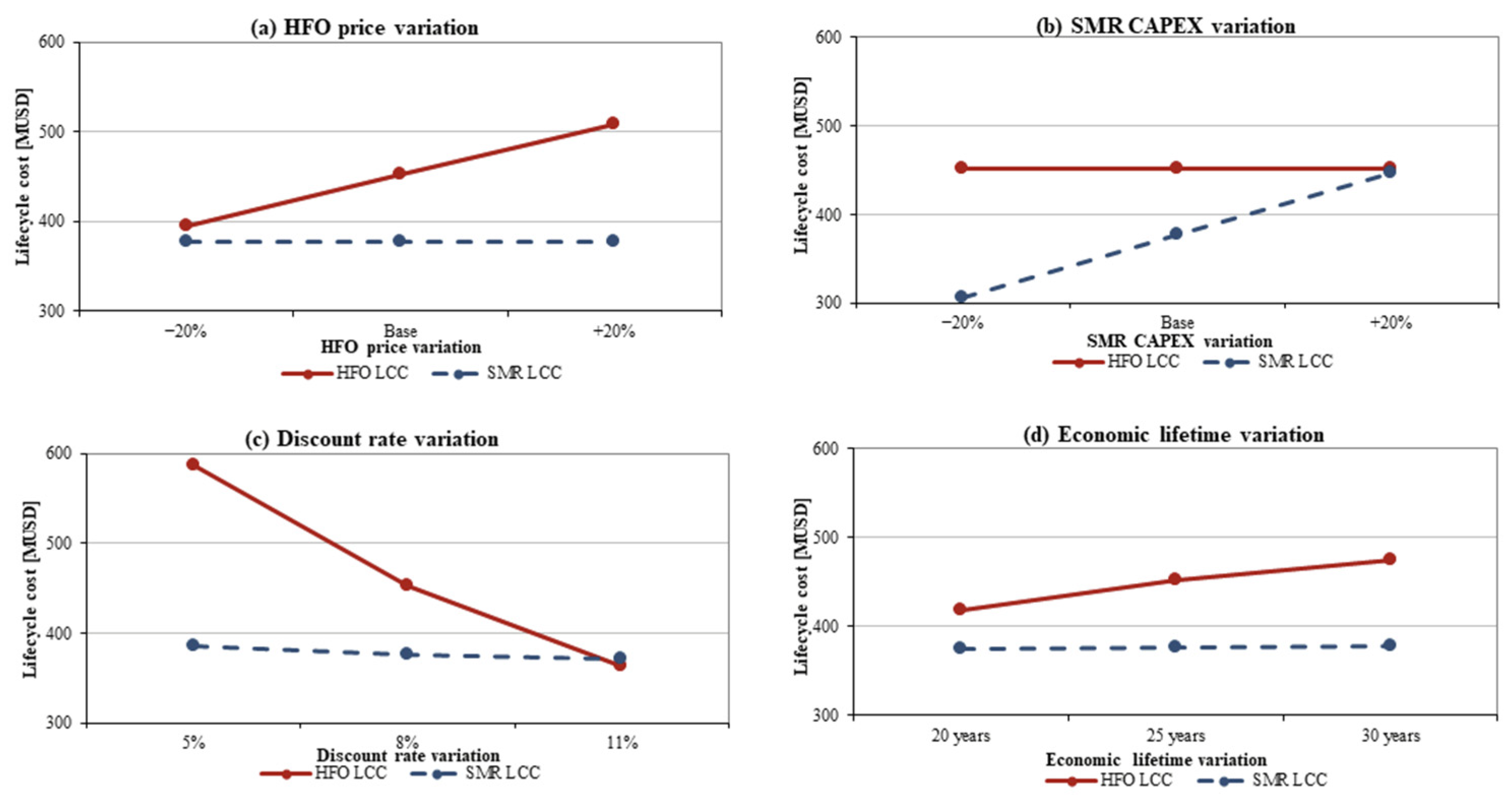
We have conducted a sensitivity analysis with four parameters analyzed: HFO price, SMR CAPEX, discount rate, and economic lifetime, and the winner remains—on three of the four parameters—the SMR variant of propulsion; although, regarding the discount rate, the 11% results in the HFO being the winner, while a CAPEX variation above +20% will also make SMR lose the competition. The results of this analysis are displayed in Figure 3.
Figure 3.
Sensitivity analysis of the HFO–SMR lifecycle cost comparison.
From the initial investment point of view, the nuclear configuration gives a significantly higher CAPEX than a conventional propulsion solution. For the SMR of 70 MWe adopted in our study, the literature gives a median production cost of around 350 million USD [13], which corresponds to 5000 USD/kWe installed. But this cost includes only the reactor, excluding the integration of nuclear installation onboard, conversion systems, instrumentation, safety systems, and associated infrastructure, which are counted in the total CAPEX assessment.
Regarding the lifecycle cost comparison, although nuclear SMRs seem to win the competition, an important factor in this evaluation remains the evolution of global fuel prices, the availability of the most convenient routes for transporting crude oil by sea, and taxes related to decarbonizing sea transport.
The case of the K-278 submarine highlights the necessity of evaluating the long-term consequences of a nuclear maritime accident. The Norwegian investigations [17] showed that some radionuclides were released from the reactor, probably linked to nuclear fuel degradation into seawater. Although the concentrations found were high around the submarine hull’s evacuation points, the radionuclides were rapidly diluted, with a marginal impact on sediments and biota in the surrounding area.
The K-278 Komsomolets was a submarine powered by nuclear energy and fitted with a pressurized water reactor (PWR), the design of which—together with its power output, fuel arrangement, radioactive content, containment system, and safety features—is very different from those of the modern small modular reactor (SMR) examined in this study; hence, the K-278 case is included merely as a historical reference about marine nuclear contamination and is not seen as being typical of the SMR design under consideration.
We mention the K-278 submarine accident in this paper solely to underline the gravity of a nuclear naval accident and its potential impact on ecosystems, with serious long-term implications.
4. Conclusions
For instance, the analysis of a seagoing container ship with a capacity of 15,000 TEUs reveals that using heavy fuel oil (HFO) for propulsion leads to a fuel consumption of about 50,400 tons per annum and emits steady emissions of CO2 and other pollutants into the atmosphere. The results show the need to identify energy solutions that generate fewer direct emissions for large seagoing vessels.
A single 70 MWe small modular reactor (SMR) has, under the adopted assumptions, the technical capability to satisfy the entire power requirement of the ship, including propulsion as well as auxiliary energy. But putting a nuclear system on board requires additional safety measures, comprehensive documentation, highly trained personnel, and specialized port facilities.
Nuclear propulsion requires a high initial capital outlay. HFO propulsion entails a large ongoing operating expense. The economics of nuclear solutions are thus mainly driven by the installation cost of the SMR, the market cost of HFO, the vessel’s period of exploitation, and the specific operating costs of the nuclear plant.
The environmental impact must be assessed independently from direct atmospheric emissions. Nuclear propulsion removes the emissions associated with burning HFO in ship operation, but introduces responsibilities for reactor safety, nuclear fuel choice, nuclear waste management, and accident risk. The K-278 case emphasizes the significance of assessing long-term impacts on the marine environment and the need to consider the viability of nuclear propulsion from a technical, economic, environmental and institutional perspective.
Author Contributions
Conceptualization, V.N. (Valerian Novac) and E.R.; methodology, V.A.; software, V.N. (Valentin Nae); validation, V.N. (Valerian Novac), V.A. and E.R.; formal analysis, V.N. (Valerian Novac); investigation, V.A.; resources, V.N. (Valentin Nae); data curation, V.A.; writing—original draft preparation, V.N. (Valerian Novac); writing—review and editing, E.R.; visualization, V.N. (Valentin Nae); supervision, E.R.; project administration, V.N. (Valerian Novac). All authors have read and agreed to the published version of the manuscript.
Funding
This research received no external funding.
Institutional Review Board Statement
Not applicable.
Informed Consent Statement
Not applicable.
Data Availability Statement
No new datasets were generated or analyzed during the current study. All data and parameters used in the analysis were obtained from publicly available sources and published literature, which are appropriately cited in the manuscript. The calculations and results presented in this study are based on the assumptions and methodological framework described in the manuscript.
Conflicts of Interest
The authors declare no conflicts of interest.
Abbreviations
The following abbreviations are used in this manuscript:
| HFO | Heavy Fuel Oil |
| LCCA | Lifecycle cost analysis |
| GHG | Greenhouse gas |
| SMR | Small modular reactor |
| CAPEX | Capital expenditure |
| OPEX | Operational expenditure |
| TEUs | Twenty-foot equivalent units |
| M/V | Motor vessel |
| LOA | Length overall |
| tdw | Deadweight ton |
| kW | Kilowatt |
| kn | Knot |
| m | Meter |
| g/kWh | Gram per kilowatt hour |
| MHFO | Heavy Fuel Oil mass |
| ME | Main engine |
| PME | Power of main engine |
| t | Ton; time |
| Ei | Emission of a specific pollutant |
| EFi | Emission factor for a specific pollutant |
| LF | Load factor |
| SFOC | Specific fuel oil consumption |
| CO2 | Carbon dioxide |
| NOx | Nitrogen oxides |
| SOx | Sulphur oxides |
| PM | Particulate matter |
| CO | Carbon monoxide |
| Ctotal | Total cost |
| Cmaintenance | Maintenance cost |
| OPEXannual | Annual operational expenditure |
| Cfuel | Fuel cost |
| Ccrew | Crew cost (expenditure) |
| Coperational | Operational cost |
| MWe | Megawatt electric |
| PSMR | Small modular reactor power |
| Pprop | Propulsion power |
| Pserv | Service power |
| Prez | Reserve power |
| MW | Megawatt |
| IFO 380 | Intermediate Fuel Oil with 380 centistokes kinematic viscosity (a type of HFO) |
| USD/t | United States Dollar per ton |
| USD | United States Dollar |
| USD/kWe | United States Dollar per kilowatt electric |
| η | Rate of discount |
References
- Duong, P.A.; Ha, J.; Lee, C.; Kang, H. Nuclear Propulsion in Cargo Ship: A Pathway to the Future of Emission-Free Shipping? J. Adv. Mar. Eng. Technol. 2024, 48, 392–401. [Google Scholar] [CrossRef] [Scilit]
- Novac, V.; Rusu, E. Air emissions from ships–western Black Sea case study. In Proceedings of the 19th International Multidisciplinary Scientific GeoConference SGEM 2019, Albena, Bulgaria, 28 June–6 July 2019. [Google Scholar]
- Novac, V.; Rusu, E. On the abatement of shipping emissions-a potential approach for the Black Sea basin. In Proceedings of the 21st International Multidisciplinary Scientific GeoConference SGEM 2021, Albena, Bulgaria, 16–22 August 2021. [Google Scholar]
- Furfari, S.; Mund, E.H. Advanced Nuclear Power for Clean Maritime Propulsion. Eur. Phys. J. Plus 2022, 137, 747. [Google Scholar] [CrossRef] [Scilit]
- Novac, V.; Rusu, E.; Buzbuchi, N. An assessment of a Black Sea voyage with WASP turbo-sails. IOP Conf. Ser. Mater. Sci. Eng. 2025, 1336, 012008. [Google Scholar] [CrossRef] [Scilit]
- Novac, V.; Rusu, E. An analysis of using Flettner rotors in the Black Sea basin. In Clean Energy Research, Now and in the Future; Chen, L., Ed.; Springer: Cham, Switzerland, 2025; pp. 155–163. [Google Scholar]
- Holbert, K.E. A Review of Maritime Nuclear Reactor Systems. J. Nucl. Eng. 2025, 6, 5. [Google Scholar] [CrossRef] [Scilit]
- Drosińska–Komor, M.; Głuch, J.; Ziółkowska, N.; Breńkacz, Ł.; Brzezińska–Gołębiewska, K.; Blaut, J.; Ziółkowski, P. Integrating Fourth-Generation Reactors into Maritime Transport. Ocean Eng. 2025, 342, 122891. [Google Scholar] [CrossRef] [Scilit]
- Duong, P.A.; Ha, J.; Lee, C.; Kang, H. Nuclear Propulsion for Merchant Ships: A Path to Sustainable Maritime Energy. Int. J. Sustain. Energy 2025, 44, 2579469. [Google Scholar] [CrossRef] [Scilit]
- International Atomic Energy Agency. Overview of SMR Designs for Maritime-Based Nuclear Power Plants; IAEA: Vienna, Austria, 2025. [Google Scholar]
- Wang, Q.; Zhang, H.; Zhu, P. Using Nuclear Energy for Maritime Decarbonization and Related Environmental Challenges: Existing Regulatory Shortcomings and Improvements. Int. J. Environ. Res. Public Health 2023, 20, 2993. [Google Scholar] [CrossRef] [Scilit] [PubMed]
- Park, W.; Yoo, Y.H.; Kang, K.J.; Jeong, Y.H. Design and transient analysis of a compact and long-term-operable passive residual heat removal system. Nucl. Eng. Technol. 2023, 55, 4335–4349. [Google Scholar] [CrossRef] [Scilit]
- Kim, K.; Kwon, C.S.; Kim, S. A conceptual study of 15,000 TEU SMR-powered containerships. Int. J. Nav. Archit. Ocean Eng. 2025, 17, 100662. [Google Scholar] [CrossRef] [Scilit]
- Available online: https://www.hafen-hamburg.de/en/vessels/al-jasrah-47169/ (accessed on 11 August 2026).
- DNV. Maritime Nuclear Propulsion: Technologies, Commercial Viability, and Regulatory Challenges for Nuclear-Powered Vessels; DNV: Høvik, Norway, 2025; Available online: https://www.dnv.com/maritime/publications/maritime-nuclear-propulsion-download (accessed on 11 August 2026).
- Degiuli, N.; Farkas, A.; Martić, I.; Grlj, C.G. Optimization of Maintenance Schedule for Containerships Sailing in the Adriatic Sea. J. Mar. Sci. Eng. 2023, 11, 201. [Google Scholar] [CrossRef] [Scilit]
- Norwegian Radiation and Nuclear Safety Authority (DSA). Investigation into the Radioecological Status of the Sunken Nuclear Submarine Komsomolets in the Norwegian Sea: Results from the 2019 Norwegian Research Cruise; DSA Report 3:2024; DSA: Oslo, Norway, 2024.
- Schlitzer, R. Ocean Data View. Available online: https://odv.awi.de (accessed on 11 August 2026).
- AFRICON. Live Bunker Prices–West & Northern Europe; AFRICON Group: Lagos, Nigeria; Available online: https://africongroup.com/live-bunker-prices-west-nothern-europe/ (accessed on 11 August 2026).

Disclaimer/Publisher’s Note: The statements, opinions and data contained in all publications are solely those of the individual author(s) and contributor(s) and not of MDPI and/or the editor(s). MDPI and/or the editor(s) disclaim responsibility for any injury to people or property resulting from any ideas, methods, instructions or products referred to in the content. |
© 2026 by the authors. Licensee MDPI, Basel, Switzerland. This article is an open access article distributed under the terms and conditions of the Creative Commons Attribution (CC BY) license.