


Abstract
This paper showcases the Aluminum Highway Bridge (AHB) project as a prime example of technical excellence, innovative thinking, and cross-disciplinary expertise in modern infrastructure. Supported by over 20 organizations from Canada, the U.S., and Europe, the AHB initiative pioneers low-carbon aluminum road bridges by integrating advanced design, fabrication, and welding technologies. The project’s rigorous approach to selecting aluminum extrusions, optimizing welded and bolted connections, and addressing logistical challenges demonstrates deep engineering insight. Emphasizing the material’s lightness, durability, and recyclability, the project aims to deliver compelling sustainability and life cycle benefits. Rooted in decades of research and strict adherence to modern engineering standards, the AHB methodology blends constructability with environmental responsibility. By developing a comprehensive framework and fostering collaboration across sectors, this initiative propels global aluminum bridge innovation. With about half of the project completed, this paper focuses on the materials procurement, the assembly options, the demonstration module fabrication and the environmental footprint.
1. Introduction
The Aluminum Highway Bridge (AHB) initiative is an international development program dedicated to advancing the use of low-carbon aluminum in road bridge applications. Supported by more than twenty partner organizations, the project is financed primarily by the Government of Quebec with additional contributions from private-sector stakeholders [1]. The context of aging bridge infrastructure presents a strong incentive to explore alternative structural materials. Aluminum, a cornerstone of Quebec’s industrial base and a major export commodity, offers a compelling option alongside conventional steel and concrete. Recent global disruptions, including the COVID-19 pandemic and trade-related geopolitical constraints, have further underscored the strategic importance of resilient local supply chains and environmentally responsible construction practices.
The origins of the AHB project can be traced to the 2023 International Aluminum Conference, where renewed interest emerged in the application of aluminum to highway bridge systems [2]. WSP and AluQuébec initiated the project and assembled a multidisciplinary consortium spanning the full bridge development ecosystem through collaborations with organizations in the United States and several European countries, including Norway, Sweden, Italy, and Germany. By March 2025, public funding had been secured.
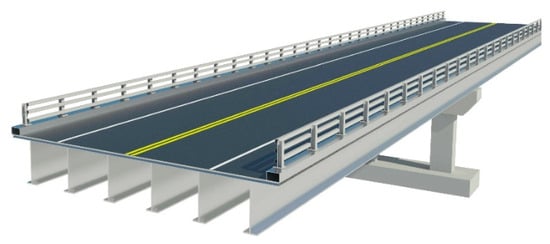
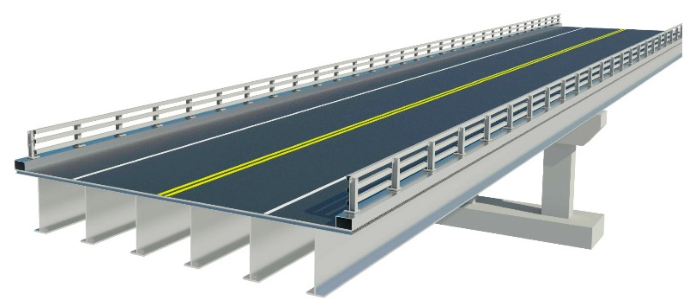
The primary objective of the AHB project is to significantly increase the adoption of aluminum in highway bridge construction by proposing a new structural system, shown in Figure 1, aligned with current industrial capabilities and regulatory frameworks. Key performance targets include structural efficiency, constructability, durability, cost effectiveness, and reduced environmental impact. Emphasis is placed on incorporating recycled aluminum to lower embodied carbon. To demonstrate technical feasibility, the project includes the fabrication of representative bridge modules, the development of parametric and optimized design solutions, and the preparation of comprehensive technical and contractual documentation intended for bridge owners and public agencies.
Figure 1.
Modern Aluminum Highway Bridge (AHB) concept.
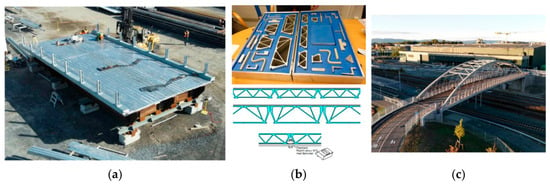
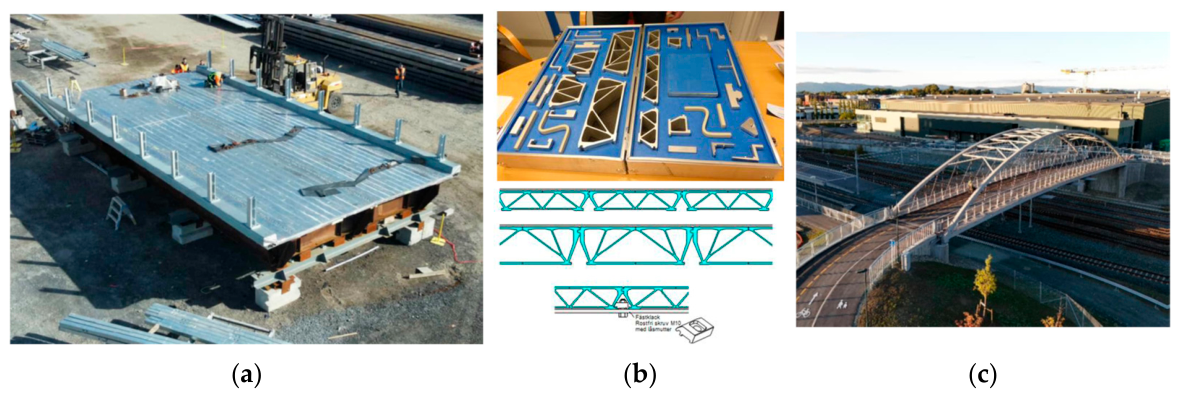
Numerous historical and contemporary bridge projects shown in Figure 2 demonstrate the long-term viability of aluminum as a primary structural material. Notable examples include the Montmorency Forest bridge in Canada [3,4], the SAPA modular bridge system in Sweden [5], and the Hangar bridge in Norway [6]. These projects illustrate the successful application of aluminum in both highway and pedestrian bridges, often leveraging advances in welding technologies and the use of recycled alloys. Such precedents provide valuable technical reference points for the current initiative.
Figure 2.
(a) Montmorency bridge (Proco); (b) SAPA system (SAPA); (c) Hangar bridge (Leirvik).
The AHB project is structured around a set of guiding principles that emphasize constructability, holistic integration of design and construction considerations, simplicity in detailing and fabrication, and strict adherence to existing standards and safety requirements. Building on more than a decade of academic research, the project prioritizes practical and concise deliverables tailored to real-world implementation.
Over a two-year period, the work program is organized into four major milestones. Initial activities focus on conceptual bridge design, cost evaluation, and material sourcing. Subsequent phases address detailed engineering, fabrication of full-scale modules, parametric optimization of the structural system, greenhouse gas assessment, and the production of complete technical guidance for bridge owners. Ultimately, the project seeks to provide designers and decision-makers with the technical confidence and evidence required to consider aluminum as a credible and competitive material for future highway bridges.
This paper forms part of a broader publication series dedicated to the AHB project [7]. It specifically addresses materials procurement, assembly options, fabrication of the demonstration module and the environmental footprint.
2. Materials Procurement
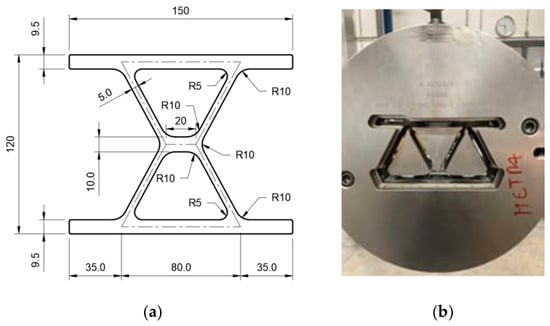
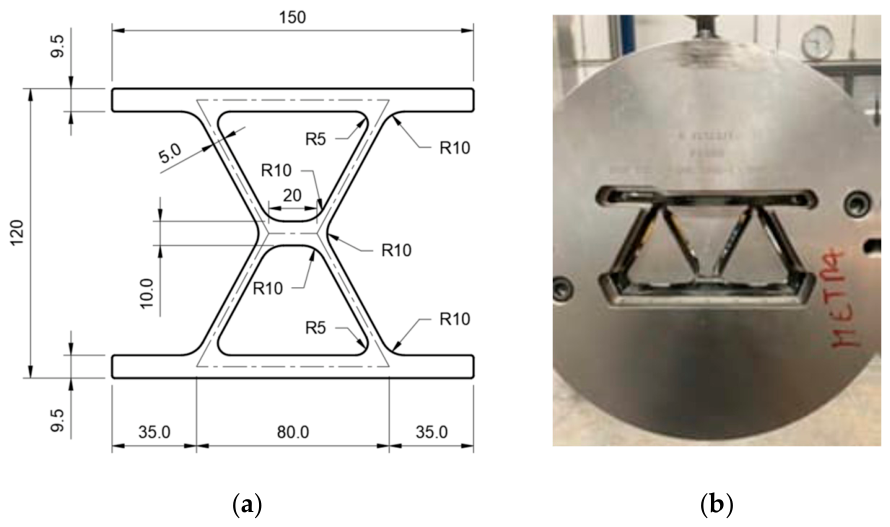
Multiple specialized partners are involved in supplying both extruded and plate aluminum elements. Their production capacities have been merged into a common table to facilitate the understanding of procurement constraints for bridge designers that are not used to this field. The extrudability of aluminum enables the creation of optimized profiles for deck panels facilitating both friction stir welding with bobbin tool (BTFSW) and bolted connections. Design constraints for extrusions include alloy and temper selection, die dimensions, profile mass and length, and logistics related to plant proximity. For the project, ASTM B221 6005A-T61 and EN573-3 & 755-2 6005A-T6 alloys are recommended, balancing strength and manufacturability, with available profile lengths ranging from 8 to 28 meters and linear masses varying by region. Certain extruders could simultaneously produce double, triple, or quadruple profiles shown in Figure 3a, which minimizes welding and costs. Previous work presented the structural potential of such geometry [8].
Figure 3.
(a) Extrusion of the AHB project; (b) extrusion die of the Montmorency Forest project [3,4].
Large aluminum plates are essential for the composite girders, with maximum lengths determined by straightness tolerances and delivery logistics. ASTM B209 6061-T651 is the preferred alloy for plates, with North American mills able to supply lengths up to 21.6 meters for webs and flanges. European projects may consider 5083-H321/H11 alloys for their enhanced mechanical properties under Eurocode 9. Flanges and webs align with production capabilities, though butt joints are necessary to achieve a bridge length similar to steel bridge projects.
The structural system prioritizes BTFSW welding technology, to fabricate large panels efficiently. With the proper parameters [9], BTFSW offers advantages such as uniform weld heating, no need for backing bars, improved weld quality, and the ability to join thicker sections in a single pass. The CSFM-UQAC center’s gantry system can weld elements up to 3500 mm wide and handle thicknesses up to 9.5 mm, with ongoing tests for 12.0 mm. These integrated supply and manufacturing strategies ensure technical feasibility and industrial compatibility for the project.
3. Assembly Options
The proposed bridge shown in Figure 1 features two continuous spans of 35 meters and an overall width of 10 meters. The superstructure is continuous at the central axis and supported by two abutments and a pier. Key superstructure components include a welded aluminum deck, composite-action aluminum girders, intermediate vertical bracings, an asphalt surface layer, steel barriers, expansion joints at each axis, and appropriate bearings. The bridge is designed for full prefabrication and pre-assembly in the factory, with details specifically engineered to ensure efficient transportability and facilitate subsequent final assembly at the construction site. On site, the lightweight modules are rapidly assembled using bolted connections, supporting an Accelerated Bridge Construction (ABC) approach.
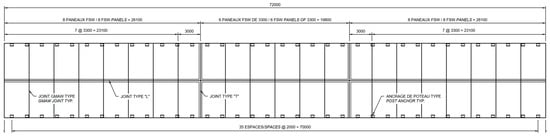
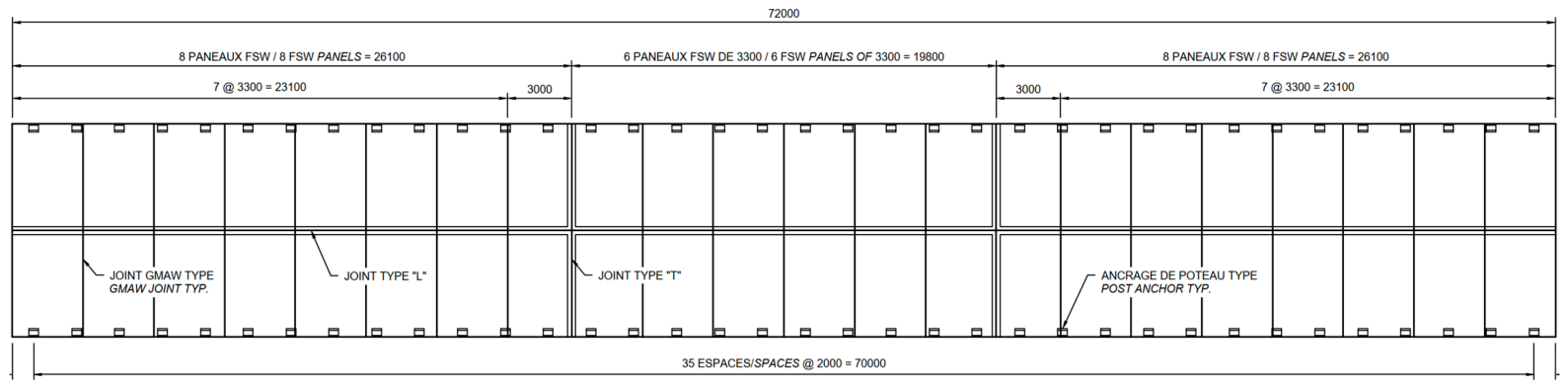
Four bridge assembly options were analyzed, focusing on the orientation of deck extrusions and the extent of welded and bolted joints. The retained option with transverse extrusions shown in Figure 4 emerged as the preferred solution due to its minimized bolted joint length, efficient modularization transport and assembly, and facilitation of a 2% transverse slope via longitudinal joints.
Figure 4.
Plan view of the bridge assemblies.
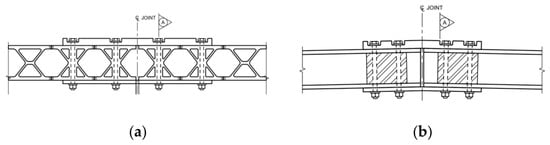
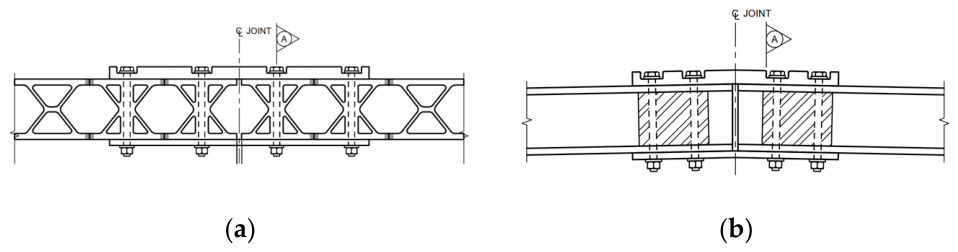
Detailed joint options were evaluated, with the longitudinal and transverse bolted joint configurations shown in Figure 5 recommended for their superior stiffness, normative compliance, assembly simplicity, and reduced bolt requirements. For the girder–deck connection, the initial intention was to use GMAW welds for its compatibility with factory prefabrication and proven shear flow performance. A recent development indicates that bolting the deck to the top flange of the girders using the bolting plate method [2,4] is a more interesting solution. It reduces fabrication complexity and offers better opportunities to optimize the design of the composite girder. These recommended solutions aim to optimize constructability, transportation, and on-site assembly while meeting stringent design and regulatory standards.
Figure 5.
(a) Transverse joints; (b) longitudinal joints.
4. Demonstration Module
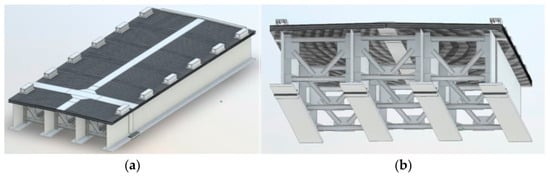
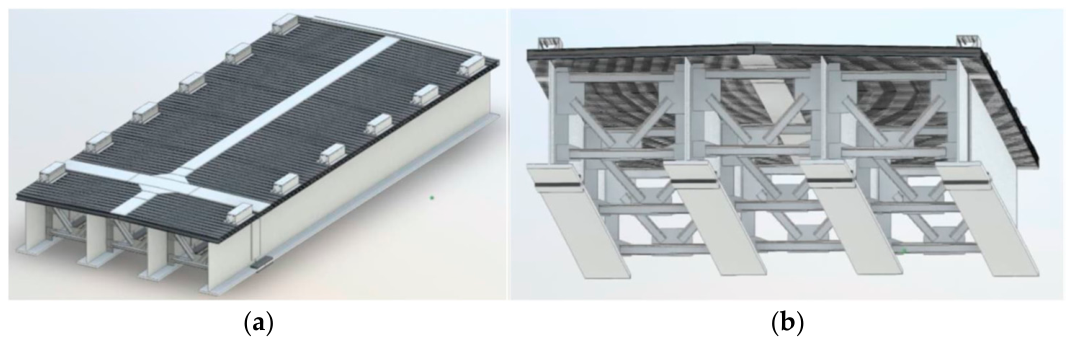
The demonstration module presented in Figure 6 serves as a full-scale physical validation of the AHB system. It integrates the same extrusion profiles, BTFSW joints and bolted connections specified in Section 3, allowing for a rigorous assessment of constructability and tolerances.
Figure 6.
(a) Deck of the demonstration module; (b) structural system.
The demonstration module is subdivided into four distinct modules, designated A through D, which collectively form a deck surface measuring approximately 5 m × 12 m. Modules A and B are identical, each featuring a decking surface comprising a single 2.5 m × 1.95 m extrusion panel. Conversely, Modules C and D are extended units; their decking is formed by five 2.5 m × 1.95 m extrusion panels, joined using GMAW to achieve a total longitudinal length of 9.75 m. The deck is supported by four girders fabricated from welded aluminum plates. To ensure composite action, the top flanges of these girders are bolted to the deck of their respective modules.
Upon completion of the four individual units, the decks are integrated using transverse and longitudinal bolted joints, complemented by a cruciform connection. The girders are joined using bolted splices for both the webs and flanges. This assembly results in a scaled representation of the AHB system.
The central feature of the demonstration module is its deck, which is composed of transversely oriented aluminum extrusions. These extrusions are joined into panels using BTFSW, a process prioritized for the technical advantages detailed in Section 2. Consequently, the integrity and execution of the FSW joints are critical to the overall success of the initiative. Although the final decking units for the module measure 2.5 m in length, the manufacturing process involves welding 10.5 m sections to validate that extrusion length does not constitute a constraint during production. These large-scale panels are subsequently sectioned into 2.5 m × 1.95 m segments for assembly.
The critical path of the fabrication timeline is defined by the sequence of activities required for deck production, namely the procurement, manufacturing, and delivery of extrusions, followed by BTFSW welding at the CSFM-UQAC center and subsequent machining operations. Conversely, activities associated with the girders and bracing systems are identified as non-critical; these workstreams are scheduled concurrently to optimize the overall timeline. To meet the project’s strategic goals, the entire fabrication phase is scheduled for completion within a twelve-month timeframe.
The fabrication of the demonstration module entails a rigorous, step-by-step analysis to identify and mitigate technical challenges inherent in aluminum bridge construction. This proactive approach has fostered an uncommon level of collaboration between designers and manufacturers, bridging the gap between theoretical design and industrial execution.
The primary objective of the demonstration module is to provide empirical evidence that large-scale aluminum bridge construction is both a technically viable and economically competitive alternative to traditional steel or concrete solutions.
To this end, the demonstration module initiative actively promotes the exchange of expertise and technical knowledge among industry partners, seeking to democratize aluminum fabrication and make these specialized processes more accessible to a broader network of companies in Quebec and abroad. Furthermore, the construction of this full-scale prototype enables the acquisition of high-fidelity cost data for every stage of the production cycle—from procurement, BTFSW welding, and fabrication to final assembly—thereby establishing a transparent financial baseline for future large-scale aluminum infrastructure projects.
Additionally, while the fabrication of the demonstration module is currently in the preparatory phase, certain normative gaps and regulatory limitations within existing codes have already been underscored. The forthcoming phases are expected to further highlight these shortcomings, notably in the non-destructive testing (NDT) field.
To address this, the fabrication process involves the establishment of a comprehensive inspection framework designed to streamline the decision-making criteria for NDT results. By defining clear acceptance thresholds and standardized evaluation procedures based on the existing codes, this framework aims to reduce ambiguity in quality control, thereby facilitating the development of standardized NDT protocols tailored to the specific requirements of large-scale aluminum structures. This systematic approach ensures that inspection outcomes are both reproducible and technically sound, providing a reliable foundation for future industrial applications.
5. Environmental Footprint
Reducing the environmental impact of infrastructure is a key objective of the AHB project. As part of this effort, carbon footprint assessment is integrated into the design process and aligned with federal and provincial targets to reduce greenhouse gas (GHG) emissions. To support this goal, the project uses an environmental life cycle assessment (LCA) to compare the aluminum bridge deck with a conventional steel–concrete composite deck.
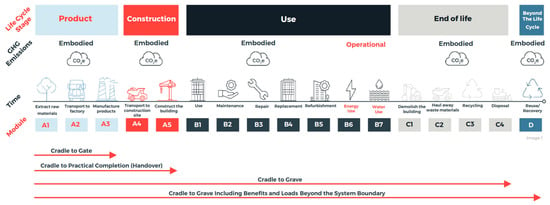
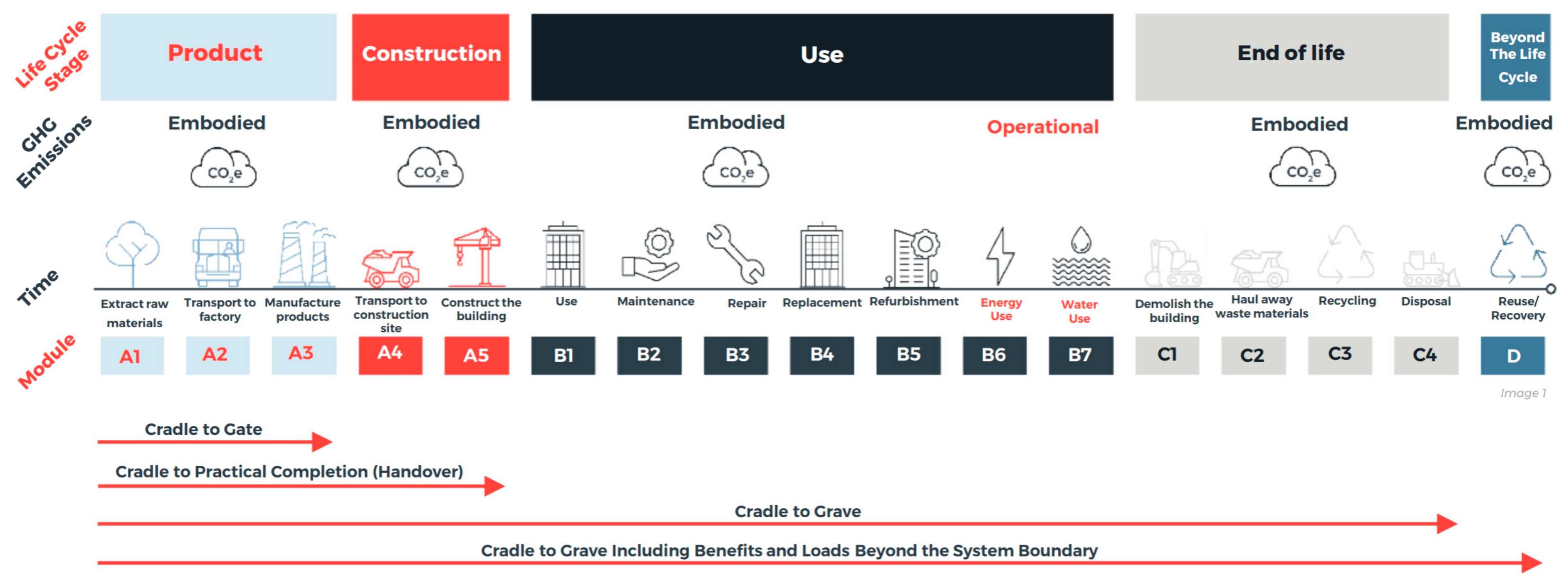
The LCA methodology follows ISO 14040 and ISO 14044 and quantifies all GHG emissions over the full life cycle of each option, expressed in tons of CO2 equivalent (t CO2 eq.). All materials, equipment, and activities are included across the stages shown in Figure 7: Materials (A1–A3), transport and construction (A4–A5), use and maintenance (B), and end-of-life (C). This ensures a consistent and transparent comparison between the two structural alternatives.
Figure 7.
Life cycle assessment steps.
Emission factors for each component of the AHB project were first established using Environmental Product Declarations (EPDs) and specialized databases. A major focus of the LCA is the determination of a realistic emission factor for aluminum. The environmental impact of primary aluminum production can vary significantly depending on the energy source, with renewable energy-based processes differing markedly from those reliant on fossil fuels. As with steel, the proportion of secondary (recycled) aluminum used in the structure has a significant influence on environmental performance. Producing secondary aluminum requires only about 5% of the energy needed for primary aluminum, resulting in substantially lower GHG emissions in stages A1–A3. This characteristic is central to the AHB project, which aims to leverage low-carbon and recycled aluminum. It will be further investigated with the project’s partners.
The carbon footprint of each bridge option is calculated by summing the GHG emissions of all items across all life cycle stages. Each item is quantified by multiplying its material quantity by its emission factor, expressed in kilograms of CO2 equivalent per unit (kg CO2 eq./unit). The resulting carbon estimation is presented in Table 1. With the cut-off approach, the benefit for using recycled materials is considered upstream in the A1–A3 stages and the end-of-life stages account for transportation of the materials to the recycling site. The emission factor (A1–A3) for aluminum was set at 1.8 kg CO2e/kg based on 2024 preliminary data from partners. These data and assumptions are planned to be further refined in the second year of the project.
Table 1.
Summary of GHG emissions (m.t., CO2 eq.) by life cycle stage.
6. Conclusions
This paper introduced the AHB project, focused on creating a new generation of Aluminum Highway Bridges. It first discussed the materials procurement, then detailed the assembly options. The demonstration modules and the carbon footprint were also addressed. Although significant work remains, the project team maintains a positive outlook regarding the future prospects of this innovative bridge solution. At the time of writing this paper, the project is approaching the end of the second milestone. The next steps of the AHB project will focus on the following activities:
- Complete the structural dimensioning of the various bridge elements;
- Complete the detailing of the aluminum bridge;
- Start writing documentation for bridge owners;
- Plan the parametric design;
- Refine the cost and carbon footprint estimate;
- Start manufacturing the demonstration module.
Author Contributions
Article organization, materials procurement and assembly options, B.C.; demonstration module and review, A.T.; environmental footprint and review, S.D. All authors have read and agreed to the published version of the manuscript.
Funding
This project is funded by the Government of Québec (Technoclimat and PAPDE programs) and by the industry partners.
Institutional Review Board Statement
Not applicable.
Informed Consent Statement
Not applicable.
Data Availability Statement
The original contributions presented in this study are included in the article. Further inquiries can be directed to the corresponding author.
Acknowledgments
The authors thank the Government of Québec, AluQuébec and the industry partners for their financial support and the opportunity to lead this project. Collaboration among stakeholders and industry representatives has been crucial to the project’s development. Industry partners are Arconic, Canmec, Colas, Constellium, Englobe, GCES, Hydro, Leirvik, Metra, Norda Stelo, NPRA, Pomerleau, Poralu, Proco, Pro-Mec Elite, Rio Tinto, Tetra Tech, SVA and UQAC.
Conflicts of Interest
The authors declare being employees of WSP and Norda Stelo.
References
- AluQuébec Revels a Structuring Project for the Future of Infrastructures. Available online: https://aluquebec.com/publications/communiques/aluquebec-devoile-un-projet-structurant-pour-l-avenir-des-infrastructures-lors-de-son-premier-rendez-vous-economique/ (accessed on 28 February 2026).
- Cusson, B. Modern Applications and Construction Details for Aluminium Bridges. Eng. Proc. 2023, 43, 13. [Google Scholar] [CrossRef] [Scilit]
- Cusson, B.; Pelletier, V. The construction of the Montmorency Forest GMAW-welded aluminium deck on steel girders bridge. In Proceedings of the 16th International Aluminium Conference (INALCO 2026), Trondheim, Norway, 10–12 June 2026. [Google Scholar]
- Cusson, B. Designing and Detailing a GMAW Welded Aluminium Deck on Steel Girders for CSA S6:19 Traffic Loads. In Proceedings of the 11th International Conference on Short and Medium Span Bridges, Toronto, ON, Canada, 19–22 July 2022. [Google Scholar]
- Beaulieu, D.; Internoscia, J. Ponts et Passerelles en Aluminium—Rapport de Visite et de Rencontres en Suède, Hollande et États-Unis; AluQuébec and Association de L’aluminium du Canada: Montreal, QC, Canada, 2015; 10p. [Google Scholar]
- Hangar Bridge. Available online: https://leirvik.com/infrastructure/hangar-bridge/ (accessed on 28 February 2026).
- Cusson, B.; Ampleman, M.; Gamache-Bureau, F. A new generation of aluminium highway bridges developed by 20 industry organisations. In Proceedings of the 12th International Conference on Short and Medium Span Bridges, Vancouver, BC, Canada, 4–7 August 2026. [Google Scholar]
- Djedid, A.; Oudjene, M.; Fafard, M. Optimal Extrusion Shape for Fabricating Aluminium Bridge Deck Using Assembly-Based Friction Stir Welding with Bobbin Tool. Eng. Proc. 2023, 43, 36. [Google Scholar] [CrossRef] [Scilit]
- Tinguery, K.M.S.; Rahem, A.; Nadeau, F.; Fafard, M. Friction Stir Welding Parameters Development of AA6061-T6 Extruded Alloy Using a Bobbin Tool. Eng. Proc. 2023, 43, 50. [Google Scholar] [CrossRef] [Scilit]

Disclaimer/Publisher’s Note: The statements, opinions and data contained in all publications are solely those of the individual author(s) and contributor(s) and not of MDPI and/or the editor(s). MDPI and/or the editor(s) disclaim responsibility for any injury to people or property resulting from any ideas, methods, instructions or products referred to in the content. |
© 2026 by the authors. Licensee MDPI, Basel, Switzerland. This article is an open access article distributed under the terms and conditions of the Creative Commons Attribution (CC BY) license.