Proceeding Paper

Blockchain for EUPHEMIA Market Transparency †
by
Tsvetomir Gospodinov
*,
Mariana Atanasova
and
Eliza Stefanova
Faculty of Mathematics and Informatics, Sofia University “St. Kliment Ohridski”, 5 James Bourchier Blvd., 1164 Sofia, Bulgaria
*
Author to whom correspondence should be addressed.
Presented at the 15th International Scientific Conference TechSys 2026—Engineering, Technologies and Systems, Plovdiv, Bulgaria, 14–16 May 2026.
Eng. Proc. 2026, 150(1), 6; https://doi.org/10.3390/engproc2026150006

Published: 16 July 2026

Abstract

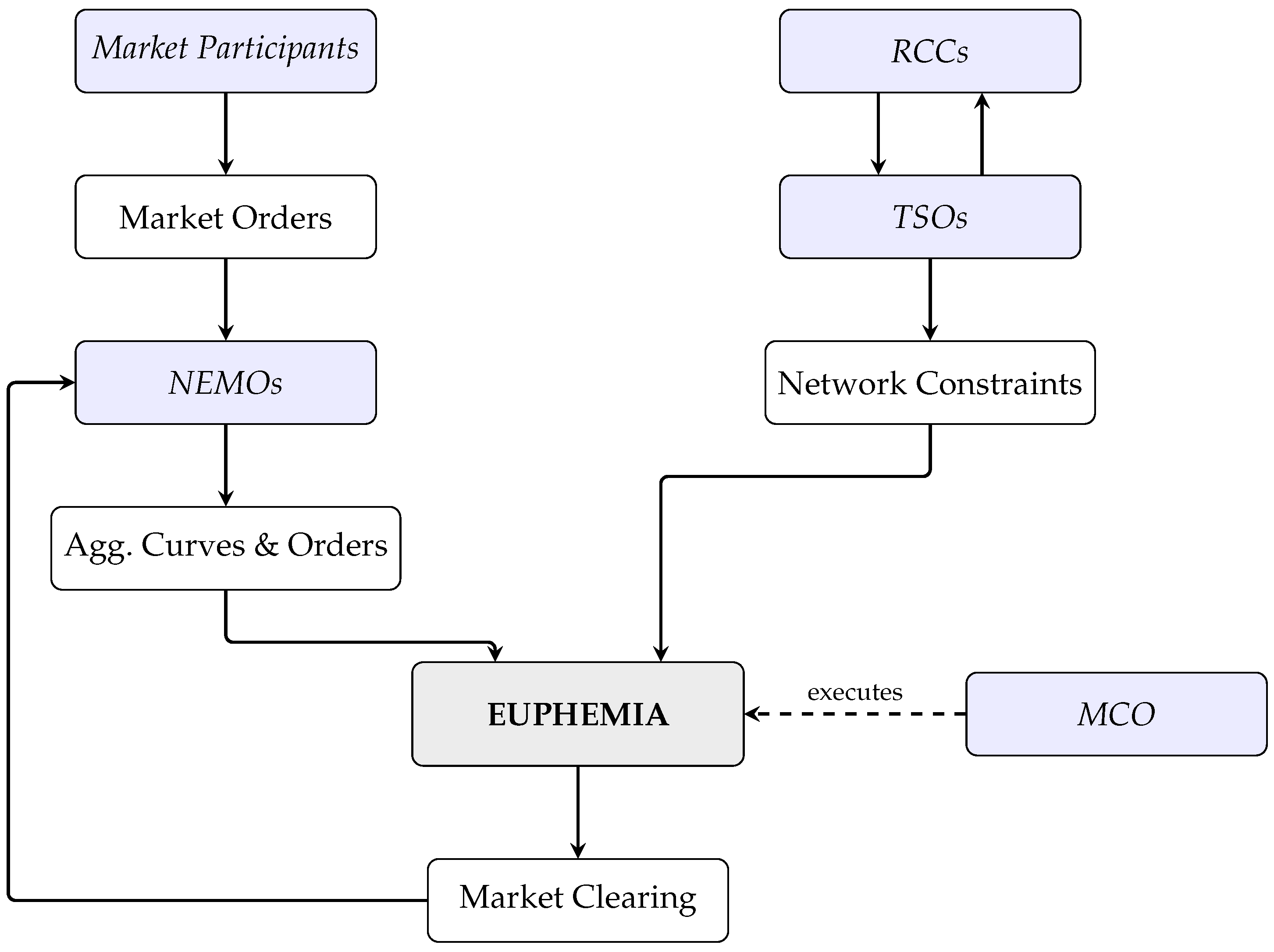
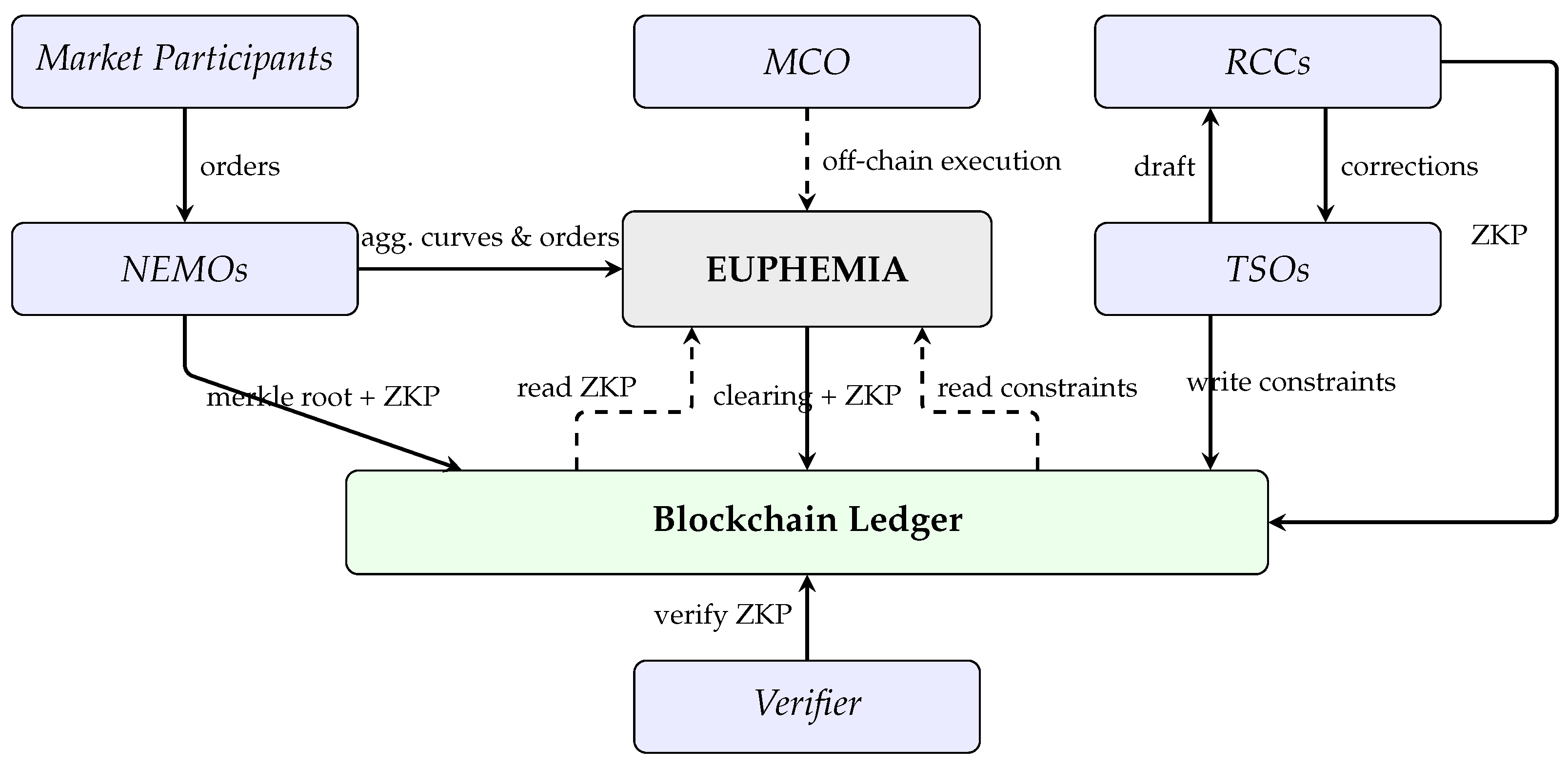
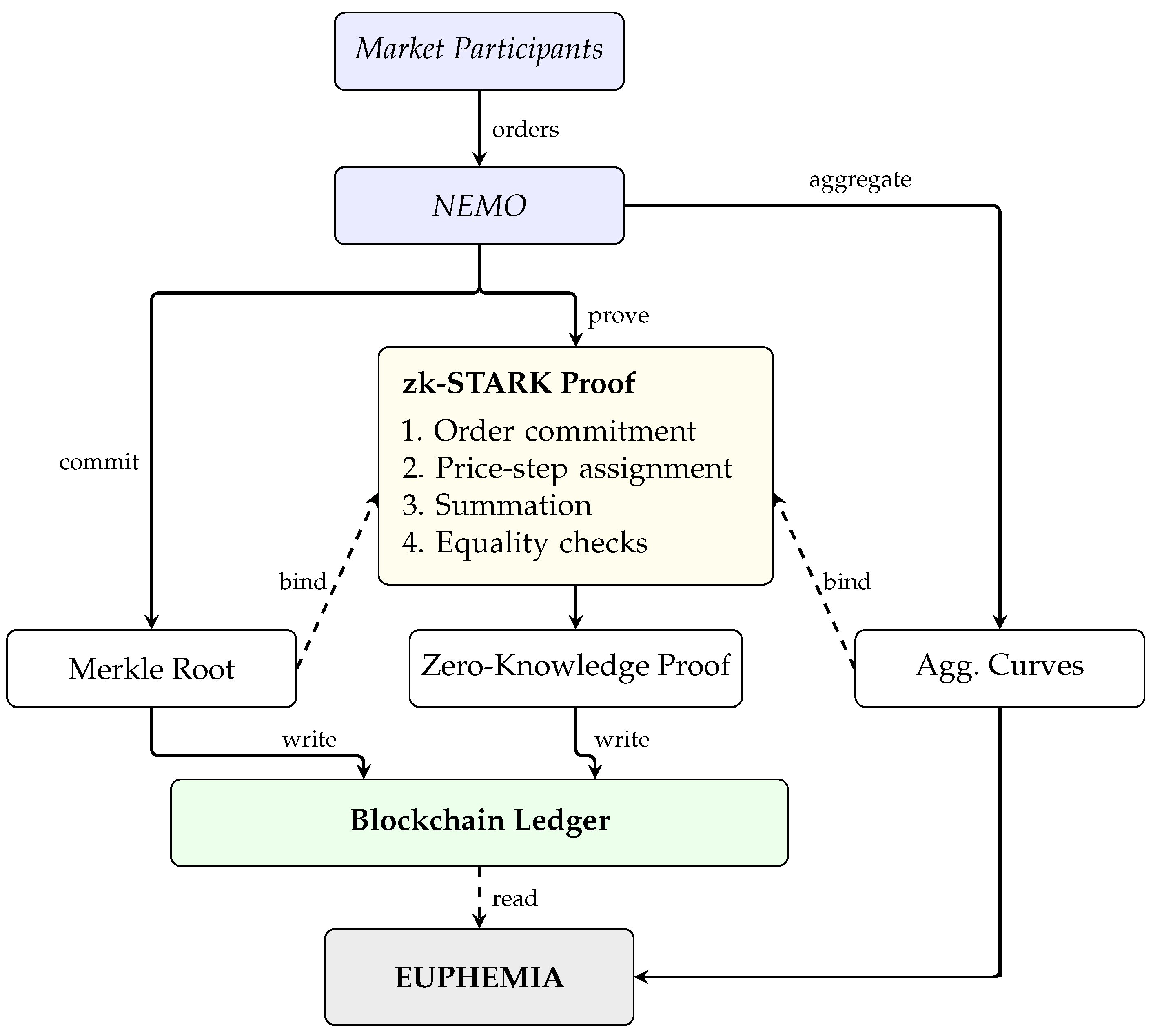
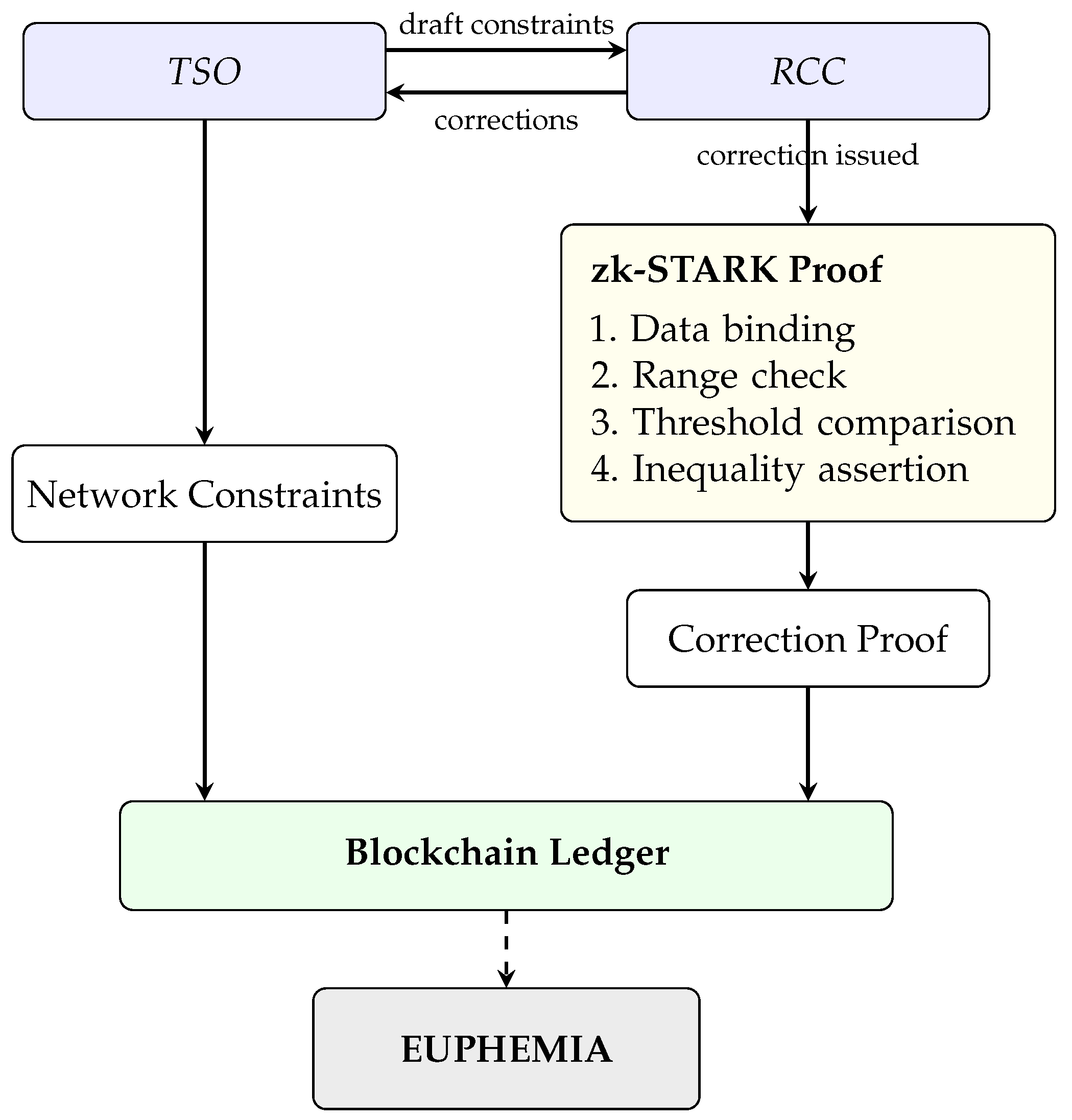
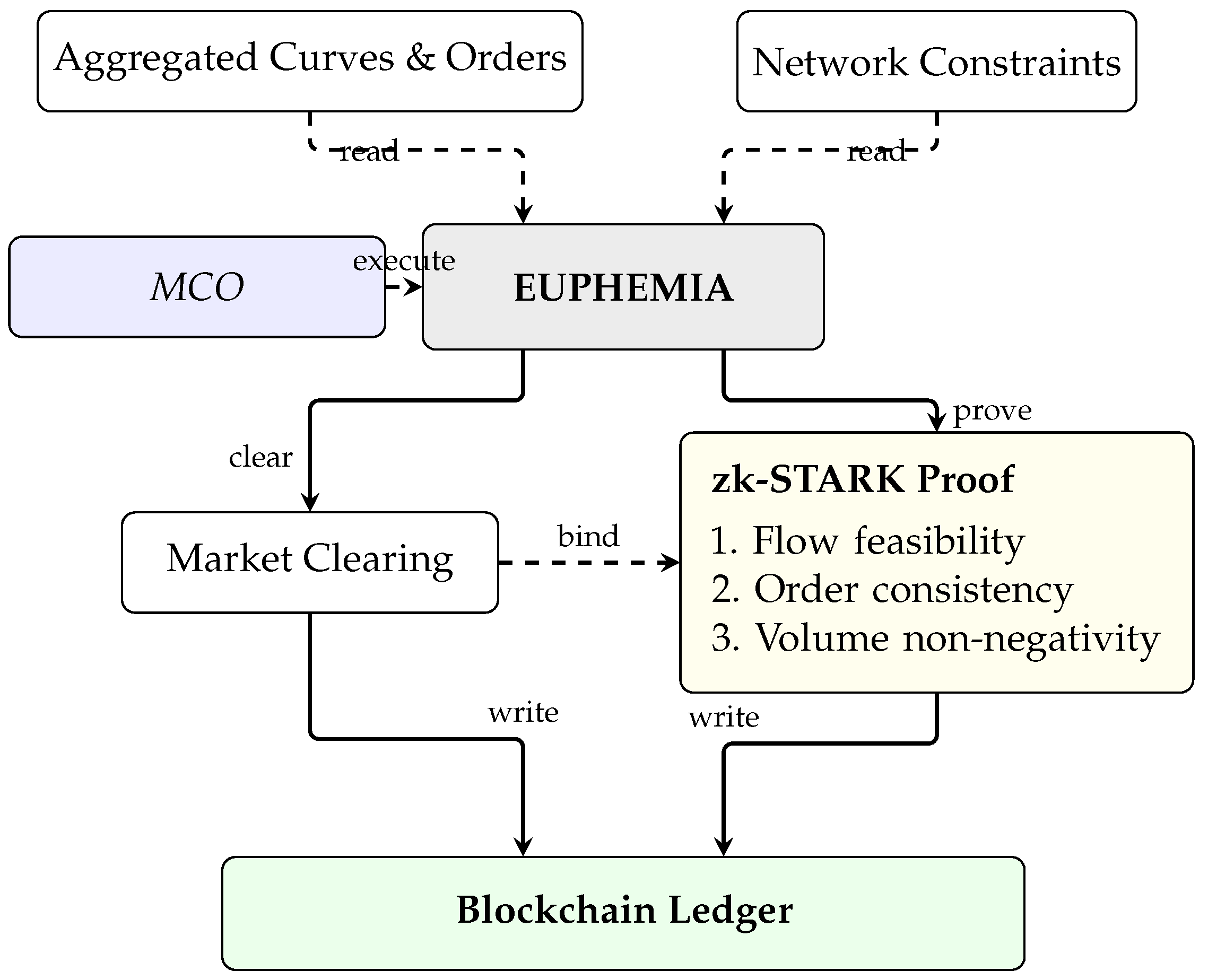
EUPHEMIA, the Pan-European day-ahead electricity market-coupling algorithm, operates in a centralized manner that restricts independent auditability and has been characterized as pseudo-transparent. We propose a blockchain-based architecture that improves the transparency and verifiability of the market-coupling process while preserving participant confidentiality. It combines off-chain computation with selective on-chain publication and treats the three principal data categories of the EUPHEMIA pipeline separately: order books, network constraints, and clearing outputs. Zero-knowledge proofs utilizing zk-STARKs are employed to verify the integrity of the order book aggregation process and specific network-constraint sub-processes, whereas Merkle commitments ensure tamper-evident anchoring of publicly disclosed data. zk-STARKs are selected over CRS-based alternatives to eliminate the trusted-setup governance overhead associated with EUPHEMIA’s multi-jurisdictional structure. The estimated AIR trace size reaches approximately 2,225,000 rows in the worst-case NEMO (EPEX SPOT) scenario. A correction proof generated by the Regional Coordination Centre (RCC) requires an AIR of 641 trace rows when a binding network constraint exceeds its threshold during the review of Transmission System Operator (TSO) submissions. This trace size corresponds to an estimated proving time of 1 to 30 s based on reported STARK prover throughput. End-to-end verification of welfare maximization remains infeasible due to the lack of a complete public algorithm specification. Preliminary calibrated estimates are provided, and full empirical benchmarking remains as future work.
Keywords: EUPHEMIA; blockchain; zero-knowledge proofs; zk-STARKs; single day-ahead coupling EUPHEMIA; blockchain; zero-knowledge proofs; zk-STARKs; single day-ahead coupling