A Model for BIM Adoption in the Government Sector of Bulgaria †
Abstract
1. Introduction
- To create a draft of a long-term strategy for the introduction of BIM in the design, delivery and operation of built assets, as a foundation for the digital transformation of the construction sector.
- To create a draft of an action plan for the execution of the long-term strategy, that details the execution of the strategy and organizes and plans its execution, monitoring, evaluation and needs for updates.
2. Relevant Goals and Measures
- Creation of regulatory conditions and IT infrastructure for the implementation of BIM;
- Provision of material resources for the introduction of electronic administrative services related to BIM in investment design;
- Development of digital capacity and skills of public administration engaged in investment design;
- Preparation of the educational system to provide quality training in the application of BIM in vocational high schools for secondary technical education in the field of construction;
- Preparation of the educational system to provide quality training in the application of BIM in higher education institutions;
- Increasing the capacity of participants in design and construction;
- Development of activities related to innovation in the construction sector;
- Ensuring awareness and active participation of the construction sector in the process of digital transformation.
2.1. Creation of Regulatory Conditions and IT Infrastructure for the Implementation of BIM
- Analysis and development of a legislative framework;
- Development of a national BIM model, templates, and procedures for collecting, managing, and sharing information, security, and access control based on BDS EN ISO 19650 [6] and CEN standards;
- Development of BIM object libraries that reflect construction products and materials in infrastructure construction;
- Creation of software infrastructure for working with BIM projects in the process of approving and coordinating investment projects;
- Introduction of requirements for the application of BIM in public procurement;
- Analysis of the application of BIM and the readiness of the sector to determine the scope of public procurement for construction projects in the third phase of BIM implementation.
2.2. Provision of Material Resources for the Introduction of Electronic Administrative Services Related to BIM in Investment Design
- Provision of hardware and software for experts from municipal, district, and state administrations involved in the process of coordinating and approving investment projects;
- Development of a web-based platform with published online training, an interactive guide (manual) for the national BIM model, design and approval processes for BIM projects, and resources for download such as libraries, templates, and forms, as well as applications for checking digital maturity for enterprises in the construction sector;
- Pilot development of a module for automated conflict detection between all engineering networks, structural and architectural elements within the BIM model, and for automated coordination.
2.3. Development of Digital Capacity and Skills of Public Administration Engaged in Investment Design
- Conduct specialized training aligned with the general framework standards for the implementation of BIM and European best practices in administration;
- Prepare an online training format for the subsequent training of personnel from all interested administrations through the Institute of Public Administration;
- Conduct annual training for experts from public administrations.
3. Relevant Local and International Standards
3.1. International BIM Standards
- Interoperability is key to the digital transformation in the built asset industry;
- Open and neutral standards should be developed to facilitate interoperability;
- Reliable data exchanges depend on independent quality benchmarks;
- Collaboration workflows are enhanced by open and agile data formats;
- Flexibility of choice of technology creates more value to all stakeholders;
- Sustainability is safeguarded by long-term interoperable data standards.
3.1.1. Industry Foundation Classes (IFC)
3.1.2. Information Delivery Specification (IDS)
3.1.3. BIM Collaboration Format (BCF)
3.1.4. Documents API
3.1.5. Dictionary API
3.2. Bulgarian Standards and e-Government Infrastructure
3.2.1. Regulation on Document Exchange in the Administration
3.2.2. Environment for Electronic Exchange of Messages
3.2.3. Horizontal e-Government Systems
- RegiX;
- e-Authentication;
- e-Delivery;
- e-Payment;
- Unified Portal for Electronic Administrative Services.
4. A Model for BIM Adoption
4.1. Key Software Components of the BIM Infrastructure
- Common Data Environment (CDE);
- Electronic Document Management Systems (eDMSs);
- BIM Authoring Software;
- BIM Viewing and Collaboration Software;
- Data Dictionary Service.
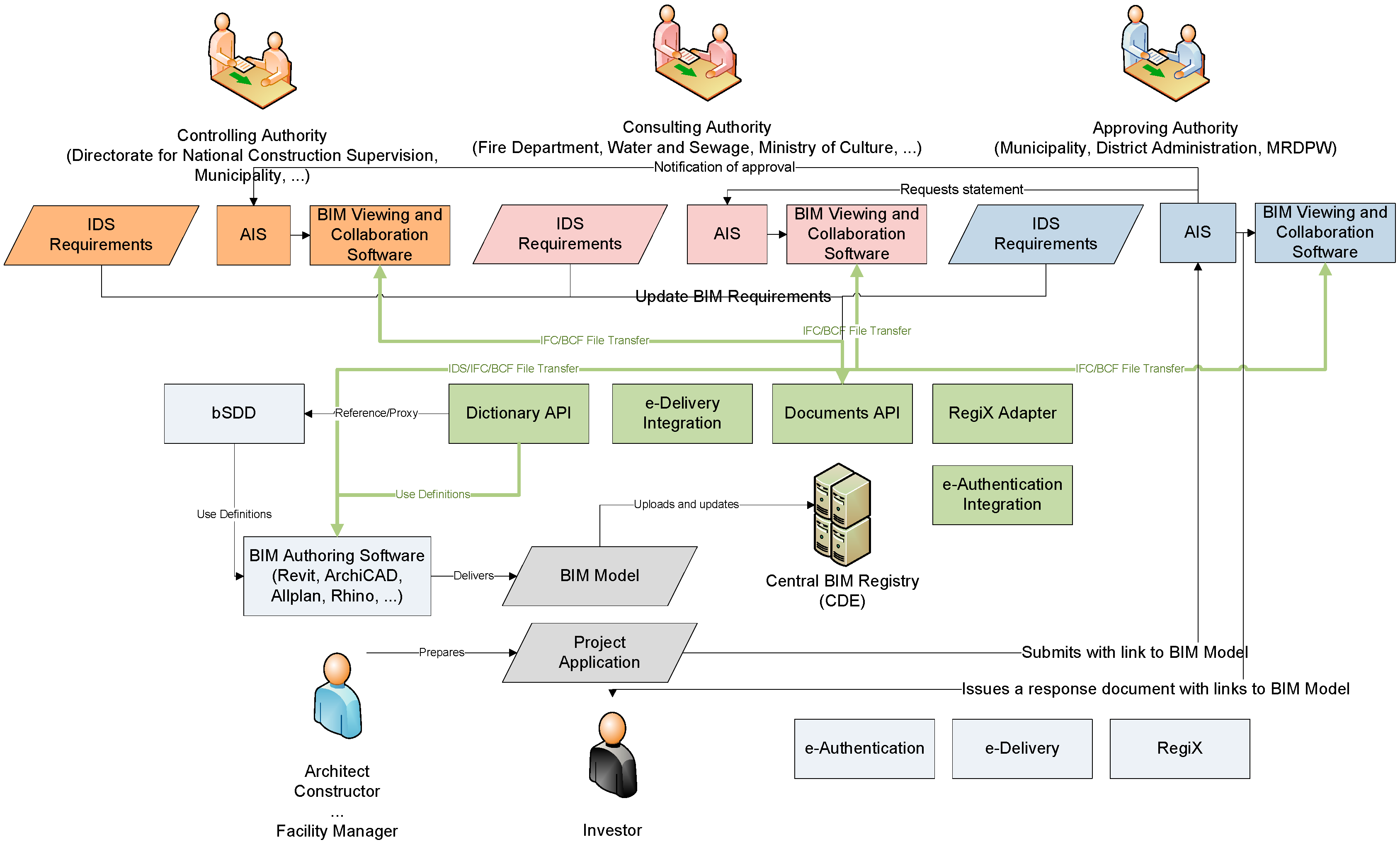
4.2. Model for BIM Adoption
4.2.1. The Central BIM Registry
- Hosts public common requirements and templates, available through the Documents API;
- Hosts investment projects, both submitted for approval and approved, available through the Documents API;
- Allows fine-grained access control to project data by requiring the exchange of identifiers/links through an alternative channel;
- Allows access to the investment projects through RegiX;
- Provides a data dictionary service (optional).
4.2.2. A National Model for BIM
4.2.3. BIM Viewing and Collaboration Software
- Support for the IFC file format;
- Simultaneous work with more than one information container (federated BIM model);
- 3D visualization tools—rotation, translation, zoom, cutting planes, viewing modes with different level of detail, isolation of chosen elements;
- Measurement tools;
- BCF viewing and authoring;
- IDS validation and authoring;
- Documents API integration.
4.3. The Government BIM Process
- A set of common requirements and templates developed by the government (a National BIM Model) is available in the Central BIM Registry;
- Architects, builders, facility managers and others use the requirements and templates to create and update BIM models using an authoring tool of their choice;
- Investors upload the BIM models to the registry and submit applications for administrative services to the government bodies with identifiers/links to the BIM models in the registry;
- Administrations use a BIM viewing and collaboration software of their choice to create BCF requests for information or raise issues;
- Approving administrations request internal administrative services from other administrations through EEEM or e-Delivery using their AIS, requests include the identifier/link to the BIM model in the registry;
- All issues and requests for information are linked to the original model uploaded in the Central BIM Registry;
- All documents sent between administrations and between them and the investor contain identifiers/links to the information container in the Central BIM Registry which allows the receiver to view the issue/model;
- The Central BIM Registry is the single source of truth about the latest data but access to the data is restricted by requiring official document exchange between the parties that contains the identifiers/links that allow access.
5. Conclusions
Funding
Institutional Review Board Statement
Informed Consent Statement
Data Availability Statement
Acknowledgments
Conflicts of Interest
Abbreviations
| AIS | Administrative Information Systems |
| API | Application Programming Interface |
| BCF | BIM Collaboration Format |
| BDS | Bulgarian State Standard |
| BIM | Building Information Modelling |
| bSDD | buildingSMART Data Dictionary |
| CAD | Computer-Aided Design |
| CDE | Common Data Environment |
| CEN | European Committee for Standardization |
| DCM | Decree of the Council of Ministers |
| eDMS | Electronic Document Management System |
| EEEM | Environment for Electronic Exchange of Messages |
| EU | European Union |
| GIS | Geographic Information Systems |
| IDS | Information Delivery Specification |
| IFC | Industry Foundation Classes |
| ISO | International Organization for Standardization |
| IT | Information Technology |
| Portable Document Format | |
| SMEs | Small and Medium Enterprises |
References
- ISO 19650-1:2018; Organization and Digitization of Information About Buildings and Civil Engineering Works, Including Building Information Modelling (BIM)—Information Management Using Building Information Modelling Part 1: Concepts and Principles. International Organization for Standardization: Geneva, Switzerland, 2018.
- EU BIM Task Group. Handbook for the Introduction of Building Information Modelling by the European Public Sector. Available online: https://www.eubim.eu/wp-content/uploads/2017/07/EUBIM_Handbook_Web_Optimized-1.pdf (accessed on 8 May 2024).
- Oliver Eischet, L.K. BIM Adoption Across the World: A Global Outlook. 2022. Available online: https://medium.com/specter-automation-insights/bim-adoption-across-the-world-a-global-outlook-1b3879f23bc6 (accessed on 8 May 2024).
- Council of Ministers of The Republic of Bulgaria. DCM No 270, Sofia, 2023. Available online: https://www.strategy.bg/bg/pris/legal-information/reseniia/131652 (accessed on 9 June 2024).
- Law On Spatial Planning. 2023. Available online: https://lex.bg/laws/ldoc/2135163904 (accessed on 9 May 2024).
- BDS EN ISO 19650-1:2019; Organization and Digitization of Information About Buildings and Civil Engineering Works, Including Building Information Modelling (BIM)—Information Management Using Building Information Modelling—Part 1: Concepts and Principles (ISO 19650-1:2018). Bulgarian Institute for Standardization: Sofia, Bulgaria, 2024.
- United-BIM Inc. BIM Level Explained. 2024. Available online: https://www.united-bim.com/bim-maturity-levels-explained-level-0-1-2-3/ (accessed on 9 May 2024).
- buildingSMART International. Purpose, Vision and Mission. 2024. Available online: https://www.buildingsmart.org/about/vision/ (accessed on 9 May 2024).
- buildingSMART International. What Is openBIM®? 2024. Available online: https://www.buildingsmart.org/about/openbim/openbim-definition/ (accessed on 9 May 2024).
- ISO 16739-1:2018; Industry Foundation Classes (IFC) for Data Sharing in the Construction and Facility Management Industries. Part 1: Data Schema. International Organization for Standardization: Geneva, Switzerland, 2018.
- buildingSMART. Industry Foundation Classes (IFC). 2022. Available online: https://technical.buildingsmart.org/standards/ifc/ (accessed on 9 May 2024).
- buildingSMART International. Information Delivery Specification IDS. 2024. Available online: https://technical.buildingsmart.org/projects/information-delivery-specification-ids/ (accessed on 9 May 2024).
- buildingSMART International. BIM Collaboration Format (BCF). 2024. Available online: https://technical.buildingsmart.org/standards/bcf/ (accessed on 9 May 2024).
- buildingSMART International. Documents API. 2024. Available online: https://github.com/buildingSMART/documents-API/blob/main/README.md (accessed on 9 May 2024).
- buildingSMART International. Dictionaries API. 2024. Available online: https://app.swaggerhub.com/apis-docs/buildingSMART/Dictionaries/v1 (accessed on 9 May 2024).
- buildingSMART International. buildingSMART Data Dictionary (bSDD). 2024. Available online: https://www.buildingsmart.org/users/services/buildingsmart-data-dictionary/ (accessed on 9 May 2024).
- The Council of Ministers of The Republic of Bulgaria, Regulation on Document Exchange in the Administration (Title Amended—SG No. 5 of 2017, Effective from 01.03.2017). 2017. Available online: https://www.mtc.government.bg/sites/default/files/naredba_za_obmena_na_dokumenti_v_administraciqta_zagl_izm_dv_br_5_ot_2017_g_v_sila_ot_1032017_g.pdf (accessed on 9 June 2024).
- Environment for Electronic Exchange of Messages. 2020. Available online: https://e-gov.bg/wps/portal/agency/systems/info-systems/seos (accessed on 9 June 2024).
- Environment for Intra-Registry Exchange of Data (RegiX). 2019. Available online: https://e-gov.bg/wps/portal/agency/systems/info-systems/regix (accessed on 9 June 2024).

| Country | Year | BIM Program/Mandate |
|---|---|---|
| Finland | 2007 | Open-BIM mandate for new buildings |
| Norway | 2008 | Open-BIM mandate |
| Denmark | 2011 | BIM mandate for all government buildings |
| Netherlands | 2012 | Open-BIM mandate for infrastructure |
| Austria | 2015 | Introduction of Open-BIM standards |
| Sweden | 2015 | BIM mandatory for transportation |
| United Kingdom | 2016 | BIM compulsory for government contracts |
| France | 2017 | Announcement of BIM roadmap |
| Germany | 2017 | Phased BIM implementation for infrastructure |
| Czech Republic | 2017 | Launch of BIM program |
| European Union | 2017 | Handbook for the introduction of BIM |
| Spain | 2018 | BIM mandatory for all the public construction tenders. |
| Italy | 2019 | BIM mandate for large public projects |
| Russia | 2021 | BIM mandatory for federal contracts |
Disclaimer/Publisher’s Note: The statements, opinions and data contained in all publications are solely those of the individual author(s) and contributor(s) and not of MDPI and/or the editor(s). MDPI and/or the editor(s) disclaim responsibility for any injury to people or property resulting from any ideas, methods, instructions or products referred to in the content. |
© 2026 by the author. Licensee MDPI, Basel, Switzerland. This article is an open access article distributed under the terms and conditions of the Creative Commons Attribution (CC BY) license.
Share and Cite
Petkov, A. A Model for BIM Adoption in the Government Sector of Bulgaria. Eng. Proc. 2026, 150, 41. https://doi.org/10.3390/engproc2026150041
Petkov A. A Model for BIM Adoption in the Government Sector of Bulgaria. Engineering Proceedings. 2026; 150(1):41. https://doi.org/10.3390/engproc2026150041
Chicago/Turabian StylePetkov, Alexander. 2026. "A Model for BIM Adoption in the Government Sector of Bulgaria" Engineering Proceedings 150, no. 1: 41. https://doi.org/10.3390/engproc2026150041
APA StylePetkov, A. (2026). A Model for BIM Adoption in the Government Sector of Bulgaria. Engineering Proceedings, 150(1), 41. https://doi.org/10.3390/engproc2026150041