


Abstract
We present a system that allows cultural organizations to configure their own exhibitions using artefacts from multiple collections. Those might include their own private collections, public collections, for example indexed in Europeana, or private collections of other organizations they collaborate with. The system includes several modules and applications that facilitate the communication with public/private collections via APIs, the configuration of an exhibition and the experiencing of the configured exhibition in VR.
1. Introduction
In recent years, there has been a lot of attention on presenting cultural heritage through digital media. This concept is often associated with the broad term “virtual museum” [1]. Generally, a virtual museum aims to establish means of interactively visualizing cultural objects so these can be accessed from anywhere around the globe. In contrast to a traditional museum, the virtual one operates round the clock and provides a safe and affordable alternative for accessing cultural heritage during pandemics or other crises.
On the other hand, Virtual Reality (VR) acts as a technology medium, mainly used for visualizing environments. It is characterized by three primary features: immersion, perception of being present in an environment, and interaction with that environment [2]. These features work together to create a convincing and engaging virtual experience.
Virtual museums do make use of Virtual Reality as a way of enhancing the immersiveness in such experiences. Jung et al. found that the use of Virtual Reality (VR) and Augmented Reality (AR) enhanced the visitor experience and motivated tourists to revisit the museum [3]. This implies virtual reality enables a deeper engagement with the exhibits, allowing visitors to interact with artifacts in ways that are not possible in a physical setting.
In this article, we present a system that makes use of VR and public and private artefact collections to create virtual museum exhibitions. Our solution could be helpful for curators when organizing exhibitions, as it allows them to visualize and arrange artefacts in a virtual space before finalizing the physical layout.
2. VR in Cultural Heritage
Virtual reality is becoming an increasingly important tool in the field of cultural heritage, providing new ways to present, preserve and interact with historical and cultural artefacts. The immersive nature of VR offers a unique opportunity to engage audiences in ways that traditional methods cannot, by creating experiences that are both educational and entertaining. In addition, Virtual Reality removes the need for physical presence in museums and galleries, enabling people from all over the world to experience a country’s cultural heritage without the necessity of travel, which is a major factor for people with disabilities, for whom it is a major obstacle.
Technology in this case acts as an enabler for broader and richer access to museums, but also could preserve artefacts and allow for easier curation of such. There are different approaches to digitizing museums—these could be, for example, through on-site interactive installations [4], Web-based platforms [5,6] or through Virtual Reality [7].
On-site interactive installations often use touch screens or projection-based systems that create an immersive experience for visitors. In museums, these installations can provide detailed information about artifacts and can even include interactive elements such as quizzes or games to engage visitors, serving not only to entertain but also to educate [8]. Web-based platforms, on the other hand, offer accessibility to a global audience. Museums can upload digital representations of their collections onto these platforms, allowing users from around the world to explore their exhibits online [9]. Platforms like Google Arts & Culture [5] and Europeana [10] are prominent examples of such initiatives.
Fukuda and Ishibashi [7] presented their Virtual Art Exhibition System, which uses full-scale VR screened technology integrated with a proprietary art exhibition database to project images and allow visitors to explore the virtual environment. The system aims to generate an exhibition based on the user’s interests and intentions by calculating the total viewing time of a specific artwork and suggesting related pieces to the user. A feasibility study conducted by the authors confirmed that the system effectively considers the user’s interests in suggesting exhibits. However, since the solution utilizes a proprietary database that is not publicly available, integrating it with existing public databases would be challenging.
Zidianakis et al. [11] introduced the Invisible Museum, which allows users to create their own 3D/VR exhibition through a generic technological framework. The system adheres to domain standards such as CIDOC-CRM and EDM, allows curators to utilize deep learning technology to assist curators and provides visualization in web-based 3D/VR. The proposed solution is designed to be user-centric by actively incorporating museum curators and end-users. A major limitation of The Invisible Museum is the web-based rendering for the 3D/VR visualizations, especially when visualizing graphics-heavy exhibitions or very detailed artefacts.
One of the key advantages of VR in cultural heritage is the ability to configure environments that replicate historical sites, museums, and galleries with a high degree of accuracy. These virtual environments can be tailored to suit the needs of different exhibitions, allowing curators to design spaces that reflect the context and significance of the displayed artefacts. An example of such a project is the ARCO (Augmented Representation of Cultural Objects) system [12], which enables the creation of virtual museum exhibitions. ARCO allows curators to configure environments by integrating 3D models and interactive features to replicate historical settings accurately [12]. This flexibility enables the creation of dynamic and engaging exhibitions that can be easily modified to fit various themes and narratives.
An important component of creating VR exhibitions is the integration of artifacts from various public and private collections. Many museums and institutions now maintain extensive digital archives that include 3D models of artifacts. These digital resources can be accessed and downloaded from online databases, allowing curators to include a wide range of objects in their VR exhibitions without the logistical challenges of transporting physical objects. For example, platforms such as Europeana [10] and Sketchfab [13] index and host extensive collections of digitized cultural artefacts that can be freely accessed and used for educational purposes. Using these databases, curators can create comprehensive and diverse exhibitions that draw from a global array of cultural assets. This not only enriches the content of the exhibitions, but also promotes better collaboration and resource sharing between institutions. Additionally, the ARCO system also maintains such collections [12], enabling the creation of virtual museum exhibitions with diverse artifacts. The use of these databases enables the creation of comprehensive and diverse exhibitions that draw from a global array of cultural artefacts. This not only enriches the content of the exhibitions, but also promotes collaboration and the sharing of resources between institutions.
Another notable example of virtual reality regarding cultural heritage is the British Museum’s collaboration with Samsung to develop a VR tour of the Bronze Age. This project allows users to virtually explore a reconstructed Bronze Age roundhouse, complete with artifacts and interactive elements that provide detailed information about the era and its significance [14]. This experience allows the artefacts to be viewed up close without being closed behind display cases, as well as providing additional information about them. The advantage of this type of tour is that it fully immerses the visitor in the environment of the era, and the information that users receive is not only in the form of text, but also in the form of audio recordings, which makes it interesting and fascinating to listen to the history of the artifacts.
VR also plays an important role in the preservation of cultural heritage. By creating detailed 3D models of artifacts, VR preserves these items digitally, ensuring that even if the physical objects are damaged or lost, their digital images remain. The importance of this is heightened for artifacts that are fragile or located in areas prone to natural disasters [15].
Another significant application of VR in cultural heritage is in the reconstruction of historical sites. For example, the project of the Australian Lithodomos team [16] uses VR to reconstruct ancient Jerusalem. By creating a detailed and immersive virtual model of Jerusalem, users will be able to explore the city as it existed before its destruction, providing valuable insight into the daily life and architecture of the time. With this type of reconstruction, users are given the opportunity to become part of history by exploring a city that until now they could only see in a movie or in a photo.
In addition, VR makes the cultural heritage accessible to people who cannot visit the museums in person; these are most often people with special needs, disabilities and students, but also working people who do not have the time. VR offers a way to experience these places from a distance. It is also particularly useful for educational purposes as it allows students and researchers to explore and interact with historical artifacts and objects in a virtual environment [17].
The use of VR in cultural heritage also extends to collaborative projects. For example, Falconer et al. [18] created a virtual reality simulation of the Avebury Neolithic Stone Circle and Henge Complex, depicting its possible appearance around 2300 BC. This immersive multi-user experience uses 3D headsets and haptic devices to provide visual and auditory information. The simulation includes interactive elements allowing participants to see and communicate with each other through speech or text, thereby increasing overall engagement. This approach not only improves the user experience, but also enables collaborative research and education.
In summary, VR offers numerous benefits for cultural heritage, including enhanced engagement, preservation, accessibility, and collaboration. However, so far research has been mainly focused on creating 3D reconstructions of cultural heritage artefacts or cultural heritage presentation in VR through custom-developed applications, or the users need to have the 3D models available on their own machines. In our proposed system, cultural heritage artefacts are remotely hosted in private or public repositories and exhibition designers can add artefacts to an exhibition from different sources, allowing, for example, several cultural heritage organizations to create joint exhibitions combining artefacts from their digital funds that are privately hosted or creating more extensive exhibitions using artefacts from public repositories like Europeana.
3. Configuring VR Exhibitions Using Artefacts from Multiple Collections
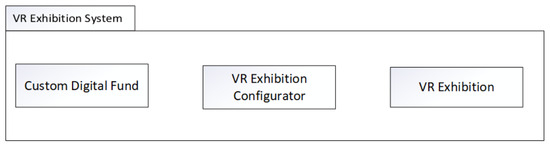
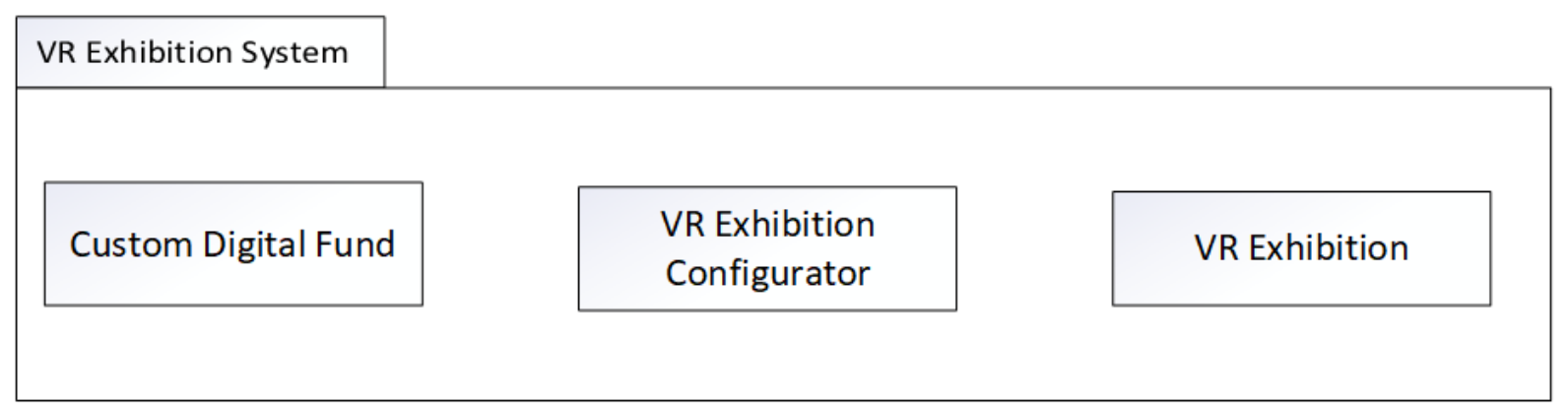
The proposed system consists of three major components, as can be seen in Figure 1:
Figure 1.
System components.
- Custom Digital Fund—a system that allows storage, description, search and download of 3D models of artefacts. This allows museums to describe their private digital funds and make them available as a source for exhibition design. The API of the Custom Digital Fund is protected so that it’s not publicly accessible. But also allows one cultural organization to provide access to its Custom Digital Fund to another cultural organization by generating an authorization access key and sharing it with the other organization.
- VR Exhibition Configurator—an application that allows searching for and downloading 3D models from custom or public databases and arranging them in an exhibition. In other words, an application that is used to design a VR exhibition. The designed exhibition can then be exported to be imported into the VR Exhibition application.
- VR Exhibition—a VR application that allows a user to experience an exhibition prepared using the VR Exhibition Configurator by importing the designed exhibition.
This paper will focus on describing the architecture and algorithms behind the VR Exhibition Configurator application and, to some extent, also on the VR Exhibition application. The Custom Digital Fund system is a fairly simple system with a basic description of artefacts in a database and an API to search for and download artefacts. There are existing systems that approach this in a more extensive way in the context of cultural heritage, like for example [19,20].
3.1. Architecture of the VR Exhibition Configurator Application
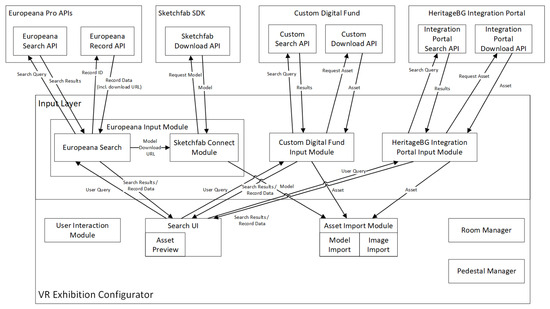
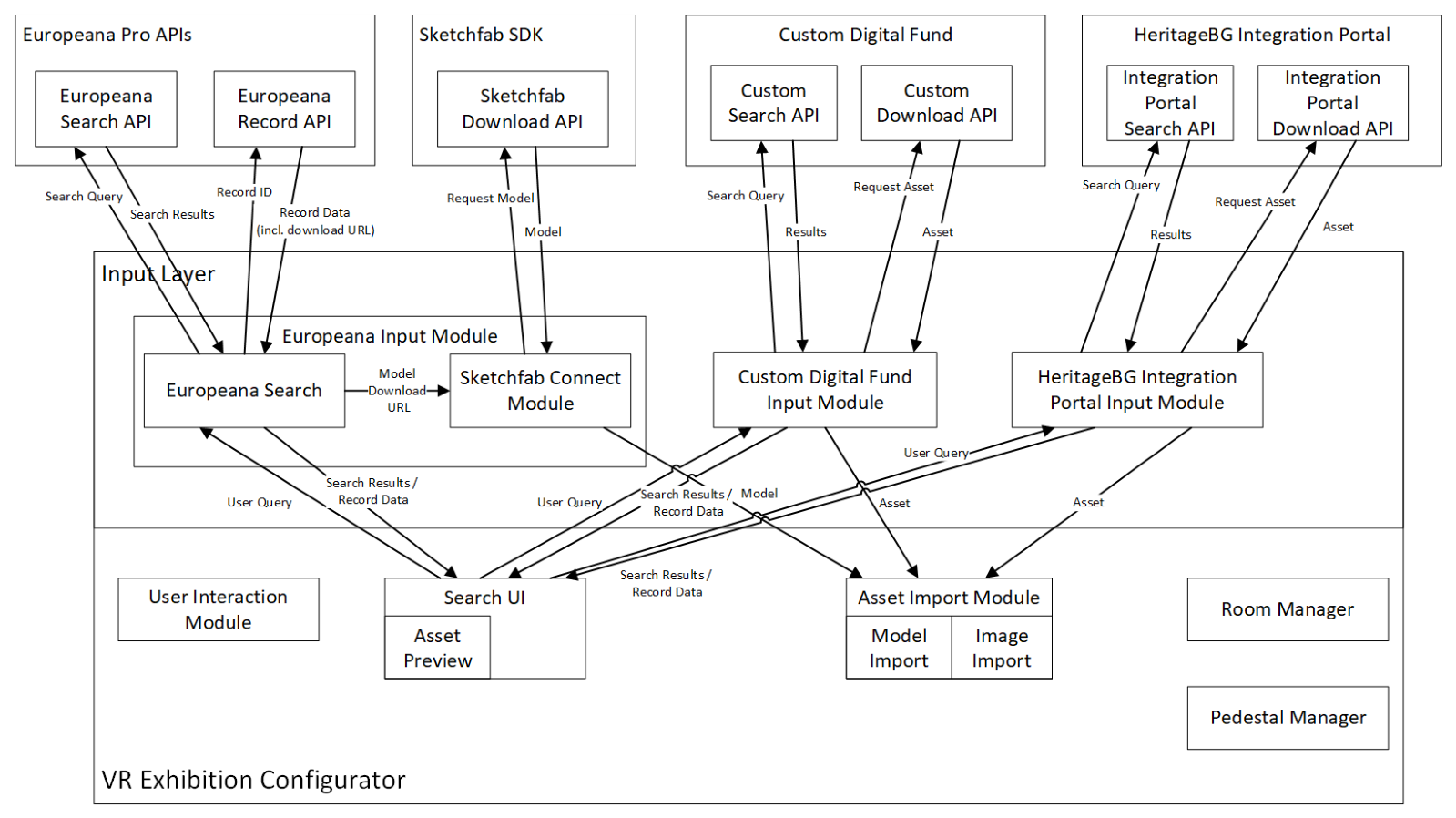
The focus of the VR Exhibition Configurator architecture, as presented in Figure 2 falls on the Input Layer—this layer includes all interfaces to supported repositories. As can be seen in the figure, currently the system supports input from the Europeana Collections with models hosted in Sketchfab, the Custom Digital Fund and the HeritabeBG Integration Portal. Being able to search and download artefacts from another repository requires only the addition of a new input module to the input layer of the application that connects to the respective repository’s search and download API. This happens relatively easily by implementing an ISearch, IRecordInfo and IDownload interfaces. Besides those interfaces, the new module needs a configuration that describes how the requests coming from the input module authenticate with the repository’s API. For example, the Europeana and Custom Digital Fund module authenticate their requests with API keys.
Figure 2.
The architecture of the VR Exhibition Configurator with focus on the Input Layer and Search & Download APIs.
The IRecordInfo interface is necessary in order to unify the presentation of the results from different repositories—an implementation of a Search method from the ISearch interface returns a list of IRecordInfo results that can then be displayed by the Search UI.
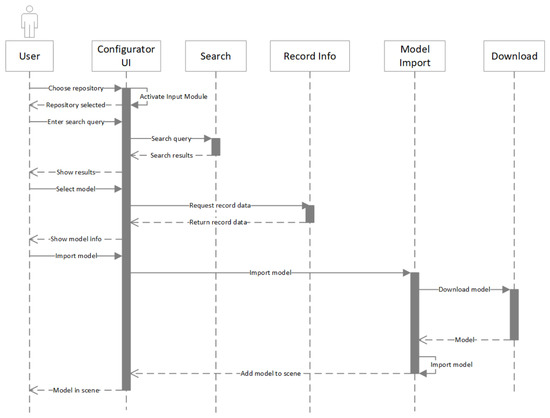
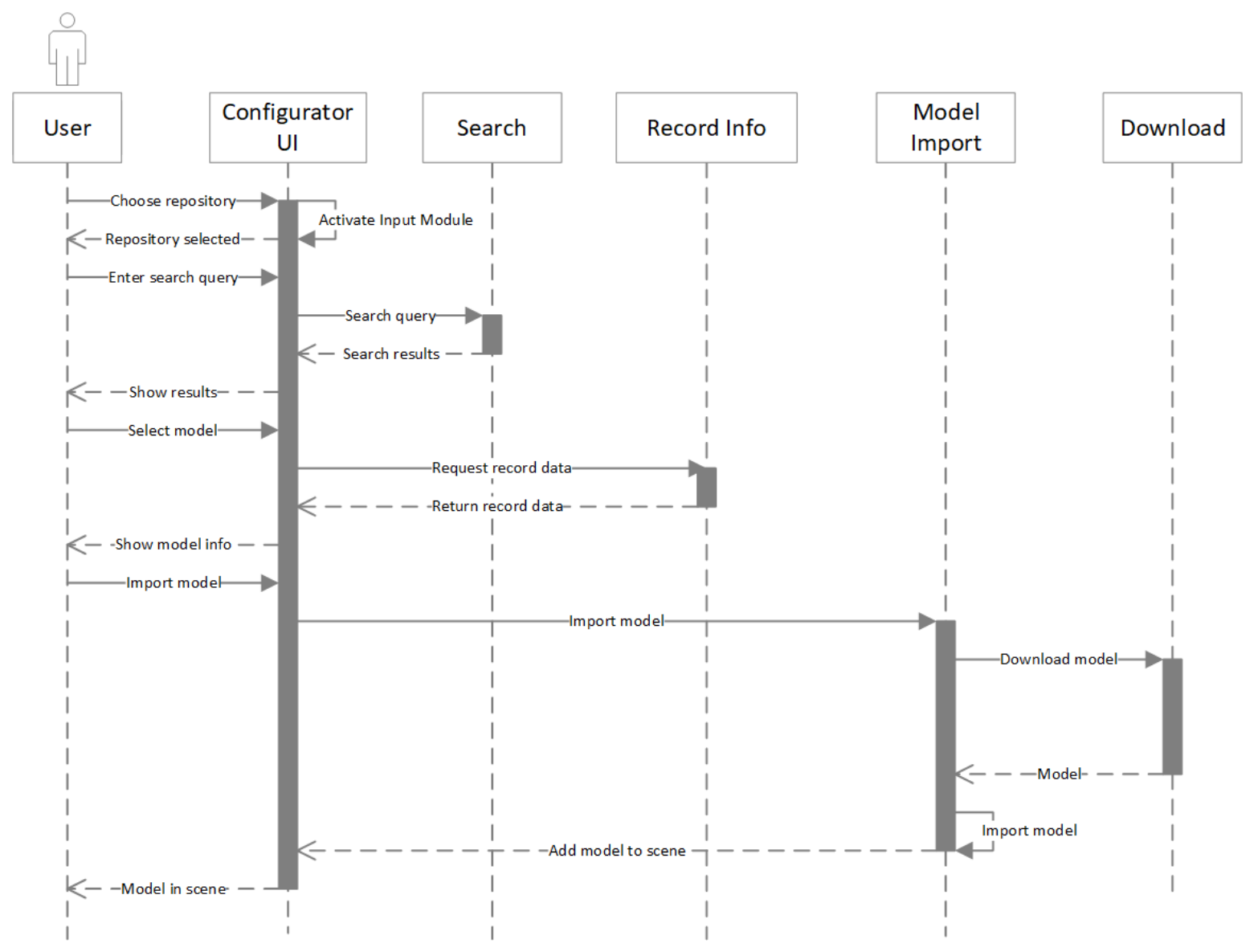
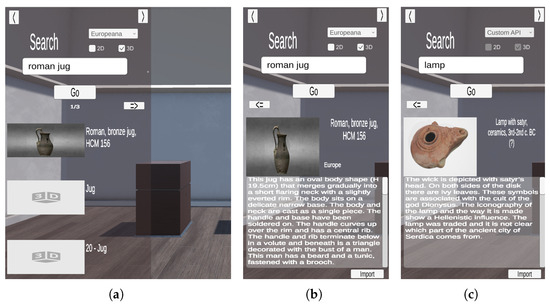
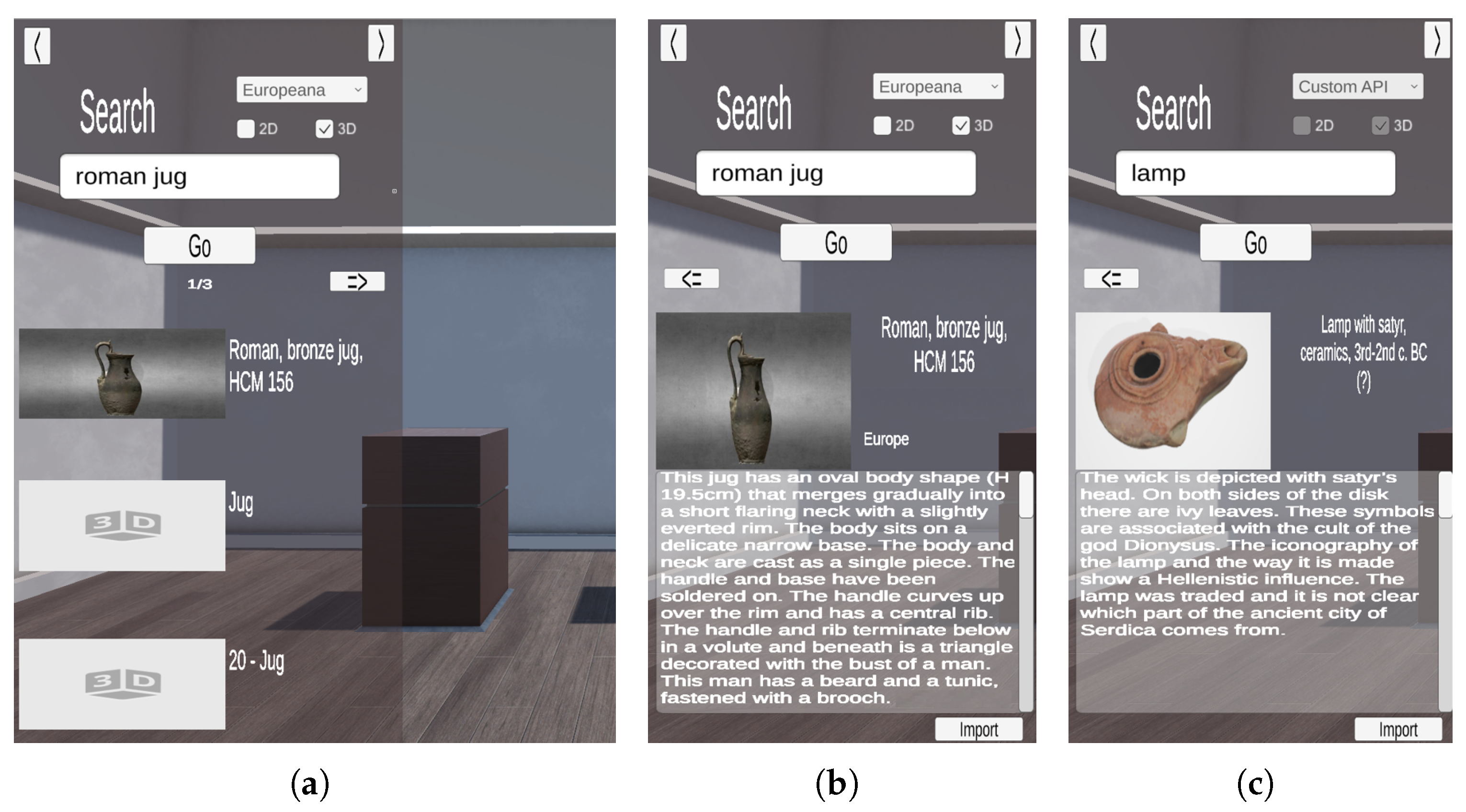
The process of searching for and importing a model to a scene that is being configured is shown in Figure 3—first the user selects a repository. This activates the Input Module associated with the chosen repository. Following search and download operations will be directed through that Input Module. When the user enters a search query, a search is triggered using the Input Module’s ISearch implementation, which returns a list of IRecordInfo objects. When the user selects to view a given search result, the data in that IRecordInfo is used to display available data, i.e., title, description, thumbnail, etc. How this looks in the VR Exhibition Configurator application can be seen from the screenshots in Figure 4. If the user chooses to import the currently viewed model, the model is downloaded using the Input Module’s IDownload implementation, and then imported into the current exhibition configuration. The user can choose to place the model on a pedestal or directly on the floor.
Figure 3.
Process flow for searching for, downloading and importing an artefact.
Figure 4.
An example showing a search in Europeana (a), and artefact record information for a Europeana record (b) and a Custom Digital Fund record (c).
After the user has imported and placed all desired artefacts, they can export the configuration to a file. This file can either be imported into the Configurator application to continue with the exhibition design or into the VR Exhibition application to experience the designed exhibition in VR. The file is encrypted to avoid visibility of endpoints and other possibly sensitive information.
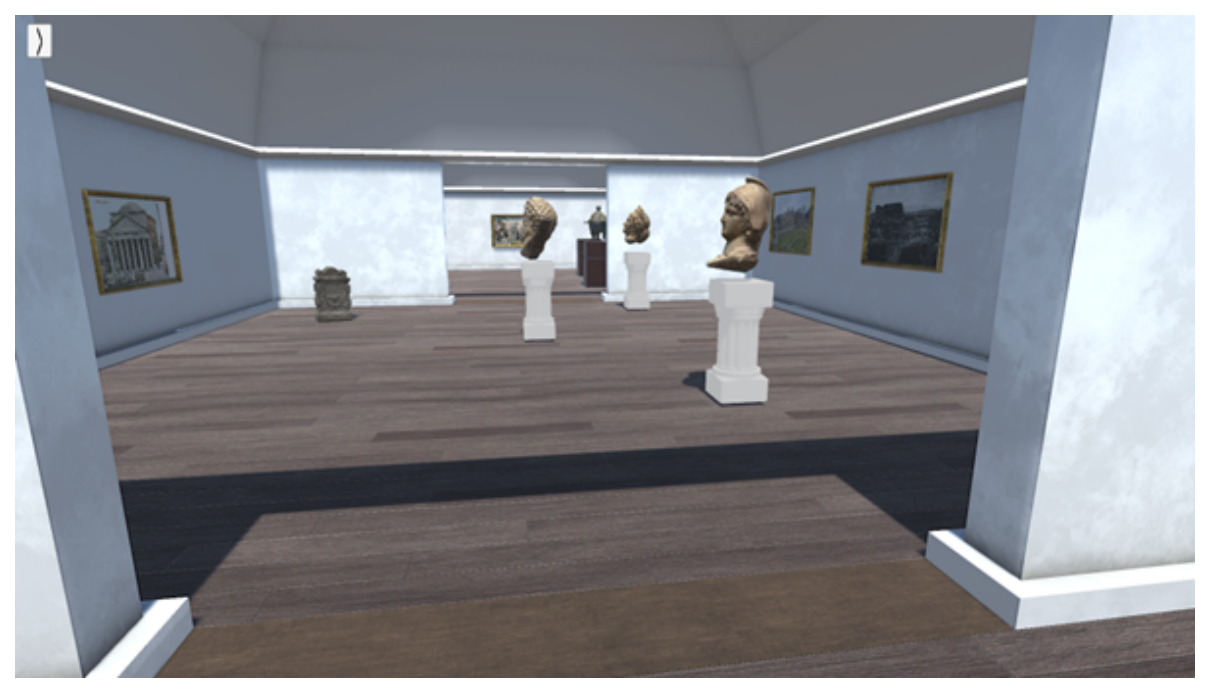
A sample configured exhibition can be seen in Figure 5.
Figure 5.
A sample configured exhibition as seen in the VR Exhibition Configurator application.
3.2. Experiencing an Exhibition in VR
A file exported from the VR Exhibition Configurator application can be imported into the VR Exhibition application. The file does not contain the actual artefacts, i.e., 3D models, but the data where they should be downloaded from, i.e., repository and download URL. This keeps the file small and easy to transfer; for example, it can be provided by a museum to users, i.e., from the museum’s website or by other means, who would then be able to use the VR Exhibition application to experience the exhibition described in the file. This also means that the VR Exhibition application has the same Input Layer, with the same Input Modules, as the VR Exhibition Configurator application.
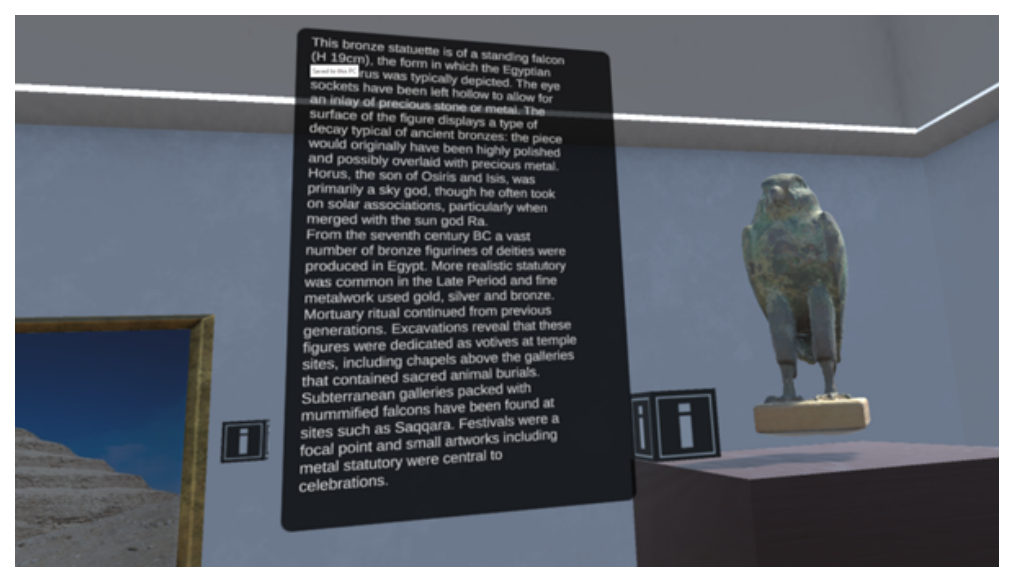
The VR Exhibition application allows the user to move around the exhibition using physical walking as well as teleportation. Artefacts that have an available description have interactable “info” boxes next to them with which users can interact to open/close the description of the respective artefact. Figure 6 shows the user’s view while experiencing an exhibition in VR.
Figure 6.
Experiencing an exhibition in VR.
4. Conclusions
The proposed system, architecture and algorithms allow cultural heritage experts to design their own exhibitions using artefacts from multiple different online repositories, both public and private, without the need for custom application development or any coding abilities. Joint exhibitions between two or more cultural organizations can be developed if collaborating organizations provide each other with access to their digital fund repositories. The system does not use artefact files directly; instead, it uses URLs/API endpoints where those are hosted and authenticated requests to download runtime those artefacts. As a result, cultural organizations can create and share richer, easily accessible interactive VR exhibitions.
Author Contributions
Conceptualization, D.C.; methodology, D.C. and A.T.; software, A.V., D.T. and D.C.; validation, A.V., D.T. and A.T.; resources, A.V. and D.T.; writing—original draft preparation, D.T. and A.V.; writing—review and editing, D.C. and A.T.; visualization, D.T., A.V. and D.C.; supervision, D.C. and A.T.; project administration, A.T.; funding acquisition, A.T. All authors have read and agreed to the published version of the manuscript.
Funding
This research was funded as part of the project BG05M2OP001-1.001-0001 “Creation and development of “Heritage BG” Centre of Excellence” under Operational Programme “Science and Education for Smart Growth”, Priority axis 1 “Research and technological development”, Procedure BG05M2OP001-1.001 “Creation and development of centres of excellence”, Component 4 “New technologies in creative and recreation industries”.
Institutional Review Board Statement
Not applicable.
Informed Consent Statement
Not applicable.
Data Availability Statement
No new data were created or analyzed in this study. Data sharing is not applicable to this article.
Acknowledgments
The authors wish to express their gratitude to the Regional History Museum Sofia for providing 3D models of artefacts to be used during the development of the system.
Conflicts of Interest
The authors declare no conflicts of interest.
Abbreviations
The following abbreviations are used in this manuscript:
| VR | Virtual Reality |
| AR | Augmented Reality |
References
- Schweibenz, W. The virtual museum: An overview of its origins, concepts, and terminology. Mus. Rev. 2019, 4, 1–29. [Google Scholar]
- Cipresso, P.; Giglioli, I.A.C.; Raya, M.A.; Riva, G. The past, present, and future of virtual and augmented reality research: A network and cluster analysis of the literature. Front. Psychol. 2018, 9, 2086. [Google Scholar] [CrossRef] [Scilit] [PubMed]
- Jung, T.; tom Dieck, M.C.; Lee, H.; Chung, N. Effects of Virtual Reality and Augmented Reality on Visitor Experiences in Museum. In Proceedings of the Information and Communication Technologies in Tourism 2016; Inversini, A., Schegg, R., Eds.; Springer International Publishing: Cham, Switzerland, 2016; pp. 621–635. [Google Scholar]
- Partarakis, N.; Grammenos, D.; Margetis, G.; Zidianakis, E.; Drossis, G.; Leonidis, A.; Metaxakis, G.; Antona, M.; Stephanidis, C. Digital Cultural Heritage Experience in Ambient Intelligence. In Mixed Reality and Gamification for Cultural Heritage; Ioannides, M., Magnenat-Thalmann, N., Papagiannakis, G., Eds.; Springer International Publishing: Cham, Switzerland, 2017; pp. 473–505. [Google Scholar] [CrossRef] [Scilit]
- Google Arts and Culture. Available online: https://artsandculture.google.com (accessed on 22 June 2024).
- Inventing Europe: European Digital Museum for Science and Technology. Available online: https://www.inventingeurope.eu (accessed on 22 June 2024).
- Fukuda, T.; Ishibashi, N. Virtual Art Exhibition System: An Implementation Method for Creating an Experiential Museum System in a Virtual Space. In Information Modelling and Knowledge Bases XXXIV; IOS Press BV: Amsterdam, The Netherlands, 2023; Volume 364, pp. 38–47. [Google Scholar] [CrossRef] [Scilit]
- Hornecker, E.; Stifter, M. Learning from interactive museum installations about interaction design for public settings. In Proceedings of the 18th Australia Conference on Computer-Human Interaction: Design: Activities, Artefacts and Environments; Association for Computing Machinery: New York, NY, USA, 2006; OZCHI ’06; pp. 135–142. [Google Scholar] [CrossRef] [Scilit]
- Bonis, B.; Stamos, J.; Vosinakis, S.; Andreou, I.; Panayiotopoulos, T. A platform for virtual museums with personalized content. Multimed. Tools Appl. 2009, 42, 139–159. [Google Scholar] [CrossRef] [Scilit]
- Europeana. Available online: https://www.europeana.eu/ (accessed on 4 July 2024).
- Zidianakis, E.; Partarakis, N.; Ntoa, S.; Dimopoulos, A.; Kopidaki, S.; Ntagianta, A.; Ntafotis, E.; Xhako, A.; Pervolarakis, Z.; Kontaki, E.; et al. The Invisible Museum: A User-Centric Platform for Creating Virtual 3D Exhibitions with VR Support. Electronics 2021, 10, 363. [Google Scholar] [CrossRef] [Scilit]
- Walczak, K.; Cellary, W.; White, M. Virtual museum exbibitions. Computer 2006, 39, 93–95. [Google Scholar] [CrossRef]
- Sketchfab. Available online: https://sketchfab.com/ (accessed on 9 July 2024).
- McMullan, T. Samsung and the British Museum Bring Virtual Reality to the Bronze Age. 2020. Available online: https://www.alphr.com/samsung/1001307/samsung-and-the-british-museum-bring-virtual-reality-to-the-bronze-age/ (accessed on 9 July 2024).
- Bousseta, B. 3D Modeling and Cultural Heritage: Preserving the Past Through Digital Reconstruction. 2023. Available online: https://medium.com/@badreddinebousseta/3d-modeling-and-cultural-heritage-preserving-the-past-through-digital-reconstruction-ce0695260504 (accessed on 9 July 2024).
- Shtybin, V. Historical Reconstruction in VR. 2020. Available online: https://vshtybin.medium.com/historical-reconstruction-in-vr-63eb3358ab55 (accessed on 9 July 2024).
- Styliani, S.; Fotis, L.; Kostas, K.; Petros, P. Virtual museums, a survey and some issues for consideration. J. Cult. Herit. 2009, 10, 520–528. [Google Scholar] [CrossRef] [Scilit]
- Innocente, C.; Ulrich, L.; Moos, S.; Vezzetti, E. A framework study on the use of immersive XR technologies in the cultural heritage domain. J. Cult. Herit. 2023, 62, 268–283. [Google Scholar] [CrossRef] [Scilit]
- Pan, X.; Schröttner, M.; Havemann, S.; Schiffer, T.; Berndt, R.; Hecher, M.; Fellner, D.W. A Repository Infrastructure for Working with 3D Assets in Cultural Heritage. Int. J. Herit. Digit. Era 2013, 2, 143–166. [Google Scholar] [CrossRef] [Scilit]
- Castiglione, A.; Colace, F.; Moscato, V.; Palmieri, F. CHIS: A big data infrastructure to manage digital cultural items. Future Gener. Comput. Syst. 2018, 86, 1134–1145. [Google Scholar] [CrossRef] [Scilit]
Disclaimer/Publisher’s Note: The statements, opinions and data contained in all publications are solely those of the individual author(s) and contributor(s) and not of MDPI and/or the editor(s). MDPI and/or the editor(s) disclaim responsibility for any injury to people or property resulting from any ideas, methods, instructions or products referred to in the content. |
© 2026 by the authors. Licensee MDPI, Basel, Switzerland. This article is an open access article distributed under the terms and conditions of the Creative Commons Attribution (CC BY) license.