


Abstract
The present study examines the influence of plastic deformation on the corrosion behavior of aluminum alloy EN AW-2024 (AlCu4Mg) in an acidic medium (0.5 M H2SO4). Specimens without deformation and with a degree of plastic deformation of 25%, 33% and 50% were studied. Corrosion tests were carried out using the gravimetric method for a period of 72 h. The inhibitory effect of environmental inhibitors—ascorbic acid (vitamin C) and citric acid—was also evaluated. The results show that the degree of plastic deformation has a significant influence on the corrosion rate of the studied alloy. The lowest corrosion rate is observed at 25% deformation, while at higher degrees, the resistance decreases. It was found that citric acid exhibits the highest inhibitory effect at 33% deformation (77.27%), while vitamin C shows a better effect at 50% deformation. The results obtained show that the optimal degree of deformation in combination with a suitable inhibitor can significantly improve the corrosion resistance of EN AW-2024 alloy in acidic environments.
1. Introduction
Aluminum and its alloys are widely used structural materials due to their low density, high strength-to-weight ratio and good corrosion resistance. Due to these properties, they are widely used in the aviation, automotive and marine industries [1,2]. However, aluminum alloys can be subject to local corrosion processes, especially in aggressive environments, which can significantly affect their operational reliability and durability [3,4]. The corrosion behavior of aluminum alloys is determined to a significant extent by their chemical composition and microstructure. Alloys of the Al–Cu–Mg system, such as EN AW-2024, contain intermetallic phases that can act as local cathodic or anodic regions and cause micro-galvanic corrosion processes [5,6]. A number of studies have shown that in acidic environments, corrosion processes in aluminum alloys can be significantly accelerated, leading to faster material failure [6,7]. In particular, the aluminum alloy EN AW-2024 (AlCu4Mg) is widely used in aviation structures due to its high strength and fatigue resistance. However, this alloy has a relatively lower corrosion resistance compared to other aluminum alloys due to the presence of copper-containing intermetallic phases, which can promote localized corrosion and micro-galvanic interactions [7,8]. Many studies have shown that the corrosion behavior of Al-2024 alloy is strongly dependent on microstructural characteristics such as the distribution of intermetallic phases, grain boundaries and surface condition [9,10]. Therefore, the study of factors affecting the corrosion resistance of this alloy is an important scientific and practical task. One of the widely used approaches to limit corrosion is the application of corrosion inhibitors. Organic compounds are among the most effective inhibitors, as they can adsorb onto the metal surface and form a protective film that reduces the corrosion rate [11,12]. The effectiveness of these compounds depends on their molecular structure, adsorption properties and interaction with the metal surface [13,14]. In recent years, there has been increased interest in the use of environmentally safe corrosion inhibitors derived from natural or biodegradable compounds [4,15]. The so-called “green” inhibitors represent an attractive alternative to traditional toxic substances, while at the same time, they can provide high inhibition efficiency [16,17]. Numerous studies have shown that natural compounds, plant extracts and organic molecules can effectively limit the corrosion of aluminum alloys in acidic environments [8,18]. Among the investigated environmental inhibitors, organic acids such as citric acid and ascorbic acid show very good inhibitory properties. These compounds can adsorb on the surface of aluminum and form a protective layer that reduces the rate of corrosion processes [19,20]. A number of studies have confirmed the effectiveness of such organic compounds as corrosion inhibitors in acidic solutions [21,22]. Despite the significant number of studies devoted to the inhibition of corrosion of aluminum alloys, the combined effect of plastic deformation and the use of environmentally safe inhibitors on corrosion behavior remains insufficiently studied. Plastic deformation can significantly change the microstructure of metallic materials by changing the grain size, dislocation density and distribution of secondary phases, which in turn can affect corrosion resistance.
The aim of the present study is to determine the influence of different degrees of plastic deformation (25%, 33% and 50%) on the corrosion behavior of aluminum alloy EN AW-2024 in an acidic environment (0.5 M H2SO4). In addition, the inhibitory effect of environmentally safe corrosion inhibitors—ascorbic acid and citric acid—was investigated by applying the gravimetric method.
2. Materials and Methods
For the purposes of the present study, a commercial EN AW-2024 (AlCu4Mg) aluminum alloy rod with a diameter of 40 mm was used. Its chemical composition is presented in Table 1. Cylindrical specimens with a length of 60 mm were prepared from the rod and subjected to hot plastic deformation.
Table 1.
Chemical composition of EN AW-2024 (AlCu4Mg) aluminum alloy (wt.%).
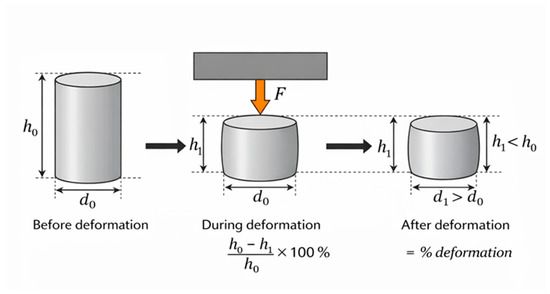
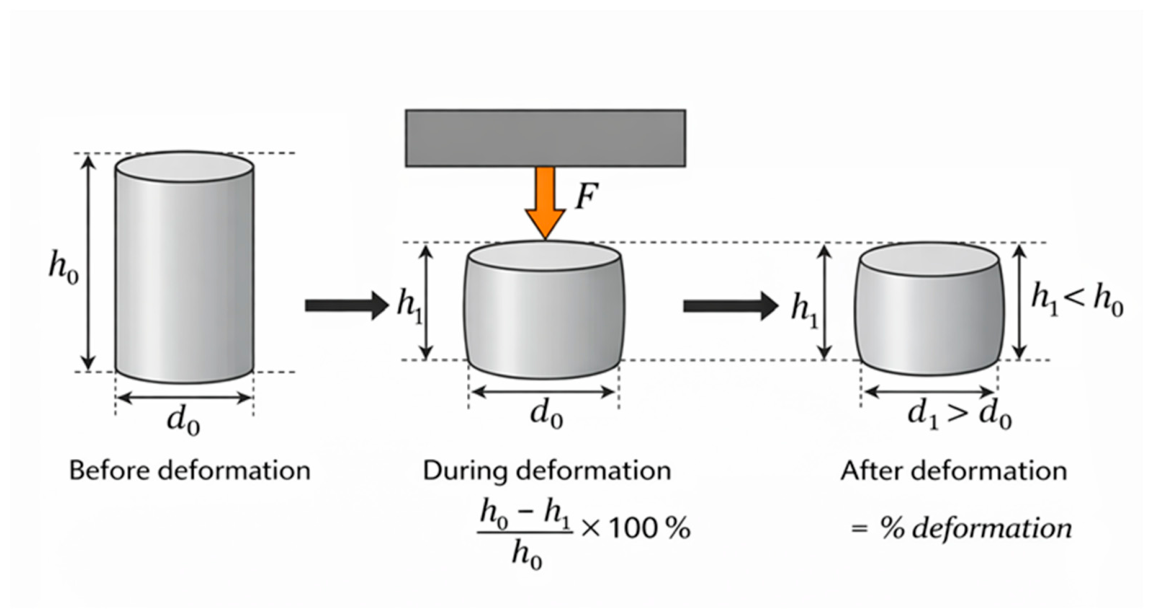
The heating of the specimens prior to deformation was carried out in a laboratory electric resistance chamber furnace, model F20 TE11 (Teheco Ltd., Kostinbrod, Bulgaria), at a temperature of 380 °C for 2 h, in order to ensure uniform heating of the material. A schematic representation of the plastic deformation process (upsetting) is shown in Figure 1.
Figure 1.
Schematic representation of the upsetting process of cylindrical specimens. The applied compressive force is denoted by F, and the arrows indicate the deformation sequence.
During the deformation process, a reduction in the height of the specimens and a corresponding increase in their diameter were observed, assuming volume constancy of the material. The upsetting of the heated specimens was carried out immediately after heating using a SMERAL 1600 t press (Šmeral Brno Inc., Brno, Czech Republic) with a limited ram stroke, where the minimum distance between the deforming plates was 66 mm. As a result of the applied plastic deformation, specimens with different degrees of deformation (25%, 33%, and 50%) were obtained, and their corresponding geometrical dimensions are presented in Table 2. The dimensions were determined assuming volume constancy during plastic deformation.
Table 2.
Calculated geometrical dimensions of the cylindrical specimens after plastic deformation, assuming volume constancy.
After plastic deformation, cylindrical specimens with a diameter of Ø5 mm and a length of L = 10 mm were machined from the deformed billets and used for gravimetric corrosion testing. All specimens were prepared to the same surface roughness (Ra = 1.25 μm) in order to ensure comparable experimental conditions.
The experimental investigations were carried out on EN AW-2024 (AlCu4Mg) aluminum alloy specimens without plastic deformation and with different degrees of plastic deformation, namely, 25%, 33%, and 50% plastic deformation.
To determine the corrosion behavior of the tested samples, a gravimetric study was conducted in a corrosive medium of 0.5 M H2SO4 for a period of 72 h. The obtained data on the corrosion rate were used to evaluate the inhibitory effect of environmentally safe inhibitors—ascorbic acid (vitamin C) and citric acid. The gravimetric method is based on determining the mass loss of the test specimens after exposure to a corrosive medium. Before testing, the samples were cleaned by immersion in ethyl alcohol for 5 min, washed with distilled water, dried and weighed on an Acculab ATILON analytical balance (Sartorius AG, Göttingen Germany) with an accuracy of ±0.0001 g. After the initial weighing, the samples were immersed in 0.5 M H2SO4 at room temperature, both without inhibitors and in the presence of inhibitors. The duration of exposure was 72 h. After completion of the test, the samples were removed from the solution, cleaned with a brush under running water, dried and re-weighed with an accuracy of ±0.0001 g.
Based on the measured mass loss, the corrosion rate (CR) is determined by Equation (1):
where:
m1—initial mass of the sample (g);
m2—mass of the specimen after the corrosion test (g);
S—sample area (m2);
t—exposure time (h).
The obtained CR values were used to evaluate the corrosion behavior of the EN AW-2024 alloy at different degrees of plastic deformation, as well as to determine the effectiveness of the inhibitors used.
The inhibitory effect (η%) was calculated by Equation (2):
where:
CR—corrosion rate of the specimen without an inhibitor;
CR′—corrosion rate of the sample in the presence of an inhibitor.
A metallographic analysis was carried out to study the microstructure of the alloy after plastic deformation. Samples for metallographic analysis were taken from the central region of the specimens along the deformation axis to ensure representative microstructural characterization. The preparation of the microsections for metallographic analysis was carried out according to a standard method: wet grinding on abrasive paper with increasing number from No. 240 to No. 1000 and polishing with diamond paste and lubricant, until a mirror surface of the sections was obtained. The microstructure of the sections thus prepared was revealed with Keller’s reagent (1 part. HF, 1.5 part. HCl, 2.5 part. HNO3, 95 part. H2O) and clarified with HNO3. The study was carried out on a Leica DM ILM microscope (Leica Microsystems GmbH, Wetzlar, Germany).
3. Results
3.1. Corrosion Rate of EN AW-2024 (AlCu4Mg) Alloy Without Plastic Deformation
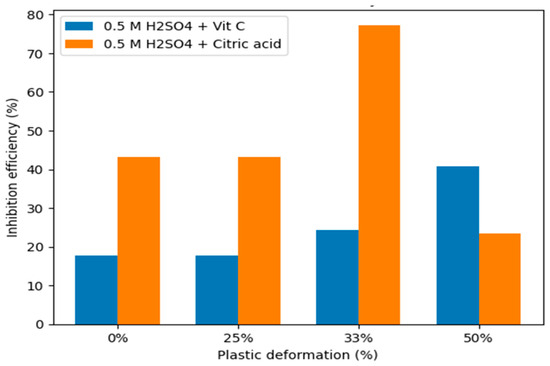
To determine the corrosion behavior of the aluminum alloy EN AW-2024 (AlCu4Mg) without plastic deformation, a gravimetric study was conducted in a 0.5 M H2SO4 corrosion medium for a period of 72 h. The obtained corrosion rate values were used to evaluate the inhibitory effect of vitamin C (Vit C) and citric acid. The results show that the corrosion rate of the alloy EN AW-2024 without plastic deformation in a 0.5 M H2SO4 medium is CR = 0.0118 g·m−2·h−1. In the presence of the inhibitor vitamin C, the corrosion rate decreases to CR = 0.0097 g·m−2·h−1, while when citric acid is added, an even lower value of CR = 0.0067 g·m−2·h−1 is recorded. Based on these results, the inhibitory effect of the substances used was calculated. Vitamin C was found to reduce the corrosion rate by 17.8%, while citric acid showed higher efficiency, with an inhibitory effect reaching 43.22%.
3.2. Corrosion Rate of EN AW-2024 Alloy with 25% Plastic Deformation
The corrosion behavior of alloy EN AW-2024 (AlCu4Mg) with 25% plastic deformation was investigated using the gravimetric method in corrosive medium 0.5 M H2SO4 for a period of 72 h. The obtained results show that the corrosion rate of the alloy with 25% plastic deformation in corrosive medium 0.5 M H2SO4 is CR = 0.0005 g·m−2·h−1. In the presence of vitamin C, the corrosion rate value is CR = 0.0132 g·m−2·h−1, and with the addition of citric acid, CR = 0.0058 g·m−2·h−1. The obtained results show that, at this degree of plastic deformation, no inhibitory effect of either vitamin C or citric acid is observed, since the corrosion rate does not decrease compared to the values in a medium without added inhibitors.
3.3. Corrosion Rate of EN AW-2024 Alloy with 33% Plastic Deformation
In order to determine the corrosion behavior of the EN AW-2024 (AlCu4Mg) alloy with 33% plastic deformation, a gravimetric study was conducted in a corrosive medium of 0.5 M H2SO4 for 72 h. The results show that the corrosion rate of the alloy under these conditions is CR = 0.0066 g·m−2·h−1. In the presence of vitamin C, the corrosion rate decreases to CR = 0.005 g·m−2·h−1, and with the addition of citric acid, it decreases to CR = 0.0015 g·m−2·h−1. The calculated inhibitory effect of vitamin C is 24.24%, while citric acid shows a significantly higher efficiency, with the inhibitory effect reaching 77.27%.
3.4. Corrosion Rate of EN AW-2024 Alloy with 50% Plastic Deformation
The corrosion behavior of alloy EN AW-2024 (AlCu4Mg) with 50% plastic deformation was also investigated using the gravimetric method in 0.5 M H2SO4 corrosion medium for a period of 72 h. The results show that the corrosion rate of the alloy in a medium without added inhibitors is CR = 0.0081 g·m−2·h−1. When vitamin C is added, the corrosion rate decreases to CR = 0.0048 g·m−2·h−1, and in the presence of citric acid, a value of CR = 0.0062 g·m−2·h−1 is reported. The calculated inhibitory effect of vitamin C reaches 40.7%, while with citric acid the inhibitory effect is 23.45%.
3.5. Metallographic Analysis
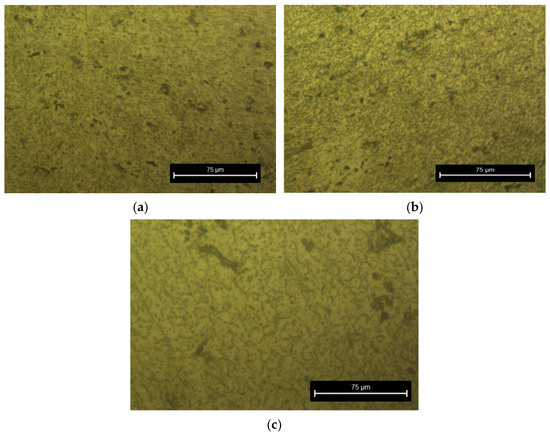
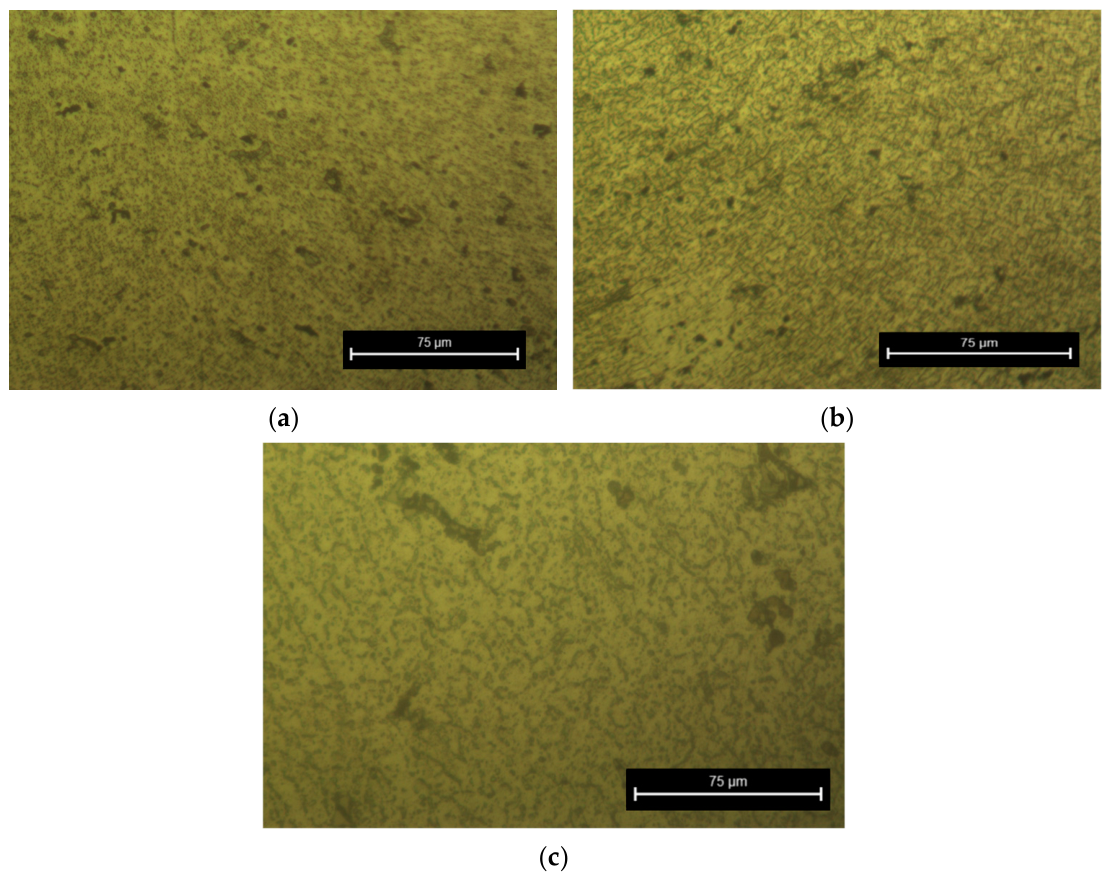
In order to determine the influence of the degree of plastic deformation on the microstructure of the alloy EN AW-2024 (AlCu4Mg), a metallographic analysis was carried out. In the microstructure of a sample with a degree of plastic deformation of 25%, deformed at a temperature of 380 °C, an α-phase is observed, in which the strengthening intermetallic phases are located (Figure 2a). The microstructure of a sample with 33% plastic deformation, presented in Figure 2b, shows the presence of a recrystallized structure formed as a result of the processes of plastic deformation at a temperature of 380 °C. In a sample with 50% plastic deformation, a recrystallized microstructure is also observed (Figure 2c), which indicates that at higher degrees of plastic deformation, intensive structural changes occur in the alloy.
Figure 2.
Microstructure of the EN AW-2024 (AlCu4Mg) alloy after plastic deformation: (a) 25% deformation; (b) 33% deformation; (c) 50% deformation.
Plastic deformation at elevated temperature promotes dynamic recrystallization, resulting in the formation of new, finer, and more equiaxed grains. This accounts for the absence of clearly defined deformation features in the microstructure. Consequently, optical microscopy does not enable a clear differentiation of the structural changes associated with different degrees of plastic deformation.
4. Discussion
The results of gravimetric studies in an acidic medium of 0.5 M H2SO4 show a clear relationship between the degree of plastic deformation and the corrosion rate of the alloy EN AW-2024 (AlCu4Mg). A similar influence of microstructural changes on the corrosion behavior of aluminum alloys has been reported in a number of studies, which emphasize the role of intermetallic phases and defects in the crystal lattice for the formation of local electrochemical microelements [1,2,3]. In the test specimens without plastic deformation, a relatively high corrosion activity was recorded (CR = 0.0118 g·m−2·h−1). This behavior can be explained by the presence of intermetallic particles containing copper, which often act as cathodic sites in relation to the aluminum matrix and stimulate local corrosion processes [6,7]. When the degree of plastic deformation increases to 25%, a sharp decrease in the corrosion rate is observed (CR = 0.0005 g·m−2·h−1). A similar effect may be due to changes in the microstructure of the material, including grain fragmentation and a more uniform distribution of intermetallic phases. Such structural changes may lead to a decrease in the number of active anodic sites and, accordingly, to lower corrosion activity. However, at this degree of deformation, the addition of vitamin C or citric acid does not lead to an improvement in corrosion resistance, and in some cases, even an increase in the corrosion rate is observed. This can be explained by the possible formation of complex compounds between organic molecules and metal ions, which changes the electrochemical balance of the alloy surface [12,13]. At 33% plastic deformation, the corrosion rate increases compared to that at 25% deformation (CR = 0.0066 g·m−2·h−1), but remains lower compared to that of the undeformed material. In this case, the addition of inhibitors leads to a clearly pronounced protective effect. Citric acid shows a particularly high efficiency, for which an inhibitory effect of 77.27% was calculated. This is probably due to the ability of citric acid molecules to adsorb on the metal surface and form a protective adsorption film that limits the course of anodic and cathodic reactions [14,18]. At a degree of plastic deformation of 50%, a repeated increase in the corrosion rate is observed (CR = 0.0081 g·m−2·h−1). This may be associated with the accumulation of dislocations and other defects in the crystal lattice, which increase the number of active centers for electrochemical reactions. An interesting result is observed in the interaction of organic inhibitors with the deformed structure of the alloy. At 50% deformation, vitamin C exhibits a relatively stronger inhibitory effect (40.7%), while the effectiveness of citric acid decreases to 23.45%. This suggests that the adsorption mechanism of organic inhibitors is strongly dependent on the microstructural state of the alloy and the presence of active sites on the metal surface. Figure 3 presents a comparative analysis of the inhibitory effect of vitamin C and citric acid on the corrosion of alloy EN AW-2024 (AlCu4Mg) at different degrees of plastic deformation in a 0.5 M H2SO4 environment for 72 h. The overall analysis of the results obtained shows that the effectiveness of organic inhibitors depends on both the chemical nature of the inhibitor and the microstructural state of the material.
Figure 3.
Inhibition effect of vitamin C and citric acid on the corrosion of EN AW-2024 (AlCu4Mg) alloy with plastic deformation in 0.5 M H2SO4 after 72 h.
This confirms that structural changes induced by plastic deformation can significantly affect the adsorption of organic molecules on the metal surface and, accordingly, the effectiveness of corrosion inhibition.
5. Conclusions
Based on the conducted gravimetric studies and microstructural analysis of the aluminum alloy EN AW-2024 (AlCu4Mg), the following main conclusions can be made:
The degree of plastic deformation has a significant impact on the corrosion resistance of the studied alloy. The lowest corrosion rate was found at 25% plastic deformation, while at a higher degree of deformation (50%), an increase in corrosion activity was observed, probably due to the accumulation of structural defects in the crystal lattice.
Organic inhibitors—vitamin C and citric acid—exhibit different levels of effectiveness depending on the microstructural state of the alloy. Citric acid shows higher inhibitory efficiency in the undeformed alloy and at moderate plastic deformation (33%), while vitamin C exhibits a better protective effect at higher degrees of deformation (50%).
The results obtained show that vitamin C and citric acid can be successfully used as environmentally safe corrosion inhibitors for the protection of EN AW-2024 aluminum alloy in an acidic environment under the studied experimental conditions.
From a practical point of view, optimal corrosion resistance of EN AW-2024 alloy can be achieved at a degree of plastic deformation in the range of 25–33%, and the choice of a suitable organic inhibitor should be consistent with the structural state of the material.
Author Contributions
Conceptualization, D.D. and B.D.; methodology, K.K.; software, T.S.; validation, B.D. and K.K.; formal analysis, D.D.; investigation, D.D.; resources, K.K.; data curation, T.S.; writing—original draft preparation, D.D.; writing—review and editing, B.D.; visualization, D.D.; supervision, K.K.; project administration, B.D.; funding acquisition, T.S. All authors have read and agreed to the published version of the manuscript.
Funding
This research was funded by the European Regional Development Fund within the OP “Research, Innovation and Digitalization Programme for Intelligent Transformation 2021–2027”, Project No. BG16RFPR002-1.014-0005 Center of competence “Smart Mechatronics, Eco- and Energy Saving Systems and Technologies”.
Institutional Review Board Statement
Not applicable.
Informed Consent Statement
Not applicable.
Data Availability Statement
Data will be made available on request.
Acknowledgments
The authors gratefully acknowledge the technical support provided by the Center of Competence “Smart Mechatronic, Eco- and Energy-Saving Systems and Technologies”.
Conflicts of Interest
The authors declare no conflicts of interest.
References
- Frankel, G.S. Pitting corrosion of metals: A review of the critical factors. J. Electrochem. Soc. 1998, 145, 2186–2198. [Google Scholar] [CrossRef] [Scilit]
- Rani, B.E.A.; Basu, B.B.J. Green inhibitors for corrosion protection of metals. Int. J. Corros. 2012, 2012, 380217. [Google Scholar] [CrossRef] [Scilit]
- Méndez, C.M.; Gervasi, C.A.; Pozzi, G.; Ares, A.E. Corrosion Inhibition of Aluminum in Acidic Solution by Ilex paraguariensis (Yerba Mate) Extract as a Green Inhibitor. Coatings 2023, 13, 434. [Google Scholar] [CrossRef] [Scilit]
- Galleguillos Madrid, F.M.; Soliz, A.; Cáceres, L.; Bergendahl, M.; Leiva-Guajardo, S.; Portillo, C.; Olivares, D.; Toro, N.; Jimenez-Arevalo, V.; Páez, M. Green Corrosion Inhibitors for Metal and Alloys Protection in Contact with Aqueous Saline. Materials 2024, 17, 3996. [Google Scholar] [CrossRef] [Scilit] [PubMed]
- Yousef, T.A.; Hussein, R.K.; Alhamzani, A.G.; Al-Enazi, A.T.; AL-Osimi, M.B.; Abou-Krisha, M.M. Environment-Friendly Corrosion Inhibitors for Aluminum in Hydrochloric Acid: Quantum and Experimental Research. Metals 2022, 12, 1538. [Google Scholar] [CrossRef] [Scilit]
- Fabris, R.; Masi, G.; Bignozzi, M.C. Corrosion Behavior of Aluminum Alloys in Different Alkaline Environments: Effect of Alloying Elements and Anodization Treatments. Coatings 2024, 14, 240. [Google Scholar] [CrossRef] [Scilit]
- Obot, I.B.; Obi-Egbedi, N.O.; Umoren, S.A. Adsorption characteristics and corrosion inhibitive properties of clotrimazole for aluminum corrosion in hydrochloric acid. Int. J. Electrochem. Sci. 2009, 4, 863–877. [Google Scholar] [CrossRef] [Scilit]
- Umoren, S.A.; Solomon, M.M. Effect of halide ions on the corrosion inhibition efficiency of different organic compounds for aluminum in acidic media. J. Ind. Eng. Chem. 2015, 21, 81–100. [Google Scholar] [CrossRef] [Scilit]
- Bentiss, F.; Traisnel, M.; Lagrenée, M. The substituted 1,3,4-oxadiazoles: A new class of corrosion inhibitors of mild steel in acidic media. Corros. Sci. 2000, 42, 127–146. [Google Scholar] [CrossRef] [Scilit]
- Obot, I.B.; Obi-Egbedi, N.O. Adsorption properties and inhibition of aluminum corrosion in acidic media. Corros. Sci. 2010, 52, 198–204. [Google Scholar] [CrossRef] [Scilit]
- Amin, M.A.; Khaled, K.F.; Fadl-Allah, S.A. Testing validity of the Tafel extrapolation method for monitoring corrosion of aluminum in hydrochloric acid solutions—Experimental and theoretical studies. Corros. Sci. 2010, 52, 140–151. [Google Scholar] [CrossRef] [Scilit]
- Al-Amiery, A.A.; Kadhum, A.A.H.; Mohamad, A.B.; Musa, A.Y. Corrosion inhibition of aluminum alloy in acidic medium using Schiff base compounds. IOP Conf. Ser. Mater. Sci. Eng. 2021, 1107, 012066. [Google Scholar] [CrossRef] [Scilit]
- Kaya, S.; Kaya, C.; Guo, L.; Kandemirli, F. Quantum chemical investigation of corrosion inhibitors. J. Mol. Struct. 2021, 1230, 129879. [Google Scholar] [CrossRef] [Scilit]
- Popova, A.; Sokolova, E.; Raicheva, S.; Christov, M. AC and DC study of corrosion inhibition. Corros. Sci. 2003, 45, 33–58. [Google Scholar] [CrossRef] [Scilit]
- Palumbo, G.; Berent, K.; Proniewicz, E.; Banaś, J. Guar Gum as an Eco-Friendly Corrosion Inhibitor for Pure Aluminium in 1-M HCl Solution. Materials 2019, 12, 2620. [Google Scholar] [CrossRef] [Scilit] [PubMed]
- Kadhim, A.; Al-Amiery, A.A.; Kadhum, A.A.H.; Mohamad, A.B. Eco-friendly organic inhibitors for enhancing the corrosion resistance of Al-2024 alloy. Mater. Today Commun. 2026, 12, 63. [Google Scholar] [CrossRef] [Scilit] [PubMed]
- Al-Amiery, A.A.; Isahak, W.N.R.W.; Al-Azzawi, W.K. Corrosion Inhibitors: Natural and Synthetic Organic Inhibitors. Lubricants 2023, 11, 174. [Google Scholar] [CrossRef] [Scilit]
- Valbon, A.; Xavier, N.F., Jr.; Carlos, M.F.L.P.; Bauerfeldt, G.F.; Almeida-Neto, F.W.Q.; de Lima-Neto, P.; Neves, M.A.; Rodrigues-Santos, C.E.; Echevarria, A. The Corrosion Inhibition Performance of Eco-Friendly bis-Schiff Bases on Carbon Steel in a Hydrochloric Solution. Surfaces 2023, 6, 509–532. [Google Scholar] [CrossRef] [Scilit]
- Solmaz, R.; Kardas, G.; Yazici, B.; Erbil, M. Citric acid as corrosion inhibitor for aluminum in acidic solution. Electrochim. Acta 2008, 53, 5941–5948. [Google Scholar] [CrossRef] [Scilit]
- Anejjar, A.; Salghi, R.; Zarrouk, A.; Hammouti, B. Inhibition of aluminum corrosion by vitamin C. J. Mater. Environ. Sci. 2017, 8, 411–420. [Google Scholar]
- Raja, P.B.; Sethuraman, M.G. Natural products as corrosion inhibitor for metals in corrosive media—A review. Mater. Lett. 2008, 62, 113–116. [Google Scholar] [CrossRef] [Scilit]
- Răuță, D.-I.; Matei, E.; Avramescu, S.-M. Recent Development of Corrosion Inhibitors: Types, Mechanisms, Electrochemical Behavior, Efficiency, and Environmental Impact. Technologies 2025, 13, 103. [Google Scholar] [CrossRef] [Scilit]

Disclaimer/Publisher’s Note: The statements, opinions and data contained in all publications are solely those of the individual author(s) and contributor(s) and not of MDPI and/or the editor(s). MDPI and/or the editor(s) disclaim responsibility for any injury to people or property resulting from any ideas, methods, instructions or products referred to in the content. |
© 2026 by the authors. Licensee MDPI, Basel, Switzerland. This article is an open access article distributed under the terms and conditions of the Creative Commons Attribution (CC BY) license.