


Abstract
As education embraces digital transformation, integrating AI into pedagogy is increasingly important. One promising innovation is AI-generated 3D models, which help visualize complex concepts, enhance spatial reasoning, and foster creativity. Unlike traditional 3D modeling, which requires advanced skills and time, AI tools make content creation more accessible to educators and students. This study develops and validates a structured methodology for using AI-generated 3D models in education. It supports personalized, rapid, and intuitive content development, particularly in STEM. The framework includes guidelines for effective text-to-3D prompts, validation of educational impact, and a roadmap toward immersive technologies like VR, AR, and digital twins, enabling scalable, student-centered learning experiences.
1. Introduction
Technological innovation continues to redefine pedagogical practice, making it essential for educators to adapt their methodologies [1,2]. Using various technological implementations of artificial intelligence (AI) in education has shown significant potential as a tool for personalizing the learning experience and encouraging active participation [3]. The study [4] proposes an integrated data representation model with multifaceted functions aimed at enhancing the teaching of art appreciation. The results of the proposed approach in [5] for embedding AI rendering to enrich architectural education show that it encourages creative research of architecture students. Among emerging technologies, AI-generated 3D modeling is particularly potent for its capacity to simplify visualization, enrich interaction, and democratize content creation. The relationship between AI-physical products and AI-digital products in the design process is investigated in [6].
Traditionally, 3D modeling has been restricted to users with significant technical skill in tools like Blender (v4.1) or CAD software. However, AI-based generators—capable of translating text prompts into detailed models—lower the entry barrier, making sophisticated 3D content creation accessible even to novices. This article presents a research-based, practical methodology to guide educators in leveraging this potential across disciplines.
This paper proposes a structured methodology for integrating AI-generated 3D content into educational contexts. Grounded in empirical evidence and pedagogical theory, the framework emphasizes rapid prototyping, creative engagement, and scalability across disciplines, especially in STEM education.
2. Rationale and Technological Imperatives
A number of studies note that with the development of digital technologies, new learning processes have emerged that require the application of different competencies on both sides of the educational process. For the digitally savvy generation, communicating in a technology-mediated interactive environment is very common. But to create engagement and facilitate student-centered interactions, the ability to effectively use digital tools is essential [7]. AI-generated 3D models allow students to explore complex concepts in an engaging way, and bridge the gap between theory and practice. Technological advancements in AI and 3D modeling create a rational base for integrating these tools into educational settings.
AI-generated 3D models could offer significant benefits over manual modeling or free model repositories in several aspects:
- Speed: Models are produced in minutes from simple prompts;
- Customization: Tailored models suited to specific curriculum goals;
- Creativity: Encourages student exploration and design thinking;
- Licensing: Avoids complications associated with third-party model libraries.
AI-generated 3D models are well suited for a number of educational applications, for example, in STEM subjects [8], anatomical models in biology can be visualized in 3D. In chemistry, various molecular structures can be constructed, and in mathematics, geometric bodies are represented spatially. In History and Geography subjects, numerous cultural artifacts, historical reconstructions, topographic maps are appropriate for 3D modeling. And furniture, tools, and simulation environments in the classroom are considered as general educational tools.
In summary, the use of AI for 3D modeling in education could reduce the time required to generate 3D content, providing speed and accessibility. By reducing skill barriers, complexities can be removed, allowing even novice users to create 3D models. 3D models for curriculum integration are particularly effective in STEM subjects, supporting creativity, design thinking, and exploration. They are applicable in various educational scenarios. And finally, using generative artificial intelligence for 3D modeling avoids licensing issues with pre-made models.
All this encouraged us to propose a methodology to integrate AI into existing learning environment to increase personalized learning outcomes. The following sections explain it in detail.
3. Materials and Methods
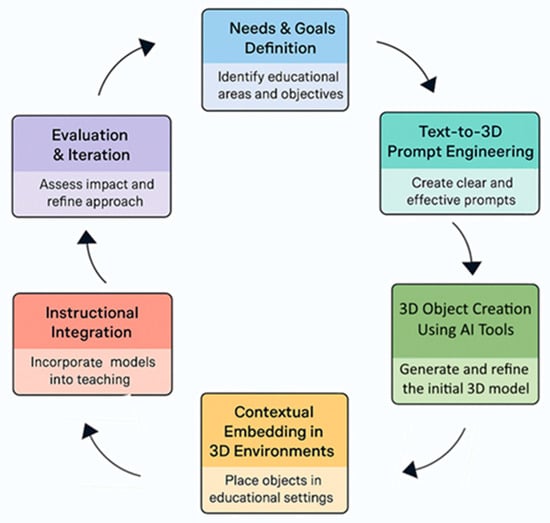
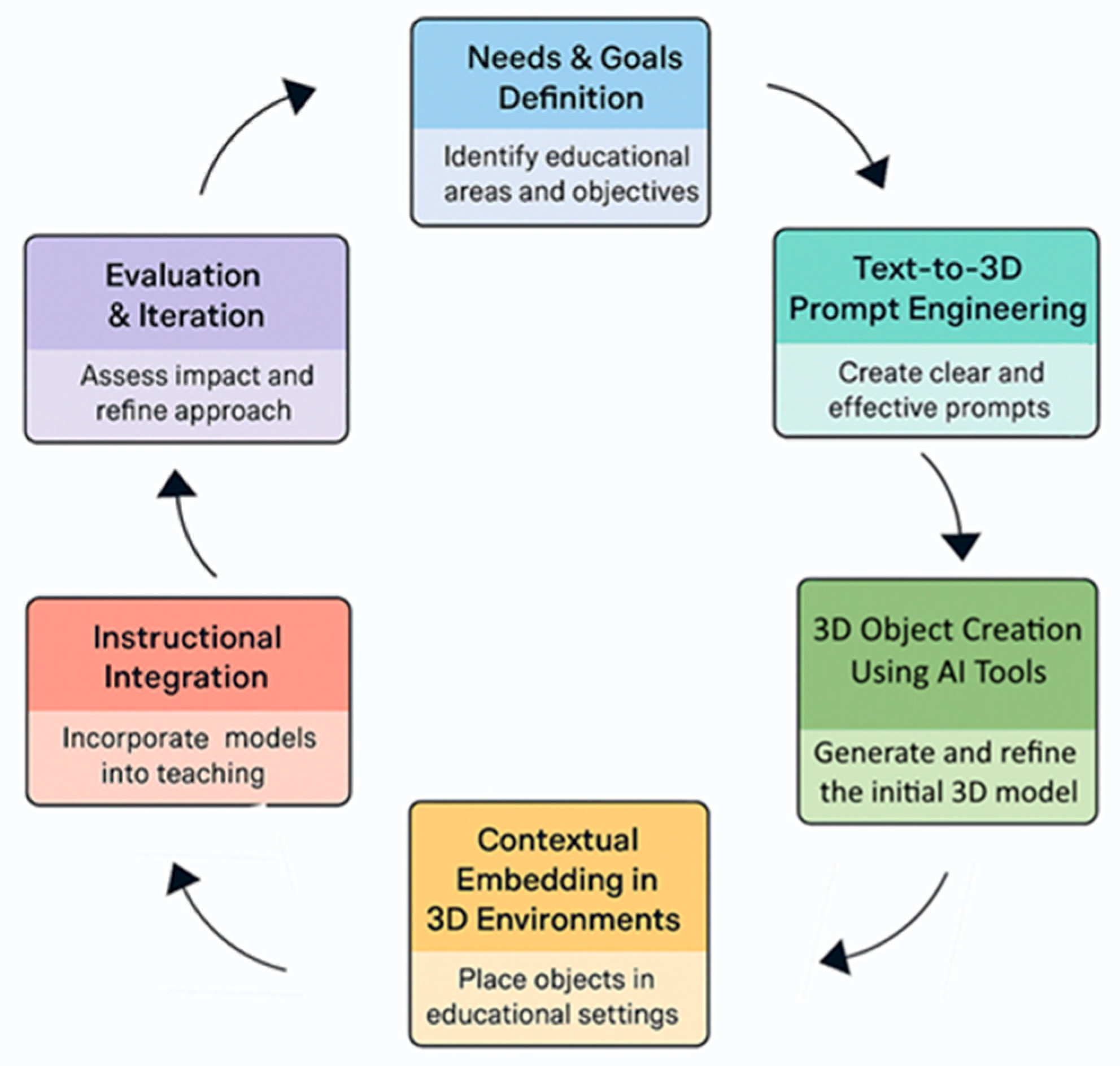
The methodology is presented as a cyclic, six-stage model.
3.1. The AI–3D Educational Integration Cycle
3.1.1. Stage 1: Needs Analysis and Goal Definition
Identify content areas benefiting from spatial visualization. Define pedagogical objectives (e.g., comprehension, engagement) and specify model attributes (interactivity, fidelity, context relevance).
3.1.2. Stage 2: Prompt Engineering for Text-to-3D Generation
Create prompts that meet clear criteria:
- Explicit object description;
- Key visual attributes;
- Intended use case;
- Scale and proportion;
- Avoid conflicting terms.
Example: “A realistic 3D model of a DNA double helix with color-coded base pairs, suitable for high school biology.”
For this stage, we suggest the following Prompt template:
“A [style] [object] made of [material], featuring [key details or function], suitable for [context or use case].”
Example:
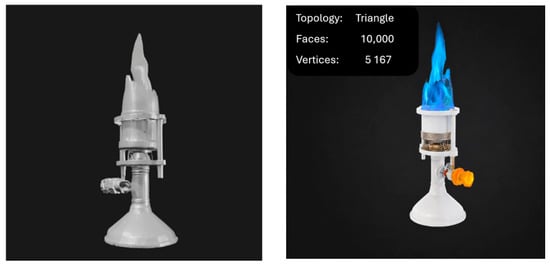
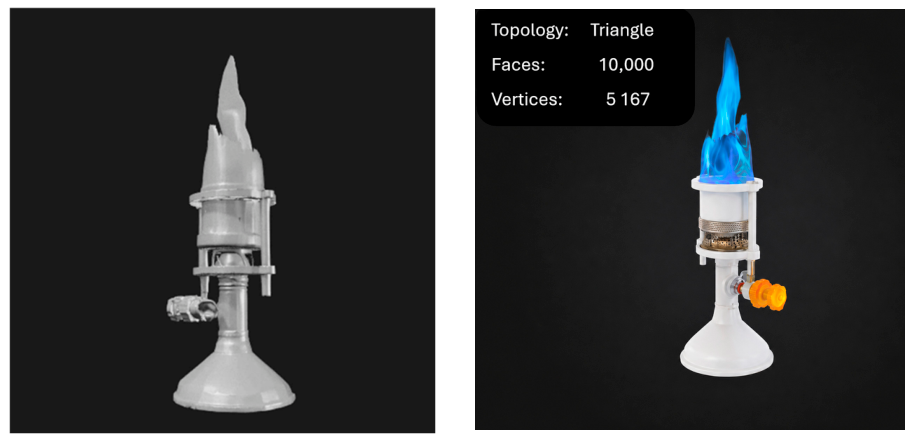
“A realistic model of a laboratory Bunsen burner with metal base, gas valve, and flame, suitable for science class simulations.”
3.1.3. Stage 3: 3D Object Creation Using AI Tools
Utilize AI platforms such as Meshy.ai (https://www.meshy.ai (accessed on 5 May 2025)), Luma AI (https://lumalabs.ai/ (accessed on 5 May 2025)), or Leonardo AI (https://leonardo.ai (accessed on 5 May 2025)) to generate the initial 3D model. Use Blender with AI plugins for further refinement, texturing, and optimization.
The result is shown in Figure 1.
Figure 1.
3D object creation using AI tools.
3.1.4. Stage 4: Embedding Models into Interactive Environments
Incorporate models into larger educational contexts—e.g., a virtual classroom, physics lab, or ecosystem. Develop immersive 3D scenes in Unity (v2022.3 LTS) or WebGL (https://www.khronos.org/webgl/ (accessed on 5 May 2025)). Optionally integrate AR/VR elements for enhanced interactivity. The embedding of the generated 3D models into interactive environments is shown in Figure 2.
Figure 2.
Embedding models into interactive environments.
3.1.5. Stage 5: Instructional Integration
- Aligning the 3D content with lesson plans, learning modules, or project-based assignments;
- Delivering through smartboards, VR headsets, or web portals;
- Encouraging students to co-create or customize models to support constructivist learning.
3.1.6. Stage 6: Evaluation and Iteration
Assessing efficacy using:
- Time-on-task and completion speed;
- Student engagement (surveys, interviews);
- Learning outcomes (quizzes, comprehension tests);
- System Usability Scale (SUS) for teacher ease-of-use.
Iterate based on feedback to enhance model quality, instructional alignment, or student experience. A simplified representation of the methodology, converted into a visual diagram, is shown in Figure 3.
Figure 3.
Simplified representation of the methodology turned into a visual diagram. Clockwise arrows indicate the sequential progression through the cycle, and colors are used for visual differentiation of the stages.
3.2. Extending the Methodology with AI and Virtual Reality (VR)
To further enrich the learning experience, the proposed methodology can be integrated with Virtual Reality (VR), powered by AI-driven content and analytics. This combination brings immersive, interactive, and adaptive educational environments to life. Our previous studies of the impact of AR/VR tools on students’ learning performance have shown increases in both students’ learning achievements and their motivation to learn [9,10].
The enhancing of the methodology with AR/VR is achieved by taking these factors into account:
- Immersive Learning: AI-generated 3D models can be placed into VR scenes, allowing students to explore anatomical structures, physical systems, or historical reconstructions in 360° environments;
- Adaptive Experiences: AI can track student interactions in VR (e.g., time spent on a task, focus, errors) and adjust the difficulty level or suggest targeted resources in real time;
- Scenario-Based Learning: VR enables simulated labs, field trips, or social science scenarios (e.g., exploring an ancient city), all populated with AI-generated models;
- Spatial Reasoning Development: VR enhances students’ ability to understand spatial relationships— which is especially valuable in STEM subjects like geometry, physics, and biology.
The sample workflow follows this sequence of actions:
- Prompt Generation: Teacher creates a prompt (“A 3D model of a plant cell for VR biology lab”);
- AI Model Creation: AI tool generates the model, refined in Blender if needed;
- VR Embedding: Model is placed in a Unity/Unreal Engine environment configured for VR;
- Classroom Integration: Students explore the model using headsets, completing tasks or simulations;
- AI Analytics: Performance and engagement data are logged and analyzed for personalized feedback.
4. Results
4.1. Experimental Setup
A small-scale pilot study to test the methodology was conducted in a Bulgarian secondary school. A controlled study was led with 20 school students split into control and experimental groups:
- Ten high school students in control group (traditional modeling);
- Ten high school students in experimental (AI-assisted modeling).
Additionally, six students were involved as game developers. The overall management of the experiment was carried out under the supervision of six STEM teachers and three IT teachers.
As software tools for the study, the control group used Blender, and the experimental group used Blender + AI tools. The educational task was formulated as “Design a biological model (e.g., human heart)”.
4.2. Tools and Platforms
- Modeling: Blender, Meshy.ai, Luma AI;
- VR Development: Unity + XR Interaction Toolkit (v2.5), Unreal Engine (v5.3), Mozilla Hubs (https://hubs.mozilla.com (accessed on 5 May 2025));
- Analytics: Python (v3.12.2; Pandas v2.2.0; Scikit-learn v1.4.0), Unity Analytics;
- Delivery: Oculus Quest 2 (Meta Platforms Inc., Menlo Park, CA, USA), HTC Vive (HTC Corp., Taoyuan, Taiwan), or WebVR-compatible browsers.
4.3. Research Questions
Our study asks four focused research questions (RQ):
- RQ1: Is using AI tools + Blender really faster than just modeling straight in Blender?
- RQ2: Why use AI-generated 3D models instead of free downloads?
- RQ3: When might free models still be best?
- RQ4: What criteria should a text-to-3D prompt meet?
Regarding RQ1, our findings show that as the combination of AI + Blender is faster, students have a quick starting point; they do not need to build the model from scratch. This advantage is obvious when the model is complex or organic (such as creatures, props, or complex shapes) that are tedious to model by hand. Furthermore, AI can generate variations quickly, so students get ideas or inspiration faster and easier. This combination allows for saving time on blocking shapes for non-expert modelers. And it helps in planning for later refinement and customization of the model in Blender.
The reason for using AI-generated 3D models instead of free downloads (addressing RQ2) is the possibility for customization and uniqueness. AI creates models tailored exactly to the specified prompt, resulting in unique designs, styles, or concepts that cannot be found in free libraries. AI gives speed and flexibility, allowing for quick generation of models for ideas that do not exist yet instead of hunting through dozens of sites and downloads. Also, AI can produce unexpected variations or creative twists that inspire new directions, stimulating creative exploration. With no licensing hassles, AI-generated assets can be owned outright (depending on tool terms) because many free models have complex licenses or require attribution. Rapid prototyping with the AI model is useful, which is ideal for quickly creating concepts when only a placeholder or a basis for later modification is needed. Moreover, free libraries may not offer anything that meets the specific or unusual requirement.
As for RQ3, free models are probably still best suited when highly detailed, production-ready assets are needed without cleanup. Free models are a good choice, especially for games or VR, where well-tested and optimized models are needed. The same applies when standardized or licensed assets are needed for commercial use, or when working with common objects easily found in asset libraries.
To answer RQ4, the characteristics of a good text-to-3D prompt have to be considered (Table 1). Examples of text-to-3D prompt cheat sheets for education are given in Table 2. Using adjectives helps with visualization, such as elegant, bulky, matte, transparent, curved, modular, sturdy, shiny, vintage, mechanical, educational, industrial, cartoonish, ergonomic, etc.
Table 1.
Characteristics of a good text-to-3D prompt.
Table 2.
Text-to-3D prompt cheat sheets for education.
4.4. Findings Summary
Our findings can be summarized as:
- AI-assisted students completed models 1.5 × faster;
- Slightly lower anatomical accuracy was offset by higher creativity and usability;
- Students reported higher engagement, citing ease and enjoyment;
- Post-intervention tests showed marginally better conceptual understanding in the experimental group.
5. Discussion
The use of modern, advanced technological tools in education poses its challenges to both teachers and students. Professional development is essential for teachers to successfully use AI tools and align them with curricular objectives [11]. Educators must fundamentally adapt how they design and deliver instruction [12]. Insufficient training of teachers is reflected in poor prompt design by educators. The software tools themselves are constantly being improved [13]. Their imperfection requires overcoming the limitations of access to VR/AR hardware. Inconsistent AI output quality requires post-processing with Blender and using of quality prompt design. Last but not least, there are concerns about data privacy, which is why it is recommended to use anonymous data [14] and comply with GDPR/FERPA.
To achieve scalability and support future integration, we propose transitioning to a digital twin architecture capable of real-time monitoring and predictive analytics [15]. As a natural extension of this methodology, institutions can develop interactive digital twins—dynamic, data-driven representations of learning environments and student models. Possible applications include:
- Smart Classrooms: Real-time sensor integration (e.g., CO2, temperature) for responsive environments;
- Student Modeling: AI-based tracking of engagement and academic performance;
- STEM Simulations: Interactive science labs with AI feedback loops;
This integration not only enhances engagement but also supports differentiated learning, data-driven instruction, and advanced skill development like critical thinking and problem-solving.
6. Conclusions
AI-generated 3D modeling stands as a transformative approach to educational content creation. It accelerates development, fosters engagement, and supports individualized learning. Through structured integration, effective prompt design, and iterative evaluation, schools can build a sustainable ecosystem that evolves into digital twin environments—paving the way for deeply immersive, intelligent, and equitable education.
In this study a scientifically grounded methodology for the creation and integration of AI-generated 3D models in educational contexts is proposed. Adopting an experimental, research-oriented approach, the work focuses on producing empirical evidence and effective strategies for the pedagogical application of emerging technologies. By utilizing AI in 3D modeling, educators can introduce students to complex design principles through intuitive tools that simplify content creation and visualization. This process not only enhances creative expression but also supports the development of essential 21st-century skills such as critical thinking, collaboration, and problem-solving. Anticipated outcomes include a validated methodological framework, a curated repository of effective AI prompts and models, quantitative data on the educational impact of 3D content, and a set of ready-to-use instructional resources for classroom implementation.
Author Contributions
Conceptualization, P.P. and T.A.; methodology, P.P.; software, P.P.; validation, P.P. and T.A.; investigation, P.P.; resources, P.P.; writing—original draft preparation, P.P.; writing—review and editing, P.P. and T.A.; visualization, P.P.; supervision, T.A.; project administration, T.A.; funding acquisition, T.A. All authors have read and agreed to the published version of the manuscript.
Funding
The presented research is supported by the National Science Fund of Bulgaria, with Contract No. KП-06-H85/16.
Institutional Review Board Statement
Ethical review and approval were waived for this study due to the non-invasive nature of the educational experiment, involving standard classroom activities with adult participants (over 18 years of age) and fully anonymized data.
Informed Consent Statement
Informed consent was obtained from all subjects involved in the study.
Data Availability Statement
The data presented in this study are available upon request from the corresponding author.
Conflicts of Interest
The authors declare no conflicts of interest. The funders had no role in the design of the study; in the collection, analyses, or interpretation of data; in the writing of the manuscript; or in the decision to publish the results.
Abbreviations
The following abbreviations are used in this manuscript:
| STEM | Science, Technology, Engineering, Mathematics |
| AI | Artificial Intelligence |
| AR | Augmented Reality |
| VR | Virtual Reality |
| XR | Extended Reality |
| GDPR | General Data Protection Regulation |
| FERPA | Family Educational Rights and Privacy Act |
| SUS | System Usability Scale |
| RQ | Research Question |
| CAD | Computer-Aided Design |
| WebGL | Web Graphics Library |
References
- Mena-Guacas, A.F.; López-Catalán, L.; Bernal-Bravo, C.; Ballesteros-Regaña, C. Educational Transformation Through Emerging Technologies: Critical Review of Scientific Impact on Learning. Educ. Sci. 2025, 15, 368. [Google Scholar] [CrossRef] [Scilit]
- Çelik, F.; Baturay, M.H. Technology and innovation in shaping the future of education. Smart Learn. Environ. 2024, 11, 54. [Google Scholar] [CrossRef] [Scilit]
- Almeman, K.; El Ayeb, F.; Berrima, M.; Issaoui, B.; Morsy, H. The integration of AI and metaverse in education: A systematic literature review. Appl. Sci. 2025, 15, 863. [Google Scholar] [CrossRef] [Scilit]
- Ren, X. Integrating artificial intelligence into multimedia education: An in-depth analysis of software applications. J. Educ. Humanit. Soc. Sci. 2024, 44, 60–65. [Google Scholar] [CrossRef] [Scilit]
- Alymani, A.A. Integrating artificial intelligence rendering tools in design: Integrating AI as teaching methods in architectural education. In Proceedings of the 42nd Conference on Education and Research in Computer Aided Architectural Design in Europe (eCAADe 2024), Nicosia, Cyprus, 11–13 September 2024. [Google Scholar]
- Merter, S.; Güneç, A. From conceptualization to realization: Integrating generative AI into design education. In Proceedings of the 17th International Conference on Education and New Learning Technologies (EDULEARN25), Valencia, Spain, 30 June–2 July 2025. [Google Scholar]
- Yaseen, H.; Mohammad, A.S.; Ashal, N.; Abusaimeh, H.; Ali, A.; Sharabati, A.-A.A. The Impact of Adaptive Learning Technologies, Personalized Feedback, and Interactive AI Tools on Student Engagement: The Moderating Role of Digital Literacy. Sustainability 2025, 17, 1133. [Google Scholar] [CrossRef] [Scilit]
- Truong, V.L.; Pham, L.P.C. Determinants of Adopting 3D Technology Integrated With Artificial Intelligence in STEM Higher Education: A UTAUT2 Model Approach. Comput. Appl. Eng. Educ. 2025, 33, e70019. [Google Scholar] [CrossRef] [Scilit]
- Petrov, P.D.; Atanasova, T.V. The effect of augmented reality on students’ learning performance in STEM education. Information 2020, 11, 209. [Google Scholar] [CrossRef] [Scilit]
- Petrov, P.; Atanasova, T. Enhancing STEM education through project-based learning combined with virtual and augmented reality. In Proceedings of the 15th annual International Conference of Education, Research and Innovation (ICERI 2022), Valencia, Spain, 7–9 November 2022. [Google Scholar]
- Osorio Vanegas, H.D.; Segovia Cifuentes, Y.d.M.; Sobrino Morrás, A. Educational Technology in Teacher Training: A Systematic Review of Competencies, Skills, Models, and Methods. Educ. Sci. 2025, 15, 1036. [Google Scholar] [CrossRef] [Scilit]
- Zou, Y.; Kuek, F.; Feng, W.; Cheng, X. Digital learning in the 21st century: Trends, challenges, and innovations in technology integration. Front. Educ. 2025, 10, 1562391. [Google Scholar] [CrossRef] [Scilit]
- Alenezi, M.; Akour, M. AI-Driven Innovations in Software Engineering: A Review of Current Practices and Future Directions. Appl. Sci. 2025, 15, 1344. [Google Scholar] [CrossRef] [Scilit]
- Han, Y.; Lu, X. Is Data Anonymization an Effective Way to Protect Privacy or Not. Int. J. Comput. Sci. Inf. Technol. 2024, 4, 152–156. [Google Scholar] [CrossRef] [Scilit]
- Abdelrahman, M.; Macatulad, E.; Lei, B.; Quintana, M.; Miller, C.; Biljecki, F. What is a digital twin anyway? Deriving the definition for the built environment from over 15,000 scientific publications. Build. Environ. 2025, 274, 112748. [Google Scholar] [CrossRef] [Scilit]



Disclaimer/Publisher’s Note: The statements, opinions and data contained in all publications are solely those of the individual author(s) and contributor(s) and not of MDPI and/or the editor(s). MDPI and/or the editor(s) disclaim responsibility for any injury to people or property resulting from any ideas, methods, instructions or products referred to in the content. |
© 2026 by the authors. Licensee MDPI, Basel, Switzerland. This article is an open access article distributed under the terms and conditions of the Creative Commons Attribution (CC BY) license.