


Abstract
High-chromium white cast irons represent an important group of wear-resistant engineering materials widely used in mining, mineral processing and cement industries due to their excellent abrasion resistance and high hardness. The present study investigates the influence of chemical composition and magnesium modification on the microstructure and hardness of two high-chromium cast irons. Two alloys were examined: a 28 mass% Cr cast iron without magnesium addition and a modified alloy containing 14 mass% Cr and 0.88 mass% Mg. Optical metallographic analysis revealed significant differences in carbide morphology between the investigated alloys. The alloy without magnesium exhibited coarse primary M7C3 chromium carbides embedded in the metallic matrix, whereas the Mg-modified alloy showed a significantly refined eutectic structure with fine carbide distribution. Hardness measurements revealed values of approximately 475 HV for the non-modified alloy and 750 HV for the Mg-modified alloy. The obtained results demonstrate the strong relationship between chemical composition, microstructure and hardness of high-chromium cast irons.
1. Introduction
High-chromium white cast irons represent one of the most important groups of wear-resistant engineering materials widely used in mining, mineral processing and cement industries due to their excellent resistance to abrasive wear [1].Their outstanding wear resistance is primarily attributed to the presence of hard chromium carbides embedded within the metallic matrix [2] (pp. 90–95). The microstructure of high-chromium cast irons typically consists of chromium carbides of the type M7C3 distributed within an austenitic or martensitic matrix depending on chemical composition and cooling conditions [3] (pp. 1617–1620). These carbides possess very high hardness and are mainly responsible for the superior wear resistance of these alloys. The morphology, size and distribution of these carbides strongly influence the mechanical and tribological properties of the material [4] (pp. 210–225). Coarse carbide structures may lead to structural heterogeneity and increased brittleness, whereas refined carbide distributions generally improve mechanical performance and wear resistance [5] (pp. 411–414). Chromium is the principal carbide-forming element in these alloys and promotes the formation of M7C3 carbides during solidification [6] (pp. 286–287). Increasing chromium content generally increases the volume fraction of carbides and enhances wear resistance [7] (pp. 320–330). However, excessive carbide coarsening may lead to reduced toughness and structural heterogeneity. In addition to chromium, other alloying elements such as carbon, silicon, manganese, nickel and molybdenum influence the solidification behaviour and final microstructure of the alloy [8] (pp. 120–183). Modifying elements can also significantly affect nucleation processes during alloy solidification [9] (pp. 210–225). Magnesium is widely known for its use in ductile cast irons, where it modifies graphite morphology. However, magnesium may also influence the solidification behaviour of high-alloy cast irons by promoting heterogeneous nucleation and microstructural refinement [10] (pp. 210–230). The aim of the present study is to investigate the influence of chemical composition and magnesium modification on the microstructure and hardness of high-chromium cast iron alloys.
2. Materials and Methods
The investigated alloys were produced by melting in a medium-frequency induction furnace using steel scrap and alloying additions. Two experimental alloys were investigated in the present study. The chemical compositions of the alloys are presented in Table 1.
Table 1.
Chemical composition of investigated cast irons (mass%).
The first alloy contains high chromium content (28 mass%) without magnesium modification. The second alloy contains lower chromium content but includes magnesium addition. Metallographic samples were prepared using standard metallographic procedures including grinding, polishing and etching.
The selected cuts of two cast-iron samples were ground by using a sequence of the following types of sandpaper—240, 400, 600, and 1000. Afterwards they were polished with polishing cloth “Mediolap” and polishing paste DP-LUBRICANT RED HQ Struers 3 μm (Struers ApS, Pederstrupvej 84, DK-2750 Ballerup, Denmark) and electrolytically etched with a solution of 10% oxalic acid in water.
Optical microscopy was used for micro-structural analysis. We used an inverted optical reflected-light microscope Carl-ZEISS (Jena), model EPITYP-2 (Carl Zeiss Jena GmbH, Carl-Zeiss-Promenade 10, 07745 Jena, Germany). The samples were observed and photographed under magnifications of ×50, ×100 and ×200.
Hardness measurements were performed using the Vickers hardness method according to standard metallurgical testing procedures [2] (pp. 90–95), with device “3ИΠ”, model “TΠГ-2” (Zavod Ispytatelnykh Priborov (ZIP), 11 Stankostroiteley St., 153032 Ivanovo, Russia), with loading equivalent of 5 kgf. A total of 2 hardness measurements were made.
3. Results
The metallographic examination revealed significant differences in the microstructure of the investigated cast irons.
- Alloy 1 (28% Cr, without Mg)
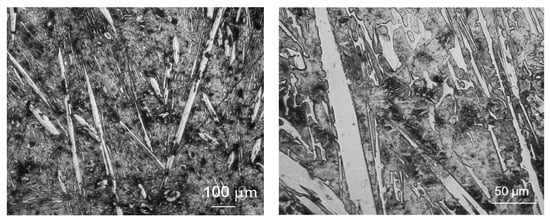
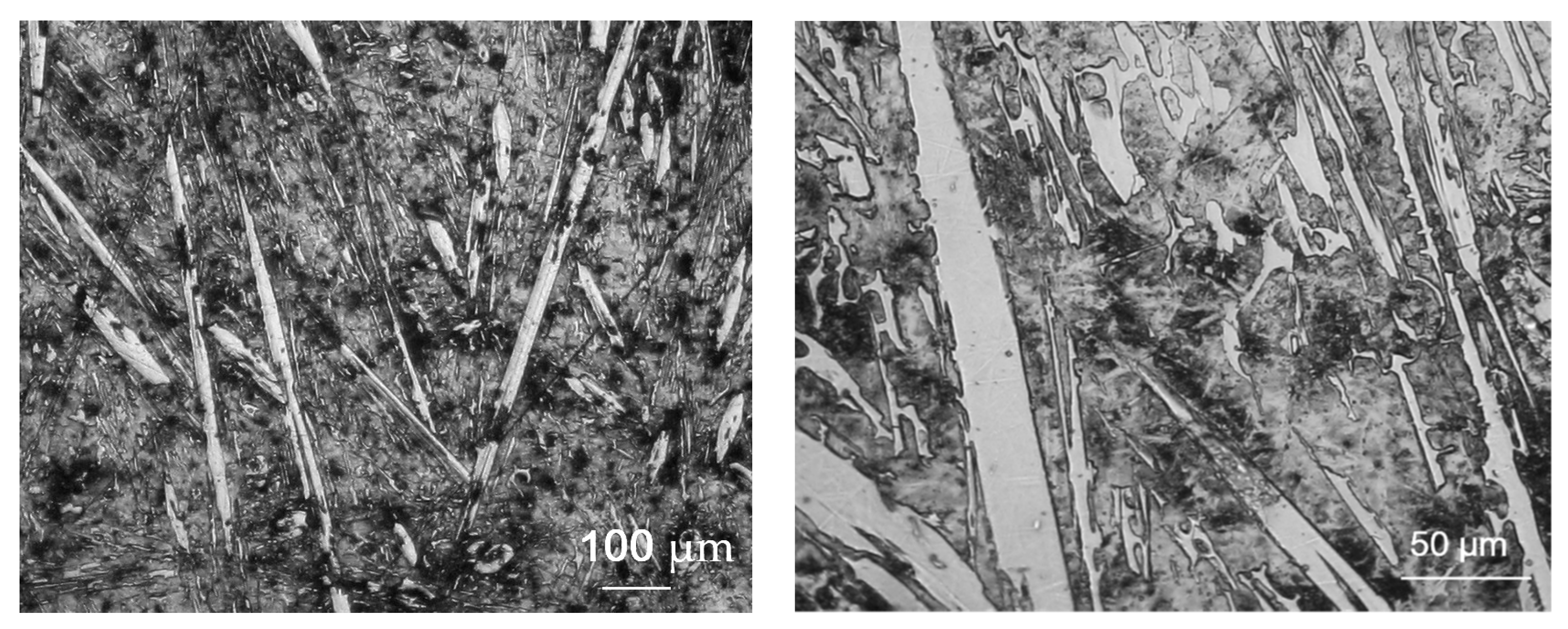
The microstructure of the alloy without magnesium addition shows a typical structure of high-chromium white cast iron (Figure 1). The structure is characterized by coarse primary chromium carbides distributed within the metallic matrix.
Figure 1.
Microstructure of cast iron with 28% Cr (×100 and ×200).
The carbides appear elongated and irregular in shape, typical for M7C3 chromium carbides formed during solidification of high-chromium cast irons. These carbides form during the eutectic reaction between liquid metal and austenite.
The relatively high chromium content promotes the formation of large carbide particles. The matrix consists mainly of martensite and retained austenite formed during cooling.
Such structures are typical for high-chromium white cast irons where carbon is predominantly bound in carbide phases.
- Alloy 2 (14% Cr + Mg)
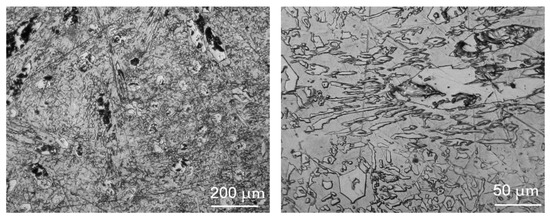
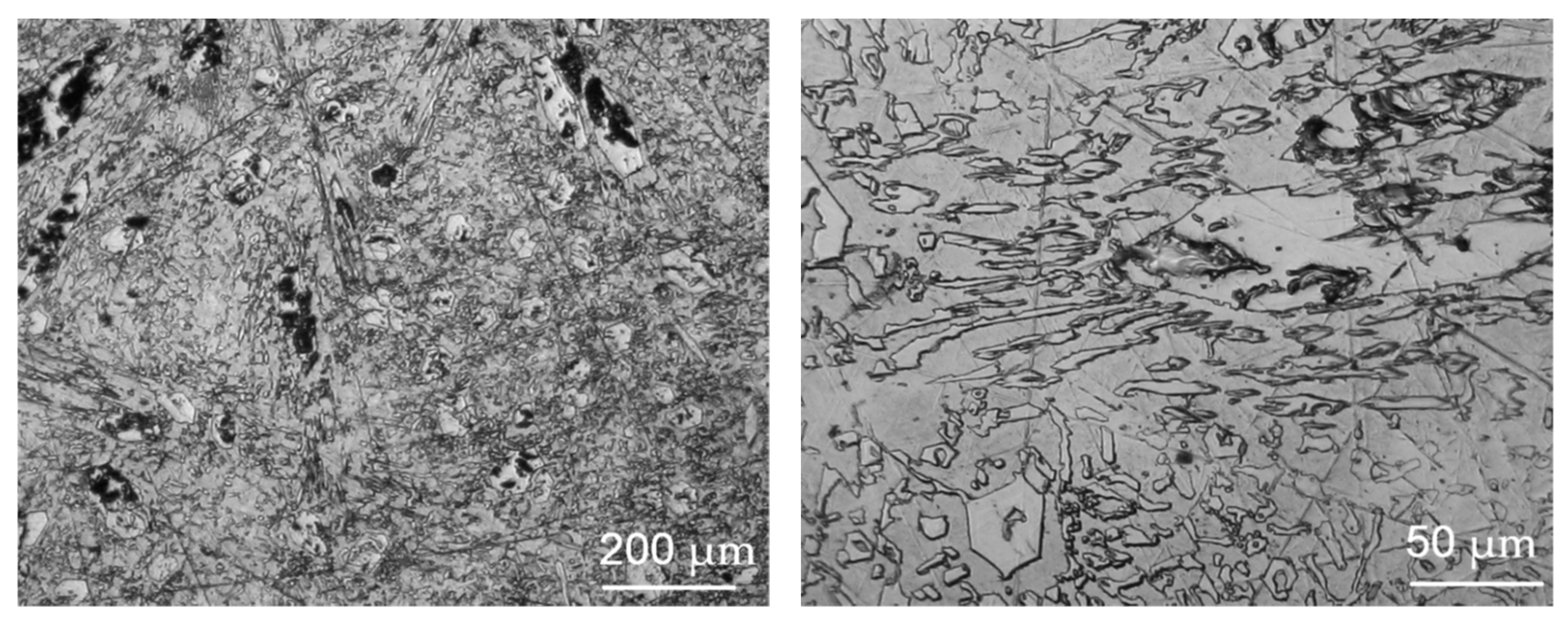
The microstructure of the magnesium-modified alloy differs significantly from the non-modified alloy (Figure 2).
Figure 2.
Microstructure of cast iron with 14% Cr + Mg (×50 and ×200).
The Mg-modified alloy exhibits a much finer and more homogeneous structure. Instead of coarse primary carbides, the structure is dominated by fine eutectic carbides distributed uniformly throughout the metallic matrix.
Magnesium promotes heterogeneous nucleation during solidification, which leads to microstructural refinement. The increased number of nucleation sites results in the formation of smaller carbide particles.
The refined carbide morphology leads to a more homogeneous structure and improved mechanical properties.
Hardness
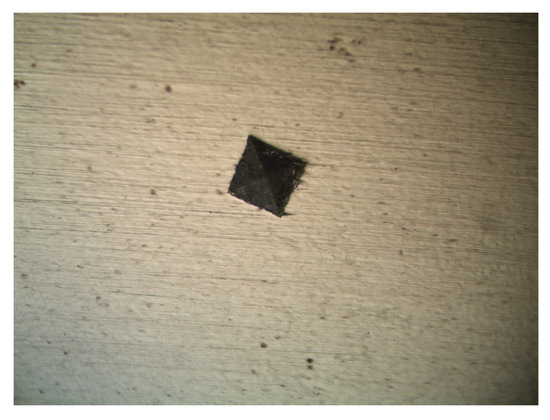
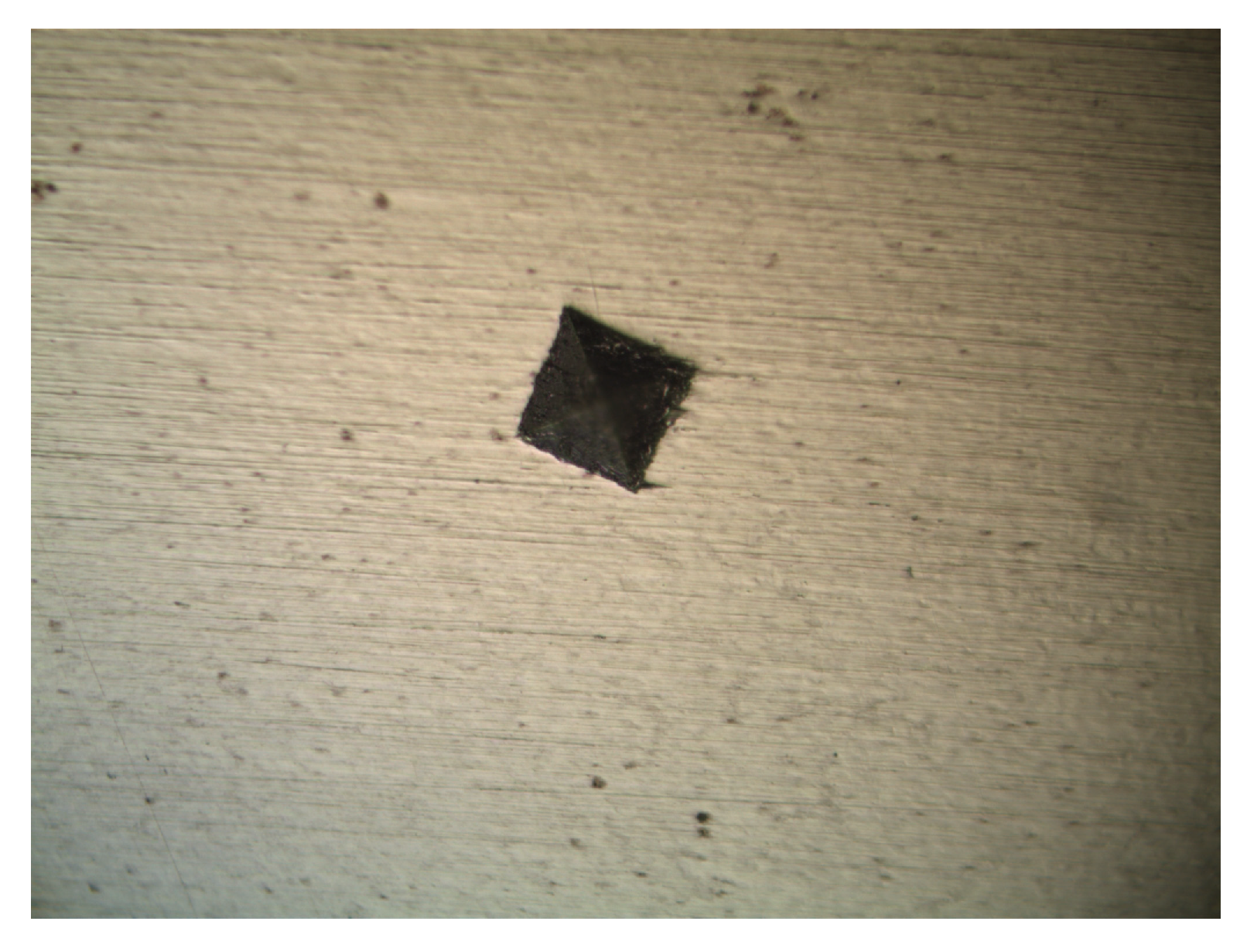
Figure 3.
Indentation from the Vickers hardness measurement (×200).
Table 2.
Hardness of investigated alloys.
The Mg-modified alloy exhibits significantly higher hardness despite the lower chromium content.
This increase in hardness can be explained by the refined microstructure and the higher density of fine carbides distributed throughout the matrix.
4. Discussion
The obtained results clearly demonstrate the strong relationship between chemical composition, microstructure and hardness of high-chromium cast irons.
The alloy containing 28 mass% chromium without magnesium modification exhibits coarse carbide morphology typical for high-chromium white cast irons. Such structures provide excellent wear resistance but may lead to structural heterogeneity and increased brittleness.
In contrast, the magnesium-modified alloy exhibits a significantly refined microstructure. Magnesium increases the number of nucleation sites during solidification and promotes carbide refinement.
The refined structure improves the distribution of carbides and enhances the strengthening effect of the carbide phase. Microstructural refinement is known to significantly improve hardness and wear resistance in high-chromium cast irons.
This explains the significantly higher hardness measured for the Mg-modified alloy despite the lower chromium content.
5. Conclusions
The present study demonstrates the strong influence of chemical composition and magnesium modification on the microstructure and hardness of high-chromium cast irons.
The alloy containing 28 mass% chromium without magnesium modification exhibits coarse primary chromium carbides and hardness of approximately 475 HV.
The alloy containing 14 mass% chromium and magnesium addition shows a significantly refined microstructure with fine eutectic carbides.
The refined microstructure results in a substantial increase in hardness to approximately 750 HV.
The obtained results confirm that magnesium modification can significantly improve the microstructure and mechanical properties of high-chromium cast irons.
Author Contributions
Conceptualization, G.B.; methodology, G.B.; validation, G.B.; formal analysis, B.I.; investigation, G.B.; resources, G.B.; data curation, G.L.; writing—original draft preparation, G.B.; writing—review and editing, G.L. and B.I.; visualization, B.I.; supervision, G.B.; project administration, B.I. All authors have read and agreed to the published version of the manuscript.
Funding
The authors would like to thank the Research and Development Sector at the Technical University of Sofia for the financial support.
Institutional Review Board Statement
Not applicable.
Informed Consent Statement
Not applicable.
Data Availability Statement
The data presented in this study are available on request from the corresponding author. The data are not publicly available due to ongoing research activities.
Conflicts of Interest
The authors declare no conflicts of interest. The funders had no role in the design of the study; in the collection, analyses, or interpretation of data; in the writing of the manuscript; or in the decision to publish the results.
References
- Tabrett, C.P.; Sare, I.R.; Ghomashchi, M.R. Microstructure–property relationships in high chromium white iron alloys. Int. Mater. Rev. 1996, 41, 59–82. [Google Scholar] [CrossRef]
- Davis, J.R. ASM Specialty Handbook: Cast Irons; ASM International: Materials Park, OH, USA, 1996; pp. 90–115. ISBN 978-0-87170-564-5. [Google Scholar]
- Bedolla-Jacuinde, A. Microstructure of high chromium white irons. J. Mater. Sci. 2001, 36, 1617–1629. [Google Scholar] [CrossRef] [Scilit]
- Laird, G.; Gundlach, R.; Rohrig, K. Abrasion Resistant Cast Iron Handbook; American Foundry Society: Schaumburg, IL, USA, 2000; pp. 210–245. [Google Scholar]
- Zhou, Y.; Liu, X. Effect of modification on carbide morphology in high chromium cast iron. Mater. Sci. Eng. A 2008, 483–484, 411–414. [Google Scholar] [CrossRef] [Scilit]
- Guo, E.; Wang, L.; Zhao, Z. Effect of modification elements on solidification and carbide morphology of high chromium cast irons. Wear 2012, 286–287, 29–38. [Google Scholar]
- Stefanescu, D.M. Science and Engineering of Casting Solidification, 2nd ed.; Springer: New York, NY, USA, 2009; pp. 320–340. [Google Scholar]
- Vander Voort, G.F. Metallography: Principles and Practice; ASM International: Materials Park, OH, USA, 2004; pp. 120–160. [Google Scholar]
- Callister, W.D.; Rethwisch, D.G. Materials Science and Engineering: An Introduction, 9th ed.; Wiley: Hoboken, NJ, USA, 2014; pp. 210–225. [Google Scholar]
- Davis, J.R. Cast Irons; ASM International: Materials Park, OH, USA, 2005; pp. 210–265. ISBN 978-0-87170-803-5. [Google Scholar]

Disclaimer/Publisher’s Note: The statements, opinions and data contained in all publications are solely those of the individual author(s) and contributor(s) and not of MDPI and/or the editor(s). MDPI and/or the editor(s) disclaim responsibility for any injury to people or property resulting from any ideas, methods, instructions or products referred to in the content. |
© 2026 by the authors. Licensee MDPI, Basel, Switzerland. This article is an open access article distributed under the terms and conditions of the Creative Commons Attribution (CC BY) license.