


Conference Overview
The conference proposes a critical discussion of the activities carried out at the conclusion of the period, granted to the project funded in Italy by the Ministry of University and Research (MUR–PRIN22). SCORPiò-NIDI, as the project is commonly referred to, has digitally surveyed samples of pre-Christian ballistic impacts identified along the northern stretch of Pompeii [1]. The damage generated by Sulla’s artillery during the conquest of the Oscan-founded city in 89 BC had already been recognized as such by Amedeo Maiuri [2], director of the excavations in the early twentieth century. The exceptional history of Pompeii guarantees the uniqueness of these indentations. The archeological evidence—miraculously preserved despite Roman restorations of the city walls, natural catastrophes, and, after their re-emergence, the bombings of the Second World War—constitutes a unique testimony to the existence and certified lethality of Republican and Imperial neuroballistic weapons.
Discussing weapons and war damage inevitably generates discomfort in the present day. Clarifying that this study was initiated when the current geopolitical scenario was unimaginable does not entirely dispel legitimate concerns. Nevertheless, renouncing the study of engineering, military, and archeological aspects does not appear to be the most appropriate choice, especially considering that natural disasters and human negligence could erase, perhaps irreversibly, a heritage of unparalleled value. The urbanistic and architectural fame of the city, crystallized in its first-century AD appearance, cannot reasonably be undermined by a shared rejection of war. Persevering in the scientific investigation of ballistic traces is therefore not only a duty arising from commitments undertaken with the Ministry but is more profoundly justified by the need to give meaning to past events to inspire positive change. As George Santayana famously wrote in 1920, “Those who cannot remember the past are condemned to repeat it,” a statement engraved on the memorials of Dachau [3].
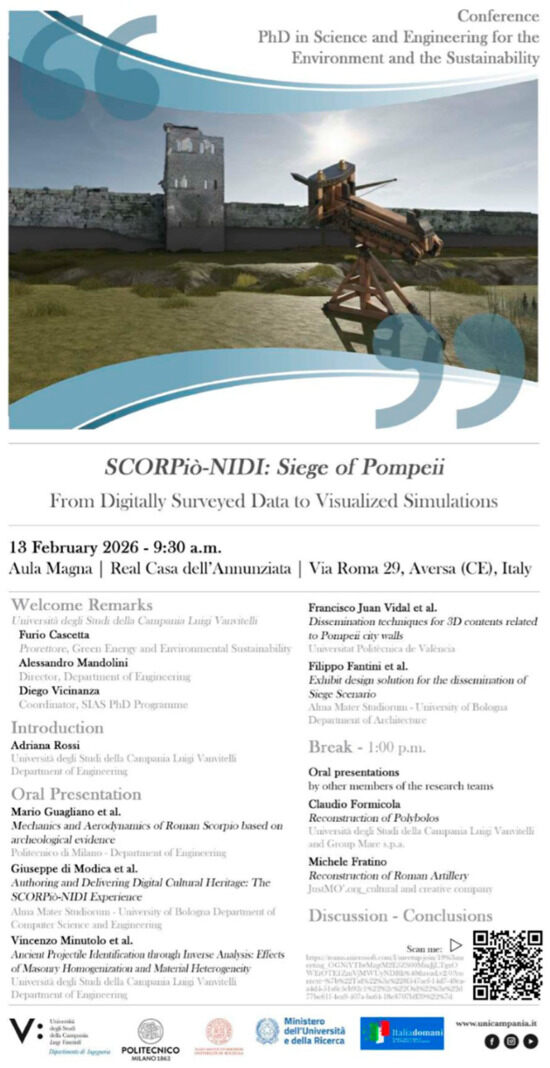
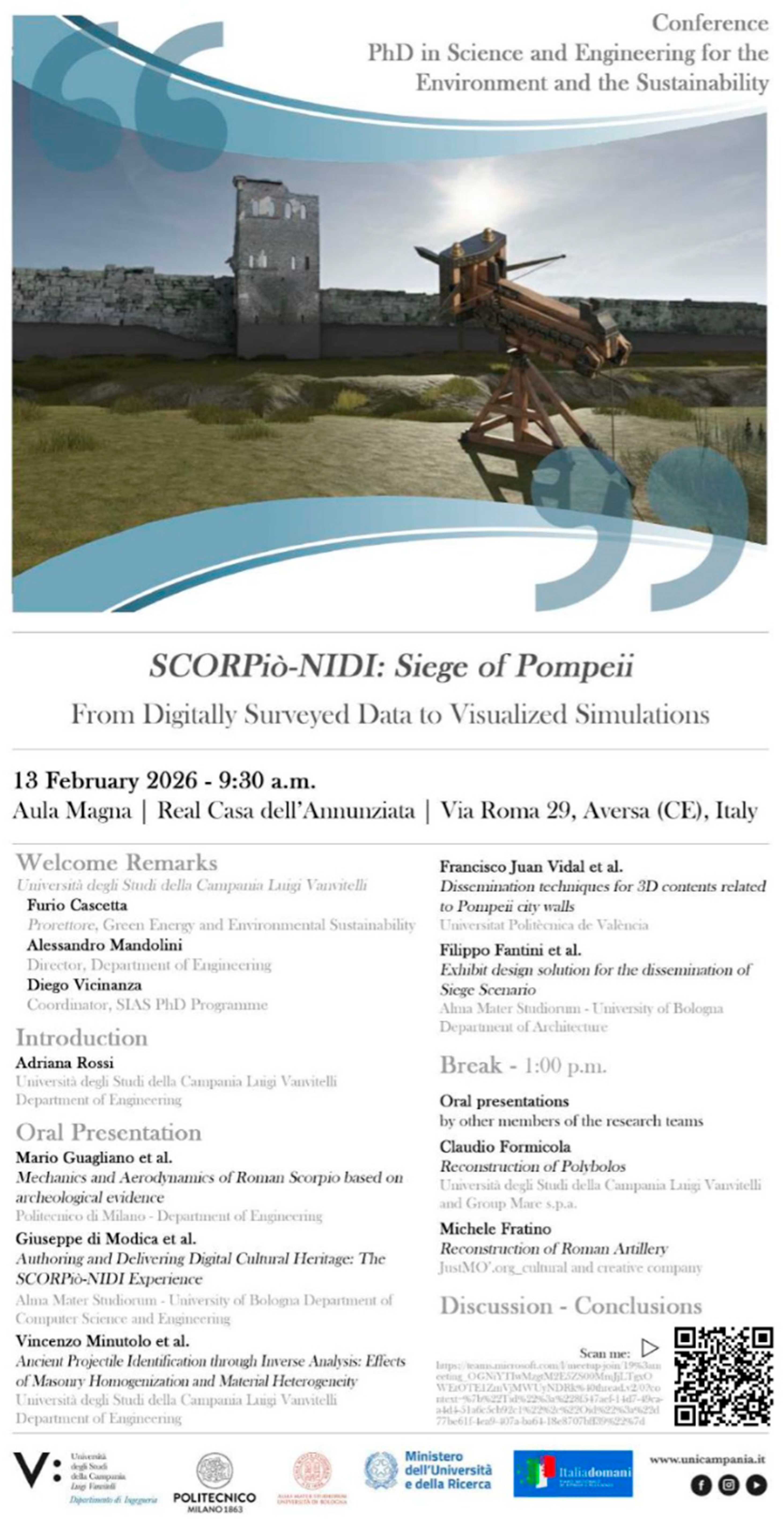
Academic research represents the most appropriate context for identifying the concepts capable of shaping tools that initiate cultural processes by recognizing material evidence as testimony to knowledge and technology. Within this framework, the project—ranked first in the ERC SH5 sector (PRIN 2022, Call 2022)—entitled “Comparative Analysis and Certified Reconstructions for a Correct Experimental Archaeology: Roman Scorpions and Ballistae for the Imperial Mechanical Culture, Origin of European Identity. Governance Policy for the Development and Sustainable Fruition of Cultural Heritage,” proposes a renewed image of ancient Pompeii (Figure 1). This image is grounded in the survey of reality, scientific analysis, and verifiable calculations. Digital photogrammetry, 3D scanning, georeferenced information systems, and other forms of computer-based analysis are integrated into a single workflow centered on Information and Communication Technologies (ICT). Phases that were once strictly linear—Survey, Representation, and Design—are now interactively recalled within a circular, dynamic digital process. Recursive investigations emphasize the act of making, whereby tools and methods—far from being neutral with respect to outcomes—guide successive analyses and orient the hermeneutic and critical interpretation of scientifically acquired data.
Figure 1.
Conference poster.
The research initiative has therefore addressed conceptual challenges even before social and methodological ones, arising from technological implementation, in the expectation that the scholarly community may benefit from intellectual progress. Accordingly, the project provides documented evidence of archeological data reconstructed within a critical and interdisciplinary framework.
The simultaneous presence of multiple fields of expertise has made it possible to grasp the many dimensions of the problem. The development of a shared methodological framework proved necessary to ensure both coherence and integration among the individual theoretical and practical contributions.
The group of scholars involved in the project brings together all the competencies required to respond responsibly to specific research questions. The investigative “excavation” process produced reality-based 3D models of digital casts, which were subsequently adapted to the requirements of reverse engineering workflows to generate data suitable for terminal ballistics calculations. The method focused on the possibility of computing the mechanical work—namely, the energy—required to fracture or disaggregate the material once the density of the stone blocks was established.
Determining projectile velocity, estimating firing distance, and inferring the power of the machines to reconstruct their morphometry—based on Hellenistic technical treatises—made it possible to build original and innovative demonstrators. Stone-throwing and dart-throwing machines were calibrated directly on the measured data. The results were then compared with experimental archeology reconstructions derived from archeological evidence uncovered at the sites of Ampurias, Camin Real, Cremona, and Hatra, and reinterpreted considering the exegetical tradition of Philo of Byzantium’s Belopoeica (3rd century BC).
The research output delivers a guideline set of material prototypes, either physically constructed or produced by 3D printing from virtual models. The resulting “certified” outputs, based on the premises outlined above, aim to clear the field of approximate reenactments, and instead to provide precise and accurate furnishings for museum scenarios to be arranged in situ, on-site, or off-site.
In view of this broader objective, the initial activities concentrated on surveying the most evident and convincing forms of damage. The traces left by spheroidal projectiles had already been classified by Van Buren based on the diameters of sand-stone balls recovered at the site [4] (pp. 110–111). After falling into relative oblivion, these traces were brought back to scholarly attention only in the second Millennium, when the Superintendency—prompted by targeted requests [5] (pp. 178–181)—carried out the extraction of silicone casts, which are now displayed at the Archeological Area of Saepinum (Altilia, Campobasso, Italy).
Unlike ballistae used for long-range demolition, Hellenistic catapults (not to be confused with medieval devices) were anti-personnel weapons. Conceived to “pierce” (“kata pelta”, from Greek) wooden and/or leather shields, these machines were equipped with elastic propulsion loading systems. Their trigger-based release mechanism made catapults suitable for standard military equipment. Referred to as “scorpions” in Roman terminology—due to the lethal action of their tail-like mechanism and loading arms—these devices were employed to strike archers emerging from posterns or from behind the battlements on the top of the walls [6,7,8].
The damage caused by shots that missed their targets, those which today are in fact examined with interest, is difficult to detect. Wall imprints are relatively small and often chipped. It should also be noted that, unlike the stone projectiles attributed to ballistae and recovered on site, iron dart tips—more rarely made of bronze—have largely disintegrated over the centuries. When fragments are still present, only high-resolution microscopic analysis allows them to be distinguished from lithic clasts embedded within the cavities.
It is therefore understandable that dart impact traces, despite being repeatedly mentioned in the literature, have never been subjected to systematic analytical study.
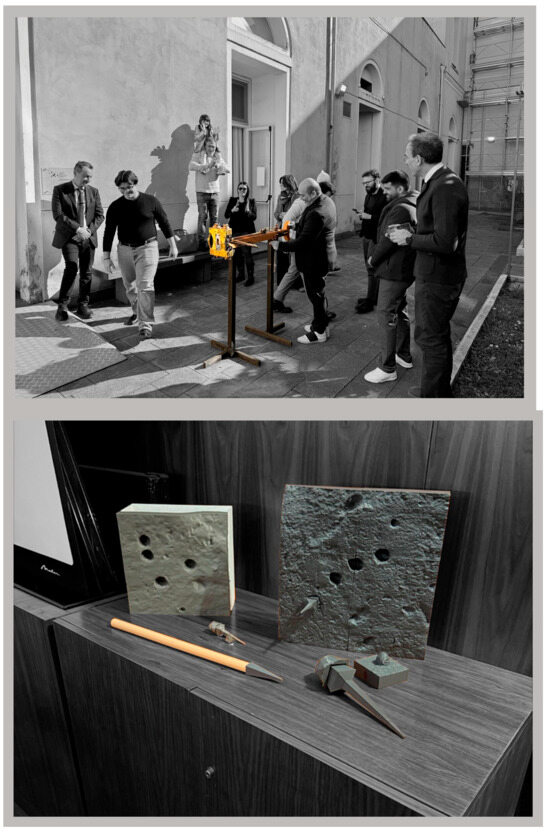
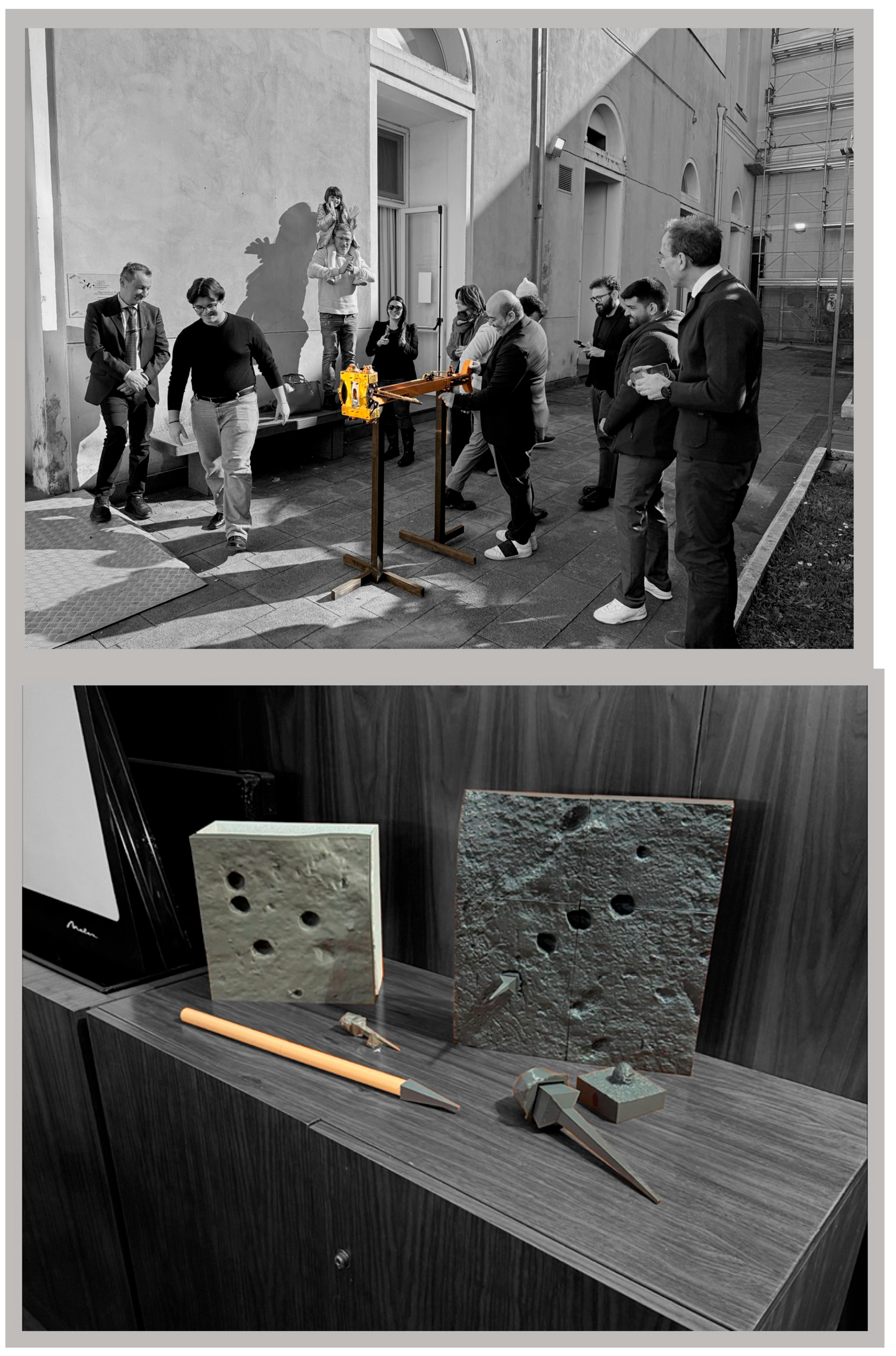
Despite the uncertainties and difficulties involved, SCORPiò-NIDI deliberately chose to focus on these traces. The very name of the project reflects the intention to examine weapon typologies derived from the same underlying mechanical principles and developed over the course of several centuries (Figure 2).
Figure 2.
The SCORPiò-NIDI project team at the 2026 conference (above) and during firing tests with the 1:1 reproduction of the weapon (bottom).
The traces examined in Pompeii were selected based on characteristics that significantly reduce the uncertainty typically associated with small-diameter impact marks. The vaguely quadrangular outline of the cavities makes it possible to distinguish marks generated by darts from those caused by small stone projectiles. Although conical dart tips did exist, pyramidal points were by far the most widespread. The destructive effects produced by the high-velocity pressure generated by the penetration of a metal tip differ substantially from those caused by other types of impact. Moreover, closely spaced holes arranged in radial configurations—identified for the first time by the research group—make plausible the hypothesis that these shots were fired by automatic repeating weapons.
The extraordinary nature of this discovery has been subjected to multiple levels of verification. Additional plausibility is provided by the interpretative frameworks offered by Philo of Byzantium in the Belopoeica, made accessible through the critical translation by Erwin Marsden (1971). Two hundred and eleven years separate the siege of Rhodes by Demetrius I Poliorcetes (305–304 BC) from Sulla’s siege of Pompeii (89 BC). It is highly likely that, over this time span, the Romans—well known for their pragmatic approach to engineering—optimized neuroballistic technologies.
The cross-sections of the damage recorded along the northern stretch of Pompeii’s ancient city walls demonstrate propulsion systems of extraordinary power. With the collapse of the Roman Empire—and of the organizational structures that had enabled the equipping and sustained operation of its army—the scientific knowledge and technical skills required to design and maintain such machines likewise disappeared. Only with the first archeological discoveries did it become possible to reconstruct the dimensional parameters necessary to achieve such levels of ballistic performance.
The interpretative and comparative logic adopted in this research constructs coherent argumentative lines whose applications extend beyond individual case studies, offering research outputs that integrate multiple fields of expertise and converge toward shared objectives through differentiated methodological paths. With due disciplinary respect, the results transcend traditional “professional,” “organizational,” and “cultural” barriers.
The information space conceived for the project—originally designed to enable the sharing of intermediate results and to allow each participant to contribute from their specific disciplinary perspective, while remaining attentive to the overall process—now promises, through the accessibility of digital language at every stage, to be extended in the near future to the dissemination of data and the engagement of a broader public (Figure 3). The selection of contributions collected in these proceedings addresses partial objectives that can be traced back to the following main ERC fields:
- SH5_12—computational modeling and digitization in the cultural sphere;
- PE8_10—manufacturing engineering and industrial design;
- PE6_9—human–computer interaction and interface, visualization.
Figure 3.
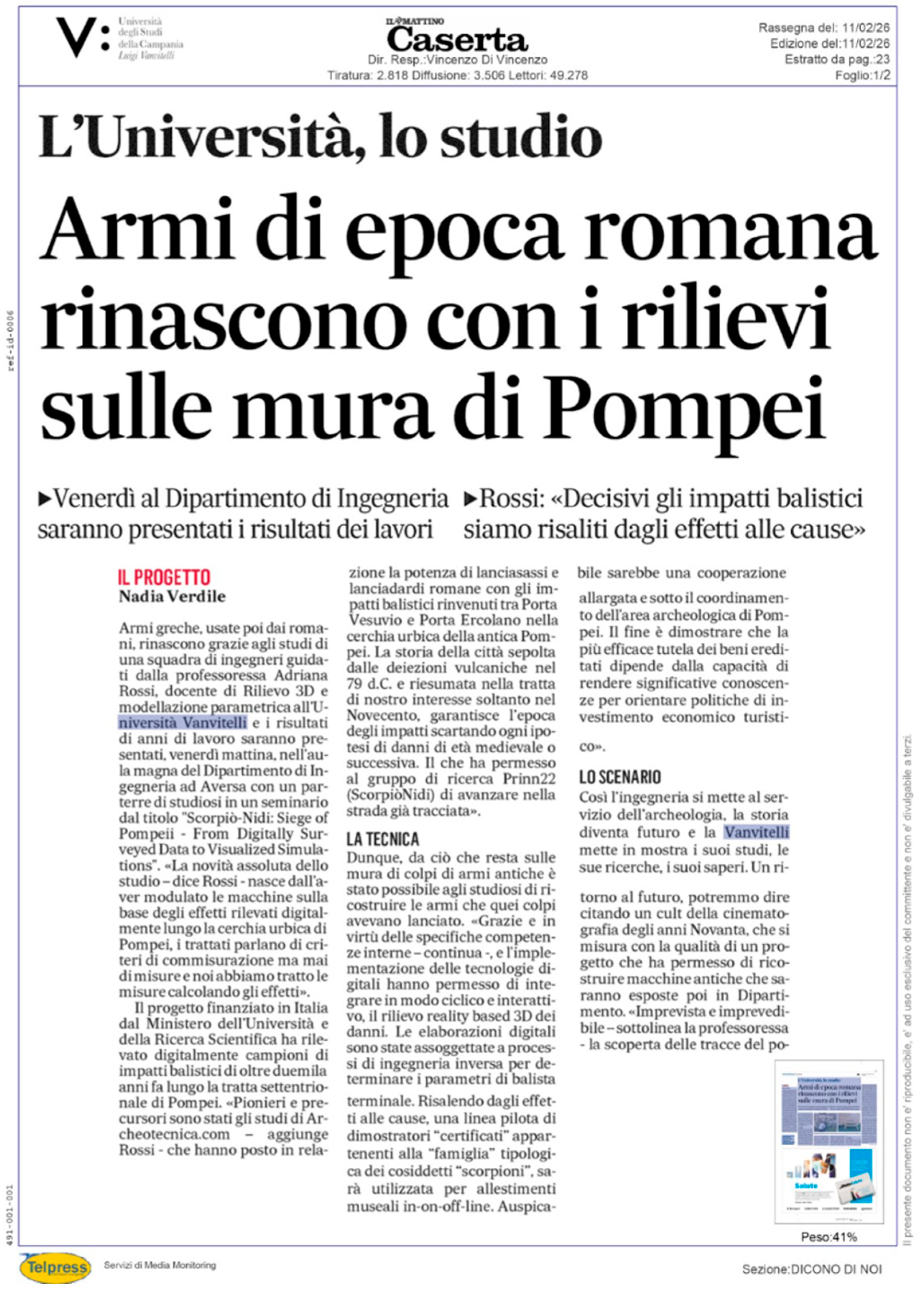
Press release published in Il Mattino di Caserta on 11 February 2026.
Funding
This work was supported by the Italian Ministry under the Project of Relevant National Interest (PRIN call D.D. no. 104/2022—code PRIN_20222RJE322022—CUP B53D23022100006, D.D. no. 1012/2023) “SCORPiò-NIDI. Comparative Analysis and Certified Reconstructions for a correct experimental archeology: Roman Scorpions and Ballistae for the Imperial mechanical culture, origin of European identity. Governance policy for the development and sustainable fruition of Cultural Heritage”.
Acknowledgments
Thanks go to those who have worked in various capacities at the Ministry of Cultural Heritage since the beginning of the millennium, starting with Mario Pagano, Superintendent for Archeological Heritage of Molise since 2004, who, previously urged by Flavio Russo, Historical Consultant of the Army General Staff, took action to obtain authorization to proceed with the creation of silicone casts of the ballistic impacts found in the walls of Pompeii. The casts are now on display in the archeological area of Saepinum (CB, Italy). We appreciate the interest shown in the research topic by MIBACT-SABAP-CS (0013535 of 23 October 2017 CI. 19.10.38/1-9), equally supported by the Municipality of Pompeii (0051038/U of 6 November 2017), the Ministry of Defense, and other academic institutions. The authors reaffirm their gratitude to the Directorate and officials of the Archeological Park of Pompeii, who have repeatedly authorized both access to the sites and the survey of the northern section of the city wall circuit (MIBACT-SSBA-PES PROTO-ARCH 0006225 14 April 2016 CI. 28.13.07/6; and prot. no. 9707 of 29 March 2023). The most recent authorization, updated to 28 February 2025 (PDF_1739786899487a35a63ff-f5f3-4360-9c25-7f65ef107e27), was subject to delivery of the laser scanner survey in the formats requested by the Park Research Laboratories. The delivery was made on the morning of 28 February. A few weeks later, a draft agreement for sharing the results was delivered to the legal team for review.
Conflicts of Interest
The author declares no conflicts of interest.
References
- Rossi, A. (Ed.) Discovering Pompeii. From Effects to Causes—From Surveying to the Reconstructions of Ballistae and Scorpiones; MDPI—Multidisciplinary Digital Publishing Institute: Basel, Switzerland, 2025. [Google Scholar]
- Maiuri, A. Studies and research on the fortification of Pompeii (Studi e ricerche sulla fortificazione di Pompei). In Monumenti Antichi Pubblicati per Cura Della R; Accademia dei Lincei: Milan, Italy, 1930; Volume 33, pp. 114–286. (In Italian) [Google Scholar]
- Durant, D.; Lovejoy, A.O.; Pratt, J.B.; Rogers, A.K.; Santayana, G.; Sellars, R.W.; Strong, C.A. Essays in Critical Realism: A Co-Operative Study of the Problem of Knowledge; MacMillan and co.: London, UK, 1920. [Google Scholar]
- Van Buren, A.W. Further Studies in Pompeian Archaeology. MAAR 1925, 5, 103–113. [Google Scholar] [CrossRef] [Scilit]
- Russo, F.; Russo, F. 89 BC: The Siege of Pompeii: The Dynamics and Military Technologies of Silla’s Conquest of Pompeii (89 a.C. Assedio a Pompei: La Dinamica e Le Tecnologie Belliche Della Conquista Sillana Di Pompei); Flavius Edizioni: Pompei, Italy, 2005. (In Italian) [Google Scholar]
- Marsden, E.W. Greek and Roman Artillery: Historical Development; Clarendon Press: Oxford, UK, 1969. [Google Scholar]
- Marsden, E.W. The Artillery Manual of Philon. In Greek and Roman Artillery. Technical Treatises; Clarendon Press: Oxford, UK, 1971. [Google Scholar]
- Garlan, Y. Book “V” of Philo of Byzantium’s “Mechanical Syntax” (Le livre «V» de la «Syntaxe mécanique» de Philon de Byzance). In Recherches de Poliorcétique Grecque; Bibliothèque des Écoles françaises d’Athènes et de Rome; École française d’Athènes: Atene, Greece, 1974; Volume 223, pp. 279–290. (In French) [Google Scholar]
Disclaimer/Publisher’s Note: The statements, opinions and data contained in all publications are solely those of the individual author(s) and contributor(s) and not of MDPI and/or the editor(s). MDPI and/or the editor(s) disclaim responsibility for any injury to people or property resulting from any ideas, methods, instructions or products referred to in the content. |
© 2026 by the author. Licensee MDPI, Basel, Switzerland. This article is an open access article distributed under the terms and conditions of the Creative Commons Attribution (CC BY) license.