


Abstract
The paper analyzes the impact of low-frequency (50 Hz) electromagnetic fields (EMFs) generated by a 110 kV overhead power line (OHL) on the exposure of the population and workers, in the context of increasing transmission capacity through reconduction. For the worst-case operating scenario (N-1), the levels of the electric field (E) and magnetic induction (B) at 1.5 m above the ground are checked and compared to the limit values established by Recommendation 1999/519/EC for the public and by Romanian Government Decision no. 520/2016, which transposes Directive 2013/35/EU, for workers. The calculation method is based on the Biot–Savart law for the magnetic field and the Maxwell potential coefficient method for the electric field.
1. Introduction
The Romanian National Energy System (SEN) uses 110 kV overhead power lines (OHLs) as a transmission network, ensuring the connection between 400/110 kV, 220/110 kV and 110 kV/20 kV transformer stations. Energy transition, integration of renewable production capacities and increasing demand for energy often trigger the need for supplementary transmission capacity.
Building a new 110 kV overhead power line represents a major energy infrastructure project, with multiple implications. From a technical point of view, this type of investment increases the safety and flexibility of the network, but the higher cost of the project and severe urbanistic restrictions dictated by protection and safety zone for OHL limits the possibilities for a new line construction.
A common technical solution is reconductoring: replacing the existing conductor with one of larger cross-section or with a high-temperature, low-sag (HTLS) conductor, while preserving the pole infrastructure.
Increasing the current involves an intensification of the magnetic field produced under the line, while the electric field remains practically invariant (depending on the voltage and not on the value of the current). Evaluation of the impact on the human body must be carried out from the design phase and compared to the limit values established by national and European regulations. This paper presents a case study for a 110 kV overhead line, with double circuit and vertical arrangement of conductors, and verifies compliance with the limits imposed when the transmission capacity is increased from 20 MW to 60 MW.
2. Regulatory Framework
Exposure of people to low-frequency electromagnetic fields is regulated separately for population and for workers. For the public, Recommendation 1999/519/EC [1] establishes, at 50 Hz, references levels Eref = 5 kV/m and Bref = 100 µT, corelated with ICNIRP 2010 [2] for limiting sensory effects and electrical stimulation of tissues, as shown in Table 1 and Table 2, bolded values. For workers, Romanian Government Decision no. 520/2016 [3], published in the Official Gazette no. 576 of 28 July 2016, fully transposes Directive 2013/35/EU [4,5] and defines the following limits:
Table 1.
Action levels (ALs) for electric field [3].
Table 2.
Action levels (ALs) for magnetic induction [3].
Compliance with action levels (ALs) implicitly guarantees compliance with exposure limit values (ELVs). These limits, defined by the intensity of the electric field induced in tissues, are structured into two categories: thresholds for health effects and thresholds for sensory effects [3].
Regarding technical standards, IEC 62110:2009 [6] describes the procedures for measuring EMF at 50/60 Hz in the proximity of electrical installations, and the SR EN 50413 [7] standard deals with the basic method for assessing human exposure to EMF (0 Hz–300 GHz).
3. The Effects of Electromagnetic Fields on the Human Body
At the industrial frequency of 50 Hz, the wavelength in vacuum (≈6000 km) is much larger than the dimensions of a person, so the interaction with the human body is quasi-static, not radiant. The external electric field E induces superficial charges on the conductive human body, generating a very low internal electric field Ei (typically 5–6 times lower than Eext), due to the high permittivity of the tissues and the shielding effect. Magnetic field B crosses the tissues (which have relative permeability μr ≈ 1) and, through its variation in time, generates eddy currents through electromagnetic induction.
Below the 100 kHz threshold, the biological impact is limited to tissue stimulation (neurons, retina) and minor physical sensations (vertigo, hair lifting). Since they operate at 50 Hz, 110 kV power lines do not generate thermal effects on the body, which only occur at much higher frequencies [2,8,9].
4. Electromagnetic Field Measurement
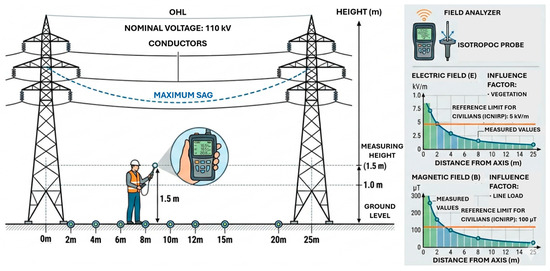
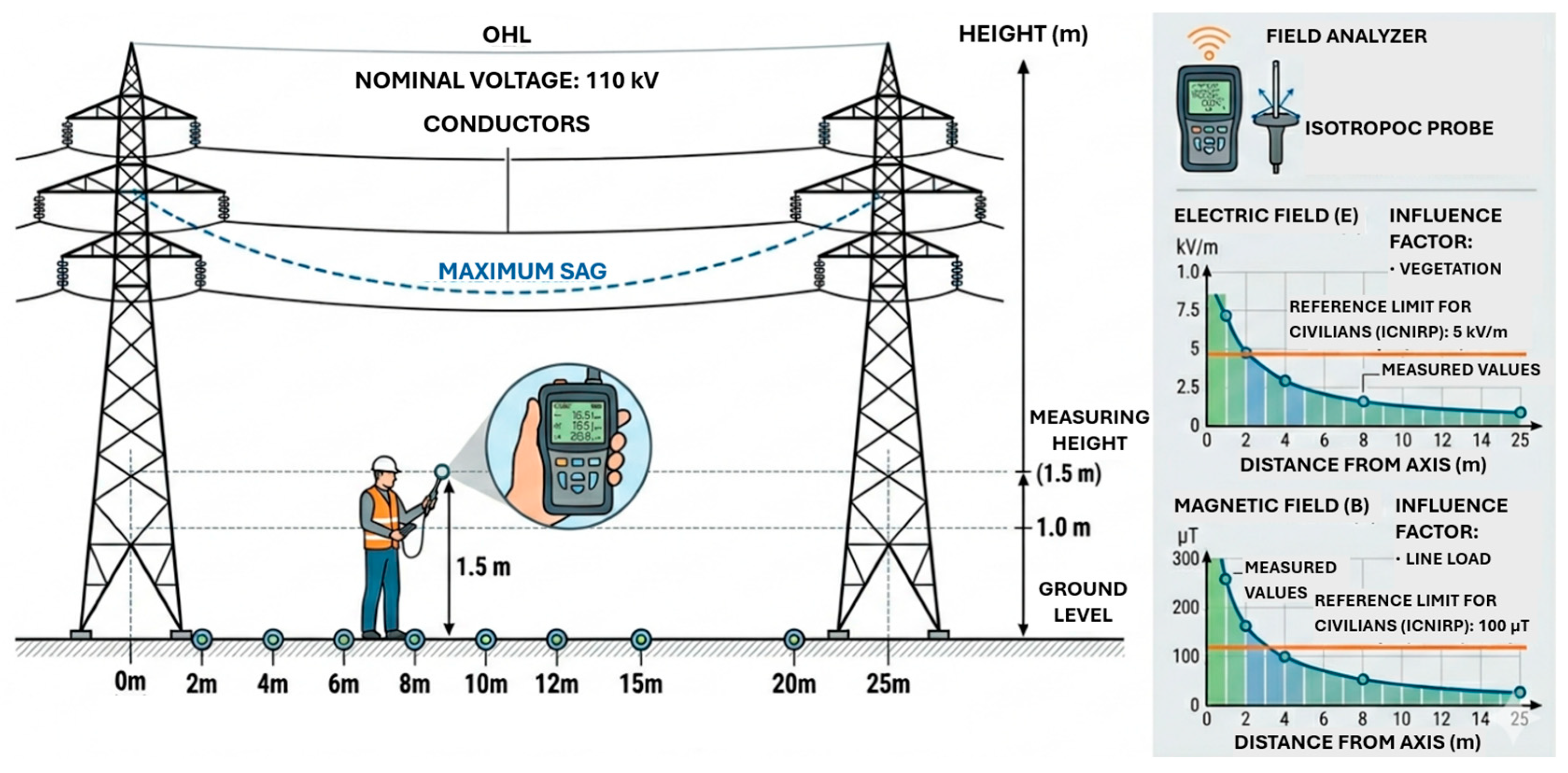
For electrical power equipment in operation, verification of compliance with appliable safety standards is carried out by direct measurements. Low-frequency field analyzers equipped with isotropic probes capable of recording values on all three axes (x, y, z) are used [10]. For overhead power lines, measurements are carried out at 1.5 m above the ground, at the points of maximum sag, as shown in the drawing below (Figure 1).
Figure 1.
EMC measurement procedure under 110 kV overhead lines.
5. Calculation Methodology
Theoretical determination of the fields under the transmission lines adopts the hypothesis of a permanent sinusoidal regime (50 Hz). To simplify the calculation, the geometry of the parallel conductors and the reflection on the ground approximated as a perfect plane are considered.
5.1. Magnetic Induction
To calculate the magnetic induction at the point with coordinate (), the Biot–Savart law is applied under the assumption of an infinite conductor for each phase k, considering the position (), and the intensity of the phasor current [11].
5.2. Electric Field
Determination of the electric field intensity E is carried out by the image method, using a three-phase symmetrical system. According to this method, each real conductor located at the point () is associated with a symmetrical image at the point (), those two being loaded with linear charges of opposite signs. The phasor charges are determined by solving the system of Maxwell’s equations, using the matrix of potential coefficients:
where
is the distance between conductor i and j;
is the distance between conductor i and the image of conductor j from the ground;
is radius of the conductor i.
Total field at the observation point results from the superposition of the real charges and the image charges [12].
6. Case Study: 110 kV Overhead Line Reconduction
6.1. Input Data
The analyzed line has the nominal voltage Un = 110 kV, frequency 50 Hz, power factor cos φ = 0.95 (typical assumption for a transit regime on the 110 kV network). The poles are Sn type, with vertical arrangement of the two circuits on each side of the pole, a configuration frequently encountered on 110 kV networks in the National Power System. Positions of the phase conductors adopted (typical assumptions for a 110 kV Sn pole with a minimum height of 9 m above the ground) are presented in Table 3.
Table 3.
Arrangement of conductors (x—position from the pole axis. y—height above the ground).
6.2. Operating Scenarios
Four representative scenarios are analyzed, in which the phasing is parallel on both circuits (the worst case for the resulting magnetic field):
- (Scenario A) 20 MW total, operating regime N (10 MW/circuit);
- (Scenario B) 60 MW total, operating regime (30 MW/circuit);
- (Scenario C) 60 MW concentrated on a single circuit (operating regime N-1, worst-case scenario);
- (Scenario) 20 MW on a single circuit.
The phase currents resulting from the formula I = P/(√3·U·cos φ) are I20 = 110.5 A for 20 MW total and I60 = 331.5 A for 60 MW total. The observation point is located 1.5 m above the ground, on the transverse perpendicular to the OHL axis, according to [6].
6.3. Results
The maximum electric field, dependent only on voltage and geometry, is Emax = 1703 V/m ≈ 1.70 kV/m at 1.5 m above ground, below the pole axis. This value represents 34.1% of the reference level for the population (5 kV/m, [1]) and 17% of the AL low for workers (10 kV/m, [3]). The electric field does not change by reconduction, as the operating voltage remains constant.
For the worst-case scenario presented in Table 4, bolded row (Sc. C, N-1 contingency with 60 MW concentrated on a single circuit), the maximum magnetic induction is Bmax = 3.66 µT, reached at x ≈ −3.5 m from the pole axis, which is below the lowest conductor of the loaded circuit. This value represents 3.7% of the limit for the population (100 µT) and 0.37% of the AL low for workers (1000 µT). The transverse profile of the magnetic field shows a sharp decrease with distance (approx. 1.1 µT at x = ±20 m, in Sc. C), confirming that, outside the OHL corridor, public exposure tends rapidly towards the value of the ambient electromagnetic field.
Table 4.
Maximum magnetic induction at 1.5 m above ground, compared to applicable limits.
6.4. Maximum Admissible Load from EMC Perspective
Since the magnetic field has a linear dependence on the current value, for a given geometric configuration, the maximum permissible load on the EMC criteria results from the ratio Blim/Bcalc. The proportionality coefficient, calculated for the N-1 case (a single loaded circuit, parallel phasing), is k = 1.11 × 10⁻² µT/A. Thus, the maximum permissible currents and powers below the public limit of 100 µT and below the AL low for workers of 1000 µT are indicated in Table 5.
Table 5.
Maximum admissible load from EMC perspective, calculated at 1.5 m above the ground.
The resulting values are 1.5–2 higher than the realistic thermal capacity of a reconducted 110 kV OHL, which confirms that we do not have a limiting factor from an EMC perspective. Instead, the limitations are given by the thermal capacity of the conductor, the maximum deformation of the gauge relative to the ground and the mechanical stresses of the poles.
7. Conclusions
This analysis demonstrates that, for a 110 kV double circuit overhead line with vertical layout, the increase in transmission capacity trough reconductoring from 20 MW to 60 MW is achieved in accordance with the EMC protection requirements, both for the population and for workers. The electric field (1.70 kV/m) does not modify by changing the conductor, and the resulting magnetic induction in the worst case (3.66 µT, N-1 contingency) is less than 4% of the public limit and below 0.4% of the AL low for workers, according to HG 520/2016 and Recommendation 99/5119/99. The maximum admissible load on the EMC criteria (approx. 1638 MW in N-1 regime) far exceeds the thermal capacity and the operational needs. The method is replicable for any configuration, by updating the layout of the conductors and the phase currents.
Funding
This research received no external funding.
Institutional Review Board Statement
Not applicable.
Informed Consent Statement
Not applicable.
Data Availability Statement
No new data were created or analyzed in this study. Data sharing is not applicable to this article.
Conflicts of Interest
The author declares no conflict of interest.
Abbreviations
The following abbreviations are used in this manuscript:
| EMF | Electromagnetic Fields |
| OHL | Overhead Power Line |
| N-1 | Energy network operating scenario with an unavailable line |
| SEN | Romanian National Energy System |
| HTLS | High-Temperature, Low-Sag (conductor) |
| AL | Action Levels |
| ELV | Exposure Limit Values |
| NPS | National Power System |
| ICNIRP | International Commission on Non-Ionizing Radiation Protection |
| ASRO | National Standardization Organization of Romania |
| WHO | World Health Organization |
References
- European Parliament. Recomandarea 1999/519/CE a Consiliului din 12 iulie 1999 privind limitarea expunerii publicului larg la câmpurile electromagnetice (0 Hz–300 GHz). J. Un. Eur. 1999, 199, 59–70. [Google Scholar]
- ICNIRP. Guidelines for limiting exposure to time-varying electric and magnetic fields (1 Hz to 100 kHz). Health Phys. 2010, 99, 818–836. [Google Scholar] [CrossRef] [Scilit] [PubMed]
- Hotărârea Guvernului României Nr. 520/2016 Privind Cerințele Minime de Securitate și Sănătate Referitoare la Expunerea Lucrătorilor la Riscuri Generate de Câmpuri Electromagnetice. Monitorul Oficial al României, Partea I, Nr. 576 din 28 Iulie 2016. Available online: https://legislatie.just.ro/Public/DetaliiDocument/180509 (accessed on 24 June 2026).
- European Parliament. Directiva 2013/35/UE a Parlamentului European și a Consiliului din 26 iunie 2013 privind cerințele minime de sănătate și securitate referitoare la expunerea lucrătorilor la riscuri generate de agenți fizici (câmpuri electromagnetice). J. Un. Eur. 2013, 179, 1–21. [Google Scholar]
- ENTSO-E. Guide for Implementing Directive 2013/35/EU on Electromagnetic Fields; European Network of Transmission System Operators for Electricity: Brussels, Belgium, 2014. [Google Scholar]
- IEC 62110:2009; Electric and Magnetic Field Levels Generated by AC Power Systems—Measurement Procedures with Regard to Public Exposure. International Electrotechnical Commission: Geneva, Switzerland, 2009.
- SR EN 50413:2020; Standard de Bază Privind Procedurile de Măsurare și Calcul Pentru Expunerea Umană la Câmpuri Electrice, Magnetice și Electromagnetice (0 Hz–300 GHz). ASRO–Organismul Național de Standardizare din România: Bucharest, Romania, 2020.
- CIGRE WG C4.203; Technical Brochure 320: Characterization of ELF Magnetic Fields. International Council on Large Electric Systems: Paris, France, 2007.
- WHO. Extremely Low Frequency Fields, Environmental Health Criteria 238; World Health Organization: Geneva, Switzerland, 2007.
- IEEE Std 644-2019; IEEE Standard Procedures for Measurement of Power Frequency Electric and Magnetic Fields from AC Power Lines. IEEE Power & Energy Society: Piscataway, NJ, USA, 2019.
- Roșu, G.; Samoilescu, G.; Sotir, A.; Bordianu, A.; Baltag, O. Studiul Câmpului Magnetic Generat de Liniile Electrice de Înaltă Tensiune într-o Zonă cu Acces Public. Buletinul AGIR, Nr. 4/2015. Available online: https://www.buletinulagir.agir.ro/articol.php?id=2424 (accessed on 24 June 2026).
- Marincu, A. Contribuţii la Calculul şi Analiza Influenţei Liniilor Electrice Aeriene de Înaltă Tensiune Asupra Circuitelor Electrice Învecinate. Ph.D. Thesis, Universitatea “Politehnica” din Timişoara, Timişoara, Romania, 2003. [Google Scholar]

Disclaimer/Publisher’s Note: The statements, opinions and data contained in all publications are solely those of the individual author(s) and contributor(s) and not of MDPI and/or the editor(s). MDPI and/or the editor(s) disclaim responsibility for any injury to people or property resulting from any ideas, methods, instructions or products referred to in the content. |
© 2026 by the author. Licensee MDPI, Basel, Switzerland. This article is an open access article distributed under the terms and conditions of the Creative Commons Attribution (CC BY) license.