


Abstract
This paper examines cross-border Smart Villages in Romania, Moldova, and Ukraine, focusing on AI integration, knowledge engineering, and distributed digital infrastructures. A multi-layer architecture—covering data collection, processing, analysis, decision support, and IoT integration—is proposed to enable scalable and interoperable rural ecosystems. European innovation platforms, including xDIH, CONNECTINNO, and the Polish Node, support secure data networks, pilot testing, and startup collaboration. AI and IoT enable predictive analytics, adaptive management in agriculture, mobility, and environmental monitoring. Security is ensured through GDPR-compliant frameworks and AI-based threat detection. The study provides a foundation for inclusive, innovative, and digitally resilient rural development.
1. Introduction
Rural development in today’s digital world faces numerous challenges, especially in countries with limited infrastructure. In the Republic of Moldova, over 60% of the population [1] lives in rural areas, yet these regions face a number of challenges:
- Low availability of digital services: less than 50% of rural households have stable access to high-speed internet.
- Demographic and economic challenges: high youth migration (up to 30% of young rural residents go abroad), an aging population and limited opportunities for job creation.
- Inefficient resource management: limited capacity to monitor agriculture and natural resources hampers decision-making at the municipal level.
- Low innovation activity and digital competence: most local businesses and farmers do not use modern technologies, which reduces the region’s competitiveness.
The Smart Villages concept [2] aims to increase the resilience, inclusiveness, and innovation of rural regions through the integration of advanced technologies such as artificial intelligence (AI), knowledge engineering, and distributed digital infrastructures. In the cross-border context of Romania, Moldova, and Ukraine, collaborative digital ecosystems that enable data exchange, shared resource management, and the coordination of innovative initiatives are particularly important.
This study aims to develop a multi-layer digital backbone (digital spine) [3] architecture that integrates data collection, processing and analysis, decision support, and AI and IoT integration for the development of cross-border Smart Villages.
2. Theoretical Foundations and Conceptual Framework
In the context of cross-border cooperation, the concept of “Smart Villages” is viewed as distributed systems where data, services, and knowledge are shared through interoperable platforms. In the Romania–Moldova–Ukraine region, the cross-border approach enables:
- Creating unified data exchange standards;
- Integrating local solutions into regional and international ecosystems;
- Using shared resources to monitor agriculture, mobility and ecology.
For Moldova, the implementation of Smart Villages is a strategic tool for overcoming the challenges of rural areas: from the digital divide to low economic activity and limited opportunities for innovative development. Artificial Intelligence (AI) and Knowledge Engineering provide:
- Intelligent decision-making support: algorithms analyze data on agriculture, infrastructure, and ecology.
- Predictive analytics: forecasting crop yields, drought risks and crop diseases.
- Adaptive control: automation of resource allocation and environmental monitoring processes.
Semantic data models, knowledge graphs, and multi-agent systems enable scaling intelligent services across cross-border ecosystems, ensuring coordination across different regions and economic sectors. As demonstrated by best European practices, the digital backbone and distributed digital infrastructures provide integration of on-premises, cloud, and cloud-edge systems. This approach allows users to:
- Collect and process data in real time;
- Securely transfer information between ecosystem participants;
- Integrate IoT infrastructures for monitoring agriculture, mobility, and the environment.
For rural Moldova (Table 1), this opens up opportunities to create intelligent resource management networks, accelerate the digitalization of the rural economy, and connect local startups to cross-border innovation platforms such as xDIH [4], CONNECTINNO [5], and the Polish Node (GenAI Applications Agrofood TEF) [6].
Table 1.
Key challenges in rural Moldova and possible digital solutions.
3. Technological Architecture and Real Projects of Smart Villages
The authors propose a multi-level digital architecture for Smart Villages that can be based on the concept of a digital backbone and include three key levels:
- Data collection [7]: IoT sensors, mobile devices, and sensors for monitoring agriculture, ecology, and mobility.
- Processing and analysis: distributed cloud-edge computing for real-time data analysis, predictive analytics, and AI decision support.
- Decision making and services: multi-agent systems, semantic data models and knowledge graphs that enable automation and intelligent recommendations.
This framework enables interoperability between local, regional and cross-border systems, creating a scalable foundation for sharing data and services.
Integration of industrial platforms, solutions and communications [8], including managed IoT infrastructures and secure data networks, can support secure, scalable technology deployment in rural areas, creating new value chains for interregional innovation collaboration within the Smart Specialization framework. These platforms provide reliable connectivity, real-time monitoring, and integration with cloud and edge systems. The Smart Moldova 2030 National Program competitions [9] include opportunities for thematic cross-sector collaboration in the priority areas of smart specialization for development regions and testing innovative solutions to prepare for implementation and scaling through the integration of researchers and innovation organizations into interregional CoP S3 platforms [10]. Examples of cross-border initiatives and the potential to connect to best European practices in interregional and cross-border Artificial Intelligence projects and the operation of digital nodes include:
- -
- xDIH–Cross-Border Digital Innovation Hub–unites Romania, Moldova, and Ukraine, providing infrastructure for the joint development of AI and IoT solutions, support for startups, and pilot testing of Smart Villages technologies.
- -
- CONNECTINNO–Cross-Border Interconnected Mobile Networks for Education and Innovation–CONNECTINNO labs provide hands-on testing of 5G and IoT solutions, enabling the simulation and validation of scalable digital ecosystems for educational and innovative applications in real-world settings.
- -
- Polish Node–an example of a multi-tier digital infrastructure for startups.
Polish Node demonstrates the integration of technology, infrastructure, and practical capabilities to develop innovative rural solutions:
- Computing resources: high-performance digital infrastructure allows startups to test AI algorithms, simulations, and robotic solutions without major investments.
- Field tests and laboratories: dedicated fields and test sites support the testing of robotics, sensors, and drones in agricultural settings, accelerating product time to market.
- Advisory support: experts help adapt solutions to the cross-border environment, integrate with the xDIH and CONNECTINNO platforms, and ensure compliance with European standards.
- Economic benefits for startups: reducing capital costs, accelerating commercialization and creating innovative value chains in the agri- and digital sectors.
Polish Node is part of a consortium comprising the Łukasiewicz Research Network–Poznan Institute of Technology, the Poznan Supercomputing and Networking Centre, and the Wielkopolski Agricultural Advisory Centre, providing comprehensive support for startups from testing to scaling solutions. Knowledge engineering methods, including semantic data models, knowledge graphs, and multi-agent coordination, ensure:
- Intellectual support for decision making;
- Automation of processes;
- Compatibility and interoperability across different platforms and regions.
Thus, the Polish Node is an example of a multi-layered digital infrastructure where technology, computing resources, field tests and expertise are combined to create sustainable and innovative Smart Villages.
4. Data Security and Trust in Cross-Border Smart Villages
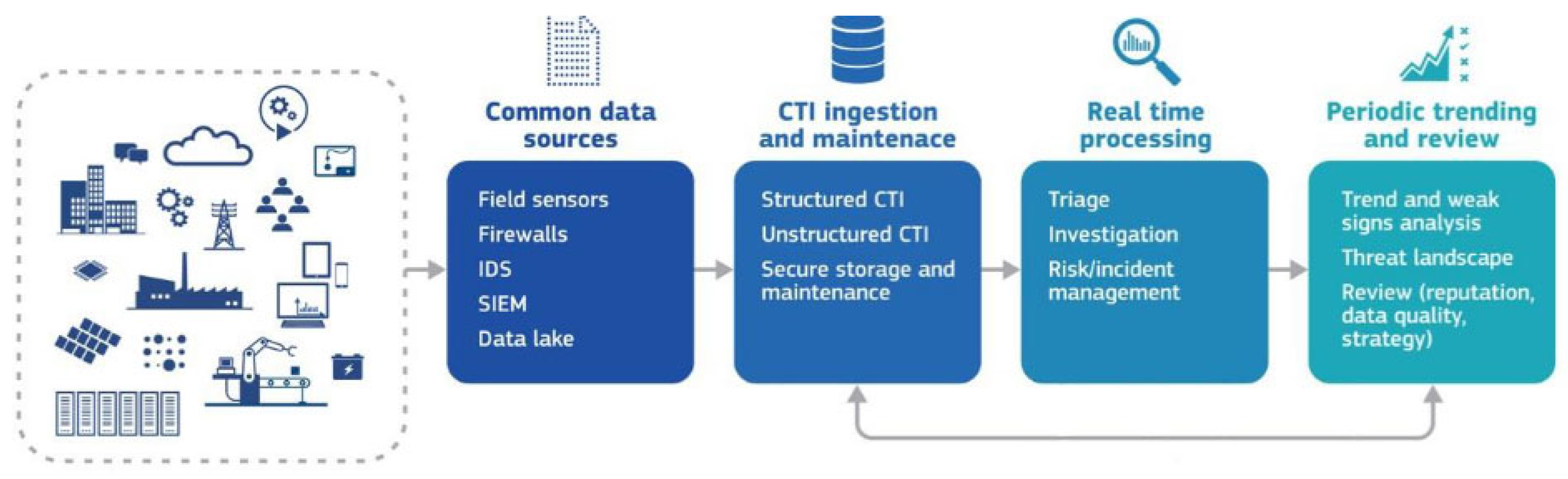
Cross-border Smart Villages require an architecture that combines multi-level modularity, data processing functionality, secure exchange, and interoperability. The principles of Smart Specialization (S3), economic and technological convergence, and cluster theory, integrated through the European Interoperability Platform (EIP), serve as the foundation for building such a system. Each local initiative–whether a group of villages or a municipal center–can be represented as a separate Data and Security Hub, analogous to a national SOC [11] in cybersecurity. These hubs collect data from IoT sensors, drones, mobile apps, and municipal databases, structure it using AI algorithms, and provide local analytics, as illustrated in Figure 1.
Figure 1.
Reprinted “Building blocks of a national SOC” [11] based on an EU Commission document distributed under a CC BY 4.0 license.
For example, the Modular IoT Platform solution enables the collection of sensor data on soil conditions, weather conditions, and rural mobility, while built-in AI analytics predicts crop yields and identifies potential incidents. Local hubs are integrated into regional consortia, which can be organized in one of three topologies: centralized, decentralized, or fully distributed. Within these consortia, data and services are securely exchanged between participants using gateways, similar to cross-border SOC gateways.
At the top level, several consortia are united into a cross-border network, where standardization of Application Programming Interface (APIs) and data formats through the EIP enables the integration of municipal and regional clusters into the international Smart Villages ecosystem. Data processing functional units include:
- -
- Data sources: IoT sensors, drones, mobile applications, cloud platforms, municipal databases.
- -
- Processing and normalization: structuring, validation and standardization of data for analysis.
- -
- AI analytics: crop yield forecasting, soil and environmental monitoring, incident detection.
- -
- Trend analysis and reporting: visualization through dashboards and a situational awareness dashboard (Smart Village Dashboard) available to farmers, municipal services and research centers [12].
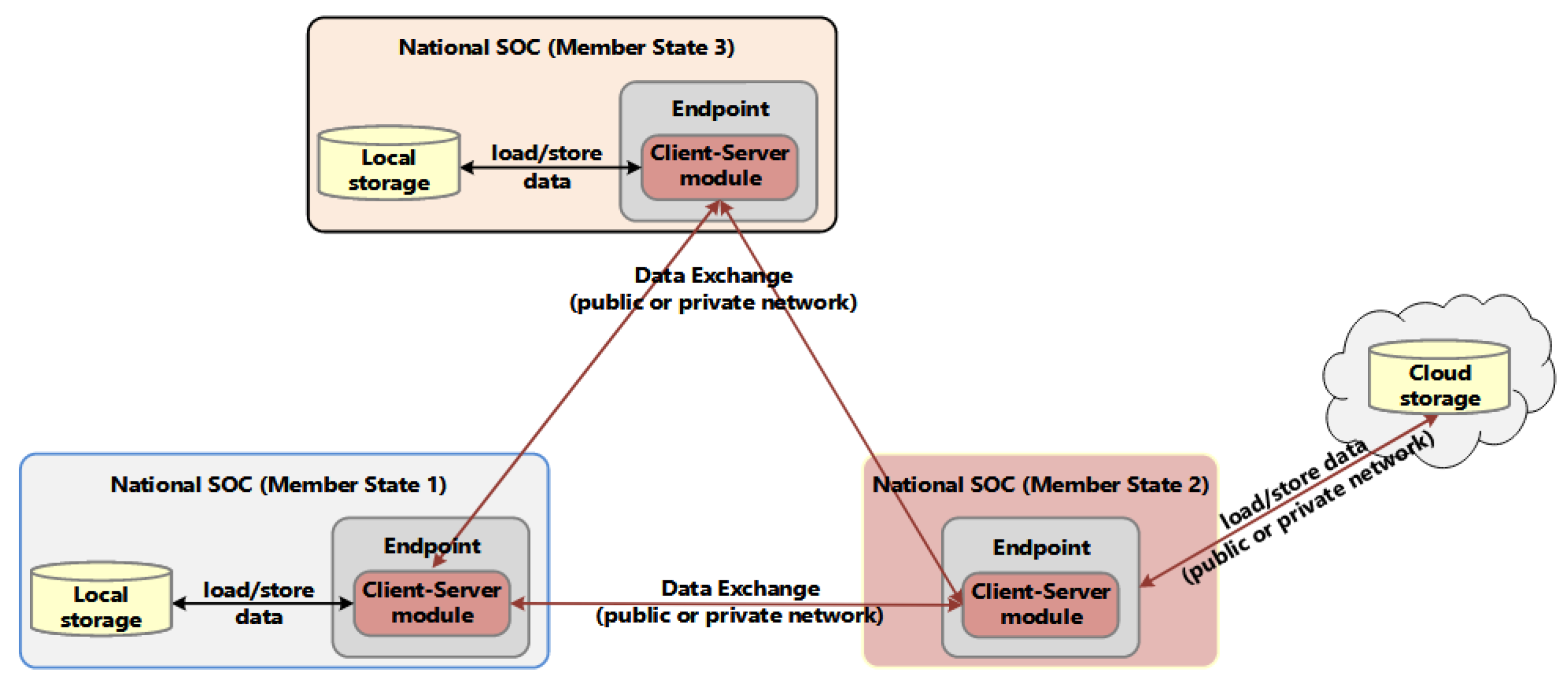
The architecture enables convergence: regions with different levels of digitalization gain access to the same analytical tools and IoT data. At the lower level of cross-border exchange, data is aggregated and transmitted between regional hubs via secure gateways, forming an international network of Smart Villages. In this network, each regional hub can simultaneously send and receive data from other hubs, ensuring technological and economic convergence between regions. The interconnection of regional and cross-border nodes, as well as the data flows between them, is shown schematically in Figure 2.
Figure 2.
Reprinted “High level architecture for SOCs interconnection [11] based on an EU Commission document distributed under a CC BY 4.0 license.
Figure 2 illustrates how each regional hub can simultaneously send and receive information, ensuring secure data exchange between Smart Villages and integration into the international network. For example, farmers in Moldova can use the same yield forecasting algorithms as those in Romania, accelerating technological and economic alignment. Cluster logic is implemented through the unification of municipal hubs, universities, startups, and research centers, creating cross-border value chains. The xDIH and Polish Node platform, supported by cloud and IoT solutions, enables the integration of local and international startups into a single cluster, where resources and knowledge are exchanged automatically through multi-agent systems and knowledge graphs. Data security and trust are ensured at multiple levels:
- Data encryption at rest: Hardware Security Module (HSM) and smartcards for key management.
- Two-level protection of communication channels: Transport Layer Security (TLS) for the application layer and VPN/IPSec for the network layer.
- Identification and certificates: Public Key Infrastructure (PKI) and digital signatures for participant access control.
- User authentication: two- or multi-factor verification.
These measures create a secure environment for exchanging data on agriculture, mobility, and the environment, compliant with European General Data Protection Regulation (GDPR) standards [13]. Furthermore, Modular IoT Analytics and Smart Village Dashboard enable visualization of the status of all connected Smart Villages and prompt response to incidents or changes in production. The integration of these theoretical frameworks with practical digital solutions is summarized in Table 2.
Table 2.
Integration of theoretical approaches and Smart Village platforms with examples of solutions.
The Data and Security Backbone architecture thus enables the creation of cross-border Smart Villages, where local hubs, regional consortia, and international platforms operate as a single, secure, and interoperable system, ensuring sustainable development, innovation, and digital integration in rural areas.
5. Conclusions and Recommendations
5.1. Conclusions
The integration of artificial intelligence (AI), IoT sensing technologies, and cross-border digital infrastructures enables the development of scalable, resilient, and data-driven Smart Village ecosystems. The proposed multi-layer architecture-comprising local hubs, municipal nodes, regional consortia, and cross-border platforms-supports end-to-end data acquisition, processing, and intelligent decision-making across rural regions.
Key findings include:
- Multi-layer data-driven architecture: The proposed architecture allows for the collection, processing, and analysis of heterogeneous data from IoT devices, agricultural sensors, environmental monitoring systems, and municipal databases. This ensures real-time insights for effective resource management and decision support.
- Integration of AI and IoT: AI algorithms, combined with IoT data, enable predictive analytics in agriculture (crop yield forecasting, drought detection, and pest monitoring), environmental management (soil, air, and water quality), and rural infrastructure management. Knowledge engineering techniques such as semantic data models and knowledge graphs enhance interoperability and intelligent automation.
- Cross-border interoperability: Standardized APIs, data formats, and integration via platforms such as xDIH, CONNECTINNO, and the Polish Node ensure seamless collaboration across Romania, Moldova, and Ukraine. This reduces the digital divide between regions and accelerates technological and economic alignment.
- Cybersecurity and trust: Data protection mechanisms-including TLS, VPN/IPSec, PKI-based authentication, and GDPR-compliant storage-ensure secure data exchange and trust in the distributed Smart Village ecosystem.
- Potential for broader applications: The architecture can be extended to environmental monitoring and rural healthcare systems, facilitating early risk detection, population health monitoring, and integration with smart healthcare initiatives.
5.2. Recommendations
To support the effective deployment and scaling of AI-enabled Smart Villages, the following actions are recommended:
- Deploy distributed IoT and sensor infrastructures for continuous data collection in agriculture, environmental monitoring, and rural mobility.
- Adopt cloud-edge computing architectures for real-time data processing, low-latency analytics, and AI-enabled decision support.
- Implement interoperable data standards and APIs to facilitate cross-border data exchange and platform integration.
- Strengthen cybersecurity frameworks to protect sensitive agricultural, environmental, and municipal data, ensuring compliance with European regulations.
- Develop and expand pilot projects that integrate AI and IoT technologies within cross-border innovation platforms, such as xDIH, CONNECTINNO, and the Polish Node, to validate scalability and interoperability.
- Explore applications beyond agriculture, including environmental health and rural healthcare monitoring, to maximize the social and economic impact of Smart Village ecosystems.
This data-driven and AI-enabled multi-layer architecture transforms rural systems into intelligent, interconnected ecosystems, supporting innovation, sustainable development, and cross-border collaboration.
Author Contributions
Conceptualization, S.T. and A.B.; methodology, S.T. and A.B.; software, S.T.; validation S.T. and A.B.; formal analysis, A.B.; investigation S.T. and A.B.; resources, S.T.; data curation, S.T.; writing—original draft preparation, S.T. and A.B.; writing—review and editing, S.T.; visualization, A.B.; supervision, S.T.; project administration, S.T. All authors have read and agreed to the published version of the manuscript.
Funding
This research received no external funding.
Institutional Review Board Statement
Not applicable.
Informed Consent Statement
Not applicable.
Data Availability Statement
The data presented in this study are available upon request from the corresponding author.
Conflicts of Interest
The authors declare no conflicts of interest.
References
- World Bank. Trading Economics. 2025. Available online: https://tradingeconomics.com/moldova/rural-population-percent-of-total-population-wb-data.html (accessed on 30 April 2026).
- Babin, A.; Covalenco, I.; Tutunaru, S.; Babina, E. Some Aspects of the Formation of an Innovation Ecosystem for the Sustainable Development of Smart Villages in the Republic of Moldova. In Proceedings of the CEEeGov ’22: Central and Eastern European eDem and eGov Days, Budapest, Hungary, 22–23 September 2022; Available online: https://dl.acm.org/doi/10.1145/3551504.3551517 (accessed on 30 April 2026).
- Babin, A.; Covalenco, I.; Tutunaru, S. Cybersecurity and smart innovation for rural resilience: Moldova’s strategic transition to green and digital villages. In SNSPA Smart Edu Hub: Vol. 2 (2025): Ensuring Trust and Security in Intelligent Urban Ecosystems; EU: Brussels, Belgium, 2025; p. 88. Available online: https://scrd.eu/index.php/trust/article/view/745 (accessed on 30 April 2026).
- xDIH–Cross-Border Digital Innovation Hub Romania–Moldova. Programme 2021–2027 Interreg VI-A NEXT Romania–Rep.Moldova. 2 August 2025. Available online: https://xdih.eu/en/home/ (accessed on 30 April 2026).
- CONNECTINNO Project–Interconnected Mobile Networks for Education and Innovation. INTERREG VI-A NEXT Romania–Republic of Moldova Programme. 2025. Available online: https://connectinno.tuiasi.ro/en/ (accessed on 30 April 2026).
- EU. Horizon Europe, Polish Node AgrofoodTEF. 2025. Available online: https://agrifoodtef.eu/nodes/polish-node (accessed on 30 April 2026).
- EU Commission. Digitalising the EU Agricultural Sector 2024–2029. Available online: https://digital-strategy.ec.europa.eu/en/policies/digitalisation-agriculture (accessed on 30 April 2026).
- EU. Finland. NOKIA. Available online: https://www.nokia.com/thought-leadership/articles/fight-to-feed-10-billion/ (accessed on 30 April 2026).
- MD. The National Program for Smart Specialization of the Republic of Moldova for 2024–2027 “Smart Moldova”. Available online: https://www.legis.md/cautare/getResults?doc_id=145032&lang=ro (accessed on 30 April 2026).
- EU Commission. CoP S3. Available online: https://ec.europa.eu/regional_policy/policy/communities-and-networks/s3-community-of-practice_en (accessed on 30 April 2026).
- EU Commission. Call for Expression of Interest on Cross-border SOCs/Cyber Hubs, Annex 5. Blueprint Architecture. 2024. Available online: https://cybersecurity-centre.europa.eu/system/files/2024-07/Annex%205%20Blueprint%20architecture.pdf (accessed on 30 April 2026).
- EU, Finland. Nokia’s Integrated Operations Center (IOC) for Smart Cities and Smart Villages. Available online: https://www.nokia.com/industries/smart-cities/integrated-operations-center (accessed on 30 April 2026).
- EU Commission, Regulation 2016/679. Available online: https://commission.europa.eu/law/law-topic/data-protection/legal-framework-eu-data-protection_en (accessed on 30 April 2026).

Disclaimer/Publisher’s Note: The statements, opinions and data contained in all publications are solely those of the individual author(s) and contributor(s) and not of MDPI and/or the editor(s). MDPI and/or the editor(s) disclaim responsibility for any injury to people or property resulting from any ideas, methods, instructions or products referred to in the content. |
© 2026 by the authors. Licensee MDPI, Basel, Switzerland. This article is an open access article distributed under the terms and conditions of the Creative Commons Attribution (CC BY) license.