


Abstract
High penetration of converter-based wind generation reduces system inertia. It poses challenges to frequency stability in modern distribution networks, particularly in doubly fed induction generator (DFIG)-based wind-energy-conversion systems (WECSs), where frequency regulation is coupled with point-of-common-coupling (PCC) voltage and power factor (PF) dynamics. This study presents a multi-objective comparative evaluation of proportional–integral (PI), proportional–integral–derivative (PID), fractional-order PID (FOPID), and adaptive neuro-fuzzy inference system (ANFIS) controllers for a DFIG-based WECS connected to a radial distribution feeder. Controller parameters are tuned using multi-objective optimisation, considering frequency deviation, overshoot, settling time, disturbance robustness, control smoothness, and computational cost, while maintaining PCC voltage and PF within acceptable limits. MATLAB/Simulink simulations are conducted under turbulent wind conditions, load variations, voltage disturbances, and measurement noise. The results indicate that conventional PI and PID controllers exhibit limited performance under low-inertia conditions, whereas FOPID improves damping and voltage/PF behaviour. ANFIS achieves the best overall performance, providing reduced frequency deviation, faster settling time (below 3 s), improved disturbance rejection, and significantly lower integral absolute error (up to ~90%) compared to PI control. These findings offer practical guidance for selecting and tuning controllers to enhance frequency-centric stability in wind-integrated distribution networks.
1. Introduction
The increasing integration of renewable energy sources (RES), particularly wind and solar generation, is fundamentally transforming the operation and control of modern electrical power systems [1,2]. The progressive displacement of conventional synchronous generators by converter-interfaced generation significantly reduces system inertia and weakens the inherent frequency support traditionally provided by rotating machines [3,4]. This transition is especially pronounced in distribution networks, where wind-energy-conversion systems (WECSs) and other embedded generators are predominantly connected through power electronic interfaces, resulting in low-inertia operating conditions.
Under such circumstances, frequency stability emerges as a critical challenge. Variability in wind speed, abrupt load changes, and grid disturbances can induce rapid frequency deviations, potentially violating grid-code requirements or activating protection mechanisms [5,6]. Doubly fed induction generator (DFIG)-based WECSs, despite their widespread adoption and high efficiency, do not naturally contribute physical inertia. Consequently, their grid-side and rotor-side converters must be appropriately controlled to emulate inertial response and deliver effective active power support during frequency disturbances.
Recent advances in control, notably fractional-order PID (FOPID) and adaptive neuro-fuzzy inference system (ANFIS) controllers, offer enhanced dynamic flexibility, memory effects, and non-linear adaptability for addressing challenges posed by low-inertia systems [7]. However, their comparative effectiveness for frequency-centric control in wind-integrated distribution networks remains insufficiently investigated. At the distribution level, frequency regulation is intrinsically coupled with voltage control and power factor (PF) at the point of common coupling (PCC). Reactive power exchange between the WECS and the grid directly influences voltage magnitude and PF, while active power modulation for frequency support must comply with converter ratings and network constraints. This interdependence necessitates coordinated multi-objective control of active and reactive power to simultaneously maintain acceptable frequency, voltage, and PF [8,9].
This work advances stability, control, and optimisation in renewable-dominated power systems by systematically comparing conventional (PI, PID) and advanced (FOPID, ANFIS) controllers for frequency-centric control of a DFIG-based WECS in a distribution feeder. By jointly optimising frequency response, PCC voltage, power factor, robustness, and control effort, the study provides practical guidance for controller selection and tuning in low-inertia renewable grids.
1.1. Motivation
In converter-dominated, wind-integrated networks, reduced inertia and dynamic operating conditions challenge frequency and voltage stability. DFIG-based WECS, therefore, require advanced controllers to coordinate active and reactive power within converter limits under stochastic disturbances, making adaptive methods such as FOPID and ANFIS more suitable than conventional PI and PID for low-inertia distribution systems [10,11].
1.2. Research Gap
Existing studies extensively address WECS control for MPPT, reactive power regulation, and static power-factor correction [4,8,9,12], yet key gaps remain. Most studies treat frequency stability and voltage/PF control separately rather than within an integrated multi-objective framework, and comparative analyses of PI/PID versus advanced controllers such as FOPID and ANFIS for frequency-centric stability are limited. Moreover, the coupled effects of frequency response, PCC voltage, reactive power behaviour, converter constraints, and computational efficiency are often oversimplified, with few works adopting a rigorous multi-objective optimisation approach that jointly enforces frequency, voltage, and PF requirements [13,14].
1.3. Contribution
This study develops a frequency-centric dynamic model of a DFIG-based WECS in a radial distribution network and formulates controller tuning as a multi-objective optimisation problem that accounts for frequency, voltage, power factor, robustness, and computational efficiency. A comparative evaluation of PI, PID, FOPID, and ANFIS under identical simulations shows that advanced controllers, particularly ANFIS and, to a lesser extent, FOPID, significantly improve frequency stability, voltage regulation, and power factor performance, with ANFIS achieving up to 90% reduction in frequency IAE and the fastest settling, providing practical guidance for low-inertia, wind-integrated grids [3,15,16].
1.4. Novelty
The novelty of this work lies in presenting a unified, frequency-centric control framework that jointly regulates frequency, voltage, and PF in a wind-integrated distribution network, along with a multi-objective, comparative analysis of PI, PID, FOPID, and ANFIS controllers. The study provides new quantitative evidence of the superior frequency and voltage performance of advanced controllers, especially ANFIS, within a realistic low-inertia grid environment.
2. System Description and Control Formulation
2.1. System Model
The study examines a DFIG-based WECS connected at the point of common coupling (PCC) of a radial medium-voltage distribution feeder, as shown in Figure 1. The system comprises a variable-speed wind turbine that converts wind energy into mechanical torque, a DFIG represented in the synchronous d-q frame, and a back-to-back converter comprising rotor-side and grid-side converters for active and reactive power control. The distribution network is modelled as a radial feeder with line impedances, a composite ZIP load, and a substation equivalent. Key electrical quantities, active power , reactive power , PCC voltage and system frequency are continuously measured at the PCC and fed into the coordinated control system. These feedback signals enable dynamic adjustment of active and reactive power references, allowing the controller to maintain frequency stability while supporting voltage regulation in the wind-integrated distribution network.
Figure 1.
System architecture of the integrated DFIG wind turbine with the grid.
2.2. Frequency, Voltage, and PF Dynamics
At the network level, the frequency dynamics can be approximated by the following equation [15]:
where is the system frequency, the nominal frequency (50 Hz), the system inertia, the damping coefficient, the turbine mechanical power, and the electrical power exported to the grid. In low-inertia networks, small increases frequency sensitivity to imbalance, requiring DFIG-based WECS to modulate via converter control. PCC voltage and PF are governed by reactive power exchange, with active and reactive power injections constrained by grid-code voltage and PF limits [15,16].
2.3. Control Objectives
The proposed converter-level control system targets the following objectives:
- Frequency stability: The controller must maintain the system frequency close to the nominal value by minimising overshoot, undershoot, settling time, and oscillations during disturbances, while limiting the rate of change of frequency (ROCOF) to satisfy protection and grid-code requirements.
- Voltage and PF regulation: The controller must keep the PCC voltage within permissible limits under varying wind and load conditions and regulate the power factor close to the reference value , while limiting reactive power excursions and oscillations to ensure smooth and stable operation.
- Additional objectives: The control system must be robust to wind variability, load disturbances, voltage dips, and measure noise, minimise control effort and abrupt command changes to reduce converter stress, and remain computationally efficient for real-time implementation on WECS digital controllers.
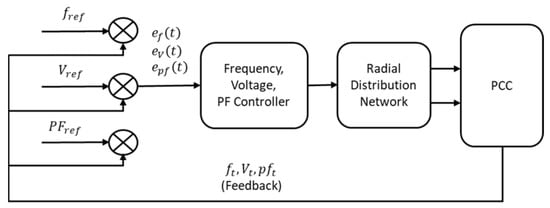
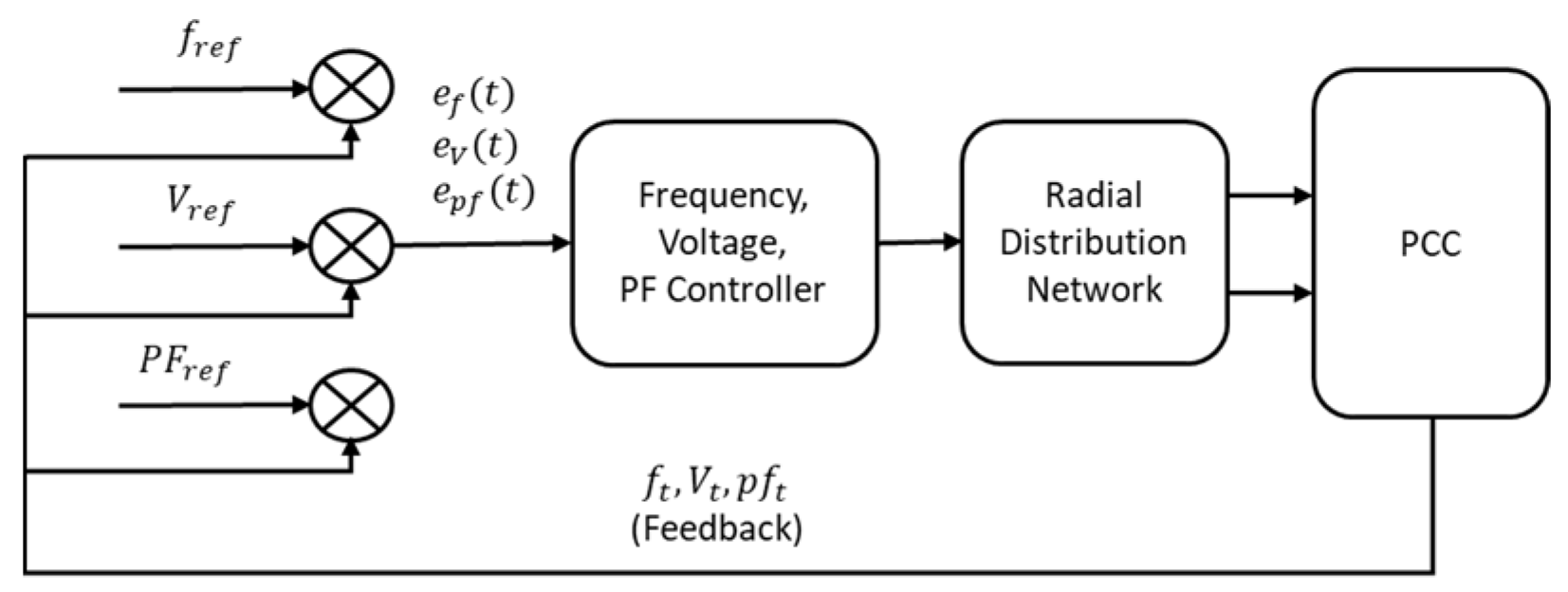
Figure 2 shows the coordinated control structure, where the frequency error generates the active power reference , while a voltage or power-factor loop produces the reactive power reference , with PI, PID, FOPID, and ANFIS controllers implemented in the frequency-centric loop.
Figure 2.
Conceptual control structure for coordinated control in the WECS.
2.4. Multi-Objective Optimisation Framework
The controller tuning problem is cast as a multi-objective optimisation task. Let denote the vector of controller parameters (gains, fractional orders, ANFIS membership parameters, etc.). The composite objective function is defined as follows:
where denotes the frequency integral absolute error, the frequency over/undershoot penalty, the settling-time penalty, the maximum ROCOF measure, the control effort (e.g., norms of and ), and the average computation time per control step. The weights satisfy ; the values are used in this study, prioritising frequency performance while accounting for control smoothness and computational cost.
The optimisation is subject to constraints:
where is the voltage limit; and are grid-code power factors’ bounds; and is the maximum computation time per step.
3. Controller Design and Mathematical Models
In this section, the design formulations and mathematical models of each of the four controllers, PI, PID, FOPID, and ANFIS, are developed.
3.1. Proportional–Integral (PI) Controller
The proportional–integral (PI) controller is adopted for its simplicity and ease of tuning, using the frequency error to generate the active power reference within converter limits, with optional secondary PI regulation of . The gains and are tuned to ensure acceptable settling time, steady-state error, and overshoot under typical wind and load disturbances.
3.2. Proportional–Integral–Derivative (PID) Controller
The PID controller augments PI control with derivative action to improve damping and transient response, with gains initialised via standard tuning methods and refined through optimisation; however, the derivative term increases sensitivity to measurement noise. The regulatory law is as follows [11]:
3.3. Fractional-Order PID (FOPID) Controller
The FOPID controller extends PID by introducing fractional integral and derivative orders and , providing enhanced tuning flexibility and robustness for non-linear WECS dynamics, with fractional operators approximated via Oustaloup filters. The parameters are optimised using metaheuristic methods by minimising the multi-objective cost . Formally, the controller transfer function [10,11]:
3.4. Adaptive Neuro-Fuzzy Inference System (ANFIS) Controller
The adaptive neuro-fuzzy inference system (ANFIS) controller integrates neural network learning with fuzzy logic inference, using the frequency error and optionally its derivative as inputs to generate the control signal . Its architecture consists of a fuzzification and rule-based inference layer that encodes expert knowledge, followed by a neural learning layer that adapts membership functions and rule weights using WECS disturbance data, and a final defuzzification layer that produces the real-time control output. Mathematically, the structure can be expressed as a weighted sum of rule outputs:
where is the number of rules, the normalised firing strength, and the (typically linear) consequent function; parameters are adapted by minimising a tracking error cost, enabling ANFIS to capture non-linear and time-varying system behaviour.
3.5. Overview of Different Controller Models and Their Key Characteristics
Table 1 summarises each controller, including its key features and tuning parameters.
Table 1.
Summary of Controller Models.
4. Methodology
4.1. Simulation, Evaluation Process, and Test Scenarios
Simulation studies were conducted in MATLAB/Simulink (R2022b) using the control system and optimisation toolboxes to model a variable-speed, converter-interfaced DFIG-based WECS connected to a radial medium-voltage feeder with a ZIP load. Reactive power commands were applied directly to the converter setpoint, with fed back for control, and all controllers (PI, PID, FOPID, and ANFIS) were implemented with a 1 ms sampling period to capture dynamic responses under varying wind and load conditions.
All controllers were tested under identical disturbance conditions to assess robustness. The wind speed varied between 9 and 11 m/s, with turbulence and ±3 m/s gusts. Load steps of ±10% and ±20% were applied at 10 s and 20 s, respectively, and a 5% PCC voltage dip occurred at 15 s. Measurement noise (0.5% rms) and a 2 ms delay were included, with fixed random seeds used to ensure fair and repeatable comparisons.
4.2. Performance Indices, Tuning and Validation Process
Controller performance was evaluated using multi-objective dynamic and steady-state metrics, including frequency IAE, deviation, settling time, ROCOF, PCC voltage overshoot/undershoot and ripple, PF deviation and IAE, control effort ( and ), converter saturation, and computational cost. PI and PID gains were initialised via relay and Ziegler–Nichols tuning and refined using bounded Nelder–Mead optimisation of ; FOPID parameters were optimised using a genetic algorithm with constraints, while ANFIS was trained via hybrid learning and validated under unseen conditions. A composite objective function was minimised during controller tuning, where the weights were selected such that , with default values of [0.35, 0.20, 0.20, 0.15, 0.10].
5. Simulation Results
5.1. Overview and Baselines
The simulation study evaluates four control strategies for frequency, power factor, power flow, voltage regulation, and IAE in a wind-integrated distribution network.
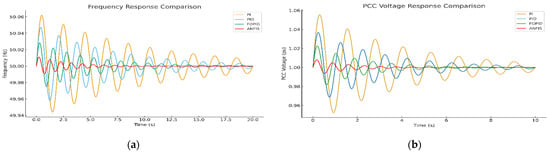
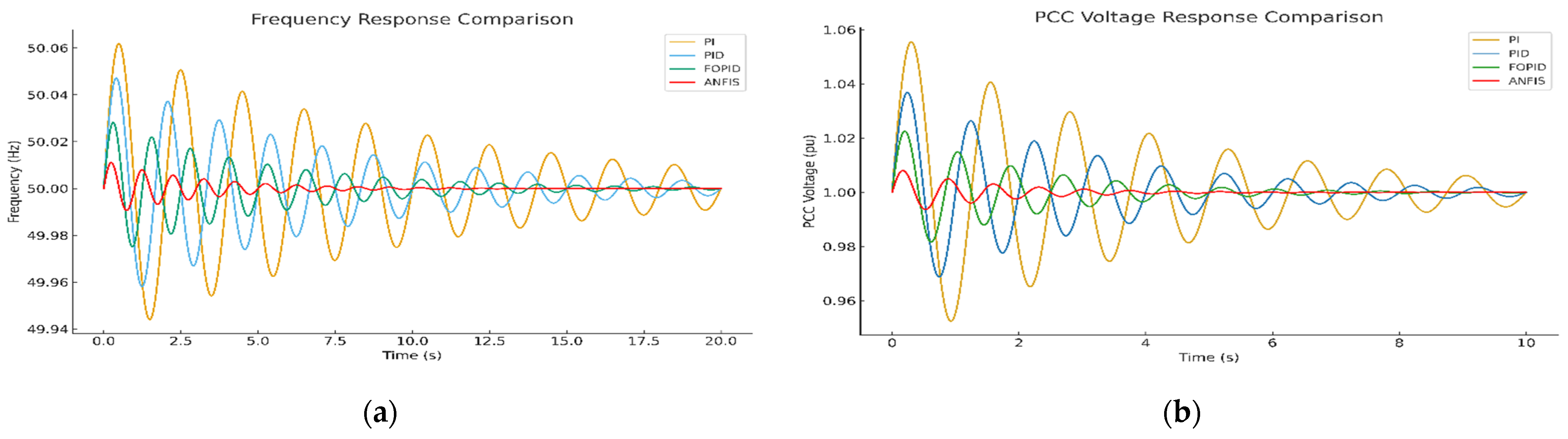
Figure 3a shows that PI exhibits the widest frequency deviation (≈49.97–50.10 Hz) and the slowest recovery (~10 s). PID improves this to 49.98–50.08 Hz with ~7 s settling, and FOPID further limits deviations to 49.99–50.05 Hz with ~5 s settling. ANFIS delivers the best response, maintaining a very tight band (≈49.995–50.02 Hz) and settling in under 3 s with minimal oscillation, indicating superior robustness and non-linear adaptability. Figure 3b shows that PCC voltage regulation improves progressively from PI (+6%/−2.5% deviation with sustained oscillations) to PID (~+4% overshoot, ~7 s settling), to FOPID (~+2.5% overshoot, ±0.001 pu ripple, ~4 s settling), with ANFIS providing the best performance (<1% overshoot, <2 s settling, and negligible ripple).
Figure 3.
(a) Frequency tracking amongst the validated controllers. (b) PCC voltage response amongst the validated controllers.
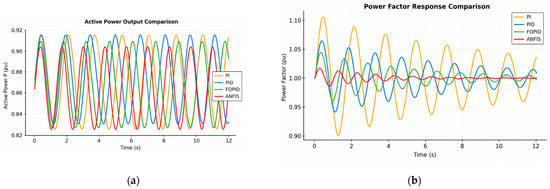
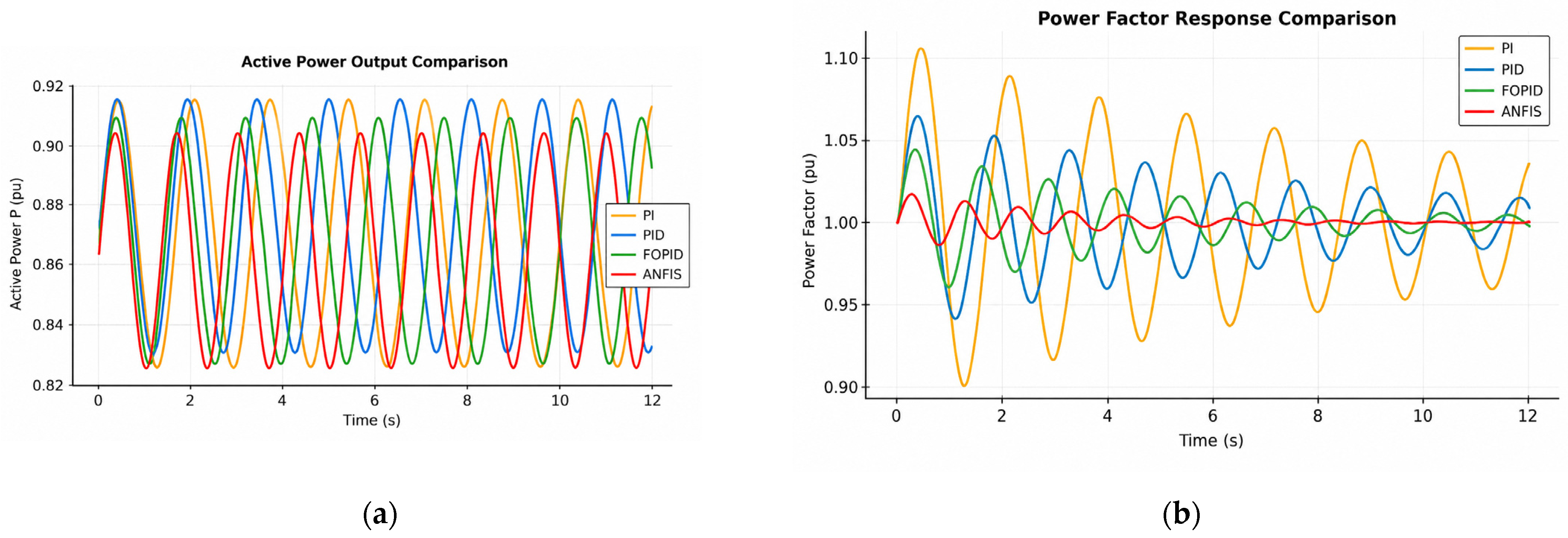
Figure 4a shows that active power smoothness improves from PI (≈0.103 pu variation, ~0.865 pu peak) to PID (≈0.098 pu) and FOPID (≈0.095 pu), with progressively better damping. ANFIS provides the smoothest response, exhibiting the smallest modulation (≈0.090 pu) and lowest peak (≈0.858 pu), indicating superior precision and adaptability to disturbances. Figure 4b shows that PF performance improves progressively from PI (+11% overshoot, ~12 s settling, ±0.004 pu ripple) to PID (+7%, ~8 s, ±0.0025 pu) and FOPID (+5%, ~5 s, ±0.0015 pu). ANFIS delivers the best response, with <2% overshoot, <3 s settling time, and minimal ripple below ±0.0005 pu.
Figure 4.
(a) Active power response comparison among the controllers. (b) Power factor response comparison among the controllers.
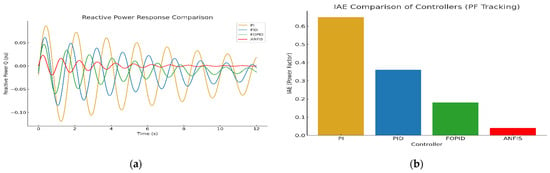
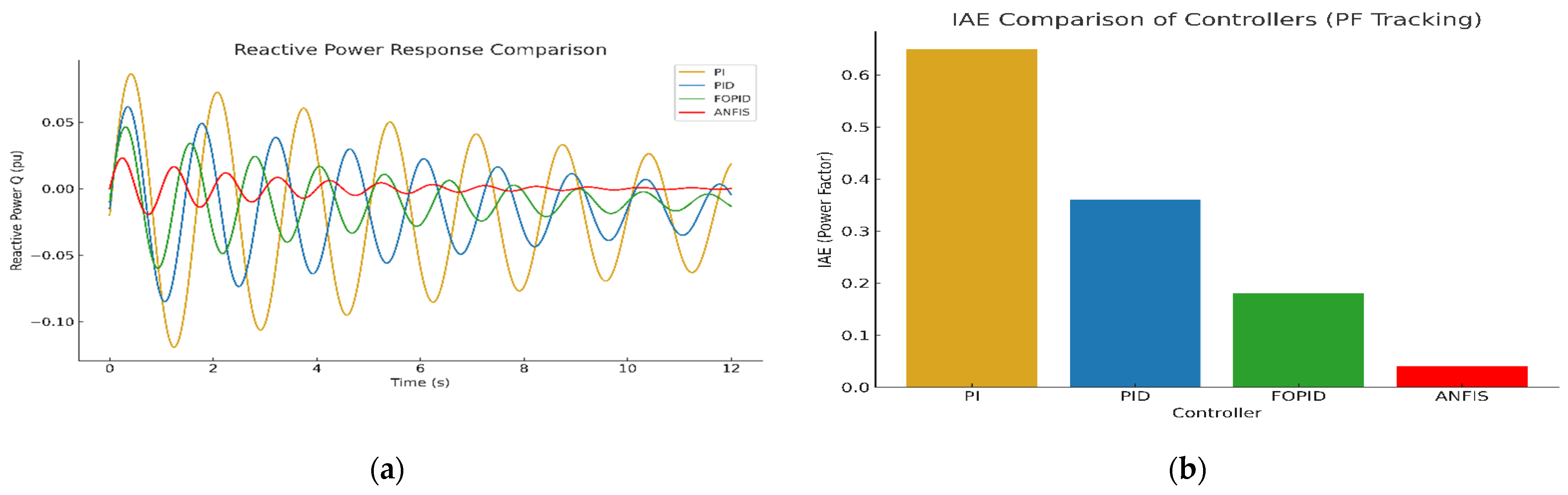
Figure 5a shows that reactive power oscillations decrease progressively from PI (+0.11 to −0.04 pu) to PID (+0.08 to −0.03 pu) and FOPID (+0.06 to −0.02 pu), with ANFIS providing the smoothest response, limited to a small initial peak (~+0.025 pu) and minimal ripple (<±0.005 pu). Figure 5b indicates a corresponding reduction in frequency IAE, decreasing from ~0.65 (PI) to ~0.36 (PID) and ~0.18 (FOPID), with ANFIS achieving the lowest error (~0.04), demonstrating its superior non-linear adaptability and fast convergence.
Figure 5.
(a) Reactive power response amongst the validated controllers. (b) IAE comparison amongst the validated controllers.
5.2. Comparative Analysis and Summary
Overall, the results clearly show that PI and PID remain viable for basic PF regulation; they lack the robustness required for modern wind-integrated distribution networks. FOPID provides substantial improvements, and ANFIS surpasses all other methods in tracking accuracy, robustness, voltage support, and control stability. Table 2 presents comparative qualitative and quantitative results summarising the performance of all controllers across the key metrics used in this study.
Table 2.
Summary of the controllers used in the study.
6. Conclusions and Future Work
This study demonstrates that high penetration of converter-based wind generation exacerbates frequency instability in low-inertia distribution networks, necessitating advanced control strategies beyond PI and PID. Under a unified multi-objective evaluation, ANFIS achieves the narrowest frequency deviation (≈49.995–50.02 Hz), fastest settling (<3 s), and lowest PF IAE (~0.04), representing nearly 90% improvement over PI, while FOPID provides strong damping with ~70% IAE reduction and voltage overshoot limited to ~2.5%. In contrast, PI and PID exhibit slower recovery, higher overshoot (≈6% and 4%), and larger active and reactive power oscillations. Overall, ANFIS offers the most robust and smooth dynamic response, highlighting the effectiveness of intelligent non-linear control in disturbance-rich, converter-dominated grids. Future work will address hardware-in-the-loop validation, integration with grid-forming inverters, online adaptive tuning, and scalability to multi-turbine systems under varying grid strengths.
Author Contributions
Conceptualisation, K.B. and R.K.B.; methodology, K.B.; software, R.K.B.; validation, K.B. and R.K.B.; data curation, R.K.B.; writing—original draft preparation, K.B.; writing—review and editing, R.K.B.; supervision, K.B.; project administration, K.B.; funding acquisition, K.B. All authors have read and agreed to the published version of the manuscript.
Funding
This research received no external funding.
Institutional Review Board Statement
Not Applicable.
Informed Consent Statement
Not Applicable.
Data Availability Statement
The authors will provide the data on request.
Conflicts of Interest
The authors declare no conflicts of interest.
References
- Behara, R.K.; Saha, A.K. Deep Q-Network Reinforcement Learning-Based Rotor Side Control System of a Grid Integrated DFIG Wind Energy System Under Variable Wind Speed Conditions. IEEE Access 2024, 12, 184179–184205. [Google Scholar] [CrossRef] [Scilit]
- Behara, R.K.; Saha, A.K. Comparative Performance Analysis of Deep Learning-Based Diagnostic and Predictive Models in Grid-Integrated Doubly Fed Induction Generator Wind Turbines. Energies 2025, 18, 4725. [Google Scholar] [CrossRef] [Scilit]
- ENTSO-E. Grid Forming Capability of Power Park Modules. 2024. Available online: www.entsoe.eu (accessed on 7 May 2026).
- Altayara, D.M.A. Reactive Power Management with Distributed Energy Resources; IEA Photovoltaic Power System Programme: Redfern, Australia, 2024. [Google Scholar]
- Decision Options Matrix for IEEE 1547TM-2018 Adoption—Interstate Renewable Energy Council (IREC). Available online: https://irecusa.org/resources/decision-options-matrix-for-ieee-1547-2018-adoption-3/ (accessed on 7 May 2026).
- Pohl, E.; Mckenna, K. Interconnection of Distributed Energy Resources in the Indian Context: IEEE 1547-2018 Adaptation for Locally-Appropriate Grid Code Development. 2018. Available online: www.nrel.gov/publications (accessed on 15 December 2025).
- Hamza, M.F.; Abdullahi, A.M. An Adaptive Neuro-Fuzzy Fractional-Order PID Controller for Energy-Efficient Tracking of a 2-DOF Hip–Knee Lower-Limb Exoskeleton. Modelling 2026, 7, 54. [Google Scholar] [CrossRef] [Scilit]
- Moutevelis, D. Voltage Stability and Control of Electrical Distribution Systems with High Penetration of Power Electronic Converters. arXiv 2024, arXiv:2504.18466. [Google Scholar]
- Loza, B.; Minchala, L.I.; Ochoa-Correa, D.; Martinez, S. Grid-Friendly Integration of Wind Energy: A Review of Power Forecasting and Frequency Control Techniques. Sustainability 2024, 16, 9535. [Google Scholar] [CrossRef] [Scilit]
- Paducel, I.; Safirescu, C.O. Fractional Order Controller Design for Wind Turbines. Appl. Sci. 2022, 12, 8400. [Google Scholar] [CrossRef] [Scilit]
- Ahmed, M.; Mohamed, E. Modern PID/FOPID controllers for frequency regulation of interconnected power system by considering different cost functions. Sci. Rep. 2023, 13, 14084. [Google Scholar] [CrossRef] [Scilit] [PubMed]
- Merem, E.C.; Twumasi, Y.; Wesley, J.; Olagbegi, D.; Crisler, M.; Romorno, C.; Alsarari, M.; Isokpehi, P.; Hines, A.; Hirse, G.; et al. The Evaluation of Wind Energy Potentials in South Africa. Energy Power 2022, 12, 9–25. [Google Scholar] [CrossRef] [Scilit]
- Iftikhar, M.Z.; Imran, K. Network reconfiguration and integration of distributed energy resources in distribution network by novel optimisation techniques. Energy Rep. 2024, 12, 3155–3179. [Google Scholar] [CrossRef] [Scilit]
- Ali, E.S. Reconfiguration of a Radial Distribution System using the Harris Hawks Optimization Algorithm. WSEAS Trans. Syst. 2025, 24, 156–163. [Google Scholar] [CrossRef] [Scilit]
- National Energy Regulator of South Africa (NERSA). Grid Connection Code for Renewable Power Plants Connected to the Electricity Transmission System (TS) or the Distribution System (DS) in South Africa; Version 3.1; National Energy Regulator of South Africa (NERSA): Arcadia, South Africa, 2022; Volume 1, pp. 1–113. [Google Scholar]
- Eskom Holdings Limited. The South African Grid Code—The Network Code; National Energy Regulator of South Africa (NERSA): Arcadia, South Africa, 2019; Volume 10. [Google Scholar]



Disclaimer/Publisher’s Note: The statements, opinions and data contained in all publications are solely those of the individual author(s) and contributor(s) and not of MDPI and/or the editor(s). MDPI and/or the editor(s) disclaim responsibility for any injury to people or property resulting from any ideas, methods, instructions or products referred to in the content. |
© 2026 by the authors. Licensee MDPI, Basel, Switzerland. This article is an open access article distributed under the terms and conditions of the Creative Commons Attribution (CC BY) license.