


Abstract
This paper presents a comprehensive analysis of energy optimization strategies for the Ferrarin and Arzergrande water pumping stations, located in the Piovese Area, close to Padua, managed by multiutility company AcegasApsAmga S.p.A. Based on studies conducted by the University of Naples Federico II, the paper compares current operational configurations and proposes innovative solutions to reduce energy consumption, improve hydraulic efficiency, and enhance operational flexibility. The integration of high-efficiency pumps, strategic network interconnections, and the use of hydraulic turbines are evaluated for their impact on energy savings and system resilience.
1. Introduction
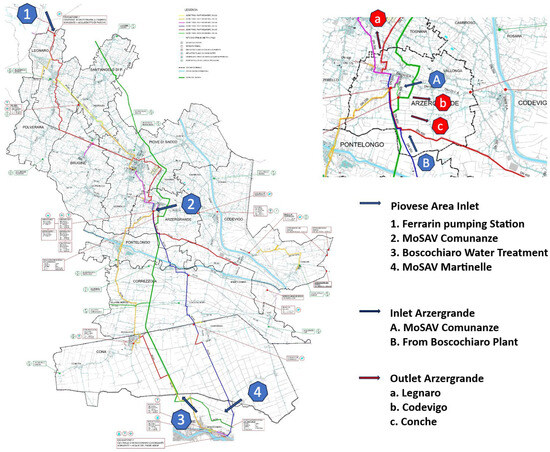
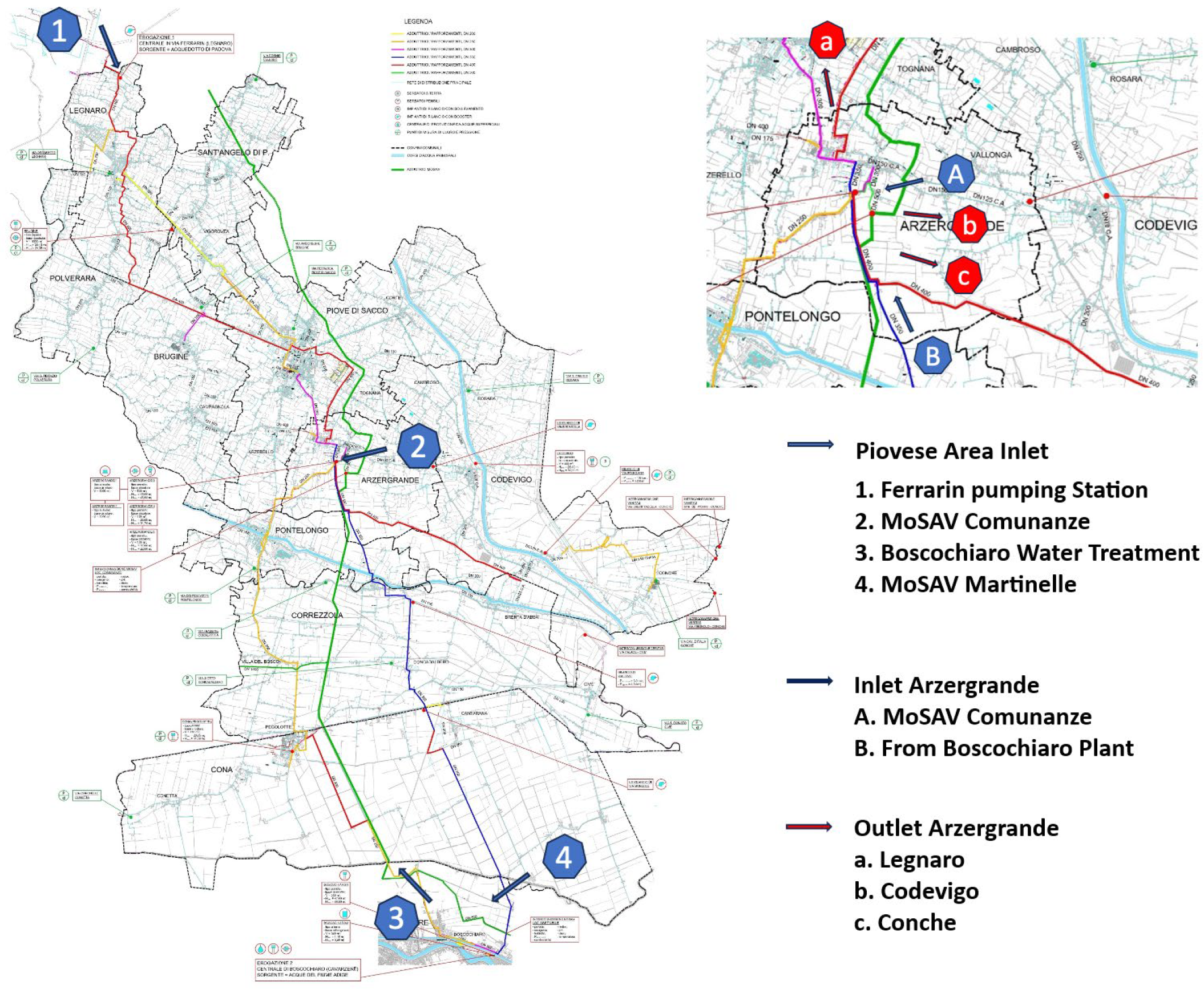
Water distribution systems are critical infrastructures that require continuous optimization to meet increasing demands and sustainability goals [1]. The Ferrarin and Ar-zergrande pumping stations are central to the Piovese water network, each serving distinct roles in water transfer and pressure regulation. Ferrarin acts as a relay between Padova and Piovese, while Arzergrande manages inflows from MoSAV (i.e., Modello Strutturale Acquedottistico del Veneto)—Comunanze Interconnection—and Boscochiaro water treatment plant (Figure 1). This study, commissioned by AcegasApsAmga and conducted by the University of Naples Federico II, aims to identify inefficiencies and propose energy-saving measures through detailed analysis, field data evaluation, and hydraulic simulations. The research aligns with the UNI ISO 14414:2019 standard [2] for pump system energy assessment and contributes to the broader goals of sustainable water management.
Figure 1.
Water flows enter and exit the Saccisica area and the Arzergrande pumping station.
The rationalization of the pumping systems in the Piovese area must consider both external contextual factors and operational experience. The development of the MoSAV regional water supply system enables the selection of new network feed points, moving beyond previous configurations. According to agreements within the Bacchiglione Basin Council, volumes extracted from MoSAV via Comunanze and Martinelle are expected to reach 50 L/s at the end of 2025 and up to 80 L/s from 2026.
Given its central location and large storage capacity, the Arzergrande station is the preferred node for integrating these flows. Recent studies highlight the need to reduce water detention times in reservoirs to improve quality and efficiency.
2. Current Operational Analysis
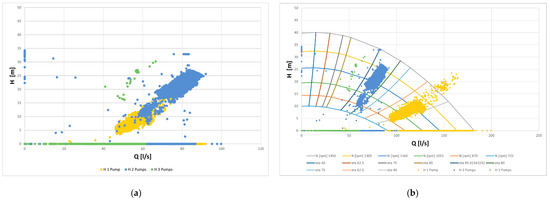
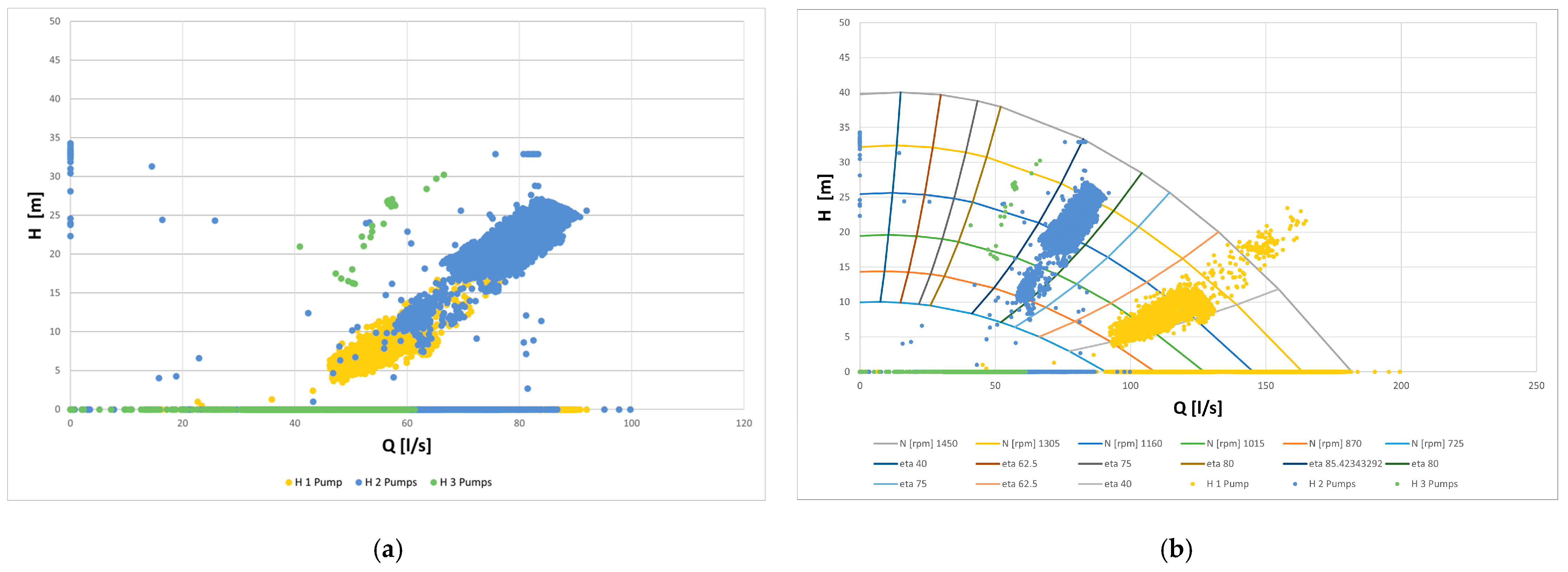
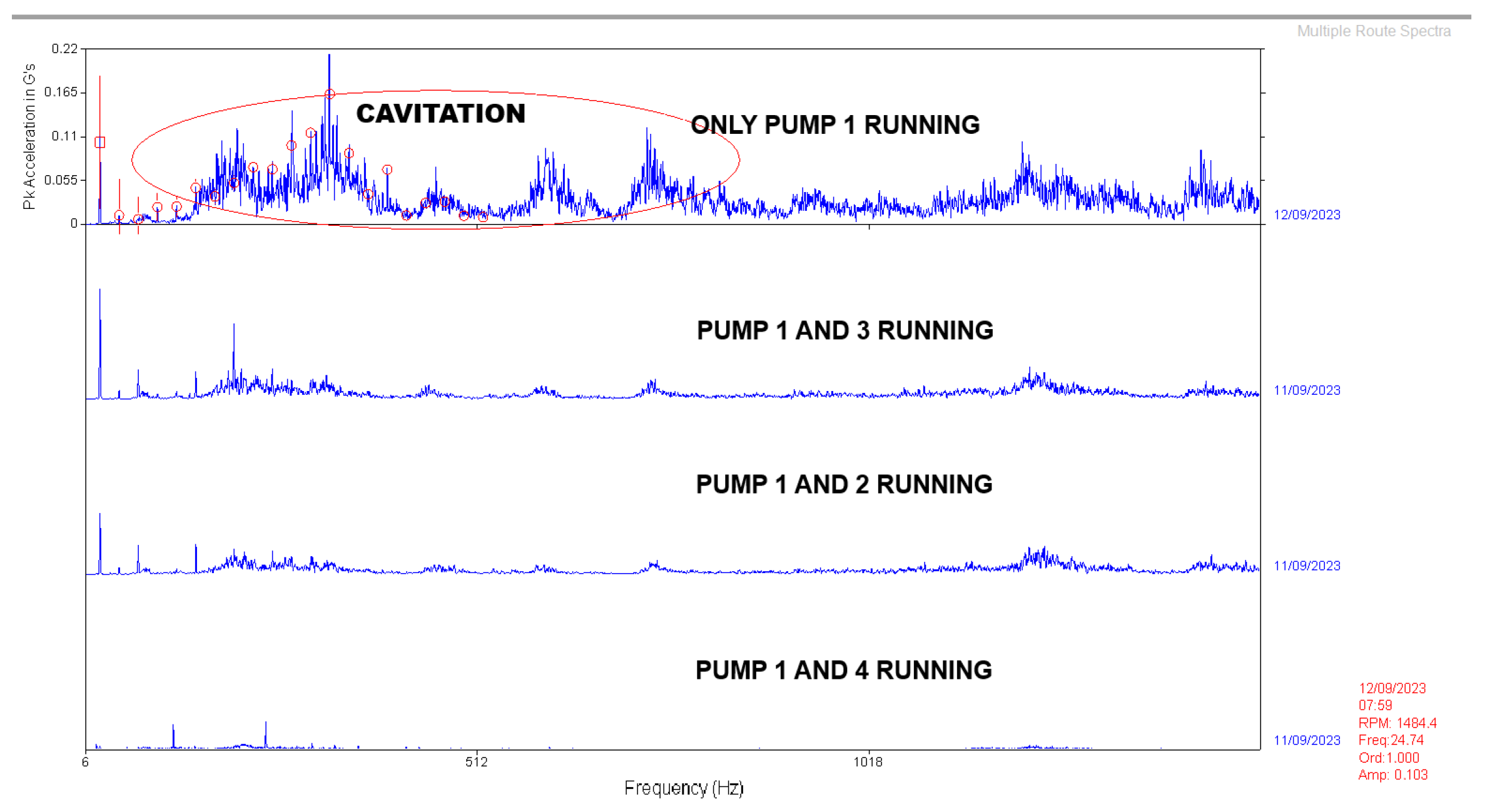
The Ferrarin pumping station operates with four pumps, typically using a single pump during nighttime hours. This configuration leads to cavitation, increased vibration, and reduced efficiency, with performance dropping below 45%. Multi-pump operation during daytime maintains efficiency above 77%, supported by inverter-controlled motors and telemetry data (Figure 2).
Figure 2.
(a) Plant operating conditions and (b) evaluation of the working conditions of each individual machine at the Ferrarin Pumping Plant.
Arzergrande pumping station receives water from MoSAV and Boscochiaro (as shown in Figure 1), with dual reservoirs of 8000 m3 and 2000 m3. The station faces challenges in balancing pressure zones, managing flow distribution, water age [3], and maintaining consistent service levels. Telemetry and asset analysis reveal inefficiencies in pump operation, pressure regulation, and water aging, particularly during transitions between reservoirs.
3. Proposed Improvements
For Ferrarin, three targeted solutions are proposed to address the inefficiencies observed during nighttime operations, as shown in Figure 3. (1) The complete shutdown of the station during low-demand nighttime hours is based on telemetry data showing minimal impact on downstream pressure and flow when the station is inactive. This approach eliminates energy waste and reduces mechanical wear. (2) Operating two pumps in parallel allows the system to maintain flow requirements while keeping each pump within its optimal efficiency range, thereby reducing cavitation and vibration. This approach could be achieved in these two different ways: (2.1) reducing pump velocity rotation at 580 rpm, (2.2) by inserting a remotely controlled valve downstream of two of the four pumps in the system to aim for an increase in pump head. (3) Replacing the least efficient pump with a model specifically designed for low-flow conditions ensures that nighttime operations, when necessary, are conducted with minimal energy input and maximum reliability. The new pump would feature a larger impeller diameter and lower nominal head, tailored to the hydraulic profile of the network during off-peak hours.
Figure 3.
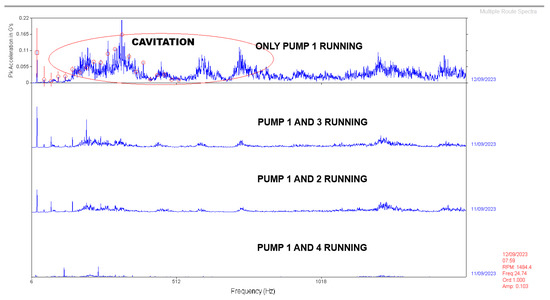
Spectral analysis of the signal acquired by accelerometers for different machine operation combinations.
For Arzergrande, the proposed improvements are more structural and involve reconfiguring internal piping to separate high- and low-pressure circuits. This separation allows for precise control of flow paths and pressure zones, reducing the need for energy-intensive regulation via control valves. Optimizing reservoir usage involves balancing inflows and outflows between the 8000 m3 and 2000 m3 tanks, ensuring that detention times are minimized and water quality is preserved. Simulations show that by directing Mo-SAV inflow preferentially to the larger reservoir and using PID-controlled pumps to manage inter-reservoir transfers, the system achieves both hydraulic stability and energy efficiency. The retention time in the tanks (τ) was estimated by numerically solving the following differential equation:
The possibility of defining two separate pumping systems has also been designed to differentiate the output flow rate according to the users to be supplied. In this way, it is possible to optimize the power of the pumping units, limiting energy waste.
A key innovation is the proposed installation of a hydraulic turbine (Pump As Turbine, PAT) at the MoSAV inflow point. This turbine would recover energy from the excess pressure head, converting it into electrical power that can be reintegrated into the station’s energy supply. Based on pressure differential and flow rate data, the turbine is expected to generate between 9.5 and 12.6 kW, resulting in an annual energy recovery of up to 110 MWh. This not only offsets operational costs but also aligns with sustainability goals and reduces the carbon footprint of the water distribution system.
4. Conclusions
The analysis of the Ferrarin pumping station confirms high energy costs driven by flow and head requirements. While the pumps and motors are efficient, single-pump operation leads, particularly at night, to potentially dangerous transients [4], cavitation, reduced efficiency, and increased maintenance. Telemetry and vibration diagnostics reveal that pumps operate far from their design point during these hours. AcegasApsAmga S.p.A. plans to connect Ferrarin to a new adduction pipe in the design phase, allowing the station to be deactivated under normal conditions and used only during MoSAV. This investment, estimated at €1.5 million, would eliminate annual pumping costs of €181.164,00. Until this network reconfiguration is completed, operational improvements are necessary. Four solutions have been identified to drastically reduce energy demand and lifting costs, including optimized pump scheduling and equipment upgrades. These solutions result in reduced energy consumption and are compared to 2022 data, as shown in Table 1.
Table 1.
Reduction in energy consumption compared to 2022 following optimization in different consumption time slots.
As introduced in the opening chapter, the proposed changes to the Piovese water network will make the Arzergrande pumping station increasingly central. Arzergrande’s infrastructure, with dual pumping systems and three reservoirs at different elevations, offers significant operational flexibility. However, this potential is currently underutilized, with all volumes directed to the highest reservoir, causing excessive pressure and energy waste due to throttling valves.
A new configuration is proposed: exclusive feeding from MoSAV via Comunanze, proportional distribution of inflow to reservoirs, restoration of separate pumping circuits for high- and low-pressure zones, and installation of a hydraulic turbine (PAT) to recover energy from excess pressure. These measures are expected to reduce energy demand by over 50% and halve water detention times, enhancing pressure stability and system resilience. A comparison between the used and recovered power in different scenarios is presented in Table 2.
Table 2.
Comparison between the powers used and recovered in different scenarios, in the Arzergrande system.
Author Contributions
Conceptualization, L.C., L.T., A.C., O.F., C.C. and S.M.; methodology, L.C., L.T., A.C., O.F., C.C. and S.M.; validation L.C., L.T., A.C., O.F., C.C. and S.M.; formal analysis, L.C., L.T., A.C., O.F., C.C. and S.M.; investigation, L.C., L.T., A.C., O.F., C.C. and S.M.; resources, L.C., L.T., A.C., O.F., C.C. and S.M.; data curation, L.C., L.T., A.C., O.F., C.C. and S.M.; writing—original draft preparation, L.C., L.T., A.C., O.F., C.C. and S.M.; writing—review and editing, L.C., L.T., A.C., O.F., C.C. and S.M.; visualization, L.C., L.T., A.C., O.F., C.C. and S.M.; supervision, L.T., A.C. and O.F.; project administration, A.C. and O.F.; All authors have read and agreed to the published version of the manuscript.
Funding
This research has been jointly supported by the University of Perugia “Fondi di ricerca di Ateneo-edizione 2022”; by the European Union—Next Generation EU, Mission 4, Component 2 under the Project of Relevant Interest PRIN2022 (D.D. 104/2022 MUR) “Hybrid Transient-Machine Learning Approach for Anomaly Detection and Classification in Water Transmission Mains (TANDEM)” (project 2022FR5FB7; CUP: J53D23002110006). This work was carried out within the project MORE4WATER, which has received funding from MUR (Italy), FCT (Portugal), Fapesc (Brazil), and the European Union’s Horizon Europe Programme under the 2022 Joint Transnational Call of the European Partnership Water4All (Grant Agreement n° 101060874).
Institutional Review Board Statement
Not applicable.
Informed Consent Statement
Not applicable.
Data Availability Statement
The original contributions presented in this study are included in the article. Further inquiries can be directed to the corresponding authors.
Conflicts of Interest
Author Luca Costa and Lorenzo Tirello were employed by the company AcegasApsAmga S.p.A. The remaining authors declare that the research was conducted in the absence of any commercial or financial relationships that could be construed as a potential conflict of interest.
References
- Morani, M.C.; Carravetta, A.; D’Ambrosio, C.; Fecarotta, O.; Montillo, R. Detailed Audit of the Energy Efficiency in Water Systems: New Performance Indices. Water Resour. Manag. 2024, 38, 1241–1260. [Google Scholar] [CrossRef] [Scilit]
- UNI EN ISO 14414:2019; Valutazione Energetica dei Sistemi di Pompaggio. UNI: Milano, Italy, 2019.
- Zaghini, A.; Gagliardi, F.; Marsili, V.; Mazzoni, F.; Tirello, L.; Alvisi, S.; Franchini, M. A Pragmatic Approach for Chlorine Decay Modeling in Multiple-Source Water Distribution Networks Based on Trace Analysis. Water 2024, 16, 345. [Google Scholar] [CrossRef] [Scilit]
- Capponi, C.; Falocci, D.; Brunone, B.; Yu, X.; Yu, C.; Meniconi, S. Pump operations-induced transients in water distribution systems. Laboratory experiments. Phys. Fluids 2025, 37, 037155. [Google Scholar] [CrossRef] [Scilit]

Disclaimer/Publisher’s Note: The statements, opinions and data contained in all publications are solely those of the individual author(s) and contributor(s) and not of MDPI and/or the editor(s). MDPI and/or the editor(s) disclaim responsibility for any injury to people or property resulting from any ideas, methods, instructions or products referred to in the content. |
© 2026 by the authors. Licensee MDPI, Basel, Switzerland. This article is an open access article distributed under the terms and conditions of the Creative Commons Attribution (CC BY) license.