


Abstract
Banana production is a vital agricultural sector in the Philippines and faces major threats from Bacterial Wilt, Banana Bunchy Top Disease, Sigatoka, and Panama. We developed a portable, non-destructive detection system using image processing and deep learning to classify banana leaf diseases. Using the MobileNetV2 architecture, the system achieved 74.6% accuracy, with the highest performance on Bacterial Wilt (F1 = 0.76) and Healthy leaves (F1 = 0.85), and lower results on Banana Bunchy Top Disease (F1 = 0.50). The system provided severity scoring through Open Source Computer Vision Library segmentation: low (0–20%), moderate (21–40%), and high (>41%). Despite power and thermal constraints, the prototype proved effective for early, field-ready disease diagnosis.
1. Introduction
Bananas are a vital agricultural commodity in the Philippines [1], which ranks as the world’s second-largest exporter and cultivates over 20 varieties [2]. However, the industry faces severe threats from banana leaf diseases such as Bacterial Wilt, Banana Bunchy Top Disease, Sigatoka, and Panama [3], which significantly affect yield, fruit quality, and farmers’ livelihoods.
While deep learning has advanced plant disease detection, classifying multiple banana diseases and their severity remains a challenge. No prior study has addressed all four major banana leaf diseases within a single system.
This study aims to develop a portable, non-destructive banana leaf disease detection and classification system using image processing and deep learning. The system captures images of banana leaves, classifies the disease type, and evaluates severity levels. By enabling on-site diagnosis through a compact and integrated prototype, this approach helps farmers make informed decisions on disease management and crop preservation.
2. Literature Review
Banana leaf diseases remain a persistent challenge to farmers, involving various pathogens such as fungi, bacteria, and viruses, each with distinct symptoms and infection mechanisms. In the Philippines, the four most destructive diseases are Panama (Fusarium Wilt or TR4), Sigatoka, Bacterial Wilt (Moko Disease), and Banana Bunchy Top Virus. Panama disease, a soil-borne fungal infection, blocks water flow in the plant’s xylem vessels, leading to leaf wilting and potential total yield loss if left unmanaged [4]. Sigatoka, a fungal disease, causes necrotic leaf spots that reduce photosynthetic activity, leading to undersized and prematurely ripened fruits [5,6]. Bacterial Wilt affects Cavendish plantations, producing vascular discoloration and uneven fruit ripening [7,8,9,10]. The Bunchy Top Virus, transmitted by aphids, causes leaf stunting, upward growth, and the distinct “bunchy” appearance [5,11,12].
Recent studies in agricultural computer vision have advanced disease detection using deep learning and transfer learning. Researchers have applied lightweight convolutional neural network (CNN) models such as MobileNetV2, EfficientNet, and Vision Transformers to rice, maize, and cassava, achieving accuracies between 90 and 96% in the field [13]. These developments highlight the growing effectiveness of portable and non-destructive classification systems in real-world agricultural settings, motivating similar approaches for banana leaf disease detection.
3. Methodology
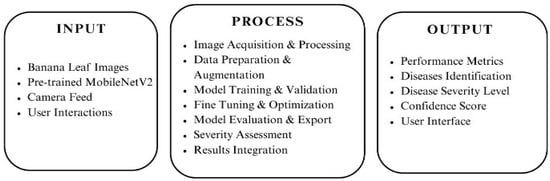
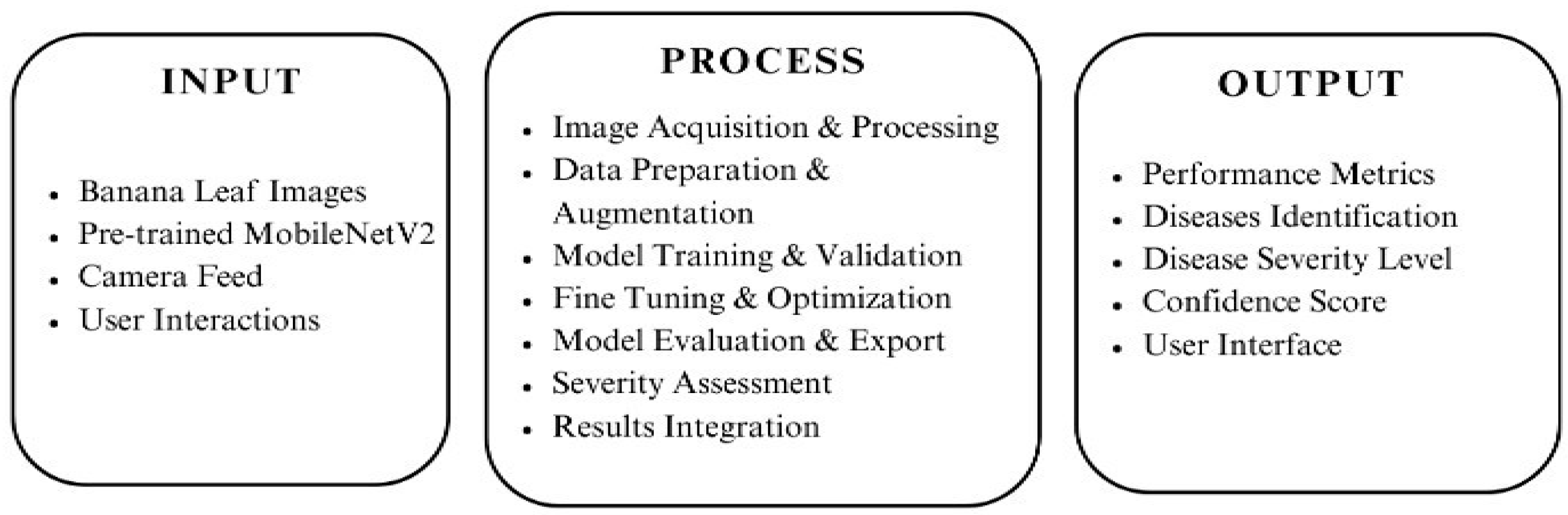
The developed system consisted of training and deployment phases. The training input includes labeled banana leaf images and pre-trained MobileNetV2 weights trained on the ImageNet dataset. During deployment, the system captures live banana leaf images using a portable camera (8MP Camera Module V2, Raspberry Pi Ltd., Cambridge, UK) and processes them for classification and severity detection (Figure 1).
Figure 1.
System’s process phases.
A CNN architecture was employed for image classification [12]. MobileNetV2, a lightweight CNN optimized for mobile and embedded vision tasks, was used as the core model. It employs inverted residuals and depthwise separable convolutions, achieving high performance with reduced computational cost [4]. The open source computer vision library was integrated for image segmentation and severity assessment through pixel-based analysis [14].
The dataset consisted of 2528 banana leaf images categorized into five classes: Bacterial Wilt, Banana Bunchy Top Disease, Sigatoka, Panama Disease, and Healthy leaves. Images were sourced from open-field captures and open datasets under natural lighting. Data were split into training (80%), validation (10%), and testing subsets (10%). Pre-processing involved image resizing, normalization, and augmentation (flipping, zooming, brightness adjustment, and shearing) to enhance generalization [15].
The MobileNetV2 base model was fine-tuned by adding custom classification layers while freezing pre-trained weights to preserve learned features. The model was trained using TensorFlow Lite with performance evaluated using accuracy, precision, recall, and F1-score. Testing involved both image-based evaluation and real-field validation using the portable prototype [16].
A portable Raspberry Pi 4B-based prototype was developed, equipped with an 8 megapixel camera and a 3.5-inch touchscreen display. Power was supplied through dual 18,650 lithium-ion batteries, enabling fully offline field operation. During field testing, optimal image capture was achieved at a distance of 6–12 inches from the banana leaf surface to balance clarity and background noise.
4. Results and Discussion
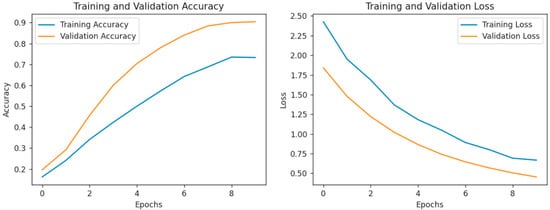
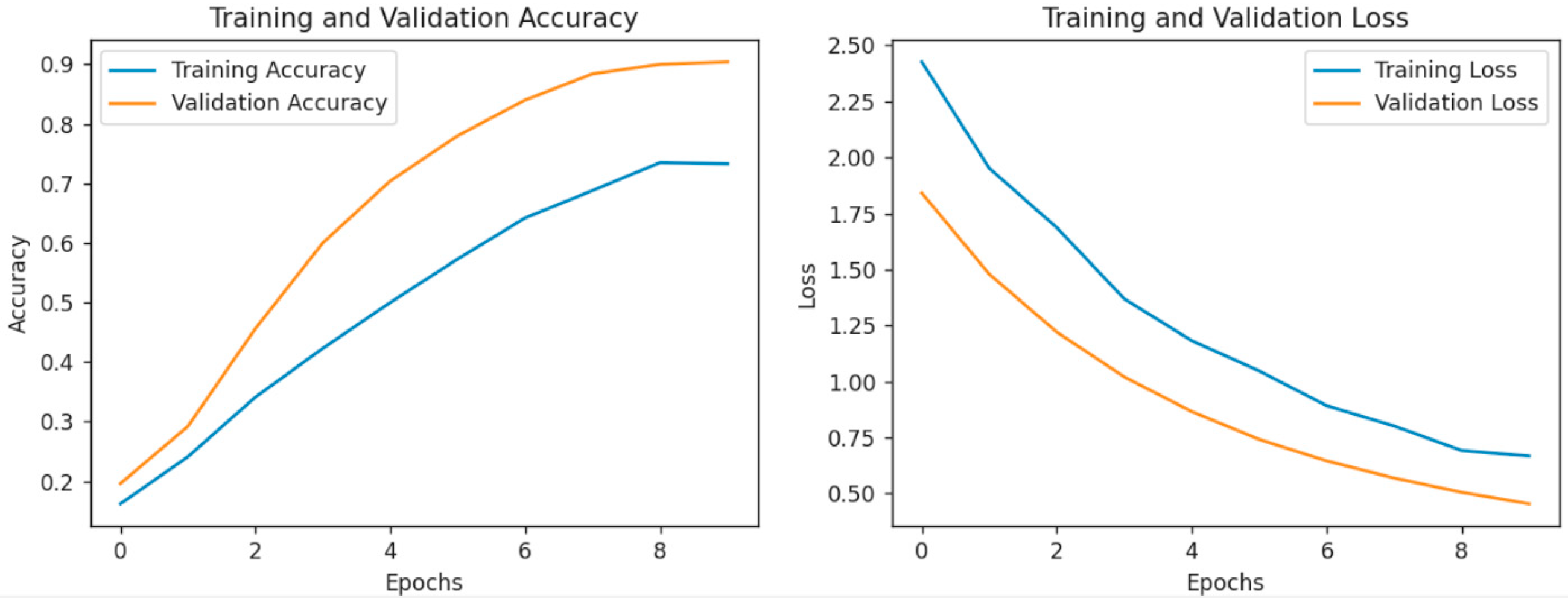
Figure 2 shows that the accuracy improved to 72% and the validation reached 90% with no overfitting.
Figure 2.
Training and validation accuracy and loss results.
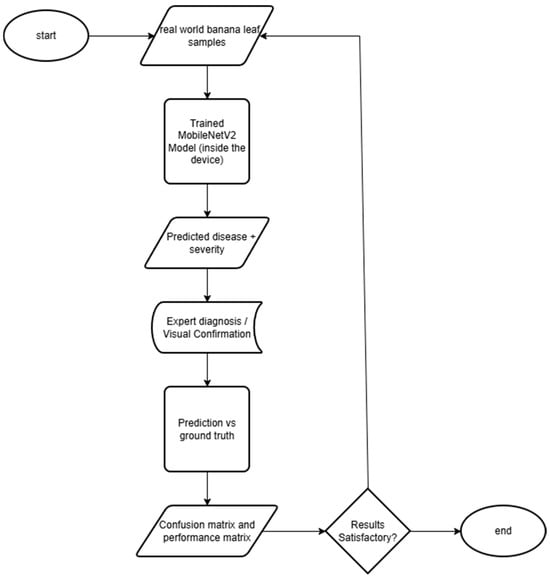
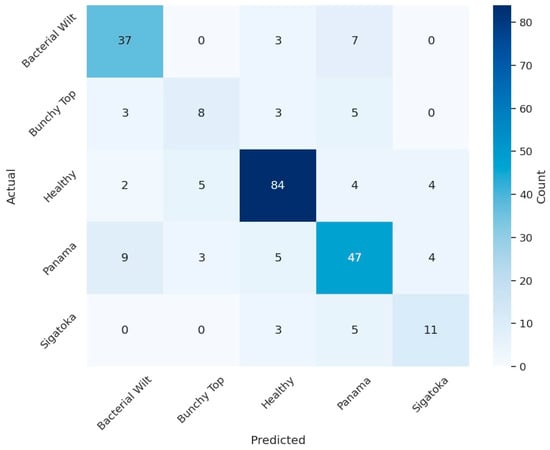
The trained MobileNetV2 model was tested using real-world banana leaf samples to evaluate field performance. Approximately 15% of the dataset was used for live testing. Figure 3 illustrates the actual testing process, while the confusion matrix (Figure 4) summarizes classification performance.
Figure 3.
Workflow of the actual testing process using real-world banana leaf samples.
Figure 4.
Confusion matrix.
Cluster analysis results showed an overlap between disease categories due to mixed symptoms. The model achieved an overall accuracy of 74.6%, with Healthy and Bacterial Wilt classes showing the highest performance (Table 1). The Bunchy Top class obtained the lowest F1-score due to limited samples and subtle symptom features.
Table 1.
Cluster analysis results.
To evaluate the classification model’s performance, standard metrics were computed, including accuracy, precision, recall, and F1-score using Equations (1)–(4). Accuracy measures the overall proportion of correctly classified samples, while precision and recall were used to quantify the model’s reliability in identifying specific disease classes. The F1-score, the harmonic mean of precision and recall, was used as a balanced indicator of performance, particularly in imbalanced datasets.
where
TP = True Positive;
TN = True Negative;
FP = False Positive;
FN = False Negative.
The system quantified infection severity through color segmentation, separating healthy (green) and infected (brown/black) leaf regions. The severity score, defined as the sum of brown and black region percentages, determines infection level: low (0–20%), moderate (21–40%), or high (>41%) (Table 2).
Table 2.
Performance metrics.
5. Conclusions
We developed a portable, non-destructive image classification system for detecting banana leaf diseases and assessing infection severity. The MobileNetV2-based model achieved high accuracy and minimal loss during training, validation, and field testing, confirming its reliability, achieving an overall field accuracy of 74.6% with strong performance in identifying symptoms within the Healthy and Bacterial Wilt classes. These results demonstrate that lightweight convolutional neural networks have deployment potential in embedded agricultural devices while maintaining reliable classification capability.
Although a 74.6% accuracy is lower than that of other CNN-based plant disease detection systems using controlled or curated datasets, the result of this study reflects the complexity of multi-disease classification under open field conditions. The integrated Raspberry Pi prototype offers an accessible and cost-efficient diagnostic tool for early disease detection. The current hardware setup is limited by power capacity, which constrains extended field use. Future work may focus on optimizing power efficiency, expanding the dataset with more diverse samples, and enhancing real-time inference. Improving casing durability and integrating IoT-based analytics could further strengthen portability, reliability, and data-driven disease management.
Author Contributions
Conceptualization, A.C.C.N. and A.L.G.; methodology, A.C.C.N., A.L.G. and G.V.M.; software, A.L.G. and A.C.C.N.; validation, A.C.C.N., A.L.G. and G.V.M.; formal analysis A.C.C.N., A.L.G. and G.V.M.; investigation, A.C.C.N. and A.L.G.; resources, A.L.G.; data curation, A.C.C.N.; writing—original draft preparation, A.C.C.N. and A.L.G.; writing—review and editing, G.V.M., A.C.C.N. and A.L.G.; visualization, A.C.C.N. and A.L.G.; supervision, G.V.M.; project administration, A.L.G.; funding acquisition, G.V.M. All authors have read and agreed to the published version of the manuscript.
Funding
This research received no external funding.
Institutional Review Board Statement
Not applicable.
Informed Consent Statement
Not applicable.
Data Availability Statement
Data is located inside the article.
Conflicts of Interest
The authors declare no conflict of interest.
References
- Shoemaker, S.; Richter, A. 11 Evidence-Based Health Benefits of Bananas. Healthline. Available online: https://www.healthline.com/nutrition/11-proven-benefits-of-bananas (accessed on 27 November 2024).
- What Is a Banana, Really? Bayer Global. Available online: https://www.bayer.com/en/agriculture/article/history-modern-banana/ (accessed on 27 November 2024).
- PCAARRD’s Industry Strategic Science and Technology Programs. Banana Industry Profile. Available online: https://ispweb.pcaarrd.dost.gov.ph/isp-commodities/banana/ (accessed on 27 November 2024).
- Vezina, A. Bunchy Top. ProMusa. Available online: https://www.promusa.org/Bunchy+top (accessed on 29 November 2024).
- ProMusa. Fusarium Wilt of Banana. Available online: https://www.promusa.org/Fusarium+wilt (accessed on 2 December 2024).
- Vikaspedia. Banana: Diseases and Symptoms. Available online: https://vikaspedia.in/agriculture/crop-production/integrated-pest-managment/ipm-for-fruit-crops/ipm-strategies-for-banana/diseases-and-symptoms (accessed on 2 December 2024).
- Yumang, A.N.; Baguisi, J.M.; Buenaventura, B.R.S.; Paglinawan, C.C. Detection of Black Sigatoka Disease on Banana Leaves Using ShuffleNet V2 CNN Architecture in Comparison to SVM and KNN Techniques. In Proceedings of the 15th International Conference on Computer and Automation Engineering (ICCAE 2023), Sydney, Australia, 24–26 February 2023. [Google Scholar]
- Grant, A. Info On Banana Plant Pests—Learn About Banana Plant Diseases. Gardening Know How. Available online: https://www.gardeningknowhow.com/edible/fruits/banana/banana-pests-and-diseases.htm (accessed on 2 December 2024).
- Addy, H.S.; Azizi, N.F.; Mihardjo, P.A. Detection of bacterial wilt pathogen and isolation of its bacteriophage from banana in Lumajang area, Indonesia. Int. J. Agron. 2016, 2016, 5164846. [Google Scholar] [CrossRef] [Scilit]
- Blomme, G.; Dita, M.; Jacobsen, K.S.; Pérez Vicente, L.; Molina, A.; Ocimati, W.; Poussier, S.; Prior, P. Bacterial diseases of bananas and enset: Current state of knowledge and integrated approaches toward sustainable management. Front. Plant Sci. 2017, 8, 1290. [Google Scholar] [CrossRef] [Scilit] [PubMed]
- Lucidcentral. Pacific Pests, Pathogens, Weeds & Pesticides. Available online: https://www.lucidcentral.org (accessed on 2 December 2024).
- Molina, A.B.; Sinohin, V.G.O.; dela Cueva, F.M.; Esguerra, A.V.; Crucido, S.S.; Vida, E.; Temanel, B.E.; Anit, E.A.; Eusebio, J.E. Managing Banana Bunchy Top Virus in Smallholdings in the Philippines. Acta Hortic. 2009, 828, 383–388. [Google Scholar] [CrossRef] [Scilit]
- Howard, A.G.; Zhu, M.; Chen, B.; Kalenichenko, D.; Wang, W.; Weyand, T.; Andreetto, M.; Adam, H. MobileNets: Efficient Convolutional Neural Networks for Mobile Vision Applications. arXiv 2017, arXiv:1704.04861. [Google Scholar] [CrossRef] [Scilit]
- IBM. What Are Convolutional Neural Networks? Available online: https://www.ibm.com/topics/convolutional-neural-network (accessed on 3 December 2024).
- Sorallo, C.D.L.; Jabal, E.J.M.; Balbin, J.J.R. Plant Health and Severity Recognition System for Pechay (Brassica rapa ssp. chinensis) Using Convolutional Neural Network. In Proceedings of the International Electronics Symposium (IES 2024): Society 5.0 and Beyond, Surabaya, Indonesia, 31 July–2 August 2024. [Google Scholar]
- Sandler, M.; Howard, A.; Zhu, M.; Zhmoginov, A.; Chen, L.-C. MobileNetV2: Inverted Residuals and Linear Bottlenecks. In Proceedings of the IEEE/CVF Conference on Computer Vision and Pattern Recognition (CVPR 2018), Salt Lake City, UT, USA, 18–23 June 2018. [Google Scholar]

Disclaimer/Publisher’s Note: The statements, opinions and data contained in all publications are solely those of the individual author(s) and contributor(s) and not of MDPI and/or the editor(s). MDPI and/or the editor(s) disclaim responsibility for any injury to people or property resulting from any ideas, methods, instructions or products referred to in the content. |
© 2026 by the authors. Licensee MDPI, Basel, Switzerland. This article is an open access article distributed under the terms and conditions of the Creative Commons Attribution (CC BY) license.