


Abstract
Electronic waste (e-waste) continues to increase globally, yet conventional bins cannot distinguish hazardous batteries and devices from recyclable metals. This article presents an AI- and IoT-enabled smart dustbin that automatically identifies and segregates general waste, metals, and electronic or battery-based hazards while providing real-time monitoring through a cloud-based dashboard. The system integrates inductive sensing, Time-of-Flight detection, an Espressif Systems Platform 32 (ESP32)-CAM module, and Google Gemini 1.5 Flash for image classification. The prototype achieved a waste segregation accuracy of 93.5% with a total cycle time of 4–6 s per item. The touch-free lid, swift mechanical actuation, and compact 59 × 59 × 100 cm footprint make the dustbin suitable for deployment in campuses, offices, and shopping malls. Dual ESP32 controllers, cloud connectivity through Message Queuing Telemetry Transport (MQTT), Firebase, and a Streamlit web interface enable automated alerts through Discord and email, demonstrating a scalable and energy-efficient approach to sustainable e-waste management.
1. Introduction
The global production of electronic waste (e-waste) continues to grow rapidly. In 2022, the world generated 62 million tons (Mt) of e-waste, averaging 7.8 kg per capita. This figure is projected to rise by 33%, reaching 82 million ton by 2030 [1]. Baldé et al. [1] report that if countries could achieve a 60% e-waste collection and recycling rate by 2030, the resulting benefits, including reduced human health risks, would exceed costs by over US $38 billion. In university campuses, office buildings, and shopping malls, the improper disposal of electronic devices and batteries has emerged as a significant environmental and safety concern. Traditional dustbins are typically designed for general waste and do not accommodate the special handling requirements of hazardous materials. As a result, students, faculty, employees, and shoppers often discard items such as old gadgets, smartphones, and used batteries into these general waste bins without recognizing the hazardous materials they contain, including such as lead, mercury, cadmium, and lithium. These toxic substances can leach into soil and water systems, leading to pollution that poses serious risks to local ecosystems and human health [2,3]. Additionally, improperly discarded batteries in general waste bins can cause fires or explosions, creating immediate safety hazards [4].
However, another challenge is designing a smart dustbin that can differentiate between metals, batteries, and electronic devices. While metals can be recycled, batteries and electronic devices also contain metals but include hazardous components that require special handling. Normal smart dustbins typically rely on basic sensors [5] or visible-image classification [6], which struggle to differentiate between batteries or electronic devices from metal items based solely on sensor readings or exterior appearance. Moreover, image-data scarcity and limited image-data diversity also pose a major challenge to training computer-vision models to achieve industry-standard performance [7]. This makes it difficult to ensure that hazardous waste is properly separated from recyclable metals. Gemini was pre-trained on a large-scale, diverse collection of multimodal data, including images [8]. This paper presents an AI-enabled smart dustbin that leverages Gemini, a camera, and an inductive sensor to automatically identify and segregate general waste, metals, and electronics or battery-based hazards while delivering real-time data to users.
2. Materials and Methods
2.1. Design
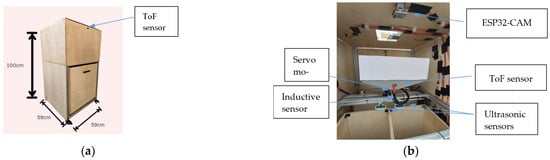
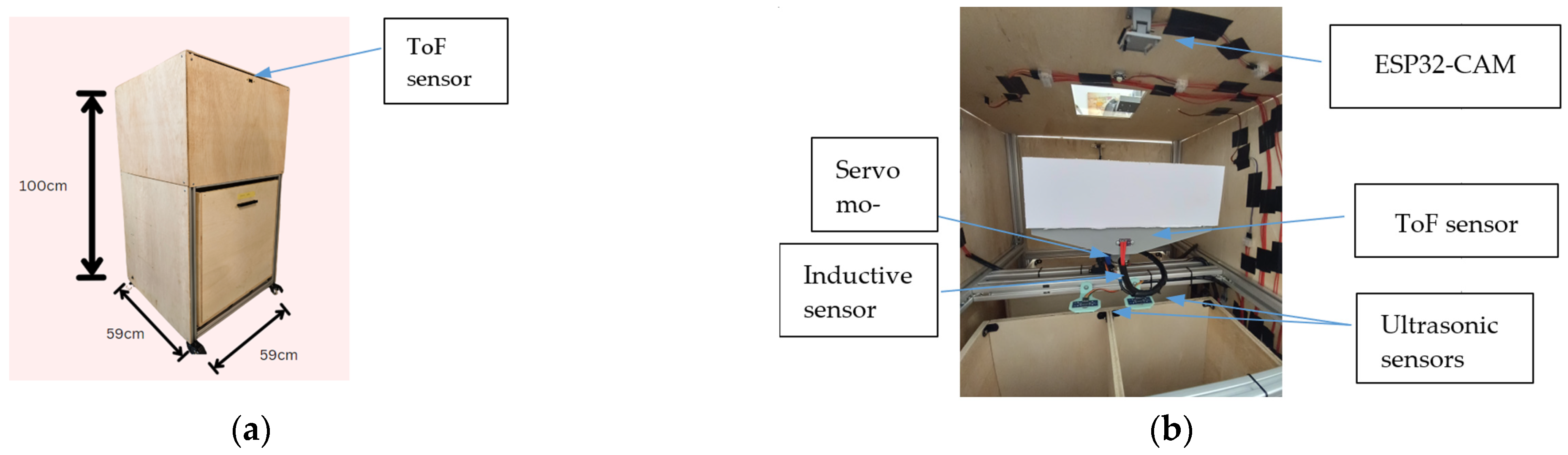
The AI-Enabled Smart Dustbin integrates mechanical, electrical, and cloud-IoT subsystems for automated waste identification and segregation. The unit comprises three compartments—for general, metal, and hazardous (battery/electronic) waste—within a compact 59 × 59 × 100 cm enclosure as shown in Figure 1a. The height of 100 cm was strategically selected to align with the average height of Malaysian users, with men averaging 169 cm and women 157 cm [9]. This design ensures that the waste input area is positioned at a comfortable and ergonomic level, allowing users to dispose of waste easily without excessive bending or stretching, thereby promoting proper posture and accessibility during operation. A Time-of-Flight (ToF) sensor triggers the lid servo for touch-free operation, while an inductive sensor and ESP32-CAM module perform material detection and image capture, respectively. Captured images are transmitted to the cloud through a User Datagram Protocol (UDP) socket and processed by Google Gemini Flash, which classifies the waste type and sends the result back to the local controller for mechanical actuation. Two high-torque servos (DS-R003B 35 kg Digital Servo, DSpower, Guangdong, China and SPT5435LV-180 35 kg Digital Servo, SPT-servor, Guangdong, China) drive the plate’s rotation and tilt, routing items into the correct bin. A second ESP32 monitors the fill levels of each compartment through ultrasonic sensors, displaying real-time percentages on a 1.3-inch Organic Light-Emitting Diode (OLED) screen (SINDA, Shenzhen, China) and uploading the information to the Firebase Realtime Database for storage via Message Queuing Telemetry Transport (MQTT). Part of the interior of the dustbin is shown in Figure 1b.
Figure 1.
Smart dustbin: (a) Overall design. (b) Part of the interior of the dustbin.
2.2. System Architecture
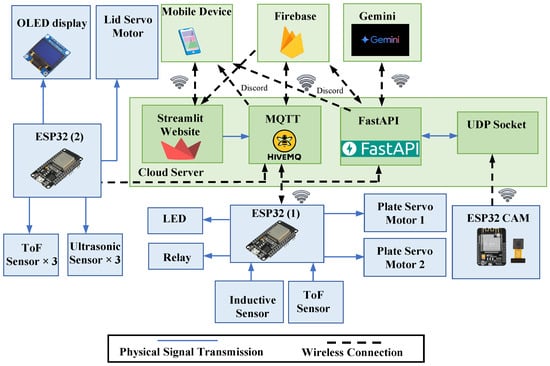
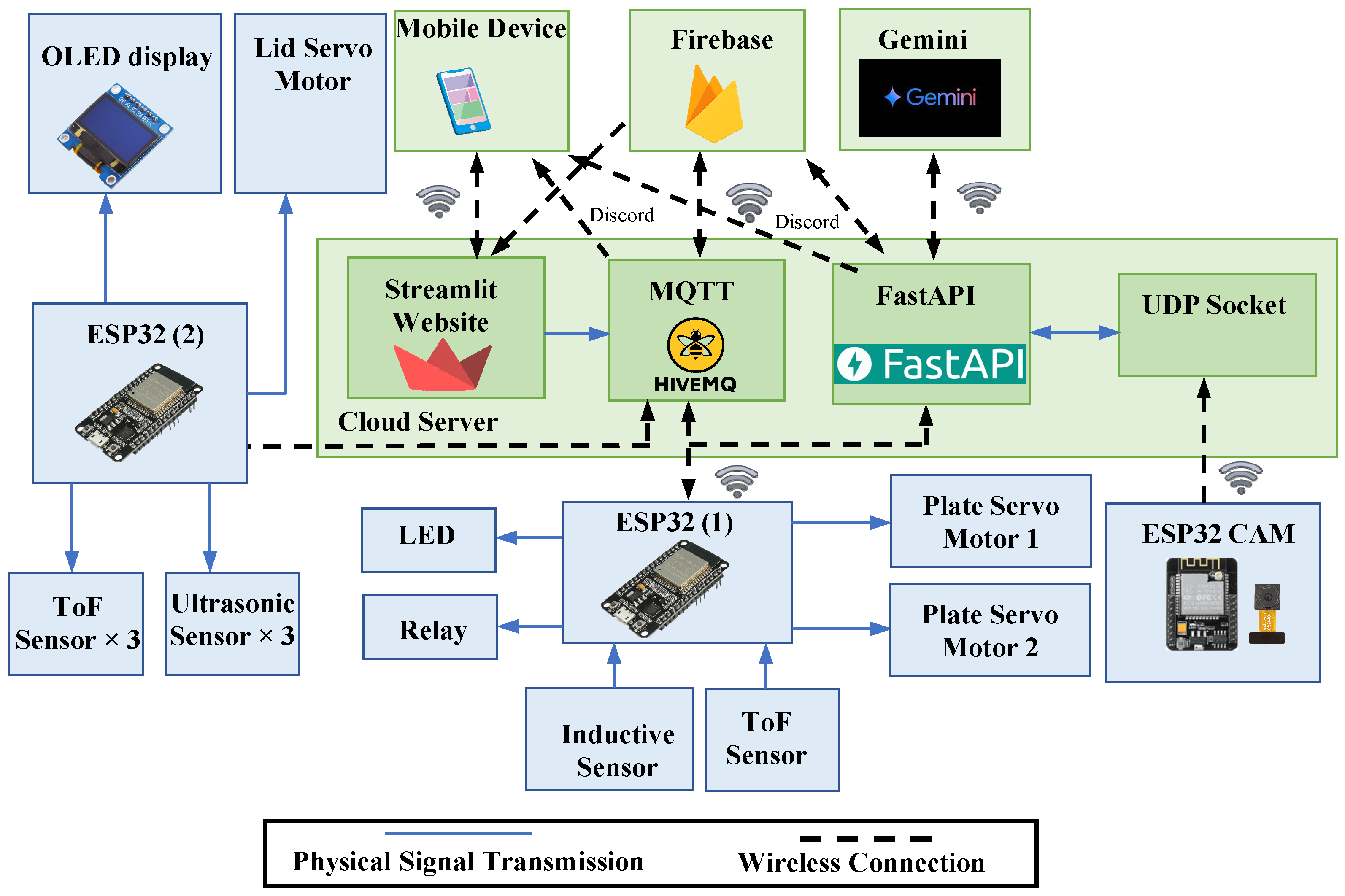
The block diagram of the smart dustbin’s system architecture is illustrated in Figure 2. When a user approaches the bin, the ToF sensor connected to ESP32 (2) triggers the automatic lid-opening mechanism to allow waste disposal. Once the waste is placed on the plate, the ToF sensor embedded in the waste disposal plate connected to ESP32 (1) accurately detects its presence, activating the LED illumination for optimal image capture and prompting the ESP32-CAM to capture an image. The encoded image is transmitted through UDP sockets to the Fast application programming interface (FastAPI) server. ESP32 (1) communicates with the FastAPI backend, which retrieves the image captured by the ESP32-CAM and forwards it to Gemini Flash for inference. The classification results are then sent back to ESP32 (1) via FastAPI. Subsequently, the microcontroller actuates two high-torque servo motors to drive the plate and route the waste into the correct compartment. ESP32 (2) monitors the fill levels of the three compartments using three ultrasonic sensors and publishes updated capacity data to the OLED display and Firebase. Alerts are triggered via Discord and email when any bin reaches ≥80% capacity or when hazardous waste is detected.
Figure 2.
Block diagram of the smart dustbin’s system architecture.
The software stack was implemented in MicroPython v1.22, featuring asynchronous task scheduling (asyncio) for non-blocking sensing, actuation, and communication. A Digital Ocean Ubuntu droplet (cloud server) hosts a FastAPI backend, an MQTT broker (HiveMQ Cloud), a UDP socket and a Streamlit website. The Streamlit web dashboard provides real-time visualization, historical analytics, and remote power control.
3. Results and Discussion
3.1. System Performance Evaluation
Prototype evaluation was conducted using 23 representative waste items, each tested ten times to assess mechanical reliability and AI classification accuracy. The system achieved a mean overall accuracy exceeding 90%, validating the developed smart dustbin’s suitability for real-time e-waste identification. The summary of key performance metrics is shown in Table 1.
Table 1.
Summary of key performance metrics for AI-enabled smart dustbin.
The performance evaluation of the AI-enabled smart dustbin demonstrated consistent and reliable operation across multiple subsystems. The overall waste segregation accuracy, defined as the percentage of trash correctly routed to its designated compartment, reached 93.5% (215 out of 230 samples). The system consistently classified and directed metals, general waste, and electronic waste into the correct bins with high precision. Minor misclassifications were primarily attributed to reflective surfaces or irregularly positioned items, which occasionally affected image clarity and sensor detection accuracy.
The system’s end-to-end sorting cycle time, including detection, AI processing, and mechanical actuation, ranged between 4 and 6 s per item, ensuring smooth operation suitable for public use. The automatic lid mechanism, controlled by the ToF sensor and servo motor, exhibited a response time of 0.5 to 1.0 s, confirming stable and accurate motion control. Data synchronization between the local ESP32 controllers and the Firebase cloud via MQTT communication maintained an average latency below 300 milliseconds, demonstrating robust and low-delay IoT connectivity.
Additionally, the alert notification system achieved a 100% success rate through both Discord and email channels, confirming the reliability of dual-channel alerts during full-bin simulations. Power measurements showed an average consumption of approximately 12 V at 1.2 A, highlighting the system’s energy-efficient design suitable for continuous 24-h operation. Collectively, these results validate the system’s real-time responsiveness, energy efficiency, and practical scalability for smart waste management applications.
3.2. User Interface and Data Monitoring
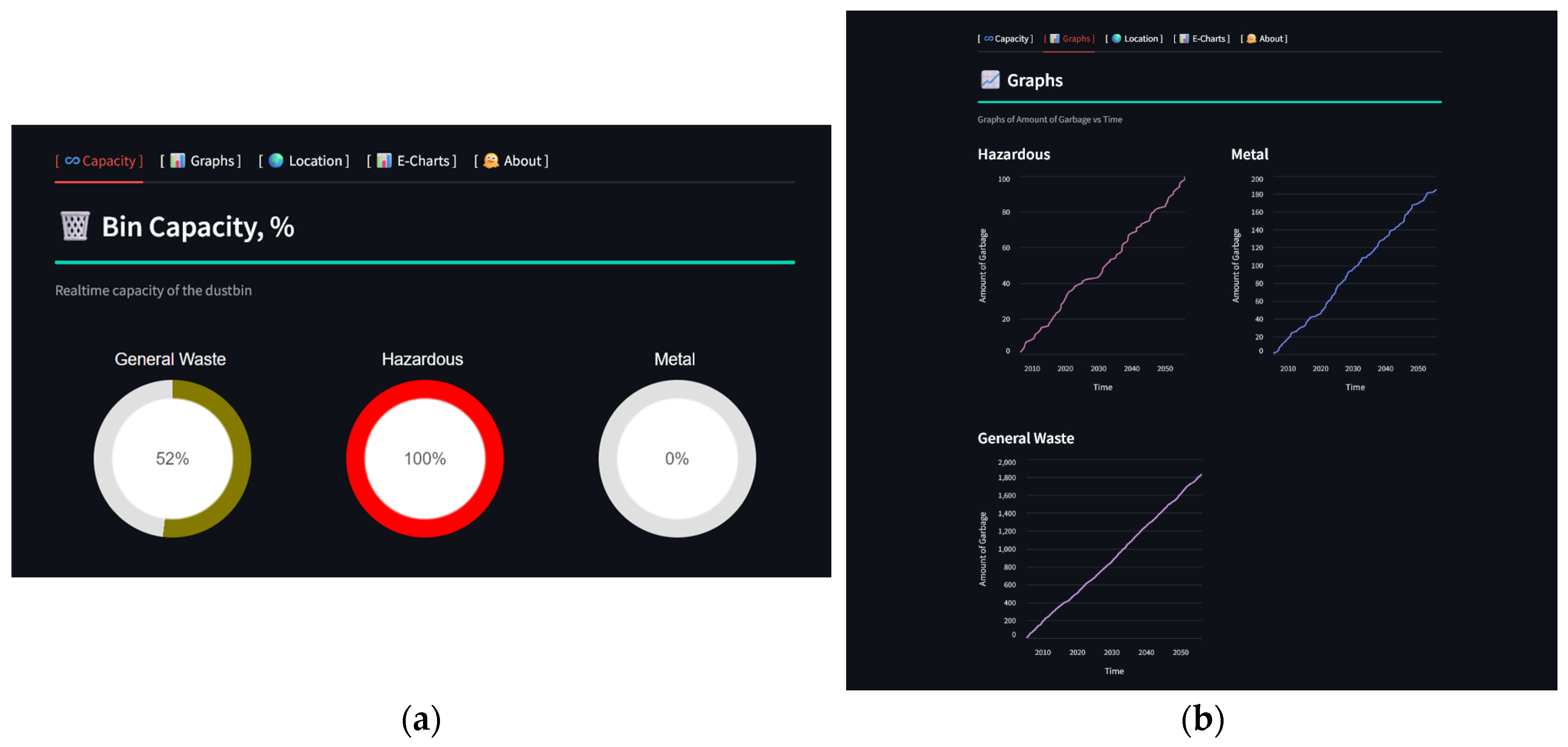
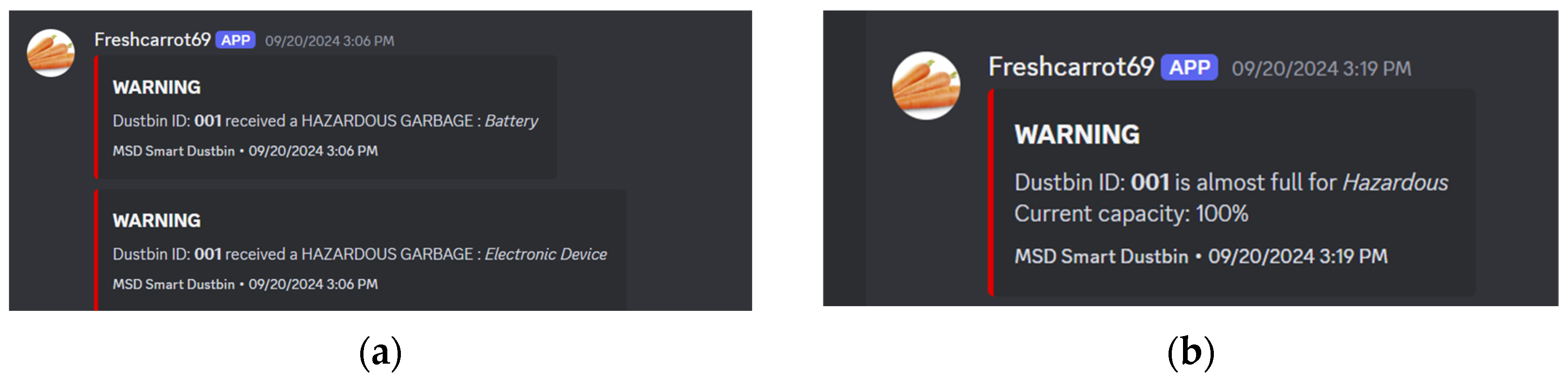
Figure 3 illustrates the real-time bin capacity visualization and waste disposal trends displayed on the web dashboard. The dashboard enables users or facility managers to monitor the fill levels of the general, hazardous, and metal compartments (Figure 3a) while also providing historical graphs, as indicated by colored lines in Figure 3b that summarize waste accumulation patterns over time. Examples of automated alert notifications in Discord are shown in Figure 4a,b, corresponding to situations where hazardous waste is detected and when a bin reaches its full capacity threshold, respectively. These alerts, delivered through dual communication channels (Discord and email), ensure timely maintenance responses and promote continuous, safe operation of the smart dustbin system. A YouTube video demonstrating the smart dustbin is provided in the Supplementary Materials section.
Figure 3.
Web-based dashboard: (a) Bin capacity visualization. (b) Historical waste disposal trends.
Figure 4.
Automated alert notifications in Discord: (a) Hazardous waste detection alert. (b) Bin’s capacity full alert.
3.3. Discussion
The combined hardware–software framework demonstrated stable real-time performance with high sorting accuracy and responsiveness. Integration of Gemini Flash reduced on-device computation load while maintaining low latency through optimized FastAPI routing and UDP transmission. The dual-ESP architecture effectively separated high-frequency mechanical tasks from communication processes, minimizing interference. Compared with conventional smart bins [5,6], the proposed system provides multimodal detection by fusing inductive sensing and AI-based image classification, enabling discrimination between recyclable metals and hazardous e-waste. Real-time IoT monitoring and automated alerts improved operational efficiency, while the dashboard analytics facilitated predictive maintenance.
4. Conclusions
We developed a compact AI- and IoT-enabled smart dustbin capable of automatically identifying and segregating hazardous e-waste. The system achieved a waste segregation accuracy of 93.5%, with a total processing time that remained below 6 s per item, demonstrating efficient real-time operation. Cloud integration via Gemini Flash, Streamlit website and Firebase further enabled real-time analytics, automated notifications, and remote system management. The prototype dustbin showed the feasibility of combining LLM-based vision, edge-IoT control, and ergonomic mechanical design for sustainable waste handling. Future enhancements will focus on multi-object detection, local fallback inference for offline operation, and integration of additional sensors (e.g., odor or temperature) to extend safety monitoring. The proposed approach offers a scalable pathway for intelligent, data-driven e-waste management in campuses, offices, and urban environments.
Supplementary Materials
The following supporting information can be downloaded at: https://youtu.be/Em3_oCiwPoU (accessed on 15 March 2025), Video S1: AI-Enabled Smart Dustbin for Automated Hazardous E-Waste Separation.
Author Contributions
Conceptualization, M.X.S., H.Z.L. and Z.K.N.; methodology, M.X.S., H.Z.L. and Z.K.N.; software, M.X.S.; validation, M.X.S., H.Z.L. and Z.K.N.; formal analysis, M.X.S., H.Z.L. and Z.K.N.; investigation, M.X.S., H.Z.L. and Z.K.N.; resources, H.K.M.; writing—original draft preparation, M.X.S., H.Z.L. and Z.K.N.; writing—review and editing, H.K.M. and Y.C.H.; visualization, H.K.M.; supervision, H.K.M.; project administration, H.K.M. and Y.C.H.; funding acquisition, Y.C.H. All authors have read and agreed to the published version of the manuscript.
Funding
This research was supported by IEEE Signal Processing Society (SPS) and Humanitarian Technology Board (HTB) Grant on Signal Processing Technologies for Local Community Challenges: Project Number: 3-SPSHTB-02 (vote: 8202-0001).
Institutional Review Board Statement
Not applicable.
Informed Consent Statement
Not applicable.
Data Availability Statement
No new data were created or analyzed in this study. Data sharing is not applicable to this article.
Acknowledgments
The authors sincerely thank the management of Universiti Tunku Abdul Rahman (UTAR) for their continuous support and for providing campus facilities to set up and test the smart dustbin prototype. Their assistance in enabling on-site experimentation was crucial to the successful completion of this study.
Conflicts of Interest
The authors declare no conflicts of interest.
Abbreviations
The following abbreviations are used in this manuscript:
| AI | Artificial Intelligence |
| CAM | Camera Module |
| ESP32 | Espressif System-on-Chip Microcontroller |
| IoT | Internet of Things |
| LLM | Large Language Model |
| MQTT | Message Queuing Telemetry Transport |
| ToF | Time-of-Flight |
| UDP | User Datagram Protocol |
| API | Application Programming Interface |
| OLED | Organic Light-Emitting Diode |
References
- Baldé, C.P.; Kuehr, R.; Yamamoto, T.; McDonald, R.; D’Angelo, E.; Althaf, S.; Bel, G.; Deubzer, O.; Fernandez-Cubillo, E.; Forti, V.; et al. Global E-Waste Monitor 2024; International Telecommunication Union (ITU) and United Nations Institute for Training and Research (UNITAR): Geneva/Bonn, Switzerland, 2024. [Google Scholar]
- Kumar, A.; Singh, P.P.; Khanna, M.K. Sustainable e-Waste Management and Its Effect on Environment and Human Health. In Integrated Waste Management; Gupta, A., Kumar, R., Kumar, V., Eds.; Springer: Singapore, 2024; pp. 1–18. [Google Scholar] [CrossRef] [Scilit]
- Better Meets Reality. Environmental & Human Health Impact of Battery Production & Disposal. 2022. Available online: https://bettermeetsreality.com/ (accessed on 15 March 2025).
- Jensen Hughes. Batteries in Household Waste—An Increasing Fire Hazard. 2024. Available online: https://www.jensenhughes.com/insights/batteries-in-household-waste-an-increasing-fire-hazard (accessed on 15 March 2025).
- Zoumpoulis, P.; Konstantinidis, F.K.; Tsimiklis, G.; Amditis, A. Smart bins for enhanced resource recovery and sustainable urban waste practices in smart cities: A systematic literature review. Cities 2024, 152, 105150. [Google Scholar] [CrossRef] [Scilit]
- Vijay Sathappan, M.; Satyanarayan, G.D.; Kishore, V.; Rathish, A.; Sandeep, S.; Konguvel, E. Smart Bin: A Waste Classification System for Eco-Friendly Urban Environments. In Proceedings of the 2024 3rd International Conference on Artificial Intelligence for Internet of Things (AIIoT), Vellore, India, 3–4 May 2024; pp. 1–6. [Google Scholar] [CrossRef] [Scilit]
- Acaro Chacón, X.C.; Lo Scudo, F.; Cappuccino, G.; Dodaro, C. RecyBat24: A dataset for detecting lithium-ion batteries in electronic waste disposal. Sci. Data 2025, 12, 843. [Google Scholar] [CrossRef] [Scilit] [PubMed]
- Gemini Team. Gemini: A Family of Highly Capable Multimodal Models. arXiv 2023, arXiv:2312.11805. [Google Scholar] [CrossRef] [Scilit]
- World Population Review. Average Height by Country (Malaysia). Available online: https://worldpopulationreview.com/country-rankings/average-height-by-country (accessed on 28 September 2025).

Disclaimer/Publisher’s Note: The statements, opinions and data contained in all publications are solely those of the individual author(s) and contributor(s) and not of MDPI and/or the editor(s). MDPI and/or the editor(s) disclaim responsibility for any injury to people or property resulting from any ideas, methods, instructions or products referred to in the content. |
© 2026 by the authors. Licensee MDPI, Basel, Switzerland. This article is an open access article distributed under the terms and conditions of the Creative Commons Attribution (CC BY) license.