


Abstract
Unconventional aircraft configurations hold great potential for improving air transport efficiency and reducing aviation’s contribution to global warming. However, these novel layouts require robust evidence of their advantages from the conceptual design phase to justify the substantial development costs they entail. Computerized design environments provide the most suitable framework for the conceptual design of unconventional aircraft. This paper proposes an original taxonomy of unconventional aircraft configurations tailored to computerized design environments, reviews the existing tools with such design capabilities, and identifies the current trends and challenges in this field.
1. Introduction
Aviation is responsible for approximately 2.4% of global CO2 emissions annually and about 4% of measurable anthropogenic global warming [1]. If the average annual growth rate of 4.4% in air traffic were to continue [2], global aviation emissions would almost triple by 2050. Consequently, reducing aviation’s environmental footprint has become the main driver for technological progress in the aeronautical industry over the last few decades. The need to limit the greenhouse effect as well as pollutant and noise emissions has led to significant improvements in terms of materials, aerodynamics, sustainable fuels, engines, and navigation procedures, among others. However, improvement margins reduce progressively as technology advances, requiring higher efforts for more marginal benefits, which results in unconventional aircraft configurations becoming more attractive for researchers and industry stakeholders alike [2].
These unconventional aircraft concepts aim to reduce fuel consumption by exploring architectures that deviate from the well-established tube-and-wing airplane concept and result in weight savings and/or a more efficient aerodynamic behavior. Several configurations have been studied in both academia and industry, including the blended wing body [3], box wing [4], strut-braced wing [5], and twin body [6] concepts. These designs exhibit varying Technology Readiness Levels (TRLs), and some have already been implemented, primarily in the Remotely Piloted Aircraft Systems (RPAS) sector, where design and certification costs are lower. This field also benefits from a less conservative environment due to lower economic and safety risks and more flexible regulatory frameworks [7]. In contrast, adopting unconventional configurations in commercial transport aviation requires strong justification, as manufacturers face significant financial risks. Consequently, conceptual design plays a critical role in assessing potential benefits and determining the feasibility of progressing to more detailed and costly design phases.
Traditionally, conceptual design of conventional aircraft has relied on statistical methods and analytical sizing procedures [8]. However, the growth in computational power has made computerized design environments increasingly viable [9,10,11]. Tools that once belonged exclusively to the preliminary design phase can now be employed earlier, offering low- and medium-fidelity analyses within the conceptual design stage. For unconventional aircraft, such environments are even more relevant, since historical data are scarce and analytical methods must be tailored to each unique configuration.
In light of these developments, this research reviews existing computerized conceptual design environments capable of handling unconventional aircraft configurations. The goal is to identify benchmark strategies, highlight current technological gaps, and guide future research in this domain. For readers interested in related topics, comprehensive reviews on computerized design environments for RPAS and general design methodologies for unconventional aircraft can be found in [7] and [2], respectively.
2. Methods
A systematic review of the existing computerized design environments with unconventional aircraft conceptual design capability was performed. First, a definition of a computerized design environment was selected to frame the literature search and to precisely define the scope of the present work. Then, the reviewed environments were studied according to three main areas: the design phases they cover, the unconventional configurations they can handle, and the disciplines that are involved in the design loop. Finally, the results of these analyses, together with additional considerations relative to relevant and emerging features present in the environments, were further studied to extract the main trends and challenges in this research field.
2.1. Definition of Computerized Aircraft Design Environment
The definition of a computerized aircraft design environment proposed in [12] was adopted. It encompasses all aircraft design software packages that meet three conditions: (i) they must include two or more aircraft design and analysis disciplines in the design loop; (ii) the output of each disciplinary analysis must be fed back into the design loop and influence the aircraft geometry or sizing; and (iii) they must cover at least one design phase comprehensively. The present work focuses on software packages that, in addition to fulfilling these three conditions, also meet two further criteria: (iv) they must address the conceptual design phase (or aim to do so, as explained in the next paragraph), and (v) their capability to design unconventional aircraft configurations must be explicitly stated either in the academic literature or on the developer’s website. A total of 21 such environments were identified, and their capabilities and features are analyzed in this review.
2.2. Considerations of the Aircraft Design Stages
The aircraft design process comprises three distinct design phases with increasing levels of detail. A brief description of each phase is provided, as the term “conceptual design” is used inconsistently in the reviewed literature. The conceptual design stage starts from the Top-Level Aircraft Requirements (TLAR) and aims to generate a small set of general layouts that satisfy these requirements. Design processes in this stage must be fast enough to explore the design space widely, typically using low-fidelity methods, while keeping errors within acceptable margins (~10%) [8], since this stage influences over 70% of the Life-Cycle Costs (LCCs) [13]. The preliminary design stage builds on the most promising concept from the previous phase and employs medium- and high-fidelity methods to optimize the design, often using Multidisciplinary Design Optimization (MDO) techniques to close the design loop. Finally, the detailed design stage involves the comprehensive design of all aircraft systems and subsystems, producing the final design ready for certification and manufacturing. The present review covers all environments that claim conceptual design capability. However, analysis of their workflows and inputs/outputs reveals that some strictly perform optimization on a provided aircraft concept, which would classify them as preliminary design environments. These results are presented in Section 3.
2.3. Unconventional Aircraft Taxonomy
In order to study the environments’ unconventional aircraft design capability, it is first necessary to clearly define what is meant by “unconventional aircraft.” The present work focuses on general layout deviations from the classical tube-and-wing configuration; that is, all aircraft concepts incorporating innovative solutions for the lifting surfaces and/or body. Other types of innovation, such as aerodynamic enhancements (e.g., laminar flow control), propulsion technologies (e.g., electric or hydrogen-powered aircraft, boundary layer ingestion), or structural innovations (e.g., active load alleviation, structural health monitoring) are outside the scope of this review.
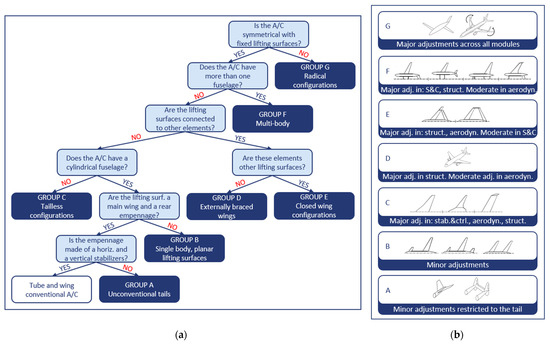
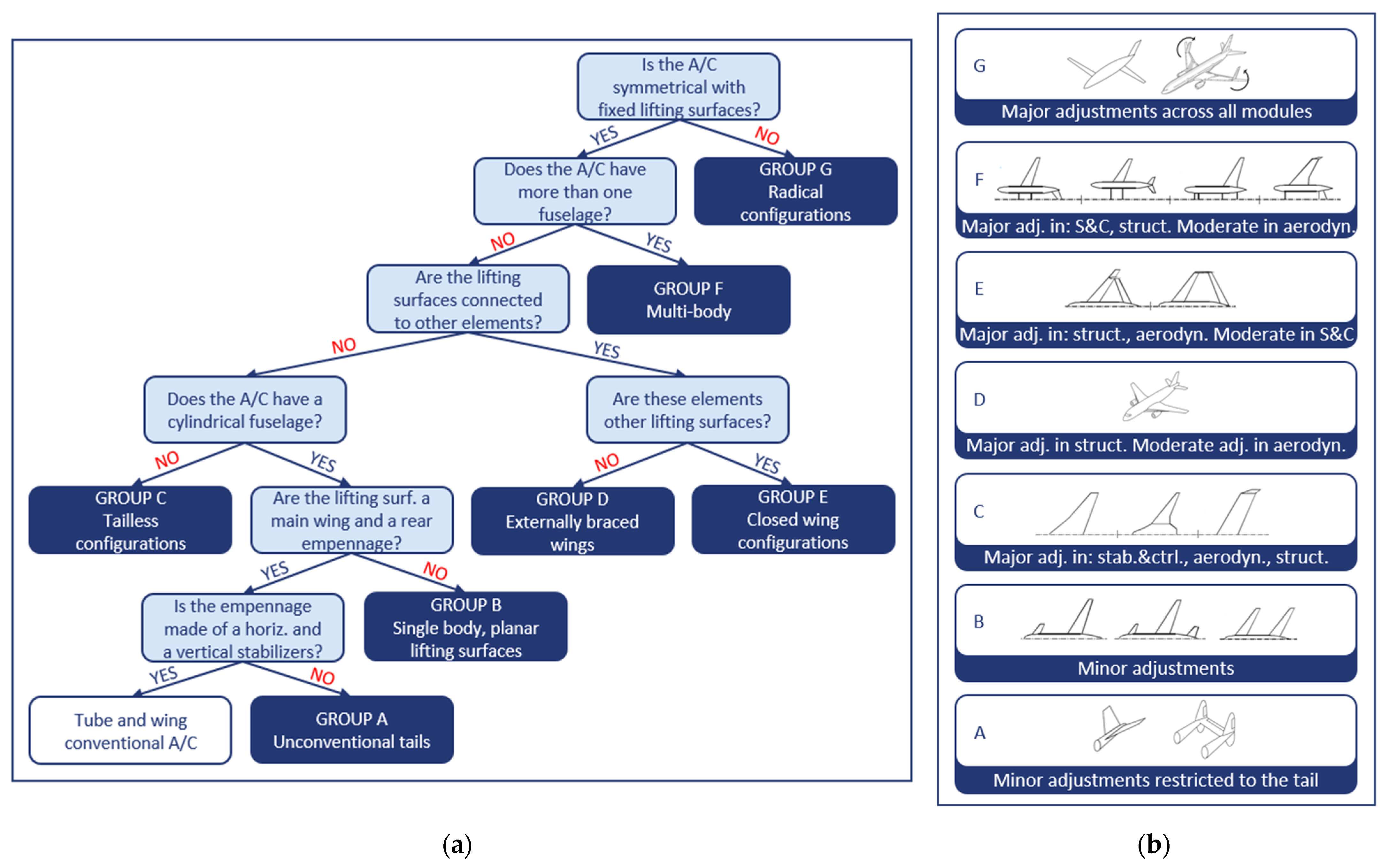
An original taxonomy for classifying unconventional aircraft is presented in Figure 1. This taxonomy is based on Torenbeek’s unconventional configuration matrix [8], but it is specifically tailored to assess the capabilities of computerized design environments. The different possible configurations are grouped according to the similarities in the modifications that would be required in the various disciplinary modules to enable their design.
Figure 1.
(a) Unconventional aircraft classification; (b) relative impact on the methodologies.
3. Results
3.1. Design Phase Covered by the Environments
As mentioned in Section 2.1, the present review covers the design environments that claim to address the conceptual design stage. However, due to significant discrepancies in the actual range of design capabilities among the reviewed tools, they have been classified into three groups:
- Conceptual design environments: These generate aircraft concepts from the TLARs using low- to medium-fidelity methods and exhibit limited optimization capabilities.
- Preliminary design environments: These refine an existing aircraft concept using medium- to high-fidelity methods and MDO techniques.
- Comprehensive design environments: These depart from the TLARs, not requiring an initial concept, and apply medium- to high-fidelity methods and MDO techniques to further refine the design.
Among the 21 reviewed environments, six focus on the conceptual phase, while ten can be classified as comprehensive design environments. The remaining five require an initial geometry as input and can therefore be considered preliminary design environments, demonstrating that the term “conceptual design” is often overused in the literature. RPAS-specific environments are generally oriented toward conceptual design, with only one of the five reviewed environments covering both the conceptual and preliminary phases. The high incidence of comprehensive design environments, accounting for almost half of the reviewed tools, is in line with the progressive reduction in computational costs, which enables the introduction of higher-fidelity methods in the early stages of the design loop with reduced penalties in terms of time and cost.
3.2. Unconventional Aircraft Design Capability
Each environment’s ability to design aircraft within the categories defined in the taxonomy presented in Section 2.3 is summarized in Table 1. It includes unconventional configurations whose design capabilities have been implemented by the original developers or subsequently added by external researchers [6,14,15].
Table 1.
Unconventional configuration design capability across all reviewed environments.
Groups A, B, and C are widely implemented across most of the reviewed environments. The high prevalence of Groups A and B can be attributed to the relatively minor modifications required in the numerical tools to adapt the methodologies to unconventional tails and alternative layouts of wing-like lifting surfaces. In contrast, the strong representation of Group C can be explained by the growing research interest in tailless configurations in recent years, as well as by their visual appeal. Notably, up to four environments display images of tailless configurations on their websites or in associated research papers, even though neither their computational capability to design such aircraft, nor the specific methodological adaptations required, are explicitly documented.
The remaining groups show a considerably lower level of implementation across the reviewed environments. Group F exhibits the lowest degree of support, with only one environment demonstrating multi-body aircraft design capability, an extension added by external researchers [6]. This finding highlights a significant gap in the state of the art, especially considering that some operational aircraft already employ this configuration.
3.3. Disciplines Included in the Design Loop
The disciplines included in the design loop for each environment are summarized in Table 2. Core disciplines at the conceptual design level, such as aerodynamics, weight estimation, propulsion, and performance, are widely incorporated. Regarding aerodynamics, up to 11 environments allow the use of either internal low-fidelity methods or external modules implementing higher-fidelity analyses. Similarly, geometric representation is often externalized, with some environments providing limited internal visualization capabilities that can be complemented with external tools for more advanced features.
Table 2.
Disciplines included in the design loop across all reviewed environments.
All environments classified as preliminary design lack an initial sizing module. On another note, certain disciplines, such as aeroelasticity, noise and emissions, and certification, are included in fewer environments, highlighting potential gaps in the state of the art. Moreover, a notable number of environments do not include a stability and control module, which is necessary to assess the feasibility of configurations C, E, F, and G.
3.4. Additional Remarks
Artificial Intelligence (AI) strategies are implemented in most environments to varying extents. This is primarily reflected in the use of Knowledge-Based Engineering (KBE) resources to transfer design knowledge into computerized environments, including common data models such as CPACS or ADML [4,5,16,17,21,24,28], parametric geometry models [19], and knowledge components defined using object-oriented programming languages [14,23]. However, two RPAS-oriented environments rely further on AI as a design tool incorporated into the design loop. UAVOpt bases its design process on data mining, employing a genetic algorithm which leads to design decisions based on its existing RPAS database [30], while RAMP uses a generative algorithm to explore the design space [29].
This reflects a consolidated use of AI to enhance software capabilities, as well as an emerging trend toward integrating AI strategies directly into the design loop. Both approaches show promising growth potential as AI technologies become more capable and reliable. For the first approach, the use of ontologies to extend the functionality of computerized aircraft design environments has already been proposed [31], while for the second, the feasibility of employing Large Language Models to generate acceptable initial geometries has been demonstrated [32].
Moreover, these environments are generally conceived according to the principles of modularity, method flexibility, and framework extensibility. These aspects are particularly important in the design of unconventional aircraft, as they allow modules and methods to be adapted to specific configurations and facilitate the incorporation of new configurations in later iterations of the environment’s development. Conversely, environments that lack these characteristics risk becoming obsolete as technology evolves.
Concerning the aspects that could be improved, few environments provide enough information on the methodologies implemented in their modules, or their adaptation for unconventional configurations, and even fewer publish validation of these methods. This complicates verifying whether a given environment is suitable for external researchers or industry stakeholders. In addition, results for unconventional aircraft are most often compared against existing aircraft data or references computed with different methodologies, which negatively affects data reliability. The adoption of a standardized methodology to validate numerical methods and to compare unconventional configurations with a reference aircraft using the same methods would help mitigate these limitations.
4. Conclusions
Regarding the current trends in this research field, conceptual design environments generally extend their capabilities into the preliminary design phase through the use of multi-fidelity approaches, with the exception of RPAS-oriented environments, which remain focused on conceptual design and are still at an early stage of development. In addition to multi-fidelity methods, key features that enhance environment capabilities include modularity, extensibility, and the integration of KBE and other AI strategies. New environments should adopt the same principles to ensure flexibility, avoid being limited to specific study cases, and remain relevant as technology evolves. In particular, the incorporation of AI strategies as an integral part of the design loop shows significant potential and warrants further exploration.
Regarding the current challenges in the field, multi-body aircraft, despite having a mid-level TRL, are only handled by one environment, highlighting a significant technology gap. With respect to the environments themselves, many rely on adding specific disciplinary modules to account for methodological differences when incorporating unconventional configurations, which complicates the assessment of the benefits associated with these layouts. Result reliability could be improved by comparing unconventional configurations against a reference aircraft designed using the same methods, thereby reducing methodological errors. While some studies adopt this approach, it is not yet widely applied. Additionally, the adoption of standardized methodologies for validating numerical methods would facilitate meaningful comparisons between design environments. Finally, current environments do not automatically compare layouts starting from the TLARs, as designers must select the target configuration manually. Environments that allow layout comparisons from the early stages of design could save significant time by avoiding sequential analyses of separate design spaces.
Author Contributions
Conceptualization, C.C.-R. and Á.C.-G.; methodology, C.C.-R. and Á.C.-G.; formal analysis, Á.C.-G.; investigation, C.C.-R. and Á.C.-G.; resources, Á.C.-G.; data curation, Á.C.-G.; writing—original draft preparation, Á.C.-G.; writing—review and editing, C.C.-R. and Á.C.-G.; supervision, C.C.-R. All authors have read and agreed to the published version of the manuscript.
Funding
This research received no external funding.
Data Availability Statement
The data presented in this study are available within the article. Further inquiries can be directed to the corresponding author.
Conflicts of Interest
The authors declare no conflicts of interest.
References
- Klöwer, M.; Allen, M.R.; Lee, D.S.; Proud, S.R.; Gallagher, L.; Skowron, A. Quantifying Aviation’s Contribution to Global Warming. Environ. Res. Lett. 2021, 16, 104027. [Google Scholar] [CrossRef] [Scilit]
- Bravo-Mosquera, P.D.; Catalano, F.M.; Zingg, D.W. Unconventional Aircraft for Civil Aviation: A Review of Concepts and Design Methodologies. Prog. Aerosp. Sci. 2022, 131, 100813. [Google Scholar] [CrossRef] [Scilit]
- Karpuk, S.; Liu, Y.; Elham, A. Multi-Fidelity Design Optimization of a Long-Range Blended Wing Body Aircraft with New Airframe Technologies. Aerospace 2020, 7, 87. [Google Scholar] [CrossRef] [Scilit]
- Ciampa, P.D.; Prakasha, P.S.; Torrigiani, F.; Walther, J.-N.; Lefebvre, T.; Bartoli, N.; Timmermans, H.; Della Vecchia, P.; Stingo, L.; Rajpal, D.; et al. Streamlining Cross-Organizational Aircraft Development: Results from the AGILE Project. In Proceedings of the AIAA Aviation 2019 Forum, Dallas, TX, USA, 17–21 June 2019. [Google Scholar] [CrossRef] [Scilit]
- Carrier, G.G.; Arnoult, G.; Fabbiane, N.; Schotte, J.-S.; David, C.; Defoort, S.; Benard, E.; Delavenne, M. Multidisciplinary Analysis and Design of Strut-Braced Wing Concept for Medium Range Aircraft. In Proceedings of the AIAA SCITECH 2022 Forum, San Diego, CA, USA, 3–7 January 2022. [Google Scholar] [CrossRef] [Scilit]
- Ma, Y.; Elham, A. Twin-Fuselage Configuration for Improving Fuel Efficiency of Passenger Aircraft. Aerosp. Sci. Technol. 2021, 118, 107000. [Google Scholar] [CrossRef] [Scilit]
- Gómez-Rodríguez, A.; Sanchez-Carmona, A.; García-Hernández, L.; Cuerno-Rejado, C. Assessment of Aircraft Conceptual Design Tools towards the Synthesis of Remotely Piloted Aircraft Platforms. In Proceedings of the 8th European Conference for Aeronautics and Space Sciences (EUCASS), Madrid, Spain, 1–4 July 2019; pp. 1–4. [Google Scholar]
- Torenbeek, E. Advanced Aircraft Design: Conceptual Design, Analysis and Optimization of Subsonic Civil Airplanes; John Wiley & Sons: Chichester, UK, 2013; ISBN 978-1-118-56811-8. [Google Scholar]
- Locatelli, D.; Riggins, B.; Schetz, J.A.; Kapania, R.K.; Robic, B.; Leenaert, C.; Poquet, T. Aircraft Conceptual Design: Tools Evaluation. In Proceedings of the 14th AIAA Aviation Technology, Integration, and Operations Conference, Atlanta, GA, USA, 19–20 June 2014. [Google Scholar] [CrossRef] [Scilit]
- Raymer, D. Conceptual Design Modeling in the RDS-Professional Aircraft Design Software. In Proceedings of the 49th AIAA Aerospace Sciences Meeting including the New Horizons Forum and Aerospace Exposition, Orlando, FL, USA, 4–7 January 2011. [Google Scholar] [CrossRef] [Scilit]
- Field, A.J.; Lickenbrock, M.; McGough, W.; Syfrett, P. An Overview of HPCMP CREATE-AVTM ADAPT. In Proceedings of the AIAA SCITECH 2022 Forum, San Diego, CA, USA, 3–7 January 2022. [Google Scholar] [CrossRef] [Scilit]
- Gómez-Rodríguez, Á. Initial Sizing Methodologies for Multi-Role Fixed-Wing Remotely Piloted Aircraft. Ph.D. Thesis, Universidad Politécnica de Madrid, Madrid, Spain, 2025. [Google Scholar] [CrossRef] [Scilit]
- Raymer, D. Aircraft Design: A Conceptual Approach, 5th ed.; AIAA: Reston, VA, USA, 2012. [Google Scholar] [CrossRef] [Scilit]
- Riggins, B.; Locatelli, D.; Schetz, J.; Kapania, R.; Poquet, T. Development of a Multi-Disciplinary Optimization Framework for Nonconventional Aircraft Configurations in PACELAB APD. In Proceedings of the SAE 2015 AeroTech Congress & Exhibition, Seattle, WA, USA, 22–24 September 2015. [Google Scholar] [CrossRef] [Scilit]
- Caja Calleja, R.; Scholz, D. Box Wing Flight Dynamics in the Stage of Conceptual Aircraft Design. In Proceedings of the Deutscher Luft-und Raumfahrtkongress (DLRK), Berlin, Germany, 10–12 September 2012. [Google Scholar]
- Anemaat, W.; Kaushik, B.; Hale, R.D.; Ramabadran, N. A Knowledge-Based Design Framework for Aircraft Conceptual and Preliminary Design. SAE Trans. 2006, 115, 598–611. [Google Scholar] [CrossRef] [Scilit]
- Herbst, S. Development of an Aircraft Design Environment Using an Object-Oriented Data Model in MATLAB. Ph.D. Thesis, Technical University of Munich, Munich, Germany, 2018. [Google Scholar]
- Anemaat, W.A.J. Conceptual Airplane Design Systems. In Encyclopedia of Aerospace Engineering; John Wiley & Sons: Chichester, UK, 2010; ISBN 978-0-470-68665-2. [Google Scholar]
- Munjulury, R.C.; Staack, I.; Berry, P.; Krus, P. A Knowledge-Based Integrated Aircraft Conceptual Design Framework. CEAS Aeronaut. J. 2016, 7, 95–105. [Google Scholar] [CrossRef] [Scilit]
- Becar, J.S.; Gorrell, S.E. A Collaborative Conceptual Aircraft Design Environment for the Design of Small-Scale UAVs in a Multi-University Setting. In Proceedings of the 53rd AIAA Aerospace Sciences Meeting, Kissimmee, FL, USA, 5–9 January 2015. [Google Scholar] [CrossRef] [Scilit]
- Richardson, T.S.; McFarlane, C.; Isikveren, A.; Badcock, K.; Da Ronch, A. Analysis of Conventional and Asymmetric Aircraft Configurations Using CEASIOM. Prog. Aerosp. Sci. 2011, 47, 647–659. [Google Scholar] [CrossRef] [Scilit]
- Gorissen, D.; Quaranta, E.; Ferraro, M.; Schumann, B.; van Schaik, J.; Bolinches Gisbert, M.; Keane, A.; Scanlan, J. Value-Based Decision Environment: Vision and Application. J. Aircr. 2014, 51, 1360–1372. [Google Scholar] [CrossRef] [Scilit]
- Smith, H.; Sziroczák, D.; Abbe, G.E.; Okonkwo, P. The GENUS Aircraft Conceptual Design Environment. Proc. Inst. Mech. Eng. Part G J. Aerosp. Eng. 2018, 232, 702–718. [Google Scholar] [CrossRef] [Scilit]
- De Marco, A.; Di Stasio, M.; Della Vecchia, P.; Trifari, V.; Nicolosi, F. Automatic Modeling of Aircraft External Geometries for Preliminary Design Workflows. Aerosp. Sci. Technol. 2020, 98, 105667. [Google Scholar] [CrossRef] [Scilit]
- Hosseini, S.; Vaziry-Zanjany, M.A.; Ovesy, H.R. A Framework for Aircraft Conceptual Design and Multidisciplinary Optimization. Aerospace 2024, 11, 273. [Google Scholar] [CrossRef] [Scilit]
- Welstead, J.R.; Caldwell, D.; Condotta, R.; Monroe, N. An Overview of the Layered and Extensible Aircraft Performance System (LEAPS) Development. In Proceedings of the 2018 AIAA Aerospace Sciences Meeting, Kissimmee, FL, USA, 8–12 January 2018. [Google Scholar] [CrossRef] [Scilit]
- Dufresne, S.; Johnson, C.; Mavris, D.N. Variable Fidelity Conceptual Design Environment for Revolutionary Unmanned Aerial Vehicles. J. Aircr. 2008, 45, 1405–1418. [Google Scholar] [CrossRef] [Scilit]
- Werner-Westphal, C.; Heinze, W.; Horst, P. Multidisciplinary Integrated Preliminary Design Applied to Future Green Aircraft Configurations. In Proceedings of the 45th AIAA Aerospace Sciences Meeting and Exhibit, Reno, NV, USA, 8–11 January 2007. [Google Scholar] [CrossRef] [Scilit]
- Aliaga Aguilar, H. RPAS Design: An MDO Approach. Ph.D. Thesis, Universidad Politécnica de Madrid, Madrid, Spain, 2018. [Google Scholar] [CrossRef] [Scilit]
- Neufeld, D.; Chung, J. Unmanned Aerial Vehicle Conceptual Design Using a Genetic Algorithm and Data Mining. In Proceedings of the Infotech@Aerospace, Arlington, VA, USA, 26–29 September 2005. [Google Scholar] [CrossRef] [Scilit]
- Gómez-Rodríguez, Á.; Poveda-Villalón, M.; García-Castro, R.; Gómez-Pérez, A.; Cuerno-Rejado, C. Towards the Use of Ontologies in Remotely Piloted Aircraft Systems Conceptual Design: Opportunities and Challenges. In Proceedings of the AIAA Scitech 2021 Forum, Virtual, 11–21 January 2021. [Google Scholar] [CrossRef] [Scilit]
- Tong, Y.; Luo, M.; Ren, S.; Zhang, Z.; Xing, C.; Du, Z. A Rapidly Structured Aircraft Concept Design Method Based on Generative Artificial Intelligence. Chin. J. Aeronaut. 2025, 38, 103629. [Google Scholar] [CrossRef] [Scilit]

Disclaimer/Publisher’s Note: The statements, opinions and data contained in all publications are solely those of the individual author(s) and contributor(s) and not of MDPI and/or the editor(s). MDPI and/or the editor(s) disclaim responsibility for any injury to people or property resulting from any ideas, methods, instructions or products referred to in the content. |
© 2026 by the authors. Licensee MDPI, Basel, Switzerland. This article is an open access article distributed under the terms and conditions of the Creative Commons Attribution (CC BY) license.