


Abstract
Sustainability is one of the guiding principles of the aviation industry. In the coming years, new sustainable aircraft concepts and propulsion technologies are expected to be developed and scaled up. One of the most promising solutions is the development of battery-powered aircraft. This paper aims to present the key concepts associated with these new aircraft designs. The first part of the paper provides an overview of the key advantages of battery-powered aircraft. It also identifies limitations that these designs will need to overcome to be scaled up. The second part focuses on the two main types of battery-powered aircraft. The difference between all-electric aircraft (AEA) and hybrid-electric aircraft is explained. The main advantages and limitations of each type are also discussed. The third part of the paper analyses the impact of introducing battery-powered aircraft on different aviation markets. Due to its relevance, the analysis of a new business model—Innovative Air Mobility (IAM)—is detailed. The development of battery-powered aircraft is discussed as a key driver for this business model.
1. Introduction
Sustainability is a fundamental dimension of the air transport industry. Concerns about climate change, emissions and the impact of noise and local air quality around airports are leading to significant changes in the aviation industry. In particular, sustainability is a key criterion in the design of the new generation of aircraft [1].
However, the path to decarbonising aviation is not straightforward. Due to its complexity, it is, by definition, a multidimensional problem. According to [2], there are six key pathways to decarbonising aviation. These include adopting sustainable fuels, developing zero-emission technologies, improving the efficiency of air operations, implementing policies that incentivise net-zero emissions, promoting alternative transport and integrating digital technologies. To be successful, these pathways must combine the development of short- and medium-term solutions with a forward-looking vision for the implementation of more disruptive technologies and new aircraft models in the long-term.
The electrification of transport is a subject of great international interest. In order to achieve long-term sustainability, it is crucial that the electricity used is generated from sustainable sources [3]. Electric aircraft are a particular example of transport electrification. There are several ways to achieve the electrification of aircraft. One option is the use of electric motors. New aircraft designs and propulsion options are also worth mentioning. Notably, retrofitting and new design concepts are considered interesting approaches. Examples include distributed propulsion and boundary layer ingestion (BLI).
Of the previously mentioned pathways, this paper will focus on batteries. Batteries have been used in aviation for decades. Initially, they were used in conventionally powered aircraft for different systems. Their main functions were to provide continuous power and emergency power. Batteries have also played a key role in the electrification of certain aircraft systems. Recently, as part of the search for sustainable aircraft alternatives, batteries have emerged as a promising option for aircraft electrification. Using batteries to power aircraft is considered a technological breakthrough in the aviation sector [4]. Their use is driven by the pursuit of alternatives to traditional fossil fuel propulsion.
The research presented in this paper is framed in the Environmentally Friendly Aviation for All Classes of Aircraft (EFACA) project, which is funded by the Horizon Europe programme. The project proposes a combination of sustainable technologies for different classes of aircraft. Specifically, the EFACA project follows a research-oriented approach to analysing batteries. Their use is proposed for small aircraft with limited range.
In technological terms, a battery is an energy storage system. It is a set of interconnected electrochemical cells. They operate based on a chemical reaction. This reaction enables stored chemical energy to be converted into electrical energy. For sustainable aviation, rechargeable batteries—also known as secondary batteries—must be used. These batteries can be compared with each other based on a series of quantitative and qualitative parameters. These parameters are known as performance metrics [5]. While some parameters, such as specific energy or number of cycles, allow for a direct comparison between battery types, others, such as recyclability or the environmental impact of the battery’s entire life cycle, are more difficult to compare.
In addition to technological considerations, it is essential to characterise battery-powered aircraft designs to identify their respective advantages and limitations. Furthermore, it is necessary to characterise the market for these aircraft and analyse the current aviation markets that may be impacted by their introduction. This paper’s main objective is to analyse the technologies and designs associated with battery-powered aircraft. To this end, it is organised to answer three research questions:
- What are the main benefits and limitations of battery-powered aircraft?
- What are the main types of battery-powered aircraft, and what are their key characteristics?
- Despite the current limitations of these aircraft, what could the markets for battery-powered aircraft be?
This paper is research-oriented. It presents general ideas based on an analysis developed considering several dimensions. Its main contributions to the current state of research into battery-powered aircraft are:
- Consideration of different levels associated with battery-powered aircraft in the analysis, including technology, aircraft designs, and market entry.
- Presentation of the key ideas of each level of analysis in a schematic form to highlight the main concepts and keywords.
- An explanation of all general concepts to facilitate understanding of the analysis and the establishment of a framework that brings the research closer to different aviation stakeholder profiles.
To answer the three research questions posed, the remainder of the paper is divided into four additional sections. Section 2 analyses battery technology, presenting its main advantages and limitations. Section 3 introduces the two key concepts followed in the design of battery-powered aircraft. Section 4 analyses the impact of introducing battery-powered aircraft on aviation markets. Finally, Section 5 summarises the main conclusions of the developed research.
2. Main Benefits and Challenges of Battery-Powered Aircraft
This section focuses on the technological aspects for batteries to be implemented in the aviation sector. The aim of this section is to analyse the technology behind battery-powered aircraft. The objective is to address the first research question posed in the paper, which concerns the analysis of the primary advantages and challenges associated with battery-powered aircraft. To this end, it summarises the key benefits of using batteries for aircraft propulsion. It then outlines some of the key challenges faced by this technology. Identifying these challenges is essential to overcome them and enable the concept of battery-powered aircraft to be scaled up.
2.1. Main Benefits of Battery-Powered Aircraft
As mentioned above, a battery’s operating principle is to convert stored chemical energy directly into electrical energy. Some of the main advantages of battery-powered aircraft include reduced emissions and noise, and increased efficiency [6].
Developing battery-powered aircraft may involve integrating batteries into new airframe configurations and unconventional designs. One interesting option for overcoming the challenges of weight and power distribution of batteries is the use of distributed propulsion systems, which use several smaller electric motors instead of some larger ones [7]. Using this concept could reduce take-off distances sufficiently to enable operations from inter-city runways [8], enabling the development of new business models.
Using batteries for aircraft propulsion allows fossil fuels to be replaced. This is essential to reduce emissions, both CO2 and other pollutants. Using batteries also reduces noise. This is beneficial in densely populated areas near airports, where aircraft noise negatively impacts residents’ perception of aircraft use. Batteries also reduce emissions during flight. The specific reduced emissions depend on the aircraft configuration.
There are different batteries chemistries. As mentioned above, some battery chemistries have traditionally been used in conventionally-powered aircraft, such as nickel-cadmium. In the case of electric propulsion, lithium-ion batteries are currently dominant. However, alternative chemistries are currently being researched and developed (e.g., using other insertion or conversion electrodes).
The key parameters for the selection of batteries will depend on their intended use. For example, in the case of battery-powered aircraft used for Innovative Air Mobility (IAM), it will be important to use batteries that deliver high energy density and support rapid charging and discharging. These batteries should also have high specific power, be thermally safe and have a long-life cycle under demanding conditions. Finding a battery chemistry that meets all these requirements simultaneously is complex. Often, improving one parameter is associated with a decrease in another parameter’s value. Therefore, it is essential to choose a battery that enables a trade-off to achieve the best possible parameter combination.
Battery-powered aircraft can also rely on hybrid-electric architectures. Hybrid-electric propulsion combines thermal and electric power generation and/or energy storage systems [9]. The aim of these architectures is to combine the high energy density of fuels or hydrogen with the efficiency of electrified powertrains [10]. In such systems, one of the main objectives of batteries is to provide additional power during stages of flight that require it. Similarly, they can ensure additional redundancy in these hybrid systems.
2.2. Main Challenges of Battery-Powered Aircraft
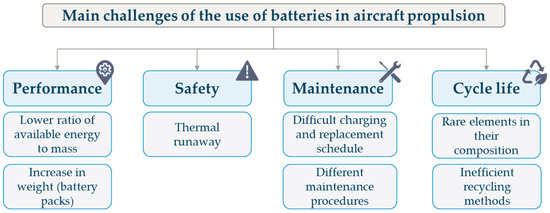
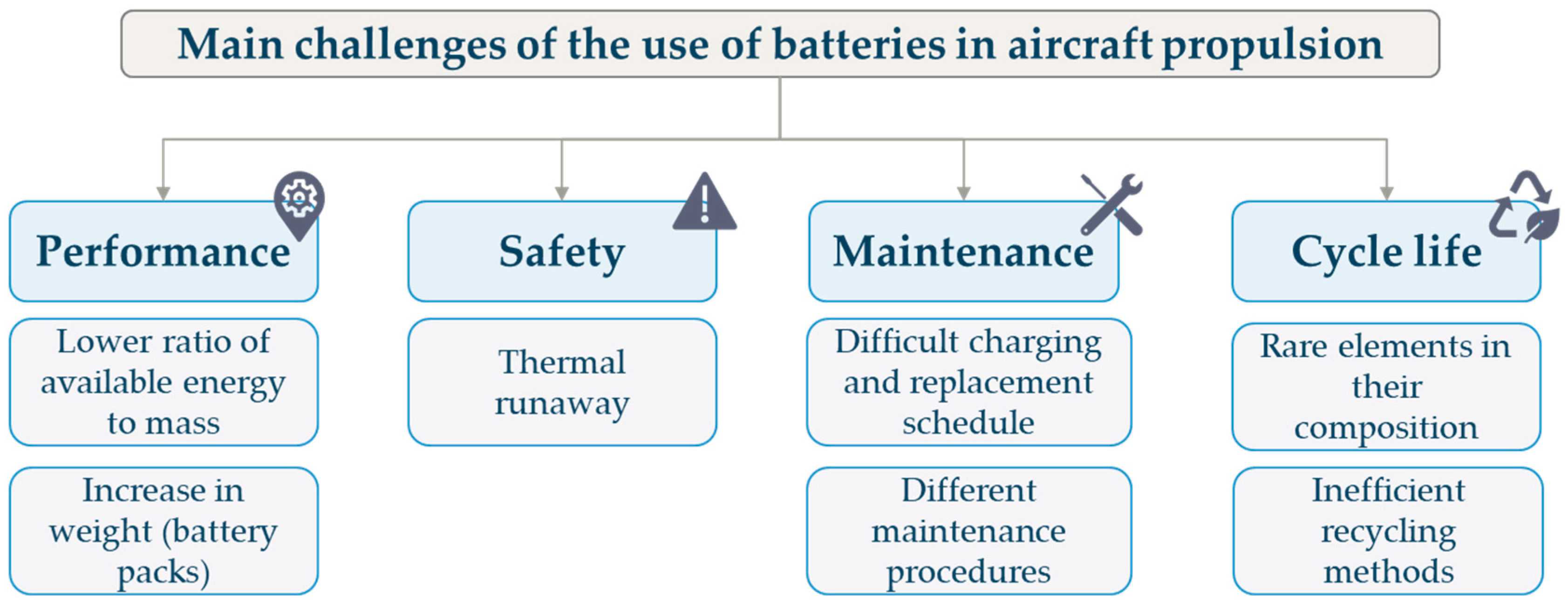
While there are clear advantages to scaling up the use of battery-powered aircraft, there are also a number of challenges to consider. When it comes to using batteries for aircraft propulsion, identifying the safest and highest-specific-energy ones is more limiting than the cost of developing them [11]. It is essential to identify these challenges. A proper analysis enables areas of research to be identified that should be further advanced to scale up the development of these aircraft concepts. Figure 1 schematically illustrates the main challenges of the use of batteries in aircraft propulsion.
Figure 1.
Main challenges of the use of batteries in aircraft propulsion.
Firstly, the factors related to performance are identified. In this case, battery-powered aircraft are found to have poorer performance characteristics than kerosene-powered aircraft. The main challenge is associated with energy density. Another challenge category considers certain safety issues; the most common of these is thermal runaway. The consequences of thermal runaway can range from general overheating to the presence of fire or a possible explosion. Furthermore, battery-powered aircraft present greater maintenance challenges. It is difficult to incorporate schedules for charging and/or replacing batteries into maintenance programmes. Moreover, using batteries for aircraft propulsion represents a significant change to conventional maintenance procedures.
As mentioned above, for this technology to be fully sustainable, the entire life cycle of the batteries must be considered, not just the aircraft’s operational phase. Currently, many existing or developing battery technologies include rare-Earth elements in their composition. This means that extracting these materials can be very energy-intensive and can have undesirable environmental effects. Furthermore, there are currently few methods for recycling existing batteries. Of those that do, many are inefficient.
The development of new battery chemistries and processes related to battery development and maintenance aims to address many of these disadvantages. However, innovation and development efforts on the part of the industry will still be required to comprehensively address all challenges.
3. Types of Battery-Powered Aircraft
Having analysed the main characteristics of battery technology in the previous section, it is possible to advance to the next stage of the analysis. This time, the analysis will focus on how batteries are integrated into aircraft propulsion systems. This section aims to address the second research question outlined at the beginning of the paper, as it aims to present the main types of battery-powered aircraft and their key characteristics.
Although classifications of battery-powered aircraft may vary slightly depending on the source, this paper will adopt a fundamental twofold division.
Firstly, all-electric aircraft (AEAs) will be considered. Secondly, hybrid-electric systems will be discussed. In the former, batteries are the primary means of propulsion. In contrast, in hybrid-electric systems, batteries contribute to propulsion in combination with other technologies.
3.1. All-Electric Aircraft
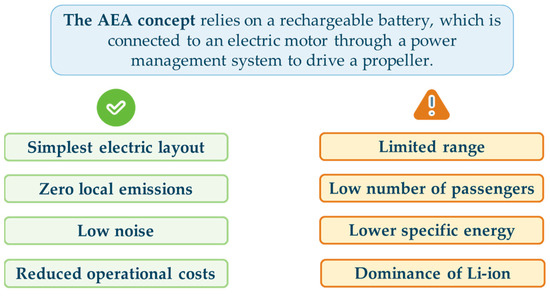
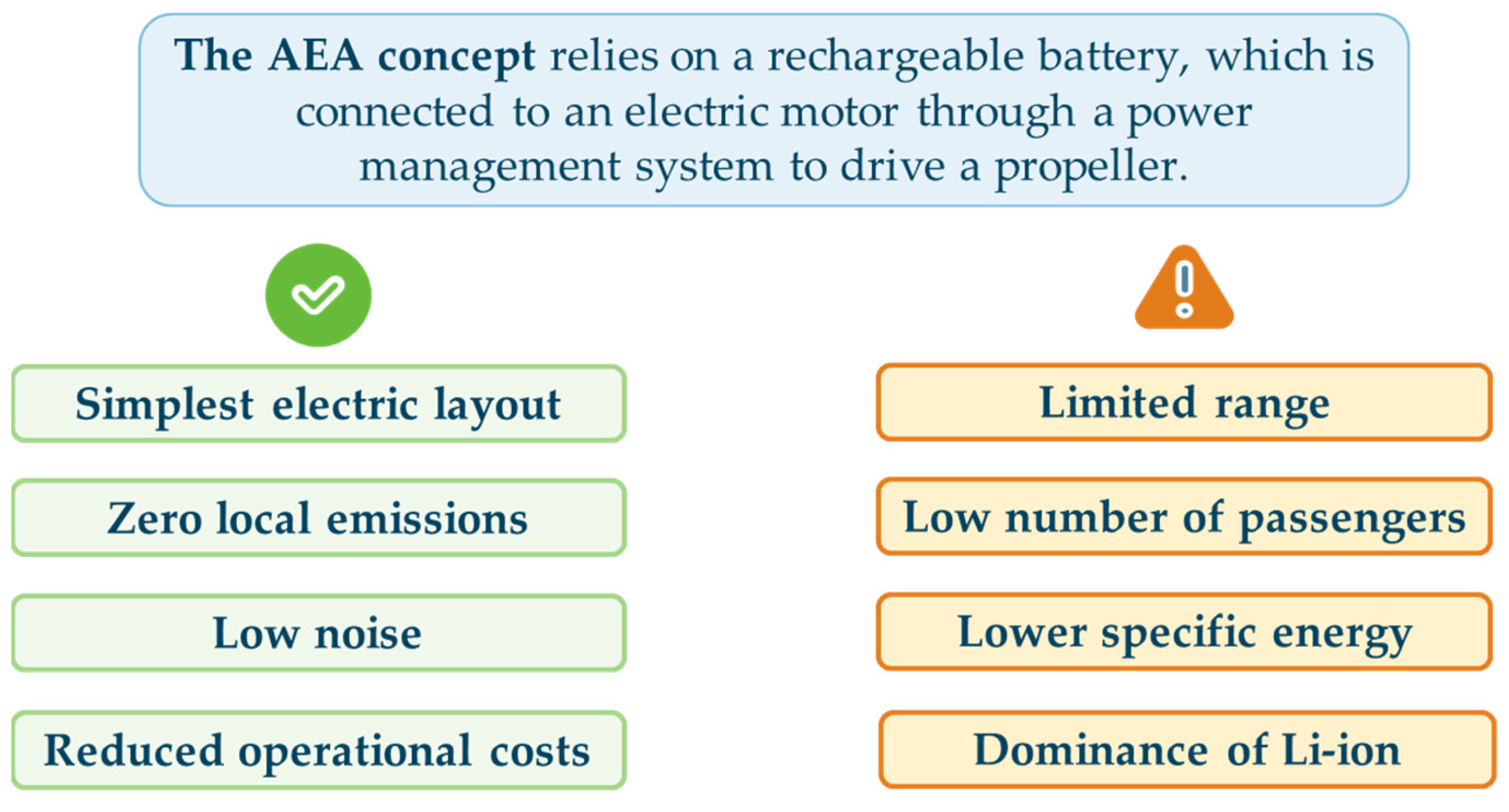
The first type of battery-powered aircraft to be considered are all-electric aircraft. This architecture relies on a rechargeable battery as energy storage. This battery is connected to an electric motor through a power management system. Figure 2 shows the main characteristics of this type of aircraft.
Figure 2.
Overview of the advantages and limitations of the AEA concept.
One advantage of this concept is that it presents the simplest electrical layout. As the propulsion system is battery-powered, it achieves zero local emissions and reduces aircraft operating noise. As the propulsion system is based on one main technology, operating costs are reduced.
However, this concept presents limitations. Currently, lithium-ion batteries are the most widely used chemistry. In addition to the problems associated with lithium extraction, another important limitation is their low energy density. Even if the specific energy of new lithium-based battery chemistries increases, electric aircraft will still have a limited impact on the aviation sector’s total greenhouse gas emissions [12]. This is due to their limited range and the limited number of passengers they will be able to carry. Although improvements in battery technology are expected to increase the range of these aircraft, this will remain insufficient for the complete replacement of kerosene-powered aircraft.
3.2. Hybrid-Electric Systems
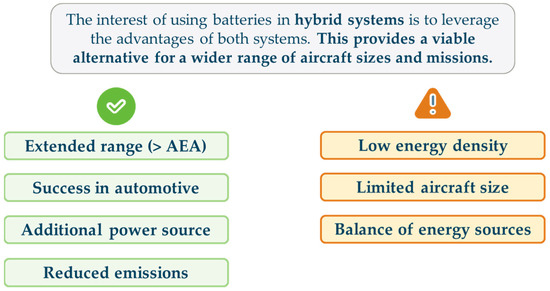
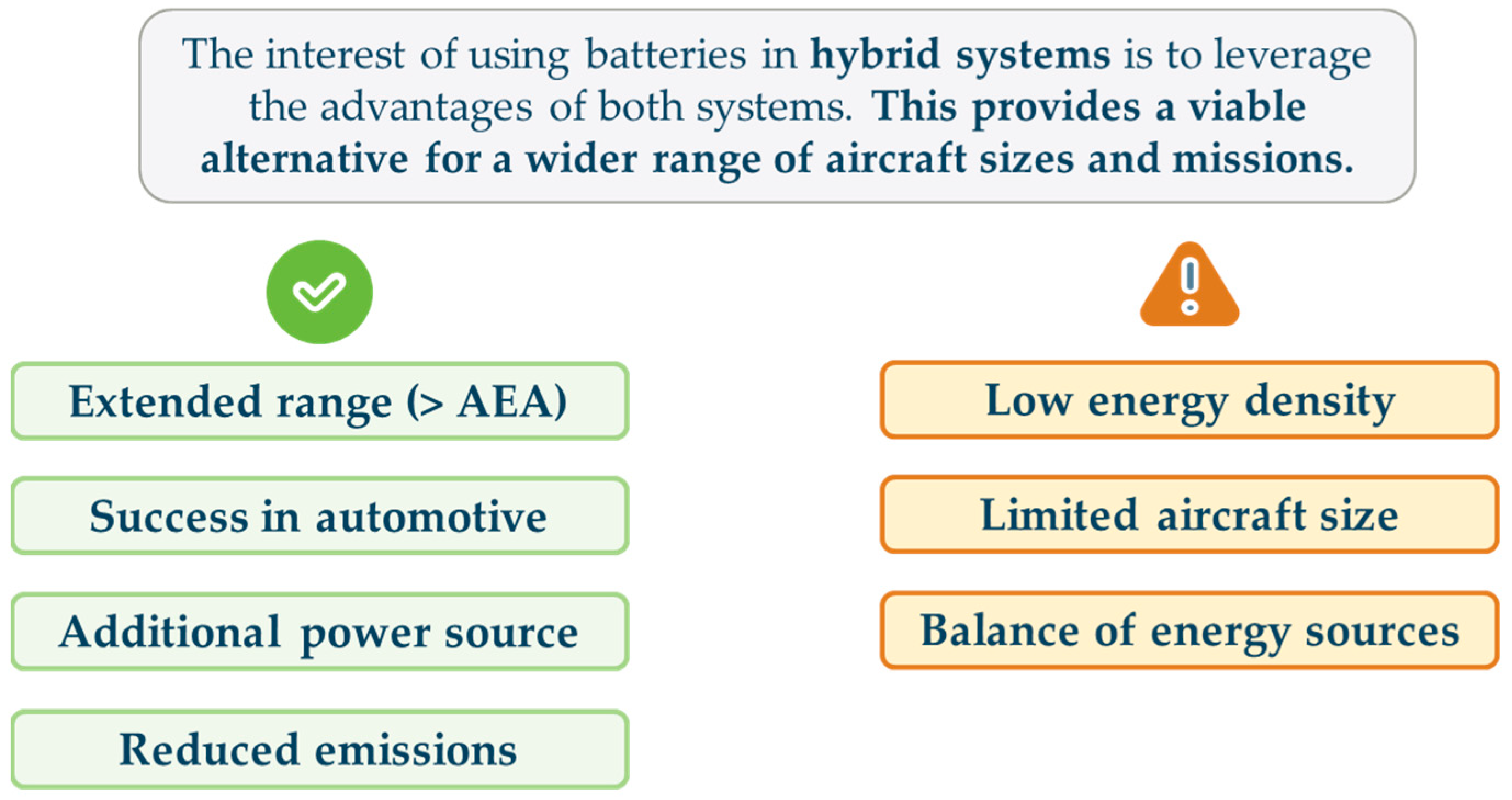
The second concept in battery-powered aircraft is the use of hybrid-electric systems. By using these systems, the aim is to power a wider range of aircraft capable of performing more diverse missions by using batteries in combination with other propulsion technologies. Figure 3 presents the main characteristics of hybrid-electric systems.
Figure 3.
Overview of the advantages and limitations of the hybrid-electric aircraft concept.
Compared to AEA, one advantage of this concept is the possibility of greater flight range. Hybrid-electric systems have experienced great success in the automotive industry. Based on these previous applications, it is possible to learn and identify key areas on which to focus innovation to advance the concept in aviation. Batteries play a pivotal role in these configurations by providing additional power to the system during the most energy-intensive phases of flight. While it is true that one advantage of these systems is reduced emissions compared to kerosene-powered aircraft, it is important to note that their emissions are higher than those of AEA, particularly when batteries are used alongside gas turbines. However, batteries help to reduce or even eliminate emissions in sensitive flight segments [13]. Take-off and landing are examples of such phases. This significantly reduces emissions in the vicinity of airports.
Nevertheless, these aircraft cannot compete with conventionally-powered aircraft in terms of size and range. Another challenge this type of aircraft may present is achieving the optimal balance between energy sources. Taking the previous ideas into account, it is reasonable to conclude that, in the near future, Sustainable Aviation Fuels (SAF) will be the only viable propulsion option for aircraft in the long-range market.
4. Battery-Powered Aircraft and Their Markets
Once the technology and main concepts of battery-powered aircraft have been presented, the next stage of the analysis considers the market for such aircraft. This section aims to answer the third and final question posed at the beginning of the paper. It seeks to analyse the main markets in which battery-powered aircraft could be introduced, while taking their current limitations into account.
For new aircraft concepts to be profitable, it is essential to consider the market that these designs could serve from the outset. Firstly, the scaling up of these aircraft concepts could significantly contribute to the development of a new market. This is the IAM market. Additionally, the introduction of battery-powered aircraft could affect existing markets. Given the current characteristics of these aircraft, the impacted markets could be regional and medium-range. The impact of introducing these new aircraft concepts will depend on which aircraft they could replace in these markets. The main ideas associated with the two approaches of the analysis are presented below.
4.1. Impact of Battery-Powered Aircraft in the IAM Market
The IAM market is a new transport model. This model aims to transport passengers and cargo within urban areas. In order to achieve this, new technologies must be developed and integrated into multimodal transport systems [14]. The central aircraft in this model are electric Vertical Take-Off and Landing (eVTOL) vehicles. The development of battery-powered aircraft could be a key driver of this new market. Additionally, the current viability of lithium-ion batteries shows promising potential for this market [15].
Despite their limitations in terms of range and passenger capacity, battery-powered aircraft would still meet the requirements set out for this new market. The IAM market is considered the most promising for introducing battery-powered aircraft. This market supports the development of short-range operations using current battery technologies. In addition, new, unconventional airframe configurations can be implemented in battery-powered aircraft. One such configuration is distributed propulsion. This is essential for the operation of eVTOLs in urban areas. Furthermore, all-electric, battery-powered aircraft are independent of thermodynamic cycles. This means they do not need to fly at high altitudes to improve performance, allowing aircraft to be optimised for low-altitude flights. The development of low-altitude operations is also compatible with the characteristic operations of the IAM market. Another advantage of scaling up this new mobility model could be reduced traffic congestion in cities and associated emissions.
However, developing this new transport model is not without its challenges. A limitation of eVTOL aircraft is that they may encounter problems operating in adverse weather conditions. These aircraft do not have excessive power. Therefore, they do not have the same ability to fly in adverse weather conditions as helicopters. Urban turbulence and wind shear from buildings also present a problem for eVTOL operation. These characteristics can limit the development of operations. Beyond the characteristics of aircraft, another challenge of the IAM market is the development and operation of infrastructure for air operations: eVTOL aircraft will operate from vertiports. As this is new infrastructure, the construction and operational models must first be defined. Financing such projects may also be challenging. Taking these limitations into account, the EFACA project concludes that the best way to scale up this market is to define a series of basic use cases. The lessons learned from these operations can be applied to more complex future operations.
4.2. Impact of Battery-Powered Aircraft on Other Aviation Markets
The impact of battery-powered aircraft on traditional aviation markets will depend on which conventional aircraft these new aircraft concepts can replace. All-electric and hybrid-electric aircraft, propelled by a propeller, exhibit flight performances similar to turboprop aircraft. If hybrid-electric aircraft become more widely used, they could become significant competitors to turboprops in the regional market. However, they will not necessarily replace jet liners. This would require the development of different battery chemistries, not expected in the short term.
5. Conclusions
This paper has presented an analysis of three key dimensions related to battery-powered aircraft. These are technology, aircraft concepts, and the impact of these concepts on different aviation markets. Batteries offer significant advantages in terms of reducing noise and emissions. However, further research is required to overcome the challenges associated with their performance, safety, maintenance and life cycle to scale up the technology.
Regarding battery-powered aircraft concepts, the two most significant have been presented: all-electric aircraft and hybrid-electric systems. In the former, batteries form the basis of the propulsion system. In the latter, they work alongside other technologies.
The potential impact of battery-powered aircraft has been analysed following two approaches. Firstly, the development of these aircraft could play a fundamental role in the growth of the IAM market. This market is characterised by short-range operations and limited passenger transport. Additionally, battery-powered aircraft could impact on other traditional aviation markets. It is important to note that both types of battery-powered aircraft present flight characteristics similar to turboprop aircraft. This implies that the main impact of battery-powered aircraft would be limited to the regional market.
Author Contributions
Conceptualization, M.Z.S.; methodology, M.Z.S. and R.M.A.V.; validation, C.G.A., R.D.-A.J., F.P.M. and V.F.G.C.; investigation, M.Z.S.; resources, R.M.A.V. and V.F.G.C.; writing—original draft preparation, M.Z.S.; writing—review and editing, M.Z.S., R.M.A.V., C.G.A., R.D.-A.J., F.P.M. and V.F.G.C.; visualisation, M.Z.S. and R.M.A.V.; supervision, V.F.G.C.; project administration, V.F.G.C.; funding acquisition, V.F.G.C. All authors have read and agreed to the published version of the manuscript.
Funding
The development of this work is framed in the Environmentally Friendly Aviation for All Classes of Aircraft (EFACA) project. This project is funded by the European Union Horizon Europe research and innovation programme (HORIZON-CL5-2021-D5-01-05) under grant agreement no.101056866.
Institutional Review Board Statement
Not applicable.
Informed Consent Statement
Not applicable.
Data Availability Statement
Data are contained within the article.
Conflicts of Interest
The authors declare no conflicts of interest.
References
- Afonso, F.; Sohst, M.; Diogo, C.M.A.; Rodrigues, S.S.; Ferreira, A.; Ribeiro, I.; Marques, R.; Rego, F.F.C.; Sohouli, A.; Portugal-Pereira, J.; et al. Strategies towards a more sustainable aviation: A systematic review. Prog. Aerosp. Sci. 2023, 137, 100878. [Google Scholar] [CrossRef] [Scilit]
- Xue, D.; Chen, X.M.; Yu, S. Sustainable aviation for a greener future. Commun. Earth Environ. 2025, 6, 233. [Google Scholar] [CrossRef] [Scilit]
- Rajashekara, K. Current and future trends in electrification of road and air transportation. iEnergy 2023, 2, 159–160. [Google Scholar] [CrossRef] [Scilit]
- Enyejo, O.; Babalola, I.; Owolabi, F.; Adeyemi, A.; Osam-Nunoo, G.; Ogwuche, A. Data-driven digital marketing and battery supply chain optimization in the battery-powered aircraft industry through case studies of Rolls-Royce’s ACCEL and Airbus’s E-Fan X Projects. Int. J. Sch. Res. Rev. 2024, 5, 001–020. [Google Scholar] [CrossRef] [Scilit]
- A Guide to Understanding Battery Specifications’-MIT Electric Vehicle Team, December 2008. Available online: https://web.mit.edu/evt/summary_battery_specifications.pdf (accessed on 15 November 2025).
- Gifford, S. Powering the Skies: The Rise of Electric and Low-Carbon Aircraft. Faraday Insights 2024, 19, 1–13. [Google Scholar]
- Pattanayak, T.; Mavris, D. Battery technology for sustainable aviation: A review of current trends and future prospects. Appl. Energy 2025, 397, 126356. [Google Scholar] [CrossRef] [Scilit]
- Moore, K.R.; Ning, A. Takeoff and Performance Trade-Offs of Retrofit Distributed Electric Propulsion for Urban Transport. J. Aircr. 2019, 56, 1880–1892. [Google Scholar] [CrossRef] [Scilit]
- Abu Salem, K.; Palaia, G.; Quarta, A.A. Review of hybrid-electric aircraft technologies and designs: Critical analysis and novel solutions. Prog. Aerosp. Sci. 2023, 141, 100924. [Google Scholar] [CrossRef] [Scilit]
- Yu, F.; Chen, J.; Gao, P.; Kong, Y.; Sun, X.; Wang, J.; Chen, X. A Review of Hybrid-Electric Propulsion in Aviation: Modeling Methods, Energy Management Strategies, and Future Prospects. Aerospace 2025, 12, 895. [Google Scholar] [CrossRef] [Scilit]
- Viswanathan, V.; Epstein, A.H.; Chiang, Y.-M.; Takeuchi, E.; Bradley, M.; Langford, J.; Winter, M. The challenges and opportunities of battery-powered flight. Nature 2022, 601, 519–525. [Google Scholar] [CrossRef] [Scilit] [PubMed]
- Eaton, J.; Naraghi, M.; Boyd, J.G. Regional pathways for all-electric aircraft to reduce aviation sector greenhouse gas emissions. Appl. Energy 2024, 373, 123831. [Google Scholar] [CrossRef] [Scilit]
- Schäfer, A.W.; Barrett, S.R.H.; Doyme, K.; Dray, L.M.; Gnadt, A.R.; Self, R.; O’Sullivan, A.; Synodinos, A.P.; Torija, A.J. Technological, economic and environmental prospects of all-electric aircraft. Nat. Energy 2019, 4, 160–166. [Google Scholar] [CrossRef] [Scilit]
- Pak, H.; Asmer, L.; Kokus, P.; Schuchardt, B.I.; End, A.; Meller, F.; Schweiger, K.; Torens, C.; Barzantny, C.; Becker, D.; et al. Can Urban Air Mobility become reality? Opportunities and challenges of UAM as innovative mode of transport and DLR contribution to ongoing research. CEAS Aeronaut. J. 2025, 16, 665–695. [Google Scholar] [CrossRef] [Scilit]
- Sripad, S.; Viswanathan, V. The promise of energy-efficient battery-powered urban aircraft. Proc. Natl. Acad. Sci. USA 2021, 118, e2111164118. [Google Scholar] [CrossRef] [Scilit] [PubMed]
Disclaimer/Publisher’s Note: The statements, opinions and data contained in all publications are solely those of the individual author(s) and contributor(s) and not of MDPI and/or the editor(s). MDPI and/or the editor(s) disclaim responsibility for any injury to people or property resulting from any ideas, methods, instructions or products referred to in the content. |
© 2026 by the authors. Licensee MDPI, Basel, Switzerland. This article is an open access article distributed under the terms and conditions of the Creative Commons Attribution (CC BY) license.