


Abstract
In contrast to the development of conventional civil aircraft propulsion systems, novel propulsion technology or non-standard energy sources disclose a lack of flexibility in the current aviation certification framework. Additionally, aircraft certification in 2025 relies heavily on manual effort, causing major difficulties in maintaining the traceability of data across vast sets of regulation documents. One promising solution to overcome such challenges is offered by the field of artificial intelligence (AI), particularly large language models (LLMs). This paper introduces an AI-aided framework designed to streamline the certifiability of novel aircraft propulsion systems. To meet the AI trustworthiness demands set by the European Union Aviation Safety Agency (EASA), the framework proposes a concept for achieving data and model transparency in machine learning (ML) applications. To address the demand for data transparency, aviation regulatory context data will be unified and stored in a Unified Regulations Database (URD). This unified data is classified and enriched with related information for ML purposes. The URD enables the creation of modern, transparent AI features for civil aircraft certification. This AI-aided framework will enable certification measures for the development and allows for certifiability checks for novel aircraft technologies. Both the aviation industry and regulatory authorities may equally benefit from the existence of the URD as a starting point for certifying AI features.
1. Introduction
1.1. European Regulatory Framework
Aircraft certification is a fundamental necessity for ensuring a high and uniform level of safety within civil aviation. The European Commission (EC), as the executive body of the European Union (EU), establishes the regulatory framework for the European aerospace industry, which defines certification as the primary method for verifying compliance (BR-2018-1139 [1]). Compliance means consideration of comprehensive documents from European Union Aviation Safety Agency (EASA), European Organization for Civil Aviation Equipment (EUROCAE), SAE International, DIN EN, IEEE, among others [2,3,4,5,6,7,8]. Table 1 shows a list of common institutions for aviation. Next to the institutions, their typical established document types are mentioned. This list makes no claim to completeness—it provides insights about the complexity of the regulatory framework for aviation. Aside from these standard documents, the aviation industry has developed and uses its own standards, e.g., standard practices for testing of airborne equipment.
Table 1.
List of common aviation standardization institutions as representative part of the aviation regulatory framework including their established document types.
These regulatory documents provide standardized guidelines, procedures, and methodologies, e.g., for aircraft development, component and equipment design, installation, reliability, testing, maintenance concepts, crew training, and level-based safety assessments. Once a development has reached a sufficient level of maturity (Technology Readiness Level (TRL)), the Original Equipment Manufacturer (OEM) submits the project to the National Aviation Authority (NAA), and the applicable rules for certifying are set out in a binding document, the Certification Basis (CB) [9].
1.2. Certification Integrated Development Approach
A recommended approach is to consider certification holistically right from the beginning of any serious aircraft development. Siemens depicted this as controversy to traditional development in a software promotional video and outlines the importance of this approach [10].
Often promised solutions, provided by global players such as IBM and Siemens, are mainly collaborative life-cycle management (CLM) tools. These tools employ a systems engineering approach and enable an end-to-end traceability from initial specifications to the verified, tested implementation. But the relationship between the aviation certification framework and the complex system development is still missing; it is not covered by use of CLM tools entirely. Certification conformity for Aviation regulation still has so far been left to experts and innovative concepts currently lead to high development cost and unforeseeable impact on certify ability.
1.3. Aviation Industry Demands
During the EASA-FAA International Aviation Safety Conference 2025 several discussions about certify ability of hybrid electric propulsion arose. Matthieu Pettes-Duler, Head of Powertrain at Beyond Aero, described many discussions with EASA regarding Beyond Aero’s new concept development of a novel hybrid-electric jet. He describes a [11]:
“(…) need for flexibility in the certification process, recognizing the unique challenges posed by emerging technologies.”(Pettes-Duler, Beyond Aero Head of Powertrain, 2025)
Another speaker, Antonio Tripoli from ATR, was talking about the non-existing certification base for the implementation of a hybrid electric propulsion system in large aeroplanes (CS-25) [12]:
“(…) if the new rules are not built with sufficient flexibility on one side and sufficient clarity on the other side, we risk to not work, we risk to work with no efficiency, and so we can also shift our planning for development, increase the cost, and ultimately lead to the cancellation of the stock of the product.”(Tripoli, ATR Preliminary Design and R&T Expert, Workshop Discussion “Electric/hybrid propulsion”, 2025, EASA-FAA International Aviation Safety Conference)
The aeronautical industry is calling for reforms to its regulatory framework to better accommodate novel technologies. There is a clear need for improved regulatory guidance, for higher transparency in the regulatory framework, and for an increased flexibility in certification processes.
2. Artificial Intelligence (AI) in Aviation
2.1. AI Integration Guidelines for Aviation
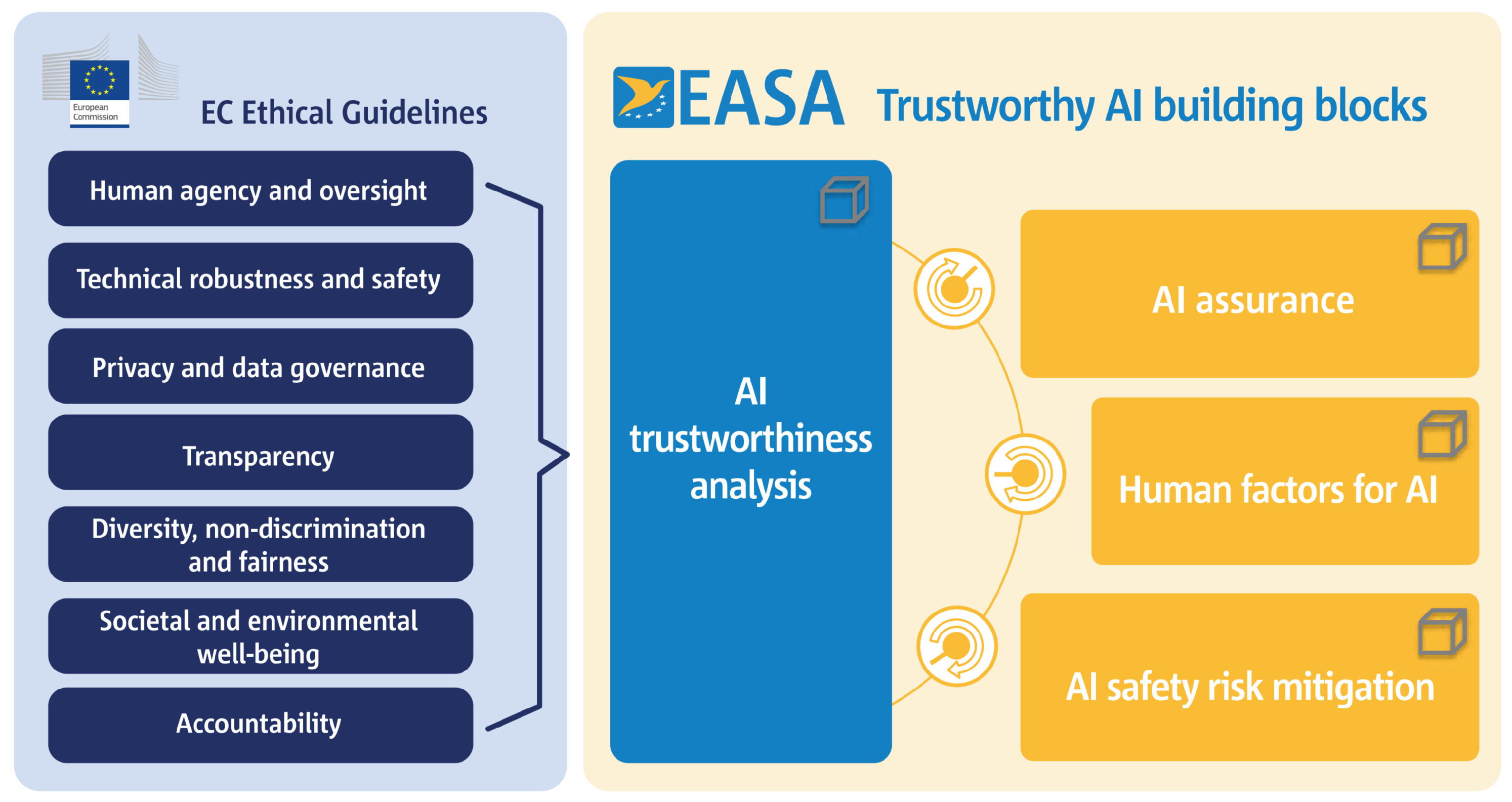
Among others, EASA and EUROCAE are actively working to address the challenges and opportunities of integrating AI into aeronautical systems. They mainly focus on developing AI integration guidelines for operational, in-service AI trustworthiness applications. The EASA AI Roadmap 2.0 ([13], p .15ff) follows a “human-centric” approach, emphasizing that AI should augment, not replace, human expertise and decision-making, see Figure 1.
Figure 1.
EC Ethical Guidelines for achieving AI trustworthiness in aviation [13] [p. 15ff].
Guidelines for using AI in certification-compliant development are not mentioned yet, whereas the implementation of AI features aligned with the aviation regulatory framework allows for a certification-compliant development. This fundamental framework is accessible for the aviation industry. Its published documents from institutions and agencies of the aeronautical sector are well known and accepted in aviation.
Its high accuracy provides a ground truth because of reviewed, proved, accepted, and published documents within the aviation regulatory landscape from aviation experts. This fundamental ground truth can be used for the training of AI models. Its accessibility ensures the transparency of the data—one of the key demands by EASA for trustworthy AI.
2.2. AI as Game Changer for Aviation
Table 2 outlines potential use cases for LLM-, regression- or classification applications in aviation, offering benefits to both the industry and regulatory certification authorities (see note information A and B).
Table 2.
Examples of potential AI-aided tools for aircraft certification and development.
Such powerful models can provide early awareness of certification demands, thereby reducing late-stage development cycles and the need for extensive discussions between certification agencies and OEMs. While several approaches can be used to create these models, only a few are relevant to aviation.
3. Transparency First
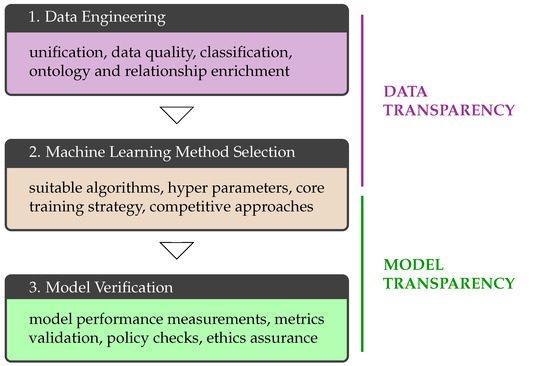
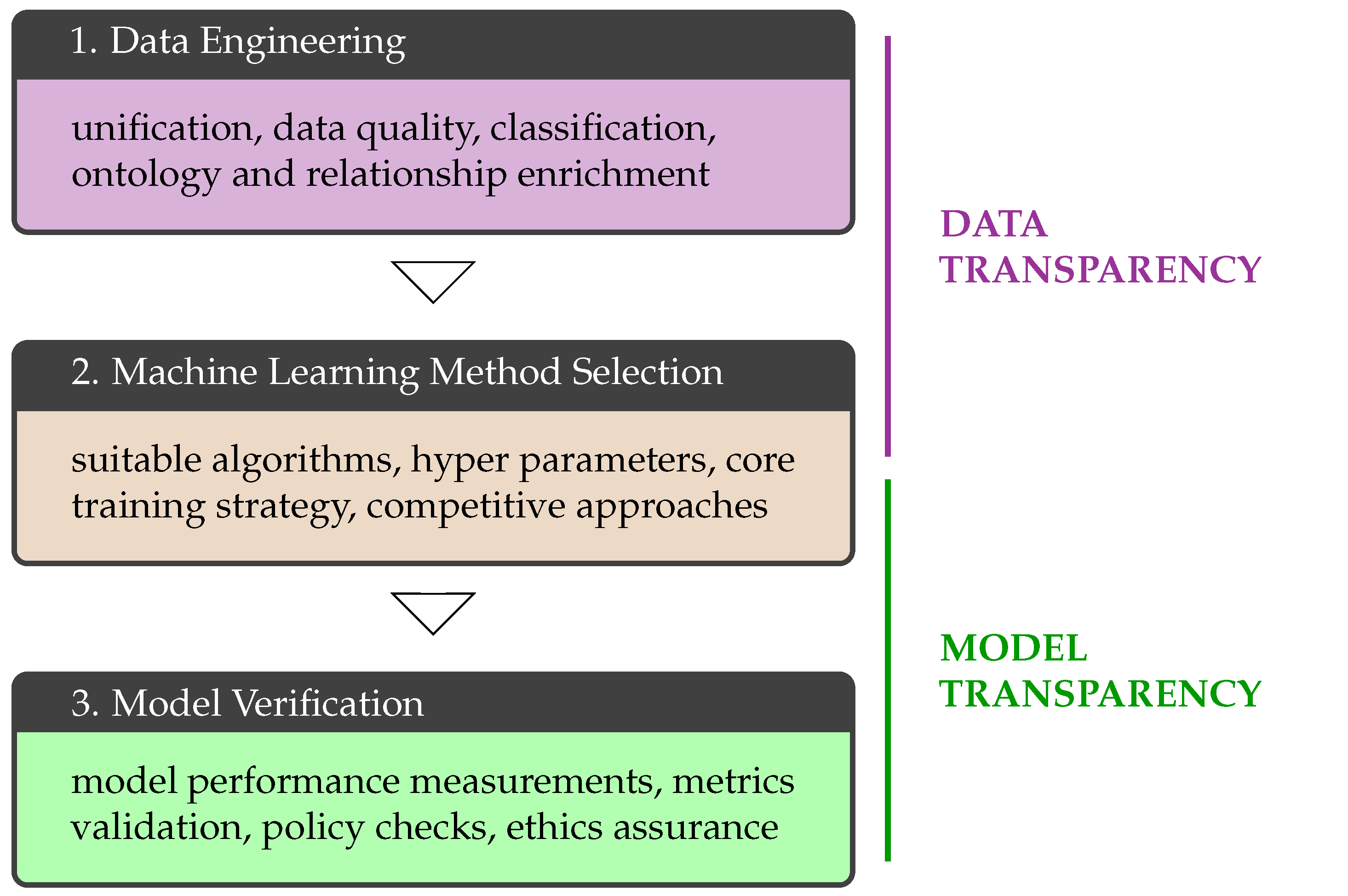
To meet EASA’s demands for AI trustworthiness and transparency, the following three major steps must be addressed individually: data engineering, machine learning method selection, and model verification, see Figure 2. AI tools, built up on this particular transparency concept can provide clarity regarding their accuracy and response behavior.
Figure 2.
Basic concept of data and model transparency to achieve AI trustworthiness.
The demand for transparency of AI models is one of the seven ethical guidelines for trustworthy AI set by the European Commission and published by EASA in the AI Roadmap 2.0 [13]. A precise understanding of, and reproducible probabilistic behavior based on, the model’s outputs are key to ensuring trust in AI solutions. However, their complex and opaque architectures can make it challenging to discern how they arrive at a particular output or exhibit uncertain behavior ([14], sec. 2.2).
Currently, only a handful of well-known aviation LLMs are available online to both industry and regulatory institutions: Aviation-GPT, Aviator-GPT, Aviation Regulatory Advisor, and US General Aviation Expert, among others. These models are website-embedded chatbots that have been fine-tuned from GPT on a wide range of aviation resources—including regulatory specifications, maintenance manuals, airplane flying handbooks (AFH), aeronautical information manuals (AIM), aviation weather publications, flight protocols, and more. The fine-tuned LLMs perform well and are often accurate on aeronautical queries. However, unlike cutting-edge GPT models, there are no dedicated, open-source aviation evaluation metrics. Consequently, their performance is assessed via general-purpose benchmarks such as Massive Multitask Language Understanding (MMLU), Graduate-Level Google-Proof Q&A (GPQA), and Humanity’s Last Exam (HLE) [15,16], among others.
Until there are no effective evaluation metrics and rankings for aviation LLMs existent, these models are unlikely to be seriously integrated into aircraft development, certification, or aircraft equipment.
3.1. Unified Regulations Database (URD)
To address the data transparency in the data engineering process (cf. Figure 2) a Unified Regulations Database (URD) is being created. Within this database all relevant document content from the aviation field is captured in a single, consistent data structure underlying a simplified referencing and filing system. This approach ensures that information from every document is weighted equally. It enables seamless data processing with further usage. The URD will provide transparency of the aviation regulatory framework for both the aviation industry and standardization authorities equally and in a unified format. One of the challenges of data unification is to overcome the diverse styles and complex document structures of the aviation regulatory document framework. All documents have varying metadata structures and content bodies, based on their institution’s terminology and the document’s character (presentation printout, regulation, specification, glossary, report, …).
Therefore, the File Content Transformer (FCT) is used for correct data extraction and creation of the initial URD (I) based on the unified extracted data points. Unlike standard text-embedding approaches that rely on fixed chunk sizes, the FCT dynamically extracts each entry in a unique manner. An entry’s size can vary and might include a sentence, a text block, a figure, or a table. It processes each certification file and parses its information into a JSON database according to the specification, see Table 3.
Table 3.
Example of a URD target data structure. A major specification request for the FCT for correct content transformation.
The development of the FCT has progressed through several key stages. The selection of pymupdf as the primary PDF parser was made after early attempts at heading detection using font heuristics and regex failed due to varied document formatting. DocLing, an open-source framework for document parsing and information extraction, is implemented next to a layout parser and screenshot-featuring models. The FCT’s internal logic captures hyperlinks and textual references correctly—existing information from the documents does not get lost through the parsing process. Table 3 shows one example of typical attributes to be transformed into the URD data structure format. For considering the Human Feedback, the Human Verification Identifier (HFID) and the Human Feedback Information (HFIN) attributes have been foreseen in the URD data structure as well. As a database format, a dedicated JSON structure has been finalized to store and refer to extracted elements like images, tables, and metadata.
The readily available, documented information, such as the data in the URD, can be used to extract essential content that is being searched for. By contrast, information that is not explicitly recorded but exists as ontological context must be connected to the search result along with its relation description.
To bridge this gap, the data enrichment model (DEM) augments URD entries with related topics and implicit keywords, functioning similarly to the assignment of tags and labels. But unlike simple tagging, the DEM provides structured transparency by differentiating between database topics and database keywords. While explicit and implicit keywords may be combined, topics must be consistently identified and harmonized across the entire database. A classifier model (CM) is responsible for categorizing all database entries. It assigns a tag from a predefined list to any entry that was not already classified during the initial data-capturing process. Table 4 shows the initial list of classifiers. Applying defined classes to each data point within the database enables precise data extraction for various purposes, such as input filtering for specific purposes or subsequent training and verification use cases.
Table 4.
Exemplary types of classification for aviation regulatory document content.
After the enriching, labeling, and classification of data, it is necessary to make the database valid for approved usage. But human verification of such a vast amount of information, like the aviation regulatory framework, requires an extremely high effort. To compensate for this effort, certain strategies will be developed and evaluated for the Human Feedback Loop (HFL) of the URD. Within the URD, two additional attributes will be used to capture the human feedback: the Human Verification Identifier (HFID) and the Human Feedback Information (HFIN). For each database entry, the HFID indicates its verification status and the necessity of using the captured feedback information. The HFIN attribute captures the human feedback content, including the name of the involved person. Both attributes come with a dynamic nature and will be frequently updated at certain verification steps of the URD data management, increasing the traceability and verification state of the database.
3.2. Explicit and Implicit Knowledge, Ontologies
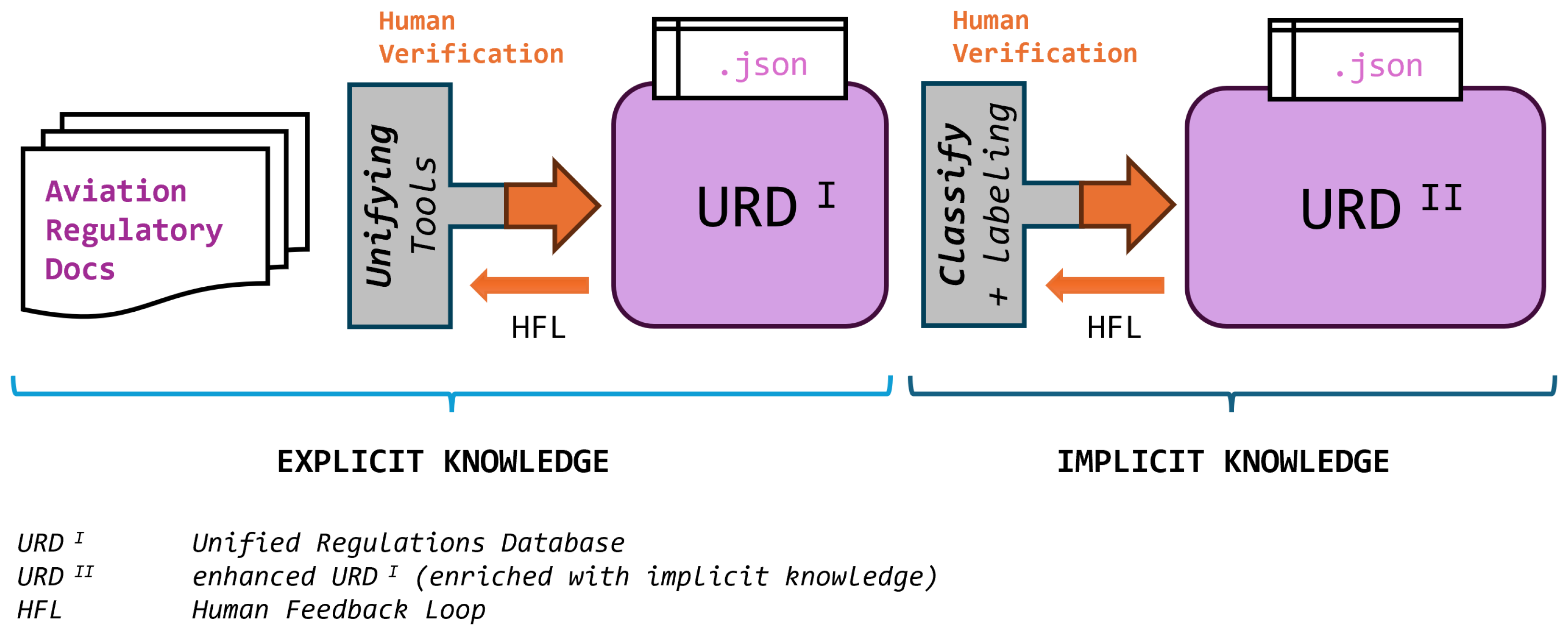
In sophistical terms, direct accessible data is known as explicit knowledge—such as data source, meta and content information. Adjacent data and indirect information, belonging to the data, is known as implicit knowledge. This knowledge enables the data enrichment process, e.g., through classification and labeling with tags and heading topics. Labeling involves adding relevant keywords and topics to specific data entries, while classifying assigns elements from predefined lists (supervised approach). Both processes turn implicit information into directly accessible explicit data and increase the transparency of the data set. A common term within this context is ontology. Ontologies encompass the entirety of word families with context-based relationships. Ontology visualizers allow for data relationship representation and information cluster printings in multi-dimensional diagrams: ontology graphs. Such ontology representations might be helpful for elaborating the data source of an ML model that has been created on top of the URD. The development steps for the creation of the URD from the aviation regulatory content as well as the allocation of explicit and implicit knowledge within the context are depicted in Figure 3.
Figure 3.
Simplified schematic of the URD creation process.
4. Conclusions and Further Development Plans
Transparent AI features can support the aviation industry and the regulatory authorities equally at the complex development of future aircraft systems such as hybrid-electric propulsion technologies. To that end, the Unified Regulations Database (URD) is built as a single source of truth derived from the aviation regulatory framework. The URD is created within the Data Engineering step one of the three identified stages for archiving EASA’s AI trustworthiness: data engineering, machine learning utilization, and model verification.
The first URD entries from EASA, EUROCAE, and SAE documents have been created by the FCT tool. Work continues to ingest additional regulatory documents’ content automatically. Parallel prototyping is testing random, pointwise human verification of URD entries. Specifications for the classification model (CM) and data enrichment model (DEM) are under construction. A key element is the human feedback loop (HFL), enabled by new human–machine interface (HMI) tools and graphical user interfaces. Intuitive interfaces accelerate human review, help converge on URD ground truth, and reinforce data and model transparency. Together, this yields an ML-ready framework that satisfies EASA’s demand for AI trustworthiness.
Author Contributions
Conceptualization, S.S.; Methodology, S.S. and D.S.S.K.; Validation, R.F.; Writing—original draft and editing, S.S.; Writing—reviews, R.F. and D.S.S.K. All authors have read and agreed to the published version of the manuscript.
Funding
This research received no external funding.
Institutional Review Board Statement
Not applicable.
Informed Consent Statement
Not applicable.
Data Availability Statement
No new data were created or analyzed in this study. Data sharing is not applicable to this article.
Conflicts of Interest
The authors declare no conflicts of interest.
Abbreviations
The following abbreviations are used in this manuscript:
| LLM | Large Language Model |
| AI | Artificial Intelligence |
| EC | European Commission |
| EASA | European Union Aviation Safety Agency |
| EUROCAE | European Organization for Civil Aviation Equipment |
| TRL | Technology Readiness Level |
| OEM | Original Equipment Manufacturer |
| NAA | National Aviation Authority |
| CB | Certification Basis |
| CLM | Collaborative Life-Cycle Management |
| GUI | Graphical User Interface |
| HFL | Human Feedback Loop |
| HMI | Human–Machine Interface |
| MMLU | Massive Multitask Language Understanding |
| GPQA | Graduate-Level Google-Proof Q&A |
| HLE | Humanity’s Last Exam |
| RLHF | Reinforcement Learning from Human Feedback |
| URD | Unified Regulations Database |
| ML | Machine Learning |
| FCT | File Content Transformer |
| CM | Classifier Model |
| SPC | Specification Item |
| MOC | Means of Compliance Information |
| GUI | Guideline / Guidance Information |
| GLT | Glossary Term |
| LL | Lessons Learned Information |
| REQ | Requirement |
| DEM | Data Enrichment Model |
| HFID | Human Verification Identifier |
| HFIN | Human Feedback Information |
| RAG | Retrieval-Augmented Generation |
References
- European Parliament and of the Council. Basic Regulation (EU) 2018-1139—On Common Rules in the Field of Civil Aviation and Establishing a European Union Aviation Safety Agency; European Parliament: Straßburg, France, 2018. [Google Scholar]
- European Union Aviation Safety Agency (EASA). Certification Specifications and Acceptable Means of Compliance, Amd. 6 for “Normal Category Aeroplanes (CS-23)”; EASA: Cologne, Germany, 2023. [Google Scholar]
- European Union Aviation Safety Agency (EASA). Certification Specifications and Acceptable Means of Compliance, Amd. 27, for “Normal Category Aeroplanes (CS-25)”; EASA: Cologne, Germany, 2023. [Google Scholar]
- European Union Aviation Safety Agency (EASA). Certification Specifications and Acceptable Means of Compliance, Amd. 8, for “Engines (CS-E)”; EASA: Cologne, Germany, 2025. [Google Scholar]
- European Union Aviation Safety Agency (EASA). Certification Specifications, Amd. 17, for “European Technical Standard Orders (CS-ETSO)”; EASA: Cologne, Germany, 2022. [Google Scholar]
- European Union Aviation Safety Agency (EASA). Special Condition CRI Consultation Paper, Issue 1, on “Electric/Hybrid Propulsion System (SC E-19)”; EASA: Cologne, Germany, 2021. [Google Scholar]
- SAE International. Aerospace Recommended Practice, Rev. A, on “Guidelines for Conducting the Safety Assessment Process on Civil Aircraft, Systems, and Equipment (ARP 4761A)”; SAE International: Warrendale, PA, USA, 2023. [Google Scholar]
- SAE International. Aerospace Recommended Practice, Rev. B, on “Guidelines for Development of Civil Aircraft and Systems (ARP 4754B)”; SAE International: Warrendale, PA, USA, 2023. [Google Scholar]
- Hinsch, M. Industrielles Luftfahrtmanagement; Springer: Berlin/Heidelberg, Germany, 2022. [Google Scholar] [CrossRef] [Scilit]
- Shift Aircraft Certification Left. Siemens—Content.sw.siemens.com. Available online: https://content.sw.siemens.com/aerospace-defense-aircraft-certification-digital-thread/video-aerospace-defense-verification-management-solution (accessed on 22 September 2025).
- Pettes-Duler, M. Day 3 Panel Discussion “Integration of New Technologies”. In Proceedings of the EASA-FAA International Aviation Safety Conference, Cologne, Germany, 10–12 June 2025. [Google Scholar]
- Tripoli, A. Day 2 Presentation “Integrating hybrid propulsion system on large transport airplane”. In Proceedings of the EASA-FAA International Aviation Safety Conference, Cologne, Germany, 10–12 June 2025. [Google Scholar]
- European Union Aviation Safety Agency (EASA). Artificial Intelligence Roadmap 2.0; EASA: Cologne, Germany, 2023. [Google Scholar]
- Liao, Q.V.; Vaughan, J.W. AI Transparency in the Age of LLMs: A Human-Centered Research Roadmap. arXiv 2023, arXiv:2306.01941. [Google Scholar]
- Artificial Analysis Intelligence Index. Artificial Analysis—Artificialanalysis.AI. Available online: https://artificialanalysis.ai/evaluations (accessed on 22 September 2025).
- Phan, L.; Gatti, A.; Han, Z.; Li, N.; Hu, J.; Zhang, H.; Zhang, C.B.C.; Shaaban, M.; Ling, J.; Shi, S.; et al. Humanity’s Last Exam. arXiv 2025, arXiv:2501.14249. [Google Scholar]

Disclaimer/Publisher’s Note: The statements, opinions and data contained in all publications are solely those of the individual author(s) and contributor(s) and not of MDPI and/or the editor(s). MDPI and/or the editor(s) disclaim responsibility for any injury to people or property resulting from any ideas, methods, instructions or products referred to in the content. |
© 2026 by the authors. Licensee MDPI, Basel, Switzerland. This article is an open access article distributed under the terms and conditions of the Creative Commons Attribution (CC BY) license.