


OLIVIA: Enabling Joint Cognitive Work in Aircraft Divert Scenario Through Operational Intentions †
 , , , and
Abstract
1. Introduction
1.1. Joint Cognitive Work/Human–AI Teaming
- Ensure performance within an operational domain, while addressing issues of learning assurance [1], specifying training, etc.
- Address new forms of work and relationship between humans and machines, enabled by AI technologies.
1.2. What Is HAIKU
1.3. What Is OLIVIA
1.4. Driving Questions
- OBJ 1.
- Does OLIVIA enable effective and efficient human–machine communication using operational intentions?
- OBJ 2.
- Do the methodologies developed during the project support safe and effective assurance for HAT assistants?
2. Material and Method
2.1. Material
2.2. Method: Evaluation OLIVIA with High-Fidelity Simulations
- Scenarios:
- Participants:
- Protocol:
- Questionnaires and interviews:
3. Results
- Highlights from quantitative results:
- Highlights from interviews:
4. Final Considerations
4.1. OLIVIA Final Considerations (OBJ1)
4.2. General Considerations for HAT Development (OBJ2)
Author Contributions
Funding
Institutional Review Board Statement
Informed Consent Statement
Data Availability Statement
Conflicts of Interest
Abbreviations
| AI | Artificial Intelligence |
| ATC | Air Traffic Control |
| EASA | European Aviation Safety Agency |
| HAT | Human–AI Teaming |
| KPI | Key performance indicator |
| OpXAI | Operational explainability of AI |
| SA | Situation awareness |
| VAL 1 | First wave of validations in HAIKU project |
| VAL 2 | Second wave of validations in HAIKU project |
References
- EASA. EASA Concept Paper: Guidance for Level 1 & 2 Machine Learning Applications, Issue 2; EASA: Cologne, Germany, 2024.
- Stowers, K.; Brady, L.L.; MacLellan, C.; Wohleber, R.; Salas, E. Improving Teamwork Competencies in Human-Machine Teams: Perspectives from Team Science. Front. Psychol. 2021, 12, 590290. [Google Scholar] [CrossRef] [Scilit] [PubMed]
- HAIKU Fact Sheet. 2025. Available online: https://cordis.europa.eu/project/id/101075332 (accessed on 10 November 2025).
- Hourlier, S.; Diaz-Pineda, J.; Gatti, M.; Thiriet, A.; Hauret, D. Enhanced dialog for Human-Autonomy Teaming-A breakthrough approach. In Proceedings of the IEEE/AIAA 41st Digital Avionics Systems Conference (DASC), Portsmouth, NH, USA, 18–22 September 2022. [Google Scholar] [CrossRef] [Scilit]
- Minaskan, N. HAIKU Deliverable D4.3: AI Model Performance Report. HAIKU Project. 2024. Available online: https://ec.europa.eu/research/participants/documents/downloadPublic?documentIds=080166e51159a7cd&appId=PPGMS (accessed on 10 November 2025).
- Hentati, T.; Letouze, T.; Dormoy, C.; Diaz-Pineda, J.; Reis, R.; Villani, A.; Andre, J. Optimizing Decision Making in Aviation: A New Communication Paradigm for Rerouting. In Proceedings of the 2nd International Conference on Cognitive Aircraft Systems (ICCAS), Toulouse, France, 16–17 May 2024. [Google Scholar] [CrossRef] [Scilit]
- Westin, C. HAIKU Deliverable D6.3: Updated Validation Strategy Plan. HAIKU Project. 2024. Available online: https://cordis.europa.eu/project/id/101075332/results (accessed on 10 November 2025).
- Hart, S.G.; Staveland, L.E. Development of NASA-TLX (Task Load Index): Results of Empirical and Theoretical Research. Adv. Psychol. 1988, 52, 139–183. [Google Scholar] [CrossRef] [Scilit]
- Taylor, R.M. Situational awareness rating technique (SART): The development of a tool for aircrew systems design. In Proceedings of the AGARD AMP Symposium on Situational Awareness in Aerospace Operations, Seuilly-sur-Seine, France, 2–6 October 1989. [Google Scholar]
- Hellmann, M.; Bocanegra, D.C.H.; Ziegler, J. Development of an Instrument for Measuring Users’ Perception of Transparency in Recommender Systems. In Proceedings of the ACM IUI WORKSHOPS 2022, Helsinki, Finland, 21–22 March 2022. [Google Scholar] [CrossRef]
- Ashoori, M.; Weisz, J.D. In AI We Trust? Factors That Influence Trustworthiness of AI-infused Decision-Making Processes. arXiv 2019, arXiv:1912.02675. [Google Scholar]
- Jessup, S.A.; Schneider, T.R.; Alarcon, G.M.; Ryan, T.J.; Capiola, A. The Measurement of the Propensity to Trust Automation. In Proceedings of the 11th International Conference on Virtual, Augmented and Mixed Reality, VAMR 2019, Held as Part of the 21st International Conference on Human-Computer Interaction, HCII 2019, Orlando, FL, USA, 26–31 July 2019. [Google Scholar] [CrossRef] [Scilit]
- Lewis, J.R. Measuring perceived usability: The CSUQ, SUS, and UMUX. Int. J. Hum.–Comput. Interact. 2018, 34, 1148–1156. [Google Scholar] [CrossRef] [Scilit]
- Gursoy, D.; Chi, O.H.; Lu, L.; Nunkoo, R. Consumers acceptance of artificially intelligent (AI) device use in service delivery. Int. J. Inf. Manag. 2019, 49, 157–169. [Google Scholar] [CrossRef] [Scilit]
- HAIKU. HAIKU–AI in Aviation Highlights, the HAIKU Viewpoint, HAIKU. 2025. Available online: https://haikuproject.eu/haiku-final-glossy-report/ (accessed on 12 September 2025).
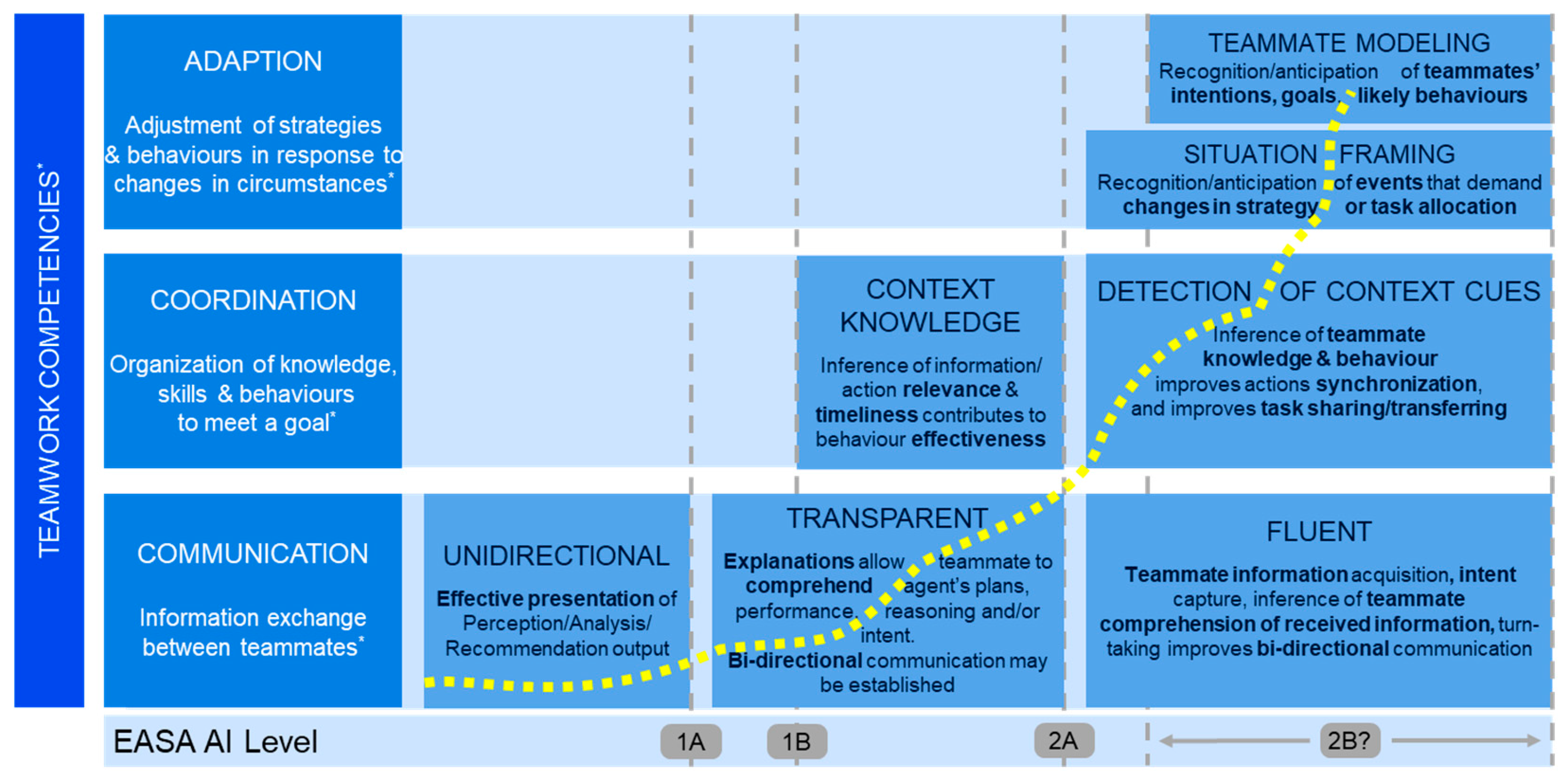
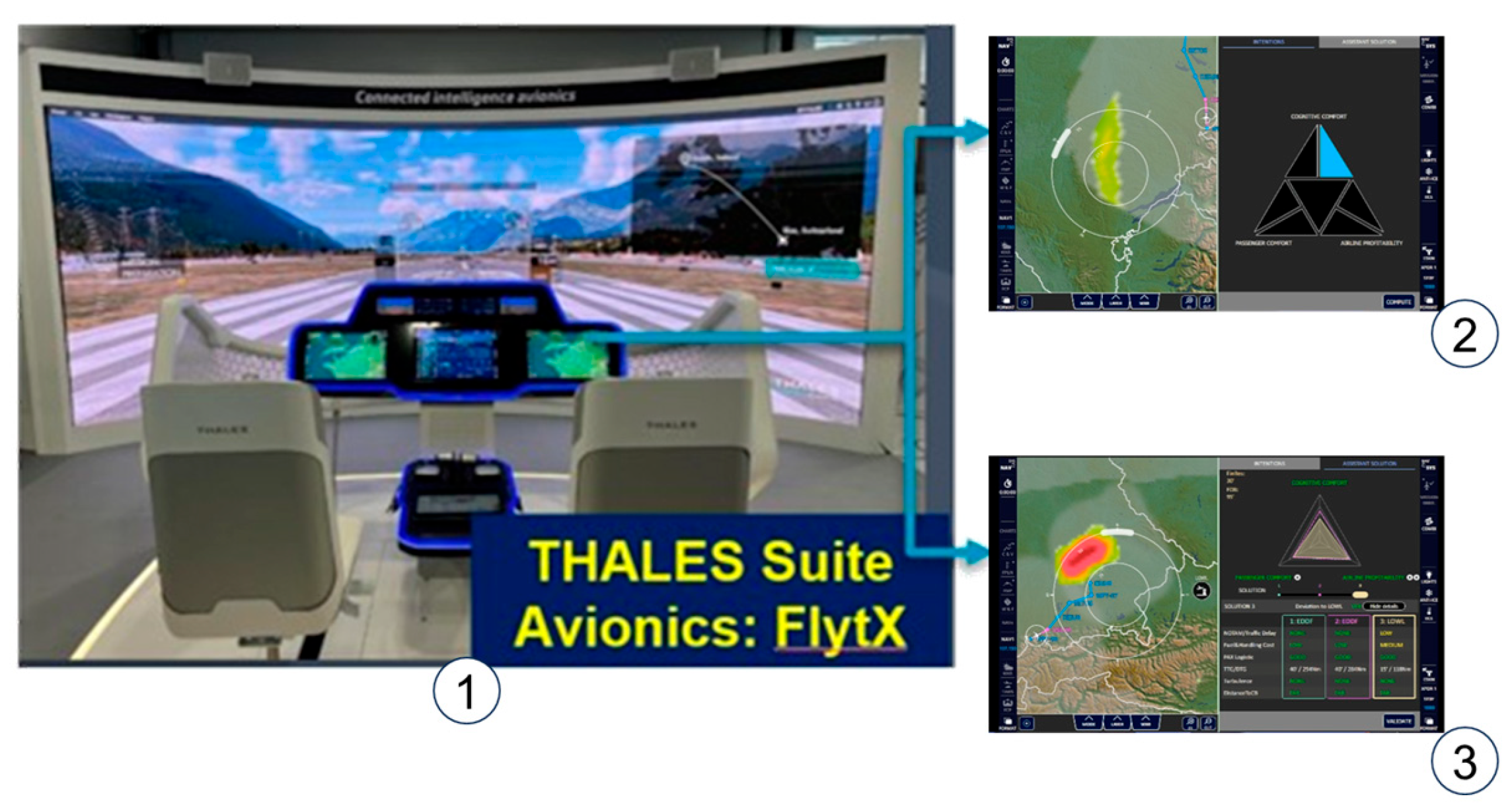

| L 1: Assistance to Human | L 2: Human–AI Teaming | L 3: Advanced Automation |
|---|---|---|
| 1A: Human Augmentation | 2A: Human and AI-based system cooperation | 3A: The AI system makes decisions and performs actions, safeguarded by the human. |
| 1B: Human cognitive assistance in decision and action selection | 2B: Human and AI- based system collaboration | 3B: The AI system makes non-supervised decisions and non-supervised actions. |
| Theme | Topics and Insights |
|---|---|
| Human–AI collaboration in decision-making processes |
|
| System usability and interface design |
|
| Trust in the AI-based assistance |
|
| Explainability and transparency |
|
| System limitations and areas for improvement |
|
| Training and adoption considerations |
|
| Added value and operational impact |
|
| Suggestions and recommendations |
|
Disclaimer/Publisher’s Note: The statements, opinions and data contained in all publications are solely those of the individual author(s) and contributor(s) and not of MDPI and/or the editor(s). MDPI and/or the editor(s) disclaim responsibility for any injury to people or property resulting from any ideas, methods, instructions or products referred to in the content. |
© 2026 by the authors. Licensee MDPI, Basel, Switzerland. This article is an open access article distributed under the terms and conditions of the Creative Commons Attribution (CC BY) license.
Share and Cite
Reis, R.J.N.d.; Villani, A.; Oliveira do Nascimento Filho, S.R.; Dormoy, C.; Diaz-Pineda, J.; Letouzé, T. OLIVIA: Enabling Joint Cognitive Work in Aircraft Divert Scenario Through Operational Intentions. Eng. Proc. 2026, 133, 146. https://doi.org/10.3390/engproc2026133146
Reis RJNd, Villani A, Oliveira do Nascimento Filho SR, Dormoy C, Diaz-Pineda J, Letouzé T. OLIVIA: Enabling Joint Cognitive Work in Aircraft Divert Scenario Through Operational Intentions. Engineering Proceedings. 2026; 133(1):146. https://doi.org/10.3390/engproc2026133146
Chicago/Turabian StyleReis, Ricardo J. N. dos, Anaisa Villani, Silvio Romero Oliveira do Nascimento Filho, Charles Dormoy, Jaime Diaz-Pineda, and Théodore Letouzé. 2026. "OLIVIA: Enabling Joint Cognitive Work in Aircraft Divert Scenario Through Operational Intentions" Engineering Proceedings 133, no. 1: 146. https://doi.org/10.3390/engproc2026133146
APA StyleReis, R. J. N. d., Villani, A., Oliveira do Nascimento Filho, S. R., Dormoy, C., Diaz-Pineda, J., & Letouzé, T. (2026). OLIVIA: Enabling Joint Cognitive Work in Aircraft Divert Scenario Through Operational Intentions. Engineering Proceedings, 133(1), 146. https://doi.org/10.3390/engproc2026133146

