


Abstract
The carriage of portable electronic devices (PED) powered by lithium-ion batteries in the aircraft cabin today is a fact. Passengers carry several such batteries in mobile phones, tablets, laptops, e-cigarettes, power banks, etc. Even though rare, there is a remaining risk that a Li-ion battery experiences thermal runaway. This typically results in the emission of smoke and gas as well as the emergence of flames and fire, thus posing a threat to safe operation. To meet this challenge, procedures have been defined, and additional mitigation means have emerged on the market. This study presents an anonymized assessment of additional mitigation means. For this, manufacturers provided samples of their product on a voluntary basis to test the potential to contain a Li-ion battery fire. Furthermore, handling was evaluated by a panel of cabin crew members. As a result, a series of recommendations for additional mitigation means and procedures was derived.
1. Introduction
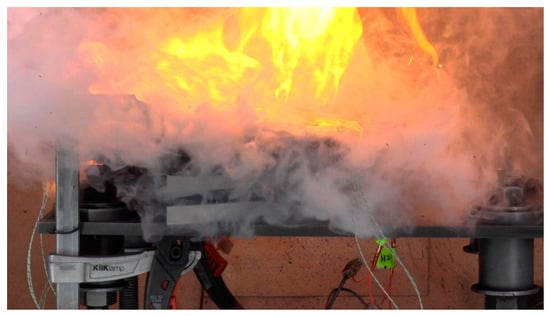
Lithium batteries are used to power portable electronic devices (PEDs) such as mobile phones, notebooks, tablets, cameras, e-book readers, and smartwatches. Passengers carry PEDs, e-cigarettes and spare batteries (e.g., power banks) in high quantities. Lithium batteries can heat up, expand, vent combustible and toxic gases, catch fire or explode (Figure 1). These hazards may threaten passengers and cabin crew.
Figure 1.
Example from thermal runaway test at Fraunhofer EMI.
UL Standards and Engagement set up the thermal runaway incidence program (TRIP) database, where carriers report Li-ion battery incidents in an anonymized way, thus giving an overview of the problem magnitude. For 2023, the number of reported incidents from participating airlines for the first time exceeded 100 and saw a slight decrease in 2024 [1].
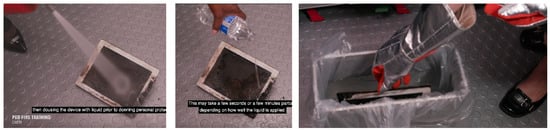
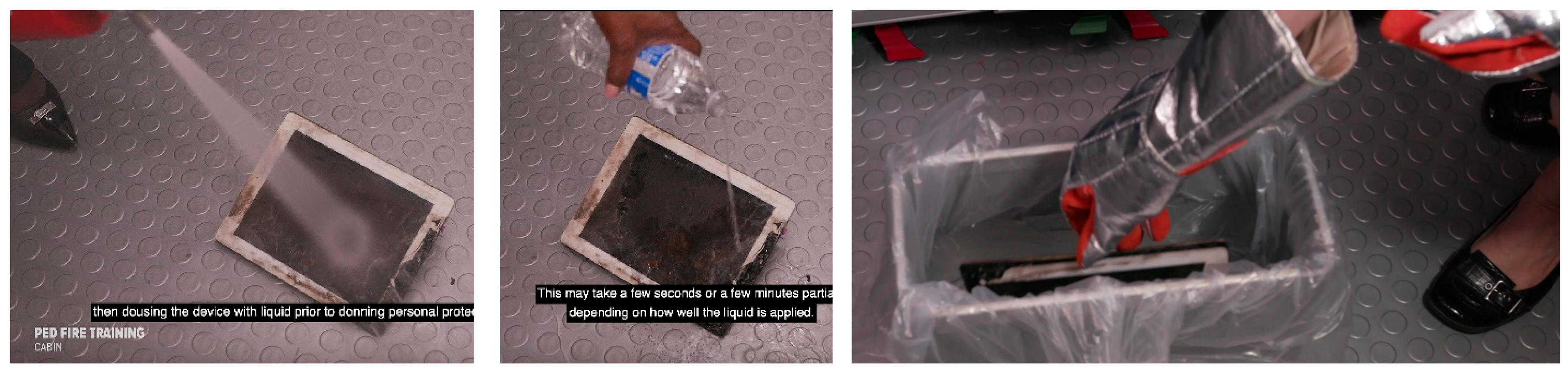
Fighting these hazards on board is challenging for crews due to the number of different battery-powered devices and possible scenarios. To give advice on the firefighting procedure for a burning PED, the FAA provided a guidance video [2]. The essential steps are first the extinguishing of flames, then the cooling of the device by “non-alcoholic” liquid and finally its submersion in a water-filled receptacle (Figure 2).
Figure 2.
PED firefighting recommended in FAA video [2]: extinguishing, cooling with water and immersing the PED.
Moreover, manufacturers offer additional mitigation means such as extinguishers and bags designed for the thermal runaway of the lithium batteries. The FAA conducted a study on the containment capability of five such additional mitigation means products [3] (Figure 3). For this, a thermal runaway was induced inside a containment bag, and its behavior was observed. From this study, the following conclusions can be drawn:
- Venting of smoke occurred in four containment bags;
- From one of the containment bags, hot particles were vented;
- Two to three (unclear from the report) of the containment bags showed venting of flames;
- Two to three of the containment bags showed opening of the containment bag closure or rupture of the bag.
Figure 3.
Images published by the FAA from containment bag testing [3].
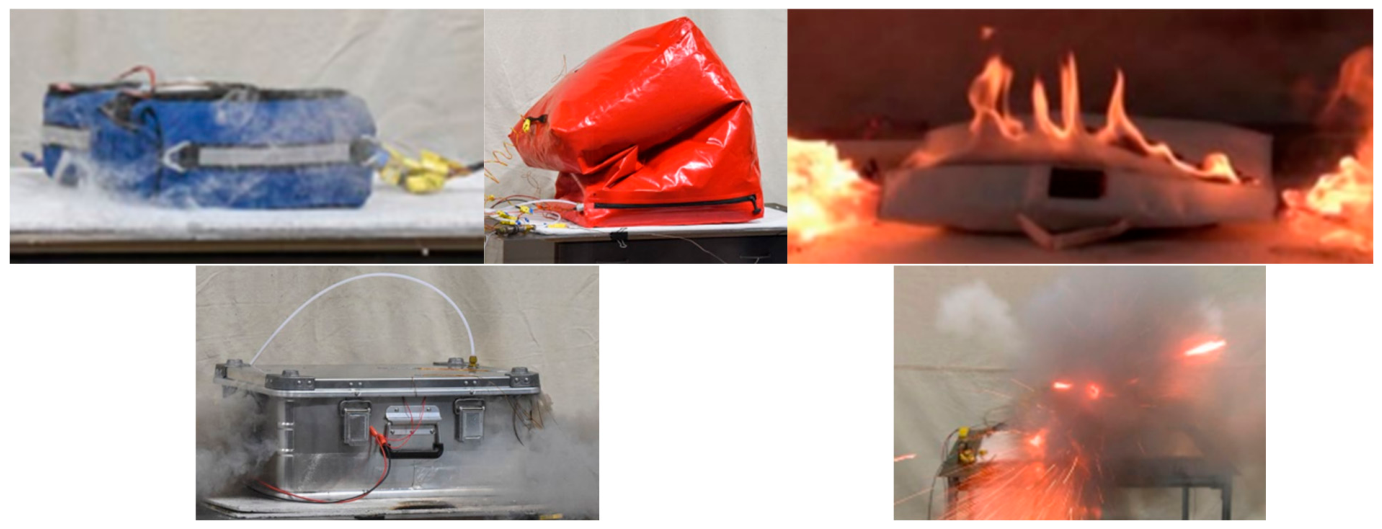
Hence, the level of performance of these products in terms of containment of fire and smoke still raises concerns.
In addition to this, airlines need to define tailored emergency procedures tailored to their cabin design and equipment.
As a contribution to improving the mitigation of PED fires on board the aircraft cabin, the European Union Aviation Safety Agency (EASA) initiated a research project called LOKI-PED. The Fraunhofer Institute for High-Speed Dynamics, Ernst-Mach-Institut, EMI, and the Fraunhofer Institute for Building Physics IBP team up with Airbus to assess additional mitigation means to manage a thermal runaway of a PED with a Li-ion battery in the cabin and cockpit. As part of this work, the cool-down capability of extinguishers, the containment capability of bags, as well as operational aspects such as emergency procedures and handling of AMMs have been investigated. In order to get a realistic picture of the current state and performance of products on the market, a brand anonymized experimental study was conducted.
2. Method
2.1. Extinguisher Evaluations
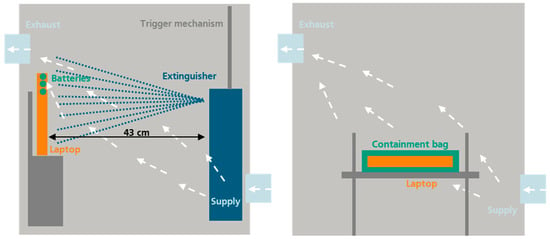
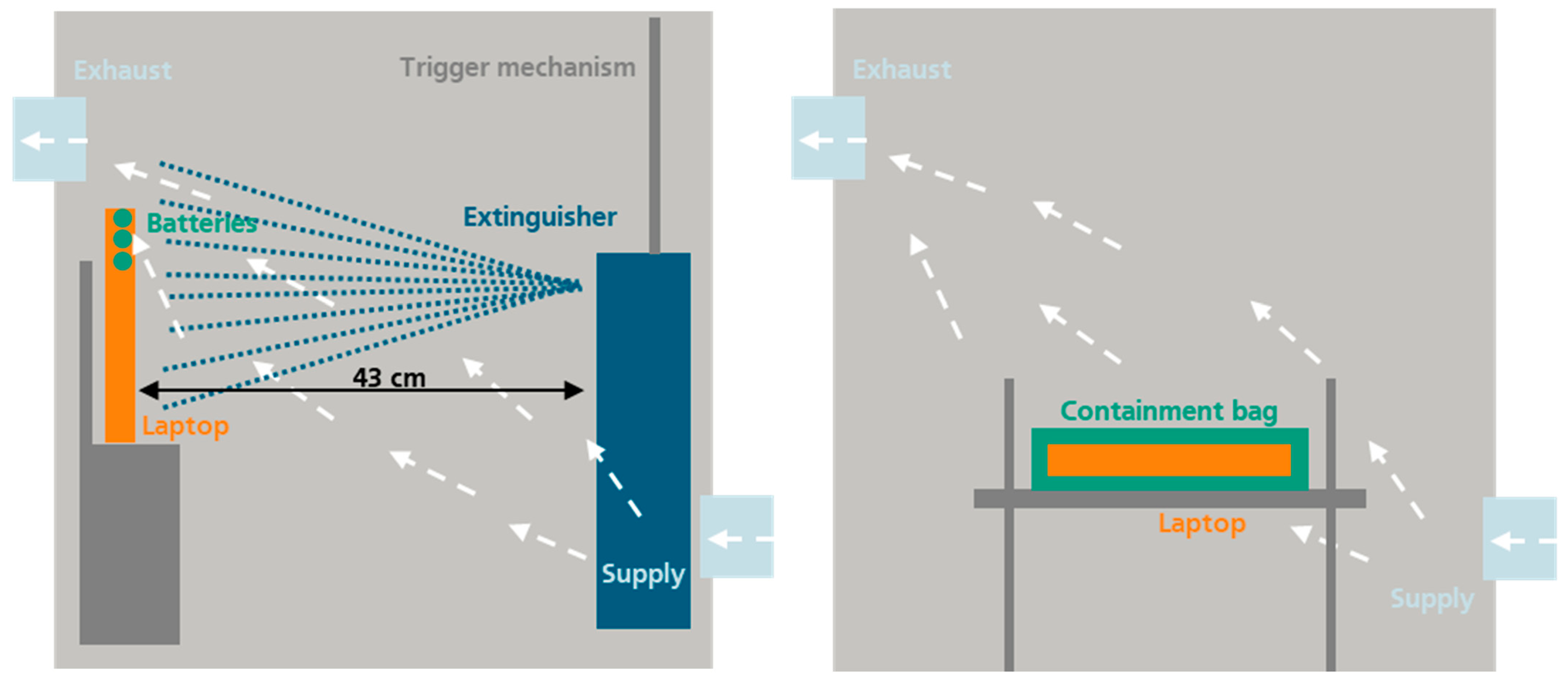
Extinguishers were provided by manufacturers from Europe and the United States, and all were designed to fight lithium battery fires. The burn chamber used by Fraunhofer EMI for the testing is depicted in [4]. Within this chamber, a laptop with 9 cylindrical cells (100 Wh) was set on fire by heating one cell to enforce thermal runaway. Upon the emergence of flames, the extinguishers were operated until they were empty after 15 s to 45 s. All of them are halon-free and commercially available, while only two of them at the time of the study (year 2024) were in service on an aircraft. Figure 4 (left) schematically depicts the test setup.
Figure 4.
Schematic test of extinguishers on burning PEDs (left); schematic view of containment bag test (right).
2.2. Containment Bag Evaluations
Eight bags from manufacturers in Europe and the US were tested for their containment capability at Fraunhofer EMI. For this, a laptop with 9 cylindrical cells representing 100 Wh in total was packed into the bag and forced into thermal runaway by heating one cell. Two of the bags were prototypes in early design, while six were commercially available. To the author’s knowledge, three of the bags were already in use on aircraft cabins during the time of the study (year 2024). Figure 4 (right) schematically depicts the test setup.
2.3. Crew Handling Tests
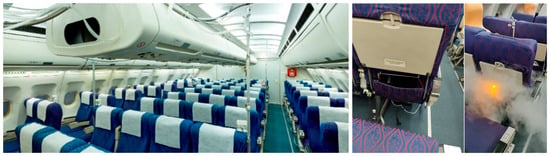
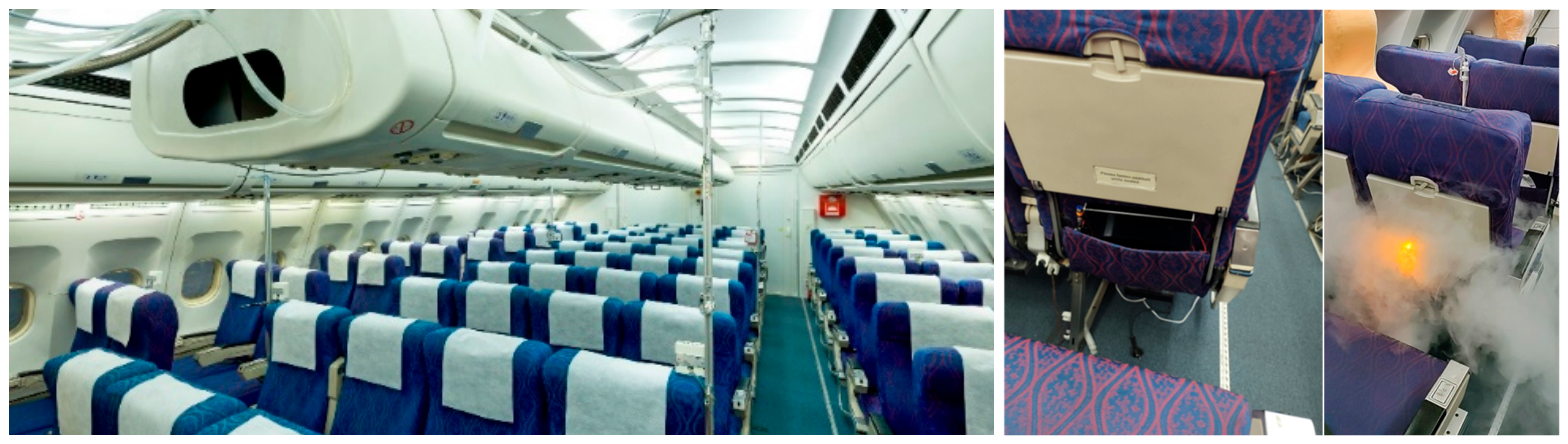
For the handling tests of bags and procedures, crew members were invited to the Fraunhofer Flight Test Facility cabin demonstrator (Figure 5, left). This test bench consists of a former in-service twin-aisle aircraft equipped with realistic cabin ventilation and the generation of flight noise by speakers. A total of 19 volunteering crew members from 12 airlines evaluated a total of 11 bags and a baseline procedure with the task to mitigate the smoke or fire of an artificial PED mimicking the thermal runaway. To make a realistic impression, a black-painted PED emulator box was manufactured (Figure 5, middle). Next to this box, an orange LED light contained in a smoking pen was placed. Furthermore, a theater smog generator was utilized to generate additional smoke in the cabin (Figure 5, right). To not put the crew in danger, the device was not heated.
Figure 5.
Fraunhofer Flight Test Facility cabin (left), PED emulator (middle), and PED fire emulation (right).
A test protocol was developed that included the steps of introducing the crew to a mitigation means prior to the test, and notes were taken to trace the duration of steps and challenges encountered. The test was followed by a crew interview to retrieve their perceptions and opinions. Prior to the test, the crew was informed that their participation would remain anonymous and no pictures of them would be taken. Through this, informed consent was retrieved from the crew members.
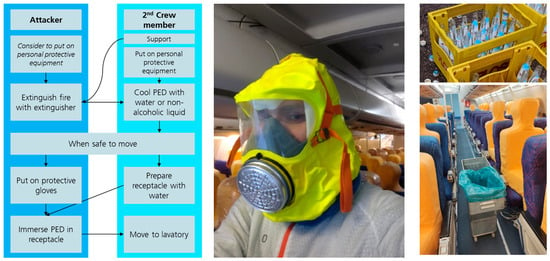
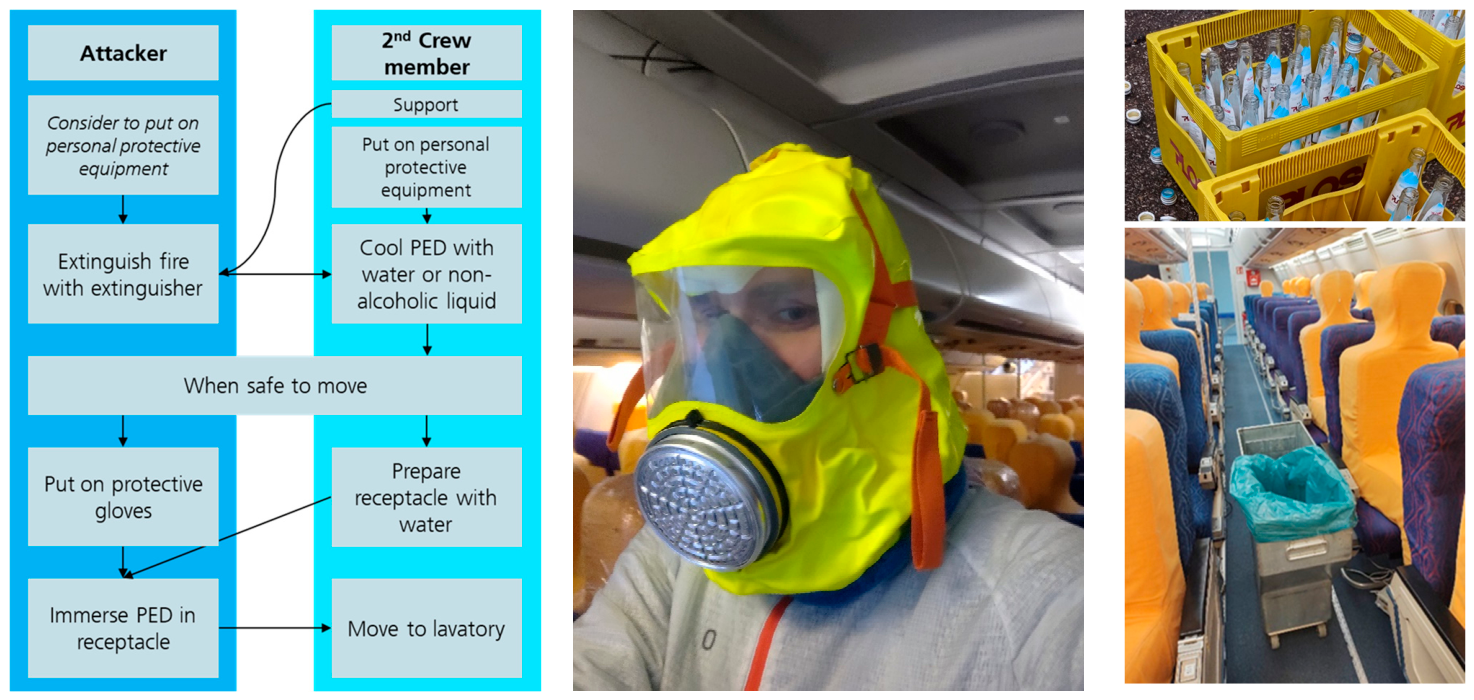
The baseline procedure was explained by a flow chart (Figure 6, left) that reflects the major steps of the FAA video [2], completed by a document Airbus shares with its customers on the Li-Ion firefighting procedure. The procedure involves two crew members. The first one (attacker) should consider wearing protective equipment and quickly extinguish flames with an extinguisher. The crew was provided at their choice of protective breathing equipment (PBE) (Smoke Hood CR6/18 – S-Cap in Faltschachtel, designed by MSA Europe GmbH, Rapperswil-Jona, Switzerland), which is like the aircraft smoke hoods (Figure 6, middle). Meanwhile, the second crew member gears up with personal protective equipment and then continues to cool the PED with water or non-alcoholic liquid. To mimic the water pouring, empty 0.25 L bottles were provided to the crew (Figure 6, top right). This was considered the most constraining case, considering the often small sizes of beverages on board. When the crew considers the device safe to be moved, the attacker puts on gloves while the 2nd crew member prepares a receptacle (Figure 6, bottom right) with water. Then, the PED is immersed, and the receptacle is moved to the lavatory. The reason for moving it to the lavatory is that lavatory air is directly exhausted overboard, and the lavatory can be closed to passengers. The procedure may even include a third crew member as communicator, to maintain communication with the cockpit; however, for the scope of this investigation, this role was not considered.
Figure 6.
Flow chart of baseline procedure (left) and provided smoke mask (middle), 0.25 L water bottles (top right) and receptacle (bottom right).
Typically, the baseline procedure and 4 to 6 different bags were tested per day. The bags were categorized depending on:
- Pure storage bags;
- Kits with extinguishing means and a bag;
- Bags involving water;
- Bags with additional smoke bags around (not part of the fire testing effort).
3. Results
3.1. Extinguisher Results
Fire extinguishers were evaluated for their potential to suppress flames. All extinguishers successfully performed this task during operation; however, in two of the investigated cases, cell-to-cell propagation led to a second fire incident after 2 to 5 min. Hence, only one extinguisher was capable of inhibiting the incident from propagating.
3.2. Containment Bag Results
Thermal propagation from cell to cell and venting of smoke and hot particles were observed in all bags. It should be noted that none of the investigated bags had a smoke containment bag around them. In five tests, flames were visible outside the bags; the closure of the bags was opened in two tests, and the hull of the bags was destroyed in two tests. Consequently, none of the tested bags fulfilled the criteria of flame, smoke and debris release defined in UL 5800 standard [5]. Propagation of the thermal runaway to other cells was consistently observed; the latest incident was even found one hour after the initial one.
3.3. Crew Handling Test Results
3.3.1. Baseline Procedure
Crew members mentioned that the tradeoff between quick action to extinguish the fire and the need to gear up with protective equipment is difficult to decide on, and the statement that it should be considered does not provide sufficient guidance. Furthermore, the procedure involves many steps, and the crew felt that extensive training is required to properly perform the procedure. The small bottle size was considered challenging, and with the rising number of empty bottles, the aisle got increasingly obstructed. As gloves were only provided in one size, some crew members reported the opening of bottles to be difficult, while others found it easy. Crew members felt that a long action close to the PED was necessary in this procedure. The judgment, when a PED is safe to move, was perceived as difficult to make. The crews reported that coordination (hearing) was difficult due to cabin noise and even more so if the smoke hood was used. Furthermore, the equipment was, in this test, stored just above the event location. Thus, smoke obstructed the view, and crews suggested storing it in a safe location.
The crew members acknowledged that quick action, as reflected in the procedure, can help to reduce the severity of a fire. Furthermore, they considered the procedure feasible once trained.
The crew members mentioned they would prefer more information on PBE use, especially the risk they take to expose themselves to smoke and combustion gases compared to the risk a delayed firefighting may pose if they decide to use protective equipment. In addition to this, the procedure should more clearly highlight that unprotected PED extinction must be minimized in time for the acute firefighting, and the attacker shall leave the place as soon as possible afterwards. Furthermore, it was suggested to make the procedure more visible by using pictograms highlighting the roles of each crew member in the procedure. The procedure should be extended to ensure PED remains attended during the whole time.
Cabin crews were reluctant to use water to cool the PED because they feared drips might harm the electric harnesses or corrode the structure of the aircraft’s structure. Furthermore, the toxicity of the water in contact with the PED is a point of doubt for the cabin crews. They would like more information on the effect of water on the cabin/galley/cockpit floor and on health concerns.
Concerning the receptacle, the crews suggest providing more examples of suitable receptacles depending on the PED size. For example, for an e-cigarette, a mug might be sufficient while training videos suggest the size of a trash bin. Another suggestion is to specify in the procedure that the PED is first placed in the receptacle, and then water is poured on it to avoid initial floating due to trapped air. In the discussion, it was found that some airlines carry dedicated, larger water bottles solely for the aim of potential firefighting. Furthermore, some airlines have dedicated plastic boxes on board to form a receptacle for PED immersion, as trash bins may be too used and therefore no longer watertight.
3.3.2. Containment Bags
The crew tests with the containment bags led to the following, summarizing recommendations for the design and deployment of such devices. First, the bag packaging should open easily. For some bags, the crews had difficulties, e.g., opening a tight plastic wrapping or sticky packaging around the containment bag. Furthermore, the bag should be ready to use and not require any additional mounting steps like the fixation of handles or strips. Ideally, the bag opens in an intuitive way, i.e., such that the natural opening of the bag packaging leads to the containment bag opening being in front of the operator. Some bags, for example, required a 90° rotation between unpacking and using them. Ideally, the bag opening is indicated by color or a visual element. The opening of many of the bags tended to be self-closing by gravity. Ideally, an opening should remain open until intentionally closed so that the PED can easily be slipped into the bag. Some suppliers provide different sizes of bags depending on the PED size to be contained. For reasons of simplicity, the crews favored a one-size-fits-all approach, allowing for any PED to fit either way (long or short side, depending on where it can be touched during operation).
Some bags used zippers to enclose the PED within the bag. A handle on the zipper made operation with gloves noticeably easier. Furthermore, it must be ensured that the zipper does not block but moves smoothly. Buckles were considered more inconvenient for closure than a zipper, especially when wearing gloves. Some bags used Velcro as a closure mechanism. For this, it should be made sure that the hook and loop tapes properly align under any condition, whether a thin or thick PED is inserted. It might be useful to make the loop side wider than the hook side to ensure alignment. Some bags did not have a closing element; here, the crews were concerned about whether the PED could fall out during handling. To ease the transport, crews found a handle on the bag, preferably.
Currently, the bags are designed for one-person operation; however, tests show that a two-person operation of the bags seems more appropriate. Often, it was required that one crew member hold the bag open while the other put the PED inside. Therefore, it is suggested to equip the bags with two pairs of protective gloves rather than one pair. The available space in the cabin should be considered when designing components of the bag. Especially the narrow aisle was challenging for large products. Obviously, this suggestion contradicts the one-size-fits-all principle. To explain bag usage, sufficiently detailed and visual documentation of the bag deployment procedure should be available, including information on when and how the bag shall be used, and what to do with the bag once the PED is inserted. Furthermore, the bag should not add workload to the pre-flight check, i.e., each component’s state, like bag expiry date, extinguisher state (if part of a kit), should be easily visible.
3.3.3. Protective Breathing Equipment (PBE) Use
The use of protection, such as PBE, was offered to the crew at their own choice, and crews were interviewed on their intentions when putting it on or taking it off. The reasons mentioned to wear the PBE were to be trained to use it as soon as smoke is visible, the perception of impaired sight, a large amount of smoke or the feeling of a need to protect oneself. Furthermore, it was mentioned that smell or difficulty breathing triggers the decision to remove the PBE. Reasons for taking it off were that it is hard to breathe or uncomfortable, that the smoke is gone, that the situation is cleared, or the crew is done with the operation and/or leaves the area of concern. Furthermore, the communication requirement leads the crew to take off the mask. Only the crew from one airline mentioned that they monitor the elapsed time, since the mask is only designed for a certain duration (typically around 15 min). Newer PBEs even provide a red flashlight to indicate when usage time is over.
3.3.4. Steps Duration
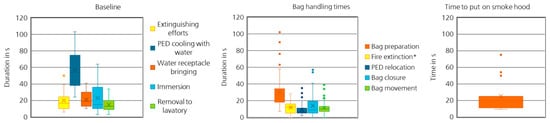
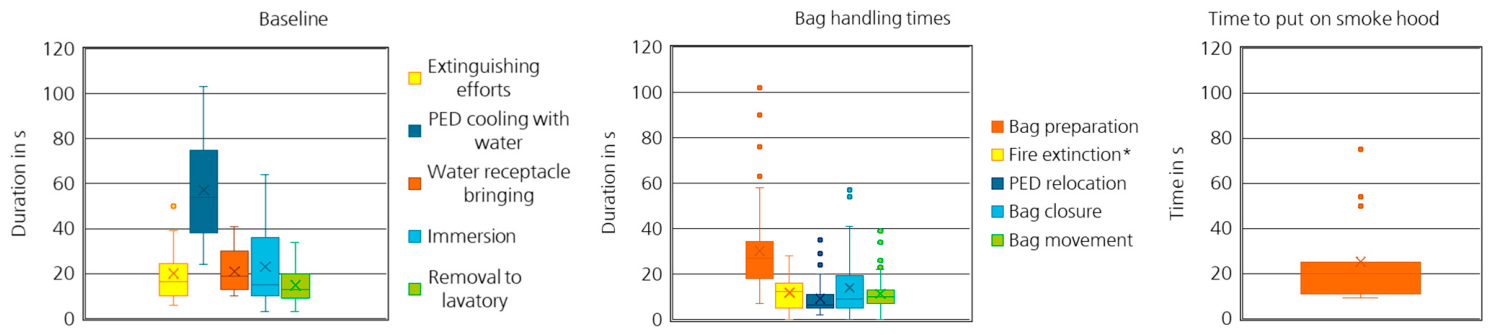
Figure 7 shows the duration of the different steps. It should be noted that the duration to cool the PED with water (left) and the time between fire extinction (*where an extinguisher was part of the kit) and the PED relocation are not entirely realistic because the PED emulator was not hot. It can be seen that putting on the smoke hood typically leads to a delay of less than 25 s.
Figure 7.
Durations observed during the test (25th and 75th-percentile boxplots). * Fire extinction only applies to kits containing an extinguisher.
4. Conclusions
The study highlights strengths and weaknesses of handling procedures, and mitigation means such as extinguishers and containment bags to fight PED battery fire in the aircraft cabin. In a laboratory fire test, fire extinguishers were shown to fight the immediate fire, but only one prevented the event from propagating from cell to cell. Most containment products showed smoke and some flame emissions when the PED was forced into thermal runaway within the containment product. Containment bags did not inhibit event propagation, leading to subsequent flame formation when additional cells caught fire. A two-person operation of containment products seems more realistic than a single-operator use. Overall, the conclusion is that confidence in containment products—at the time of the study and for the samples provided—still is not sufficient to recommend their deployment in the aircraft cabin.
To avoid exposure to noxious battery emissions, it is highly recommended to wear protective equipment like breathing masks. If crew members decide not to wear such protection to quickly extinguish the PED under thermal runaway, the exposure must be limited to acute firefighting, and the crew member should be replaced as soon as possible by a protected colleague. This procedure should be better explained in the training material.
Author Contributions
Conceptualization, V.N. and S.H.; methodology, V.N. and S.H.; formal analysis, J.P., S.S., J.K., S.H. and V.N.; investigation, J.P., S.S., J.K., S.H., A.P., M.P. and V.N.; resources, V.N. and S.H.; data curation, V.N.; writing—original draft preparation: V.N.; writing—review and editing, A.P. All authors have read and agreed to the published version of the manuscript.
Funding
The work presented in this paper is part of the LOKI-PED project, funded by the European Union’s Horizon Europe research and innovation program under contract number EASA.2022.C09. The European Union Aviation Safety Agency EASA represented by Simone Schwerdorf, Lia Calleja Barcena and Enzo Canari, acts as the contracting authority.
Institutional Review Board Statement
Ethical review and approval were waived for this study due to the uncritical nature of the exposure (theatre fog) and the anonymization of voluntary participants.
Informed Consent Statement
Informed consent was obtained from all subjects involved in the study.
Data Availability Statement
Data contained in the plots may be shared upon request.
Acknowledgments
We would like to thank the crews and their airlines and the bag manufacturers for the free provision of their support for this study.
Conflicts of Interest
The authors declare no conflicts of interest. The funders had no role in the design of the study; in the collection, analyses, or interpretation of data; in the writing of the manuscript; or in the decision to publish the results.
References
- UL Standards & Engagement. Lithium-Ion Battery Incidents in Aviation: 2024 Data Review. Available online: https://ulse.org/wp-content/uploads/2025/06/TRIP-Report-May-2025-Final.pdf?utm_source=chatgpt.com (accessed on 2 October 2025).
- Federal Aviation Administration Portable Electronic Device (PED) Fire Training—Flight Deck. Available online: https://www.youtube.com/watch?v=kbbJBzSufIY (accessed on 8 May 2026).
- Daniel, K.; Joe, S. An Evaluation of Fire Containment Products for Inflight Fires Resulting from Portable Electronic Devices (PEDs); Technical Report; U.S. Department of Transportation: Washington, DC, USA, 2024. [CrossRef]
- Holz, S.; Pfaff, J.; Kuder, J.; Schopferer, S.; May, M.; Norrefeldt, V.; Pathak, A.; Pschirer, M.; Kienberger, M. Portable Electronic Devices in Cabin and Cockpit—Analysis of Hazards. In Proceedings of the AIAA 2025-1421, Caesars Forum, Las Vegas, NV, USA, 21–25 July 2025. [Google Scholar] [CrossRef] [Scilit]
- UL 5800 Standard; Battery Fire Containment Products. UL Standards: Bensville, IL, USA, 2025.
Disclaimer/Publisher’s Note: The statements, opinions and data contained in all publications are solely those of the individual author(s) and contributor(s) and not of MDPI and/or the editor(s). MDPI and/or the editor(s) disclaim responsibility for any injury to people or property resulting from any ideas, methods, instructions or products referred to in the content. |
© 2026 by the authors. Licensee MDPI, Basel, Switzerland. This article is an open access article distributed under the terms and conditions of the Creative Commons Attribution (CC BY) license.