Proceeding Paper

Influence of Density and Porosity on the Mechanical Properties of ZE41 Hybrid Metal Matrix Composites †
by
Anand Narayanan Nair
1,* and
Senthil Kumaran Selvaraj
2
1
Department of Engineering, University of Technology and Applied Sciences (UTAS), P.O. Box 191, Al Mussannah 314, Oman
2
Department of Manufacturing Engineering, School of Mechanical Engineering, Vellore Institute of Technology (VIT), Vellore 632014, India
*
Author to whom correspondence should be addressed.
Presented at the 19th Global Congress on Manufacturing and Management (GCMM 2025), Vellore, India, 10–12 December 2025.
Eng. Proc. 2026, 130(1), 6; https://doi.org/10.3390/engproc2026130006
Published: 16 April 2026
(This article belongs to the Proceedings of The 19th Global Congress on Manufacturing and Management (GCMM 2025))

Abstract

In this research, the effects of density and porosity on the mechanical properties of a stir-cast hybrid magnesium ZE41 alloy strengthened with 2% weight of silicon carbide (SiC) and boron carbide (B4C) are assimilated. The experimental and theoretical densities of the ZE41 hybrid matrix were found and compared. From the results of density analysis, it can be inferred that the experimental density of hybrid matrix is smaller when compared to the pure ZE41 matrix. The percentage porosity of hybrid matrix was also analyzed, and it was observed that the hybrid matrix has a slight increase in porosity when compared to the pure ZE41 matrix. The ultimate strength and hardness of the ZE41 hybrid matrix have increased significantly due to its moderate density and acceptable porosity values.

1. Introduction

Magnesium (Mg) alloys are well-known for their light-weight applications, especially in automobiles, aircraft, and structural applications. It received the name ‘green material of the 21st century’ [1]. Due to the presence of rare-earth elements such as Cerium (Ce) and Zirconium (Zr), ZE41 magnesium alloy has excellent properties to be used in high-strength applications with refined microstructure and growth of intermetallic compounds [2]. The properties of ZE41 magnesium alloy can be improved by adding ceramic particles through the stir-casting route through either ex situ or in situ addition [3,4]. In an approach to develop a hybrid metal–matrix composite (matrix containing two or more reinforcements) based on the ZE41 Mg alloy, attractive results of mechanical properties were obtained by the current authors of this paper through a stir-casting approach and was published in a different article [5]. In their work, it was mentioned that ZE41 magnesium alloy was added ex situ with ceramic particles that were 2% of its weight, such as SiC, titanium carbide (TiC), and B4C, separately through stir casting, and the finest results of mechanical properties were attained for matrixes reinforced with SiC and B4C. The reinforcement particles, which were preheated at 200 °C, were introduced into the molten magnesium at 700 °C. The mixing was performed at 600 rpm for 25 min to obtain a uniformly distributed casting in an inert environment facilitated by SF6 and argon gas. By considering the improved properties of SiC and B4C, the authors have developed an ZE41 hybrid matrix containing the same, in which higher hardness, mechanical strength, and impact strength were obtained due to the refined microstructure and intermetallic growth. The experimental results were validated with the theoretical models, and a detailed explanation of the microstructure and its effects was discussed in detail in their article. This paper will delve into the effects of porosity and density on the mechanical properties of the hybrid composite (ZE41 + SiC + B4C) developed by the authors in the work mentioned, along with the castings reinforced with SiC, TiC, B4C, and pure ZE41.

2. Density

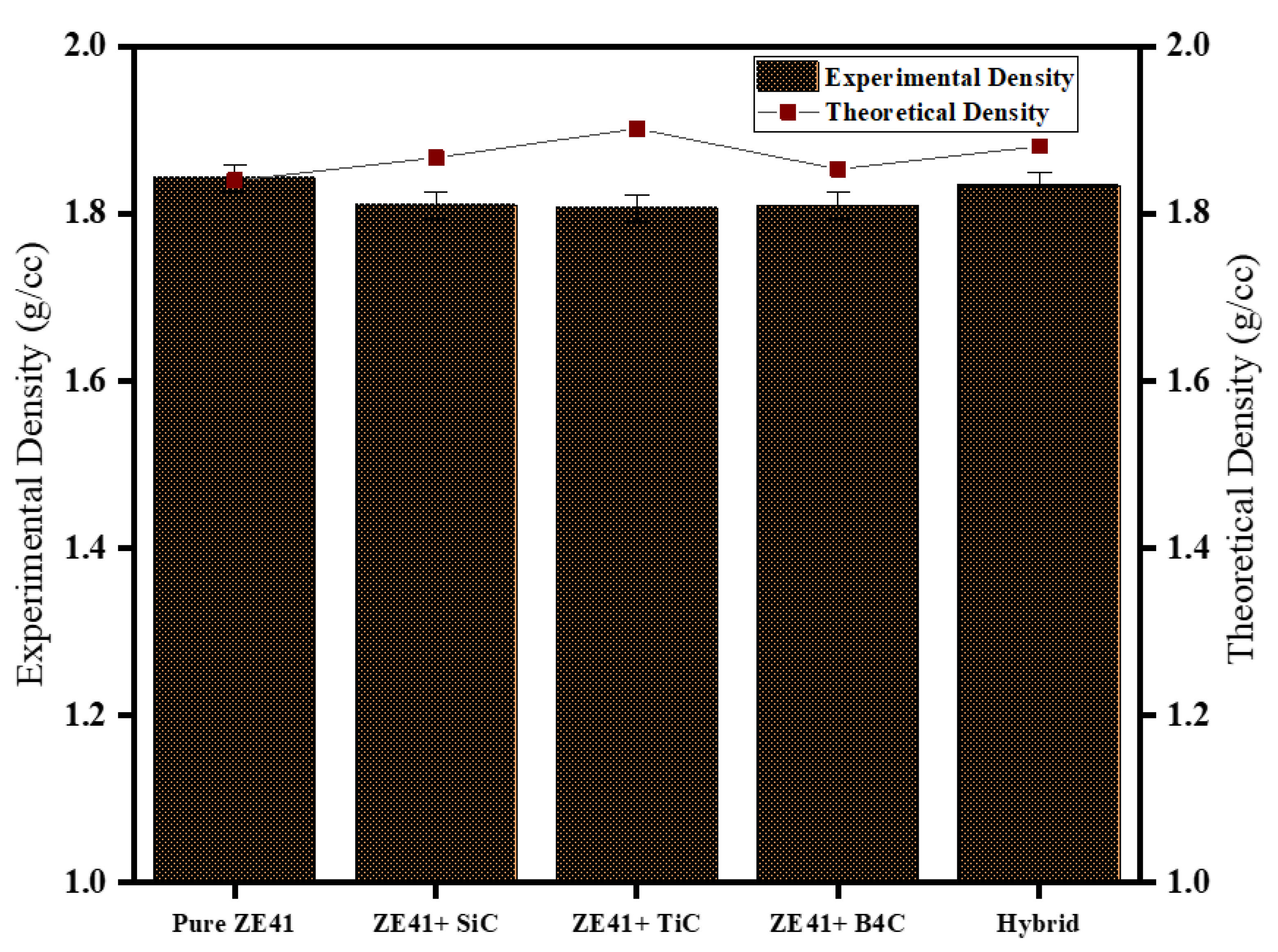
The densities (theoretical and experimental) of the manufactured composites are found by using Equations (1) and (2). The theoretical density of the composite can be found by using the rule of mixtures, whereas experimental density can be found by utilizing the Archimedes principle. The variation in theoretical and experimental densities is represented in Figure 1. The value of experimental density is noted to be less than the theoretical density due to the presence of cavities, which developed due to factors such as difference in coefficient of thermal expansion at the matrix–reinforcement interface and the variation in densities of reinforcement and the matrix. The theoretical density has a higher value, since the reinforcement particles such as SiC, TiC, and B4C have higher densities when compared to the ZE41 matrix.
Theoretical density of a composite:
ρth = ρmatVmat + ρcerVcer
Experimental density:
ρexp = (Wair/(Wair − Wwater)) × ρwat
where density of water is ρwat = 1 g/cc.
It can be inferred from Figure 1 that the variation in theoretical and experimental density is greater for the ZE41 matrix added with TiC particles. This is attributed to the improper mixing and presence of more cavities, which could be further explored with help of the porosity results in Section 3. Furthermore, it is evident from the optical microscopic and SEM images that there are agglomerations in TiC-reinforced matrix, which also exhibits poor wettability.

3. Porosity

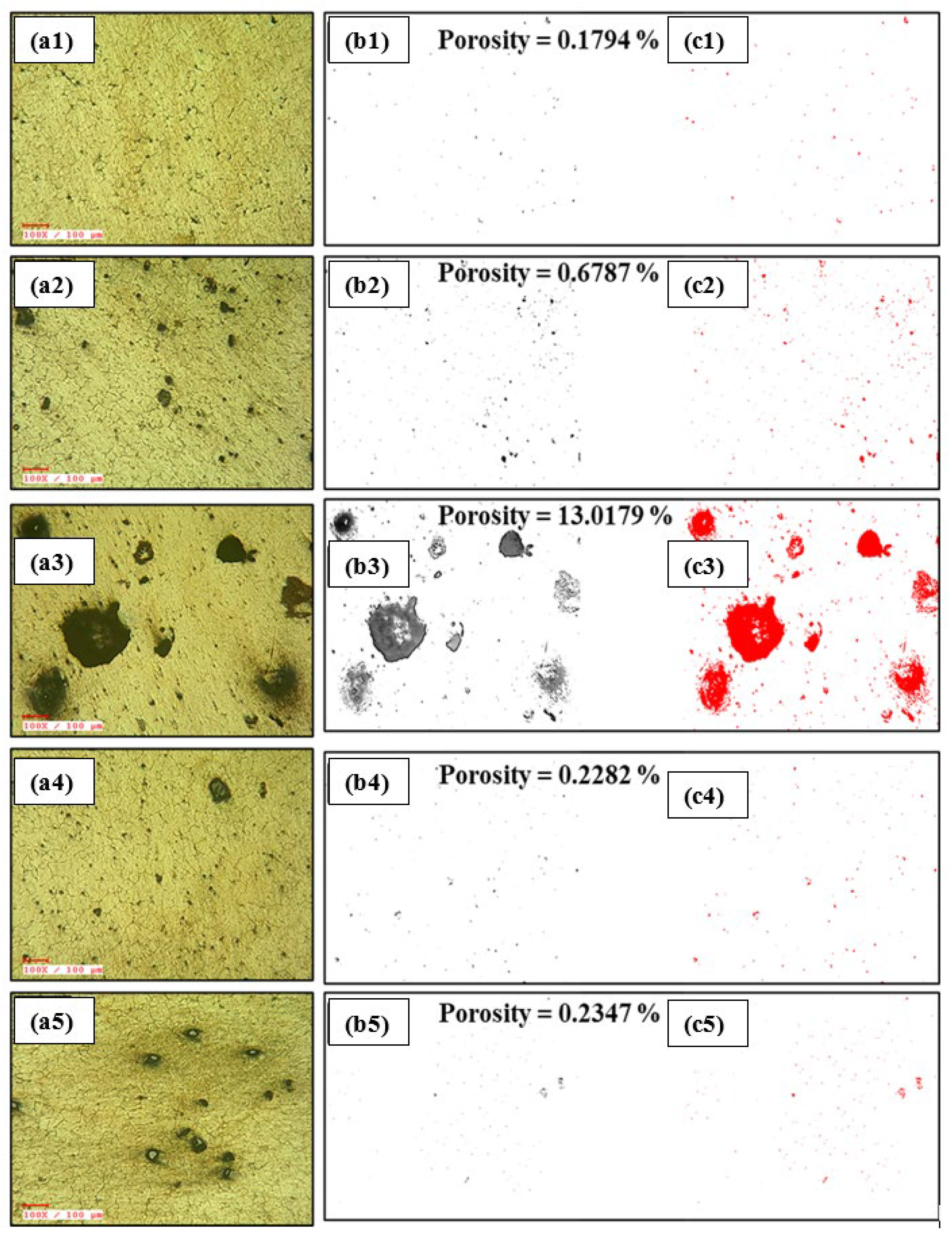
Porosity is a vital factor that decides the mechanical and tribological properties of a composite, and it is normally expressed in %. The variation in theoretical and experimental densities gives a clear picture of porosities present in the composites. The experimental porosity analysis can be found with the help of Dewinter material plus software version 4.5. An image-processing technique, which clearly differentiates between pores and solid material by creating binary images that are black in color from microscope images, is known as the thresholding methodology. From this image, the number of pores present in the scanned area of the image and its percentage area is further interpreted with the help of this software module. The minimum and maximum perimeter of the pores are also employed to find the % porosity. It is clear from the images that the matrix with TiC has a higher percentage of porosity. The results obtained in the determination of density and the inferences are in good agreement with the porosity results. Factors such as deprived wettability and clustering of particles will lead to shrinkage of casting, thus causing the air to become entrapped between the particle matrix interface. The porosity analysis images are represented in Figure 2. Generally, various methods are adopted to reduce the porosity such as selecting proper speed and impeller positions during stir casting. Furthermore, preheating the reinforcements is another method to reduce the porosity of castings. Various other methods such as squeeze casting, which applies pressure before solidification, is adopted to reduce the porosity of the castings. In this work, preheating of reinforcements to 200 °C is done to increase the wettability of particles in the castings. Even though reheating was performed, TiC particles exhibited elevated percentage of porosity, which is due to less reaction between the Mg/TiC interface. This is attributed to the fact that the path of the interfacial Mg/TiC interface is found to be sequestered as per the OM and SEM images of the matrix [6].
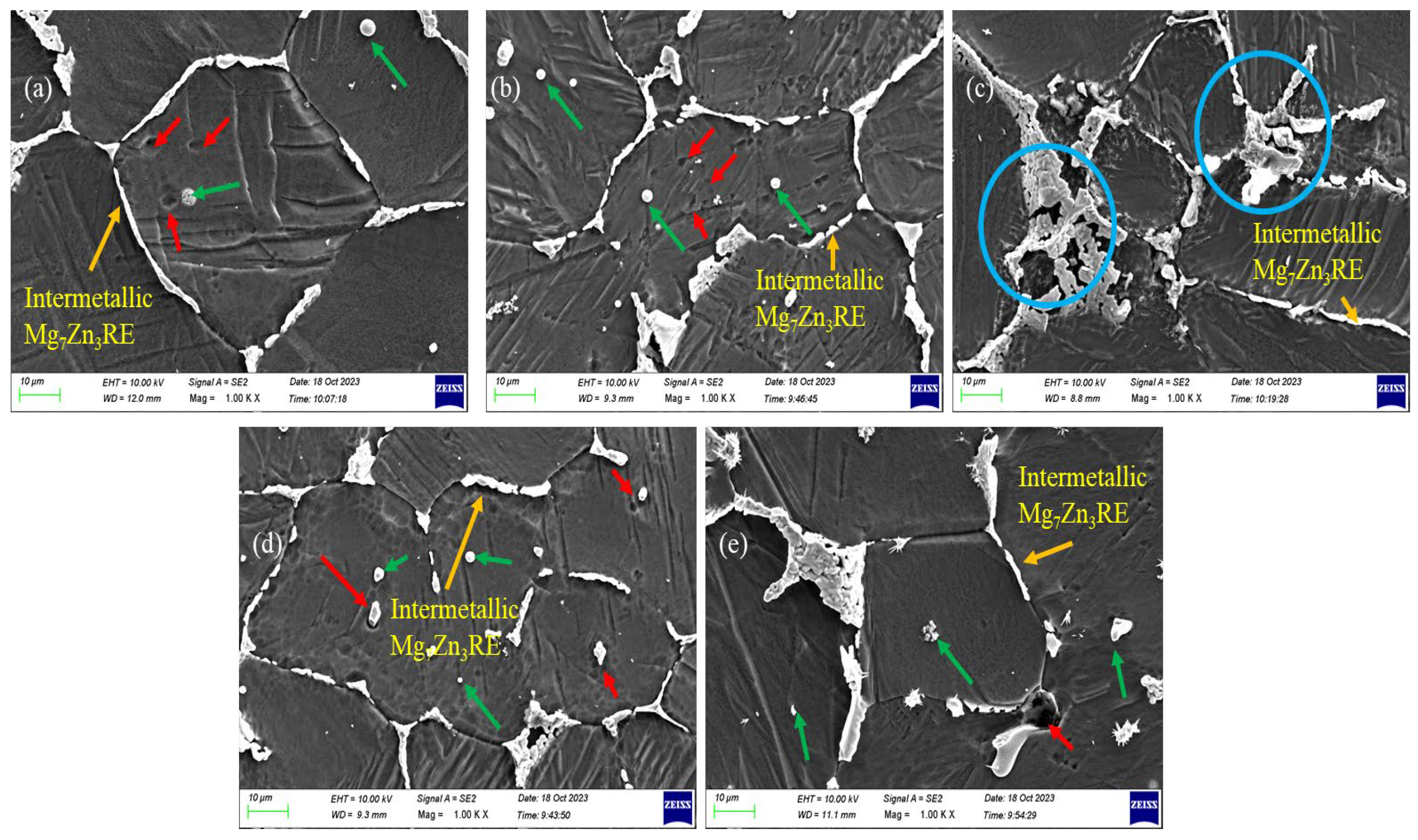
From Figure 3, it can be interpreted that the intermetallic formations are fewer in pure ZE41. When ceramic particles are added, it is observed that more nucleation sites are formed, resulting in the development of intermetallic and new grains. Furthermore, it has to be noted that the formation of pores is found near the vicinity of the nucleation sites, which normally occur at sites where the rare-earth elements are present. In the TiC-reinforced matrix, agglomerations are identified, which leads to the non-uniform distribution of particles and thus more porosity. Normally, porosity arises in a metal matrix composite due to the formation of gas, which becomes entrapped during the process, especially due to stirring. A similar finding in a research work states that agglomerations will lead to a weak bond between the particles and matrix, which absorbs gases such as hydrogen since the agglomerated particles have pores [7]. The current authors in their previous work have found that the pure matrix had an ultimate tensile strength (UTS) of 121 MPa. The matrix reinforced with SiC, TiC, and B4C had UTS values of 136, 125 and 137 MPa, respectively. The hybrid matrix displayed the highest UTS value of 141 MPa. This can be correlated with the porosity values, and it is very evident that the lowest strength of TiC-reinforced matrix is due to its highest porosity level caused by agglomeration of ceramic particles. The hybrid matrix had comparatively lower porosity, and thus the strength values is increased substantially [8]. Similarly, the hardness results also showed an almost identical trend with the TiC matrix, with the least hardness at around 58 HV. The material failure during the tensile test occurs when the cavities unite, reducing the ability of the material to elongate and resulting in the fracture of the specimen. To avoid porosity, it is suggested to perform certain heat treatment processes after the casting, which can be considered as a future scope of this work. Apart from this, the wettability of TiC or any other ceramic particles shall be improved by preheating it to a higher temperature near the value of melting point of the alloy.

4. Conclusions

The density and porosity of the stir-cast hybrid metal matrix composite based on ZE41 shows direct dependence on its mechanical properties. Furthermore, the study reveals how porosity governs load transfer efficiency and initiation of cracks, thereby establishing a process–structure–property linkage with direct inferences for optimizing the casting process. The following conclusions are drawn from the results of this work.
  • The experimental and theoretical densities of the composites are compared and it is observed that the experimental densities are less due to the presence of cavities.
  • The porosity of the composite reinforced with TiC showed highest value of porosity due to its lower wettability, and thus had reduced strength and hardness values.
  • The pores started to initiate especially near the nucleation sites of intermetallic particles, especially at the vicinity of rare-earth elements.
  • With the increase in porosity values, the mechanical properties such as strength and hardness seem to have reduced.

Author Contributions

Conceptualization, A.N.N.; methodology, A.N.N.; validation, A.N.N.; investigation, A.N.N. and S.K.S.; writing—original draft preparation, A.N.N.; writing—review and editing, S.K.S. All authors have read and agreed to the published version of the manuscript.

Funding

This research received no external funding.

Institutional Review Board Statement

Not applicable.

Informed Consent Statement

Not applicable.

Data Availability Statement

Data sharing is not applicable to this article.

Conflicts of Interest

The authors declare no conflict of interest.

References

  1. Sabour, M.R.; Taherkhani, E.; Rezaei, A.R.; Zohrevand, M.; Safahi, H.; Faraji, G. Solid-state recycling of magnesium and its alloys via plastic deformation: An overview of processing and properties. J. Mater. Res. Technol. 2024, 31, 3117–3148. [Google Scholar] [CrossRef] [Scilit]
  2. Marodkar, A.S.; Patil, H.; Borkar, H.; Behl, A. Effect of squeeze casting and combined addition of calcium and strontium on microstructure and mechanical properties of AZ91 magnesium alloy. Int. J. Met. 2023, 17, 2252–2270. [Google Scholar] [CrossRef] [Scilit]
  3. Sahoo, S.K.; Panigrahi, S.K. Synergetic effect of in-situ TiB2 reinforcement and nano precipitation on wear behavior of ZE41 magnesium matrix composite. Wear 2024, 560, 205609. [Google Scholar] [CrossRef] [Scilit]
  4. Anand, N.; S, S.K. Development and influence of tribomechanical properties on magnesium based hybrid metal matrix composites-a review. Mater. Res. Express 2020, 7, 036520. [Google Scholar] [CrossRef] [Scilit]
  5. Anand, N.; Selvaraj, S.K. Mechanical, microstructural and wear studies of a ceramic hybrid reinforced ZE41 magnesium metal matrix composite through stir casting route. Int. J. Met. 2024, 19, 1462–1480. [Google Scholar] [CrossRef] [Scilit]
  6. Contreras, A.; López, V.H.; Bedolla, E. Mg/TiC composites manufactured by pressure less melt infiltration. Scr. Mater. 2004, 51, 249–253. [Google Scholar] [CrossRef]
  7. Kumar, S.A.; Vignesh, J.H.; Joshua, S.P. Investigating the effect of porosity on aluminium 7075 alloy reinforced with silicon nitride (Si3N4) metal matrix composites through STIR casting process. Mater. Today Proc. 2020, 39, 414–419. [Google Scholar] [CrossRef] [Scilit]
  8. Verma, A.S.; Cheema, M.S.; Kant, S.; Suri, N.M. Porosity study of developed AL–MG–SI/Bauxite residue metal matrix composite using advanced stir casting process. Arab. J. Sci. Eng. 2018, 44, 1543–1552. [Google Scholar] [CrossRef] [Scilit]
Figure 1. Variation in theoretical and experimental densities of composites.
Engproc 130 00006 g001
Figure 2. Images of porosity analysis. OM images of (a1) ZE41, (a2) ZE41 + SiC, (a3) ZE41 + TiC, (a4) ZE41 + B4C, (a5) hybrid; etched images of (b1) ZE41, (b2) ZE41 + SiC, (b3) ZE41 + TiC, (b4) ZE41 + B4C, (b5) hybrid; processed etched images of (c1) ZE41, (c2) ZE41 + SiC, (c3) ZE41 + TiC, (c4) ZE41 + B4C, (c5) hybrid.
Engproc 130 00006 g002
Figure 3. SEM pictures of (a) pure ZE41, (b) ZE41 + SiC, (c) ZE41 + TiC, (d) ZE41 + B4C, (e) hybrid (ZE41 + SiC + B4C); red arrows represent the development of pores and green arrows represent new nucleation sites; light blue circles represent agglomerations.
Engproc 130 00006 g003
Disclaimer/Publisher’s Note: The statements, opinions and data contained in all publications are solely those of the individual author(s) and contributor(s) and not of MDPI and/or the editor(s). MDPI and/or the editor(s) disclaim responsibility for any injury to people or property resulting from any ideas, methods, instructions or products referred to in the content.