


Abstract
This paper presents an evaluation of the performance characteristics of lawnmowers powered by gasoline engines and electric motors. Particular emphasis is placed on usability, reduced maintenance requirements, noise emission levels, and environmental sustainability. A custom electric lawnmower was constructed for the purposes of this study, involving the selection and integration of suitable motors, batteries, and auxiliary components. A comparative analysis was subsequently conducted between the conventional gasoline-powered lawnmower and the electrically powered prototype. Measurements of operational duration and efficiency indicated notable improvements in mowing time and maintenance-related costs. The findings underscore the potential advantages of transitioning to electric propulsion technologies, both from the perspective of sustainable development and environmental responsibility, as well as in terms of operational convenience.
1. Introduction
There has been a long development process in the evolution of grass-cutting devices, ranging from hand scythes to the sophisticated machines currently available on the market, such as autonomous electric robotic lawnmowers [1]. Machines used for maintaining grassy areas—such as trimmers and lawnmowers—significantly reduce the operator’s workload and improve mowing performance. However, during use, these machines generate noise and vibrations that are transmitted to the operator [2].
By modernizing or replacing the power units in working machines, including lawnmowers, it is possible to reduce environmental pollution. Although gasoline-powered mowers pollute relatively little, there are still solutions available to further reduce harmful emissions. With the application of modern design solutions and advanced electronic control systems, engine processes—especially fuel supply and combustion—are optimized, resulting in improved exhaust characteristics [3]. An even more environmentally friendly solution is the use of electric-powered lawnmowers. Electric vehicles are particularly suitable in areas that require low noise and minimal emissions, such as hospitals, warehouses, and densely populated urban centers where air pollution is a concern [4]. From an environmental standpoint alone, replacing internal combustion engines with electric motors may not seem entirely logical. However, electric motors have a significant maintenance advantage. [5]
In his research on tractor noise—similar in nature to ride-on lawnmowers—the author [6] confirms that noise emissions increase with prolonged usage. The historical development of agricultural machinery maintenance is closely linked to the evolution of machinery production and operation. Unfortunately, maintenance standards today still lag behind the technological developments of modern agricultural machines [7]. Timely, expert, and properly executed technical exploitation of agricultural machinery is a fundamental prerequisite for reliable operation [8].
The performance of a power unit can be described in three key areas:
- Working width, working time, and working speed;
- Specific resistance and tractive force;
- Energy consumption—determined by engine power, specific resistance of the machine, and efficiency factor [9].
In modern times, new technologies have emerged involving a certain degree of “artificial intelligence”, where maintenance is monitored using computers and controllers. Their primary function includes control, monitoring, signaling, and diagnostics [10]. The primary disadvantage of early electric vehicles compared to internal combustion engines (ICEs) lies in their lower specific energy (Table 1), meaning the amount of stored energy per kilogram of mass [4].
Table 1.
Specific energy per kg of energy source [4].
Electric vehicles are unique because the entire conventional powertrain is eliminated and replaced with electronic components that are not prone to mechanical failure or wear over time. Several studies have shown that in internal combustion vehicles, up to 80% of roadside failures are engine-related. On the other hand, electric vehicles can eliminate many mechanical faults. While older battery types require bi-weekly maintenance, modern batteries are maintenance-free. Brushless motors require virtually no upkeep and can operate at significantly higher speeds. Electric vehicles also have far fewer moving parts than gasoline-powered ones, meaning fewer potential points of failure [5]. The most demanding component is the battery—the ratio between production cost, achievable range, motor power requirements, and working conditions—as well as, importantly, the battery weight. Battery weight (Table 2) is the most limiting factor in vehicle electrification.
Table 2.
Weight of commercially available batteries by vehicle range [4].
2. Materials and Methods
This research builds upon the earlier work of a co-author [11], but the experiments, data analysis, and actual conversion of the lawn tractor were conducted as part of this project. Additionally, various scientific and professional sources related to environmental protection, noise reduction, maintenance cost optimization, and machinery performance improvement were consulted. Based on the modified mower, operational time trials were performed to evaluate its actual performance, and cost analyses were included to assess economic viability. All time spent on fuel refueling, repairs, and interruptions during work was accounted for. Initial testing was carried out with the original internal combustion engine, followed by trials using the electric motor conversion under real mowing conditions. The tested machine was an MTD Spider 91 S lawn tractor (Table 3).
Table 3.
Specifications of the Spider 91 S MTD lawn tractor [11].
When converting to a different power unit, it was crucial to correctly select all components that form a unified prototype, ensuring compatibility and synergy. The selected components also had to be carefully mounted and adapted to the main mower structure—including the chassis and its elements—to ensure the system was fully functional and operational. All selected components worked together successfully as an integrated unit, and the prototype was ready for mowing [12].
Modified components included the following:
- The engine;
- Batteries;
- Controllers;
- Pulleys for the cutting deck.
For the electric drive conversion, two electric motors were used (Table 4): one for the deck and one for propulsion.
Table 4.
Electric motor specifications [11].
The energy source was a lithium iron phosphate battery (LiFePO4). This battery was chosen as the best option. If lithium-ion batteries of the same capacity had been used, the cost would have been approximately double, though with significantly reduced weight. While battery weight is critical in vehicles, it is less important for mowers. Also, lithium-ion batteries are highly flammable, whereas lithium-iron phosphate batteries are much safer.
The testing was performed three times with the original internal combustion engine and three times after the conversion to electric motors (Table 5). The measurements were taken on a 750 m2 rectangular plot without obstacles, except for a transformer station in one corner. The grass height during mowing was approximately 10 cm. The grass structure was approximately the same based on the three grass samples taken, since it was English ryegrass. Furthermore, the grass density has a stochastic character due to the distribution of grass seeds over the surface, the distribution of soil moisture, and the like.
Table 5.
Test dates and lawn characteristics.
The measurement was carried out using the chronometry method. A comparison of power, performance, maintenance of lawnmowers, and fuel consumption was carried out. Fuel consumption was measured volumetrically. Before each trial, the tank was filled on a flat surface. Time was tracked using a stopwatch, measuring the number of minutes and seconds during operation and recording the data in a table. The paper calculates the coefficient of utilization of working time (efficiency coefficient), which represents the ratio of time spent in pure work to total working time. The higher the value of the coefficient, the better the utilization of time. Total working time is the time that consists of pure working time, auxiliary supplementary time, preparation-finishing time, travel time to and from the workplace, and losses or interruptions in work. Meanwhile, effective time is the time that the mower spends in pure work (only the time mowing the grass). To determine the constituent elements of working time, a chronometry procedure is performed. The amount of gasoline consumed by a gasoline lawnmower and the reduction in battery capacity by an electric lawnmower refers to the mowed area (750 m2).
3. Results and Discussion
This study assessed the advantages, disadvantages, and overall efficiency of a lawnmower equipped with electric motors compared to one powered by a gasoline engine. Gasoline mowers remain a popular choice for lawn care, particularly over large areas. However, the test area used here was relatively small. Unlike electric mowers, which depend on batteries or cable power sources, gasoline mowers only require fuel and proper maintenance, making them more mobile and not limited by battery runtime. They are generally built more robustly for longer mowing durations, which makes them more durable and reliable for demanding tasks.
The first mowing with the gasoline lawnmower (Table 6) went without losses (except for fuel checks, almost all working hours are effective time).
Table 6.
First mowing with a gasoline mower results.
In the second mowing with a gasoline mower (Table 7), we have delays due to stalling and repairs.
Table 7.
Second mowing with a gasoline mower results.
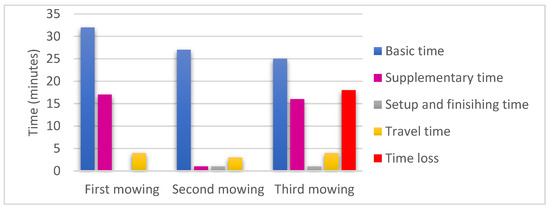
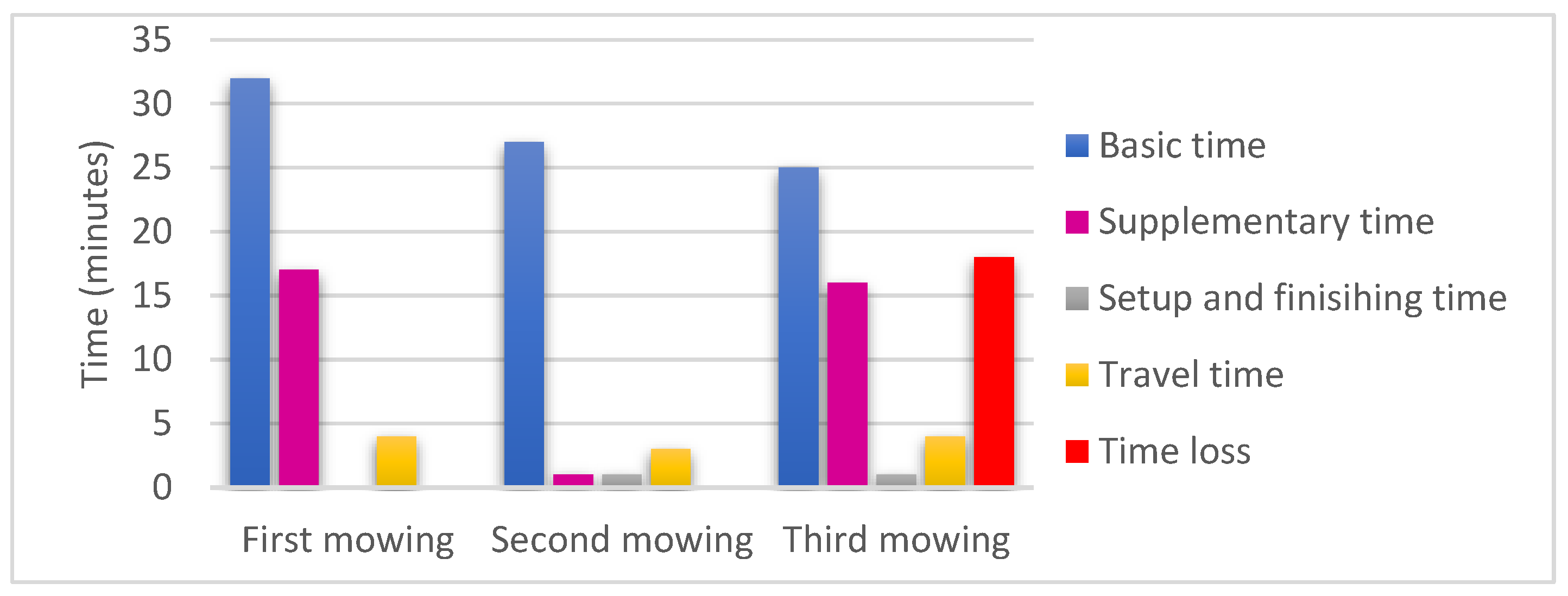
The third mowing with a gasoline mower (Table 8) was not finished (the engine failed and the belt that drives the mower was damaged and was not available for immediate purchase). Before mowing, the tank was filled, but it had no fuel consumption.
Table 8.
The third mowing with a gasoline mower results.
For a gasoline engine to operate correctly, it must be properly and regularly maintained. Maintenance includes oil changes, air filter replacement, spark plug maintenance, and belt replacements.
These tasks are considered regular maintenance. Additionally, problems may occur with the carburetor—it can become clogged and require cleaning, or it might start leaking fuel, in which case repair or replacement is necessary. Besides maintenance, attention must also be focused on fuel quality and cost. Fuel prices fluctuate, and long-term fuel dependency can represent a significant expense. Moreover, the prices of consumable parts can also change over time, especially if the mower is an older model, in which case replacement parts might not even be available.
The first mowing using the electric motor-powered mower (Table 9) was slower than with the gasoline version. The result was negatively affected due to inexperience and a mistake—the controller was left in the lowest power setting (1300 W), meaning that the mower was operating at half power. The controller supplied with the electric motors includes three speed levels (1300 W, 2100 W, 3000 W). Because of this oversight, the first test could have been completed more quickly. The difference in performance is visible in the second test. The greatest advantage compared to the gasoline-powered mower is the elimination of preparation and shutdown time—the electric mower is immediately ready for use.
Table 9.
First mowing with an electric mower results.
The second mowing session (Table 10) was much shorter. This time, the earlier error was not repeated, and the motor ran at higher RPMs; there were no delays or stoppages during this test.
Table 10.
Second mowing—electric mower results.
The third mowing session (Table 11) took a bit longer in total time, but the effective mowing time remained similar to the second test. A short break was taken because the motor temperature sensor detected a slight increase in the motor temperature (on the mowing deck) compared to the previous sessions, so the operators allowed the system to cool before completing the task.
Table 11.
Third mowing—electric mower results.
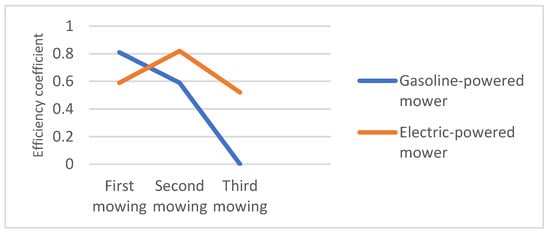
Under the tested conditions, across three mowing sessions, the average effective work coefficient (Figure 1) was as follows:
Figure 1.
Efficiency of the tested lawnmowers.
- 0.47 for the gasoline-powered mower;
- 0.64 for the electric-powered mower.
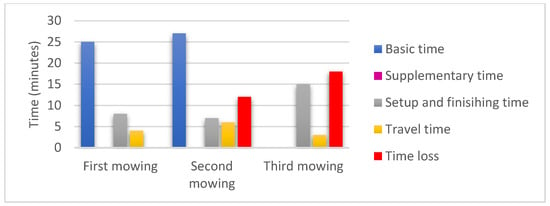
Although total mowing time was similar for both types of mowers, there were significant differences in preparation time and work interruptions. During the third test with the gasoline mower, the mowing was not completed (Figure 2), which highlights a key reliability advantage of the electric mower—it consistently performed the task without delays or failures. In contrast, the electric mower does not require any startup time. Its operation is simple and immediate.
Figure 2.
Time usage of the gasoline-powered mower.
For the electric mower (Figure 3), there was no need for preparation time due to its simpler operating principle.
Figure 3.
Time usage of the electric mower.
Gasoline engines consume fuel continuously—even when idle—whereas electric motors operate only on demand. This contributes to a higher energy efficiency and lower environmental impact for electric motors [13]. Although the total mowing times are similar between the two systems, the electric mower has a significant advantage in preparation and downtime, particularly visible in the third gasoline trial, which failed entirely due to mechanical issues. The two-motor setup in the electric prototype also allows the independent operation of the mower deck, reducing unnecessary wear and noise. In gasoline systems, the deck pulley runs constantly, which is not the case with the electric drive.
According to the author [13], the advantages of electric propulsion include reduced pollution, simpler system design, better power-to-weight ratio, and improved external motor characteristics. The disadvantages include the high battery cost, higher battery weight, and lower energy density compared to fossil fuels. The author [2] states that electric devices are more cost-effective, quieter, and cause fewer vibrations, improving operator health and comfort. In comparison, gasoline mowers are louder and less environmentally friendly, posing concerns, especially in residential areas.
4. Conclusions
The electric lawnmower generates significantly less noise (only from the rotating blade), which reduces the negative impact on the operator and makes it suitable for use in urban environments, even during rest periods or on non-working days. When mowing is required, the electric mower can be simply turned on and operated immediately, without prior preparation or interruptions. Unlike gasoline-powered mowers, it does not require maintenance intervals, which shortens the total mowing time and increases the overall efficiency. Furthermore, electric mowers have a positive impact on environmental protection, even though their operational share is relatively small compared to motor vehicles.
Based on the research conducted, the results clearly show that the electric motor-equipped mower is more cost-effective than the gasoline-powered mower—at least under the conditions previously defined. The electric mower demonstrated notable advantages in ease of use and maintenance, higher efficiency, reduced noise, and environmental sustainability. Given these benefits, it can be concluded that with continued technological advancements—especially in battery performance—the use of electric-powered work machinery will become increasingly widespread in the future. Although both mowers mowed the tested area well, the electric mower, due to its better utilization of working time, has the prerequisite of greater efficiency compared to the petrol mower.
Author Contributions
Conceptualization, M.N. and Ž.B.; methodology, M.N. and Ž.B.; software, M.N. and Ž.B.; validation, M.N., Ž.B., I.P., T.J., V.M. and M.M.; formal analysis, M.N.; investigation, M.N. and V.M.; resources, M.N. and V.M.; data curation, Ž.B.; writing—original draft preparation, M.N., V.M. and Ž.B.; writing—review and editing, M.N., Ž.B., I.P., T.J., V.M. and M.M.; visualization, M.N., V.M., Ž.B. and M.M.; supervision, T.J. and M.M.; project administration, I.P.; funding acquisition, M.N., Ž.B., I.P., T.J., V.M. and M.M. All authors have read and agreed to the published version of the manuscript.
Funding
This research received no external funding.
Institutional Review Board Statement
Not applicable.
Informed Consent Statement
Not applicable.
Data Availability Statement
The data presented in this study are available upon request from the corresponding author.
Conflicts of Interest
The authors declare no conflicts of interest.
References
- De Bona, M.; Kotarski, D. The concept of a hybrid robotic lawnmower. Polytech. Des. 2022, 10, 97–103. [Google Scholar]
- Dubrović, K. Application of Trimmer and Lawn Mower Designs to Performance in Permanent Crops. Master’s Thesis, University of Zagreb, Faculty of Agriculture, Zagreb, Croatia, 2018. [Google Scholar]
- Filipović, I.; Pikula, B.; Bibić, D.; Trobradović, M. The application of alternative fuels for the purpose of reducing road vehicles pollutant emissions. Fuels Lubr. 2005, 44, 241–262. [Google Scholar]
- Glavaš, H.; Antunović, M.; Keser, T. Electrically powered road vehicles. In Proceedings of the 26th Conference on Traffic Systems with International Participation—Automation in Traffic; Croatian Society for Communications, Computing, Electronics, Measurements, and Automation (KoREMA), Split, Croatia, 8–11 November 2006; pp. 78–81. [Google Scholar]
- Plaščak, I.; Jurić, T.; Emert, R. Application of Ferrographyin Condition Based Maintenance. Strojarstvo 2010, 52, 233–240. [Google Scholar]
- Barač, Ž.; Plaščak, I.; Heffer, G.; Vidaković, I.; Jurišić, M. Impact of tractor operating hours on produced sound level. Agronomski glasnik 2016, 78, 17–26. [Google Scholar]
- Emert, R.; Jurić, T.; Filipović, D.; Štefanek, E. Maintenance of Tractors and Agricultural Machinery; Josip Juraj Strossmayer University of Osijek: Osijek, Croatia, 1995. [Google Scholar]
- Tomić, M.; Furman, T.; Nikolić, R.; Savin, L.; Simikić, M. Selection of the location of repair facilities for the needs of small and medium-sized agricultural producers. Tract. Power Mach. Novi Sad 2004, 9, 21–27. [Google Scholar]
- Brkić, D.; Vujčić, M.; Šumanovac, L.; Lukač, P.; Kiš, D.; Jurić, T.; Knežević, D. Exploitation of Agricultural Machinery; Faculty of agriculture in Osijek, University of Josip Juraj Strossmayer in Osijek: Osijek, Croatia, 2005. [Google Scholar]
- Banaj, Đ.; Šmrčković, P. Agricultural Engineering Management; Josip Juraj Strossmayer University of Osijek: Osijek, Croatia, 2003. [Google Scholar]
- Matić, V. Determining the Actual Performance of a Self-Propelled Lawn Mower Equipped with Different Types of Engines. Master’s Thesis, Faculty of Agrobiotechnical Sciences Osijek, Juraj Strossmayer University of Osijek, Osijek, Croatia, 2024. [Google Scholar]
- De Bona, M. Prototype of a Remote-Controlled Lawn Mower. Master’s Thesis, Department of Mechanical Engineering, Karlovac University of Applied Sciences, Karlovac, Croatia, 2021. [Google Scholar]
- Bošković, M. Elektrifikacija Traktorske Kosilice. Undergraduate Thesis, Faculty of Mechanical Engineering and Naval Architecture, University of Zagreb, Zagreb, Croatia, 2022. [Google Scholar]

Disclaimer/Publisher’s Note: The statements, opinions and data contained in all publications are solely those of the individual author(s) and contributor(s) and not of MDPI and/or the editor(s). MDPI and/or the editor(s) disclaim responsibility for any injury to people or property resulting from any ideas, methods, instructions or products referred to in the content. |
© 2026 by the authors. Licensee MDPI, Basel, Switzerland. This article is an open access article distributed under the terms and conditions of the Creative Commons Attribution (CC BY) license.