


Abstract
Material selection is a crucial issue that determines both the economic and technical aspects of a product, as well as the manufacturer’s brand. This process is complex, as it requires the consideration of multiple criteria for each type of material. In this study, probabilistic methods are used for material selection. To assess the effectiveness of applying probabilistic methods in material selection, this research was conducted with three different cases involving the selection of materials for crankshaft manufacturing, cutting-tool manufacturing, and materials used in powder-mixed electrical discharge machining (PMEDM). The results of material selection using probabilistic methods were compared with those obtained using other methods, demonstrating that probabilistic methods fully ensure accuracy in the surveyed cases.
1. Introduction
Material selection in the manufacturing process plays a crucial role, directly affecting many aspects of the product and the reputation of the manufacturer [1]. Selecting a material requires the consideration of numerous criteria, thereby constituting a multi-criteria decision-making (MCDM) problem [2]. Over the past several decades, MCDM methods have been extensively employed to support material selection processes [3]. These methods continue to be widely used in diverse industries. MCDM methods continue to be widely used in various industries for material selection. In some cases, a single MCDM method has been applied to determine the most suitable material. For example, the MUTRISS method has been used to choose materials for cold storage tanks, materials for components operating in high-oxygen environments at elevated temperatures, and materials for piston manufacturing [4]. The CRADIS method has been used for selecting thermal insulation building materials [5]. The VIKOR method has been used for selecting materials for dental implants [6]. The MARCOS method has been applied for selecting sintered pulleys used in automobiles [7], etc.
However, numerous studies have reported that the optimal alternative identified may vary when MCDM methods are used. To increase the reliability of the final decision, it is therefore recommended that each selection be performed using at least two distinct methods [8]. Following this approach, the FUCA and PIV methods are jointly applied to select materials for connecting rods [9]. Similarly, two methods—VIKOR and TOPSIS—were utilized for material selection in the construction industry [10]. And in another study, three methods—MARA, RAM, and PIV—were integrated to determine appropriate materials for manufacturing gear, manufacturing screws, and selecting two-stroke engine oil [11]. The ARAS, TOPSIS, and GRA methods were used together to select materials for tank manufacturing [12]. Fire-resistant materials were selected using the AHP, SAW, TOPSIS, and ELECTRE methods simultaneously [13].
It can be seen that MCDM methods have been extensively applied to material selection across various fields. Nevertheless, several studies have noted that many conventional MCDM procedures rely on additive aggregation mechanisms, and some incorporate artificial or subjective elements, rendering them semi-quantitative and potentially introducing uncertainty into the final decisions [14]. In construction, the application of probabilistic approaches to multi-criteria decision-making provides a fully quantitative framework that enhances the decision accuracy and confidence while addressing some of the aforementioned limitations of traditional MCDM methods [14]. Zheng et al. [14] were among the first researchers to apply probabilistic methods to multi-criteria decision-making in 2021, selecting wall construction solutions, project managers, and construction contractors. Their findings suggested that probabilistic methods are simpler than many conventional MCDM methods while still ensuring reliable decision outcomes. Despite these promising results, the adoption of probabilistic methods in identifying optimal alternatives—particularly in material selection—remains limitation. Therefore, evaluating the effectiveness of probabilistic methods in material selection constitutes the primary motivation of this study.
The application of probabilistic approaches to multi-criteria decision-making is presented in Section 2 of this study. This chapter also introduces Spearman’s rank correlation coefficient to evaluate the similarity between the rankings obtained from probabilistic methods and those generated by other MCDM methods. The performance of probabilistic methods in material selection is assessed through several illustrative examples in Section 3. Finally, the conclusions and directions for future research are discussed in Section 4.
2. Materials and Methods
To determine the optimal solution among the available options, the probabilistic method is applied according to the following procedure [14].
A summary table is constructed to specify the number of alternatives to be ranked and the number of criteria used to evaluate each alternative. Suppose that there are m alternatives and n evaluation criteria. Let Xij denote the value of criterion j, corresponding to option i, with i = 1 ÷ m, j = 1 ÷ n. Let qj denote the weight of criterion j, .
For benefit criteria, the normalization factor of benefit criterion j is calculated according to (1).
For cost criteria, the normalization factor of cost criterion j is calculated according to (2).
For benefit-type criteria, the probability of achieving a favorable outcome in the decision-making process increases linearly and is calculated according to Equation (3).
For cost-type criteria, the probability of achieving a favorable outcome in the decision-making process is also a linear function and is calculated according to (4).
Taking into account the weight, qj, of criterion j, the overall favorable probability of option i is calculated according to (5). The best option is the one with the highest favorable probability.
The aforementioned mathematical expressions of the probabilistic method are employed to rank the options and identify the optimal solution among the available candidates. This procedure is implemented in the next chapter through material selection case studies.
To evaluate the applicability of the probabilistic method to select material, the similarity between rankings obtained from the probabilistic approach and those generated by other MCDM approaches is examined. In this study, Spearman’s rank correlation coefficient is adopted for this purpose [15]. The coefficient is calculated according to Equation (6).
In (6), Di represents the difference in the rank of option i when ranked by different MCDM methods.
3. Results and Discussion
3.1. Case 1
Four types of steel commonly used for crankshaft manufacturing—1080, 18CrMo4, 4130, and S48C—are considered as candidate materials. Each alternative is evaluated based on fifteen criteria: tensile strength (C1), yield strength (C2), elongation at break (C3), bulk modulus (C4), shear modulus (C5), Poisson’s ratio (C6), Brinell hardness (C7), Rockwell hardness (C8), machinability (C9), elastic modulus (C10), thermal expansion coefficient (C11), thermal conductivity (C12), specific heat capacity (C13), melting temperature (C14), and density (C15). Among these, C3 and C11 are classified as cost-type criteria, whereas the remaining criteria are treated as benefit-type criteria. The criterion weights were calculated using three objective weighting methods: the equal weight, entropy, and MEREC methods. All relevant data are summarized in Table 1, which is adapted from a recent study in which the ranking of the steels was established using the PIV method [16].
Table 1.
Materials for crankshaft manufacturing [16].
By applying (1), the normalization factors for the criteria C1, C2, C4, C5, C6, C7, C8, C9, C10, C12, C13, C14, and C15 were calculated as 0.00044, 0.00060, 0.00161, 0.00328, 0.86207, 0.00150, 0.00312, 0.00377, 0.00112, 0.00716, 0.00057, 0.00028, and 0.00003, respectively.
By applying (3), the normalization factors for the criteria C3 and C11 were calculated as 0.00943 and 0.01495, respectively.
By applying (3) and (4), the probability values were calculated as shown in Table 2.
Table 2.
Pij values.
By applying (5), the overall probabilities, Pi, for each material were calculated under all three different weighting scenarios, as shown in Table 3. The rankings of the materials for each set of criteria weights are also summarized in this table.
Table 3.
Pi values and rankings of steels.
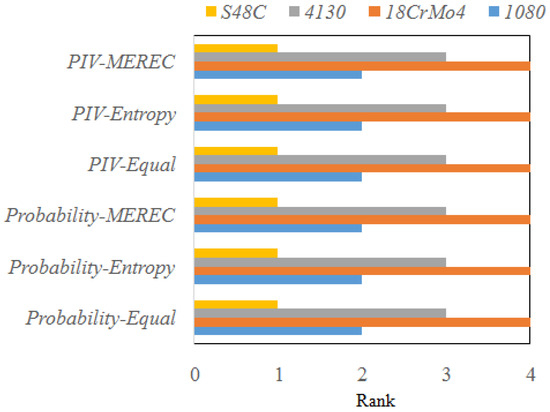
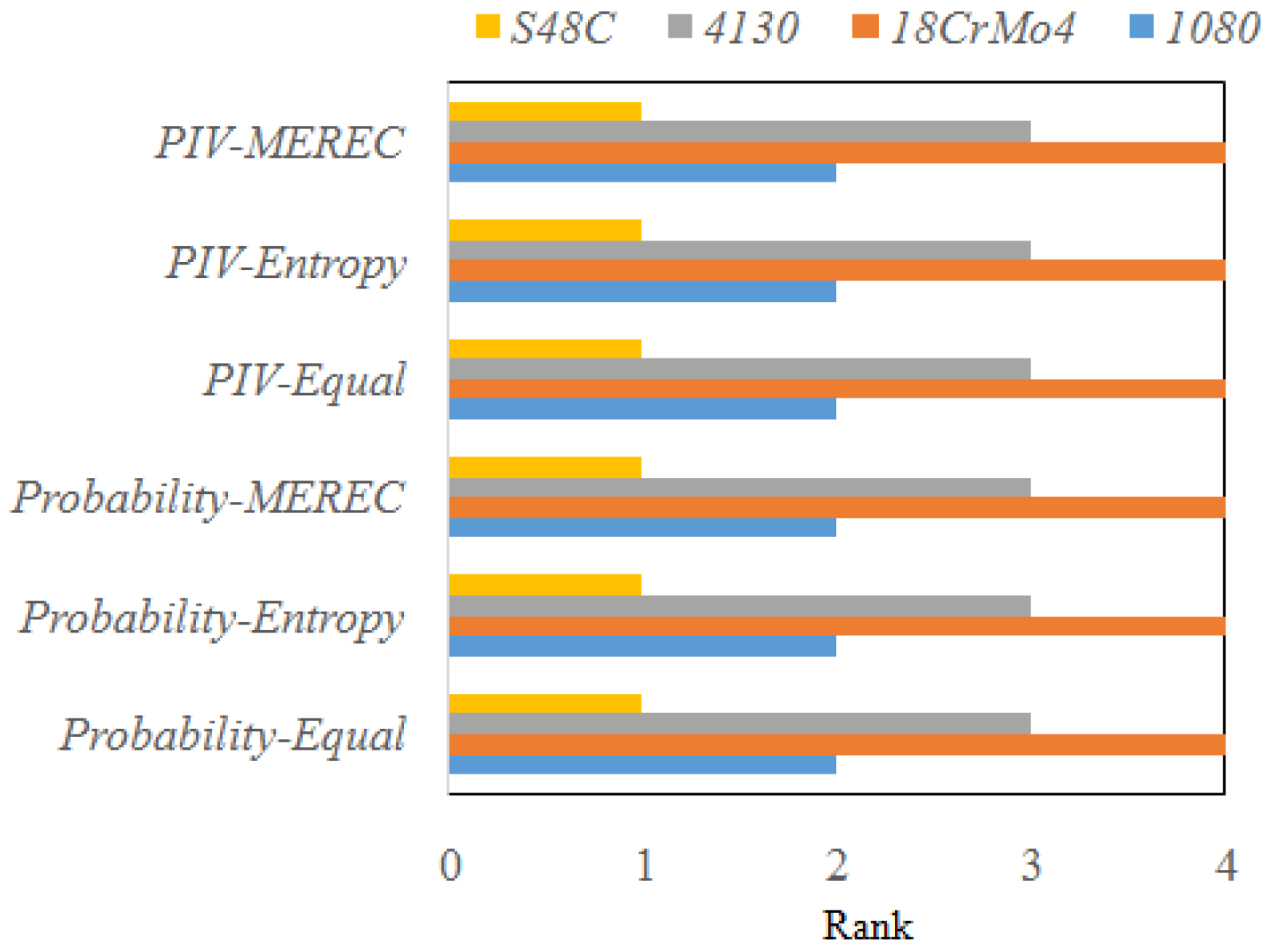
It is observed that when using the probabilistic method to rank the steels, the ordering of the alternatives remains unchanged despite variations in the criterion weights. This consistency partly confirms the stability of the ranking results when using the probabilistic method. Figure 1 presents the ranking results obtained using the probabilistic method in this study and by the PIV method in [16]. The notation “PIV-MEREC” denotes the ranking generated by the PIV method when the criteria weights are performed using the MEREC method.
Figure 1.
Ranking of materials for crankshaft manufacturing.
Furthermore, the rankings of the steels remain identical across different ranking and weighting methods. In this case, a Spearman correlation coefficient of 1 confirms the absence of any discrepancy between the ranking obtained from the probabilistic method and the rankings produced by the PIV method. This indicates that S48C is the most suitable steel among the four types surveyed for crankshaft manufacturing. Thus, in this case, the probabilistic method is determined to be appropriate for selecting materials for crankshaft manufacturing.
3.2. Case 2
This case involves ranking twelve materials commonly used for manufacturing cutting tools (cutting-tool material—CTM), designated from CTM1 to CTM12 (Table 4). Hardness, Young’s modulus, elasticity coefficient, friction coefficient, load, plastic deformation of the coating material, and wear resistance of the coating material are the seven criteria for each material, denoted as C1 to C7, respectively, with only C4 being a cost criterion, while the others are benefit criteria. The weights of the criteria are presented in the last row of Table 4 [17].
Table 4.
Materials for cutting tools [17].
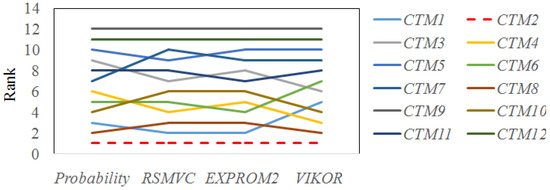
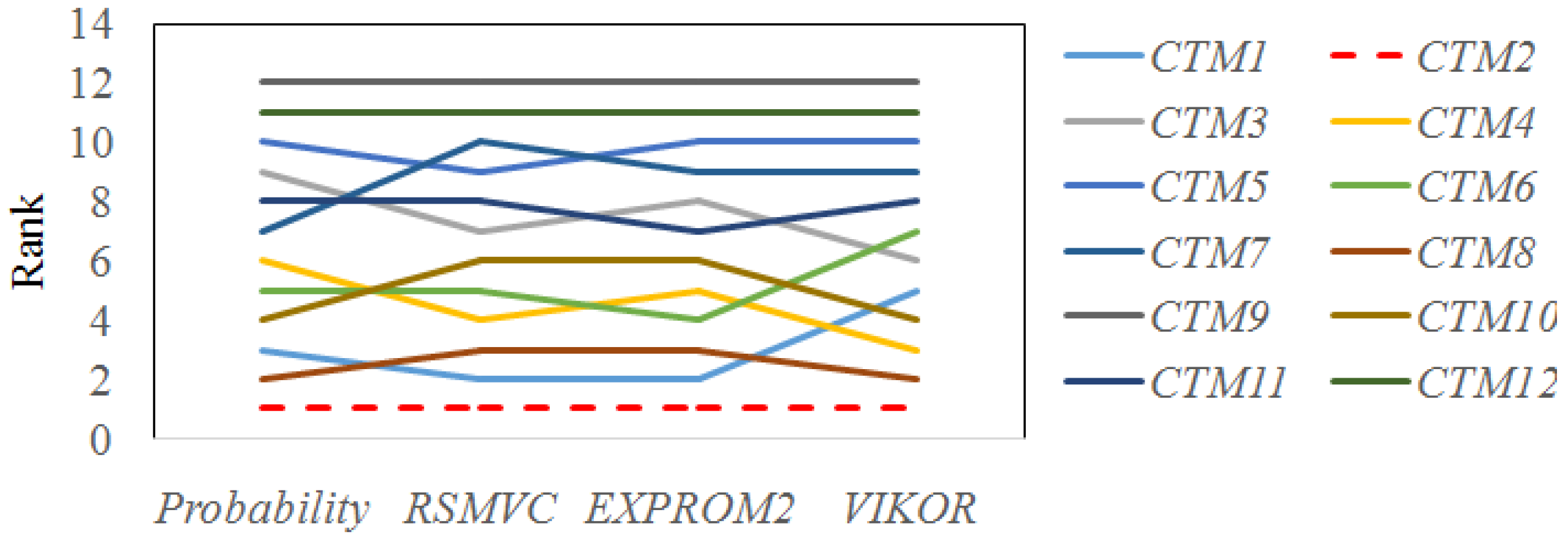
The rankings of the CTMs obtained using the probability method, similar to Case 1, are presented in Figure 2. The figure also displays the rankings performed by the RSMVC, EXPROM2, and VIKOR methods, as published in [17].
Figure 2.
Ranking of cutting-tool materials.
By applying (6), the Spearman coefficient between the methods is calculated as presented in Table 5.
Table 5.
Spearman coefficient for Case 2.
It is easily observed that all four methods, namely probability, RSMVC, EXPROM2, and VIKOR, rank CTM2 as first and CTM9 as 12th. The probability, EXPROM2, and VIKOR methods all rank CTM5 as 10th. The probability, RSMVC, and VIKOR methods all rank CTM11 as eighth. Additionally, the Spearman coefficient between the probability method and the RSMVC method is 0.9161; between the probability method and the EXPROM2 method, it is 0.9510; and between the probability method and the VIKOR method, it is 0.8951. These coefficients indicate very little difference in the ranking of the options when ranked by the probability method compared to the RSMVC, EXPROM2, and VIKOR methods. All of these results lead to a conclusive statement that the probability method ensures accuracy when used to rank cutting-tool materials in this case. Among the twelve cutting-tool materials, CTM2 is the best.
3.3. Case 3
In this case, the ranking of ten types of powders used in powder-mixed electrical discharge machining (PEDM) is performed. The ten powders considered for ranking evaluation are Al, Cr, SiC, Si, W, Ti, MoS2, Gr/C, Mo, and Al2O3. There are five criteria employed to assess each material: density (C1), thermal conductivity (C2), electrical conductivity (C3), melting point (C4), and specific heat capacity (C5). Among these, C1 is classified as a cost-type criterion, whereas the remaining four are treated as benefit-type criteria. The weights of the five criteria were determined using two methods: ROC and RS. All information about these powders is summarized in Table 6 [18].
Table 6.
Powders in PEDM [18].
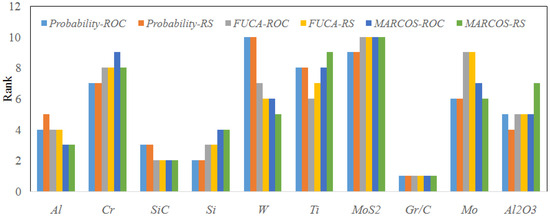
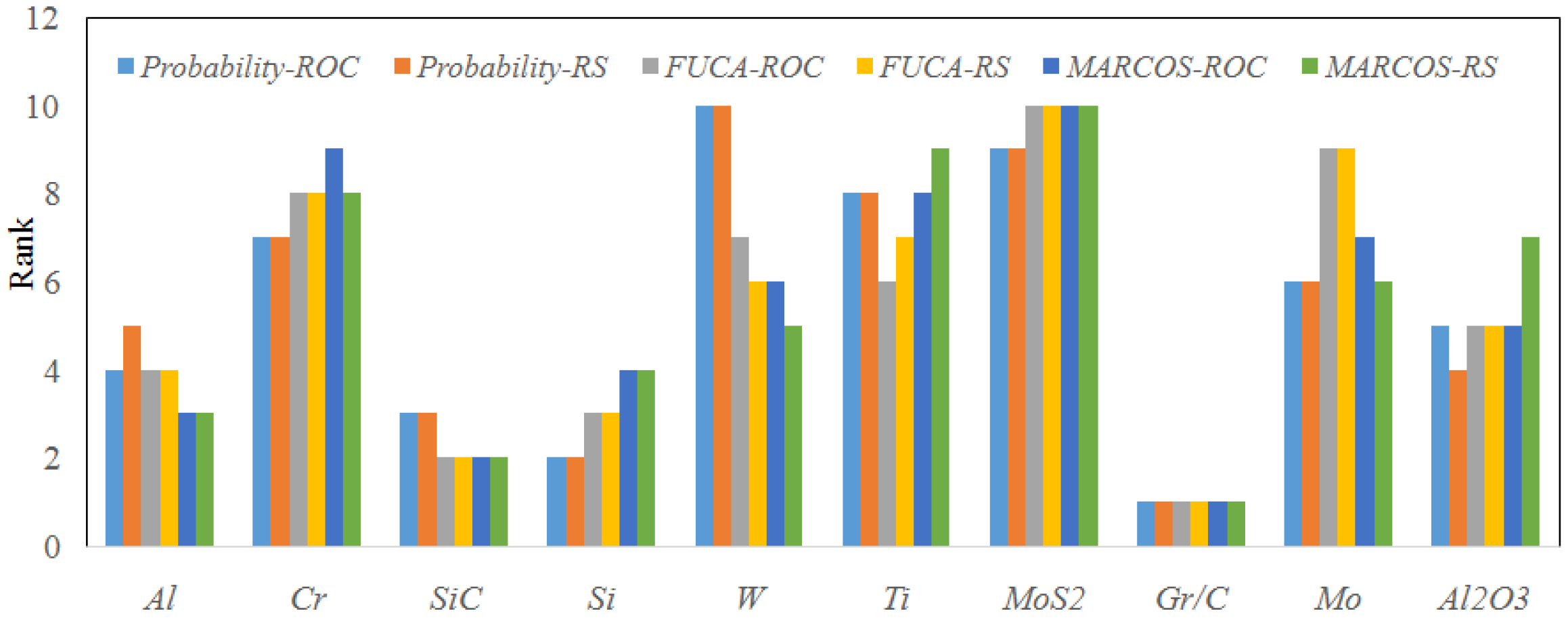
Applying the probability method in a similar way to Case 1, the powders were ranked as illustrated in Figure 3. Figure 3 also presents the rankings of the powders obtained using the FUCA and MARCOS methods, as reported in [18].
Figure 3.
Ranking of powders used in PEDM.
It is observed that all three methods—probability, FUCA, and MARCOS—identify Gr/C as the top-ranked powder in both weighting scenarios, where the criteria weights are determined using two distinct methods. This finding suggested that the probability method reliably identifies the most appropriate alternative in this case.
The Spearman coefficients between the methods, summarized in Table 7, also show relatively high values, indicating that the ranking of the options does not significantly change when different methods are used. Notably, when considering only the probability method, 8 out of 10 powders have consistent rankings when the weights of the criteria are calculated using the two different methods. This further reinforces that the use of the probability method for ranking powders is highly accurate in this case. In summary, this case demonstrates that the probability method is reliable for ranking powders used in PEDM, with Gr/C being the best option.
Table 7.
Spearman coefficients for Case 3.
In the three cases presented above, which involve the application of the probability method to material selection across various fields—including steel selection for crankshaft manufacturing, cutting tool-material selection, and powder selection for the PEDM process—the probability method consistently identified the optimal material in agreement with other MCDM methods.
Furthermore, the calculated Spearman’s rank correlation coefficient indicates only minor differences between material rankings obtained using the probability method and those produced by other techniques. These findings provide additional evidence supporting the reliability and applicability of the probability method for choosing the optimal material and ensuring accuracy. Moreover, the results suggest that the probability method has strong potential for addressing multi-objective decision-making problems in multiple research fields.
4. Conclusions
This is the first study to apply the probability method in selecting materials for various industries. The findings substantiate the reliability of utilizing the probability approach for material-type selection. We confirmed this by observing that the most suitable material pinpointed by the probability method in each conducted example was always identical to the selection indicated by other MCDM methods. Moreover, the hierarchical ordering (ranking) of the other material types resulting from the probability method showed a close correlation with the rankings established by alternative MCDM methodologies in all instances. Based on the demonstrated capability in selecting materials across the three applications implemented, there is strong confidence that the probability method will similarly excel in optimizing material choice when integrated into different fields.
This study has not addressed the application of the probability method to problems involving fuzzy sets or qualitative parameters. This is a limitation of this research and also a direction for development in future studies.
Author Contributions
Conceptualization, D.D.T. and A.A.; methodology, A.A., S.V. and N.H.S.; software, N.C.B.; validation, H.X.T. and D.D.T.; formal analysis, A.A.; investigation, D.D.T.; resources, N.H.S. and N.C.B.; data curation, D.D.T.; writing—original draft preparation, A.A., S.V. and H.X.T.; writing—review and editing, N.C.B. and N.H.S.; visualization, D.D.T.; supervision, A.A. All authors have read and agreed to the published version of the manuscript.
Funding
This research received no external funding.
Institutional Review Board Statement
Not applicable.
Informed Consent Statement
Not applicable.
Data Availability Statement
Data are contained within the article.
Conflicts of Interest
The authors declare no conflicts of interest.
References
- Emovon, I.; Oghenenyerovwho, O.S. Application of MCDM method in material selection for optimal design: A review. Results Mater. 2020, 7, 100115. [Google Scholar] [CrossRef] [Scilit]
- Trung, D.D.; Ašonja, A.; Van Duc, D.; Bao, N.C.; Son, N.H. Comparison of RAWEC and AROMAN Methods in Material Selection for Manufacturing or Maintenance. Lect. Notes Netw. Syst. 2025, 1242, 190–200. [Google Scholar] [CrossRef] [Scilit]
- Zeynali, M.; Aghdaie, M.H.; Rezaeiniya, N.; Zolfani, S.H. A hybrid fuzzy multiple criteria decision making (MCDM) approach to combination of materials selection. Afr. J. Bus. Manag. 2012, 6, 11171–11178. [Google Scholar] [CrossRef] [Scilit]
- Zakeri, S.; Chatterjee, P.; Cheikhrouhou, N.; Konstantas, D.; Yang, Y. MUTRISS: A new method for material selection problems using MUltiple-TRIangles scenarios. Expert. Syst. Appl. 2023, 228, 120463. [Google Scholar] [CrossRef] [Scilit]
- Ulutas, A.; Balo, F.; Mirkovic, K.; Stevic, Z.; Mohamed, M.H. MCDM model for critical selection of building and insulation materials for optimising energy usage and environmental effect in production focus. J. Civ. Eng. Manag. 2023, 29, 587–603. [Google Scholar] [CrossRef] [Scilit]
- Ruth Isabels, K.; Arul FreedaVinodhini, G. Material selection for dental implant—If VIKOR MCDM technique. Adv. Appl. Math. Sci. 2023, 22, 1807–1817. [Google Scholar]
- Ranjan, R.; Rajak, S.; Chatterjee, P. Material selection for sintered pulley in automobile: An integrated CRITIC-MARCOS model. Rep. Mech. Eng. 2023, 4, 225–240. [Google Scholar] [CrossRef] [Scilit]
- Alpay, S.; Iphar, M. Equipment selection based on two different fuzzy multi criteria decision making methods: Fuzzy TOPSIS and fuzzy VIKOR. Sci. Eng. Compos. Mater. 2018, 10, 661–677. [Google Scholar] [CrossRef] [Scilit]
- Thinh, H.X.; Mai, N.T. Comparison of two methods in multi-criteria decision-making: Application in transmission rod material selection. EUREKA Phys. Eng. 2023, 6, 59–68. [Google Scholar] [CrossRef] [Scilit]
- Lam, W.H.; Liew, K.F.; Lam, W.S. Selection of Materials in Construction Industry with Multi-Criteria Decision Making Models. E3S Web Conf. 2023, 405, 04015. [Google Scholar] [CrossRef] [Scilit]
- Dua, T.V.; Duc, D.V.; Bao, N.C.; Trung, D.D. Integration of objective weighting methods for criteria and MCDM methods: Application in material selection. EUREKA Phys. Eng. 2024, 2, 131–148. [Google Scholar] [CrossRef] [Scilit]
- Eisa, A.S.; Fattouh, M. Hybrid MCDM Model of ARAS -TOPSIS—GRA for Materials Selection Problem. J. Eng. Res. 2023, 7, 2. [Google Scholar] [CrossRef] [Scilit]
- Ercan, S.; Bilal, D. Material selection on countermeasure flare systems by multi criteria decision making methods. Int. J. Multidiscip. Stud. Innov. Technol. 2020, 4, 1–9. [Google Scholar]
- Zheng, M.; Teng, H.; Wang, Y. A simple approach for multi-criteria decision-making on basis of probability theory. Eng. Struct. Technol. 2021, 13, 26–30. [Google Scholar] [CrossRef] [Scilit]
- Kizielewicz, B.; Baczkiewicz, A. Comparison of Fuzzy TOPSIS, Fuzzy VIKOR, Fuzzy WASPAS and Fuzzy MOORA methods in the housing selection problem. Procedia Comput. Sci. 2021, 192, 4578–4591. [Google Scholar] [CrossRef] [Scilit]
- Nguyen, H.S.; Tran, T.H.; Nguyen, M.T.; Huynh, N.T.; Nguyen, T.C.; Pham, T.T.; Nguyen, C.B. Selection of Crankshaft Manufacturing Material by the PIV Method. Eng. Technol. Appl. Sci. Res. 2024, 14, 14848–14853. [Google Scholar] [CrossRef] [Scilit]
- Tran, V.D.; Hoang, X.T. RSMVC: A new-simple method to select the cutting tool base on multi criteria. J. Appl. Eng. Sci. 2023, 21, 167–175. [Google Scholar] [CrossRef] [Scilit]
- Nguyen, V.T.; Nguyen, H.S. Material Selection for PMEDM Process. Int. J. Mech. Eng. Robot. Res. 2024, 13, 315–324. [Google Scholar] [CrossRef] [Scilit]

Disclaimer/Publisher’s Note: The statements, opinions and data contained in all publications are solely those of the individual author(s) and contributor(s) and not of MDPI and/or the editor(s). MDPI and/or the editor(s) disclaim responsibility for any injury to people or property resulting from any ideas, methods, instructions or products referred to in the content. |
© 2026 by the authors. Licensee MDPI, Basel, Switzerland. This article is an open access article distributed under the terms and conditions of the Creative Commons Attribution (CC BY) license.