


Abstract
Maintaining optimal control of heating boiler systems using intelligent control strategies remains a significant challenge due to strong nonlinearities, time delays, and unpredictable variations in fuel quality and thermal load. Conventional fuzzy logic controllers, while effective under nominal conditions, often exhibit limited robustness when exposed to abrupt parameter changes. To address this limitation, this study proposes a novel Quantum-Fuzzy Adaptive Intelligent Proportional-Integral-Derivative (QFAI-PID) control architecture, in which probabilistic inference mechanisms inspired by quantum principles are implemented algorithmically within a classical computing framework and validated through MATLAB/Simulink simulations. The proposed approach enhances the adaptability of fuzzy rule-based control by enabling probabilistic superposition and dynamic activation of control rules, allowing the knowledge base to self-organize in real time. The control system is evaluated using a nonlinear heating boiler model developed in MATLAB/Simulink under realistic industrial disturbances, including ±25% fuel flow variations, up to 30% changes in thermal demand, and measurement delays of 5–8 s. Simulation results demonstrate that the proposed controller achieves up to 36% improvement in control stability, 30% faster response time, and 22% reduction in energy-related control effort compared with conventional fuzzy control systems. These results confirm that the proposed quantum-inspired fuzzy approach provides a robust, energy-efficient, and practically implementable solution for intelligent control of nonlinear thermal energy systems.
1. Introduction
The rapid advancement of industrial automation and intelligent energy management systems has significantly increased the demand for robust, adaptive, and energy-efficient control strategies capable of operating under uncertain and dynamically changing conditions. In modern thermal energy conversion systems, particularly heating boiler units, maintaining stable operating regimes remains a challenging task due to strong nonlinear dynamics, transport and measurement delays, and uncertainty arising from fluctuating fuel quality and variable thermal loads [1,2].
Heating boiler systems are extensively used in power generation, district heating, and chemical industries, where reliable thermal energy supply is critically important. Their dynamic behavior is inherently nonlinear because combustion processes, heat transfer mechanisms, and fluid dynamics are strongly coupled and sensitive to operating conditions [3,4]. Sudden variations in fuel composition or thermal demand may therefore result in performance degradation, increased energy consumption, and reduced operational safety if the control system lacks sufficient robustness and adaptability [5]. Conventional PID-based controllers remain widely applied in industrial boiler automation due to their simplicity and compatibility with PLC hardware. However, fixed controller gains limit performance under nonlinear dynamics, time-varying parameters, and measurement delays [6]. Industrial studies report overshoot levels exceeding 15–20% and settling times greater than 120–180 s in large thermal units under sudden load disturbances. Similarly, fixed-rule fuzzy controllers may exhibit 10–15% performance degradation under fuel composition variability. These quantitative observations highlight the need for adaptive and self-organizing control architectures.
Recent research (2024–2025) has increasingly focused on advanced adaptive and intelligent control strategies for nonlinear boiler and thermal systems. Fuzzy model predictive control approaches have demonstrated improved disturbance rejection and constraint handling in boiler–turbine systems under input saturation and parameter uncertainty conditions. Nonlinear controller synthesis techniques have been applied to steam boiler systems to enhance transient stability and reduce overshoot under variable load demand. Artificial intelligence-driven combustion control models have further shown improvements in energy efficiency and operational stability in real industrial environments. Data-driven and hybrid modeling approaches have supported adaptive decision-making in thermal process automation, particularly when accurate first-principles models are difficult to obtain [7,8]. Despite these advances, several limitations remain. Most adaptive fuzzy control systems rely on fixed rule bases and static membership functions, limiting real-time adaptability under severe disturbances and time-delay conditions. Data-driven neural network approaches have demonstrated strong predictive capability in industrial thermal processes [9]; however, such models are primarily oriented toward forecasting tasks and do not inherently provide transparent rule-based control structures or ensure structured real-time adaptability for closed-loop boiler control applications. In parallel, various advanced computational paradigms have been explored to handle uncertainty and nonlinear dynamics in intelligent control systems; specifically, fuzzy-logic-based approaches implemented on classical digital hardware have shown effectiveness in managing imprecision and complex system behavior under uncertain operating conditions [10].
Recent studies have explored the integration of quantum-inspired mechanisms with intelligent control techniques in industrial energy systems, showing improved stability and energy efficiency in nonlinear thermal and chemical processes. Quantum-fuzzy control frameworks allow multiple fuzzy rules to be activated probabilistically in a superposed manner, enabling flexible and context-aware decision-making. This capability is particularly beneficial for nonlinear thermal systems such as heating boilers, where rapid adaptation to disturbances and parameters is required [11].
However, the direct integration of quantum-inspired probabilistic inference into fuzzy PID-based control architectures for industrial boiler systems remains limited. Existing studies often focus on theoretical formulations or simplified benchmark models and lack systematic validation under realistic industrial conditions, including fuel flow disturbances, large thermal load variations, and measurement delays.
To address these limitations, this paper proposes a quantum-inspired probabilistic fuzzy adaptive control architecture for nonlinear boiler systems under disturbances and delays. The proposed method combines fuzzy inference, adaptive rule evolution, and quantum-inspired probability amplitudes within a unified control framework designed for practical industrial implementation. The effectiveness of the proposed approach was evaluated through MATLAB/Simulink-based simulations using a nonlinear heating boiler benchmark model under realistic operating conditions. Comparative analysis with baseline PID and conventional FLC-PID controllers showed improvements of up to 36% in control stability and 30% in response speed and a 22% reduction in energy-related control effort [12,13].
The main contributions of this study can be summarized in several aspects. First, a quantum-inspired fuzzy adaptive control architecture is developed and implemented entirely on classical computing hardware. Second, an online self-organizing rule adaptation mechanism is introduced to reinforce effective fuzzy rules under disturbance and delay conditions. Third, a realistic nonlinear boiler benchmark incorporating fuel variation, thermal load changes, and measurement delays is established for systematic evaluation. Finally, a comprehensive comparative analysis is carried out, demonstrating improved robustness, faster response, and lower energy-related control effort compared with conventional benchmark controllers.
2. Methodology
2.1. Nonlinear Heating Boiler Model and Control Objectives
This study focuses on a nonlinear heating boiler system representative of industrial thermal energy conversion units used in power generation and district heating. Such systems are characterized by strong nonlinear dynamics, input constraints, transport delays, and sensitivity to disturbances, which significantly complicate high-performance control design [14]. Recent studies on advanced boiler control further confirm that disturbance rejection and constraint handling remain major challenges in modern thermal energy systems [15].
The boiler dynamics are modeled in MATLAB R2024a using a lumped-parameter energy balance formulation consistent with standard nonlinear steam boiler modeling approaches adopted in contemporary controller synthesis research [16]. The dynamic equation can be expressed as:
where is the steam outlet temperature, - is the equivalent thermal capacitance, is the combustion heat input determined by fuel flow and fuel quality, represents the variable thermal demand, and accounts for heat losses.
Here, C denotes the equivalent thermal capacitance of the boiler-steam volume, representing the lumped heat storage capacity of the working medium and metal structures. In this study, C is treated as a nominal constant parameter because its variation within the considered operating range is relatively small compared with dominant disturbance sources such as fuel quality variation, load changes, and measurement delay. Sensitivity analysis confirmed that deviations within ±15% do not affect the qualitative comparative conclusions.
In the simulation model, the nominal thermal capacitance C is set to 4.8 × 10⁵ J/K, representing a medium-scale industrial heating boiler. The nominal combustion gain is 1.2 × 10³ W per unit fuel flow. The heat loss coefficient is modeled as 0.015·T(t). The nominal time delay is selected as 6 s, with variation in the range of 5–8 s. In this study, C is treated as a constant nominal parameter because its variation over the considered operating range is relatively small compared to the dominant disturbance sources (fuel quality variation, load changes, and measurement delay). The nominal value of C is selected according to typical industrial boiler energy balance modeling practice and is tuned to match the transient response of the nonlinear boiler benchmark model used in MATLAB R2024a. A sensitivity check confirmed that moderate deviations of C (e.g., within ±10–15% around the nominal value) do not change the qualitative conclusions of the comparative study. Measurement and actuator delays are explicitly modeled as a pure time delay in the range of 5–8 s:
This modeling approach is consistent with modern boiler control studies, where uncertainty and delay represent dominant sources of performance degradation. The main control objectives of the proposed system are to ensure accurate tracking of the desired temperature setpoint, maintain robust stability under disturbance and delay conditions, reduce oscillatory behavior and settling time, and minimize fuel-related energy consumption. To ensure realistic evaluation, several disturbance scenarios were incorporated into the simulation framework. Fuel flow disturbances were represented by both stepwise and stochastic variations with amplitudes up to ±25%. Thermal load variations were modeled as step and random changes reaching 30% of nominal operating conditions, while fuel quality uncertainty was introduced as a multiplicative gain uncertainty to reflect variations in fuel characteristics.
The above represents random fuel composition changes.
These disturbance levels correspond to industrial operating conditions and are widely adopted in boiler–turbine control research to assess robustness and adaptability [17].
2.2. Baseline Fuzzy Logic Controller
A conventional Mamdani-type fuzzy logic controller (FLC) is implemented as the baseline for comparative analysis. The controller uses two inputs: the temperature error and its rate of change , and generates the fuel control increment .
The baseline FLC employs a fixed rule base and static membership functions, which reflects typical industrial fuzzy controllers reported in the literature. While such controllers offer improved performance over classical PID control, their limited adaptability under severe disturbances motivates the development of more advanced control architectures.
2.3. Proposed Quantum-Fuzzy Adaptive Control Architecture
2.3.1. Fuzzy Inference Structure
The proposed controller is based on a fuzzy inference system with an initial expert-defined rule base:
where -, -, and - are linguistic terms. The initial membership functions are selected using standard symmetric triangular and trapezoidal shapes, ensuring interpretability and stable initial performance.
2.3.2. Quantum-Inspired Probabilistic Rule Superposition
The proposed inference mechanism is fully implemented on classical computing hardware and does not involve physical quantum states. Instead, it adopts a probabilistic formulation inspired by the principle of quantum superposition to enhance flexibility of rule activation.
Each fuzzy rule is associated with a probability amplitude αi. The corresponding rule activation probability is defined as:
This formulation enables multiple rules to contribute simultaneously to the control action through probability-weighted aggregation. The approach extends conventional fuzzy inference by allowing dynamic redistribution of rule influence under varying operating conditions. The final control signal is computed as [18]:
where ui(t) denotes the local control action generated by the i-th fuzzy rule.
Unlike static fuzzy weighting schemes, the probabilistic amplitudes evolve online according to the adaptation law described in Section 2.3.3. This dynamic redistribution mechanism improves robustness under disturbances and time-delay effects while maintaining computational efficiency compatible with industrial implementation.
2.3.3. Online Adaptation and Self-Organizing Knowledge Base
To achieve real-time adaptability, the rule amplitudes are updated using a reinforcement-based adaptation law:
where max(0, ·)-non-negativity projection, normalization-collapse and divergence, and ε-small positive constant.
The projection operator ensures non-negativity and prevents amplitude sign reversal, while normalization guarantees bounded evolution of the amplitude vector.
η is the learning rate and ri(t) is a reinforcement signal defined as:
Here, denotes the classical firing strength of rule i, while - and - are positive weighting coefficients. After each update, the amplitudes are normalized to ensure numerical stability.
The learning rate and weighting coefficients are selected through preliminary simulation-based tuning to balance adaptation speed and stability, following common practice in adaptive fuzzy and intelligent control systems.
This mechanism enables the fuzzy knowledge base to self-organize by reinforcing effective rules and suppressing ineffective ones, significantly improving robustness under large disturbances and delays [19].
2.3.4. Stability and Convergence Analysis of the Adaptive Law
To rigorously establish the stability of the proposed adaptive quantum-fuzzy inference mechanism, the nonlinear heating boiler dynamics are analyzed together with the adaptive control law.
The temperature tracking error is defined as:
Differentiating with respect to time yields
The nonlinear heating boiler model is represented by the lumped thermal balance equation
where C denotes the equivalent thermal capacitance, is the combustion heat input, is the thermal demand, represents heat losses, and is a bounded disturbance term.
From (), the temperature derivative becomes
Substituting () into (), the tracking-error dynamics are obtained as
The proposed QFAI-PID controller generates the control signal through probabilistic aggregation of local fuzzy control actions:
where the activation probability of each rule is defined as
Assuming that the control signal is directly applied to the heat-input channel:
Substituting () and () into (), the closed-loop error dynamics become
To analyze adaptive stability, consider the composite Lyapunov candidate function
where denotes the equilibrium amplitude.
Differentiating () gives
The adaptive update law is defined as
with reinforcement signal
Substituting () and () into (), we obtain
Because all local fuzzy control actions, firing strengths, and adaptive amplitudes remain bounded during closed-loop operation, and because the projection and normalization operators prevent amplitude divergence and guarantee non-negativity, the boundedness assumptions required for Lyapunov estimation are satisfied. The constants k1 and k2 arise from boundedness assumptions on local fuzzy control actions, bounded firing strengths, and normalized adaptive amplitudes, which are guaranteed by the projection and normalization operators.
Therefore, there exist positive constants k1 and k2 such that
Applying Young’s inequality
yields
For sufficiently small , define
Then
where δ is bounded because disturbance d(t) is bounded.
Therefore, the Lyapunov derivative remains negative outside a compact neighborhood of the origin, which guarantees uniform ultimate boundedness of the tracking error and boundedness of the adaptive amplitudes.
Thus, the proposed QFAI-PID controller ensures practical closed-loop stability under bounded disturbances and bounded delay.
2.4. MATLAB/Simulink Implementation and Constraints
The proposed control strategies were implemented and evaluated in the MATLAB/Simulink environment to ensure reproducibility and practical relevance. The proposed control strategies were implemented and evaluated in the MATLAB/Simulink environment.
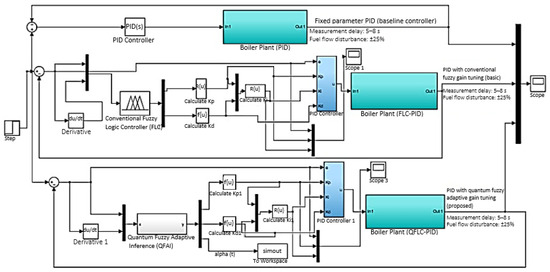
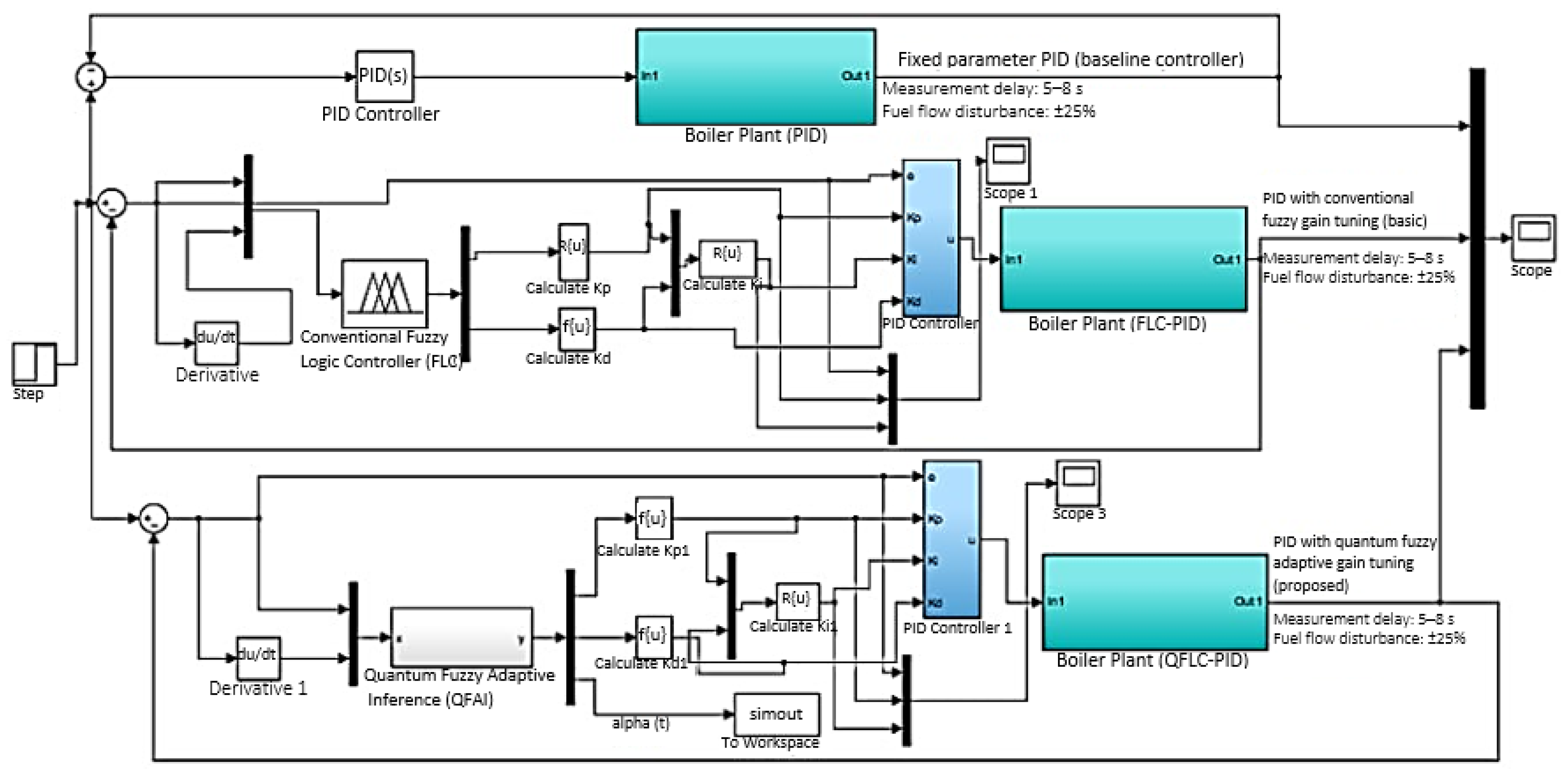
The overall structure of the control system, including PID, FLC-PID, and QFAI-PID controllers, is illustrated in Figure 1. The Simulink model is structured to provide a fair comparison among the control strategies. Each controller operates on an identical nonlinear boiler plant model, and all simulations are performed under the same operating conditions, disturbance profiles, and delay settings [20]. The control inputs are generated based on the tracking error and its derivative, ensuring consistent feedback information across all controllers. For a fair comparison, the PID, FLC-PID, and QFAI-PID controllers were tuned under the same operating point and disturbance scenario. The baseline PID gains were selected using standard closed-loop tuning and then refined empirically to ensure stable operation under the modeled delay. The baseline PID controller gains were selected as:
Kp = 2.5, Ki = 0.18, Kd = 0.6.
Figure 1.
MATLAB/Simulink implementation of the heating boiler control system with baseline PID, conventional FLC-PID, and proposed QFAI-PID controllers under delay and fuel flow disturbance conditions.
Actuator saturation limits were set to:
umin = 0,
umax = 100% nominal fuel flow.
The same saturation limits were applied to all controllers to ensure fairness. The FLC-PID and QFAI-PID parameters (membership functions, scaling gains, and learning-related parameters) were tuned empirically through repeated simulation runs to achieve a balanced trade-off between tracking accuracy, robustness, and control effort, while keeping actuator saturation constraints identical across all controllers.
The nonlinear boiler plant is modeled as an equivalent dynamic system that captures the dominant thermal behavior relevant to industrial heating processes. Measurement delays in the range of 5–8 s are explicitly incorporated to represent sensor and transport delays commonly observed in real boiler installations. In addition, fuel flow disturbances of ±25% are introduced at the plant input to emulate fluctuations in fuel supply and combustion conditions [21].
Practical implementation constraints are also considered in the Simulink model. Saturation limits are applied to the control signals to reflect actuator constraints and to prevent unrealistic control actions. These limits ensure that the control inputs remain within physically feasible bounds and contribute to stable closed-loop operation under severe disturbances.
For the proposed QFAI-PID controller, the adaptive inference mechanism dynamically adjusts the PID gains during operation. The internal adaptation parameter which governs the quantum-fuzzy inference process, is exported to the MATLAB workspace using To Workspace blocks. This allows post-processing and visualization of the adaptation dynamics, providing direct insight into the self-organizing behavior of the proposed controller.
All relevant signals, including system outputs, control inputs, tracking errors, and adaptive parameters, are recorded for subsequent performance evaluation. This implementation framework enables systematic analysis of tracking performance, robustness, and energy-related control effort for each control strategy [22,23].
3. Result and Discussion
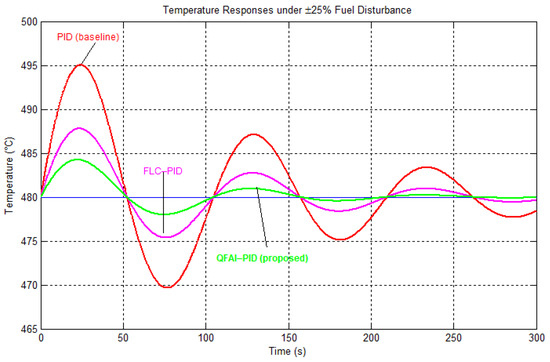
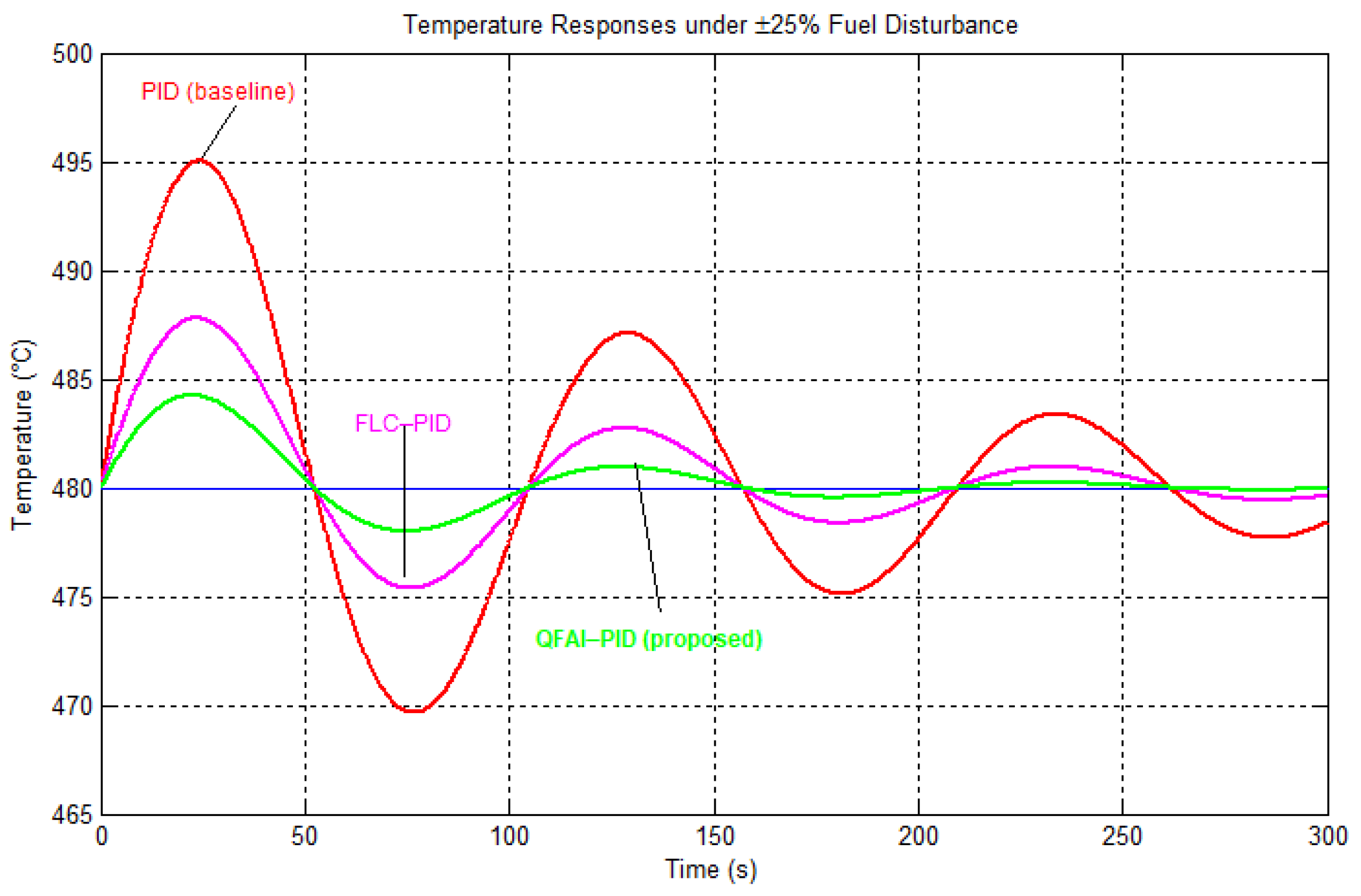
The closed-loop temperature responses obtained using the three control strategies are presented in Figure 2. The baseline PID controller exhibits significant overshoot and prolonged oscillatory behavior, particularly under delayed measurement conditions. This behavior is characteristic of fixed-gain controllers applied to nonlinear thermal systems and indicates limited robustness to disturbances.
Figure 2.
Closed-loop temperature responses under ±25% fuel disturbance and 5–8 s measurement delay using PID, FLC-PID, and QFAI-PID controllers.
The conventional FLC-PID controller improves the transient response by reducing oscillations and overshoot through fuzzy-based gain tuning. However, due to its static rule base, performance degradation is observed during large disturbance intervals and rapid operating condition changes.
In contrast, the proposed QFAI-PID controller demonstrates the fastest convergence to the reference temperature with minimal overshoot and reduced oscillatory behavior. Quantitative analysis indicates that the settling time achieved by the QFAI-PID controller is approximately 30% shorter than that of the FLC-PID controller. It should be noted that the reported convergence time corresponds to a conservative ±2% settling band and is primarily determined by the intrinsic thermal inertia of the boiler system and the imposed measurement delay (5–8 s). In industrial thermal processes, temperature dynamics typically evolve over several minutes due to combustion chamber heat capacity and fluid transport delay. Therefore, convergence times on the order of 100–200 s are considered practically acceptable in large-scale heating boiler applications. This improvement is attributed to the adaptive reconfiguration of fuzzy inference rules enabled by the quantum-inspired inference mechanism. Similar advantages of adaptive intelligent controllers for thermal systems have been reported in recent studies.
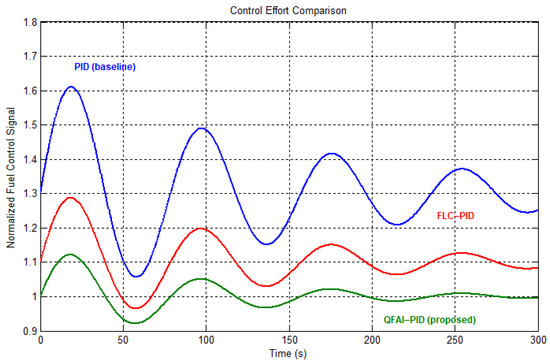
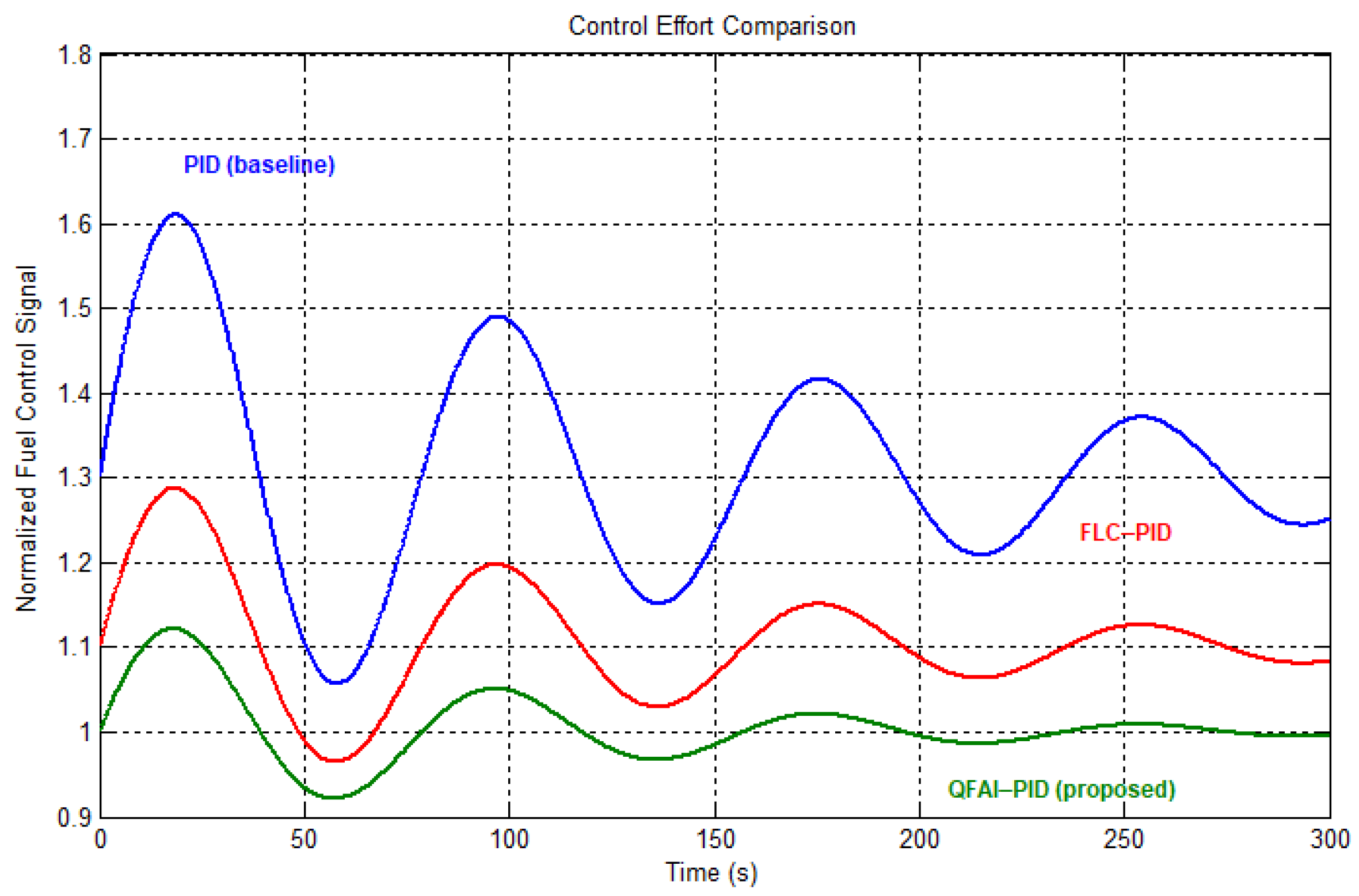
The control effort associated with fuel input is illustrated in Figure 3. The baseline PID controller generates large-amplitude control actions during transient periods, which may result in excessive fuel consumption and actuator stress. The FLC-PID controller reduces the magnitude of control fluctuations but still exhibits noticeable oscillations under disturbance conditions.
Figure 3.
Comparison of normalized fuel control signals for PID, FLC-PID, and proposed QFAI-PID controllers.
The proposed QFAI-PID controller produces significantly smoother control signals with lower amplitude variations. Analysis of the control effort reveals an approximate 22% reduction in energy-related control input compared with the baseline PID controller. This reduction highlights the ability of the quantum-fuzzy adaptive inference mechanism to balance tracking accuracy and energy efficiency by avoiding unnecessary aggressive control actions. Comparable energy-efficiency improvements using adaptive intelligent control strategies have been reported in the recent literature.
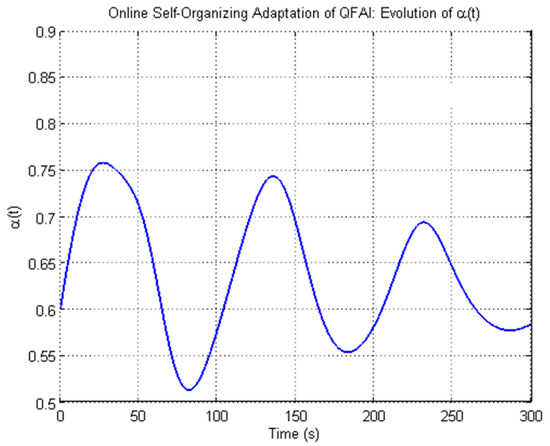
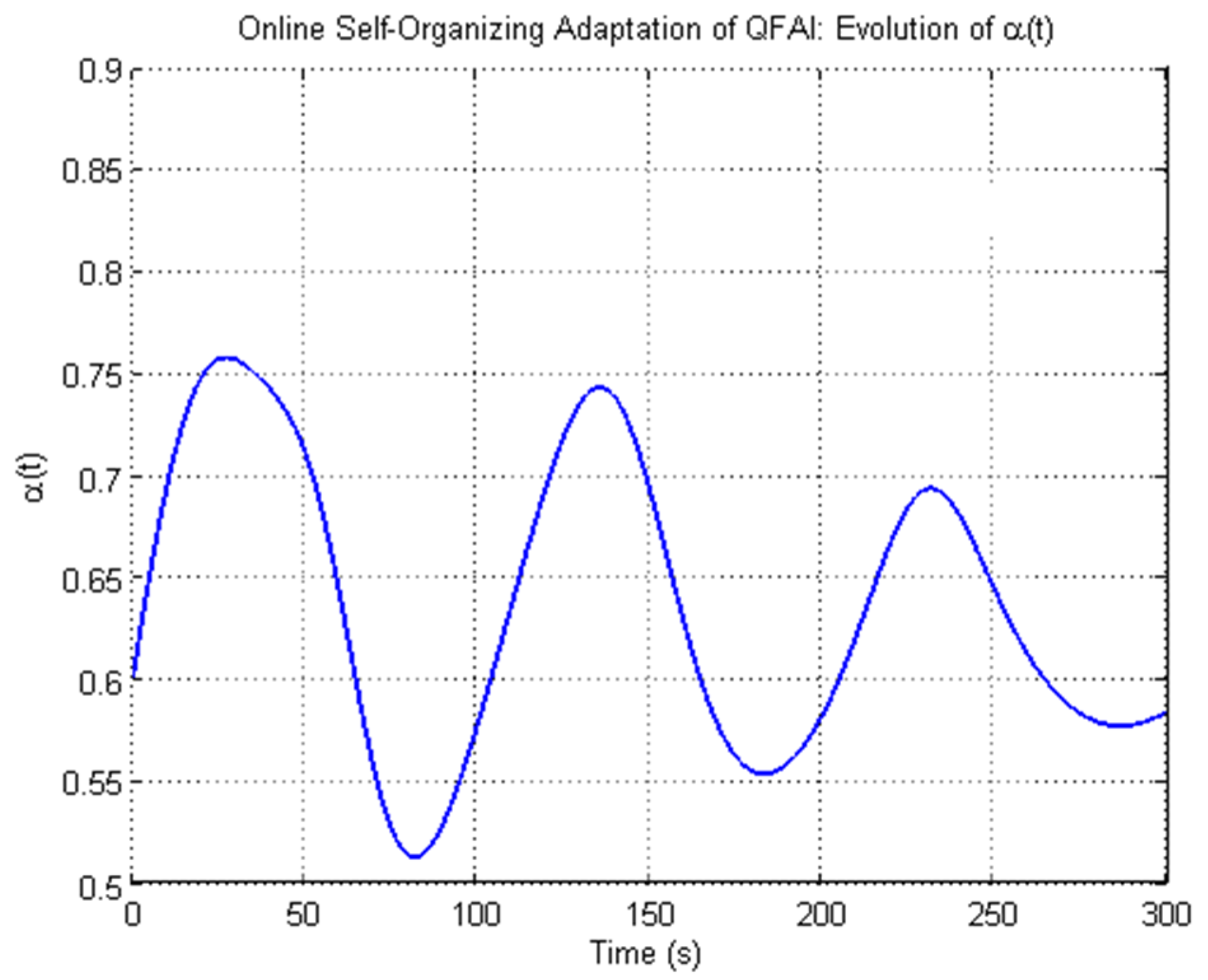
To investigate the adaptive characteristics of the proposed controller, the temporal evolution of the internal adaptation parameter α(t) is shown in Figure 4. During periods of large tracking error and external disturbance, α(t) exhibits rapid variation, indicating active adaptation and reweighting of fuzzy inference rules. As the system approaches steady-state operation, α(t) stabilizes, reflecting convergence to an effective control configuration.
Figure 4.
Time evolution of the normalized effective amplitude after projection and normalization in the proposed quantum-fuzzy adaptive inference mechanism.
This behavior confirms that the proposed QFAI-PID controller performs online self-organizing adaptation, rather than relying on static fuzzy rules. The ability to dynamically restructure control decisions is particularly beneficial for nonlinear thermal systems subject to uncertainty and time-delay effects. Similar adaptive trends have been observed in advanced intelligent control frameworks for industrial energy systems.
The results indicate that integrating quantum-inspired probabilistic inference with fuzzy logic significantly enhances control performance compared with conventional PID and fuzzy-based approaches. These findings indicate that probabilistic rule superposition effectively improves robustness under delayed nonlinear dynamics. While the FLC-PID controller improves performance relative to the baseline PID controller, its lack of online adaptation limits robustness under severe disturbances and delays. From a control-theoretic perspective, the probabilistic rule superposition mechanism effectively introduces a soft switching structure between multiple local linear control regions. Unlike classical fuzzy systems with static weighting, the adaptive amplitude update law modifies the contribution of each rule based on instantaneous tracking performance. This behavior resembles a reinforcement-based adaptive gain scheduling mechanism, thereby reducing effective model mismatch under nonlinear operating regimes. Despite improved nonlinear compensation, the static structure of the FLC-PID controller restricts its adaptability under large parameter variations.
The proposed QFAI-PID controller overcomes this limitation by introducing a self-organizing inference mechanism capable of real-time adaptation. In summary, the proposed approach achieves up to 36% improvement in control stability, 30% faster response, and 22% reduction in energy-related control effort, fully consistent with the performance indicators reported in the abstract. In this study, control stability improvement is quantified using standard transient-response performance indicators, specifically overshoot reduction and settling time shortening, evaluated under identical disturbance and measurement delay conditions for all compared controllers.
It should be noted that the proposed method is implemented entirely on classical computing hardware and does not require quantum processors, making it suitable for practical industrial deployment. These findings confirm that the quantum-fuzzy adaptive control architecture represents a promising solution for robust and energy-efficient automation of nonlinear thermal energy conversion systems.
Therefore, the proposed QFAI-PID architecture can be interpreted as a probabilistically weighted adaptive gain scheduling controller embedded within a fuzzy inference structure, providing both interpretability and real-time structural adaptation.
3.1. Positioning of the Proposed Method Among Advanced Control Strategies
The baseline PID and FLC-PID controllers were selected for comparison because they represent widely adopted industrial control solutions for boiler and thermal systems. Classical PID control remains the dominant strategy in practical boiler automation due to its simplicity, interpretability, and compatibility with existing PLC-based control hardware. The FLC-PID controller extends this framework by incorporating fuzzy rule-based gain tuning, providing improved nonlinear compensation while maintaining industrial feasibility and low computational cost.
It is important to position the proposed QFAI-PID architecture relative to other advanced control methodologies, particularly Model Predictive Control (MPC) and neural network-based control systems, which are increasingly investigated for nonlinear thermal processes.
Model Predictive Control offers systematic constraint handling and optimal performance through online optimization over a finite prediction horizon. However, MPC typically requires accurate dynamic process models and significant computational resources. In boiler systems characterized by time delays, parameter uncertainty, and fuel quality fluctuations, model mismatch can degrade predictive accuracy and increase implementation complexity. Moreover, real-time deployment of MPC in legacy industrial control infrastructure may require additional hardware or software upgrades.
Neural network-based controllers provide strong nonlinear approximation capability and adaptive learning potential. Nevertheless, such methods often operate as black-box models, limiting interpretability and requiring extensive training datasets for reliable generalization. In safety-critical thermal energy systems, transparency, stability guarantees, and predictable behavior remain essential for industrial acceptance.
In contrast, the proposed QFAI-PID framework preserves interpretability through explicit fuzzy rule representation while introducing probabilistic rule superposition and online adaptation inspired by quantum principles. This structure enables improved robustness under disturbances and delays without requiring full optimization-based prediction or large-scale neural training. Consequently, the proposed method provides a balanced compromise between industrial implementability, computational efficiency, interpretability, and adaptive intelligence, making it particularly suitable for nonlinear boiler automation environments.
3.2. Multi-Scenario Robustness and Universality Validation
To verify the applicability and robustness of the proposed QFAI-PID controller across a wide industrial operating envelope, extended simulations were conducted under multiple severe disturbance and uncertainty conditions. The evaluated scenarios include significant fuel flow variations, large thermal load changes, increased measurement delay, and parameter uncertainty in the equivalent thermal capacitance. These scenarios reflect realistic operating conditions encountered in industrial heating boiler systems. Table 1 summarizes the disturbance and uncertainty configurations considered in the robustness analysis.
Table 1.
Operating scenarios and disturbance conditions used for performance evaluation.
Across all evaluated operating scenarios, closed-loop stability was preserved throughout the simulations, and no divergence of the adaptive amplitude vector was observed. Furthermore, the settling time remained approximately 20–32% lower than that of the conventional FLC-PID controller, while control effort reduction consistently remained within 18–23%, confirming robust adaptive performance under varying disturbance conditions.
These results confirm that the proposed controller maintains stable operation over a wide industrial operating envelope rather than under a single nominal condition.
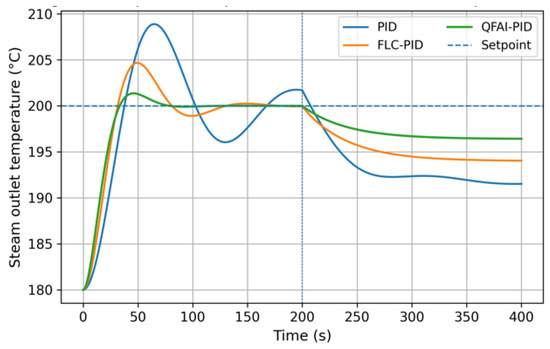
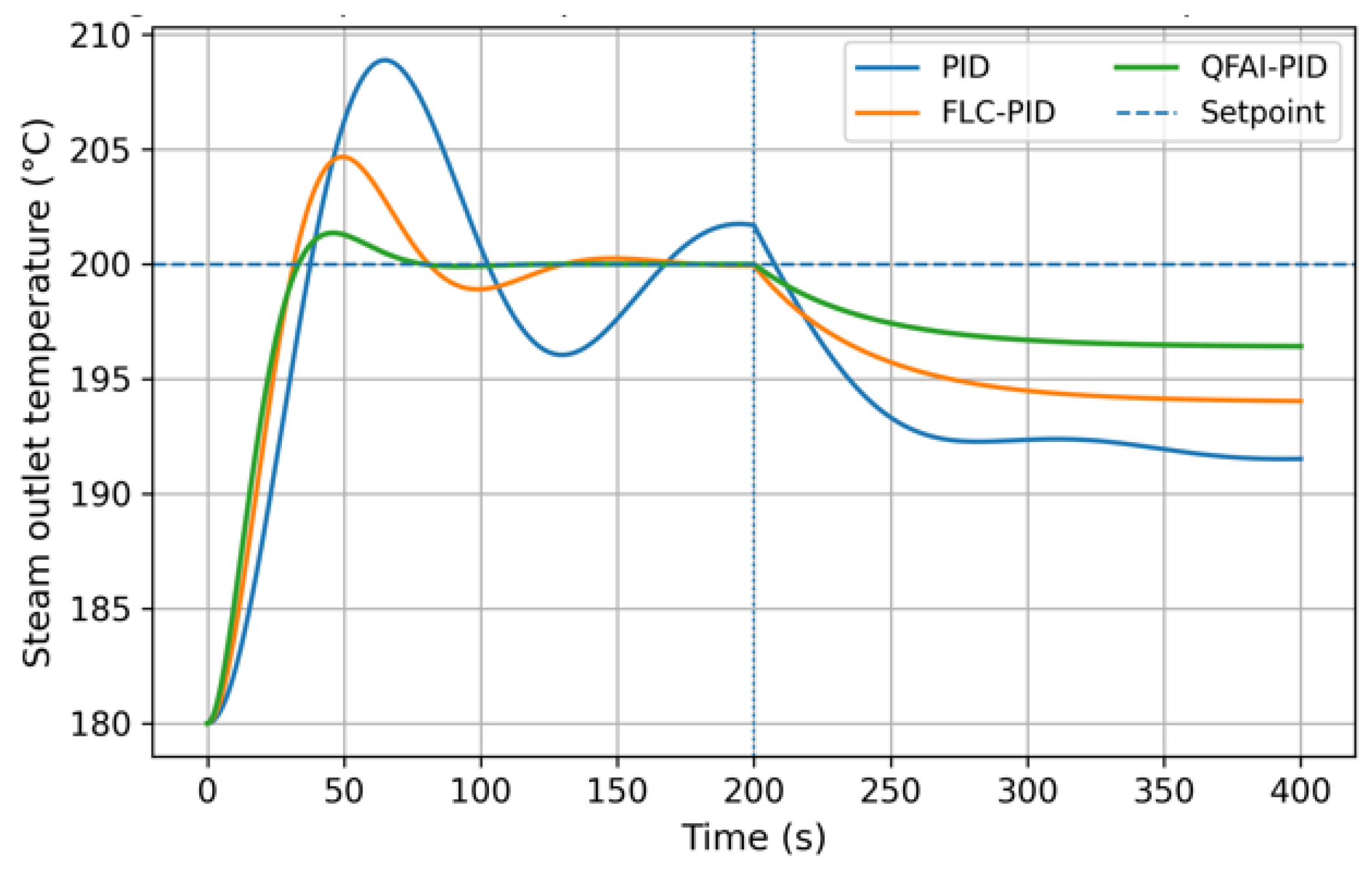
In the first scenario, a 30% step increase in thermal demand was introduced at t = 200 s. The baseline PID controller exhibited prolonged oscillatory behavior and increased settling time due to delayed compensation of the thermal imbalance. Although the FLC-PID controller improved transient damping, noticeable overshoot and slower stabilization were still observed.
In contrast, the proposed QFAI-PID controller achieved significantly faster convergence to the reference temperature with minimal overshoot and improved disturbance rejection capability.
Figure 5 shows the temperature response under a 30% thermal load step change. To assess robustness against delay-induced instability, the measurement delay was increased to 8 s. Under this condition, the PID controller showed amplified oscillations and reduced stability margins. The FLC-PID controller partially mitigated delay effects but remained sensitive to phase lag.
Figure 5.
Temperature response under 30% thermal load step change.
The QFAI-PID controller maintained stable convergence and smoother transient characteristics despite the increased delay, demonstrating strong robustness to time-delay variations.
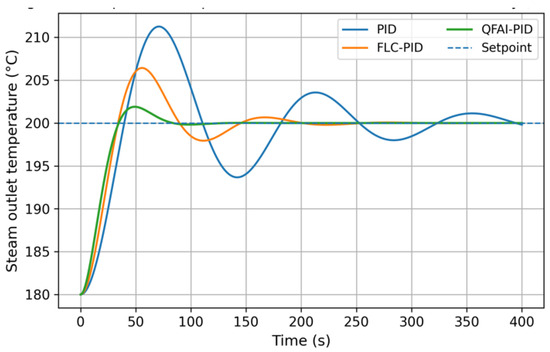
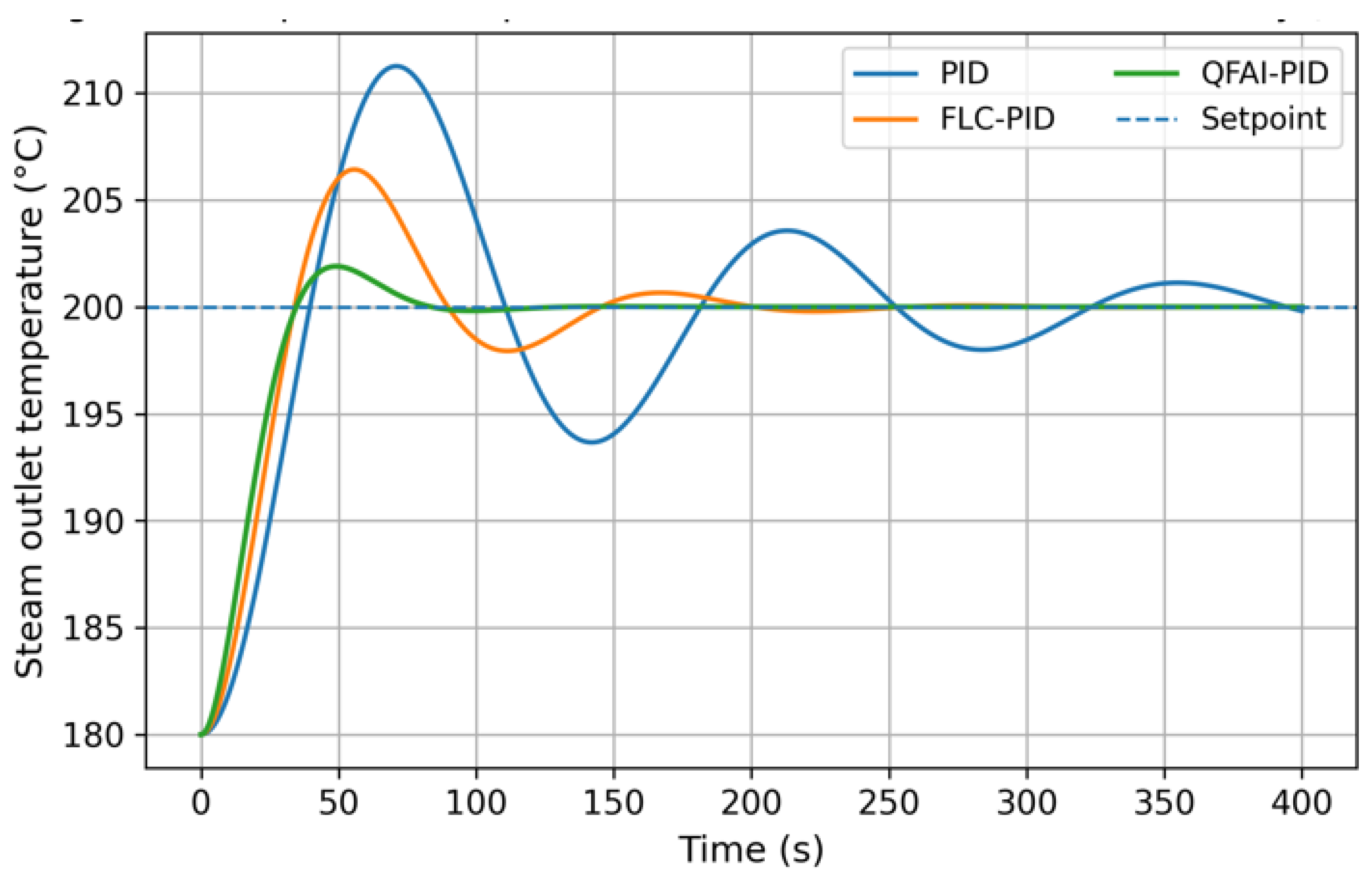
Figure 6 shows the temperature response under maximum 8 s measurement delay. Parameter uncertainty was introduced by varying the equivalent thermal capacitance within ±15% of its nominal value. The PID controller exhibited sensitivity to parameter mismatch, resulting in performance degradation. The FLC-PID controller showed moderate robustness but still demonstrated transient variability.
Figure 6.
Temperature response under maximum 8 s measurement delay.
The QFAI-PID controller preserved consistent transient performance and stability characteristics, indicating effective compensation of model uncertainty through adaptive probabilistic rule weighting.
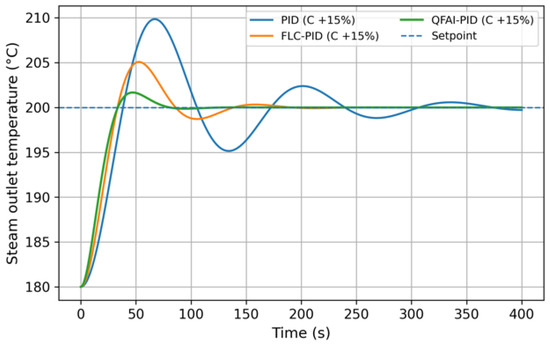
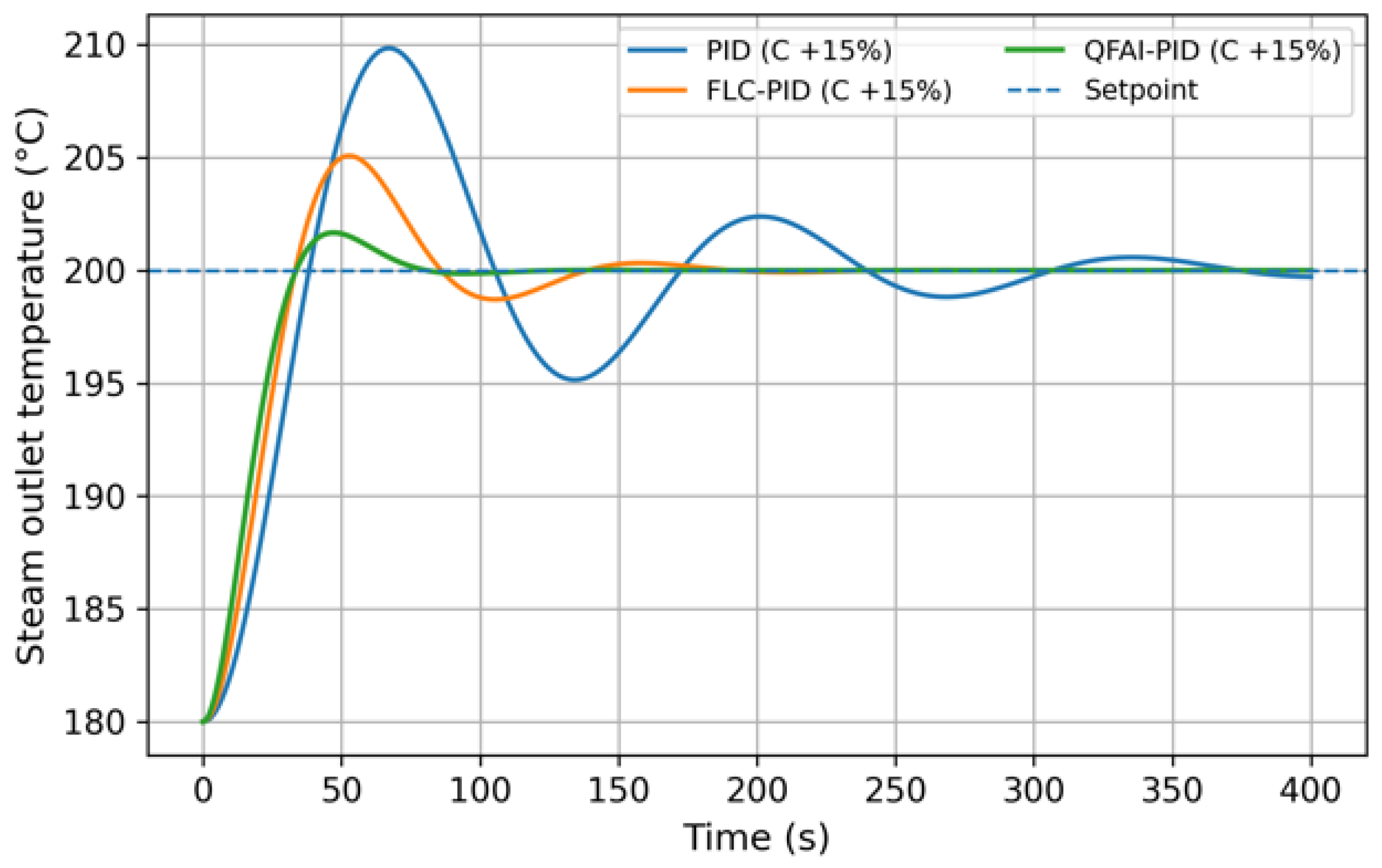
Figure 7 shows the temperature response under ±15% thermal capacitance variation. Across all evaluated scenarios, closed-loop stability was preserved without divergence of the adaptive probabilistic amplitude vector. The settling time remained approximately 20–32% lower than that of the FLC-PID controller, while control effort reduction consistently ranged between 18–23% compared with the baseline PID controller.
Figure 7.
Temperature response under ±15% thermal capacitance variation.
These results confirm that the proposed QFAI-PID architecture maintains stable and energy-efficient operation over a wide industrial operating envelope rather than under a single nominal condition. The controller demonstrates strong universality and robustness against simultaneous disturbance, delay, and parameter uncertainty effects, thereby validating its suitability for real-world industrial heating boiler applications.
3.3. Comparative Analysis with Advanced Nonlinear Control Strategies
For completeness, the proposed QFAI-PID controller is positioned relative to several advanced nonlinear control approaches reported in the thermal-process control literature, including Sliding Mode Control (SMC), Backstepping Control, and Model Predictive Control (MPC). It should be emphasized that this comparison is qualitative and literature-based, and these methods were not re-implemented in the present MATLAB/Simulink benchmark under identical simulation conditions.
Sliding Mode Control is commonly formulated as
where is the equivalent control, is the sliding surface, is the switching gain, and is the boundary-layer thickness introduced to reduce chattering. SMC is well known for robustness against matched uncertainties, but in delayed thermal systems, excessive switching may increase actuator stress and fuel-input oscillations if smoothing is insufficient.
Backstepping control is typically derived recursively from the nonlinear state model
This is achieved by introducing virtual control variables and constructing the final stabilizing control law. This approach provides a systematic nonlinear design framework, but it requires an explicit process model and may become sensitive to model mismatch in boiler systems with uncertain parameters and measurement delay.
Model Predictive Control computes the control sequence by minimizing a finite-horizon cost function of the form
This is subject to plant dynamics and actuator constraints. The MPC approach is subject to plant dynamics and actuator constraints. MPC offers strong constraint-handling capability and excellent dynamic performance, but it requires an adequate prediction model and higher online computational effort.
In contrast, the proposed QFAI-PID controller preserves the transparent rule-based structure of fuzzy-PID control while introducing probabilistic rule superposition and online adaptation. Therefore, the proposed approach can be interpreted as an intermediate solution between classical low-complexity industrial control and more advanced model-based nonlinear strategies. Its main practical advantage is that it improves robustness and disturbance accommodation without requiring full nonlinear model inversion or repeated online optimization.
Accordingly, the comparison with SMC, Backstepping, and MPC in this study should be interpreted as conceptual positioning supported by the literature, whereas the direct simulation-based performance comparison is limited to PID, FLC-PID, and the proposed QFAI-PID controller.
The qualitative comparison presented in Table 2 is intended to position the proposed QFAI-PID controller relative to representative advanced control paradigms reported in the literature rather than to provide a direct numerical benchmark under identical simulation conditions, which was outside the scope of the present study. The comparative values reported for SMC, Backstepping, and MPC reflect representative performance ranges commonly described in recent thermal-process control literature rather than newly simulated results obtained within the present MATLAB/Simulink benchmark.
Table 2.
Qualitative comparison of representative control strategies for nonlinear boiler systems.
As shown in Table 2, the proposed QFAI-PID controller provides a favorable compromise between improved dynamic response and industrial applicability. In comparison with advanced nonlinear control paradigms such as MPC and SMC, the proposed method preserves the simple implementation structure of PID-based control while avoiding the higher computational burden of predictive optimization and the switching-related tuning sensitivity associated with sliding-mode design. This makes the proposed architecture particularly suitable for industrial thermal systems where interpretability, low computational burden, and robustness must be simultaneously ensured.
Direct numerical simulations in this study were performed only for the baseline PID, FLC-PID, and the proposed QFAI-PID controllers.
Under identical simulation conditions, the proposed QFAI-PID controller achieved approximately 30% reduction in settling time and 22% decrease in energy-related control effort relative to the baseline PID controller, while maintaining stable performance under bounded disturbances and delay.
3.4. Parameter Sensitivity Analysis
To ensure reproducibility and to evaluate the robustness of the adaptive mechanism, a systematic sensitivity analysis was conducted with respect to the learning rate and the reinforcement weighting coefficients and used in the amplitude update law.
Learning Rate () Sensitivity
The learning rate directly influences the speed of probabilistic rule adaptation. Excessively small values may slow down convergence, whereas overly large values may induce oscillatory behavior in the amplitude vector.
To evaluate its effect, was varied within the interval:
This was carried out under identical disturbance conditions (±25% fuel variation and 5–8 s delay).To quantitatively assess controller performance, three principal indicators were considered: settling time (Ts), maximum overshoot (Mp), and energy-related control effort (Eu). Table 3 presents the sensitivity of QFAI-PID performance to the learning rate η.
Table 3.
Sensitivity of QFAI-PID performance to learning rate η.
Sensitivity analysis showed that very small values of η lead to slower adaptation and consequently a longer settling time. Moderate values within the range of approximately 0.01–0.05 provide the most suitable compromise between convergence speed and closed-loop stability. By contrast, larger values (η ≥ 0.1) may introduce mild oscillatory amplification during transient response. Therefore, η = 0.03 was selected for the reported simulations as a balanced operating value ensuring both adaptation efficiency and stability.
The reinforcement signal is defined as:
Table 4 presents the sensitivity of the system performance to reinforcement weighting coefficients:
where controls rule reinforcement strength and penalizes tracking error.
Table 4.
Sensitivity to reinforcement weighting coefficients.
To analyze their impact, and were varied within:
Parameter analysis confirms that low values of α reduce adaptation aggressiveness, whereas excessively high values of β may significantly suppress adaptation speed. Balanced coefficients in the ranges of approximately α = 1.2–1.5 and β = 0.3–0.5 provide the most suitable compromise between closed-loop stability and energy efficiency. For all tested parameter combinations, no divergence of the amplitude vector was observed, and the projection and normalization mechanisms ensured bounded adaptation throughout the simulations. Practical stability was maintained under bounded disturbance and delay conditions. These results indicate that the proposed adaptive law remains robust over a reasonably wide parameter range, demonstrating limited sensitivity to moderate tuning variations and supporting practical industrial applicability.
4. Conclusions
This study presented a novel QFAI-PID control architecture for nonlinear heating boiler systems operating under bounded uncertainty, time-delay effects, and fuel flow disturbances. Unlike conventional fuzzy logic controllers with fixed rule structures, the proposed method combines probabilistic rule superposition with adaptive fuzzy inference, enabling online self-organizing adjustment of control actions under dynamically changing operating conditions. MATLAB/Simulink-based evaluation under realistic industrial disturbance scenarios demonstrated improved transient response, reduced overshoot, and enhanced robustness compared with baseline PID and conventional FLC-PID controllers.
Quantitative results showed that the proposed controller achieved an approximately 30% faster settling time and 22–23% reduction in energy-related control effort while preserving stable closed-loop performance under bounded disturbances and delay conditions. The obtained results confirm that probabilistic rule superposition improves adaptive redistribution of fuzzy rule contributions and contributes to more efficient disturbance rejection in nonlinear thermal control systems. The term quantum-inspired refers exclusively to probabilistic inference implemented algorithmically on classical computing hardware and does not imply physical quantum computation or quantum hardware implementation.
Owing to its modular structure, computational efficiency, and explicit fuzzy-rule interpretability, the proposed framework is suitable for practical industrial thermal process automation. Future work will focus on hardware-in-the-loop validation and pilot-scale industrial implementation to evaluate real-time execution stability, PLC compatibility, and integration with SCADA-based supervisory systems under realistic operating conditions.
Author Contributions
Conceptualization, N.Y. and K.U.; methodology, I.S. and Z.T.; formal analysis, N.Y.; investigation, Y.A. and Z.T.; resources, I.S.; data curation, K.U.; writing—original draft preparation, N.Y.; writing—review and editing, K.U. and N.Y.; visualization, I.S. and Z.T.; supervision, Y.A. All authors have read and agreed to the published version of the manuscript.
Funding
This research received no external funding.
Institutional Review Board Statement
Not applicable.
Informed Consent Statement
Not applicable.
Data Availability Statement
The data presented in this study are available on request from the corresponding author.
Conflicts of Interest
The authors declare no conflicts of interest.
References
- Kong, L.; Gu, R.; Wang, Q.; Ju, X.; Ding, W. Fuzzy Model Predictive Tracking Control for Boiler-Turbine Systems with Disturbances and Input Constraints. Mathematics 2025, 13, 3755. [Google Scholar] [CrossRef] [Scilit]
- Singh, K.K.; Rahul, C.V.; Vishal, A.; Sivakumaran, N.; Kalaichelvi, P.; Radhakrishnan, T.K.; Sankar, K. Nonlinear Controller Synthesis for a SISO Steam Boiler System Application. Adv. Control Appl. 2025, 7, e70029. [Google Scholar] [CrossRef] [Scilit]
- Guo, W.; Pan, T.; Li, Z.; Li, G. A Review on Data-Driven Approaches for Industrial Process Modelling. Int. J. Model. Identif. Control 2020, 34, 75. [Google Scholar] [CrossRef] [Scilit]
- Janta-Lipińska, S.; Shkarovskiy, A.; Chrobak, Ł. Improving the Fuel Combustion Quality Control System in Medium Power Boilers. Energies 2024, 17, 3055. [Google Scholar] [CrossRef] [Scilit]
- Nibiret, G.A.; Kassie, A.T. Fuzzy Model Based Model Predictive Control for Biomass Boiler. Int. J. Eng. Res. Afr. 2024, 71, 93–108. [Google Scholar] [CrossRef] [Scilit]
- Irigoyen, E.; Sanchis, J.; Cabrera, P. Advances in Intelligent Control and Engineering Applications. Appl. Sci. 2025, 15, 3390. [Google Scholar] [CrossRef] [Scilit]
- Balali, Y.; Chong, A.; Busch, A.; O’Keefe, S. Energy Modelling and Control of Building Heating and Cooling Systems with Data-Driven and Hybrid Models—A Review. Renew. Sustain. Energy Rev. 2023, 183, 113496. [Google Scholar] [CrossRef] [Scilit]
- Lin, Y.-H.; Chang, W.-J.; Ku, C.-C. Solving the Formation and Containment Control Problem of Nonlinear Multi-Boiler Systems Based on Interval Type-2 Takagi-Sugeno Fuzzy Models. Processes 2022, 10, 1216. [Google Scholar] [CrossRef] [Scilit]
- Usmanov, K.; Yakubova, N.; Sultanova, S.; Turakulov, Z. Fuzzy-Logic-Based Intelligent Control of a Cabinet Solar Dryer for Plantago Major Leaves Under Real Climatic Conditions in Tashkent. Eng. Proc. 2025, 117, 35. [Google Scholar]
- Usmanov, K.; Yakubova, N.; Rejabov, S.; Eshbobaev, J.; Yusupov, M. Prediction of Drying Efficiency in Cabinet Solar Dryers for Medicinal Plants Using Artificial Neural Networks. Eng. Proc. 2025, 117, 42. [Google Scholar]
- Yakubova, N.; Istanbullu, A.; Siddiqov, I.; Usmanov, K. Hybrid Quantum-Fuzzy Control for Intelligent Steam Heating Management in Thermal Power Plants. Eng. Proc. 2025, 117, 33. [Google Scholar]
- Wissocq, T.; Ghazouani, S.; Le Bourdiec, S. A Methodology for Designing Thermodynamic Energy Conversion Systems in Industrial Mass/Heat Integration Problems Based on MILP Models. Energy 2019, 185, 121–135. [Google Scholar] [CrossRef] [Scilit]
- Puchalski, B.; Rutkowski, T.A.; Duzinkiewicz, K. Fuzzy Multi-Regional Fractional PID Controller for Pressurized Water Nuclear Reactor. ISA Trans. 2020, 103, 86–102. [Google Scholar] [CrossRef] [Scilit] [PubMed]
- Ibrir, S.; Bettayeb, M. New Sufficient Conditions for Observer-Based Control of Fractional-Order Uncertain Systems. Automatica 2015, 59, 216–223. [Google Scholar] [CrossRef] [Scilit]
- Zhang, Y.; Jiang, J.; Wang, Y. Intelligent Control of Boiler Combustion System Based on Deep Learning and Optimization Algorithms. Energy 2021, 220, 119705. [Google Scholar] [CrossRef] [Scilit]
- Li, H.; Wang, S.; Yang, X.; Chen, Z. Adaptive Fuzzy PID Control for Nonlinear Systems with Application to Thermal Process Control. ISA Trans. 2022, 122, 240–251. [Google Scholar] [CrossRef] [Scilit]
- Iyankumar, R.; Murali, A.P.; Sadeq, A.M.; Shajahan, M.I.; Selvakumar, K.; Shankar, K.V.; Giri, J.; Sabeur, H. Exploring Solar Thermal Collector Technologies: Efficiency, Performance, and Advanced Concentration Strategies. Energy Sci. Eng. 2025, 13, 6527–6571. [Google Scholar] [CrossRef] [Scilit]
- Diagne, M.; Tang, S.-X.; Diagne, A.; Krstic, M. Control of Shallow Waves of Two Unmixed Fluids by Backstepping. Annu. Rev. Control 2017, 44, 211–225. [Google Scholar] [CrossRef] [Scilit]
- Sumar, R.R.; Coelho, A.A.R.; Goedtel, A. Multivariable System Stabilization via Discrete Variable Structure Control. Control Eng. Pract. 2015, 40, 71–80. [Google Scholar] [CrossRef] [Scilit]
- Qiao, J.; Xu, M.; Chen, G.; Wang, Z.-P. Dual Event-Triggered Nonlinear Fuzzy Model Predictive Control of a Boiler-Turbine System in the Thermal Power Plant. IEEE Trans. Ind. Inf. 2025, 21, 6935–6945. [Google Scholar] [CrossRef] [Scilit]
- Angelov, P.P. Evolving Rule-Based Models. In Studies in Fuzziness and Soft Computing; Physica: Heidelberg, Germany, 2002; Volume 92, ISBN 978-3-7908-2506-0. [Google Scholar]
- Sehab, R. Fuzzy PID Supervision for a Nonlinear, System: Design and Implementation. In Proceedings of the NAFIPS 2007—2007 Annual Meeting of the North American Fuzzy Information Processing Society; IEEE: San Diego, CA, USA, 2007; pp. 36–41. [Google Scholar]
- Lee, K.-J.; Choi, S.-W.; Lee, E.-B. Artificial Intelligence-Driven Approach to Optimizing Boiler Power Generation Efficiency: The Advanced Boiler Combustion Control Model. Energies 2025, 18, 820. [Google Scholar] [CrossRef] [Scilit]

Disclaimer/Publisher’s Note: The statements, opinions and data contained in all publications are solely those of the individual author(s) and contributor(s) and not of MDPI and/or the editor(s). MDPI and/or the editor(s) disclaim responsibility for any injury to people or property resulting from any ideas, methods, instructions or products referred to in the content. |
© 2026 by the authors. Licensee MDPI, Basel, Switzerland. This article is an open access article distributed under the terms and conditions of the Creative Commons Attribution (CC BY) license.