


These proceedings present the contributions of the 8th International Conference on Knowledge Innovation and Invention 2025 (ICKII 2025). This conference was jointly organized by the Science Education Center, National Taiwan Normal University, Photovoltaic Research and Education Center for Smart Green Energy, National Formosa University, International Institute of Knowledge Innovation and Invention (IIKII), and IEEE Tainan Section Sensors Council (IEEE TSSC) in the fields of sciences and engineering technologies. The conference provides a unified communication platform among researchers in diverse fields, including information technology, innovation design, bioengineering, communication science and engineering, industrial design, creative design, applied mathematics, computer science, electrical and electronic engineering, mechanical and automation engineering, green technology and architecture engineering, material science, and their related disciplines. This conference fosters interdisciplinary collaboration between science and engineering researchers from academic and industrial fields, while also promoting international networking. Throughout the conference, ample time is dedicated to presentations and discussions from which participants benefit from a variety of activities and bring together a broad spectrum of engineers and technologists by exchanging ideas, exploring collaborative opportunities, and developing business partnerships.
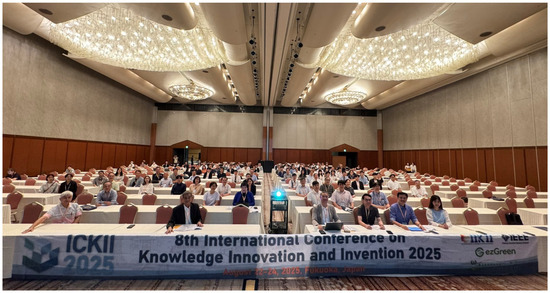
ICKII 2025 was held in a hybrid format, combining on-site and online presentations. Figure 1 features a group photo of the conference’s opening ceremony.
Figure 1.
A group photo at the opening ceremony of ICKII 2025.
Two keynote speeches were given by prominent scholars. The first keynote speech, entitled “Tokenized Real World Asset (RWA)–TranSurfing in Reality”, was presented by Dr. Vincent Ming, the CEO and Partner of Singapore Azura Investment Partners Pte. Ltd. (Figure 2). This keynote speech shares how tokenized real-world assets are reshaping the financial industry and the way we perceive and interact with the foundations of economic reality. The title itself bridges two domains: one grounded in tangible, measurable value of real-world assets such as real estate and commodities, and the other inspired by the possibility of TranSurfing, the concept of adjusting our perspectives and decisions, and is ‘surfed’ across different layers of reality toward desired outcomes.
Figure 2.
The first keynote speech at ICKII 2025.
In finance, tokenization represents more than a technological trend; rather, it is a paradigm shift. By converting assets, such as a USD 100 million office building, a solar farm, or even a vintage wine collection, into digital tokens on a blockchain, a range of new possibilities emerges. Fractional ownership, instant settlement, borderless transfer, and programmable cash flows become operational realities rather than theoretical ideals. Tokenization breaks down the barriers of geography, liquidity, and accessibility, transforming assets once reserved for limited groups of people into investment opportunities available to a much broader base of investors.
Through the lens of TranSurfing, Tokenized RWA enables looking beyond the “what” and “how” of blockchain technology, and considering the “why” and “where to.” What kind of reality do we wish to co-create within the global financial ecosystem? How can we position ourselves not merely to respond to transformation, but to guide it? And how do we ride this wave toward a fundamentally upgraded economic reality? The tide has arrived, the waves are rising, and the surfboards are ready. This keynote speech makes the audience learn how to step into this new reality consciously, strategically, and fearlessly.
The second keynote speech was given, entitled “The Driving Engines of Smart Healthcare: Integration and Clinical Practice of AI, MR, and Medical Robotics.” The keynote speech was presented by Professor Yi-Chun Du from the Department of Biomedical Engineering, National Cheng Kung University, Taiwan (Figure 3). With the flourishing integration of medical science and technology, robotic arms, mixed reality (MR), and AI models are widely applied in clinical assistance systems. Robotic arms offer high stability and precision, while AI-based 3D image analysis, combined with MR technologies, enhances the visualization of real-time surgical and intra-operative risk assessment. Such advances enhance surgical success rates while reducing the risk of post-operative infections. Two recent research outcomes from Professor Du’s team were presented.
Figure 3.
The second keynote speech at ICKII 2025.
In the automated dialysis fistula examination system, an ultrasound-guided robotic arm was used to automatically scan the fistula. An AI model was embedded to evaluate the degree of stenosis, providing consistent and objective measurements to improve the quality of patient care. In the dual-arm intelligent assistant system for liver cancer radiofrequency ablation, synchronous ultrasound scanning and AI multi-angle analysis were employed to plan the optimal ablation path. In addition, MR technology provided a see-through view of internal organs, including blood vessels and tumors, greatly assisting physicians with pre-operative planning and real-time monitoring during surgery.
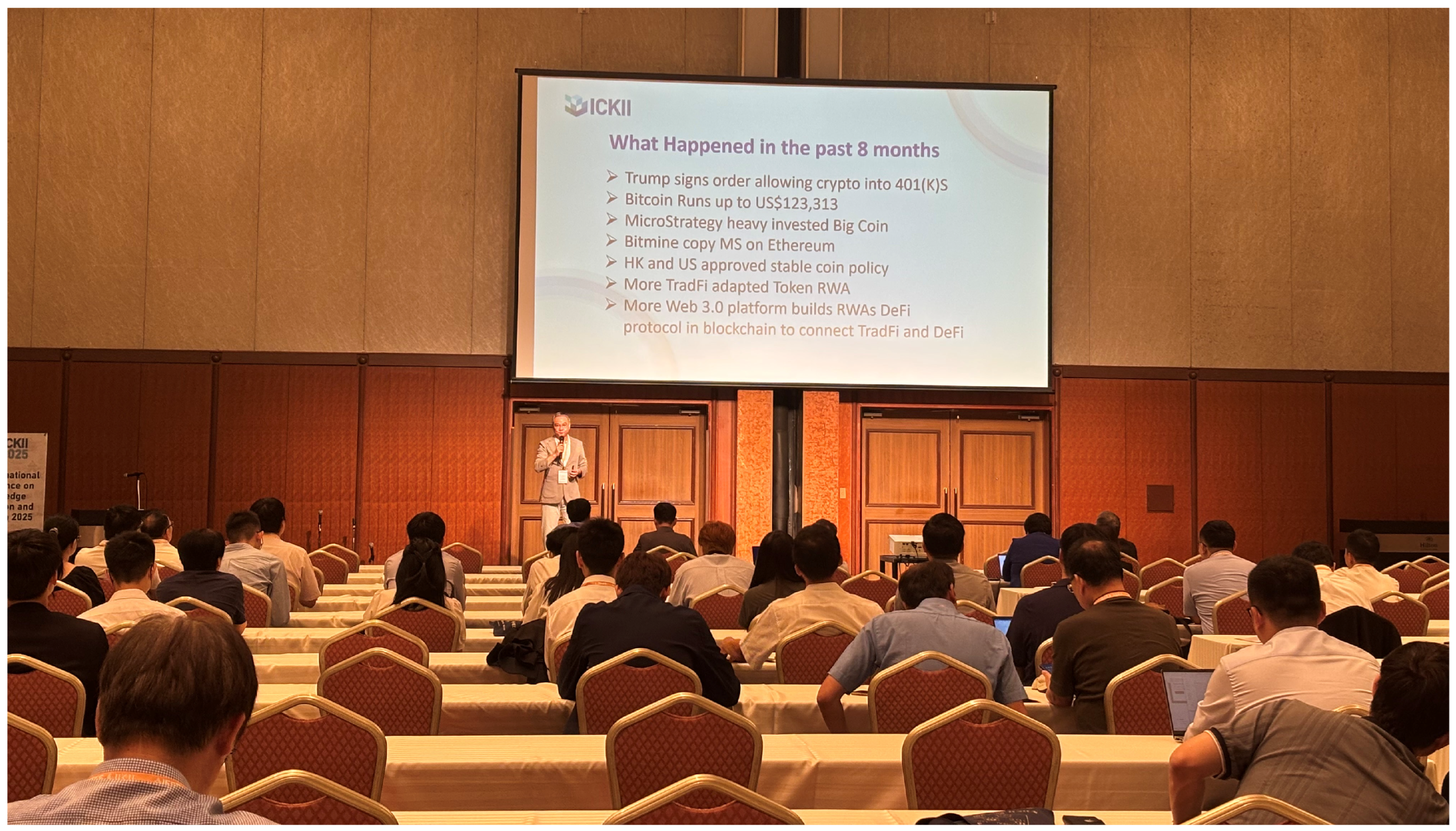
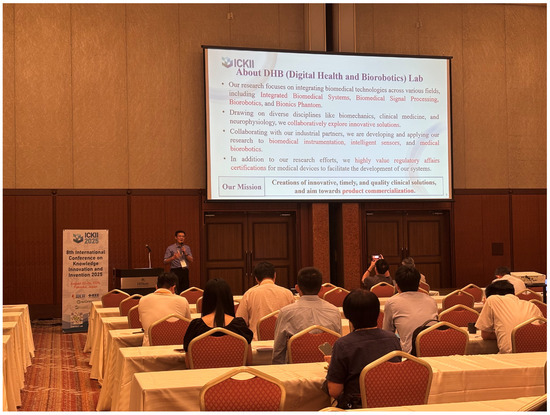
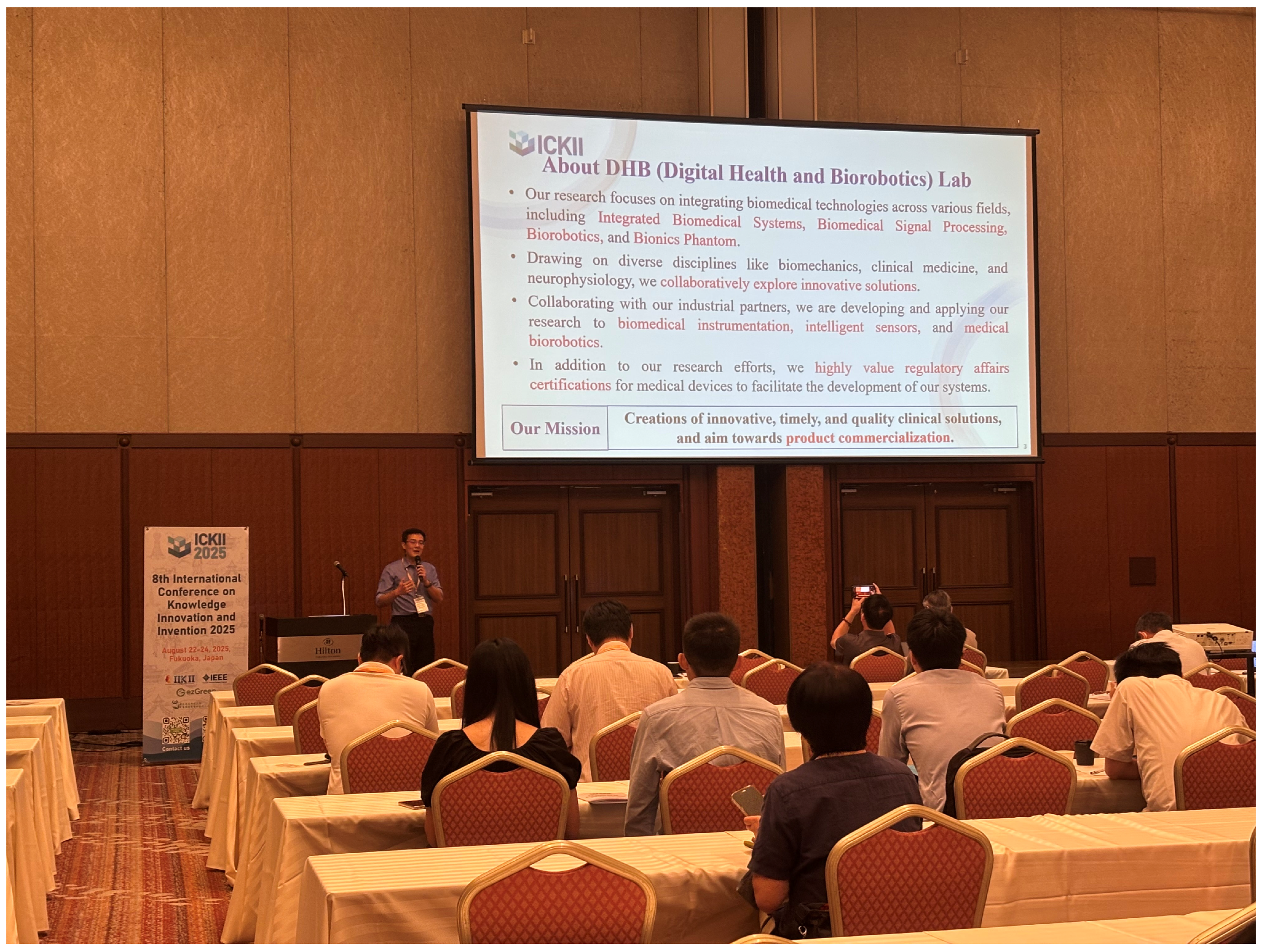
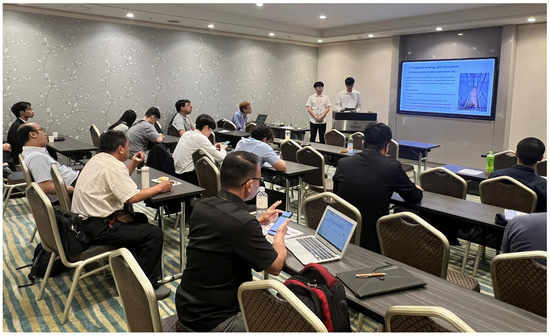
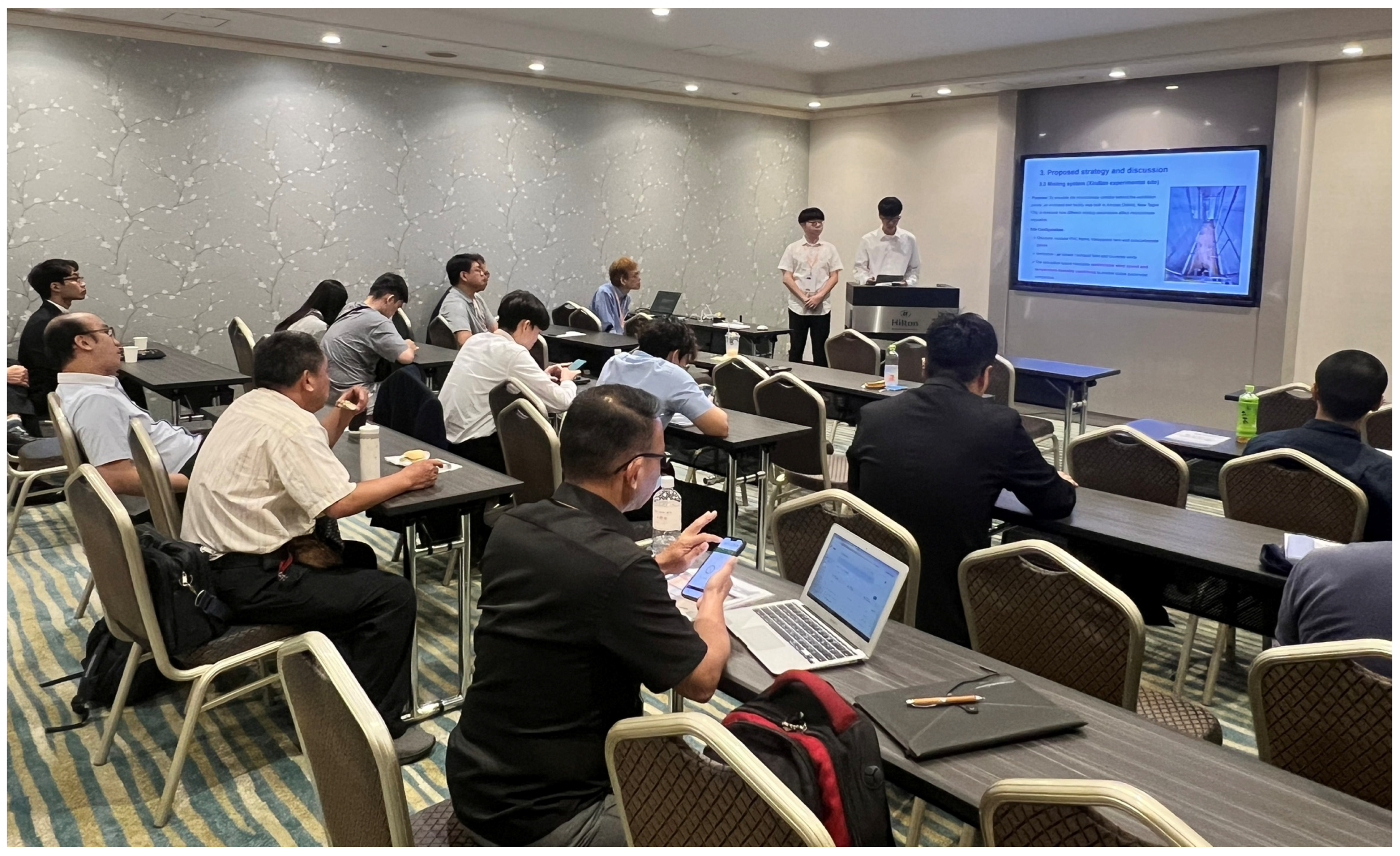
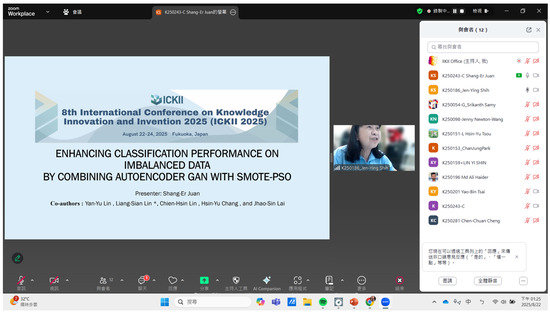
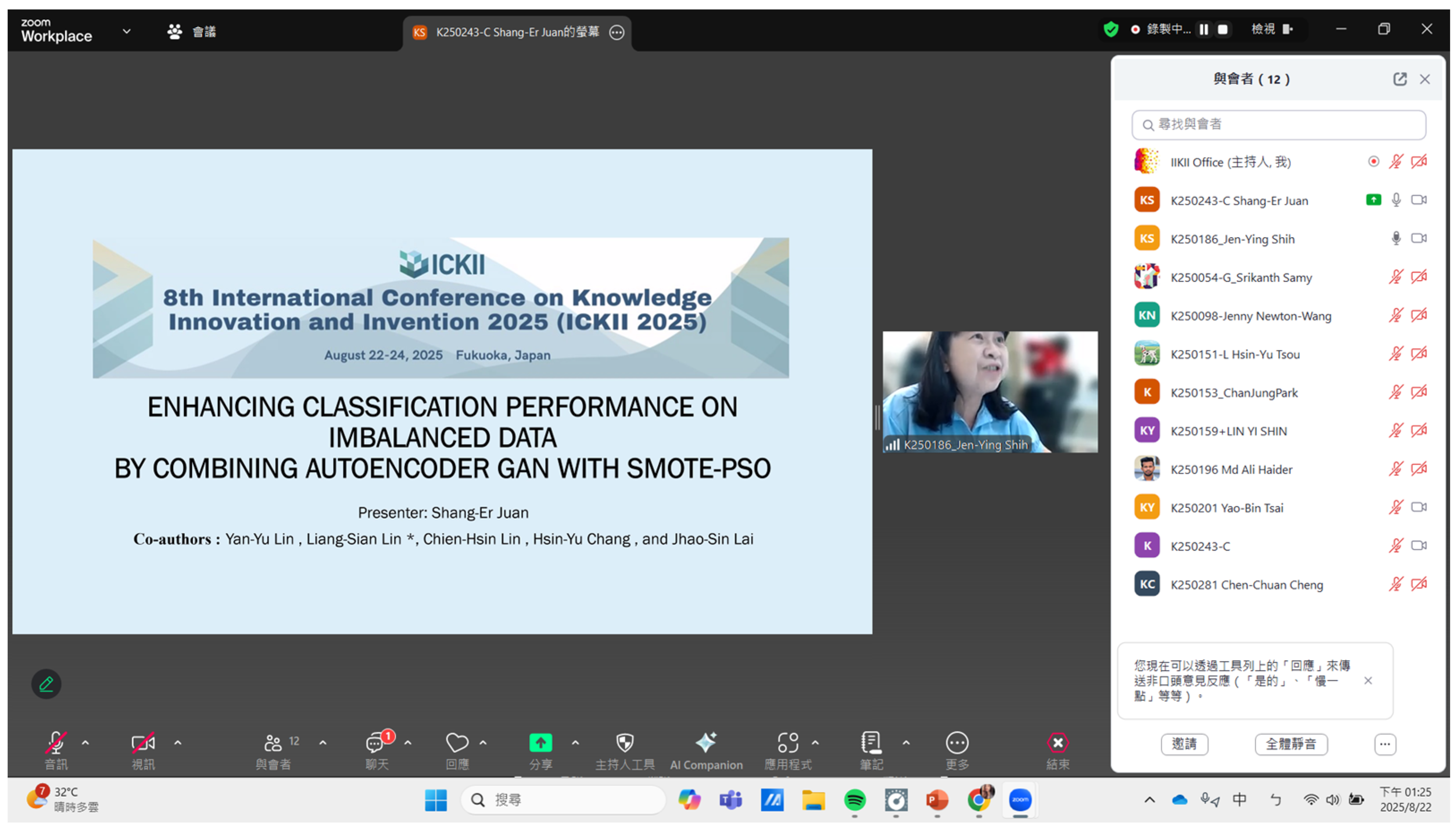
At ICKII 2025, 15 regular and 4 invited sessions were provided, including 240 papers from 10 countries. The contributions covered a wide range of scientific and engineering fields, including information technology, innovation design, bioengineering, communication science and engineering, industrial design, creative design, applied mathematics, computer science, electrical and electronic engineering, mechanical and automation engineering, green technology and architecture engineering, material science, and their related disciplines. Figure 4 and Figure 5 show on-site and online oral presentation sessions at the conference.
Figure 4.
A presentation at an on-site session of ICKII 2025.
Figure 5.
A presentation at an online session of ICKII 2025.
Substantial results were presented at ICKII 2025 by enthusiastic participants at the conference. Among them, 63 outstanding papers were selected through peer review for publication on Engineering Proceedings (ISSN: 2673-4591, indexed by Scopus). The proceedings of ICKII 2025 are expected to further accelerate the interdisciplinary collaboration among scientists and engineers in academia and industry while also strengthening global networking.
Conflicts of Interest
The authors declare no conflict of interest.
Disclaimer/Publisher’s Note: The statements, opinions and data contained in all publications are solely those of the individual author(s) and contributor(s) and not of MDPI and/or the editor(s). MDPI and/or the editor(s) disclaim responsibility for any injury to people or property resulting from any ideas, methods, instructions or products referred to in the content. |
© 2026 by the authors. Licensee MDPI, Basel, Switzerland. This article is an open access article distributed under the terms and conditions of the Creative Commons Attribution (CC BY) license (https://creativecommons.org/licenses/by/4.0/).