


Abstract
We developed a large language model-powered system that classifies complaint categories and adapts response styles for e-commerce reviews. By integrating sentiment clustering, zero-shot classification, and style-conditioned prompt engineering, it enables context-aware, emotionally aligned reply generation for enhancing automated customer interaction and reputation management.
1. Introduction
The explosion of user-generated reviews on e-commerce platforms has brought both opportunities and challenges for businesses. These reviews serve as real-time customer feedback, revealing satisfaction levels, emotional tone, and expectations for products and services. The result of Ref. [1] proposed a sentiment clustering system capable of identifying emotional polarity and grouping reviews by topic using a bidirectional encoder representation from transformers (BERT)-based embedding and a K-means pipeline. While the system effectively quantified emotional feedback and grouped it thematically, it lacked deeper contextual reasoning and stylistic adaptability in responses.
Building upon previous sentiment clustering work, this research adds a semantic classification layer and style-conditioned response generation for more precise and human-aligned review engagement. While detecting sentiment is a fundamental step in understanding customer dissatisfaction, it is not sufficient. Negative reviews are often diverse in content—some stem from sizing issues, others from poor quality, late delivery, or even customer service frustration. Furthermore, human communication is nuanced; not every negative comment demands a serious or apologetic tone—some may benefit from humor, empathy, or directness.
To address this, this research presents a system that classifies emotional polarity, identifies the main reason for dissatisfaction, and determines the most appropriate style for replying, using LLMs to automatically generate personalized brand responses. The system forms the backbone of the second-stage system for intelligent review management.
This research aims to develop an emotional and context-aware response system which (1) leverages zero-shot classification in Ref. [2] via LLMs to determine the core complaint category in a review, (2) infers an appropriate response style based on emotion and topic, (3) automatically generates contextually accurate and stylistically aligned brand replies using LLM prompts, and (4) integrates these results with previously developed sentiment and clustering outputs for comprehensive analysis.
The system developed presents a zero-shot prompt-based complaint classification module requiring no fine-tuning, a schema for style-adaptive response generation aligned with emotional tone and complaint category, and a structured data pipeline combining clustering, sentiment, complaint type, and LLM outputs into a unified dataset, demonstrating how LLMs can be prompted effectively to align content with style and function.
2. Complaint Classification Using LLMs
2.1. Zero-Shot Classification
A comprehensive framework combining prompt-based LLM with multimodal emotion-aware summarization was proposed in Ref. [3]. The use of aspect-aware attention is consistent with the focus of this study, which is to use pitch-guided cues for zero-shot complaint category classification of e-commerce reviews.
Traditional text classifiers require labeled data and fine-tuning, which can be costly and inflexible. This research extends prior sentiment clustering approaches by incorporating a semantic classification layer and style-conditioned response generation framework, enabling more precise and human-aligned review engagement. The proposed method employs zero-shot learning with LLMs to dynamically infer root causes of dissatisfaction directly from unstructured customer review text, eliminating the need for model retraining. This approach is flexible to category changes, adaptable across domains, and easily integrated into a prompt-based response generation pipeline.
2.2. Prompt Structure for Complaint Classification
A central component of this research is the use of a prompt. From a cognitive perspective, Prompt is the conditional input. In most LLM architectures (such as Together artificial intelligence (AI) in Ref. [4]), the core of the model is the conditional probability distribution, as shown in Equation (1).
where X is the input text, which is the prompt, and Y is the output generated by the model, which is the response. The essence of a prompt is to transform the problem description into X, then let the model maximize the conditional probability based on X.
More specifically, prompt forms a conditional probability space; given a prompt X, the goal of LLM is to predict the probability of each possible next Token , as shown in Equation (2).
where are the texts generated so far, and X is the entire prompt as one of the conditions. The key is that the prompt changes the initial hidden state and attention mechanism, so that subsequent generation is strongly guided by X.
Therefore, the prompt design can be modeled as an optimization problem. Assuming that the model output is expected to meet certain expected attributes (for example, the response should be “professional”), the goal is to find an optimal prompt that can make the generated text Y meet the expected attribute A to the greatest extent, expressed as (3):
where is a scoring function that evaluates whether the output Y meets the attribute A. Therefore, it can also be understood that prompt engineering is essentially a problem of condition shaping.
Based on review, inspection, and business-relevant concerns, we define six primary categories of customer dissatisfaction.
- Size or fit problem
- Material or quality issue
- Price or value dissatisfaction
- Shipping or delivery issue
- Customer service problem
- Other
These categories balance coverage and interpretability for both analysis and response design.
2.3. Prompt Template Design
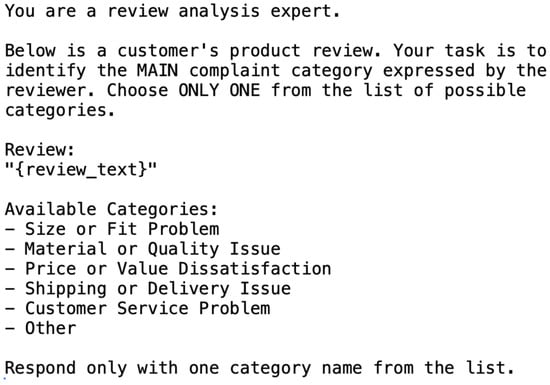
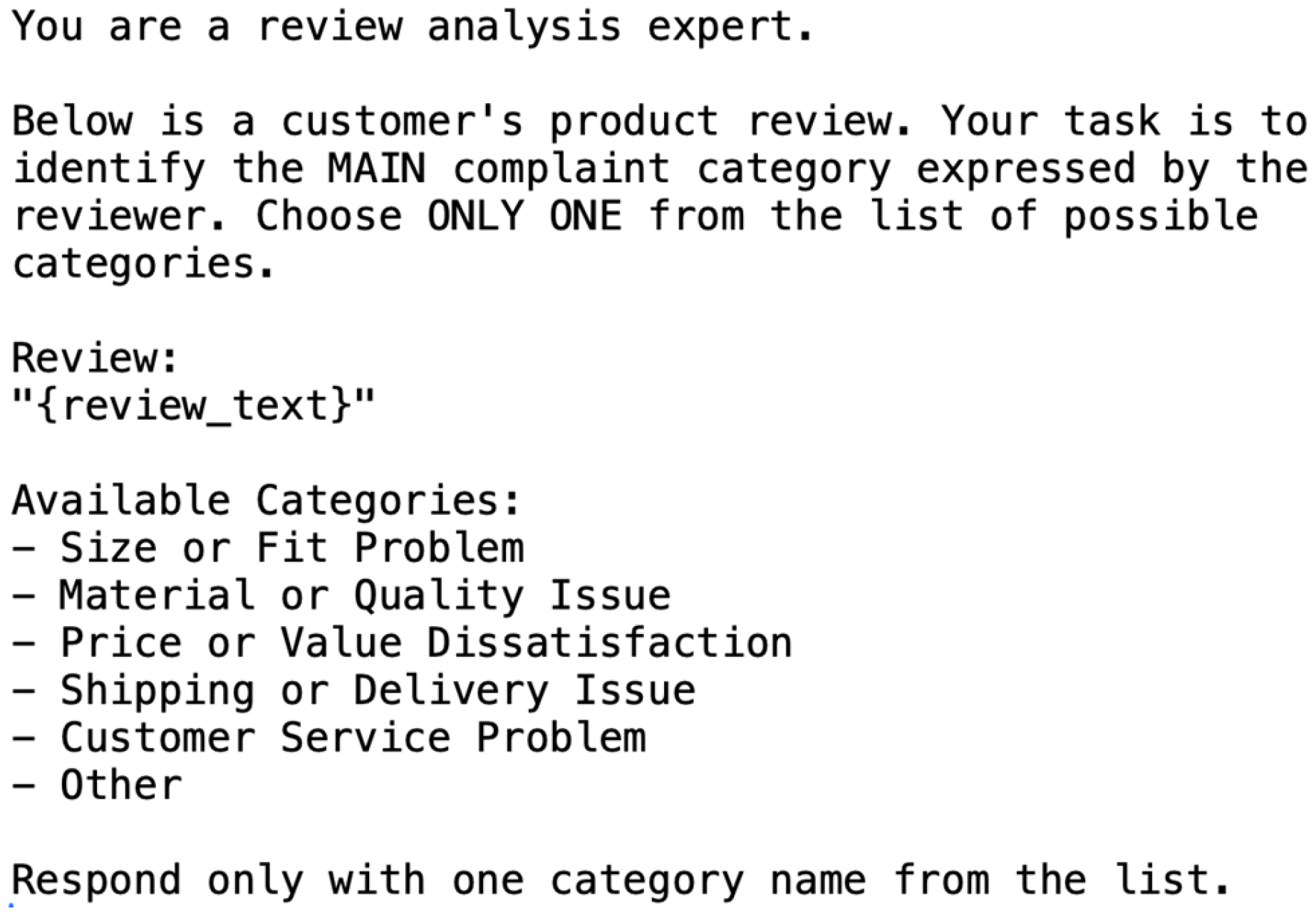
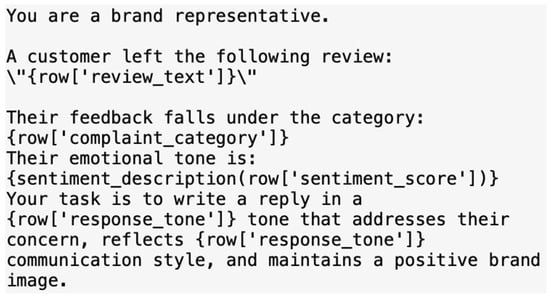
To enable accurate classification, this research proposed a consistent and instruction-following prompt structure for LLMs, as shown in Figure 1. In addition, this research can also automatically select different tones to generate responses based on the conditions in Table 1, according to the estimated emotional scores of customer reviews, where represents the sentiment score calculated based on the customer review of this record.
Figure 1.
Prompt proposed in this research.
Table 1.
Criteria for selecting corresponding tones.
2.4. Inference Process and Data Integration
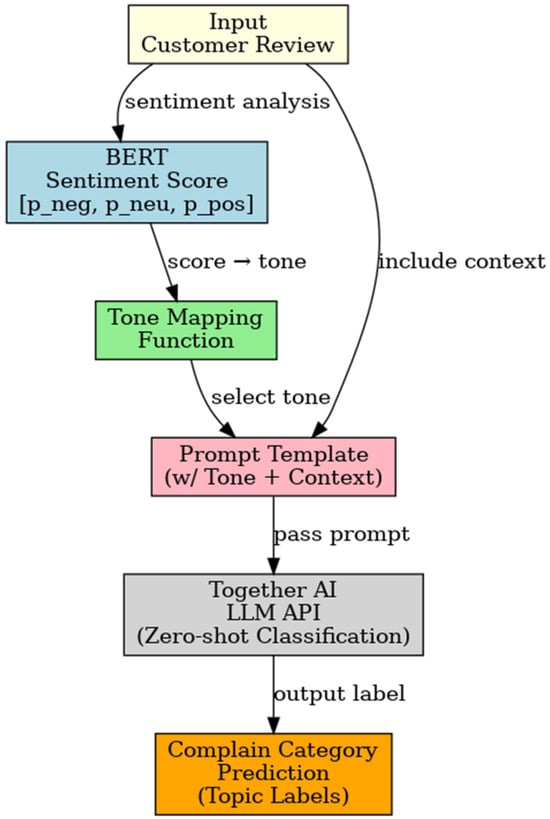
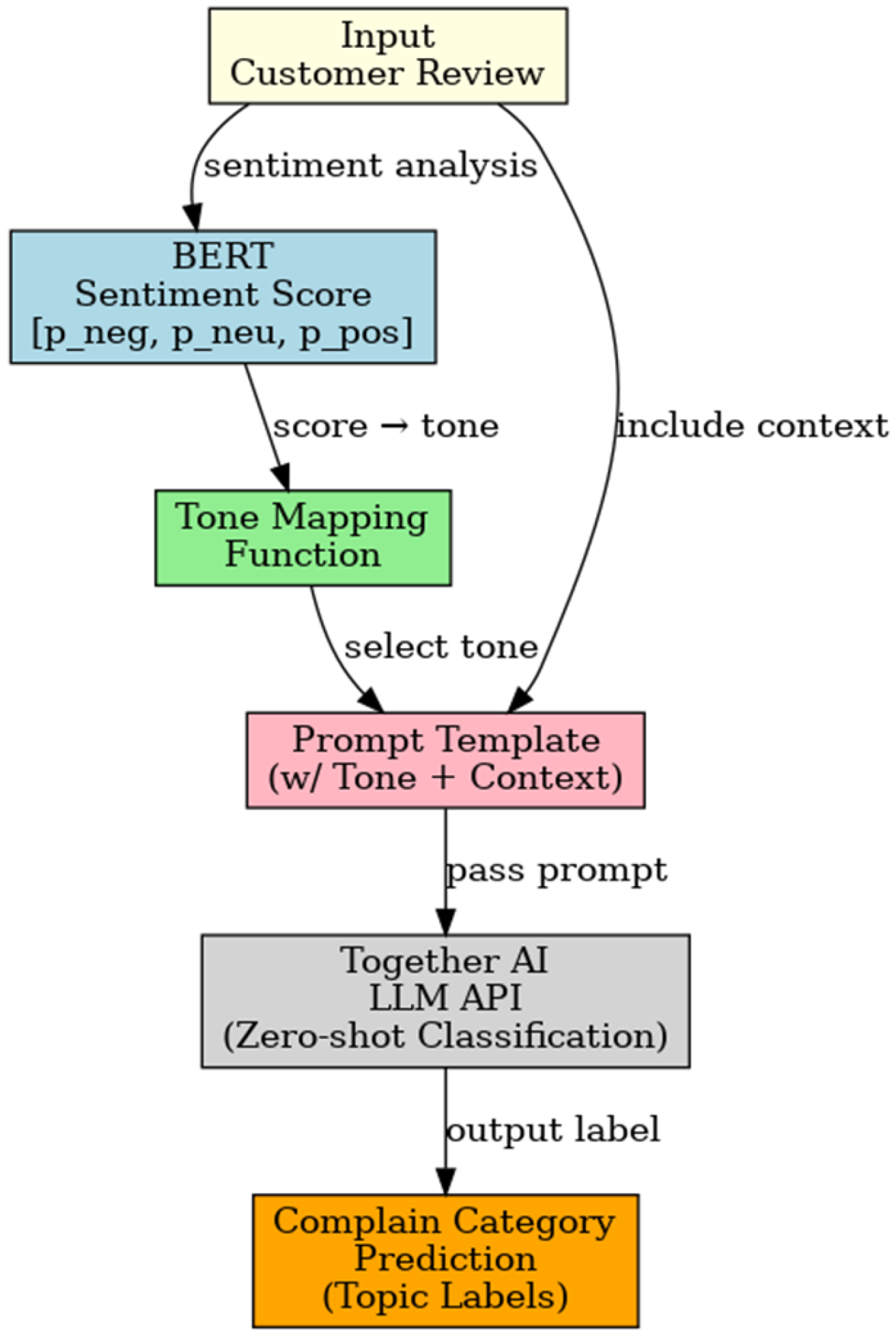
By applying the above prompt to each review in the dataset using Together AI, each response will be recorded as a new field in the dataset, which is named “complaint_category”. The proposed method enables high-semantic-resolution categorization of previously unlabeled free-text reviews. Representative classification outputs are presented in Table 2, while Figure 2 illustrates the end-to-end workflow of the LLM-based classification module.
Table 2.
Categorized output.
Figure 2.
Complete processing flow of the LLM classification module.
3. System Architecture
3.1. Overview
The complete system is composed of the following five modules.
- Text preprocessing and embedding module
- Sentiment analysis module
- Complaint category classification module (LLM-based zero-shot)
- Response style selector
- LLM prompt construction and response generator
3.2. Text Preprocessing and Embedding Module
Prepare review data for semantic and sentiment analysis by cleaning and embedding each review into a high-dimensional space. Let be a raw review. The defined preprocessing logical function is expressed in Equation (4).
Based on Ref. [1], we applied a pretrained BERT model to extract the [CLS] token embedding as the sentence representation, as shown in (5).
3.3. Sentiment Analysis Module
Following the fundamental sentiment estimation framework [1], the sentiment probability distribution across classes can be computed as shown in Equation (6). Subsequently, a scalar sentiment score is defined in Equation (7), where and represent the positive and negative class probabilities, respectively. The sentiment labeling scheme is adopted from Ref. [1], as presented in Equation (8), where represents scalar sentiment score in Equation (7).
3.4. LLM-Based Complaint Category Classification Module
Given a review , this research defined a prompt template shown in Equation (9), where C is a set of category labels and expressed in Equation (10), then the LLM is instructed to return a categorized answer shown in Equation (11), where represents the returned answer, is the LLM. This is a zero-shot inference task with constrained output.
3.5. Response Style Selector
Let S denote the space of available response styles. The appropriate tone for addressing complaints varies depending on their nature. For instance, a humorous tone may effectively mitigate frustration in cases involving minor fit issues, whereas a serious and professional tone is imperative when handling complaints related to product defects or service failures. This module predicts the optimal response style by leveraging both sentiment analysis scores and complaint categorization, as formalized in the mapping defined in (12). The style selection function is defined in Equation (13), where represents the i-th complaint category and represents scalar sentiment score in Equation (7), which implements the rule-based mapping specified in Table 1.
3.6. LLM-Based Brand Response Generator
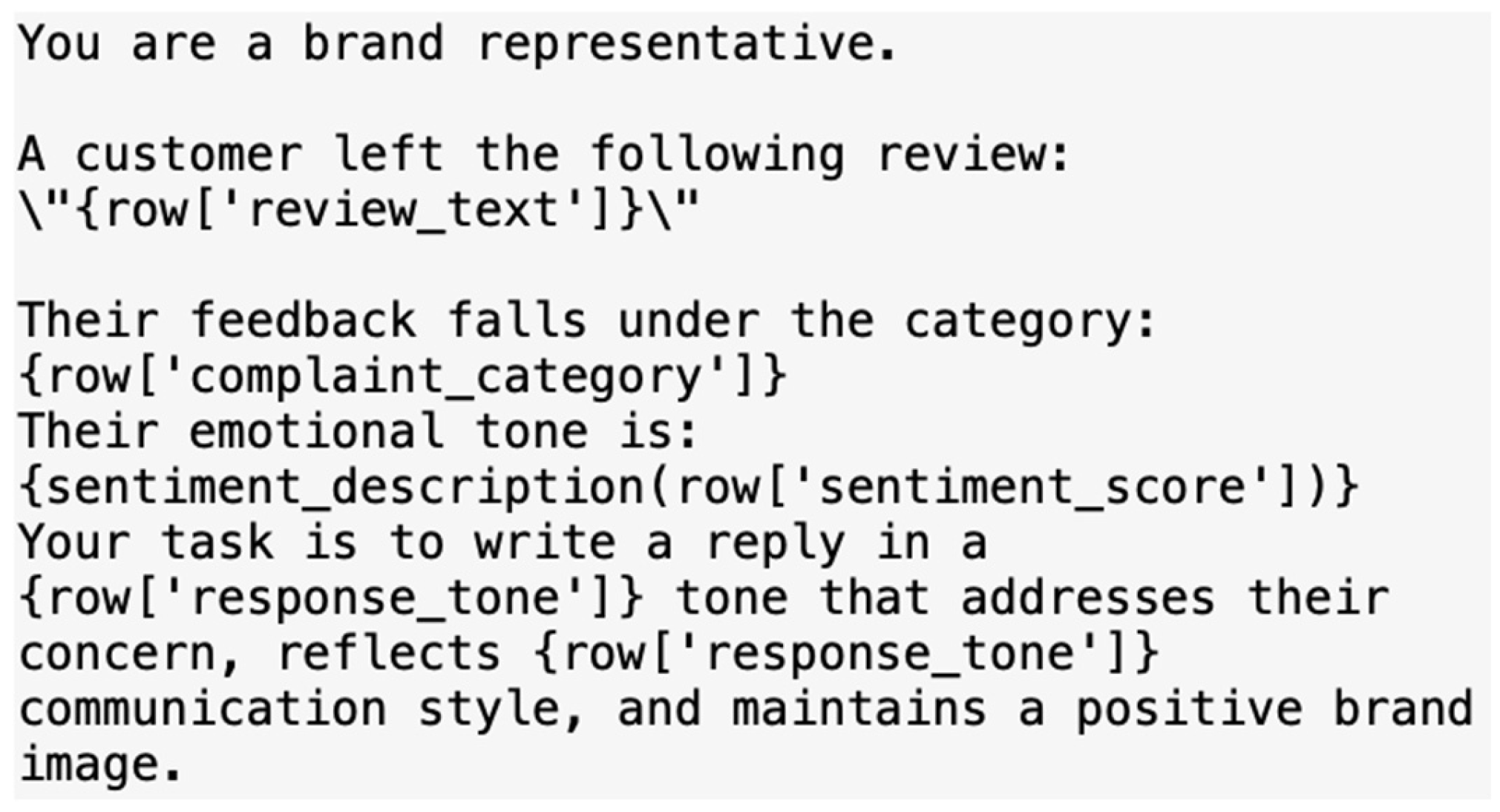
This module generates a personalized and context-aware response to each customer review using LLM, based on the emotion score, complaint category, and selected response style illustrated in Equation (14), where is the review text, the response tone will be selected by (13), and sentiment descriptions corresponding to are illustrated in Equation (15). The template to generate prompts is shown in Figure 3.
Figure 3.
Template to generate prompts.
4. Implementation Result
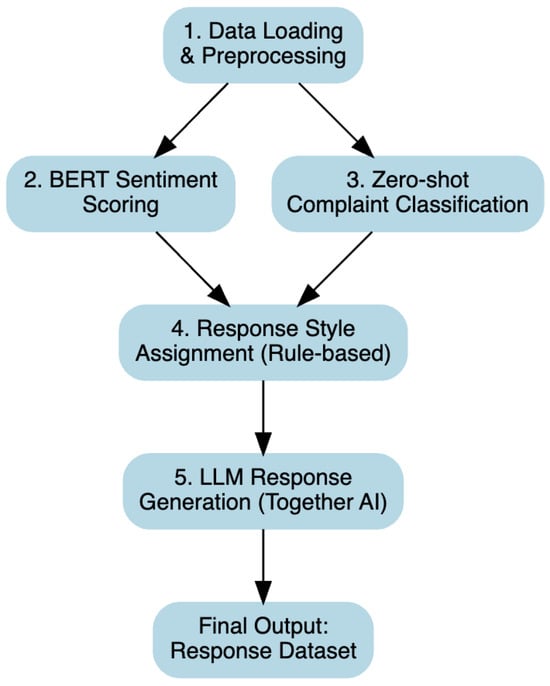
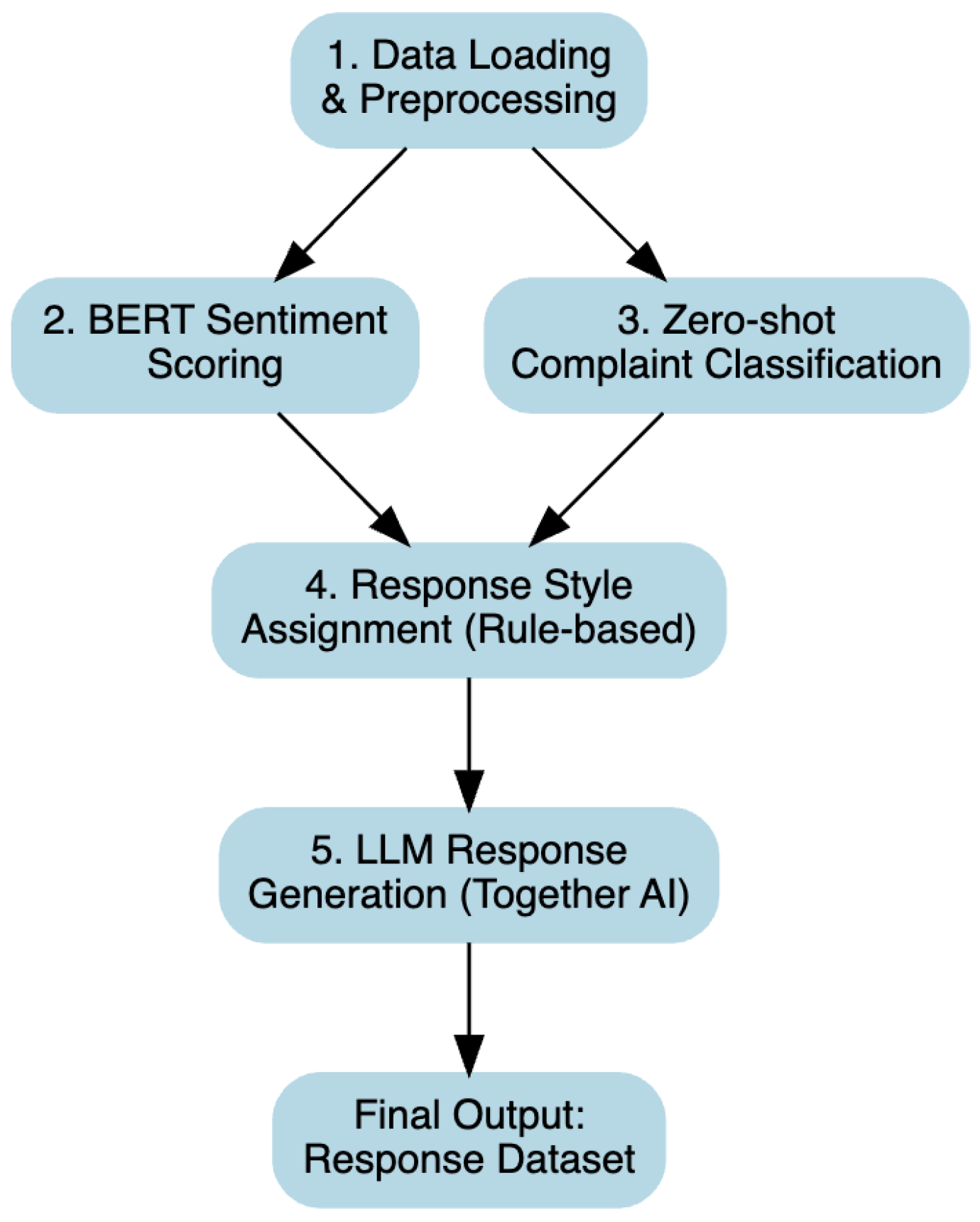
To implement the system of this research, the same dataset, Women’s Clothing E-Commerce Reviews from Kaggle in Ref. [5], was chosen. The implementation pipeline is shown in Figure 4.
Figure 4.
Proposed implementation pipeline.
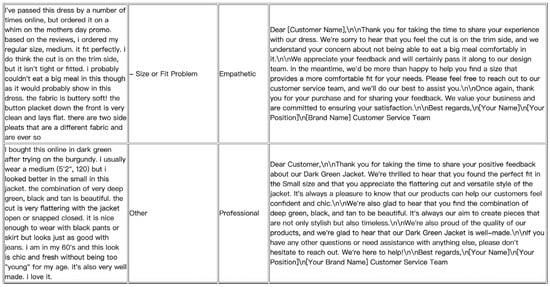
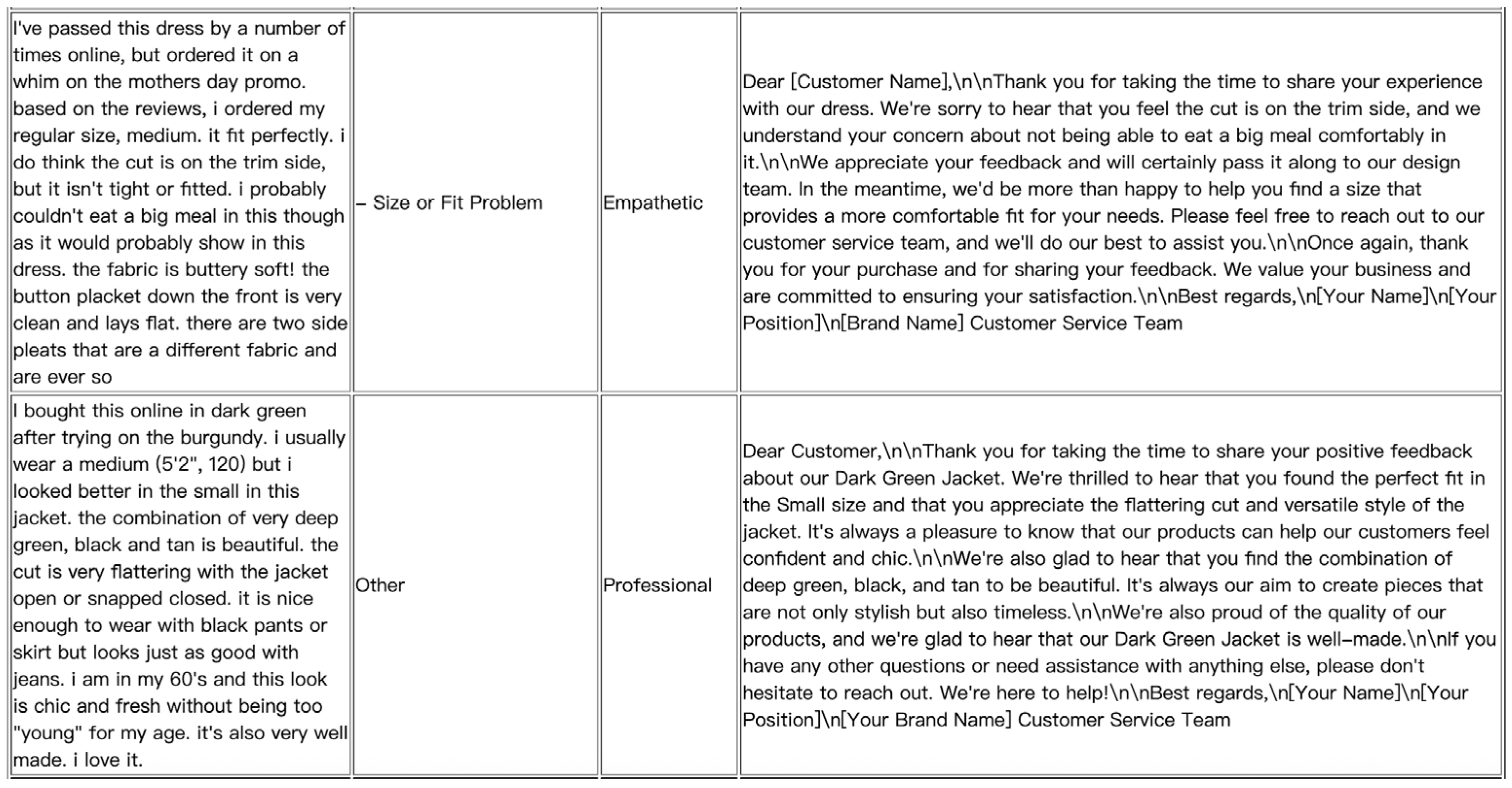
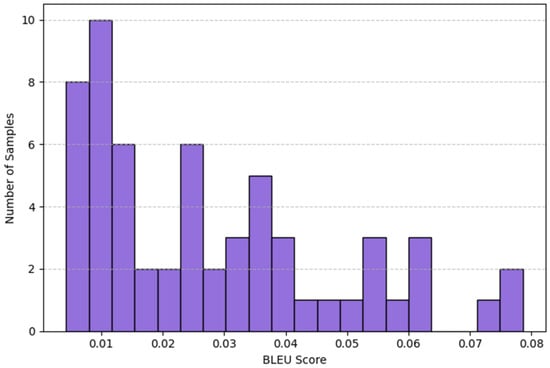
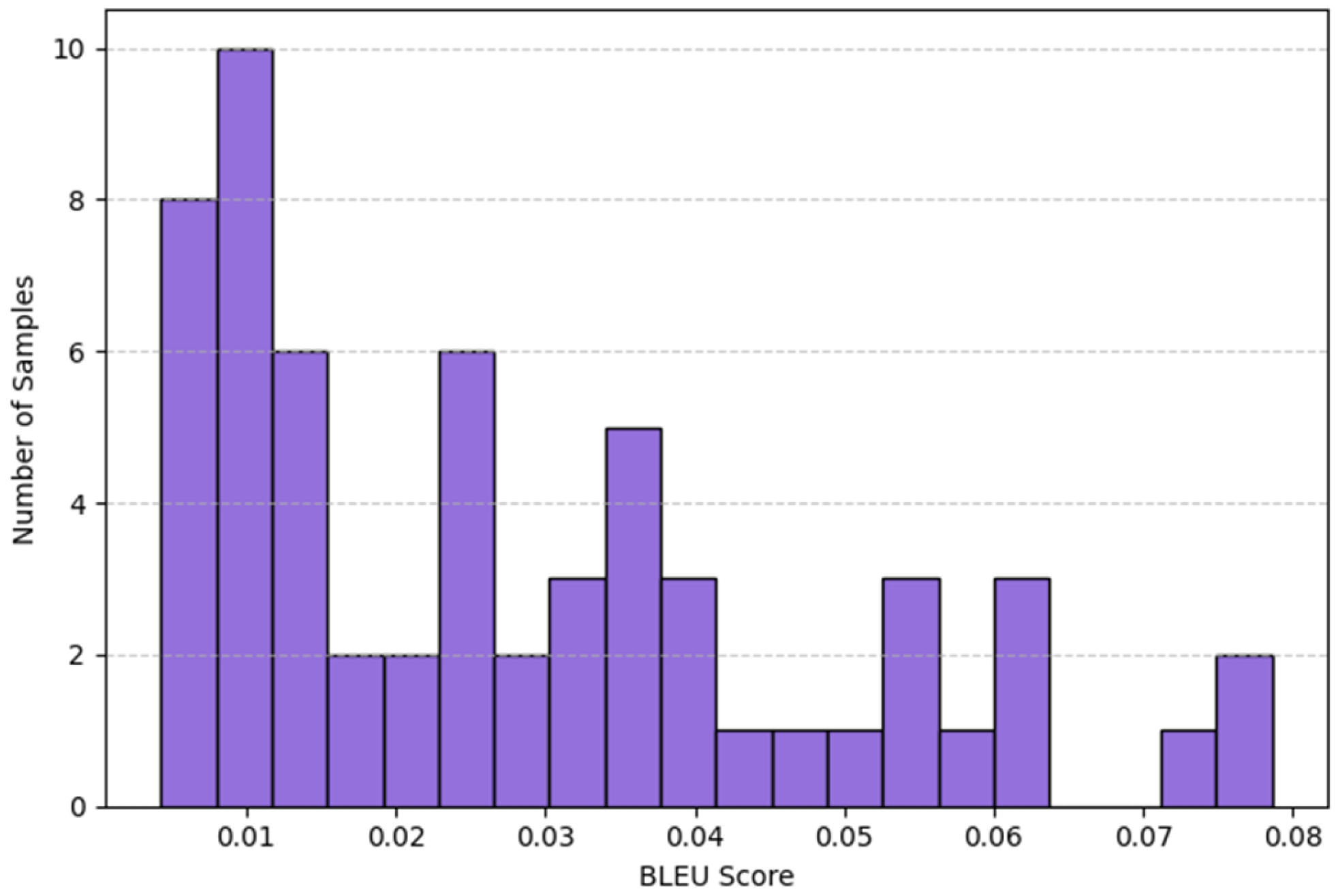
When analyzing the effectiveness and quality of each implemented module, special attention should be paid to the zero-shot complaint category classification, rule-based response style selection, and the content of responses generated by LLM. The analysis results combine distributional metrics (counts by category/style), qualitative review samples, and human interpretation of the adequacy of responses. The system automatically generates the text content of the response through the LLM, as shown in Figure 5, and evaluates the effect with the Bilingual Evaluation Complementarity (BLEU) score in Ref. [6], as shown in Figure 6. The research results show the expected results after being implemented according to the theoretical inference.
Figure 5.
Mapping of customer reviews and generated responses.
Figure 6.
Evaluation results using the BLUE score.
5. Conclusions
This study presents a modular, fully automated framework that integrates sentiment analysis and LLMs to enable real-time, emotionally attuned responses to e-commerce customer reviews. Expanding upon prior sentiment clustering work, two key enhancements are introduced: A: a zero-shot complaint classification module leveraging prompt-based LLM inference to identify dissatisfaction causes without supervised data, and B: a response generation mechanism that adapts tone and content according to emotional polarity and complaint type.
These contributions collectively enable scalable and context-sensitive brand communication. The system not only reduces the manual burden of customer service but also improves consumer trust and brand perception by providing stylistically appropriate, empathy-aware replies. Furthermore, the integration of interpretable complaint categories offers actionable insights into product and service optimization.
As digital commerce continues to expand, the proposed framework offers a viable blueprint for developing emotion-aware AI agents that support automated reputation management, intelligent customer engagement, and data-driven product feedback cycles.
Author Contributions
Conceptualization, C.-H.L. and Y.L.; methodology, C.-H.L.; investigation, T.-S.L.; resources, T.-S.L. and Y.L.; writing—original draft preparation, C.-H.L.; writing—review and editing, C.-H.L. and Y.L. All authors have read and agreed to the published version of the manuscript.
Funding
This research received no external funding.
Institutional Review Board Statement
Not applicable.
Informed Consent Statement
Not applicable.
Data Availability Statement
Data are available at https://drive.google.com/drive/folders/10J0PxvD1k-hUtHTpmasOGGSKdwchQRK0?usp=drive_link (accessed on 29 January 2026).
Conflicts of Interest
The authors declare no conflict of interest.
References
- Lai, C.-H.; Yaonan, H.; Lin, Y.; Liu, T.-S. Research on Designing a Composite Machine Learning System for Real-Time Response to Negative Online Reviews: A Case Study Based on the Negative Reinforcement Model of Digital Marketing. In Proceedings of the 8th International Conference on Knowledge Innovation and Invention, Fukuoka, Japan, 22 August 2025. [Google Scholar]
- Zero-Shot Classification of Crisis Tweets Using Instruction-Finetuned Large Language Models. Available online: https://arxiv.org/abs/2410.00182 (accessed on 20 November 2025).
- Large Language Models Meet Text-centric Multimodal Sentiment Analysis: A Survey. Available online: https://arxiv.org/abs/2406.08068 (accessed on 20 November 2025).
- Together AI. Available online: https://www.together.ai/ (accessed on 20 November 2025).
- Women’s E-Commerce Clothing Reviews. Available online: https://www.kaggle.com/datasets/nicapotato/womens-ecommerce-clothing-reviews (accessed on 20 November 2025).
- Papineni, K.; Roukos, S.; Ward, T.; Zhu, W.-J. BLEU: A Method for Automatic Evaluation of Machine Translation. In Proceedings of the 40th Annual Meeting of the Association for Computational Linguistics, Philadelphia, PA, USA, 7–12 July 2002. [Google Scholar]

Disclaimer/Publisher’s Note: The statements, opinions and data contained in all publications are solely those of the individual author(s) and contributor(s) and not of MDPI and/or the editor(s). MDPI and/or the editor(s) disclaim responsibility for any injury to people or property resulting from any ideas, methods, instructions or products referred to in the content. |
© 2026 by the authors. Licensee MDPI, Basel, Switzerland. This article is an open access article distributed under the terms and conditions of the Creative Commons Attribution (CC BY) license.