Proceeding Paper

Obstacle Avoidance for Multirotor Urban Air Mobility via Prediction-Based Control Barrier Functions †
by
Ali Mesbah
1,
Jafar Roshanian
2,* and
Dimitar Ginchev
3
1
Department of Aerospace Engineering, Sharif University of Technology, Tehran 1458889694, Iran
2
Faculty of Aerospace Engineering, K.N. Toosi University of Technology, Tehran 1969764499, Iran
3
Faculty of Transport, Technical University of Sofia, 1000 Sofia, Bulgaria
*
Author to whom correspondence should be addressed.
Presented at the 17th International Scientific Conference on Aerospace, Automotive, and Railway Engineering (BulTrans-2025), Sozopol, Bulgaria, 10–13 September 2025.
Eng. Proc. 2026, 121(1), 30; https://doi.org/10.3390/engproc2025121030
Published: 2 February 2026

Abstract

This paper applies the recently developed Prediction-Based Control Barrier Functions (PB-CBFs) to the obstacle avoidance problem for multirotor air taxis in Urban Air Mobility (UAM). Unlike conventional Control Barrier Functions (CBFs), PB-CBFs incorporate escape path predictions into the formulation, facilitating safe controller design for dynamical systems with high relative degree and enabling safety under strict control constraints. We first review the PB-CBF framework, then formulate the safety requirements specific to the collision avoidance problem and derive the corresponding invariance conditions. Finally, we validate our approach through simulation of the obstacle avoidance scenario, demonstrating the efficacy of PB-CBFs in ensuring safety in UAM operations and providing additional insight into the mechanism by which predictions are leveraged to enforce safety.

1. Introduction

The rapid advancement of Urban Air Mobility (UAM) has brought forth new challenges in guaranteeing the safety of multirotor aerial vehicles navigating through dense, uncertain, and dynamic environments. In such contexts, ensuring obstacle avoidance is critical, not only for mission success but also for public safety and regulatory compliance. Traditional motion planning techniques may fall short in real-time performance or, especially when fast, reactive behavior is needed. This calls for real-time safety filtering frameworks that can guarantee constraint satisfaction during closed-loop execution.
Control Barrier Functions (CBFs) have emerged as a powerful tool for synthesizing such safety filters, enabling the design of controllers that ensure forward invariance of a predefined safe set [1,2]. CBFs have been successfully applied to a range of robotic systems, including ground and aerial vehicles [3,4,5,6,7,8]. However, most existing CBF formulations are myopic, relying on instantaneous state measurements and local system dynamics. This limitation necessitates overly conservative behavior, especially when dealing with systems with low control authority for which a longer-term view is critical.
Furthermore, when dealing with systems of high relative degree, the task of formulating the CBF itself becomes non-trivial. This problem has been approached in a great number of ways, such as exponential or high-order generalizations [9,10,11], or the extension of the Lyapunov backstepping method to the CBF formulation [12]. However, in addition to the aforementioned conservative behavior, these approaches often rely on intensive derivations, especially when dealing with complex systems with a high relative degree.
The recently developed Prediction-Based Control Barrier Function (PB-CBF) framework introduces a prediction-based safety margin into the CBF formulation, enabling the synthesis of safety filters that can produce feasible control solutions even in the presence of input constraints [13]. The central idea is to simulate the system’s future trajectory under a designated escape controller toward an escape set, and then identify the point of minimum predicted safety along that trajectory. This information is used to compute a safety margin that quantifies how close the system is to constraint violation. A great advantage of the approach is its applicability to high relative degree systems, provided as feasible escape controller could be designed. While the PB-CBF approach shares conceptual similarities with the Backup CBF framework introduced in [14,15], it differs in key aspects, notably, the terminal set used during prediction and the fact that PB-CBFs employ a variable prediction horizon instead of a fixed one.
The recent surge of interest in UAM has led to extensive studies on every aspect of the topic. Studies, such as [16,17], address the advantages and drawbacks of different UAM configurations. Others work to produce useful models for performance analysis and control design [18,19]. Correspondingly, planning and control approaches for different UAM configurations have also been subject to considerable study [20,21,22,23].
In this paper, we contribute to the last of these categories by demonstrating the PB-CBF framework on a UAM quadrotor model. A three degrees of freedom (DoF) planar model has been chosen to represent a simplified yet practically relevant UAM platform operating in urban terrain. Despite the reduced dimensionality, the obstacle avoidance task represents a core safety consideration present in real-world low-altitude urban flight. The proposed PB-CBF safety filter is formulated independently from the primary controller. As a result, it is broadly applicable in piloted and autonomous UAM vehicles of the aforementioned configuration. We demonstrate the efficacy of the proposed approach via a simulation of the UAM aircraft model performing terrain avoidance.
The remainder of this paper is structured as follows. In Section 2, we present the preliminary material pertaining to PB-CBFs, including the relevant definitions and theorems, and the adopted notation. We also provide some insight into the implementation of the PB-CBF framework. Subsequently, in Section 3, we model the UAM aircraft as well as the obstacle it is to avoid, deriving the state space representation of the system. In Section 4, we implement the PB-CBF framework on the system, focusing primarily on the escape set and controller design; presenting the results and providing analysis and insight into the functionality of PB-CBFs in Section 5. Lastly, in Section 6, we provide a conclusion and some directives for future research.

2. Preliminaries

This section briefly introduces the formulation and underlying concepts of PB-CBFs, used as tools for safe, input-constrained control synthesis. We provide the relevant definitions and theorems necessary for implementing PB-CBFs, while omitting proofs, as their theoretical development lies outside the scope of this paper. It is assumed that the reader is familiar with the fundamentals of safety-critical control using CBFs; however, a comprehensive overview can be found in [2].

2.1. Background and Notation

Before introducing the PB-CBF formulation, we first formally present the problem of safety-critical control under input constraints. We also introduce the specialized notation adopted throughout the paper, which facilitates a more comprehensive expression of the PB-CBF formulation and its functionality.
The problem considers the general case for nonlinear dynamical systems:
x ˙ = f ( x , u ) ,
where f: n × mn is a Lipschitz continuous function. Subsequently, given a safe set C with a corresponding continuously differentiable function h(x): n such that
C = x : h ( x ) 0 , C = x : h ( x ) = 0 , Int ( C ) = x : h ( x ) > 0 .
and ∂h/∂x0x ∈ ∂C, it is desired to synthesize a controller u*(x): n → Uc that renders (1) forward invariant in C, where Ucm is the prescribed input constraint set.
The set C is commonly referred to as the superlevel set of h. For convenience, we shall refer to any function h satisfying the above properties as a superlevel function (SLF) of C. It is important to note that no assumptions are made regarding the relative degree of h.
We introduce the notation used throughout this section, along with the state transition maps (also referred to as state flow maps), which play a central role in the formulation. To this end, consider a controller ui(x) with i ∈ {0, 1, 2, …}, and define the closed-loop dynamics it imposes on (1) as follows:
x ˙ = f ( x , u i ( x ) ) f i ( x ) .
Additionally, the rate of change in h induced by the dynamics (3) is denoted as follows:
h ˙ i ( x ) h x | x f i ( x ) .
Assuming the existence of a unique solution to (3) for a given initial condition xn, this solution is represented by a state transition map ϕ i ( τ , x ) governed by
ϕ i ( τ , x ) x ( t ) + 0 τ f i ( ϕ i ( τ , x ) ) d τ ϕ ˙ i = f i ( ϕ i ) s . t . ϕ i ( 0 , x ) = x ,
where τ ≥ 0. The sensitivity Jacobian of the state transition map Φi( τ , x )   ϕi/ x is therefore given by
Φ ˙ i = f i ϕ ϕ i Φ i s . t . Φ i ( 0 , x ) = I .
Also, considering a unique event labeled by j ∈ {∅, 0, 1, 2, …} (∅ meaning no label) that occurs along the paths generated by the dynamics (5), the time at which this event occurs is denoted by T j   i (x) ≥ 0.

2.2. Prediction-Based Control Barrier Functions

As the first step toward introducing PB-CBFs, the notion of an escape set shall first be defined.
Definition 1 (Escape Set). 
A closed set S ⊆ ℝn is an escape set for an SLF h(x) of C, if SC is non-empty and there exists a controller u0(x): ℝnUc subject to which the dynamics x ˙   =   f 0 ( x ) is forward invariant in S, and ḣ0(x) ≥ 0 ∀ xS.
Informally, Definition 1 gives the escape set as a set of states where the system is turning away from the boundary of the safe set or can instantaneously be made to do so.
In addition to the property outlined for all xS in Definition 1, the controller u0(x) is also assumed to deliver the system to the escape set in finite time from all initial conditions xC\S. A formal statement of this assumption is as follows.
Assumption 1.
For all xC\S, there exists a continuous T0(x) > 0, such that ϕ0(T0,x) ∈ ∂S and ϕ0(τ,x) ∉ S for all τ < T0. Furthermore, let T0(x) =  0 for all xS.
A controller u0(x) that satisfies Definition 1 and Assumption 1 shall be referred to as an escape controller. The corresponding trajectories ϕ 0 ( τ , x ) generated under this controller are called escape paths. For a given dynamical system, both the escape set and the controller must be designed to satisfy these conditions.
With the fundamental assumptions introduced, PB-CBFs may now be defined as follows.
Definition 2 (Prediction-Based Control Barrier Function).
Given the dynamical system (1), the continuously differentiable function h(x): n with the corresponding superlevel safe set C and the input constraint uUc, the function hP(x) =  h(x) + δh(x) where
δ h ( x ) m i n t [ 0 , T 0 ( x ) ] 0 t h ˙ 0 ( ϕ 0 ( τ , x ) ) d τ ,
is a prediction-based control barrier function (PB-CBF) on C for the constraint uUc, if the state transition maps ϕ0(τ,x) are escape paths for the dynamics (1) and the SLF h, with the corresponding escape set S and controller u0(x).
The gradient of δh is also required for implementing a PB-CBF hP. To compute this gradient, which is denoted by δhx, when δh(x) < 0, we may define T 0 0 (x) ≥ 0 as the smallest value for which the following holds:
0 T 0 0 ( x ) h ˙ 0 ( ϕ 0 ( τ , x ) ) d τ = min t [ 0 , T 0 ( x ) ] 0 t h ˙ 0 ( ϕ 0 ( τ , x ) ) d τ .
Subsequently, the gradient is given by
δ h x ( x ) = 0 T 0 0 ( x ) f 0 T ( ϕ 0 ( τ , x ) ) 2 h ϕ 2 ϕ 0 ( τ , x ) + h ϕ ϕ 0 ( τ , x ) f 0 ϕ ϕ 0 ( τ , x ) Φ 0 ( τ , x ) d τ .
The state ϕ0( T 0 0 (x),x), which corresponds to the point along the predicted trajectory where the minimum value of h is attained, is referred to as the critical state. It represents the most safety-critical point encountered before reaching the escape set.
With PB-CBFs defined, the corresponding invariance condition is formalized in the following theorem.
Theorem 1.
Given the dynamics (1), the set C with the SLF h(x), and the set Uc. Let hP(x) be a PB-CBF on C with the corresponding escape set S and control law u0(x) ∈ Uc, then there exists a controller u*(x) ∈ Uc for all xCP where
C P = x : h P ( x ) 0 ,
such that,
h ( x ) x + δ h x ( x ) f ( x , u * ( x ) ) + α h P ( x ) 0 ,
for an arbitrary class K function α(·), rendering the system invariant on CP.
In the specific but common case where the system is in the control-affine form:
x ˙ = f ( x ) + G ( x ) u ,
where f: nn and G: nn×m, when δh(x) < 0, (11) may be simplified to the following:
h ( x ) x + δ h x ( x ) G ( x ) [ u * ( x ) u 0 ( x ) ] + α [ h P ( x ) ] 0 .
This alternative formulation is significant as it could allow for computational efficiency by eliminating the need to evaluate some of the entries in δhx.
With the PB-CBF framework established, we now turn to the formulation of the obstacle avoidance problem for UAM.

3. Flight and Terrain Modeling

In this section, we introduce a flight model of a UAM multirotor operating near terrain. Considering an air taxi in a quadrotor configuration, we present the corresponding 3-DoF equations of motion along with the relevant physical parameters. We then derive the state space representation of the system. Finally, we introduce a terrain elevation model, assuming topological obstacles.

3.1. The Aircraft Model

As previously mentioned, we consider the vehicle’s motion restricted to the vertical plane and neglect lateral dynamics. Under these assumptions, we present a 3-DoF model for quadrotor flight.
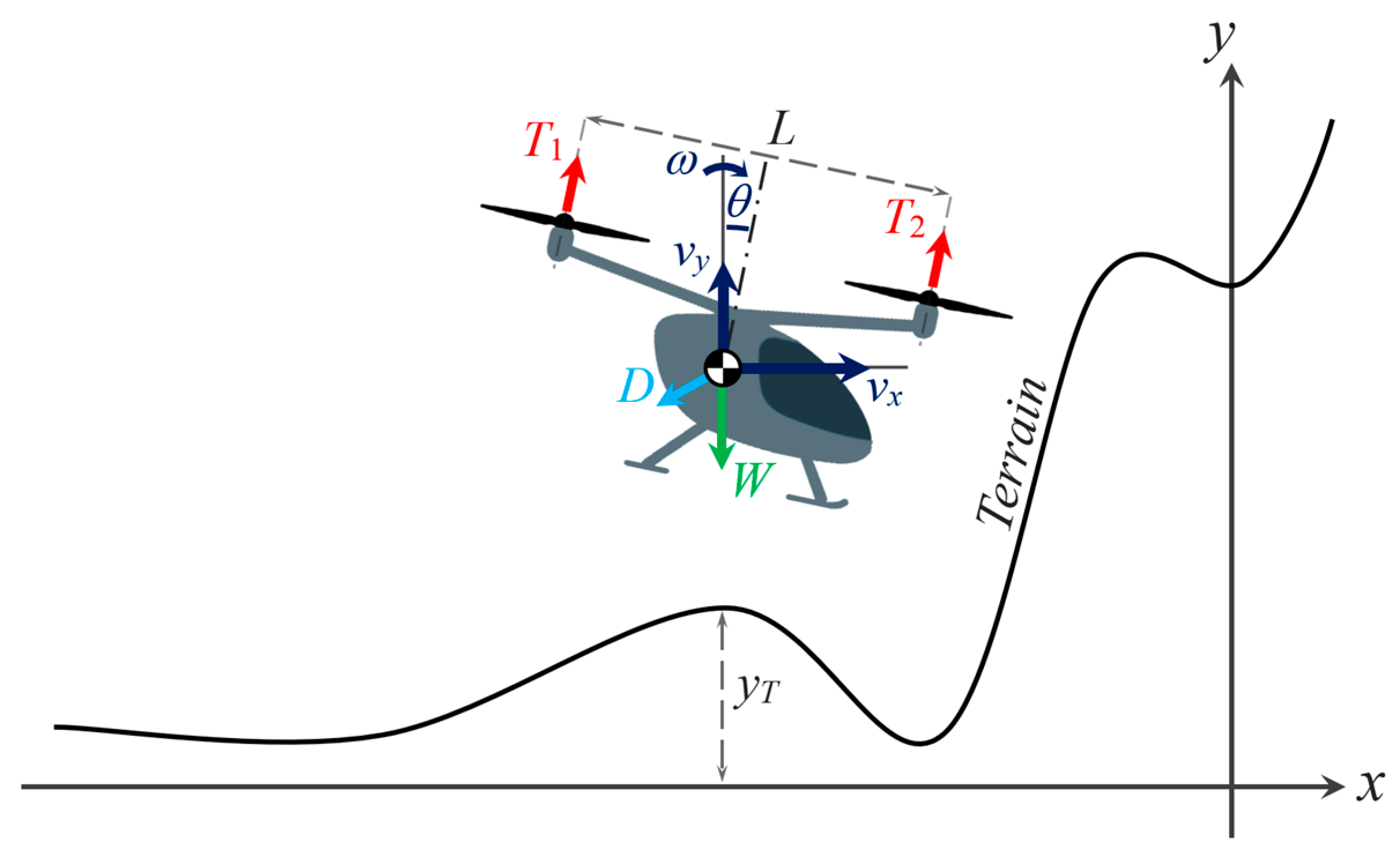
Based on the free body diagram presented in Figure 1, the equations of motion for the quadrotor aircraft in the longitudinal plane are derived as follows:
m x ¨ = ( T 1 + T 2 ) sin θ v 1 v x D m y ¨ = ( T 1 + T 2 ) cos θ v 1 v y D W θ ˙ = ω I y ω ˙ = 0.5 L ( T 1 T 2 ) ,
where T2 and T1 are the total thrust forces produced by the aft and fore motors, respectively, D is the drag force magnitude, and W  =  mg is the weight of the aircraft, with g denoting the (constant) local gravitational acceleration. The variables x and y represent the horizontal and vertical position components, while vx and vy denote the corresponding velocity components. The pitch angle and angular velocity are denoted by θ and ω, respectively. The total speed is defined as v ( v x 2 + v y 2 ) 0.5 . Lastly, m and Iy represent the aircraft’s mass and moment of inertia about the pitch axis, and L is the distance between the fore-aft motors.
As seen in (14), we assume the moment arms of the fore and aft motors in the longitudinal plane are equal, and that the drag force points in the direction opposite to the total velocity vector. The magnitude of the drag force is modeled as follows:
D = m c v 2 ,
where c  > 0 is a constant.
The constant c may be determined based on the aircraft’s flight performance characteristics. Simplifying (14) for level cruising flight at maximum speed yields:
T max cos θ ¯ = W T max sin θ ¯ = m c v max 2 ,
where vmax and Tmax denote the aircraft’s maximum cruise speed and maximum total thrust, respectively, and θ   - is the steady-state pitch angle for this flight condition. Solving (16) for c gives:
c = g v max 2 T max W 2 1 .
Therefore, given the aircraft’s weight, maximum speed, and thrust-to-weight ratio, the constant c may be estimated. Table 1 gives the values for all parameters necessary for modeling the aircraft. These values have been adopted from [22], with the thrust-to-weight ratio and the maximum speed assumed.

3.2. State Space Representation

Prior to deriving the state space representation of the system, we define the following parameters for convenience:
l 2 I y m L , u - g 2 T m a x W
Furthermore, we define the system inputs as follows:
u 1 T 1 + T 2 m , u 2 T 1 T 2 m .
Consequently, the state space representation of (14) with input constraints is:
x ˙ = f ( x , u ) = x 3 x 4 u 1 sin x 5 c x 3 x 3 2 + x 4 2 u 1 cos x 5 c x 4 x 3 2 + x 4 2 g x 6 l 1 u 2 s . t . 0 u 1 2 u ¯ u ¯ u 2 u ¯ ,
where x ≜ [x y vx vy θ ω]T ≜ [x1 x2 x3 x4 x5 x6]T and u ≜ [u1 u2]T. We observe that the system is control-affine, with the input matrix:
G ( x ) = 0 2 × 1 0 2 × 1 sin x 5 0 cos x 5 0 0 0 0 l 1 .
The control-affine property of the system (21) will be greatly helpful in the PB-CBF design process, as shall be seen in Section 4.

3.3. Terrain Model

Under the assumption of topological obstacles (i.e., terrain), their geometry can be modeled by a continuous function y T (x1), as illustrated in Figure 1. This function represents the terrain elevation (or an artificial substitute) as a function of the horizontal position x1.
In order to model the terrain level, we utilize hyperbolic functions and define the terrain level function as follows:
y T ( x 1 ) = y H ( x 1 ) + y B ( x 1 ) ,
where yH(x1) and yB(x1) represent artificial terrain elevation profiles near a hill and a moderately tall building, respectively, defined as follows:
y H ( x 1 ) = a H sech x 1 b H d H c H + sech x 1 + b H d H c H ,
y B ( x 1 ) = a B tanh x 1 + b B d B c B tanh x 1 b B d B c B .
The selected values for the parameters ai, bi, ci and di are given in Table 2.

4. Obstacle Avoidance via PB-CBFs

In this section, we present the design methodology for implementing the PB-CBF framework for UAM multirotor terrain avoidance. We begin by formulating the safe set and deriving the corresponding SLF. We then construct a feasible escape controller and derive the PB-CBF invariance condition to ensure safety.

4.1. Safe Set and the Escape Set

To ensure safety and prevent ground collisions, the aircraft must always remain above the terrain level, i.e., x2yT(x1). Consequently, the safe set is defined as follows:
C { x R 6 : x 2 y T ( x 1 ) } .
The corresponding SLF for C is given by
h ( x ) = x 2 y T ( x 1 ) ,
for which the gradient is computed as follows:
h x = [ d y T d x 1 1 0 0 0 0 ] .
A comparison between (21) and (27) reveals that LGh(x) = 0 for all x, which indicates that h(x) does not satisfy the conditions for a valid CBF [2]. Consequently, a more advanced formulation is required. In the remainder of this section, we apply the previously introduced PB-CBF framework to construct a viable CBF.
In order to synthesize the PB-CBF, the escape set is defined as follows:
S { x R 6 : x 3 , x 5 , x 6 = 0 , x 4 0 } .
which only contains states where the aircraft’s velocity vector is directly pointing upwards. Showing that S is an escape set for C is straightforward; therefore, the proof is omitted for brevity.
Given the property S  = S, the selected escape set is a measure-zero boundary-only set, which may make it problematic to reach using a physically realizable controller. Consequently, we approximate this set with the following:
S ~ { x R 6 : ε ( x ) ε 0 , x 4 0 } .
Here, ε0 > 0 is a small constant and
ε ( x ) ( x 3 v n ) 2 + ( x 5 θ n ) 2 + ( x 6 ω n ) 2 ,
where vn, θn and ωn are normalizing values for the speed, pitch angle and pitch rate, respectively. Unlike S, the set S ~ is a full-dimensional subset of the state space and can be reached by a controller that asymptotically drives ε to zero.

4.2. Escape Controller Design

As a next step, we shall design the escape controller that is able to reach S ~ in finite time. Consider the fourth-order system
x ˙ 4 = f 4 ( x 4 ) = x 3 x 4 a sin x 5 d c x 3 x 3 2 + x 4 2 a cos x 5 d c x 4 x 3 2 + x 4 2 g ,
with x4 ≜ [x1 x2 x3 x4]T, 2ūa > 0 (note that a is not assumed to be constant), and:
x 5 d = θ 0 tan   h ( v 0 1 x 3 ) ,
where v0 > 0 and π/2 > θ0 > 0.
Lemma 1.
Under the dynamics of (31), x3 asymptotically converges to zero.
Proof. 
Let V0 = 0.5x32, then
V ˙ 0 = x 3 x ˙ 3 = x 3 a sin x 5 d c x 3 x 3 2 + x 4 2           = x 3 a sin [ θ 0 tanh ( v 0 1 x 3 ) ] + c x 3 x 3 2 + x 4 2 .
Consequently, V 0   <   0 for all x3 ≠ 0 and V 0 = 0 for x3 = 0. Therefore, the proposition is proven by Lyapunov’s theorem [24].
Next, the sixth state that realizes (32) must be designed. So, consider the following fifth-order system.
x ˙ 5 = f 5 ( x 5 ) = x 3 x 4 a sin x 5 c x 3 x 3 2 + x 4 2 a cos x 5 c x 4 x 3 2 + x 4 2 g x 6 d ,
where x5 ≜ [x1 x2 x3 x4 x5]T and x6d is given by
x 6 d = θ 0 v 0 sech 2 ( v 0 1 x 3 ) a sin x 5 c x 3 x 3 2 + x 4 2 ω 0 tanh ( θ 1 1 e θ ) .
Here, ω0, θ1 > 0 are constants, and eθx5x5d. As a result,
e ˙ θ = x ˙ 5 + θ 0 v 0 sech 2 ( v 0 1 x 3 ) x ˙ 3 = x 6 d + θ 0 v 0 sech 2 ( v 0 1 x 3 ) a sin x 5 c x 3 x 3 2 + x 4 2 = ω 0 tanh ( θ 1 1 e θ ) .
Lemma 2.
Under the dynamics of (33), eθ asymptotically converges to zero.
Proof. 
Let V1 = 0.5eθ2, then
V ˙ 1 = e θ e ˙ θ = ω 0 e θ tanh ( θ 1 1 e θ ) < 0 .
Consequently, V 1   <   0 for all eθ ≠ 0 and V 1 = 0 for eθ = 0. Therefore, the lemma is, once again, proven by Lyapunov’s theorem. □
Lastly, we shall design the controller that realizes (33) and subsequently, (32). We utilize the dynamic inversion approach to achieve this goal. Provided that a controller drives eωx6x6d to zero (in finite time), the system governed by (20) is reduced to the dynamics (33), under which the asymptotic convergence of x3 to zero is ensured. The following control law achieves this objective.
u 1 ( x ) = a , u 2 ( x ) = l x 6 d x f ^ k S sgn e ω ,
where f ^ (x) ≜ f(x,[a 0]T).
Lemma 3.
Under the dynamics of (20) without input constraints, and with the control inputs from (35), eω converges to zero in finite time.
Proof. 
Since x 6 d / x 6   =   0 ,   f ^ ( x ) corresponds to the closed-loop dynamics that affects x6d. Consequently,
e ˙ ω = l 1 u 2 ( x ) x 6 d x f ^ = l 1 u 2 ( x ) x 6 d x f ^ = k S sgn e ω .
Now, let V = 0.5eω2, then
V ˙ = e ω e ˙ ω = k S e ω sgn e ω = k S | e ω | = 2 k S V 0.5 .
By the Finite-Time Stability Theorem [24], this implies eω will be nullified in finite time. □
Proposition 1.
Under the dynamics of (20) without input constraints, and with the control input from (35), (i) ε asymptotically converges to zero, (ii) there exists T0 ≥ 0, such that for all t > T0, we have ε < ε0.
Proof. 
By Lemma 3, eω is nullified at some finite time T. Therefore, for all t > T, the closed-loop system (20) with (35) behaves identically to (33), which asymptotically converges to (31), subject to which x3 asymptotically converges to zero by Lemma 1. Based on (32), x5d → 0 as x3 → 0. Since by Lemma 2 eθ = x5x5d → 0, it follows that x5 → 0 as t → ∞. Furthermore, (34) implies x6d → 0 as t → ∞. Similarly, by Lemma 3, x6 → 0 as t → ∞. These results imply based on (30) that ε(x(t)) → 0 as t, i.e., the statement (i) holds. Since ε0 > 0, the convergence of ε to zero immediately implies (ii). □
Based on these results, the escape controller u0(x) = [u10 u20]T is formulated as follows:
u 10 ( x ) = sat [ 0 , 2 u ¯ ] ( u 1 ( x ) ) , u 20 ( x ) = sat [ u ¯ , u ¯ ] ( u 2 ( x ) ) ,
where u1 and u2 are given by (35) and sat [ c 1 , c 2 ] ( x ) is the saturation function defined as follows:
sat [ c 1 , c 2 ] ( x ) max ( c 1 , min ( c 2 , x ) ) .
Assuming |x6| to be bounded by a maximum value ωmax, the controller parameters can be selected to avoid saturation. The pertaining calculations are omitted for brevity.
By substituting (21) into (13), expanding and simplifying, the invariance condition utilizing the formulated escape control law is derived as follows:
( H 3 sin x 5 + H 4 cos x 5 ) ( u 1 u 10 ) + H 6 ( u 2 u 20 ) l + α ( δ h ( x ) + x 2 y T ) 0 ,
where δhx ≜ [H1 H2 H3 H4 H5 H6], and δh is computed from (7) with the escape dynamics given by substituting (36) into (20). It is observed that (38) does not require the gradient in its entirety. Subsequently, in implementation, the required entries of the gradient (i.e., H3, H4 and H6) may be computed via perturbation.
To implement the safety filter, the class K function α(z) = αcz where αc > 0 is a constant and a(x) = 2ū, were chosen. The selected parameter values for the designed escape controller are given in Table 3.

5. Simulation Results

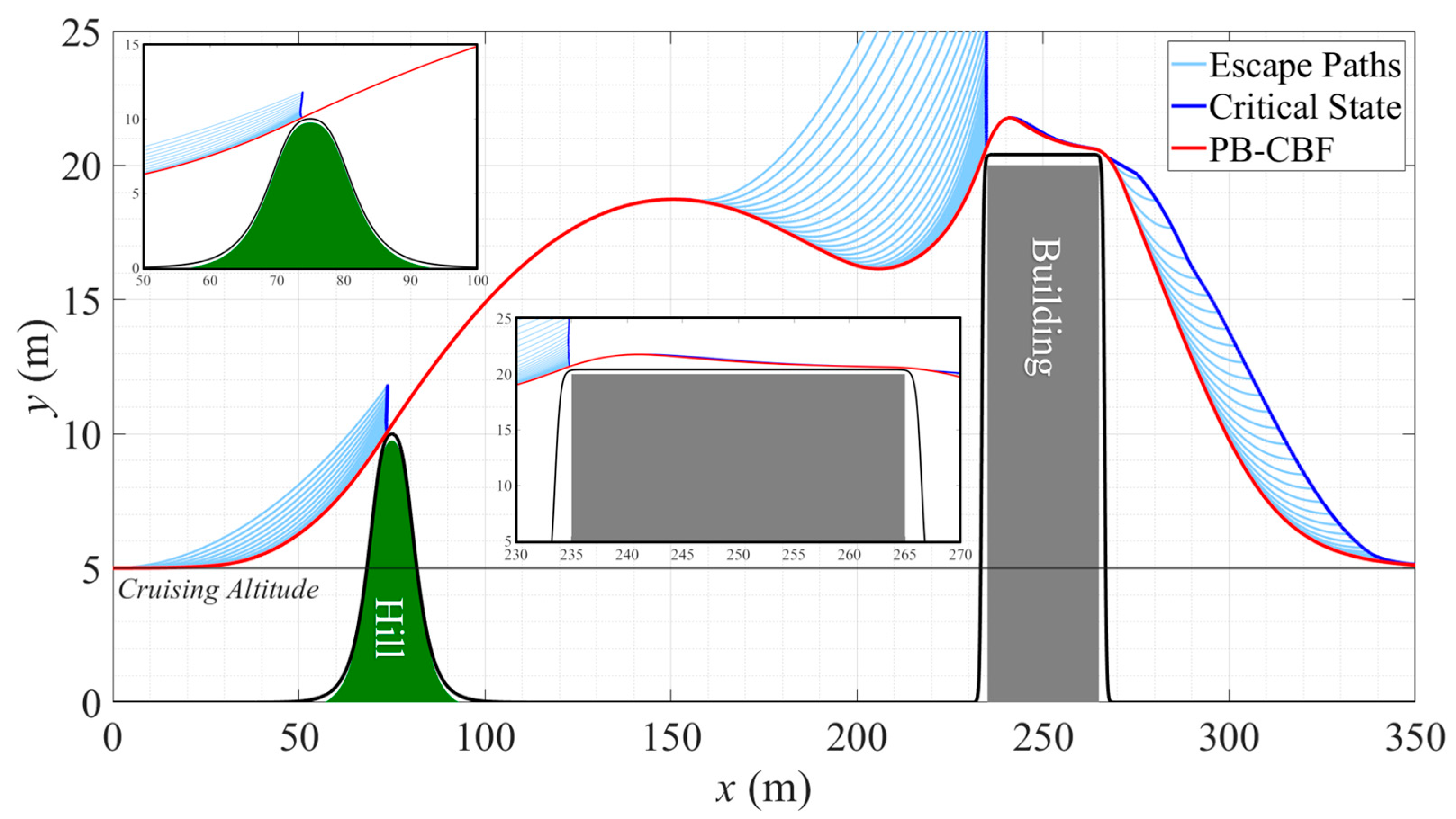
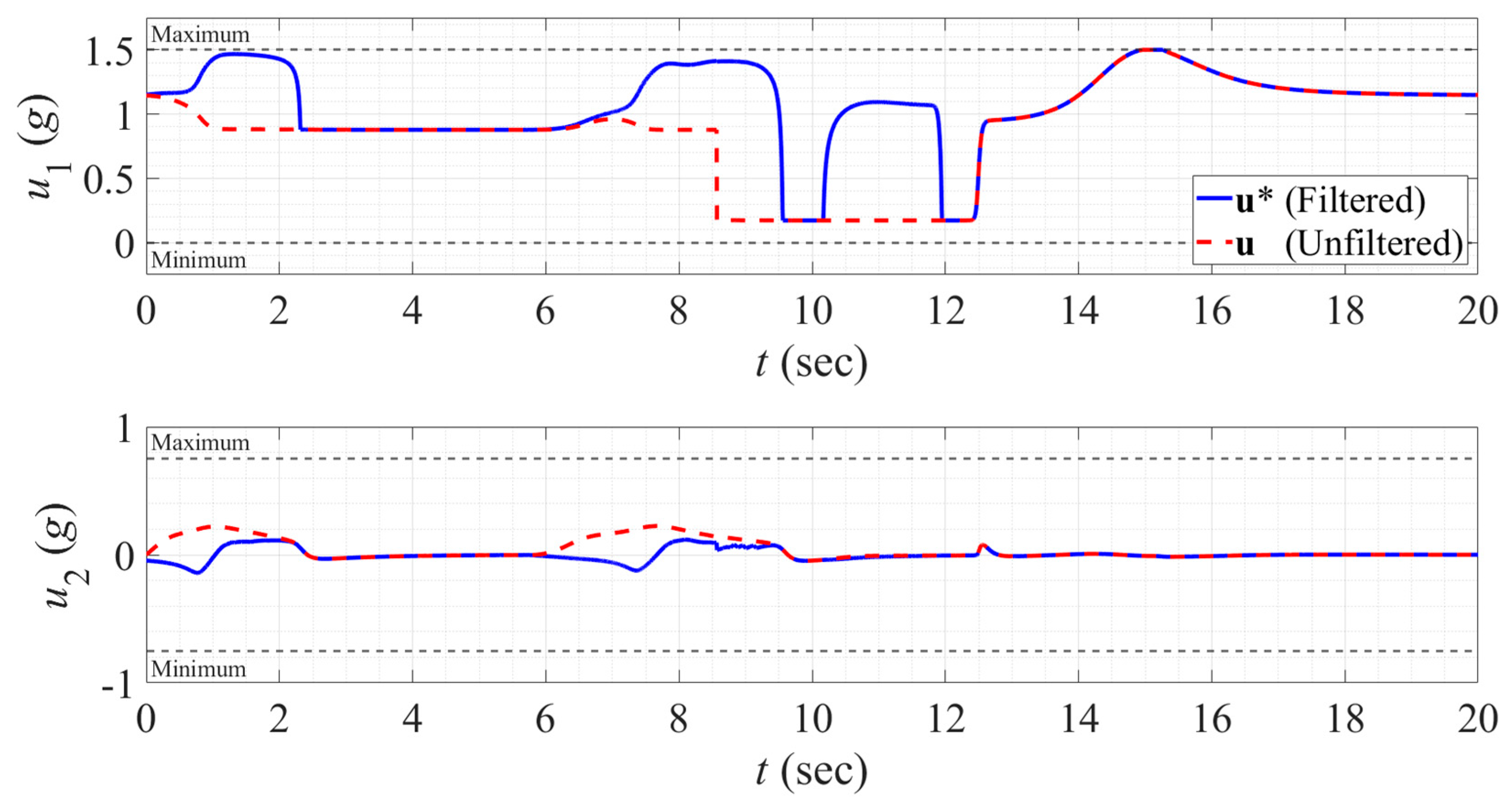
The simulation begins with the aircraft cruising at a set altitude of 5 m and a speed of 120 km/h, regulated by a nonlinear control system. Upon encountering the previously introduced terrain, safety filter intervention becomes necessary to prevent collisions. Figure 2 illustrates the system’s flight path, along with the evolution of the critical states and the corresponding escape paths (up to the critical state). Additionally, Figure 3 shows the evolution of the control inputs before and after passing through the safety filter.
Initially, the critical state lies well above the hill, but as the aircraft approaches, it progressively descends toward the terrain, requiring increasingly aggressive intervention. Around t = 0.75 s, the safety filter begins to dominate the control input, causing the actual trajectory to closely align with the predicted escape paths. This convergence results in the actual state, critical state, and escape path all meeting at the closest point of approach.
This pattern continues until the aircraft nears the second obstacle, the building, at which point the critical state rapidly (in fact, discontinuously) shifts to a position above the building. A similar response pattern follows. However, a notable difference is observed after passing the second obstacle, which is the critical state diverging from the actual trajectory for some time. This is attributed to the aircraft’s downward velocity component, which causes the vehicle to need to descend slightly before reaching the critical state.
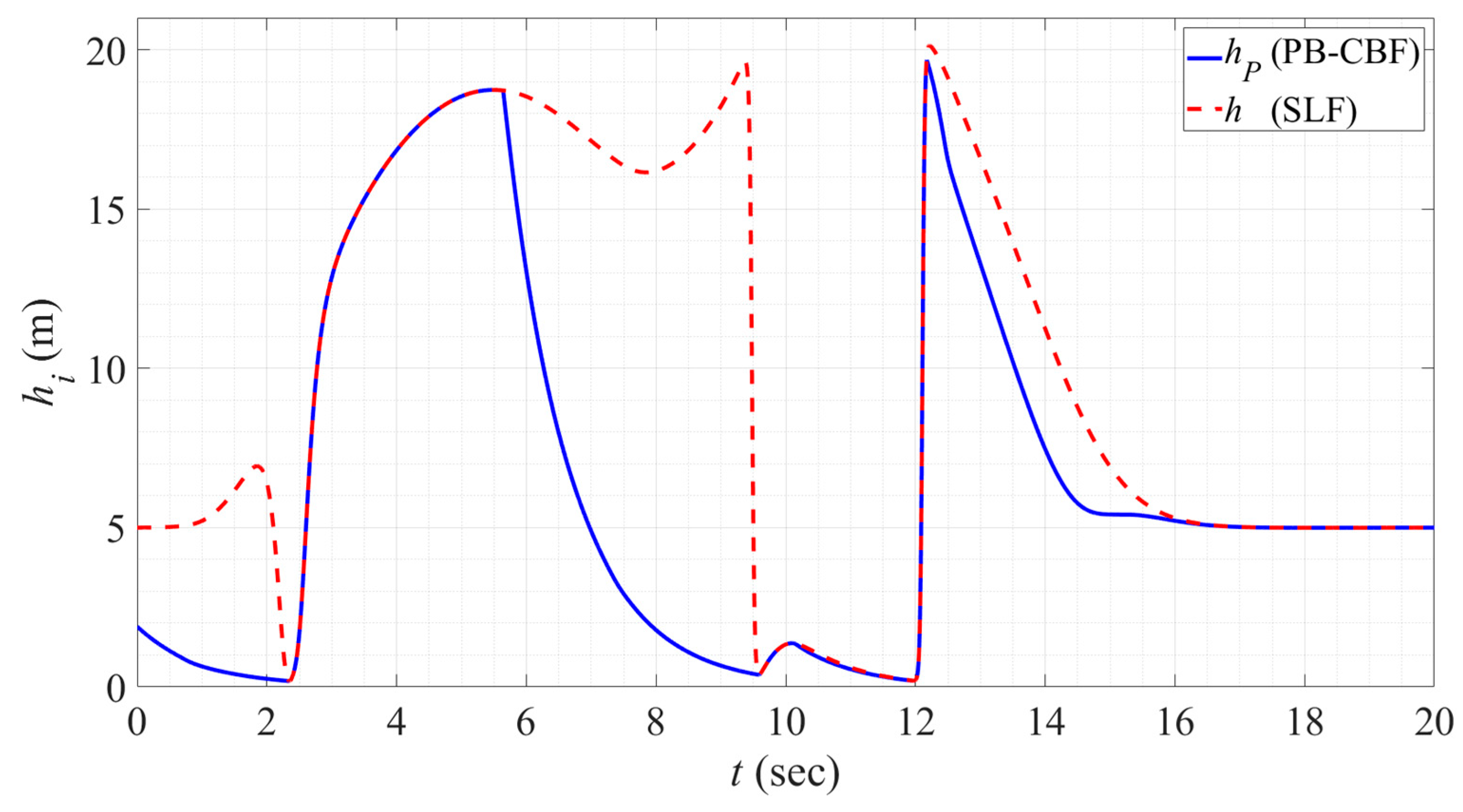
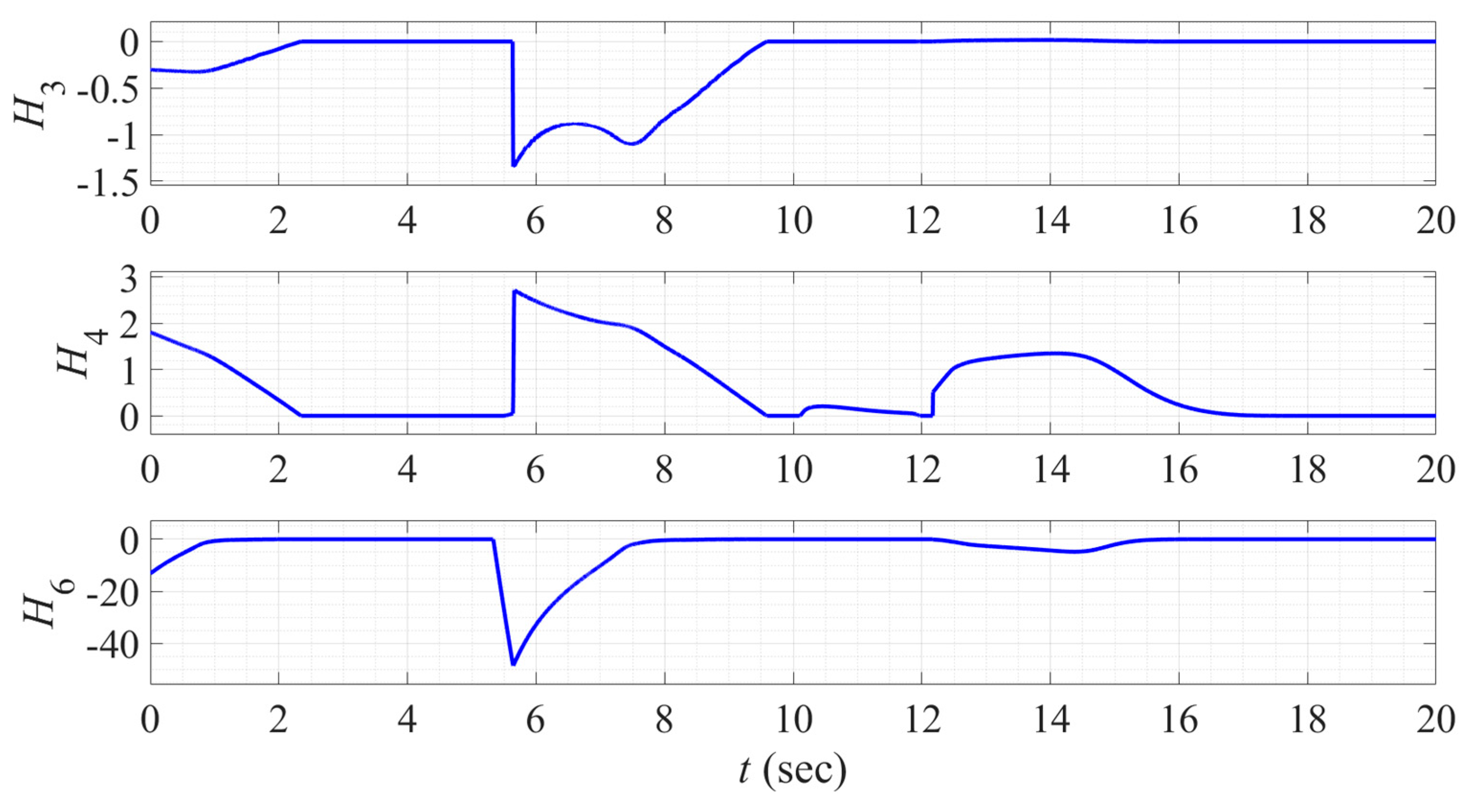
Figure 4 and Figure 5 depict the evolution of the SLF, the PB-CBF, and the relevant PB-CBF gradient terms throughout the simulation. As expected, the PB-CBF value remains less than or equal to the SLF at all times. The gap between the two becomes most significant when the aircraft approaches obstacles, underscoring the importance of the PB-CBF’s non-myopic formulation. Moreover, the values of H1, H2 and H3 remain non-zero whenever hPh, indicating the persistent feasibility of the PB-CBF conditions.

6. Conclusions

This work presented an implementation of the PB-CBF framework for ensuring flight control safety in UAM systems. A certifiable safety filter was designed to prevent terrain collisions, and its effectiveness was demonstrated through simulation. Although the analysis was restricted to planar motion, the design methodology used to construct the escape set and the corresponding controller may be intuitively extended to three dimensions. Addressing the nuances of undertaking this extension could constitute an interesting directive for future research. Another promising direction would be to apply the same framework to more sophisticated UAM configurations, such as tilt-rotor or tilt-wing aircraft, where more complexity would be involved, but also, more versatility to be had.

Author Contributions

Conceptualization, A.M. and J.R.; methodology, A.M.; software, A.M.; validation, A.M., J.R. and D.G.; formal analysis, A.M.; resources, A.M. and J.R.; data curation, A.M.; writing—original draft preparation, A.M.; writing—review and editing, A.M., J.R. and D.G.; visualization, A.M.; supervision, J.R. and D.G.; project administration, J.R.; funding acquisition, D.G. All authors have read and agreed to the published version of the manuscript.

Funding

This research was funded by the scientific-research project № 253CH0001-04 “Development of infrastructure and environment for aerospace education and research at TU-Sofia/INSATUS/” by the contract with “Research and development sector at TU-Sofia”.

Institutional Review Board Statement

Not applicable.

Informed Consent Statement

Not applicable.

Data Availability Statement

Data are available in this manuscript.

Acknowledgments

We gratefully acknowledge the support of the Aerospace Equipment and Technologies Laboratory at the Technical University of Sofia in the publication of this article.

Conflicts of Interest

The authors declare no conflicts of interest.

Abbreviations

The following abbreviations are used in this manuscript:
UAMUrban Air Mobility
SLFSuperlevel Function
CBFControl Barrier Function
PB-CBFPrediction-Based Control Barrier Function

References

  1. Ames, A.D.; Xu, X.; Grizzle, J.W.; Tabuada, P. Control Barrier Function Based Quadratic Programs for Safety Critical Systems. IEEE Trans. Autom. Control 2017, 62, 3861–3876. [Google Scholar] [CrossRef]
  2. Ames, A.D.; Coogan, S.; Egerstedt, M.; Notomista, G.; Sreenath, K.; Tabuada, P. Control Barrier Functions: Theory and Applications. In Proceedings of the 2019 18th European Control Conference (ECC), Naples, Italy, 25–28 June 2019. [Google Scholar]
  3. Ames, A.D.; Grizzle, J.W.; Tabuada, P. Control Barrier Function Based Quadratic Programs with Application to Adaptive Cruise Control. In Proceedings of the 53rd IEEE Conference on Decision and Control, Los Angeles, CA, USA, 15–17 December 2014. [Google Scholar]
  4. Rauscher, M.; Kimmel, M.; Hirche, S. Constrained Robot Control Using Control Barrier Functions. In Proceedings of the 2016 IEEE/RSJ International Conference on Intelligent Robots and Systems (IROS), Daejeon, Republic of Korea, 9–14 October 2016; pp. 279–285. [Google Scholar]
  5. Agrawal, A.; Sreenath, K. Discrete Control Barrier Functions for Safety-Critical Control of Discrete Systems with Application to Bipedal Robot Navigation. In Proceedings of the Robotics: Science and Systems, Cambridge, MA, USA, 12–16 July 2017. [Google Scholar]
  6. Chen, Y.; Singletary, A.; Ames, A.D. Guaranteed Obstacle Avoidance for Multi-Robot Operations with Limited Actuation: A Control Barrier Function Approach. IEEE Control Syst. Lett. 2021, 5, 127–132. [Google Scholar] [CrossRef]
  7. Tayal, M.; Singh, R.; Keshavan, J.; Kolathaya, S. Control Barrier Functions in Dynamic UAVs for Kinematic Obstacle Avoidance: A Collision Cone Approach. In Proceedings of the 2024 American Control Conference (ACC), Toronto, ON, Canada, 10–12 July 2024; pp. 3722–3727. [Google Scholar]
  8. Molnar, T.G.; Kannan, S.K.; Cunningham, J.; Dunlap, K.; Hobbs, K.L.; Ames, A.D. Collision Avoidance and Geofencing for Fixed-Wing Aircraft with Control Barrier Functions. IEEE Trans. Control. Syst. Technol. 2025, 33, 1493–1508. [Google Scholar] [CrossRef]
  9. Nguyen, Q.; Sreenath, K. Exponential Control Barrier Functions for Enforcing High Relative-Degree Safety-Critical Constraints. In Proceedings of the 2016 American Control Conference (ACC), Boston, MA, USA, 6–8 July 2016; pp. 322–328. [Google Scholar]
  10. Tan, X.; Cortez, W.S.; Dimarogonas, D.V. High-Order Barrier Functions: Robustness, Safety and Performance-Critical Control. IEEE Trans. Autom. Control 2022, 67, 3021–3028. [Google Scholar] [CrossRef]
  11. Agrawal, D.R.; Panagou, D. Safe Control Synthesis via Input Constrained Control Barrier Functions. In Proceedings of the 2021 60th IEEE Conference on Decision and Control (CDC), Austin, TX, USA, 14–17 December 2021; pp. 6113–6118. [Google Scholar]
  12. Taylor, A.J.; Ong, P.; Molnar, T.G.; Ames, A.D. Safe Backstepping with Control Barrier Functions. In Proceedings of the 2022 IEEE 61st Conference on Decision and Control (CDC), Cancun, Mexico, 6–9 December 2022; pp. 5775–5782. [Google Scholar]
  13. Mesbah, A.; Pourtakdoust, S.H.; Sharifi, A.; Banazadeh, A. Prediction-Based Control Barrier Functions for Input-Constrained Safety Critical Systems. arXiv 2024, arXiv:2412.12926. [Google Scholar]
  14. Gurriet, T.; Mote, M.; Ames, A.D.; Feron, E. An Online Approach to Active Set Invariance. In Proceedings of the 2018 IEEE Conference on Decision and Control (CDC), Miami, FL, USA, 17–19 December 2018; pp. 3592–3599. [Google Scholar]
  15. van Wijk, D.E.J.; Coogan, S.; Molnar, T.G.; Majji, M.; Hobbs, K.L. Disturbance-Robust Backup Control Barrier Functions: Safety Under Uncertain Dynamics. IEEE Control Syst. Lett. 2024, 8, 2817–2822. [Google Scholar] [CrossRef]
  16. Roshanian, J.; Darvishpoor, S.; Georgiev, K.; Serbezov, V. Vehicle Configurations, Infrastructures, and Future of Urban Air Mobility: A Review. AIP Conf. Proc. 2024, 2980, 50001. [Google Scholar] [CrossRef]
  17. Darvishpoor, S.; Roshanian, J.; Mesbah, A.; Haghighi, K.; Ebrahimi, B.; Serbezov, V.; Georgiev, K. A Survey of the Effects of Vehicle Configuration on Urban Air Mobility. Appl. Sci. 2025, 15, 3181. [Google Scholar] [CrossRef]
  18. Johnson, W.; Silva, C.; Solis, E. Concept Vehicles for VTOL Air Taxi Operations. In Proceedings of the AHS Technical Conference on Aeromechanics Design for Transformative Vertical Flight, San Francisco, CA, USA, 16–19 January 2018. [Google Scholar]
  19. Silva, C.; Johnson, W.; Solis, E.; Patterson, M.; Antcliff, K. VTOL Urban Air Mobility Concept Vehicles for Technology Development. In Proceedings of the 2018 Aviation Technology, Integration, and Operations Conference, Atlanta, GA, USA, 25–29 June 2018. [Google Scholar]
  20. Pradeep, P.; Lauderdale, T.; Chatterji, G.; Sheth, K.; Lai, C.; Sridhar, B.; Edholm, K.-M.; Erzberger, H. Wind-Optimal Trajectories for Multirotor EVTOL Aircraft on UAM Missions. In Proceedings of the 2020 AIAA AVIATION Forum, Virtual Event, 15–19 June 2020. [Google Scholar]
  21. Ivler, C.M.; Hunter, W.; Vo, E.; Russell, K.; Malpica, C.; Withrow-Maser, S. Handling Qualities Considerations in Control Allocation for Multicopters. In Proceedings of the Vertical Flight Society’s 78th Annual Forum & Technology Display, Fort Worth, TX, USA, 10–12 May 2022. [Google Scholar]
  22. Malpica, C.; Withrow-Maser, S.; Aires, J.; Schuet, S.; Ruan, A.; Suh, P.; Barnes, K.; Hanson, C.; Foster, J. Handling Qualities of Multirotor RPM-Controlled Electric-Vertical Take-Off and Landing (EVTOL) Aircraft for Urban Air Mobility (UAM). In Proceedings of the Vertical Flight Society 79th Annual Forum & Technology Display, West Palm Beach, FL, USA, 16–18 May 2023; pp. 1–22. [Google Scholar]
  23. Kim, Y.; Kim, S.; Suk, J.; Shin, H.-S. Robust Controller Design for UAM Using Incremental Nonlinear Dynamic Inversion with Double-Loop Structure. IEEE Trans. Aerosp. Electron. Syst. 2025, 61, 76–92. [Google Scholar] [CrossRef]
  24. Khalil, H.K. Nonlinear Systems, 2nd ed.; Pearson Education; Prentice Hall: Upper Saddle River, NJ, USA, 1995; ISBN 9780130673893. [Google Scholar]
Figure 1. Free body diagram for the quadrotor aircraft flying near terrain problem.
Engproc 121 00030 g001
Figure 2. Evolution of the aircraft’s flight path, critical states, and escape paths throughout the simulation.
Engproc 121 00030 g002
Figure 3. Evolution of safety-filtered and unfiltered control input values.
Engproc 121 00030 g003
Figure 4. Evolution of the SLF and the PB-CBF values throughout the simulation.
Engproc 121 00030 g004
Figure 5. Evolution of the relevant PB-CBF gradient components throughout the simulation.
Engproc 121 00030 g005
Table 1. UAM quadrotor model parameter values.
ParameterValue
g9.81 m/s2
m2915 kg
Iy23,000 kg·m2
L11.67 m
Tmax/W1.50
vmax170 km/h
Table 2. Terrain level function parameter values.
ParameterHill ValueBuilding Value
ai6.50 m10.2 m
bi2.80 m16.5 m
ci3.70 m0.50 m
di75 m250 m
Table 3. PB-CBF safety filter parameter values.
ParameterValue
θ020 deg
θ15.0 deg
ω030 deg/s
v01 m/s
vn0.1 m/s
θn0.5 deg
ωn1.5 deg/s
ε00.15
αc1
Disclaimer/Publisher’s Note: The statements, opinions and data contained in all publications are solely those of the individual author(s) and contributor(s) and not of MDPI and/or the editor(s). MDPI and/or the editor(s) disclaim responsibility for any injury to people or property resulting from any ideas, methods, instructions or products referred to in the content.