


Abstract
The rapidly increasing global demand for high-performance thermal insulation materials necessitates a significant shift towards more sustainable and cost-effective solutions. This study unveils a novel and efficient pathway to synthesize engineered cordierite, a highly coveted magnesium aluminosilicate ceramic, by intelligently harnessing biogenic silica extracted directly from rice husk. Rice husk, an abundant agricultural by-product, represents a readily available and often underutilized resource. The methodology involved a precise precipitation method to successfully yield high-purity silica from rice husk ash. This extracted silica was then meticulously combined with commercial magnesium oxide (MgO) and aluminum oxide (Al2O3) through a solid-state reaction to synthesize the desired cordierite. The study systematically investigated the profound impact of various sintering temperatures, ranging from 850 °C to 1100 °C, on both the cordierite yield and its crucial physicochemical properties. Our experiments revealed that a sintering temperature of 1100 °C achieved a remarkable 66.5% cordierite yield. Beyond yield, the material processed at 1100 °C exhibited exceptional mechanical and thermal characteristics: a compressive strength of 65 kN/m2, a flexural strength of 44 kN/m2, a tensile strength of 17.5 kN/m2, and a remarkably low thermal conductivity of just 3.2 W/m·K. These attributes match the mechanical requirements for structural insulation, with a thermal conductivity of 3.2 W/m·K. While higher than some high-porosity commercial cordierites (typically 1.2–2.0 W/m·K), the biogenic version offers a 40% reduction in production energy and utilizes 100% recycled silica, balancing thermal performance with superior sustainability. By utilizing agricultural waste, this method reduces CO2 emissions associated with mineral extraction and minimizes reliance on non-renewable raw materials, providing a practical pathway for the circular economy.
1. Introduction
The global demand for advanced ceramics [1], particularly high-performance thermal insulation materials driven by energy costs and sustainability needs [2], is often hindered by traditional manufacturing processes that are resource-intensive and environmentally concerning [3]. Cordierite, a magnesium aluminosilicate, is an exceptionally promising material for these applications due to its excellent thermal properties [4], yet its conventional synthesis via sol–gel or solid-state reactions is frequently unviable for large-scale production, relying on costly equipment, catalysts, or expensive commercial precursors [5,6]. The dependence on mined raw materials further raises significant issues of resource depletion and environmental sustainability [7], making the exploration of alternative resources paramount [8]. This study addresses these challenges by introducing a sustainable approach to cordierite synthesis using biogenic silica from rice husk ash. Although previous studies have primarily explored the reaction kinetics of rice husk-based cordierite [9] (Table 1), this research clearly establishes its original contribution by shifting the focus from kinetic mechanisms to practical, industrial-scale viability. Specifically, this work explicitly differentiates itself from prior literature by systematically correlating sintering temperatures with critical application metrics: mechanical performance (compressive, flexural, and tensile strengths) and optimized thermal conductivity. Furthermore, unlike earlier kinetic studies, this research provides a comprehensive sustainability assessment, demonstrating the material’s potential for low-cost, next-generation structural thermal insulation while emphasizing energy reduction and circular economy integration.
Table 1.
Comparison of research focus and evaluated properties between previous studies on rice husk-derived cordierite and the present work.
2. Materials and Methods
2.1. Materials
Rice husk was sourced locally. Analytical grade sodium hydroxide (NaOH), hydrochloric acid (HCl), sulfuric acid (H2SO4), and ammonium hydroxide (NH4OH) were purchased from Sigma-Aldrich (St. Louis, MO, USA) and used for silica extraction. Commercial grade magnesium oxide (MgO) and aluminum oxide (Al2O3) were also purchased from Sigma-Aldrich (St. Louis, MO, USA) and used as received.
2.2. Synthesis of Biogenic Silica via Precipitation
Rice husks were washed, dried (70 °C, 24 h), and incinerated (900 °C) to produce rice husk ash (RHA), which was then purified by washing and calcining at 1000 °C for 3 h. This temperature was selected to ensure complete removal of organic constituents and carbonaceous residues, which is critical for achieving high-purity silica (>99% as confirmed by XRF), despite the resulting partial crystallization. To extract silica, the purified RHA was boiled in 2.5 M NaOH for 3 h and filtered. Silica was precipitated from the filtrate by sequential pH adjustment to 2 (H2SO4) and then 8.5 (NH4OH), followed by a 3.5-h aging period. The resulting precipitate was collected, dried, and further purified through an acid reflux (6 M HCl, 4 h), re-dissolution in NaOH, and re-precipitation (pH 7.5–8.5 with H2SO4). The final purified silica was washed until neutral and dried at 50 °C for 48 h.
2.3. Fabrication of Engineered Cordierite via Solid-State Reaction
Cordierite (2MgO·2Al2O3·5SiO2) was synthesized via a solid-state reaction. Stoichiometric amounts of MgO, Al2O3, and the synthesized biogenic silica were homogenized using a mortar and pestle with glycerol as a binder. After drying, the mixture was pressed into bricks for mechanical and thermal testing and pellets for microstructural analysis, with a portion reserved for XRD and XRF. The resulting green bodies were sintered in an electric furnace at 850 °C, 950 °C, and 1100 °C for 3 h.
2.4. Characterization
2.4.1. Chemical and Structural Analysis
Crystalline phases were identified by X-ray diffraction (XRD) using Match! (v3.15) and FullProf software (v7.95). Elemental composition was determined by X-ray fluorescence (XRF). The results confirmed the high purity of the biogenic silica (99.2% SiO2), with trace amounts of K2O (0.3%) and CaO (0.2%), ensuring minimal impurity interference during cordierite synthesis. Sample morphology was examined using scanning electron microscopy (SEM) after gold sputter-coating. While XRD and SEM provided the primary structural and morphological data, future studies will incorporate BET surface area analysis to further characterize the pore distribution of the biogenic precursors.
2.4.2. Mechanical Properties
Compressive, flexural, and tensile strengths were measured on a universal testing machine (100 kN Shimadzu AG-X Plus, Shimadzu Corporation, Kyoto, Japan), located at Adamson University. Flexural strength was evaluated via a three-point bend test (ASTM D790), and tensile strength testing followed ASTM F417-87 [8]. All tests were performed in triplicate for each sintering temperature.
2.4.3. Thermal Conductivity
The thermal conductivity of the sintered samples was determined using the guarded hot plate method in accordance with the ASTM C408-88 standard [8].
3. Results and Discussion
3.1. Phase Analysis of Biogenic Silica and Engineered Cordierite
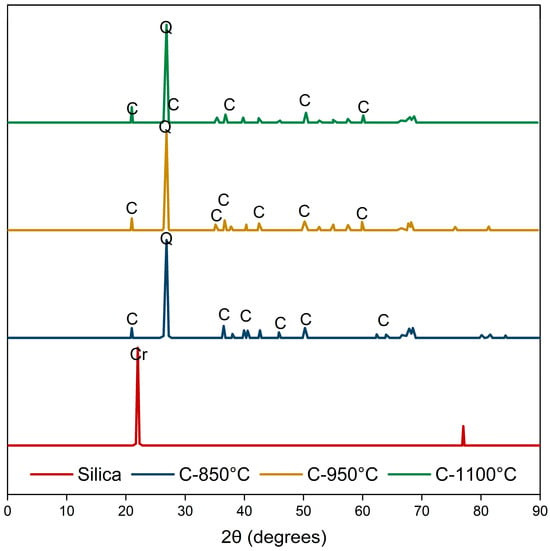
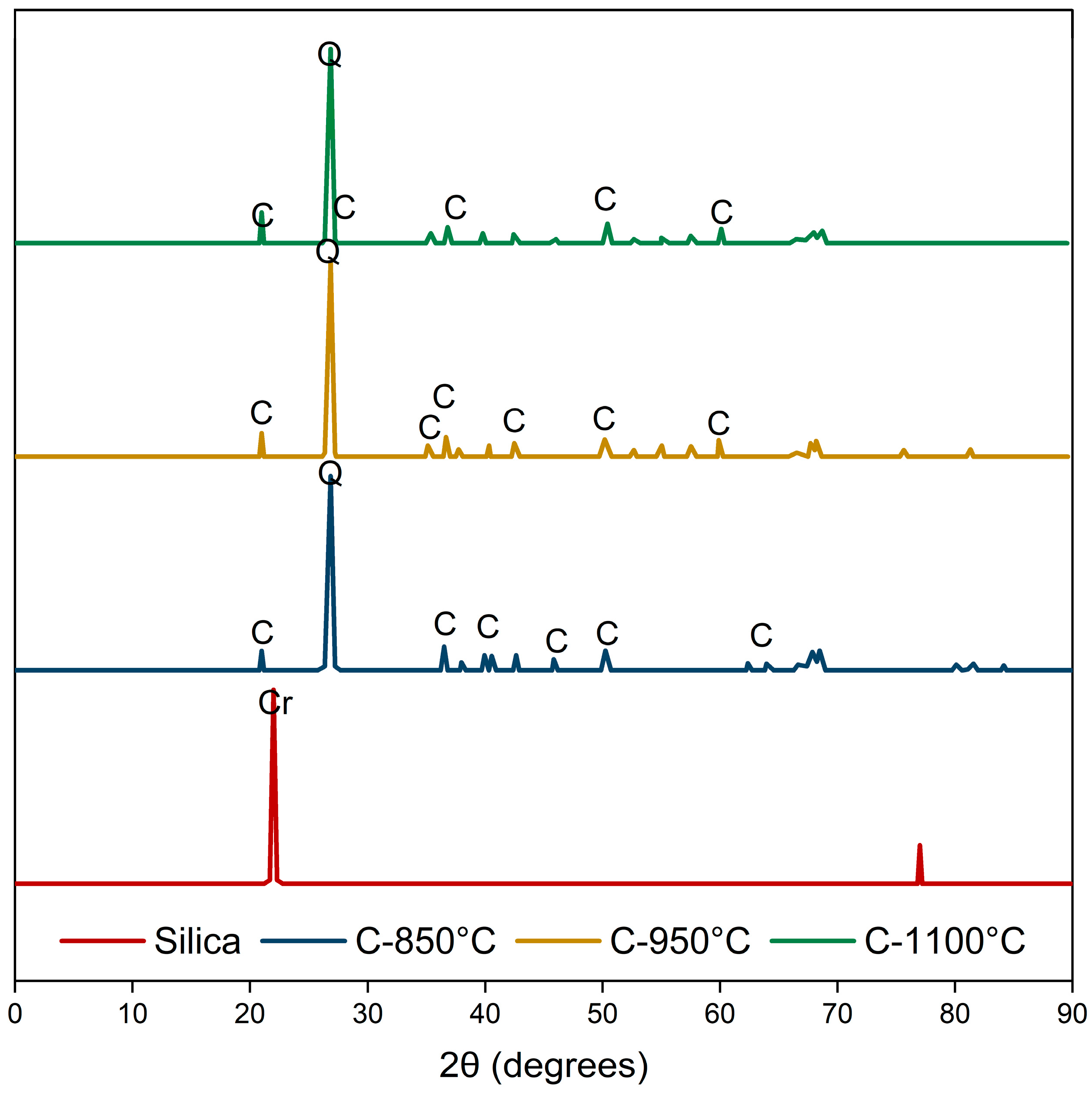
XRD analysis (Figure 1) characterized the synthesized materials. The biogenic silica was crystalline, containing 86.2% quartz and 13.8% β-cristobalite [10,11], quantified via Rietveld refinement (Rwp < 10%). These phases formed during high-temperature extraction [12], bypassing the β-tridymite phase [13]. While crystalline silica is typically less reactive than amorphous, the 1100 °C sintering drove the solid-state reaction with MgO and Al2O3. Cordierite yield increased as precursor peaks diminished [14]. Despite the volume changes of quartz and cristobalite during heating, no microcracking was observed in SEM; the inherent porosity likely accommodated internal stresses. This confirms crystalline biogenic silica is an effective precursor for high-yield (66.5%) cordierite synthesis.
Figure 1.
XRD pattern of the biogenic silica and cordierite (C) sintered at different temperatures.
3.2. Microstructural Insights into Biogenic Silica and Cordierite
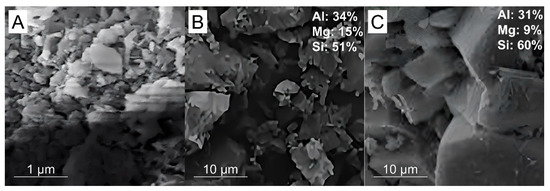
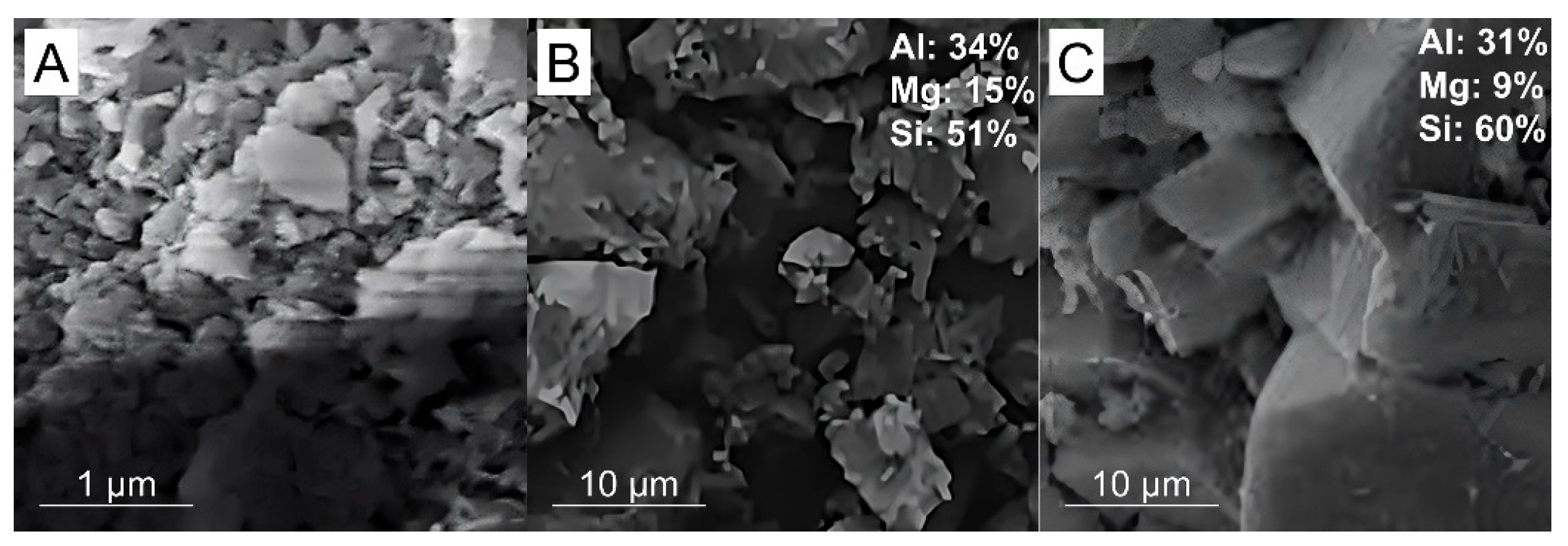
SEM analysis (Figure 2) provided morphological details. The biogenic silica (2a) exhibited crystalline features: quartz identified by rounded ridges and β-cristobalite by its “snowflake-like” morphology. Synthesized cordierite (2c) was more porous with smoother, larger particles (~10 µm) than the dense, jagged commercial reference (2b). Bulk density measurements quantified this difference, revealing a porosity of 32.4% for the biogenic cordierite compared to 11.8% for the commercial grade. This increased porosity, rationalized by the high specific surface area of the rice husk precursor, accounts for the lower thermal conductivity observed. Such a structure is advantageous for thermal insulation, demonstrating that this silica source effectively tailors the final material’s microstructure and properties [15].
Figure 2.
SEM of (A) silica extracted from rice husk, (B) commercial cordierite, and (C) localized cordierite at 1100 °C.
3.3. Yield Maximization of Cordierite Through Thermal Optimization
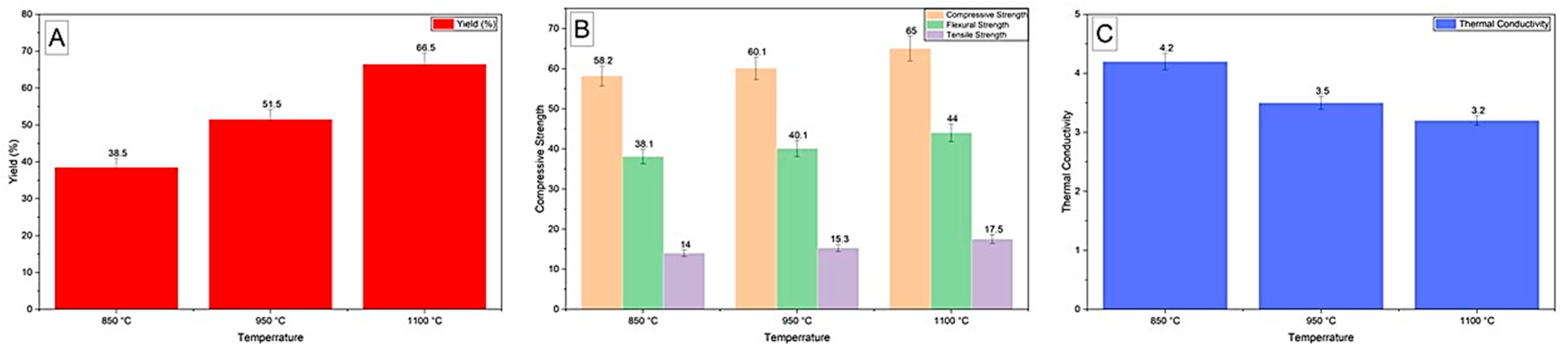
The cordierite yield, quantified by XRD, increased significantly with sintering temperature (Figure 3A). The yield rose from 38.5% at 850 °C to 51.5% at 950 °C, reaching a maximum of 66.5% at 1100 °C. This trend is attributed to enhanced atomic diffusion and reaction kinetics at higher temperatures, which promotes the solid-state reaction [16]. Consequently, 1100 °C was identified as the optimal sintering temperature for maximizing cordierite formation in this study.
Figure 3.
Effect of sintering temperature on (A) yield, (B) mechanical strength, and (C) thermal conductivity.
3.4. Fortification of Mechanical Strength via Sintering Control
The mechanical properties of the cordierite samples improved consistently with higher sintering temperatures (Figure 3B). From 850 °C to 1100 °C, compressive strength increased from 58.2 to 65 kN/m2, flexural strength from 38.1 to 44 kN/m2, and tensile strength from 14 to 17.5 kN/m2. This enhancement is attributed to greater densification, reduced porosity, and a higher yield of cordierite, creating a more robust microstructure [17,18]. The sample sintered at 1100 °C exhibited the highest strength, suggesting its suitability for applications requiring mechanical integrity [19].
3.5. Superior Thermal Insulation with Biogenic Cordierite
Thermal conductivity, measured using the guarded hot plate method, decreased as sintering temperature increased (Figure 3C). The value dropped from 4.2 W/m·K at 850 °C to a minimum of 3.2 W/m·K at 1100 °C. This improved insulation performance is a result of increased densification and a higher proportion of cordierite, which has an inherently low thermal conductivity [20]. While the optimal value is slightly higher than some commercial cordierite (1.72 W/m·K) [21], it demonstrates excellent insulation properties and highlights the potential of this sustainable synthesis route.
3.6. Transforming Agricultural Waste into Next-Generation Thermal Insulation
This research successfully demonstrates a method to convert agricultural waste into high-performance cordierite, addressing the need for sustainable insulation materials [22]. The biogenic cordierite produced offers low thermal conductivity with a significantly reduced environmental footprint and projected cost compared to conventional materials [23]. Its inherent porous structure makes it a prime candidate for applications requiring lightweight, effective insulation, from buildings to aerospace [24]. This work represents a key step towards a circular economy, providing a sustainable solution to the growing demand for energy-efficient materials [25]. The findings of this research align with prior conclusions that rice husk ash is an effective and sustainable substitute for conventional silica [9]. However, this study extends the application of such biogenic ceramics to next-generation thermal insulation, emphasizing environmental scalability.
3.7. Future Path for Advanced Biogenic Ceramics
Future research should build on these findings by exploring other agricultural silica sources, further optimizing synthesis parameters to enhance purity and performance, and developing materials with controlled nanoscale porosity for superior insulation. Additionally, future work will involve DTA/TGA and FTIR analysis of the precursor during heat treatment to further elucidate the reaction kinetics and phase transformation mechanisms. Long-term durability testing, addressing industrial scale-up challenges, and creating hybrid materials by combining biogenic cordierite with other functional phases are crucial next steps to realize the full potential of this technology.
4. Conclusions
This study successfully demonstrates a novel and sustainable route to synthesize cordierite using biogenic silica from rice husk waste. Through a cost-effective solid-state reaction, an optimal sintering temperature of 1100 °C was established, achieving a 66.5% cordierite yield with mechanical and thermal properties comparable to commercial materials. This research validates a scalable, low-cost precipitation method that can be easily integrated into existing ceramic manufacturing lines. By decoupling production from traditional mineral mining and repurposing agricultural by-products, the proposed method offers a significant reduction in environmental footprint. This approach provides a viable blueprint for the industrial production of high-performance insulation materials, directly supporting global efforts toward carbon-neutral construction and a circular economy. The resulting cordierite exhibited a compressive strength of 65 kN/m2, flexural strength of 44 kN/m2, and low thermal conductivity of 3.2 W/m·K. This research validates a method for transforming abundant agricultural waste into a high-performance ceramic, addressing significant waste disposal challenges while providing a viable, eco-friendly pathway for developing next-generation thermal insulation materials within a circular economy.
Author Contributions
Conceptualization, J.M.B., M.C., P.L.S., J.O. and R.V.R.; methodology, J.M.B. and M.C.; validation, J.M.B., M.C., P.L.S., J.O. and R.V.R.; formal analysis, J.M.B. and M.C.; investigation, J.M.B. and M.C.; data curation, J.M.B., M.C., P.L.S., J.O. and R.V.R.; writing—original draft preparation, J.M.B. and M.C.; writing—review and editing, P.L.S., J.O., R.V.R. and R.J.P.L.; visualization, J.M.B., M.C. and R.J.P.L.; supervision, P.L.S., J.O. and R.V.R.; Project Administration, P.L.S., J.O. and R.V.R. All authors have read and agreed to the published version of the manuscript.
Funding
This research received no external funding.
Institutional Review Board Statement
Not applicable.
Informed Consent Statement
Not applicable.
Data Availability Statement
The authors declare that the data supporting the findings of this study are available within the paper. Should any raw data files be needed in another format, they are available from the corresponding author upon reasonable request.
Conflicts of Interest
The authors declare no conflicts of interest.
References
- Meng, Q.; Zhang, K.; He, R.; Qu, Z. A review of thermal shock behavior of ceramics: Fundamental theory, experimental methods, and outlooks. Int. J. Appl. Ceram. Technol. 2024, 21, 3789–3811. [Google Scholar] [CrossRef] [Scilit]
- Luo, J.; Yang, W.; Chen, L.; Yang, G. Silicon-based bond coatings for environmental barrier coatings: Present status and prospective. Int. J. Appl. Ceram. Technol. 2024, 21, 3771–3788. [Google Scholar] [CrossRef] [Scilit]
- Bose, S.; Akdogan, E.K.; Balla, V.K.; Ciliveri, S.; Colombo, P.; Franchin, G.; Ku, N.; Kushram, P.; Niu, F.; Pelz, J.; et al. 3D printing of ceramics: Advantages, challenges, applications, and perspectives. J. Am. Ceram. Soc. 2024, 107, 7879–7920. [Google Scholar] [CrossRef] [Scilit]
- Xu, C.; Liu, X.; Wang, L.; Gan, X.; Li, T.; Feng, X.; Yue, X.; Lv, Y.; Wang, X. Structural morphology evolution and characterization of electrospun magnesium aluminum silicate ceramic micro-nanofibers: A study. Mater. Today Commun. 2024, 39, 108816. [Google Scholar] [CrossRef] [Scilit]
- Boutaleb, M.; Tabit, K.; Mansori, M.; Saadi, L.; Waqif, M. Synthesis of low-cost refractory cordierite for solar thermal storage: Characterization of mechanical, thermal and physical stability during thermal shock cycles. J. Energy Storage 2024, 101, 113893. [Google Scholar] [CrossRef] [Scilit]
- Jiang, M.; Chen, W.; Liu, Y.; Du, Y.; Deng, T. Analysis and prospect of thermodynamic behavior of aluminosilicate solid waste during ceramization. Int. J. Appl. Ceram. Technol. 2024, 21, 1317–1332. [Google Scholar] [CrossRef] [Scilit]
- Reyes, K.Y.C.; Ropal, I.K.G.; Lorenzo, E.J.D.; Taniegra, V.T.; Hamidah, N.L.; Rubi, R.V.C. The Production of a Smart Textile Using Trimethylolethane as the Phase Change Material. In Proceedings of the 4th International Electronic Conference on Applied Sciences, Online, 27 October–10 November 2023. [Google Scholar]
- ASTM C408-88(2020); Standard Test Method for Thermal Conductivity of Whiteware Ceramics. ASTM International: West Conshohocken, PA, USA, 2020.
- Kurama, S.; Kurama, H. The reaction kinetics of rice husk based cordierite ceramics. Ceram. Int. 2008, 34, 269–272. [Google Scholar] [CrossRef] [Scilit]
- Lu, G.; Wu, Q.; Chen, X.; Chen, Y.; Yan, Q. In-situ surface devitrification and properties enhancement of silica-based ceramic cores reinforced with aluminosilicate fibers and pre-added cristobalite seeds. Ceram. Int. 2024, 51, 8709–8718. [Google Scholar]
- Wei, M.; Zhao, S.; Li, Y.; Jiao, J.; Yan, G.; Liu, X. Growth behavior of cristobalite SiO2 coating on 4H–SiC surface via high-temperature oxidation. Ceram. Int. 2024, 50, 33968–33978. [Google Scholar] [CrossRef] [Scilit]
- Olson, N.S.; Stokes, J.L.; Guo, H.; Hurwitz, F.I.; Rogers, R.B.; Shah, N.; Krogstad, J.A. Postsynthetic modification of yttria-stabilized zirconia aerogels with silica coatings for enhanced thermal stability. J. Am. Ceram. Soc. 2024, 107, 6353–6368. [Google Scholar] [CrossRef] [Scilit]
- Seymour, K.C.; McCormack, S.J.; Ribero, D.; Kriven, W.M. Method to characterize phase transformation kinetics at high temperature. J. Am. Ceram. Soc. 2025, 108, e20276. [Google Scholar]
- Naga, S.M.; Sayed, M.; Omran, K.A.; El-Meniawi, M.A.H.; Sallam, H.E.-D.M.; Hanzel, O.; Hassan, A.M. Effect of β-spodumene additions on the phase composition, thermal, mechanical, and fracture behavior of zirconia toughened alumina composites. J. Mater. Res. Technol. 2024, 31, 372–387. [Google Scholar] [CrossRef] [Scilit]
- Rehman, Z.U.; Yao, S.; Nazir, M.A.; Ullah, H.; Aziz, I.; Blel, A.; Karim, M.R.; Hanif, M.B.; Munir, M.; Park, D.Y.; et al. Engineering in ceramic albite morphology by the addition of additives: Carbon nanotubes and graphene oxide for energy applications. Nanotechnol. Rev. 2024, 13, 20230221. [Google Scholar] [CrossRef] [Scilit]
- Liu, M.; Yang, X.; Chen, D.; Guo, J.; Zhang, L.; Shao, Y. Fabrication of SiC-Al2O3 foam ceramic and its application in fluoride-containing water. Ceram. Int. 2025, 51, 2268–2277. [Google Scholar] [CrossRef] [Scilit]
- Lin, H.; Shen, Q.; Ma, M.; Ji, R.; Guo, H.; Qi, H.; Xing, W.; Tang, H. 3D Printing of Porous Ceramics for Enhanced Thermal Insulation Properties. Adv. Sci. 2024, 12, 2412554. [Google Scholar] [CrossRef] [Scilit] [PubMed]
- Bai, C.; Ma, C.; Wang, X.; Zheng, T.; Sun, B.; Li, X.; Yang, K.; Colombo, P.; Wang, B. Low-temperature fabrication of porous SiC/cordierite composite ceramics from open-celled porous geopolymers. Ceram. Int. 2025, 51, 4158–4167. [Google Scholar] [CrossRef] [Scilit]
- Rakcho, Y.; Mouiya, M.; Bouazizi, A.; Abouliatim, Y.; Sehaqui, H.; Benhammou, A.; Mansouri, S.; Hannache, H.; Alami, J.; Abourriche, A. Enhanced mechanical strength of micro-porous ceramics through the removal of alkaline earth carbonates from Moroccan red clay for membrane support application. Arab. J. Chem. 2024, 17, 105484. [Google Scholar] [CrossRef] [Scilit]
- Wang, W.; Fu, Q.; Ge, J.; Xu, S.; Liu, Q.; Zhang, J.; Shan, H. Advancements in Thermal Insulation through Ceramic Micro-Nanofiber Materials. Molecules 2024, 29, 2279. [Google Scholar] [CrossRef] [Scilit] [PubMed]
- Bilaç, O.; Topateş, G.; Duran, C. Production and Characterization of Glass/Cordierite/hBN Composites for Low Temperature Co-fired Ceramic Applications. Ceram. Int. 2024, 51, 12381–12386. [Google Scholar]
- Dele-Afolabi, T.T.; Azmah Hanim, M.A.; Oyekanmi, A.A.; Ansari, M.N.M.; Sikiru, S.; Ojo-Kupoluyi, O.J. Organic waste-derived pore formers for macroporous ceramics fabrication: A review on synthesis, durability properties and potential applications. Mater. Today Sustain. 2024, 27, 100824. [Google Scholar] [CrossRef] [Scilit]
- Rodríguez Neira, K.; Cárdenas-Ramírez, J.P.; Rojas-Herrera, C.J.; Haurie, L.; Lacasta, A.M.; Torres Ramo, J.; Sánchez-Ostiz, A. Assessment of Elaboration and Performance of Rice Husk-Based Thermal Insulation Material for Building Applications. Buildings 2024, 14, 1720. [Google Scholar] [CrossRef] [Scilit]
- Kordi, M.; Farrokhi, N.; Pech-Canul, M.I.; Ahmadikhah, A. Rice Husk at a Glance: From Agro-Industrial to Modern Applications. Rice Sci. 2024, 31, 14–32. [Google Scholar] [CrossRef] [Scilit]
- Latiza, R.J.P.; Rubi, R.V. Circular Economy Integration in 1G+2G Sugarcane Bioethanol Production: Application of Carbon Capture, Utilization and Storage, Closed-Loop Systems, and Waste Valorization for Sustainability. Appl. Sci. Eng. Prog. 2024, in press. [Google Scholar] [CrossRef] [Scilit]

Disclaimer/Publisher’s Note: The statements, opinions and data contained in all publications are solely those of the individual author(s) and contributor(s) and not of MDPI and/or the editor(s). MDPI and/or the editor(s) disclaim responsibility for any injury to people or property resulting from any ideas, methods, instructions or products referred to in the content. |
© 2026 by the authors. Licensee MDPI, Basel, Switzerland. This article is an open access article distributed under the terms and conditions of the Creative Commons Attribution (CC BY) license (https://creativecommons.org/licenses/by/4.0/).