


Abstract
Several hydrogen explosions have been reported in ash treatment facilities at municipal solid waste incineration plants, highlighting the need for effective suppression measures. This study focuses on controlling temperature changes during the conveyor transportation process as a method to reduce hydrogen generation from incineration ash. Experiments were conducted in which heated simulated incineration ash was immersed in water inside a vessel and allowed to cool naturally. The results show that higher water temperatures during immersion significantly decreased the amount of hydrogen gas generated. Specifically, it was found that hydrogen generation ceased when the simulated incineration ash was immersed in water at 90 °C and subsequently allowed to cool naturally. These findings suggest that temperature control may contribute to preventing hydrogen explosion hazards in ash handling systems.
1. Introduction
Incineration plants have reported cases of explosions occurring inside ash conveyors, near ash discharge equipment, and within ash pits [1,2]. They are likely caused by the hydrogen produced by the reaction between metallic aluminum contained in the ash and the water used for cooling and dust suppression. The chemical reaction between aluminum and water is shown in Equation (1).
2Al + 2NaOH + 2H2O → 2NaAlO2 + 3H2
The hydrogen gas generated from reactions between aluminum contained in incineration ash and water can accumulate within ash-handling equipment, potentially causing hydrogen explosions that may damage conveyors and other systems or injure operators. Although countermeasures such as ventilation and stagnation-prevention mechanisms have been implemented, they are insufficient in completely preventing explosions. Therefore, it is essential to fundamentally suppress the root cause, namely hydrogen generation.
Several studies have investigated the reaction characteristics between aluminum in ash and water. Katahira et al. [3] reported that hydrogen generation increases as the solution’s pH becomes higher. Sakou et al. [4] confirmed that aluminum hydroxide exists on surfaces with extremely high aluminum content in incineration ash surrounded by hydrotalcite, and they indicated that these compounds inhibit reactions with water and, consequently, reduce hydrogen generation.
Although many studies have examined hydrogen generation mechanisms, no method that completely halts the reaction between incineration ash and water has been identified. In the authors’ previous study [5], actual incineration ash containing aluminum powder and water was heated to 90 °C and then allowed to cool naturally to 30 °C, successfully stopping hydrogen generation. The reaction proceeds due to the strongly alkaline environment of the Ca(OH)2 solution, which reacts with aluminum to produce hydrogen gas; however, heating to 90 °C followed by natural cooling was shown to terminate this reaction.
To date, it is unclear whether hydrogen generation can also be suppressed when incinerator-heated incineration ash is immersed in water and then naturally cooled. In actual plants, ash is dewatered after discharge and transported through conveyors, while residual moisture continues to generate hydrogen. Therefore, it is necessary to verify suppression within dewatered ash inside a conveyor. The objective of this study is to confirm whether hydrogen generation from simulated incineration ash containing aluminum powder can be suppressed in a conveyor environment. Simulated ash was used because actual ash contains many impurities and may cause unexpectedly intense reactions, making controlled experiments difficult.
2. Research Method
2.1. Experimental Overview
2.1.1. Phenomena That Occur in Incineration Plants
Explosions have occurred near ash discharge equipment, inside ash conveyors, and within ash pits at waste incineration plants. They are likely caused by the hydrogen produced by the reaction between metallic aluminum contained in the ash and the water used for cooling and dust suppression. In the ash discharge equipment, high-temperature incineration ash supplied from the incinerator is immersed in cooling water, and hydrogen gas is presumed to be generated. In ash conveyors, dewatered ash discharged from the ash discharge unit is transported. Although most of the moisture is removed during dewatering, a small amount remains, and hydrogen gas is believed to be generated from this residual water. Additionally, hydrogen gas is presumed to be generated in ash pits as incineration ash contains a small amount of moisture.
2.1.2. Reproducing Phenomena That Occur in Incineration Plants
This study individually reproduced conditions corresponding to high-temperature incineration ash transported from the incinerator to the ash discharge unit, ash immersed in cooling water within the ash discharge unit, dewatered ash conveyed from the ash discharge unit to the ash pit by the conveyor, and ash stored in the ash pit. Under these simulated conditions, experiments were conducted to verify whether the reaction between simulated incineration ash containing aluminum powder and water could be suppressed.
Reproduction of High-Temperature Incineration Ash Transported from an Incinerator to an Ash Extrusion Device
In this study, high-temperature incineration ash transported from the incinerator to the ash discharge unit was simulated by heating the simulated incineration ash to 200 °C using a hot plate. From a safety standpoint, this relatively low temperature was selected because this was the first time heated incineration ash was to be immersed in water, and an intense reaction might occur between the ash and water.
Reproduction of Incineration Ash Immersed in Cooling Water in an Ash Extrusion Device
In the ash discharge unit, incineration ash is cooled through immersion in cooling water, and this condition was reproduced here by immersing high-temperature simulated incineration ash in water inside a stainless-steel container.
Reproduction of Dehydrated Incineration Ash Present in a Conveyor
In the conveyor, incineration ash is dewatered by the ash discharge unit, and most of the moisture is removed. In this study, dewatered ash inside the conveyor was simulated by dehydrating the simulated incineration ash, which had been immersed in water within a stainless-steel container, using filter paper.
Reproduction of Incineration Ash in an Ash Pit
In ash pits, the moisture content of incineration ash varies depending on the waste incineration plant, and the ash may contain a relatively high amount of water. In this study, the condition of the ash within the ash pit was simulated by re-immersing the dewatered simulated incineration ash into the filtrate obtained during the dewatering process.
2.2. Experimental Equipment and Methods
2.2.1. Experimental Equipment Configuration
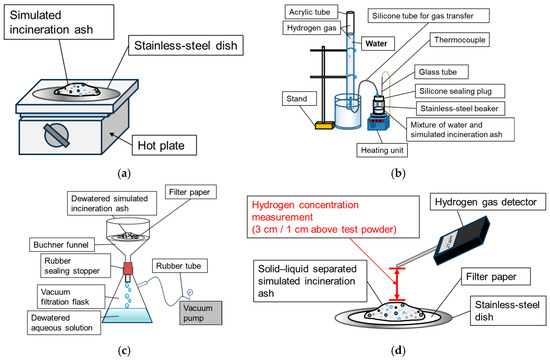
Table 1 presents an overview of the experimental apparatus. Figure 1a shows the experimental apparatus used for heating the simulated incineration ash. The ash was placed on a stainless-steel dish and heated to 200 °C using a hot plate (Model: EHP-170N, AS ONE CORPORATION, Osaka, Japan).
Table 1.
List of experimental equipment.
Figure 1.
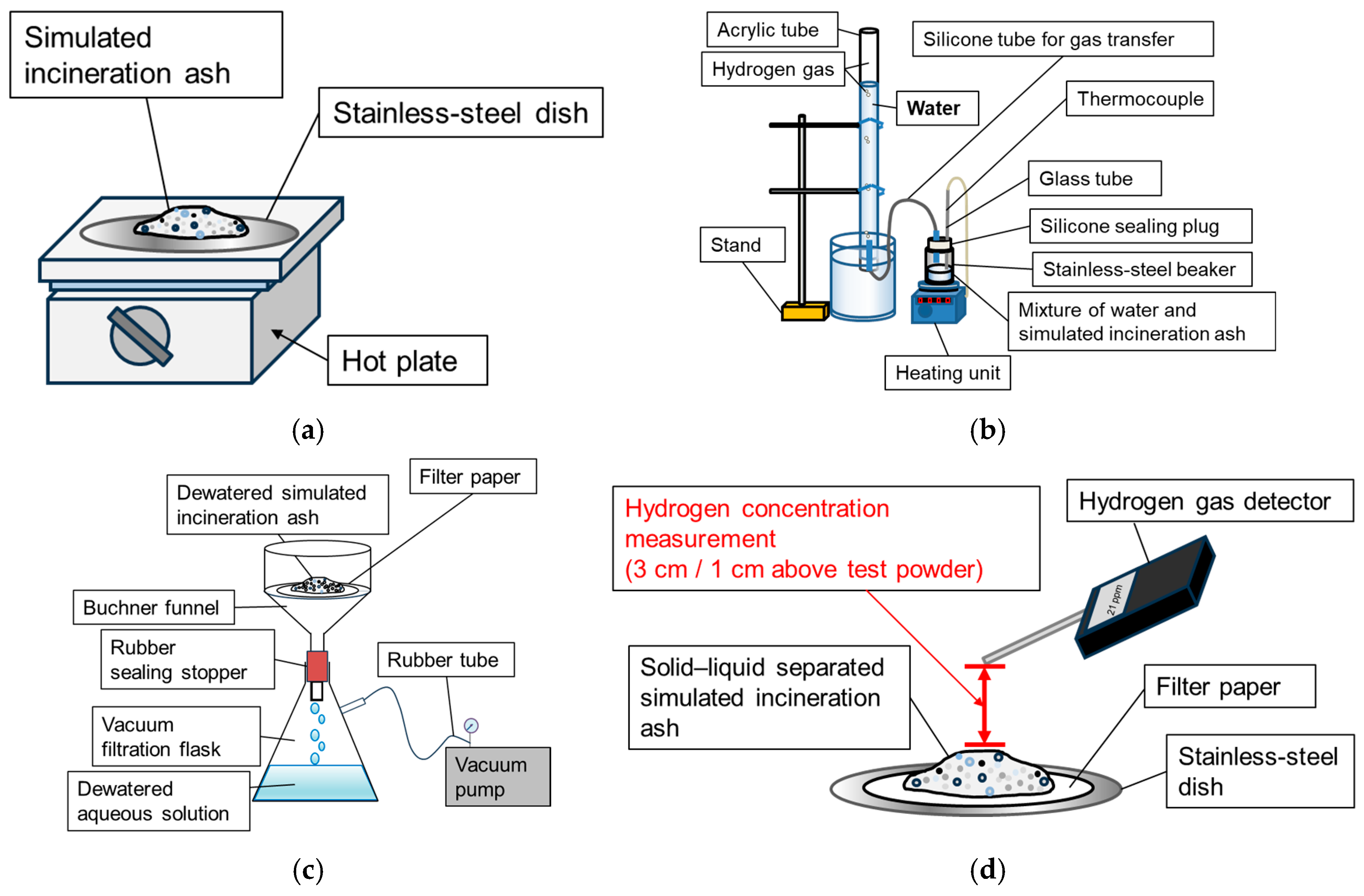
Diagram of the experimental equipment for (a) heating incineration ash to 200 °C; (b) producing hydrogen (hydrogen gas is collected and the volume is measured); (c) dehydration; and (d) measuring hydrogen gas concentration.
Figure 1b illustrates the apparatus used for hydrogen generation. The system consists of a heating unit with temperature control (Model: MI03, Kenis Ltd., Osaka, Japan), a stainless-steel beaker in which the ash and water react, a silicone sealing plug for sealing the beaker, a silicone tube for gas transfer, an acrylic tube used to collect the generated hydrogen, and a stand supporting the acrylic tube. Hydrogen generated in the stainless-steel beaker was transferred through the silicone tubing into the acrylic tube for collection. To measure the amount of hydrogen collected using the aforementioned water-displacement method, the partial pressure of hydrogen was calculated from the head difference between the liquid surface exposed to atmospheric pressure and that inside the collection tube, as well as from the vapor pressure of water corresponding to the water temperature. The hydrogen volume was then converted to that under standard conditions (0 °C, 1013 hPa). Here, the water temperature was assumed to be equal to room temperature. The number of trials for each experimental condition was set to one.
The major sources of measurement error were identified as errors (1) in reading the height of the gas phase inside the collection tube, (2) in atmospheric pressure measurement, and (3) in room temperature measurement. Error sources (2) and (3) affect the conversion of the measured hydrogen volume to standard conditions, while (3) additionally influences the calculation of the water vapor pressure at room temperature. A calculation of how these errors propagate to the hydrogen volume under standard conditions revealed that the errors associated with factors (2) and (3) were negligible, whereas that associated with factor (1) was at most 0.9 mL. This error is sufficiently small compared with the measured collected hydrogen volume.
Figure 1c shows the apparatus used during dehydration. It includes filter paper and a Büchner funnel for separating ash and water, a vacuum filtration flask for maintaining a negative-pressure environment, a rubber sealing stopper connecting the funnel and flask, a vacuum pump (Model: VP, Kenis Ltd., Osaka, Japan), and rubber tubing for connecting the pump.
Figure 1d shows the system for measuring hydrogen gas concentration, where a hydrogen gas detector (Model: XP-3360II, NEW COSMOS ELECTRIC CO., LTD., Osaka, Japan) was used. The measurement error of the hydrogen gas detector is ±100 ppm for concentrations below 1000 ppm and ±500 ppm for concentrations between 1001 and 10,000 ppm. Since conveyor motion in actual incineration plants induces airflow that facilitates gas dispersion, hydrogen concentration in this study was measured under windless conditions to prevent excessive diffusion and ensure accurate detection.
2.2.2. Experimental Method
In this study, water was placed into a reaction vessel and heated to the designated temperature. Simulated incineration ash containing aluminum powder, previously heated to 200 °C, was then introduced into the vessel to initiate hydrogen generation. After immersion, the mixture was allowed to cool naturally for 30 min, after which the solution and ash were separated and dehydrated using filter paper, a Büchner funnel, and a vacuum flask. After dehydration, the hydrogen concentration around the dewatered ash was measured using a hydrogen gas detector. Subsequently, the separated solution and simulated ash were mixed again, and hydrogen gas generated during this process was collected using the water-displacement method while the system continued natural cooling for up to 360 min. This study aims to verify whether hydrogen generation can be suppressed when aluminum-containing ash is immersed in water and whether the hydrogen concentration around dewatered ash can be reduced.
2.3. Experimental Setup
Table 2 summarizes the experimental conditions. The mass of simulated incineration ash, the mass and particle size of pure aluminum, the set temperature, and the amount of water were selected to match those used in previous experiments. The mass of simulated ash was set to 8 g, while that of the pure aluminum powder was set to 2 g, and its particle size ranged from 100 to 0 µm. In previous studies, Katahira et al. [3] used specimens with a particle size of 19 mm, Miyake et al. [6] used specimens with a particle size of 30 mm, and Nithiya et al. [7] employed specimens with particle sizes ranging from 4.75 mm to 0 mm. However, pure aluminum powder with a particle size below 100 µm—smaller than those used in the aforementioned studies—was utilized in this study to increase the amount of hydrogen generated and to facilitate clearer observation of the hydrogen-generation suppression behavior. The maximum set temperature was 90 °C to avoid excessive reactivity, and the minimum temperature was 40 °C, which is close to room temperature. To ensure the amount of water used was within the range reported in previous studies, where Katahira et al. [3], Nithiya et al. [7], Mizutani et al. [8], and Kumar et al. [9] used 10–40 mL, 75 mL, 100 mL, and 500 mL of water, respectively, the water volume was fixed at 200 mL. To simulate high-temperature ash discharged from an incinerator, the simulated ash was heated to 200 °C, in line with the study by Sato et al. [10], where the incineration ash temperature was set at 200 °C to evaluate the processing capacity of a municipal solid waste incineration facility.
Table 2.
Experimental conditions.
The total experiment time was 360 min to allow natural cooling to near room temperature. The immersion time of simulated ash in water was set to 30 min, corresponding to an assumed residence time in an ash discharge unit, while the dehydration time was 5 min, representing the actual duration required in the experiment. Hydrogen concentration was measured for 15 min based on an assumed conveyor residence time derived from a conveyor speed of 5 m/min and a length of 75 m, and the time required to re-mix the separated solution and ash was set to 10 min. To simulate immersion in an ash pit, hydrogen generated from the simulated ash was collected via water displacement until the end of the experiment.
The simulated ash consisted of 2 g of pure aluminum, 2 g of Al2O3, 2 g of CaO, and 2 g of SiO2, reflecting the primary components of real ash, with pure aluminum added as the hydrogen source. Hydrogen gas concentrations were measured at 1 and 3 cm above the dewatered ash, as concentrations fall below the detection limit beyond 4 cm due to diffusion. The measured parameters included the reaction-vessel temperature, ambient temperature, hydrogen gas volume, hydrogen concentration, and atmospheric pressure.
3. Experimental Results
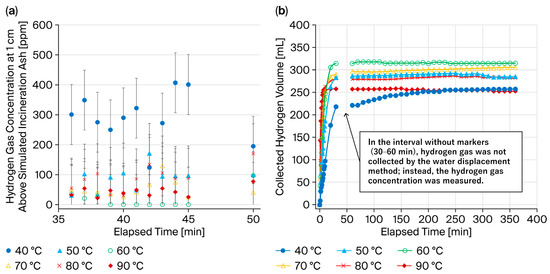
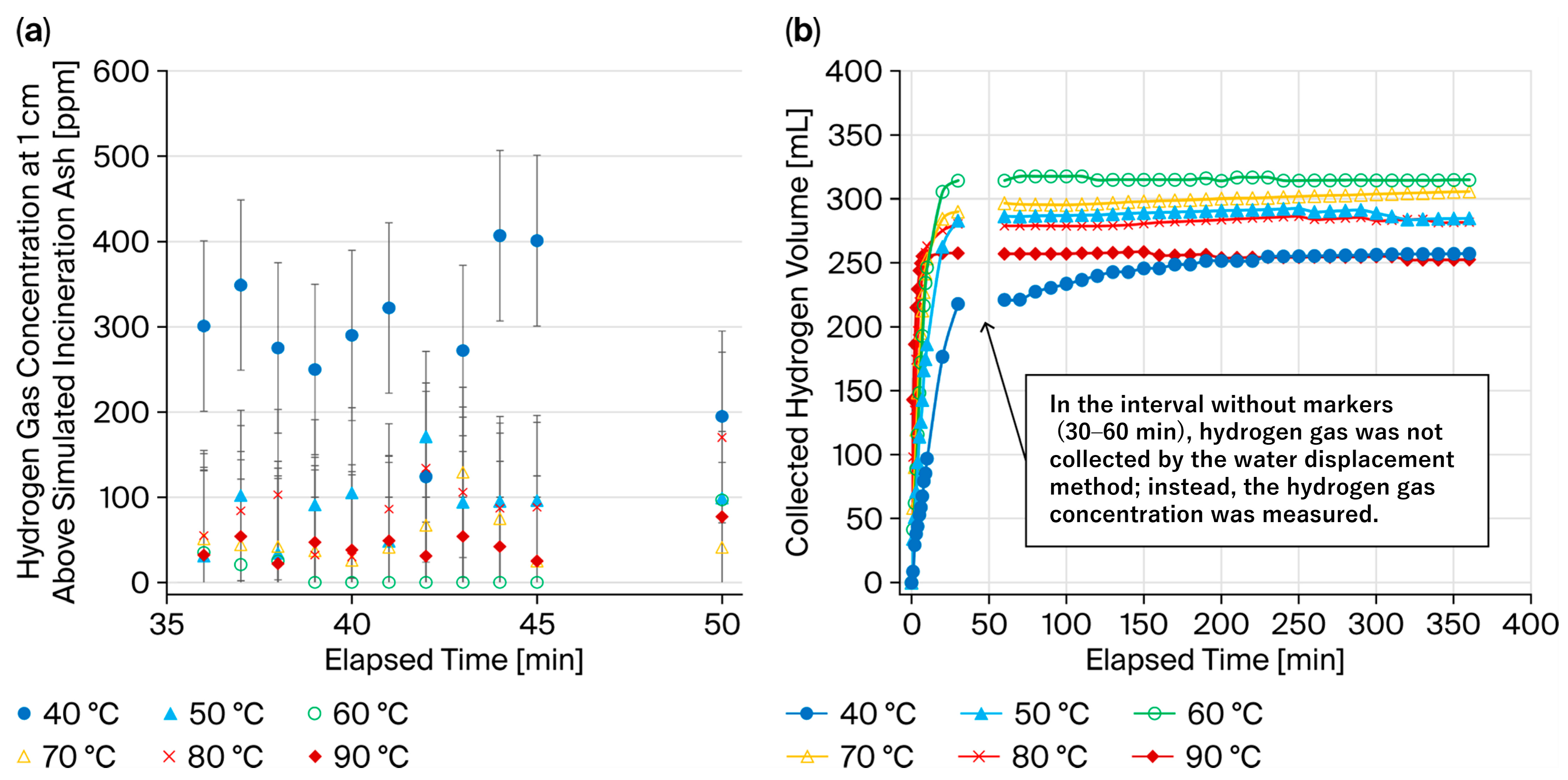
Figure 2a illustrates the influence of the set temperature on the temporal variation in hydrogen gas concentration measured at a position 1 cm above the test powder. The hydrogen concentration around the dried simulated incineration ash was measured 35 min after the start of natural cooling. As a result, it was found that when the reaction temperature exceeded 60 °C, the measured hydrogen concentration fell within the error range of the hydrogen gas detector, indicating that the concentration of the hydrogen generated from the simulated incineration ash containing dehydrated aluminum powder became extremely low.
Figure 2.
Effect of the temperature setting on the temporal change in (a) hydrogen gas concentration at a position 1 cm from the test powder and (b) hydrogen volume.
Figure 2b shows the effect of the set temperature on the temporal variation in the hydrogen gas volume. The cumulative hydrogen volume is plotted on the left vertical axis, while the elapsed time is plotted on the horizontal axis. The section without markers between 30 and 60 min corresponds to the period during which hydrogen gas was not collected via water displacement but was instead measured as a concentration.
The results demonstrated that, when the set temperature was 90 °C, hydrogen generation was effectively suppressed, with the total volume generated remaining small. When the set temperatures were 80, 70, 60, and 50 °C, hydrogen generation could also be suppressed via natural cooling; however, the accumulated hydrogen volume in the acrylic tube was greater than that observed at 90 °C. By contrast, when the set temperature was 40 °C, hydrogen generation could not be suppressed even after natural cooling began, and both the hydrogen generation activity and accumulated hydrogen volume were significantly larger than those at 90 °C.
4. Discussion
In the hydrogen-generation experiment conducted by Saffarzadeh et al. [11] using incineration ash, deposits such as hydrates were observed around the regions containing higher amounts of aluminum. These deposits may potentially inhibit the reaction between aluminum and water. According to the study by Fujimura [12], when aluminum metal foil is heated and oxidized in air, the oxide film’s thickness increases with increasing temperature. In the present study, it is presumed that an aluminum oxide film may have formed when the simulated incineration ash was heated to 200 °C in air. Yamada et al. [13] reported that aluminum immersed in water at higher temperatures results in thicker oxide films, suggesting that higher set temperatures in this study may likewise promote oxide-film growth. Furthermore, when the adhesion strength between the oxide film and the aluminum substrate exceeds the mechanical strength of the film, cracks may form first, followed by a flaking phenomenon in which the film protrudes outward [14]. During natural cooling, compressive stress may have caused the oxide film to crack. These phenomena are considered to contribute to hydrogen-generation suppression. Although the authors did not directly measure the formation of oxide films in this study, the experimental results together with the relevant literature allowed us to infer the mechanism of hydrogen generation, as described in the following section.
4.1. Mechanism of Hydrogen-Generation Suppression During the Incineration Ash Heating Process
By heating the simulated incineration ash to 200 °C in air, the oxide film on the surface of the aluminum particles contained in the ash grows in thickness and these particles also expand due to thermal effects.
4.2. Mechanism of Hydrogen-Generation Suppression in the Hydrogen Gas Capture Process Using Water Displacement
When aluminum particles heated to 200 °C are immersed in water below 100 °C, compressive stress is generated in the oxide film on the aluminum surface, causing cracks to form in the film and resulting in hydrogen gas generation.
4.2.1. At Set Temperatures of 50 °C or Higher
When the water temperature exceeds 50 °C, an oxide film forms on the surface of the aluminum particles, reducing the direct contact between aluminum and water. The oxide layers formed are identified as boehmite and bayerite films [13], and it is thought that the formation of these oxide films suppresses hydrogen generation over time.
4.2.2. At Set Temperatures of 40 °C or Lower
When the water temperature is below 40 °C, no oxide film forms on aluminum, and hydrogen generation is considered to continue.
4.3. Mechanism of Hydrogen-Generation Suppression During the Process of Measuring Hydrogen Gas Concentration in the Atmosphere
4.3.1. When the Set Temperature Is 50 °C or Higher
During the dehydration process of the simulated incineration ash, most of the moisture in the ash is removed; however, a small amount of water remains due to the short dehydration duration of 1 min, and a similar phenomenon is observed in actual plants after dehydration. Since an oxide film is formed on the surface of the aluminum particles, direct contact between aluminum and water is reduced, which is considered to result in a lower hydrogen gas concentration.
4.3.2. When the Set Temperature Is 40 °C or Lower
Since an oxide film is not formed on the surface of the aluminum particles, hydrogen gas generation is considered to continue.
Based on the above mechanisms, it is considered that, when the set temperature is 50 °C or higher, an oxide film is formed on the surface of the aluminum particles, thereby suppressing hydrogen generation. By contrast, when the set temperature is 40 °C or lower, the oxide film does not form, and hydrogen gas generation continues.
4.4. Differences Between Simulated Ash and Actual Incineration Ash
In our previous studies [5,15], it was found that there was no significant difference between simulated ash and actual incineration ash in terms of the tendency for hydrogen-generation suppression. In the present study, the experiments were conducted using simulated ash, and hydrogen generation was successfully suppressed during natural cooling at higher set temperatures. This suggests that similar suppression effects may also be achievable when using actual incineration ash.
4.5. On the Practical Applicability of This Method
This method has the potential to suppress hydrogen generation in actual incineration plants when applied to the ash discharge unit and the ash conveyor. In practical operation, the cooling-water temperature in the ash discharge unit would be maintained at 90 °C utilizing waste heat from the boiler, and the high-temperature incineration ash discharged from the furnace would be introduced into it. When the ash is immersed in water at 90 °C, oxide films begin to gradually form on the surface of the aluminum particles contained in the ash, which may lead to a reduction in the amount of hydrogen generated. Any hydrogen gas generated in the ash discharge unit would be directed back into the incinerator and combusted. As the ash is subsequently transported from the ash discharge unit to the ash conveyor, the aluminum particles in the ash are expected to exhibit reduced direct contact with water due to the formation of oxide films on their surfaces, resulting in lower hydrogen concentrations in the conveyor. Furthermore, the aluminum present in the ash transported from the ash conveyor to the ash pit is also expected to exhibit suppressed hydrogen generation due to the effects of these oxide films. Consequently, this method may help prevent hydrogen explosions within incineration plants and thereby contribute to more stable plant operation.
4.6. Novelty and Contributions of This Study
The novelty of this study lies in the experimental approach of reacting simulated incineration ash heated to high temperatures with hot water, followed by the measurement of the hydrogen gas concentration after natural cooling. Although various studies have investigated hydrogen generation in terms of the reaction between incineration ash and water, no previous research has conducted hydrogen-generation experiments using incineration ash that was intentionally heated beforehand. The present study demonstrated that hydrogen generation can be suppressed even under conditions simulating high-temperature incineration ash. Therefore, operating the ash discharge unit with elevated cooling-water temperatures has the potential to contribute to the prevention of hydrogen explosions in incineration plants.
5. Conclusions
In this study, the interaction between simulated incineration ash and water was investigated. The results demonstrate that hydrogen generation can be suppressed by mixing the simulated incineration ash with heated water followed by natural cooling. The main findings are summarized as follows:
- Setting higher temperatures resulted in lower hydrogen concentrations around the ash; specifically, concentrations were below 100 ppm at 60 and 90 °C but above 100 ppm at 40 °C.
- In water-displacement experiments, setting higher temperatures suppressed hydrogen evolution; at 90 °C, hydrogen generation ceased after natural cooling, and the total volume was markedly lower than at other temperatures.
- Hydrogen suppression occurs when oxide films form on aluminum particle surfaces at ≥50 °C, whereas hydrogen generation continues at ≤40 °C, where such films do not form.
Future work will involve experiments using actual incineration ash, with the ash mass increased to 50–100 g. Additionally, a heater will be installed in the ash discharge system of an incineration plant and operated at 90 °C to suppress hydrogen generation, with the purpose of realizing a practical implementation.
Author Contributions
Conceptualization, H.O. and R.I.; methodology, H.O. and R.I.; funding acquisition, H.O. and R.I.; investigation, H.O. and R.I.; data curation, H.O. and R.I.; writing—draft preparation, H.O.; review and editing, H.O., R.I. and M.S. All authors have read and agreed to the published version of the manuscript.
Funding
This research received no external funding.
Institutional Review Board Statement
Not applicable.
Informed Consent Statement
Not applicable.
Data Availability Statement
The data presented in this study are available upon request from the corresponding author.
Conflicts of Interest
Hideyuki Onodera were employed by Japan Aerospace Exploration Agency. The remaining authors declare that the research was conducted in the absence of any commercial or financial relationships that could be construed as a potential conflict of interest.
References
- Yasuda, K.; Tagota, H.; Miyakawa, T.; Shimizu, Y. Hydrogen gas explosion at a general waste incineration facility in Kanagawa Prefecture. Jpn. Soc. Saf. Eng. 1997, 36, 183–187. [Google Scholar] [CrossRef]
- Takatsuki, H. Lessons learned from dust ash bunker explosion. J. Mater. Cycles Waste Manag. 1994, 5, 441–448. [Google Scholar] [CrossRef] [Scilit]
- Katahira, K.; Masuda, J. Investigation of a cause of minute explosion in bottom ash pit of municipal waste incineration plant. Annu. Rep. Osaka City Res. Cent. Environ. Sci. 2018, 1, 29–32. [Google Scholar]
- Sakou, K.; Saffarazadeh, A.; Shimaoka, T. Study on the Form of Metal Contributing to Hydrogen Gas Generation in Municipal Solid Waste Incineration Ash. In Proceedings of the Meeting of the Japan Society of Civil Engineers-West, Kumamoto, Japan, 9 March 2013. [Google Scholar]
- Onodera, H.; Imai, R.; Narimo, H.; Suzuki, Y. Study on the suppression of hydrogen generation by actual incineration ash containing aluminum and water. In Proceedings of the 35th Annual Conference of Japan Society of Material Cycles and Waste Management, Tsukuba, Japan, 9–11 September 2024. [Google Scholar]
- Miyake, M.; Saffarazadeh, A.; Komiya, T.; Shimaoka, T. Effectiveness of TiO2 Addition and NaOH Aqueous Solution in Promoting Hydrogen Gas Generation from Municipal Solid Waste Incineration Ash. In Proceedings of the 29th Annual Conference of Japan Society of Material Cycles and Waste Management, Nagoya, Japan, 12–14 September 2018. [Google Scholar]
- Nithiya, A.; Saffarzadeh, A.; Shimaoka, T. Hydrogen gas generation from metal aluminum-water interaction in municipal solid waste incineration (MSWI) bottom ash. Waste Manag. 2018, 73, 342–350. [Google Scholar] [CrossRef] [Scilit] [PubMed]
- Mizutani, S.; Sakai, S.; Takatsuki, H. Investigation of hydrogen generation from municipal solid waste incineration fly ash. J. Mater. Cycles Waste Manag. 2000, 2, 16–23. [Google Scholar]
- Kumar, D.; Liu, Y.; Yang, E. Simplified kinetics model for hydrogen gas generation from metallic aluminum in municipal solid waste incineration bottom ash. J. Environ. Chem. Eng. 2023, 11, 111129. [Google Scholar] [CrossRef] [Scilit]
- Satou, K.; Futami, H. Evaluation methods of functional ability for refuse incineration plants. Bull. Jpn. Environ. Cent. 1988, 15, 42–51. [Google Scholar]
- Saffarzadeh, A.; Arumugam, N.; Shimaoka, T. Aluminum and aluminum alloys in municipal solid waste incineration (MSWI) bottom ash: A potential source for the production of hydrogen gas. Int. J. Hydrogen Energy 2016, 41, 820–831. [Google Scholar] [CrossRef] [Scilit]
- Fujimura, Z. Oxidation of Aluminum Foil at Elevated Temperature. J. Electrochem. Soc. Jpn. 1963, 31, 831–835. [Google Scholar] [CrossRef] [Scilit]
- Yamada, H.; Okamoto, T. Effects of temperature on formation and corrosion resistance of boehmite films- Studies on boehmite forming process (6th report). J. Jpn. Inst. Light Met. 1971, 21, 597–605. (In Japanese) [Google Scholar] [CrossRef] [Scilit]
- Taniguti, S. Stresses in High-Temperature Oxide Scales. J. Surf. Finish. Soc. Jpn. 2000, 51, 371–374. [Google Scholar] [CrossRef]
- Onodera, H.; Imai, R. Study on suppression of hydrogen generation using incineration ash and water simulating an ash conveyor environment. In Proceedings of the 36th Annual Conference of Japan Society of Material Cycles and Waste Management, Nagoya, Japan, 17–19 September 2025. [Google Scholar]

Disclaimer/Publisher’s Note: The statements, opinions and data contained in all publications are solely those of the individual author(s) and contributor(s) and not of MDPI and/or the editor(s). MDPI and/or the editor(s) disclaim responsibility for any injury to people or property resulting from any ideas, methods, instructions or products referred to in the content. |
© 2026 by the authors. Licensee MDPI, Basel, Switzerland. This article is an open access article distributed under the terms and conditions of the Creative Commons Attribution (CC BY) license (https://creativecommons.org/licenses/by/4.0/).