Proceeding Paper

Electrical Discharge Coating Variables Multi-Criteria Optimisation Utilising TOPSIS Method on the Wear Behaviour of WS2-Cu Coating on AA7075 Alloy †

by
Natarajan Senthilkumar
1,
Ganapathy Perumal
2,*,
Kothandapani Shanmuga Elango
3,
Subramanian Thirumalvalavan
4 and
Saminathan Selvarasu
4
1
Department of Mechanical Engineering, Saveetha School of Engineering, Saveetha Institute of Medical and Technical Sciences (SIMATS), Chennai 602105, India
2
Department of Mechanical Engineering, V.R.S. College of Engineering and Technology, Arasur, Villupuram 607107, India
3
Department of Mechanical Engineering, St. Anne’s College of Engineering and Technology, Panruti 607110, India
4
Department of Mechanical Engineering, Arunai Engineering College, Tiruvannamalai 606603, India
*
Author to whom correspondence should be addressed.
Presented at the 19th Global Congress on Manufacturing and Management (GCMM 2025), Vellore, India, 10–12 December 2025.
Eng. Proc. 2026, 130(1), 5; https://doi.org/10.3390/engproc2026130005
Published: 8 April 2026
(This article belongs to the Proceedings of The 19th Global Congress on Manufacturing and Management (GCMM 2025))

Abstract

Aluminium alloys are extensively considered in aviation and automobiles owing to their lightweight properties and favourable specific strength-to-weight ratio. Generally, the poor surface properties of these alloys limit their application, particularly in sliding conditions. To enhance the surface qualities, particularly the material’s wear resilient features, a unique surface modification process using electro-discharge coating (EDC) has been employed. This work investigates the optimisation of coating variables produced by the EDC technique utilising green compact electrodes composed of 50 wt.% tungsten disulfide (WS2) and 50 wt.% copper (Cu) powder. The substrate material utilised was AA7075 alloy. The Taguchi–TOPSIS approach was employed to determine optimal EDC process variables, with pulse-on time (Ton), current (Ip), and pulse-off time (Toff). Wear rate (WR), surface roughness (SR), and friction coefficient (CoF) were used to assess the coating features. A wear study was performed with a pin-on-disc device with an undeviating sliding speed (0.25 m/s) and a 25 N load. The results revealed that the supreme features derived from the linear plots were Ip (4 A), Ton (80 µs), and Toff (5 µs). The ANOVA found that Ip had the utmost significant impact, accounting for 44.09%; Toff, 28.01%; Ton, 20.33%; and minimum error, 8.58%. A validation trial with perfect parameters returned values of 0.000179 mm3/Nm (WR), 0.204 (CoF), and 2.818 µm (SR). These findings are significantly better than those of the other coatings. The discrepancy among the estimated and experimental relative closeness in optimal settings is 6.34%, demonstrating that the Taguchi–TOPSIS method is more appropriate for multi-criteria optimisation.

1. Introduction

Aluminium is one of the most often utilised metals owing to its low density and outstanding corrosion resistance. A constraint of pure aluminium is its weaker strength, which can be mitigated through alloying with various elements. Consequently, numerous series of aluminium alloys have been developed to satisfy industrial specifications and functional needs [1]. Aluminium (Al) alloys are widely utilised in aviation applications owing to their extremely light weight, strong mechanical properties, excellent corrosion resistance, and cost-effectiveness [2]. Among the abundant Al alloys, AA7075 offers an elevated strength-to-weight ratio, making it valuable for structural uses in maritime, aviation, national defence, and motor vehicle applications [3]. The additional benefit of AA7075 is that its corrosion resistance can be enhanced by thermal treatment under various conditions [4]. However, unlike steels, the AA7075 alloy’s inadequate surface characteristics and lack of hardenability limit its use in tribological applications [4]. Consequently, improvements in engineering surface properties are essential to enhance the surface defences of such low-strength alloys against failures [5].
Several surface enhancement procedures are currently used to improve the surface of Al alloys without altering the base alloy features. These techniques can make the surface more hard-wearing and heat-resistant. Electroless plating, plasma spraying, electro deposition, CVD, PVD, and laser cladding are some of these technologies [6,7,8,9]. Though these methods impart outstanding surface operational characteristics, they have numerous shortcomings. CVD coatings are often applied at high temperatures [10], which can alter the underlying material’s physical properties. PVD can be operated at 200 °C, but coatings deposited by ion plating or thermal evaporation do not adhere as well [11]. In addition, CVD and PVD are quite costly methods that require vacuum systems and highly complex processes [10]. Thus, the need for substantial financial resources, high temperatures, and a vacuum limit their use to only a few materials.
On the other hand, the electrical discharge coating (EDC) method for surface modification offers numerous advantages over other methods. EDC does not require expensive tools or extreme-temperature devices, and it can efficiently control the properties of the coating film [12]. EDC has attracted significant interest because it is easy to use; the only requirement is a powder metallurgy (PM) electrode to make a durable ceramic covering [13]. This method is easy to use with readily available EDM machinery, which is a significant advantage. Researchers worldwide have reported on EDC’s ability to increase the efficiency and reliability of metal-cutting tools, protective coatings on rolling mills, and machine parts [14,15,16]. Yap et al. [17] investigated the tribological attributes of EDC layers with suspensions of quarry dust. The results showed that the coating layer’s roughness, CoF, wear loss, and scar depth were lowered by 29, 61, 79, and 63%, associated with the WC-Co substratum. Adopting PMED, Mohanty et al. [18] altered the Ti6Al4V substrate with WS2 powder; the results showed that the powder fraction significantly affected the coating’s characteristics, and the specific wear rate (WR) decreased as the duty factor increased. Tyagi et al. [19] attempted to alter a mild steel substrate using EDC powder and MoS2. They observed that using a 50:50 MoS2:Cu ratio and lower parameter values led to inconsistent deposition. At high discharge current (Ip) and duty factor, microhardness reached its maximum, leading to a significant drop in WR.
The coating depth and exterior durability achieved by the protective coating method indicate improved substrate protection and functionality. To enhance effectiveness and achieve the intended results after coating, it was necessary to optimise the input variables and predict the resulting characteristics [20]. Maddu et al. [21] employed L9 orthogonal array (OA) designs for trials to evaluate the characteristics, surface structure, and thickness of the protective coating layer, the interface among materials, and the fracture density of the surface to identify the optimal coating. The studies were carried out on EDC using electrodes composed of Cu + W particles to provide a substantial coating on the carbon steel surface. The EDC procedure was used to apply a homogeneous layer of W and Cu powders over mild steel using green compact electrodes. The process factors, including load, composition, pulse-off time (Toff), Ip, and pulse-on time (Ton), were considered for optimisation. The findings show that all parameters affect the rate of material transfer, tool wear, surface roughness (SR), and coating thickness. Compared with the substrate, the deposited layer was 5–6 times more robust [22].
For coating materials, solid lubrication is necessary in high-temperature environments where conventional greases or lubricating oils cannot be used. From previous studies, one can see that only a few have used EDC in conjunction with solid lubricants, viz., white solids, PTFE, MoS2, h-BN, and Gr. There are also aluminium coatings with solid lubricants. WS2 has the best lubricity of all solid lubricants, with a friction coefficient of 0.07. It can withstand high temperatures in automotive transmissions, production sectors, agricultural equipment, maritime applications, and spacecraft [23]. Tyagi et al. [24] used the EDC technique to deposit a solid lubricant on SS304 stainless steel with weight ratios of 40:60 and 50:50 for WS2 and Cu electrodes, respectively. The results showed that the 50:50 wt.% coating was thicker when the electrical parameters were established, and it resulted in lower microhardness. Siddique et al. [25] conducted EDC with weight ratios of WS2:Brass of 50:50 and 70:30. The highest deposition rate was observed at a 50:50 blending ratio, a duty factor of 50%, and a machining voltage of 80V. The perfect surface was also achieved with a 70:30 constituent ratio.
This research aimed to apply a hard, uniform WS2 coating to an AA7075 metal substrate as a solid lubricant. The study involved assessing and refining the EDC variables to improve the alloy’s surface properties. The deposition was performed with a green compact electrode containing 50% WS2 and 50% Cu by weight. The effects of the critical EDC variables Toff, Ton, and Ip were studied to determine the optimal values for each using the TOPSIS method. This was done to reduce both the SR and the coating WR.

2. Experimental Procedures

2.1. Materials

This study used AA7075 alloy (Metmech, Chennai, India) as the primary substrate material because it is extensively used in the aviation and automotive sectors [26]. Table 1 illustrates the elemental composition of the base material. To manufacture the compact green electrode, tungsten disulfide (WS2) and copper powders were mixed in a mortar for 1 h to ensure they were evenly combined. Because WS2 is a semiconductor, EDC cannot make a pure coating of it. Cu was used as a binder to make WS2 conductive and to strengthen and toughen the electrode itself. To make a green electrode, WS2 and Cu (Southern India Scientific Corporation, Chennai, India) powder (mean particulate size of 15 µm and 10 µm) were mixed in a 50:50 ratio. Then, a solution of polyvinyl alcohol was added to make the mixture uniform, and the mixture was pressed in a die of Ø15 mm using a hardened punch. Then, it was placed in a hydraulic press and squeezed to 350 MPa. A tube furnace was used to heat the green compact to 130 °C for 10 min under vacuum. It was then allowed to cool for 5 min to make sure the bonds were firm.

2.2. Fabrication of EDCs

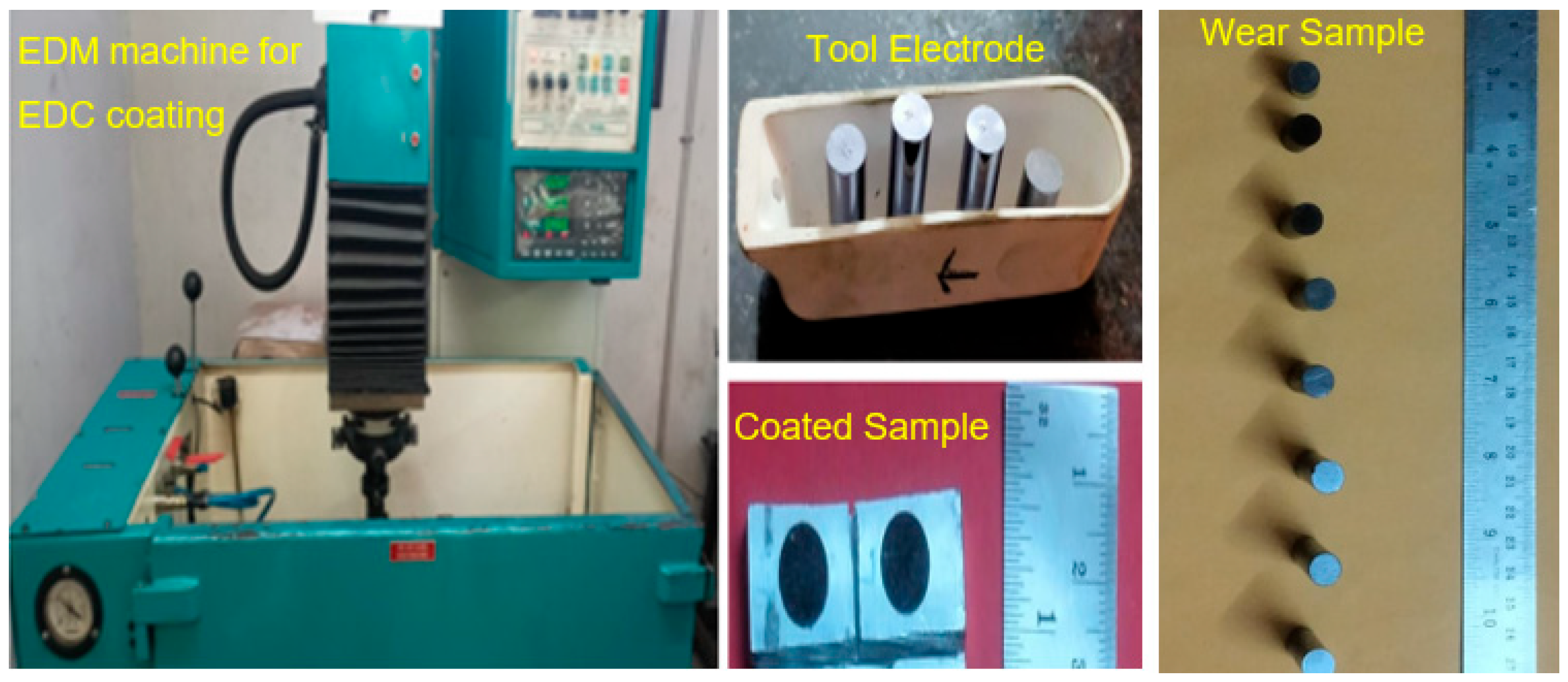
The EDC was carried out with an EDM machine (Ratnaparkhi, 5530 E-series, Nashik, Maharashtra, India). For this investigation, a tailored EDC power supply, consisting of both hardware and software, was implemented. Using reverse polarity for a set amount of time (5 min), all coatings were applied to AA7075 alloy using a special 50 wt.% WS2:/50 wt.% Cu composite electrode dipped in hydrocarbon oil (dielectric). Before EDC, the electrodes were polished to ensure that they were smooth and well-fitted to the substrate. The substrates were also ground to a mirror finish. To eliminate any imperfections, only substrates with a mirror texture were employed to aid the coating process. The samples were cleaned after each analysis using ultrasound with acetone to eliminate any grime that had adhered to the coated surface [27]. Figure 1 shows the investigation arrangement used in this study along with the tool electrode, coated samples, and wear specimens from the coated samples.

2.3. Characterisation and Wear Testing

The coating’s upper surface was assessed via scanning electron microscopy (SEM) to elucidate the morphology generated by the EDC process. Before the microstructural investigation, these specimens were ground with 1200 μm to 1600 μm SiC sandpaper; thereafter, they were mirror-polished with 1 μm diamond slurry. The SR of all coatings was assessed using the TMR 120 tester. The tribological properties were evaluated using a conventional pin-on-disc device (ASTM G99) [28] on a conventional wear tester (Ducom, Bengaluru, India) in dry conditions at ambient temperature. The disc material was EN31 steel, with a 25 mm track diameter, subjected to a persistent sliding speed of 0.25 m/s and an applied force of 25 N, considering a coated pin with a length of 15 mm and Ø5 mm. Three coated specimens of each material were assessed, with a cumulative testing time of 15 min. Weight loss was assessed by weighing samples and pins before and after each test with a precision balance with ±0.0001 accuracy. The WR was determined based on the volume loss in line with
W R = V N × v × t mm 3 / Nm
where V signifies the loss of coating volume ascertained by weight loss, N denotes the applied force, v indicates the test sliding velocity, and t represents the test period.

2.4. Multi-Objective Optimisation Using TOPSIS

This multi-objective optimisation using an orthogonal array (OA) was developed using Taguchi methods, and optimisation was performed using the TOPSIS method [29]. Taguchi uses a rigorous design of experiments to minimise process variability, thereby facilitating the production of products of outstanding eminence at a reasonable rate. Taguchi proposed an experimental framework in which the process values are systematically arranged in OA, serving as a substitute for factorial strategies by evaluating specific sets of alternatives rather than all feasible alternatives, thereby conserving time and resources while collecting essential data to discern the key factors affecting product quality with minimal experimentation. Table 2 outlines the variables and their corresponding values for investigation. Minitab-22 (U.S) statistical software was utilised to calculate and generate L9 (33) OA. Throughout the process, the other parameters remained the same. The variables being studied and their values were determined via previous studies.
One common approach to multi-criteria decision-making (MCDM) is TOPSIS (the Technique for Order Preference by Similarity to Ideal Solution), which ranks options according to how near they are to an ideal answer (denoting optimal outcomes for all requirements) and their separation from a lowest possible solution (indicating the least favourable outcomes). TOPSIS was formulated [30] to assess options by gauging their geometric closeness to an optimal solution, which embodies the optimal values for all requirements, as well as their separation from a nadir value. The approach computes a relative closeness coefficient for each choice, reconciling the trade-offs among conflicting criteria. The procedure commences with the creation of a decision matrix, which is subsequently normalised according to Equation (2):
r i j = x i j / i = 1 m x i j 2
The ith choice’s initial value about the jth criterion is represented by xij. The normalised values are adjusted to express how each criterion is related to the others, as follows:
v i j = w j r i j
where wj is the jth criterion weight. The optimal and suboptimal ideal solution A+ and A solutions are thereafter determined according to the specified criteria as follows:
A = ( max i v i j j ε J ) , ( min i v i j j ε J ) i = 1 , 2 , , m = v 1 , v 2 , , v j , , v n
A = ( min i v i j j ε J ) , ( max i v i j j ε J ) i = 1 , 2 , , m = v 1 , v 2 , , v j , , v n
where J = j = 1 , 2 , n j , linked to the benefit criterion, and J = j = 1 , 2 , n j , linked to expenditure criteria. Consequently, it is unequivocal that the two generated alternatives A* and A signify the most favourable choice (ideal solution) and the least favourable choice (negative ideal solution), respectively [31]. Every possible solution and its estimated proximity to the ideal positive and negative ones ( S i + and S i ) are
S i + = j = 1 n ( v i j A j + ) 2       &       S i = j = 1 n ( v i j A j ) 2
Finally, the relative closeness (RC) is computed to rank alternatives:
R C = S i S i + + S i
A larger RC score indicates an alternative nearer to the ideal solution, making TOPSIS a powerful and trustworthy instrument for making decisions in intricate engineering settings when several competing criteria are present.

3. Results and Discussion

3.1. Optimisation

Table 3 presents the input variables for the EDC formulation and their corresponding output responses. This study used the TOPSIS method to optimise the multicriteria wear parameters and SR of the coatings. Data normalisation is the initial phase of any analysis and is essential for scoring and ranking alternatives using MCDM approaches. It accomplishes this by transforming the supplied dataset into equivalent numerical formats. All responses in Table 3 have been converted to 0 and 1 utilising a normalised sequence [32]. Table 4 presents the normalised values for WR, coefficient of friction (CoF), and SR. Compensating techniques like TOPSIS allow for alternatives between criteria, meaning that fulfilling one criterion may mitigate a subpar outcome in another. Unlike non-compensatory processes that accept or reject potential solutions based on rigid thresholds, this approach provides a more accurate modelling method. The outcomes are given relative weight after the normalisation procedure. The responses were assigned varying weights. 25% was allocated to SR, 25% to the CoF, and 50% to WR in terms of weight. A greater weight was proposed to minimise the WR as effectively as possible [33]. After weighted normalisation, the ideal solution (positive) was determined to reduce WR, CoF, and SR. Table 5 presents the negative ideal solutions for WR, CoF, and SR, along with the positive ideal solution (desired circumstances). These signify the alternatives to the preferred conditions evaluated in the positive ideal solutions. Table 5 presents the RC calculated for the individual sample, concurrently minimising WR, CoF, and SR.
Furthermore, ranking is based on the proximity of RC values to the ideal value (1). The mean RC scores for every coated sample, corresponding to each variable level, were utilised in the formulation of the response table for the computed RC [34], as shown in Table 6. The ranking can determine the influence of the investigated components across a range of possible values (high to low) that match the examined levels. The most significant variable is ranked first, whilst the least important is ranked third [34].
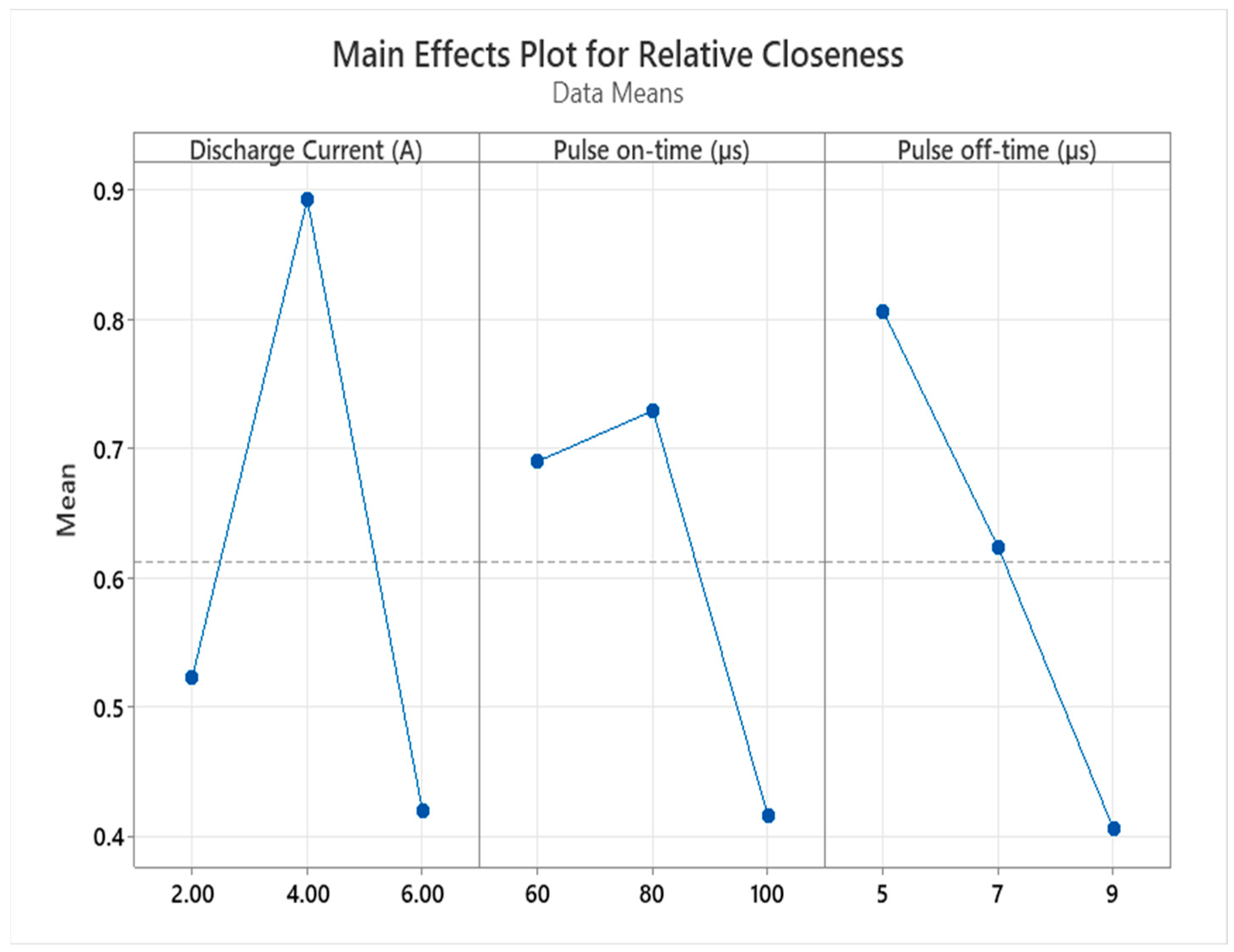
The ideal parameters, as derived are 4A for Ip, 80 µs for Ton, and 5 µs for Toff. Figure 2 illustrates the linear plot for the response table. The Ip is the most dominant variable, surpassing all other parameters. To attain superior wear resistance, reduced CoF, and minimal SR, the primary determinant is the Ip, followed by Toff and Ton.
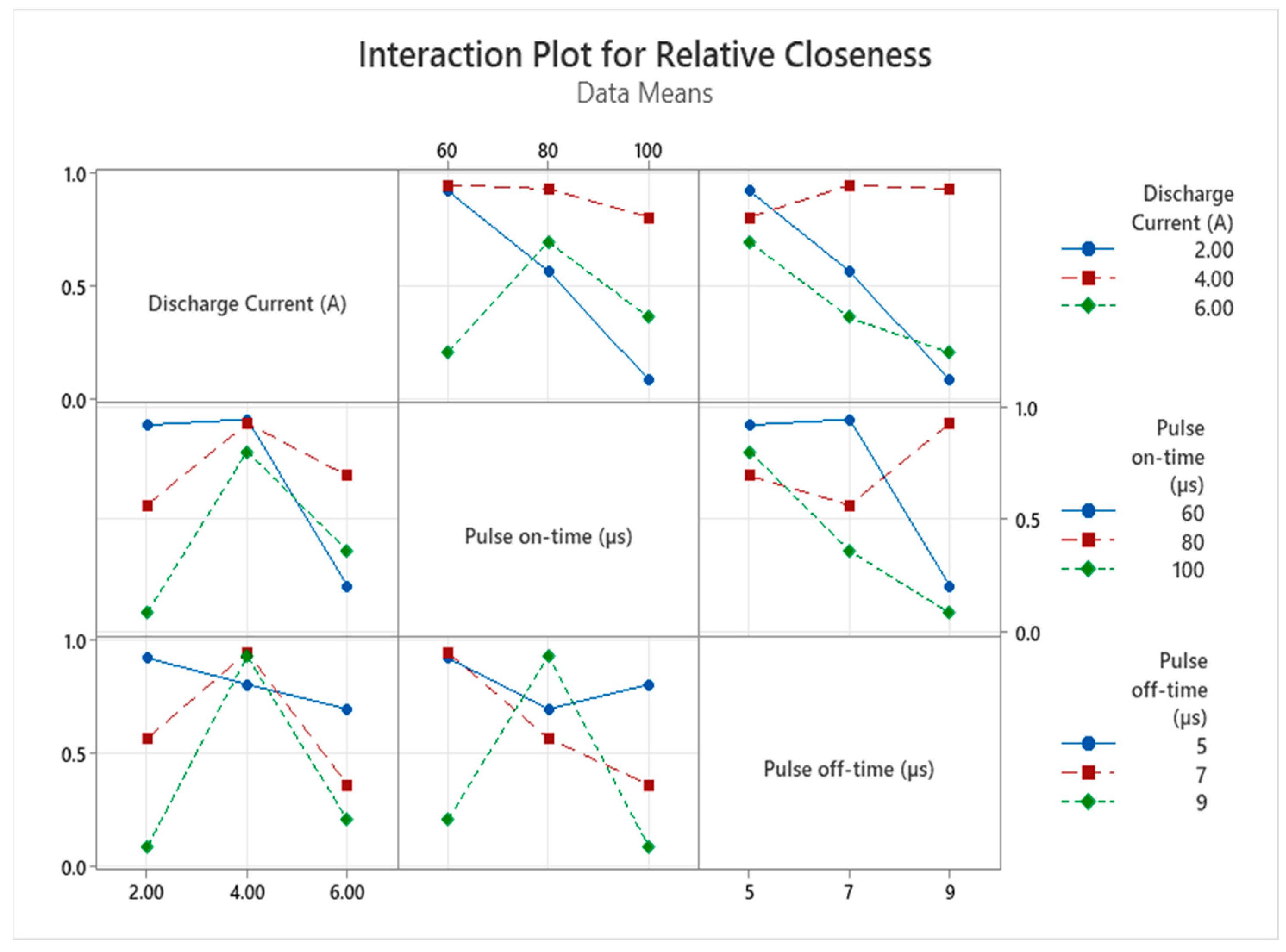
In a controlled study, the likelihood that any distinct component interacts with other investigated factors increases progressively. The influence of the extent of a particular factor on the outcomes of other factors is referred to as interaction [35]. When interaction lines are aligned, the variables exhibit no interaction; conversely, when the lines diverge, a correlation is present. In the absence of interaction, the influence of the one variable stays invariant irrespective of the level of the second factor, and vice versa. The greater the interactions among the variables, the more skewed the lines are. An interaction occurs when the influence of the first factor depends on the extent of the second variable’s values, and vice versa [36]. Figure 3 illustrates the impact of various coating input variables on relative proximity as demonstrated in the interaction plot. The observation illustrates that the higher-level interactions among the inputs, when combined with additional inputs, substantially influence their relative proximity. The graphic indicates that all input variables exhibit substantial mutual dependence. Moreover, there exists a more pronounced interaction among the Ip and Ton, Ton and Toff, as between the Ip and Toff.

3.2. Analysis of Variance

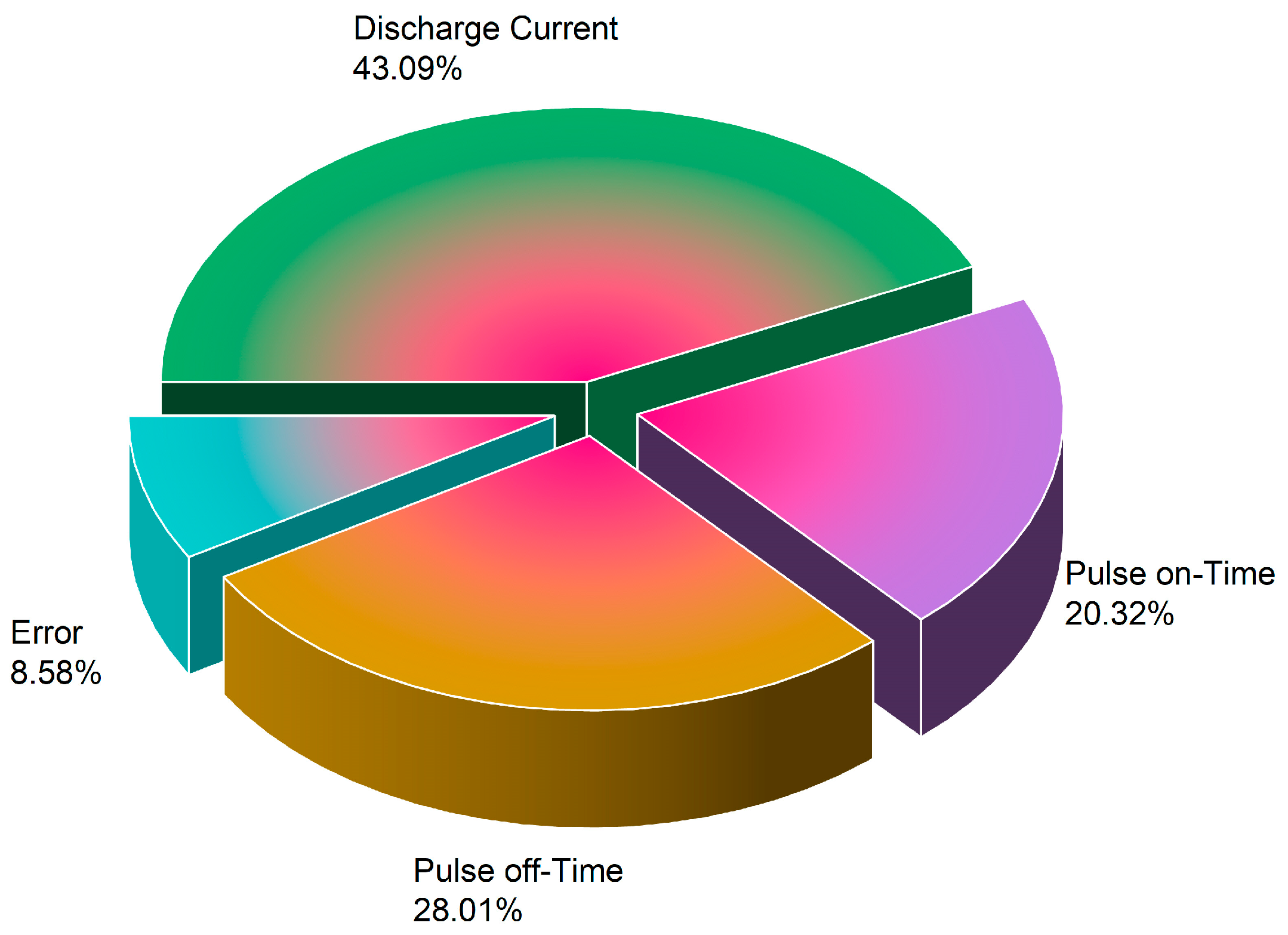
Analysis of Variance (ANOVA) is used to analyse data influenced by several co-occurring effects, aiming to detect significant effects and evaluate their impact [37]. ANOVA is a statistically grounded method for decision-making that identifies variances in the mean performance of the experimental groups [38]. The tabulated ANOVA results are presented in Table 7, while the percentage contributions of the input factors are illustrated in Figure 4. Among the variables examined, the Ip is more significant than the other two. The Ip exerts the most important influence, comprising approximately 44.09% of the total; Toff is impacted by approximately 28.01%; Ton contributes 20.33%; and the minimal error accounts for 8.58%. The regression model formulated for RC is presented in Equation (7) for predictive applications.
R C = 1.963 0.0258 × I p 0.00685 × T o n 0 .1000 × T o f f

3.3. Confirmation Experiment

An experimental investigation was conducted using ideal EDC parameters to determine optimal input variable values. The findings summarised in Table 8 demonstrate that the confirmation experiment outperformed the conventional L9 array experiment, yielding lower WL, CoF, and SR. The CoF for the EDC, produced under optimal conditions, was 0.204; the WR was recorded at 0.000179 mm3/Nm, and the SR of the coating was 2.818 µm. This indicates that coatings performed under optimal conditions exhibit a deviation of 6.34% from the estimated value. This proves that TOPSIS is the best approach for optimising with many objectives. Under ideal circumstances, the coating’s wear behaviour outperforms all of the other requirements listed in the L9 OA.
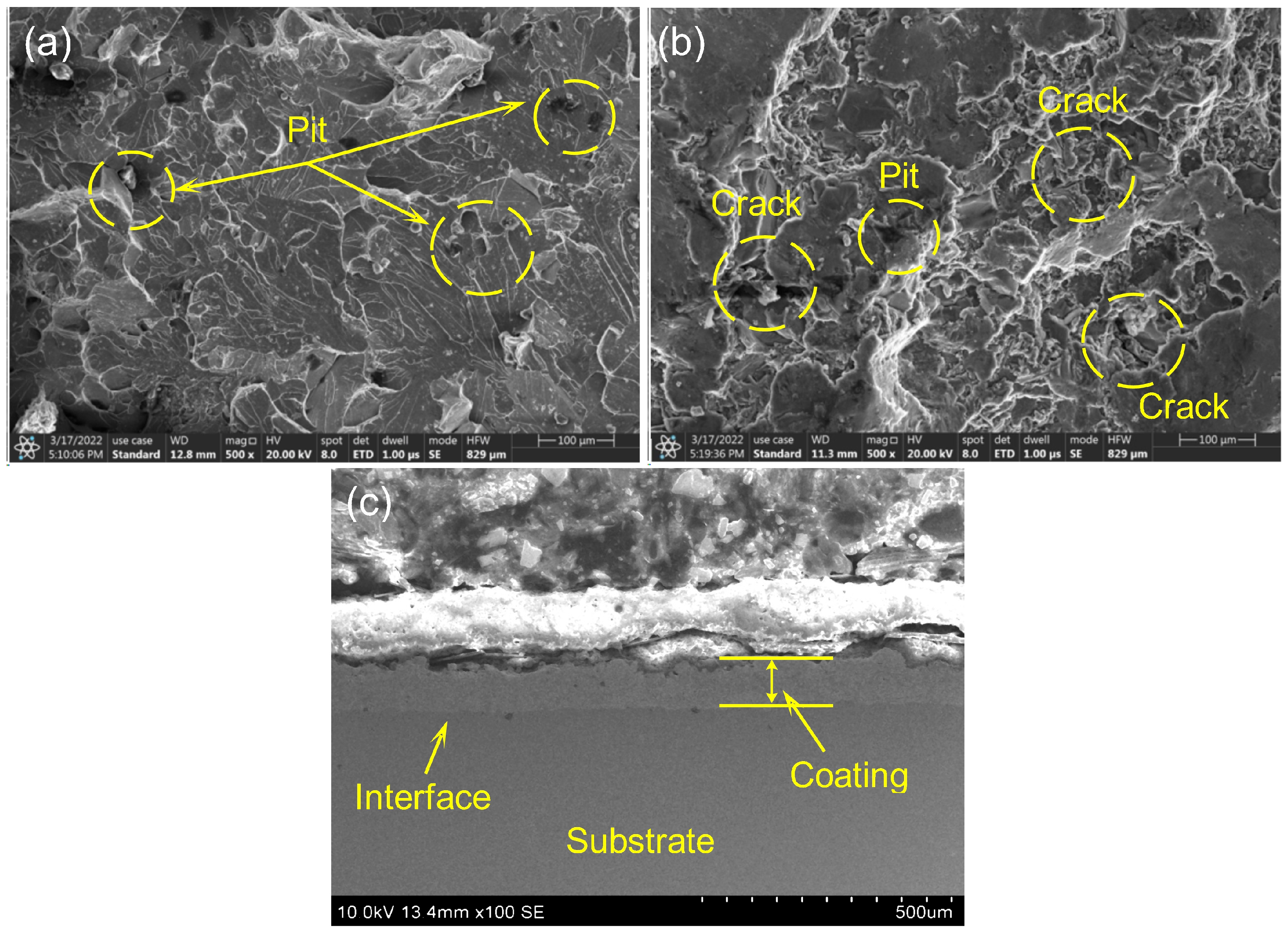
Figure 5 presents SEM images of the 50 wt.% WS2/50 wt.% Cu composite coatings fabricated under both optimal and suboptimal circumstances of Trial 7 settings and measurement of coating thickness. The amalgamated, smooth, and grey phases indicate the copper-rich regions, whereas the surface area represents WS2 zones. Moreover, the dark black areas signify pores [39]. Pores are present in all coatings, likely due to the uneven dispersal of WS2 in the Cu matrix, resulting from differing particle proportions and elevated spark energy in Cu-rich areas. The coatings generated under ideal conditions exhibit a homogeneous, smooth surface texture with low porosity, as illustrated in Figure 5a, possibly due to uniform particle dispersion. The accumulation of WS2 particles remained clearly visible in the composite coating produced under Trial 7 conditions, as depicted in Figure 5b. This specific microstructure was noted in previous research [40]. These results align with the SR value obtained for coatings produced under ideal conditions. Figure 5c shows the measurement of coating thickness at two locations and the coating thickness attained is 117.885 µm (average).
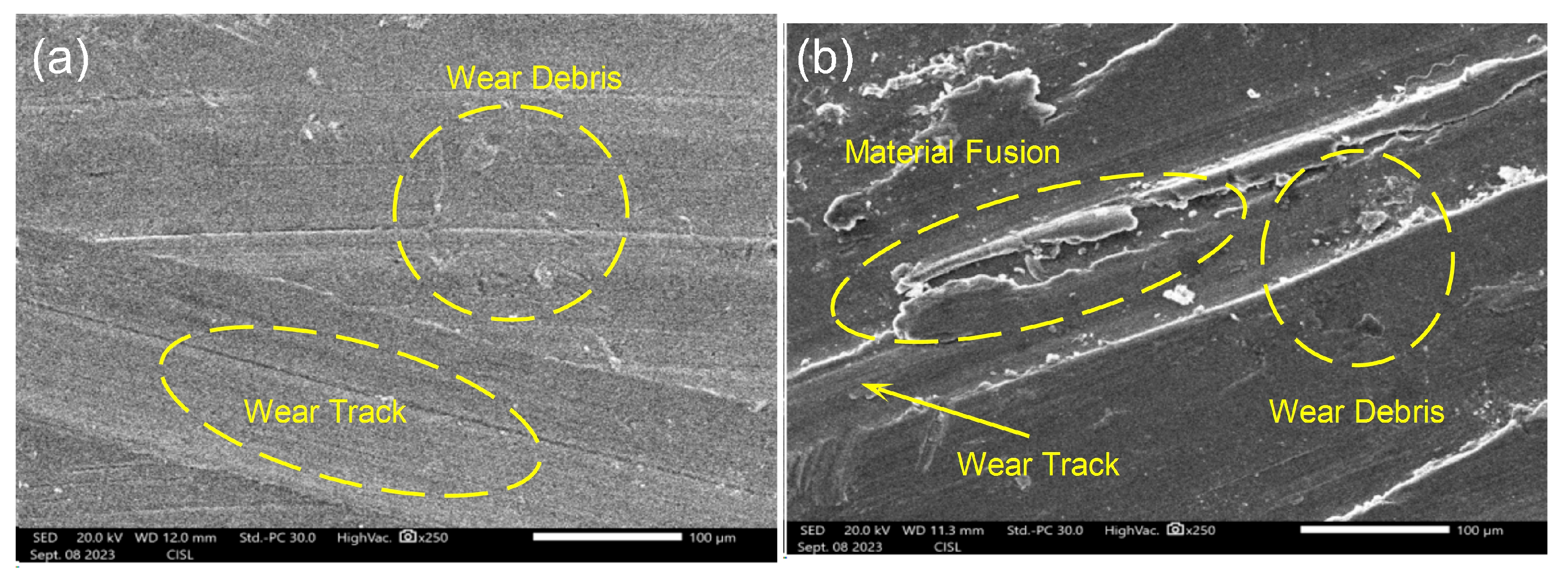
Figure 6 displays SEM images of abraded composite coating surfaces produced under ideal conditions and those from Trial 7 settings. Figure 5b illustrates that the surface of the 50 wt.% WS2/50 wt.% Cu coating exhibited substantial cracking, adhesion spalling pits, smeared metal layers, and prominent abrasive grooves. Furthermore, extra-worn surfaces and heat generated from friction will continue to develop during the process. Consequently, adhesive wear is likely to occur between the coating and the disc, while oxidation arises from the specimen’s exposure to atmospheric air. This behaviour has been recorded in several Cu matrix composites [41]. The surface features of the 50 wt.% WS2/50 wt.% Cu coating, produced under ideal conditions as illustrated in Figure 6a, was entirely dissimilar to that of the coating developed under Trial 7 conditions, as depicted in Figure 6b. The adhesive pits were absent; however, the surface showed signs of wear and tear, with many uneven metal layers and small, shallow crevices [42]. This is owing to strong bonds between the coating and the substrate, as well as strong cohesion within the coating material itself. Associated with the development of dispersed metal layers, the continuous rubbing action on the wear track followed the persistent accumulation of wear fragments. The severe asperities on the counterpart were believed to have generated the grooves on the worn track [39]. Additionally, degraded surface characteristics imply the production of a tribo-film [43]. This may clarify why the coating produced under optimal conditions has a lower WR than that made under alternative conditions.

4. Conclusions

To improve the surface characteristics of AA7075 alloy, specifically its wear resistance, a novel surface modification technique involving EDC was utilised to deposit a mixture of 50 wt.% WS2 and 50 wt.% Cu powder utilising green compact electrodes. The Taguchi–TOPSIS methodology was used to identify optimal EDC variables to achieve reduced SR, WR, and CoF. The following conclusions were reached:
  • The ideal parameters established by the main effect plots are 4A for Ip, 80 µs for Ton, and 5 µs for Toff.
  • The interaction plot indicates that elevated-level interactions among the inputs, when coupled with supplementary inputs, significantly affect their RC. This suggests that all input variables are highly interdependent. Furthermore, a more significant interaction is evident among Ip and Ton, Ton and Toff, and between Ip and Toff.
  • The ANOVA test indicates that Ip is more influential than the other two variables. The Ip is most influential, accounting for 44.09% of the total; Toff accounts for 28.01%; Ton accounts for 20.33%; and the minimal error accounts for 8.58%.
  • The regression model was additionally developed for RC in ideal circumstances. The validation experiment for the perfect parameters indicates a WR of 0.000179 mm3/Nm, a CoF of 0.204, and an SR of 2.818 µm. These findings are significantly lower than the values obtained for the settings specified in the L9OA. The RC of the predicted and experimental values for ideal settings yields an error of 6.34%, demonstrating that the Taguchi–TOPSIS method is more effective for multi-objective optimisation.
  • The microstructure of the coatings produced under optimal conditions demonstrates a homogeneous and smooth surface texture with reduced porosity compared to the coatings developed according to the OA conditions. This finding collaborates well with the output responses obtained for optimal conditions.
  • The coating wear track fabricated under optimal circumstances displayed no adhesive pits, shards of metal, or shallow furrows owing to robust adhesion between the coating materials and the substrate, as well as strong cohesion within the coating materials themselves.

Author Contributions

Conceptualisation, N.S., G.P. and K.S.E.; methodology, G.P. and K.S.E.; software, N.S., S.T. and S.S.; validation, N.S., G.P., K.S.E. and S.T.; formal analysis, G.P. and S.S.; investigation, G.P., K.S.E., S.T. and S.S.; resources, N.S., G.P. and K.S.E.; data curation, N.S., G.P. and S.T.; writing—original draft preparation, N.S., G.P. and S.S.; writing—review and editing, N.S., G.P. and S.T.; visualisation, G.P. and K.S.E.; supervision, G.P.; project administration, N.S. and G.P. All authors have read and agreed to the published version of the manuscript.

Funding

This research received no external funding.

Institutional Review Board Statement

Not applicable.

Informed Consent Statement

Not applicable.

Data Availability Statement

All data related to this study are available in the manuscript itself.

Conflicts of Interest

The authors declare no conflicts of interest.

Abbreviations

The following abbreviations are used in this manuscript:
EDCElectrical Discharge Coating
EDMElectrical Discharge Machining
WS2Tungsten Disulfide
CuCopper
AA7075Aluminium Alloy 7075
TOPSISTechnique for Order Preference by Similarity to Ideal Solution
WRWear Rate
SRSurface Roughness
CoFCoefficient of Friction
ANOVAAnalysis of Variance
OAOrthogonal Array
SEMScanning Electron Microscope
µmMicrometer
µsMicrosecond
AAmpere
RCRelative Closeness
MCDMMulti-Criteria Decision-Making

References

  1. Sudarsan, D.; Bejaxhin, A.B.H.; Sujin, P.; Prabakaran, T. Mechanical, Wear, Fatigue, and Creep Behavior of Rice Ash Si2N2O Bioceramic Dispersed AA7075 Metal Matrix Composites. J. Bio-Tribo-Corros. 2025, 11, 66. [Google Scholar] [CrossRef]
  2. Li, S.; Yue, X.; Li, Q.; Peng, H.; Dong, B.; Liu, T.; Yang, H.; Fan, J.; Shu, S.; Qiu, F.; et al. Development and Applications of Aluminum Alloys for Aerospace Industry. J. Mater. Res. Technol. 2023, 27, 944–983. [Google Scholar] [CrossRef]
  3. Soares, E.; Bouchonneau, N.; Alves, E.; Alves, K.; Araújo Filho, O.; Mesguich, D.; Chevallier, G.; Laurent, C.; Estournès, C. Microstructure and Mechanical Properties of AA7075 Aluminum Alloy Fabricated by Spark Plasma Sintering (SPS). Materials 2021, 14, 430. [Google Scholar] [CrossRef]
  4. Altas, E.; Bati, S.; Rajendrachari, S.; Erkan, Ö.; Dag, I.E.; Avar, B. Comprehensive Analysis of Mechanical Properties, Wear, and Corrosion Behavior of AA7075-T6 Alloy Subjected to Cryogenic Treatment for Aviation and Defense Applications. Surf. Coat. Technol. 2024, 490, 131101. [Google Scholar] [CrossRef]
  5. Arulvel, S.; Dsilva Winfred Rufuss, D.; Jain, A.; Kandasamy, J.; Singhal, M. Laser Processing Techniques for Surface Property Enhancement: Focus on Material Advancement. Surf. Interfaces 2023, 42, 103293. [Google Scholar] [CrossRef]
  6. Brunner-Schwer, C.; Kersting, R.; Graf, B.; Rethmeier, M. Laser-Plasma-Cladding as a Hybrid Metal Deposition-Technology Applying a SLM-Produced Copper Plasma Nozzle. Procedia CIRP 2018, 74, 738–742. [Google Scholar] [CrossRef]
  7. Tovar-Oliva, M.S.; Tudela, I. Electrodeposition of Nano- and Micro-Materials: Advancements in Electrocatalysts for Electrochemical Applications. Results Eng. 2024, 24, 103285. [Google Scholar] [CrossRef]
  8. Gugua, E.C.; Ujah, C.O.; Asadu, C.O.; Von Kallon, D.V.; Ekwueme, B.N. Electroplating in the Modern Era, Improvements and Challenges: A Review. Hybrid. Adv. 2024, 7, 100286. [Google Scholar] [CrossRef]
  9. Perumal, G.; Geetha, M.; Asokamani, R.; Alagumurthi, N. Wear Studies on Plasma Sprayed Al2O3–40 Wt% 8YSZ Composite Ceramic Coating on Ti–6Al–4V Alloy Used for Biomedical Applications. Wear 2014, 311, 101–113. [Google Scholar] [CrossRef]
  10. Schalk, N.; Tkadletz, M.; Mitterer, C. Hard Coatings for Cutting Applications: Physical vs. Chemical Vapor Deposition and Future Challenges for the Coatings Community. Surf. Coat. Technol. 2022, 429, 127949. [Google Scholar] [CrossRef]
  11. Ichou, H.; Arrousse, N.; Berdimurodov, E.; Aliev, N. Exploring the Advancements in Physical Vapor Deposition Coating: A Review. J. Bio Tribocorros 2024, 10, 3. [Google Scholar] [CrossRef]
  12. Srikanth, S.; Senthilkumar, C.; Elaiyarasan, U. Modeling and Optimization of Electro Discharge Coating Parameters for Coating of Aluminum Alloy Using WC/Ni Electrode. CIRP J. Manuf. Sci. Technol. 2023, 41, 465–476. [Google Scholar] [CrossRef]
  13. ShanmugaElango, K.; Senthilkumar, C. Surface Alloying Characteristics of WS2/Cu Composite Electrodes Deposited on an Aluminum Alloy by Electrical Discharge Coating. J. Adhes. Sci. Technol. 2023, 37, 3–15. [Google Scholar] [CrossRef]
  14. Chakraborty, S.; Mallick, I.; Bhattacharyya, T.; Moses, A.; Achari, R.B.; Chatterjee, S. State of Use of Electronic Data Capture (EDC) Tools in Randomized Controlled Trials in India. Health Policy Technol. 2022, 11, 100662. [Google Scholar] [CrossRef]
  15. Tyagi, R.; Mandal, A.; Das, A.K.; Tripathi, A.; Prakash, C.; Campilho, R.; Saxena, K.K. Electrical Discharge Coating a Potential Surface Engineering Technique: A State of the Art. Processes 2022, 10, 1971. [Google Scholar] [CrossRef]
  16. Elaiyarasan, U.; Satheeshkumar, V.; Senthilkumar, C. Parametric Effect on Electrical Discharge Treatment of Magnesium Alloy with Powder Composite Electrode. SN Appl. Sci. 2020, 2, 390. [Google Scholar] [CrossRef]
  17. Yap, C.Y.; Liew, P.J.; Othman, I.S.B.; Abdollah, M.F.B.; Yan, J. Tribological Characteristics of Electrical Discharge Coated Layers Using Quarry Dust Suspension. Surf. Coat. Technol. 2021, 428, 127895. [Google Scholar] [CrossRef]
  18. Mohanty, S.; Kumar, V.; Kumar Das, A.; Dixit, A.R. Surface Modification of Ti-Alloy by Micro-Electrical Discharge Process Using Tungsten Disulphide Powder Suspension. J. Manuf. Process 2019, 37, 28–41. [Google Scholar] [CrossRef]
  19. Tyagi, R.; Mahto, N.K.; Das, A.K.; Mandal, A. Preparation of MoS2 +Cu Coating through the EDC Process and Its Analysis. Surf. Eng. 2020, 36, 86–93. [Google Scholar] [CrossRef]
  20. Kumaran, V.; Muralidharan, B. Prediction of Coating Layer Thickness and Surface Hardness in Electric Discharge Coating Process Using RSM, ANN, and ANFIS with ANOVA Optimization. Proc. Inst. Mech. Eng. Part E J. Process Mech. Eng. 2025. [Google Scholar] [CrossRef]
  21. Maddu, J.; Karrolla, B.; Uddien Shaik, R. Experimental Optimization of Electrical Discharge Coatings Using Conventional Electrode. Mater. Sci. Eng. B 2022, 286, 116069. [Google Scholar] [CrossRef]
  22. Krishna, M.E.; Patowari, P.K. Parametric Study of Electric Discharge Coating Using Powder Metallurgical Green Compact Electrodes. Mater. Manuf. Process. 2014, 29, 1131–1138. [Google Scholar] [CrossRef]
  23. Zhang, Z.; Tan, Z.; Lu, W.; Yi, S.; Qin, X. Research on the Chemical Barrier and Failure Behavior of WS2 and WS2/Ti Coatings under High-Temperature Conditions and the Effects on the Lifespan of Diamond-Coated Cutting Tools. Surf. Coat. Technol. 2023, 469, 129795. [Google Scholar] [CrossRef]
  24. Tyagi, R.; Darmalingam, K.; Shankar Patel, V.; Kumar Das, A.; Mandal, A. Deposition of WS2 and Cu Nanopowder Coating Using EDC Process and Its Analysis. Mater. Today Proc. 2019, 18, 5170–5176. [Google Scholar] [CrossRef]
  25. Siddique, A.R.; Mohanty, S.; Das, A.K. Micro-Electrical Discharge Coating of Titanium Alloy Using WS2 and Brass P/M Electrode. Mater. Manuf. Process. 2019, 34, 1761–1774. [Google Scholar] [CrossRef]
  26. Gnanasambandam, A.; Margabandu, V. Exploring the Drilling Performance of Al7075/SiC/B4C Composites Using Hybrid Grey–Taguchi Technique. J. Inst. Eng. India Ser. D 2025. [Google Scholar] [CrossRef]
  27. Uthirapathi, E.; Chinnamuthu, S.; Kaliyamoorthi, N. An Examination on Dry Sliding Wear Behaviour of AA7075 Aluminium Alloy Modified with FA/Cu Electro-Discharge Coating. J. Bio Tribocorros 2024, 10, 25. [Google Scholar] [CrossRef]
  28. ASTM G99-23; Standard Test Method for Wear and Friction Testing with a Pin-on-Disk or Ball-on-Disk Apparatus. ASTM International: West Conshohocken, PA, USA, 2023. [CrossRef]
  29. Thirumalvalavan, S.; Perumal, G.; Senthilkumar, N.; Selvarasu, S. Enhancing Tribological Characteristics of Titanium Grade-5 Alloy through HVOF Thermal-Sprayed WC-Co Nano Coatings by TOPSIS and Golden Jack Optimization Algorithm. Recent. Pat. Nanotechnol. 2025, 19, 544–567. [Google Scholar] [CrossRef]
  30. Hwang, C.-L.; Yoon, K. Multiple Attribute Decision Making; Springer: Berlin/Heidelberg, Germany, 1981; Volume 186, ISBN 978-3-540-10558-9. [Google Scholar]
  31. Mohan, M.M.; Bandhu, D.; Mahesh, P.V.; Thakur, A.; Deka, U.; Saxena, A.; Abdullaev, S. Machining Performance Optimization of Graphene Carbon Fiber Hybrid Composite Using TOPSIS-Taguchi Approach. Int. J. Interact. Des. Manuf. (IJIDeM) 2025, 19, 3171–3182. [Google Scholar] [CrossRef]
  32. Varatharajulu, M.; Duraiselvam, M.; Kumar, M.B.; Jayaprakash, G.; Baskar, N. Multi Criteria Decision Making through TOPSIS and COPRAS on Drilling Parameters of Magnesium AZ91. J. Magnes. Alloys 2022, 10, 2857–2874. [Google Scholar] [CrossRef]
  33. Shastri, A.; Nargundkar, A.; Kulkarni, A.J.; Benedicenti, L. Optimization of Process Parameters for Turning of Titanium Alloy (Grade II) in MQL Environment Using Multi-CI Algorithm. SN Appl. Sci. 2021, 3, 226. [Google Scholar] [CrossRef]
  34. Tamiloli, N.; Venkatesan, J.; Murali, G.; Kodali, S.P.; Sampath Kumar, T.; Arunkumar, M.P. Optimization of End Milling on Al–SiC-Fly Ash Metal Matrix Composite Using Topsis and Fuzzy Logic. SN Appl. Sci. 2019, 1, 1204. [Google Scholar] [CrossRef]
  35. Senthilkumar, N.; Perumal, G.; Sivaguru, S.; Anandhakumar, S. Optimization of Duplex Heat Treatment Settings with the MOORA-PCA Technique to Customize the Mechanical and Wear Response of Ti6Al4V Alloy. Tribol. Int. 2024, 192, 109232. [Google Scholar] [CrossRef]
  36. Antony, J. Design of Experiments for Engineers and Scientists; Elsevier Science: Amsterdam, The Netherlands, 2003; ISBN 9780080469959. [Google Scholar]
  37. DeVincenzo, M. Analysis of Variance (ANOVA); SAGE Publications Incorporated: London, UK, 2023; ISBN 9781071910443. [Google Scholar]
  38. Gamst, G.; Meyers, L.S.; Guarino, A.J. Analysis of Variance Designs; Cambridge University Press: Cambridge, UK, 2008; ISBN 9780521874816. [Google Scholar]
  39. Tyagi, R.; Das, A.K.; Mandal, A. Electrical Discharge Coating Using WS2 and Cu Powder Mixture for Solid Lubrication and Enhanced Tribological Performance. Tribol. Int. 2018, 120, 80–92. [Google Scholar] [CrossRef]
  40. Zhao, L.; Yao, P.; Gong, T.; Zhou, H.; Deng, M.; Wang, Z.; Zhang, Z.; Xiao, Y.; Luo, F. Effect of Adding Tungsten Disulfide to a Copper Matrix on the Formation of Tribo-Film and on the Tribological Behavior of Copper/Tungsten Disulfide Composites. Tribol. Lett. 2019, 67, 98. [Google Scholar] [CrossRef]
  41. Juszczyk, B.; Kulasa, J.; Malara, S.; Czepelak, M.; Malec, W.; Cwolek, B.; Wierzbicki, Ł. Tribological Properties of Copper-Based Composites with Lubricating Phase Particles. Arch. Metall. Mater. 2014, 59, 615–620. [Google Scholar] [CrossRef]
  42. Vignesh, M.; Anbuchezhiyan, G.; Mamidi, V.K.; Vivek Anand, A. Enriching Mechanical, Wear, and Corrosion Behaviour of SiO2/TiO2 Reinforced Al 5754 Alloy Hybrid Composites. Mater Lett 2024, 361, 136106. [Google Scholar] [CrossRef]
  43. Murray, J.W.; Ahmed, N.; Yuzawa, T.; Nakagawa, T.; Sarugaku, S.; Saito, D.; Clare, A.T. Dry-Sliding Wear and Hardness of Thick Electrical Discharge Coatings and Laser Clads. Tribol. Int. 2020, 150, 106392. [Google Scholar] [CrossRef]
Figure 1. Experimental setup for EDC with the tool, coated samples, and wear samples.
Engproc 130 00005 g001
Figure 2. Linear plot for RC.
Engproc 130 00005 g002
Figure 3. Interaction plot for relative closeness.
Engproc 130 00005 g003
Figure 4. ANOVA % contribution of input variables over RC.
Engproc 130 00005 g004
Figure 5. SEM pictures of the coating developed under (a) optimal settings and (b) Trial 7 settings. (c) Coating thickness.
Engproc 130 00005 g005
Figure 6. Wear track SEM. (a) Optimal settings, (b) Trial 7 setting.
Engproc 130 00005 g006
Table 1. AA7075 composition.
ElementsZnMnMgSiCrFeCuAl
%5.80.062.40.080.20.241.5Bal
Table 2. Level and range of EDC variables.
Input ParametersLevel 1Level 2Level 3
Ip (A)246
Ton (µs)6080100
Toff (µs)579
Table 3. Input parameters and output responses.
Trial No.InputsResponses
Ip (A)Ton (µs)Toff (µs)SR (µm)WR (mm3/Nm)CoF
12.006052.3180.0001820.342
22.008073.4690.0002610.225
32.0010094.6460.0003450.234
44.006072.0410.0002520.302
54.008092.6280.0001780.280
64.0010053.1510.0001840.214
76.006093.8590.0003190.318
86.008053.2270.0002460.243
96.0010073.2710.0004380.253
Table 4. Normalisation of output responses.
Trial No.Xij2Normalisation
SRWRCoFSRWRCoF
15.373124000.000000030.1167320.2370.2170.420
212.033961000.000000070.0505590.3540.3110.276
321.585316000.000000120.0549190.4740.4110.288
44.165681000.000000060.0911720.2080.3000.371
56.906384000.000000030.0785630.2680.2120.345
69.928801000.000000030.0458760.3220.2190.263
714.891881000.000000100.1011590.3940.3800.391
810.413529000.000000060.0591400.3290.2930.299
910.699441000.000000190.0637910.3340.5220.310
Table 5. TOPSIS procedural steps for MCDM analysis.
Trial No.Weighted NormalisationPositive Ideal SolutionNegative Ideal SolutionRCRanking
SRWRCoFSRWRCoFA*SRWRCoFA
10.1180.0540.1050.0140.0010.0390.002−0.119−0.0760.0000.0200.9203
20.1770.0780.0690.0730.0250.0030.006−0.060−0.053−0.0360.0080.5646
30.2370.1030.0720.1330.0500.0060.0200.000−0.028−0.0330.0020.0849
40.1040.0750.0930.0000.0220.0270.001−0.133−0.055−0.0120.0210.9451
50.1340.0530.0860.0300.0000.0200.001−0.103−0.077−0.0190.0170.9282
60.1610.0550.0660.0570.0020.0000.003−0.076−0.076−0.0390.0130.8034
70.1970.0950.0980.0930.0420.0320.011−0.040−0.035−0.0070.0030.2048
80.1650.0730.0750.0610.0200.0090.004−0.072−0.057−0.0300.0090.6945
90.1670.1310.0780.0630.0770.0120.010−0.0700.000−0.0270.0060.3607
Table 6. Response table for relative closeness.
FactorsLevel 1Level 2Level 3Max–MinRank
Ip0.5230.8920.4200.4731
Ton0.6900.7290.4160.3133
Toff0.8060.6230.4060.4002
Table 7. ANOVA table for relative closeness.
SourceDFAdj SSAdj MSF-Valuep-Value
Ip (A)20.370440.185225.020.166
Ton (µs)20.174740.087372.370.297
Toff (µs)20.240790.120393.260.234
Error20.073750.03688
Total80.85972
Table 8. Confirmation of experimental results.
ParametersOptimum ValueSR
(µm)
WR
(mm3/Nm)
CoFRelative Closeness
PredictedExperimental
Ip (A)42.8180.0001790.2040.8120.867
Ton (µs)80
Toff (µs)5
% error 6.34%
Disclaimer/Publisher’s Note: The statements, opinions and data contained in all publications are solely those of the individual author(s) and contributor(s) and not of MDPI and/or the editor(s). MDPI and/or the editor(s) disclaim responsibility for any injury to people or property resulting from any ideas, methods, instructions or products referred to in the content.