


Abstract
Metal–organic frameworks (MOFs), a class of porous crystalline materials, consists of metal ions or clusters coordinated to organic linkers. The unique features of MOFs such as exceptionally high surface area, chemical versatility, and tunable porosity make them highly suitable for several applications, including gas storage, drug delivery, catalysis, and sensing. Various synthesis techniques, including solvothermal, hydrothermal, microwave-assisted, mechanochemical, electrochemical, and sonochemical methods, have been used for the fabrication of MOFs. The selection and optimization of synthesis technique significantly influence the fundamental framework structure, the existence of defects, the available active sites, and the effectiveness of MOFs in special applications. This study focuses on advances in MOF fabrication techniques and examines their role in tuning the key properties of MOFs for targeted applications. The insights of this work may guide researchers in selecting or designing appropriate fabrication strategies for application-specific development of MOFs.
1. Introduction
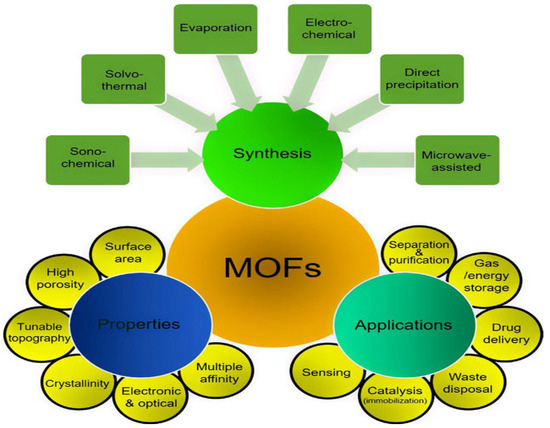
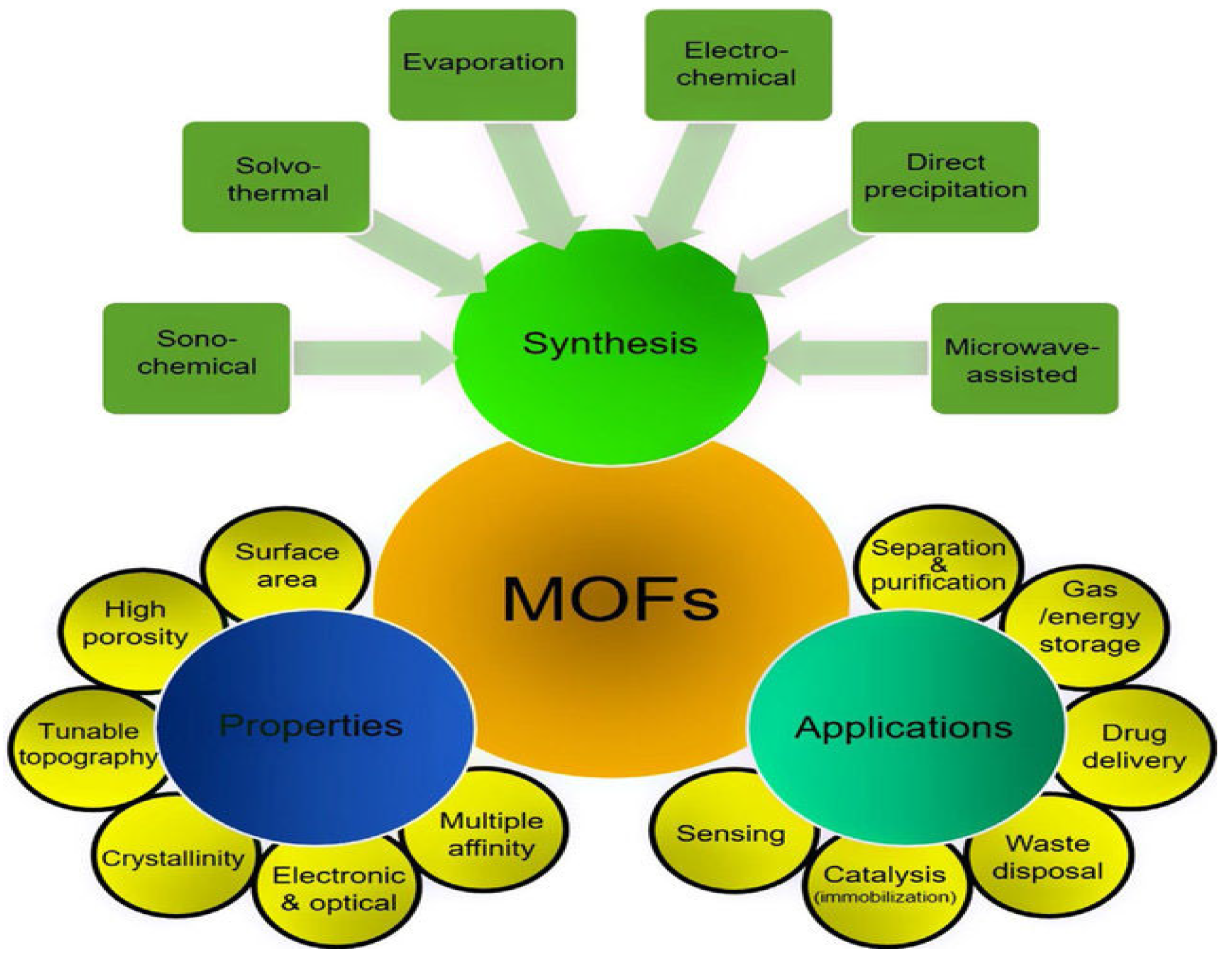
MOFs are chemical compounds having both organic ligands and metal ions in their structure. The coordinated network formed by organic ligands can be a mono-, di-, tri-, or tetravalent with pores or empty spaces [1]. MOFs have drawn a lot of interest as a type of multifunctional material because of their many features, which include high surface areas (between 1000 and 10,000 m2g−1), adjustable pore sizes and characteristics (14–98 Å), low framework densities (e.g., 0.124 gcm−3), high chemical and thermal stabilities, tunable topography, crystallinity, high luminescence, and multiple affinity. These attributes make them a promising candidate for a variety of applications, such as gas storage, separation and purification, drug delivery, catalysis, magnetism, conductivity, and sensing (Figure 1) [2]. Yaghi et al. are frequently credited with the discovery of MOFs. In 1995 and 1998, they synthesized the first MOF, Zn4O(BDC)3·(DMF)8(C6H5Cl) (BDC = 1,4-benzenedicarboxylate, DMF = dimethylformamide), which is known as MOF-5. This compound is composed of tetrahedral [Zn4O]6+ clusters that are connected by BDC ligands to form a 3D cubic network. Certain characteristics of this MOF include gas sorption capabilities, high porosity, and surface area of 6500 m2g−1 [2]. Since the early years of the twenty-first century, the field has advanced significantly, with several research groups reporting the synthesis of new products [3]. In general, a number of techniques have been easily used to produce strong and highly ordered MOFs, including hydrothermal or solvothermal synthesis, ionothermal, mechanochemical, slow diffusion, ultrasonic, microwave, and electrochemical techniques (Figure 1) [4]. These fabrication strategies directly determine the crystallinity, particle size, defect density, morphology, and surface characteristics of MOFs, which influence their performance in targeted applications. The highly organized porous frameworks of these materials allow for exact modification to fulfill a variety of specifications. They are attractive materials for gas separation and water treatment because of their highly porous structure and chemically adjustable properties [5].
Figure 1.
Overview of MOF fabrication techniques, key material properties, and applications.
2. MOF Fabrication Techniques
The synthesis of new MOFs with diversified crystal structures, high surface area, particle size, pore size distribution, and morphologies has been accomplished during the past 20 years using a variety of synthetic techniques, giving researchers a special platform for altering desired characteristics [6]. The structure of MOFs is strongly influenced by the choice of metal ions, organic linkers, solvents, and key reaction parameters such as temperature and pressure. Consequently, both the design strategy and the selected synthesis approach play crucial roles in defining the final properties and functionalities of MOFs. Various fabrication techniques are employed in MOF synthesis, each providing distinct levels of control over structural features, material performance, and scalability. These include the solvothermal/hydrothermal, ionothermal, microwave-assisted, electrochemical, sonochemical, mechanochemical, solvent-evaporation, and diffusion methods [7]. The selection of synthesis method plays a critical role in shaping the structure, performance, and scalability of MOFs, which determine their suitability for various applications. Because MOF design is closely related to the requirements of the intended application, the choice of an appropriate fabrication method is essential for tuning key characteristics such as porosity, robustness, and catalytic behavior.
2.1. Solvothermal/Hydrothermal
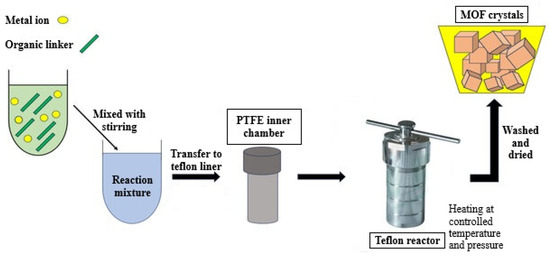
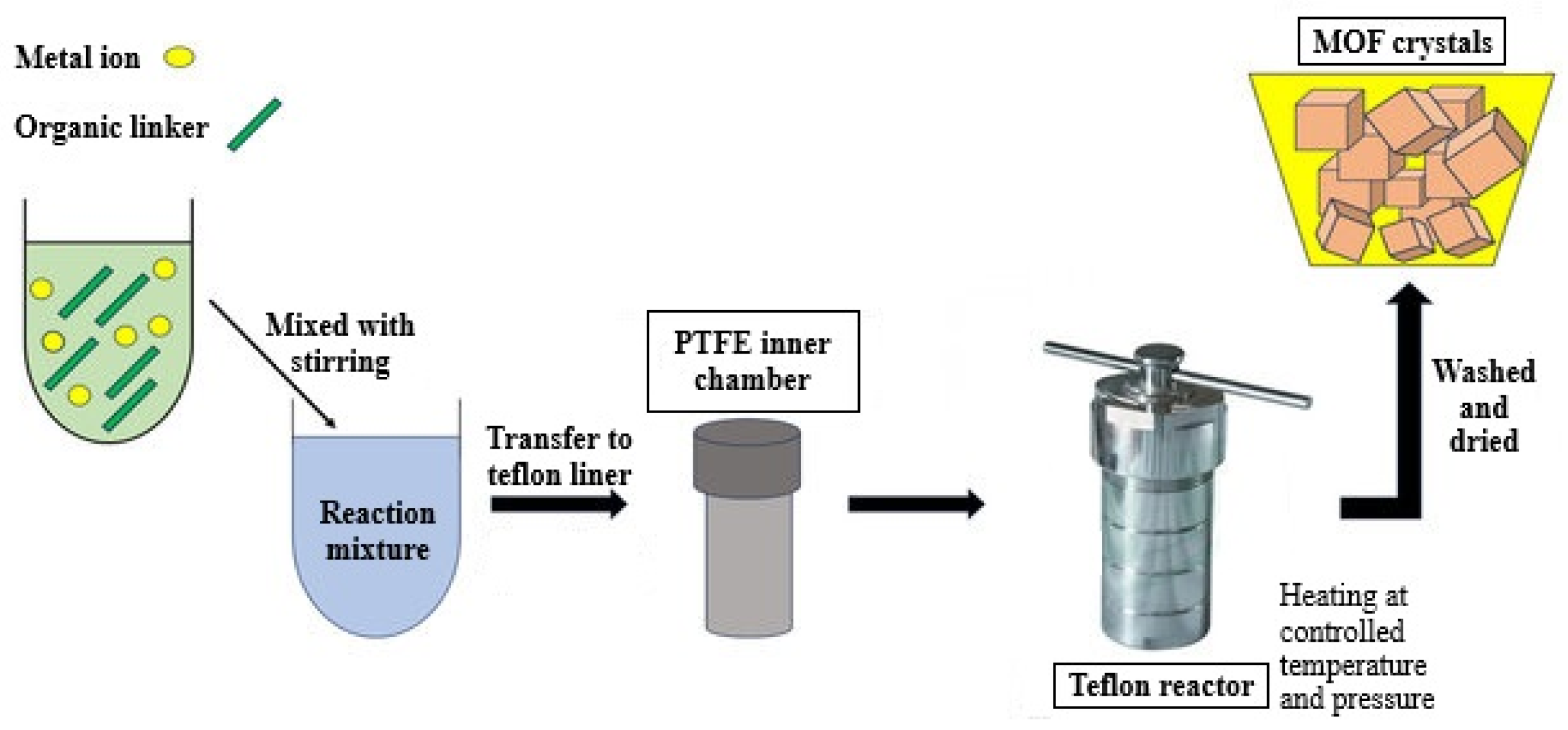
This method yields highly crystalline MOFs by means of an interaction between isolated metal ions and organic ligands, which facilitates the regulated production of MOFs [8]. The reactions take a long time (hours or even days) and are generally performed in polar solvents in closed vessels (autoclaves) at temperatures between 50 and 260 °C. Figure 2 shows the solvothermal/hydrothermal synthesis of MOFs [9]. The morphology and particle size can be tuned by modifying parameters such as reaction temperature, duration, and cooling conditions. In most cases, solvothermal methods yield MOFs with excellent crystallinity and high purity [8]. McKinstry et al. successfully prepared high-purity MOF-5 crystals, achieving a high space–time yield of nearly 1000 kg m−3 day−1. They have also observed that increasing the concentration of reactants increases the overall product yield; however, this is accompanied by a reduction in surface area. Therefore, careful optimization of reaction conditions is necessary depending on the intended application of MOFs [10]. MOFs for hydrogen storage (carboxylate-based, azolate-based, MOFs with mixed ligands, and MOFs with metal complexes as building blocks) have been synthesized using a solvothermal technique. The long reaction time, high operating temperature, and high solvent cost are the drawbacks of employing the solvothermal approach to synthesize MOFs [11]. These approaches are preferred for gas adsorption, separation, and catalysis due to their ability to produce structurally robust MOFs [9].
Figure 2.
Schematic representation of solvothermal/hydrothermal synthesis of MOFs.
2.2. Microwave-Assisted
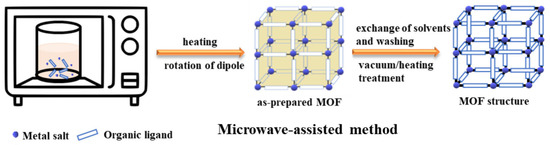
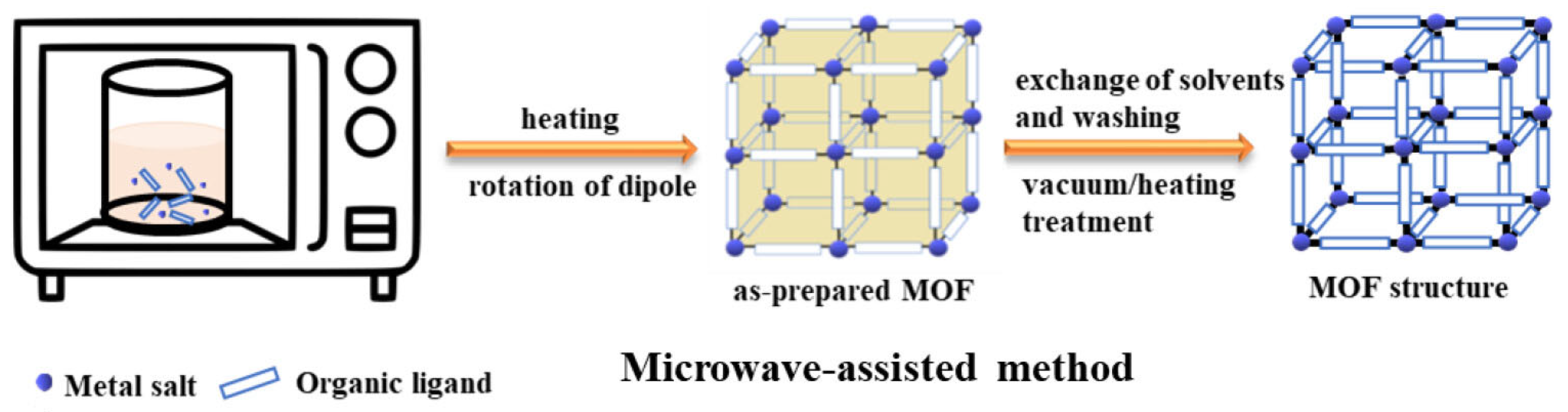
Microwave-assisted synthesis has the potential to speed up the synthetic process due to its quick and precise heating properties. According to nucleation and growth kinetics derived from in situ energy dispersive X-ray diffraction (XRD), the microwave technique can therefore result in a substantial decrease in the fabrication time of MOFs from days to minutes. The rapidity of MOF synthesis can be due to the increase in ion mobility under microwave irradiation [12]. Figure 3 shows the microwave-assisted synthesis of MOFs [13]. The first MOF to be synthesized under microwave was Cr-MIL-100, which was heated to 220°C for four hours [14]. This method enhances product yield and offers improved control over key physical properties, including particle size and morphology. The precise manipulation of reaction parameters allows for fine-tuning of structural stability, surface area, and porosity in the resulting frameworks. Alsalhi et al. have prepared Zr-VitB3/MOF with excellent yield only after 10 h of reaction. The low binding energy score is −12.32 kcal mol−1 of the Zr-MOF with HIV-RNA, indicating its promising potential for anti-HIV drug design. This Zr-MOF also showed outstanding catalytic activity for one-pot tetrahydroxanthene-1,8-dione production [15].
Figure 3.
Schematic representation of microwave-assisted synthesis of MOFs. (Blue spheres represent metal nodes, white rods represents organic linkers, and the yellow shaded region indicates solvent-filled pores in the as-prepared MOF structure).
2.3. Electrochemical
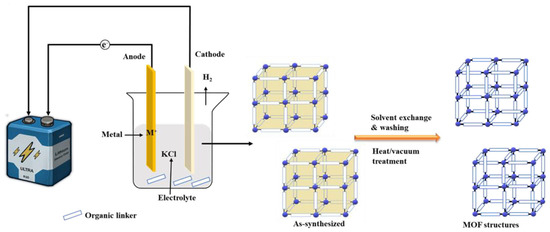
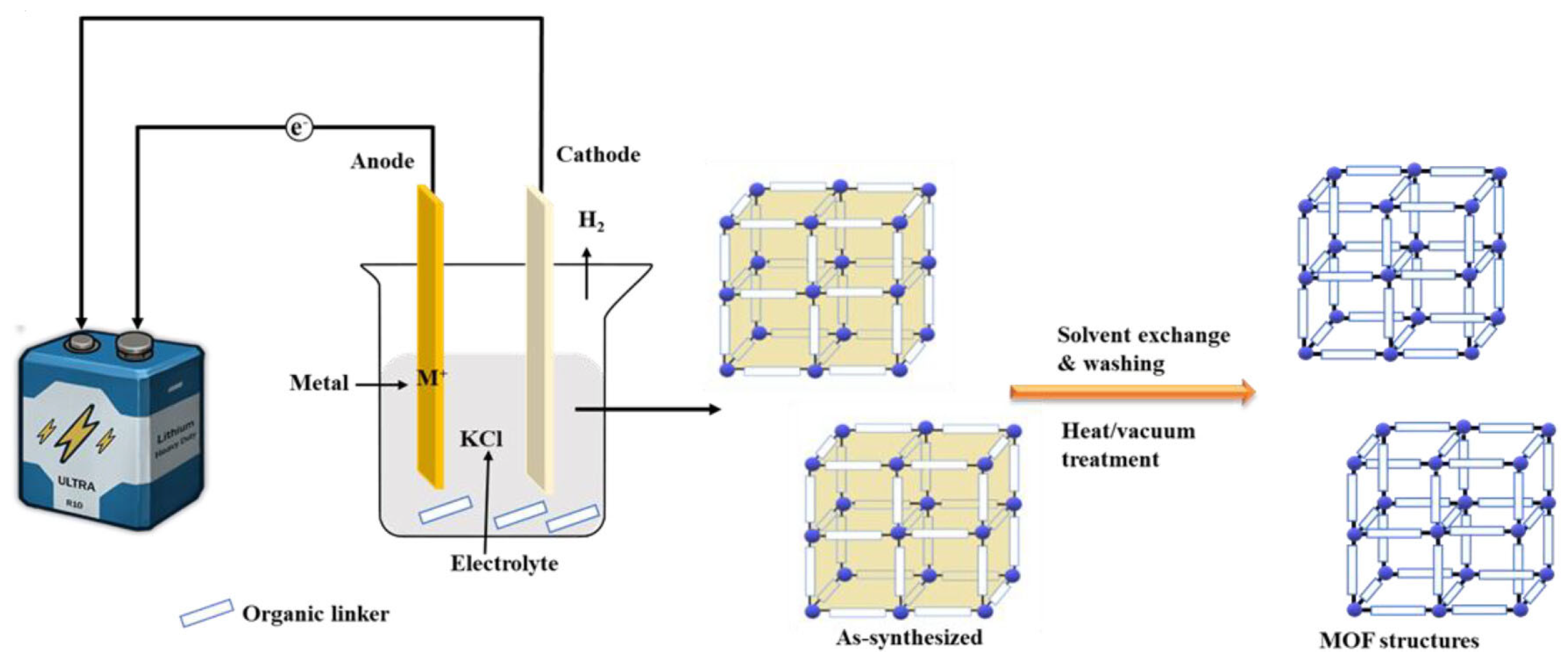
The technique is utilized for the industrial production of MOFs. In reaction mixtures containing organic ligands and electrolytes, the metal ion is delivered by anodic dissolution [6]. A thin layer of MOF is formed on the electrode surface as a result of the reaction between the metal ions and the organic linker (Figure 4) [16]. The crystallization process is governed by a number of variables, including the type of solvents used, the concentration of the electrolyte, the applied voltage, the duration of the electrodeposition, etc. This technique enables highly controlled regulation of metal-ion concentration, reaction kinetics, and deposition behavior, which results in the formation of high-quality MOF materials with targeted morphologies and functional attributes [16]. The first electrochemically fabricated Cu3(BTC) (BTC = 1,3,5-benzenetricarboxylate) was formed by Mueller et al. as a loose powder in the electrolyte via a broad applied potential range of 12 to 19 V vs a Cu counter electrode for 150 minutes [17]. The method is especially beneficial for fabricating MOF thin films and surface coatings on different substrates, making it valuable for catalytic, sensing, and energy-related applications [10]. This technique was used to produce and study Cu3(HHTP)2 (conductive 2D MOF) (HHTP = 2,3,6,7,10,11-hexahydroxytriphenylene) for electrosorption CO2 capture and electrosorbent activity [18].
Figure 4.
Schematic representation of electrochemical synthesis of MOFs. (Blue spheres represent metal nodes, white rods represents organic linkers, and the yellow shaded region indicates solvent-filled pores in the as-synthesized MOF structures).
2.4. Sonochemical
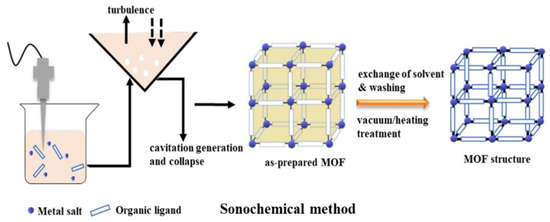
Sonochemical synthesis is a viable substitute method that uses ultrasonic vibrations to stimulate chemical reactions for creating MOFs. This technique provides localized high-energy conditions by using high-frequency sound waves to produce acoustic cavitation, which is the process by which bubbles in a liquid medium form, develop, and then suddenly collapse (Figure 5) [13,19]. In comparison to the solvothermal approach, this process’s severe temperatures and pressures enable quick and effective chemical reactions, which frequently result in the production of MOFs in much less time and under softer conditions. In addition to speeding up the kinetics of the reaction, the cavitation effect improves the homogeneity and crystallinity of the final MOF structures [20]. It is stated that cyclodextrin was incorporated as a ligand and sodium as a metal ion to fabricate the ultrasonic synthesized cyclodextrin MOF (CD-MOF) for the triboelectric nanogenerator [21]. Sonochemical methods produce ultrafine MOF nanoparticles with high dispersion and controlled morphology. These features make them particularly suitable for drug delivery, photocatalysis, and pollutant removal. The Zr-based MOF UiO-66-NH2 is synthesized with ZrCl4, 2-aminoterephthalic acid, and N, N-dimethylformamide. According to Kazemi et al., the sonochemically synthesized UiO-66-NH2 MOF has a greater adsorption ability for CO2 even at low pressures because of its larger surface area and smaller particle sizes [22].
Figure 5.
Schematic representation of sonochemical synthesis of MOFs. (Blue spheres represent metal nodes, white rods represents organic linkers, and the yellow shaded region indicates solvent-filled pores in the as-prepared MOF structure).
2.5. Mechanochemical
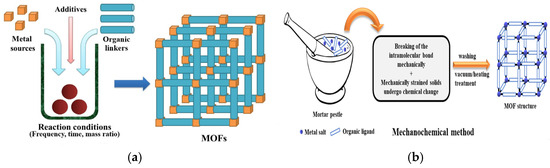
One of the most interesting chemical processes used to produce a variety of MOFs with improved yield and high purity is mechanochemical synthesis. Since mechanochemical synthesis has advanced significantly in recent years, there has been an increasing interest in the solvent-free or solid-state development of MOFs without the need of any hazardous or toxic solvents [23]. A ball mill (Figure 6a) [24] or mortar and pestle (Figure 6b) [13] are commonly used in this mechanochemical approach, which uses mechanical force to initiate chemical reactions between solid reactants. Mechanical grinding has a number of benefits over traditional techniques, including fewer solvents used, less energy used, and quicker reaction times [19].
Figure 6.
Schematic representation of mechanochemical synthesis of MOFs: (a) ball milling (Yellow cubes represent metal nodes and blue rods represents organic linkers in the MOF structure) and (b) mortar and pestle (Blue spheres represent metal nodes and white rods represents organic linkers in the MOF structure).
Cu(OAc)2.H2O and H3BTC have been employed in the mechanochemical synthesis of a copper-based MOF with a 97% product yield, which resulted in a dark blue solid at 30 Hz and 20 min of reaction time [5]. MOF-303, which is marked as Al(OH)(HPDC) (HPDC = 1H-pyrazole-3,5-dicarboxylate), is one of the more recent MOFs. The rod-like Al(OH)(COO)2 secondary building units (SBUs) that comprise MOF-303’s crystal lattice are joined by HPDC linkers for manufacturing an extended framework with a one-dimensional (1D) pore system that has a 0.6 nm pore size [25]. This method introduces higher defect densities and generates small particles, which significantly enhance catalytic activity and adsorption of bulky molecules. Mechanochemical synthesis aligns well with green chemistry goals and industrial relevance.
2.6. Solvent-Evaporation and Diffusion Methods
The process of solvent evaporation synthesis involves continuously evaporating the solvent’s water to reach a supersaturated state, which facilitates the formation of crystals in the solution. During the crystal growth process, the mother liquor is continuously refilled to assure that there is sufficient material for the crystals to develop. However, it is challenging to regulate the rate of evaporation when the corrosive solvent is released, and localized high supersaturation takes place to cause the crystals to cross and expand [26]. The process was first implemented to synthesize MOF-5 by diffusing Et3N into a solution consisting of Zn(NO3)2 and H2BDC in DMF and chlorobenzene formulation [27]. Using a solvent evaporation technique, a new Cu-MOF was designed and examined using Brunauer–Emmett–Teller (BET), Inductively Coupled Plasma–Optical Emission Spectroscopy (ICP–OES), High-Resolution Transmission Electron Microscopy (HR-TEM), X-ray Photoelectron Spectroscopy (XPS), Fourier Transform Infrared Spectroscopy (FT-IR), Powder X-ray Diffraction (PXRD), and Scanning Electron Microscopy–Energy Dispersive X-ray Spectroscopy (SEM–EDS). Cu2+, N, and O were confirmed to be present by XPS, which is in line with the anticipated catalyst structure [28].
The diffusion approach involves either placing reagent solutions on top of each other, separating them with a layer of solvent, or allowing them to gradually diffuse through physical barriers that dip. Gels frequently serve as diffusion and crystallization media. After the precipitate solvent gradually diffuses into the distinct layer, crystals develop at the interface between the layers. Furthermore, the diffusion approach is employed when the products are less soluble [5]. A terbium-based MOF called [Tb(1,3,5-BTC)]n was quickly synthesized using a method that combined ultrasonic and vapor phase diffusion [23]. The liquid–liquid or gas–liquid diffusion and slow solvent evaporation enable gentle crystallization and formation of highly ordered MOF single crystals. These techniques facilitate structural elucidation and provide defect-minimized frameworks.
3. Properties of MOFs and Their Modulation for Specific Applications
3.1. Crystallinity and Morphology
A crystal’s morphology can be affected by both external (growth solvent, degree of supersaturation, presence of impurities, time, temperature, etc.) and internal (crystal structure and crystal lattice defects) elements that affect the relative growth rates of crystal facets. The fundamental idea behind outward appearance is that the facets exhibited on the crystal surface are the ones that develop the slowest. Thereby, supporting different active sites that alter the chemical reaction barriers, controlling the shape, and increasing the exterior surface area of particular crystal facets primarily determines their catalytic activity [27]. The {002} facet of ZIF-67 and ZIF-68 MOF particles performs better catalytically than the {011} and {111} facets. Selective facet growth and morphological control of ZIF-8 and HKUST-1 MOFs are made possible by controlled molecular matrices that are adjusted by the polydimethylsiloxane contact sealing time. Increased imperfections brought about by longer sealing times cause ZIF-8 to evolve from a rhombic dodecahedron to a cube and HKUST-1 to change from a cube to an octahedron through preferential plane growth. Temperature also affects crystal shape. In order to show that MOF geometry dominates optical performance over surface quantity effects, these shape-controlled MOFs template ligand-free Au, Ag, and Cu nanoclusters. Their fluorescence is strongly dependent on MOF geometry, following the trend cube > truncated cube > truncated rhombic dodecahedron > rhombic dodecahedron [29]. ZIF-8 and hybrid systems, with their enormous surface area and effective charge transfer, have become potential photocatalysts for environmental remediation and renewable energy applications [30]. HKUST-1 nanostructures have potential for antibacterial and wound healing treatments, but stability and biocompatibility need to be improved [31].
3.2. Porosity and Surface Area
One of the most intriguing characteristics of MOFs is their porosity, which permits space on the micro- and meso-scales, revealing and restricting their functions. The goal of MOF research has been to synthesise high-porosity MOFs and develop more efficient activation techniques to maintain and get into their pore space [32]. Certain additives can alter the size of pores by influencing the structure of MOFs. A number of characteristics, including the ligand selection, pattern intermediary size, and modifier incorporation, can be changed to control porosity in MOFs. When mCBMOF-1 is sequentially functionalized with open Cu(II) sites, CO2 uptake is increased by 106% at low pressure. According to FT-IR, Carbon-13 Nuclear Magnetic Resonance (13CNMR), and Density Functional Theory (DFT), NH3 coordinates to some Cu(II) sites while the remainder sites bind CO2, allowing for NH3–CO2 interaction and the production of carbamic acid. The efficiency of post-synthetic MOF functionalization for CO2 capture from diluted sources is thus demonstrated by the greater CO2 affinity displayed by NH3-functionalized pores, which exhibit a 40% increase in Qst [33]. A MOF’s surface area is a metric that measures how much surface area is accessible for interactions with guest molecules and can influence its performance in different applications. A MOF’s surface area in gas adsorption applications indicates the availability and affinity of its binding sites, which is directly correlated with the separation performance of the material. The amount of active sites, their accessibility to reactant molecules, and consequently their catalytic activity can all be impacted by MOF surface area in catalysis applications. Tetrafluorosuccinic acid-containing perfluorinated MOF ZrTFS is structurally identical to MOF-801 but exhibits a relatively low surface area because the fluorine atoms prevent gas adsorption. By incorporating fluorinated linkers mostly at faulty acetate sites, post-synthetic exchange (PSE) of MOF-801 with H2TFS was performed to produce a porous fluorinated material. The resultant PF-MOFs exhibit stronger CO2/N2 selectivity and heat of adsorption, which rise with fluorine content, but lower CO2 uptake than MOF-801. According to DFT studies, the higher CO2 affinity can be explained by strong CO2–framework hydrogen bonding, which is strengthened by exposed fluorine atoms, and smaller pore windows that limit gas transport [34].
3.3. Thermal and Chemical Stability
A range of thermal stabilities has been demonstrated by MOFs. While certain compounds may endure higher temperatures before degrading, others are at least stable at lower temperatures. The material must have sufficient mechanical stability to prevent breaking under high pressure conditions. MOFs have no set degree of mechanical stability. The improved thermal stability of MOF-808-acetate, which maintains a large surface area at temperatures when the formate counterpart degrades, makes it a better beginning material than MOF-808-formate. Through ligand exchange, a novel derivative known as MOF-808-benzoate may be created from both acetate and formate MOFs and has thermal stability that is on par with MOF-808-acetate. Benzoate ligands stabilize the framework and change the pore environment, which in turn changes the gas adsorption behavior. The ligand-dependent tunability of adsorption and thermal stability allows for MOF-808 materials to be optimized for uses including gas separation and heterogeneous catalysis [35].
4. Effect of Fabrication Techniques on MOF Properties for Specific Applications
Solvothermal synthesis is one of the most established techniques for producing MOFs with excellent crystallinity and well-defined pore structures, which makes it highly suitable for applications such as gas adsorption, molecular separation, and heterogeneous catalysis. Despite these advantages, the method is associated with significant drawbacks, including the need for elevated temperatures, extended reaction durations, and the frequent use of hazardous organic solvents [9,10]. A one-step solvothermal technique was used to yield 1,4-naphthalenedicarboxylate (1,4-NDC) based Co(1,4-NDC), Ni(1,4-NDC), UiO-66-1,4-NDC, and Cu(1,4-NDC) MOFs. They were subsequently proven as phase-pure by PXRD and assessed as catalysts for the hydrolysis of NaBH4. In spite of its large pore volume, high surface area, and small particle size, Co(1,4-NDC) exhibited the highest activity, obtaining an HGR of 1777 mL H2 g−1 min−1 at 60 °C (Ni(1,4-NDC): 1333 mL H2 g−1 min−1). The low cost, noble metal-free, and industrially promising nature of the Co(1,4-NDC) catalyst for hydrogen generation was further demonstrated by its exceptional durability over seven cycles without regeneration [36].
To address the need for faster and more efficient fabrication, rapid synthesis routes—most likely microwave-assisted and ultrasonic methods—have gained considerable traction. The fabrication of CALF-20 MOF via MW-assisted synthesis significantly outperforms traditional solvothermal techniques, with a 92% reduction in reaction time and a 97% increase in yield. MW-synthesized CALF-20 exhibits better CO2 adsorption capability, improved CO2/N2 selectivity, and decreased regeneration energy, while maintaining its crystallinity and chemical stability, according to structural and thermal investigations. MW-assisted synthesis provides a quick, scalable, and commercially feasible method for producing CALF-20 on a multiton scale for CO2 capture applications because of its TRL-9 deployment [37].
Mechanochemical methods offer an environmentally friendly alternative by minimizing solvent consumption and lowering energy requirements. These characteristics make them suitable for large-scale applications and processes where sustainability and cost-effectiveness are priorities, such as environmental remediation. However, achieving crystallinity and structural order comparable to solvothermal products remains a challenge, which can restrict their suitability for applications demanding highly refined frameworks, such as selective catalysis and drug delivery [17,19,21,23].
A comparative overview of various synthesis techniques, their operating conditions, and their effects on MOF properties and applications is provided in Table 1. Ultimately, the chosen synthesis technique must align with the intended function of the material, as it directly impacts its physicochemical properties and scalability. For energy-storage applications, such as hydrogen storage, supercapacitors, and rechargeable batteries, the methods that deliver high surface area, robust stability, and compatibility with mass production are essential. These requirements with considerations of sustainability, precision, and efficiency remain a critical challenge in advancing MOF fabrication for diverse technological applications.
Table 1.
Various synthesis methods and their effects on properties and applications of MOFs.
5. Conclusions and Future Prospects
Recent developments in MOF fabrication methods have completely changed how material synthesis is addressed for performance adapted to individual applications. From conventional solvothermal and hydrothermal methods to microwave-assisted, electrochemical, and mechanochemical processes, the development of synthetic approaches has given scientists the ability to accurately control morphology, pore size, surface functionality, and crystallinity. Designing MOFs with specific physicochemical properties for drug administration, gas adsorption, catalysis, and sensing applications is made easier by this control. Furthermore, the rational design of frameworks with predictable structures and adjustable features has accelerated due to the convergence of experimental and computational modeling methodologies. Overall, these developments show that improving fabrication parameters is a crucial step in creating porous materials of the future that are more sustainable, efficient, and selective. It is anticipated that intelligent synthesis techniques and sustainability will drive the production of MOFs in the future. Through combining data-driven predictive modeling with machine learning, it will be possible to quickly screen synthetic circumstances and material compositions, reducing the amount of trial-and-error that occurs during experiments. In order to meet the objectives of global sustainability, green synthesis protocols—which include waste-free routes, ambient pressure procedures, and environmentally friendly solvents—will become more and more crucial. Collectively, these developments bring about a new era of application-focused material design and precision synthesis.
Author Contributions
Conceptualization, S.J. and S.; resources, S.J.; data curation, D.B., T.K. and S.J.; writing—original draft preparation, D.B. and S.; writing—review and editing, S., T.K. and S.J.; visualization, S., T.K. and S.J.; supervision, S.J. All authors have read and agreed to the published version of the manuscript.
Funding
This research was funded by the Utter Pradesh Council of Science and Technology, grant number 1762.
Institutional Review Board Statement
Not applicable.
Informed Consent Statement
Not applicable.
Data Availability Statement
No new data were created or analyzed in this study. Data sharing is not applicable to this article.
Conflicts of Interest
The authors declare no conflicts of interest.
References
- Silva, A.R.M.; Alexandre, J.Y.N.H.; Souza, J.E.S.; Neto, J.G.L.; Júnior, P.G.d.S.; Rocha, M.V.P.; dos Santos, J.C.S. The Chemistry and Applications of Metal–Organic Frameworks (MOFs) as Industrial Enzyme Immobilization Systems. Molecules 2022, 27, 4529. [Google Scholar] [CrossRef] [Scilit]
- Li, D.; Yadav, A.; Zhou, H.; Roy, K.; Thanasekaran, P.; Lee, C. Advances and Applications of Metal-Organic Frameworks (MOFs) in Emerging Technologies: A Comprehensive Review. Glob. Chall. 2023, 8, 2300244. [Google Scholar] [CrossRef] [Scilit]
- Formalik, F.; Shi, K.; Joodaki, F.; Wang, X.; Snurr, R.Q. Exploring the Structural, Dynamic, and Functional Properties of Metal-Organic Frameworks through Molecular Modeling. Adv. Funct. Mater. 2023, 34, 2308130. [Google Scholar] [CrossRef] [Scilit]
- Bilal, M.; Adeel, M.; Rasheed, T.; Iqbal, H.M. Multifunctional metal-organic frameworks-based biocatalytic platforms: Recent developments and future prospects. J. Mater. Res. Technol. 2019, 8, 2359–2371. [Google Scholar] [CrossRef] [Scilit]
- Taghipour, A.; Rahimpour, A.; Rastgar, M.; Sadrzadeh, M. Ultrasonically synthesized MOFs for modification of polymeric membranes: A critical review. Ultrason. Sonochem. 2022, 90, 106202. [Google Scholar] [CrossRef] [Scilit]
- Raptopoulou, C.P. Metal-Organic Frameworks: Synthetic Methods and Potential Applications. Materials 2021, 14, 310. [Google Scholar] [CrossRef] [Scilit]
- Dutt, S.; Kumar, A.; Singh, S. Synthesis of Metal Organic Frameworks (MOFs) and Their Derived Materials for Energy Storage Applications. Clean Technol. 2023, 5, 140–166. [Google Scholar] [CrossRef] [Scilit]
- Letwaba, J.; Uyor, U.O.; Mavhungu, M.L.; Achuka, N.O.; Popoola, P.A. A review on MOFs synthesis and effect of their structural characteristics for hydrogen adsorption. RSC Adv. 2024, 14, 14233–14253. [Google Scholar] [CrossRef] [Scilit]
- Hubab, M.; Al-Ghouti, M.A. Recent advances and potential applications for metal-organic framework (MOFs) and MOFs-derived materials: Characterizations and antimicrobial activities. Biotechnol. Rep. 2024, 42, e00837. [Google Scholar] [CrossRef] [Scilit]
- McKinstry, C.; Cathcart, R.J.; Cussen, E.J.; Fletcher, A.J.; Patwardhan, S.V.; Sefcik, J. Scalable continuous solvothermal synthesis of metal organic framework (MOF-5) crystals. Chem. Eng. J. 2016, 285, 718–725. [Google Scholar] [CrossRef] [Scilit]
- Duan, C.; Nandy, A.; Liu, S.; Du, Y.; He, L.; Qu, Y.; Jia, H.; Dou, J.-H. Building-Block Aware Generative Modeling for 3D Crystals of Metal Organic Frameworks. arXiv 2025, arXiv:2505.08531. Available online: https://arxiv.org/abs/2505.08531 (accessed on 5 February 2026).
- Zhao, Z.; Li, H.; Zhao, K.; Wang, L.; Gao, X. Microwave-assisted synthesis of MOFs: Rational design via numerical simulation. Chem. Eng. J. 2022, 428, 131006. [Google Scholar] [CrossRef] [Scilit]
- Yusuf, V.F.; Malek, N.I.; Kailasa, S.K. Review on Metal–Organic Framework Classification, Synthetic Approaches, and Influencing Factors: Applications in Energy, Drug Delivery, and Wastewater Treatment. ACS Omega 2022, 7, 44507–44531. [Google Scholar] [CrossRef] [Scilit]
- Phan, P.T.; Hong, J.; Tran, N.; Le, T.H. The Properties of Microwave-Assisted Synthesis of Metal–Organic Frameworks and Their Applications. Nanomaterials 2023, 13, 352. [Google Scholar] [CrossRef] [Scilit]
- Alsalhi, M.S.; Tarek, M.; Said, G.E.; Almehizia, A.A.; Naglah, A.M.; Khatab, T.K. Microwave-assisted synthesis of a zirconium-based MOF as an efficient catalyst for one-pot synthesis of xanthene derivatives: In silico study as a potential anti-HIV RNA. RSC Adv. 2025, 15, 16654–16666. [Google Scholar] [CrossRef] [Scilit] [PubMed]
- Araújo-Cordero, A.M.; Caddeo, F.; Mahmoudi, B.; Bron, M.; Maijenburg, A.W. Direct Electrochemical Synthesis of Metal-Organic Frameworks: Cu3(BTC)2 and Cu(TCPP) on Copper Thin films and Copper-Based Microstructures. Chempluschem 2023, 89, e202300378. [Google Scholar] [CrossRef] [Scilit] [PubMed]
- Han, Z.; Yang, Y.; Rushlow, J.; Huo, J.; Liu, Z.; Hsu, Y.-C.; Yin, R.; Wang, M.; Liang, R.; Wang, K.-Y.; et al. Development of the design and synthesis of metal–organic frameworks (MOFs)–from large scale attempts, functional oriented modifications, to artificial intelligence (AI) predictions. Chem. Soc. Rev. 2024, 54, 367–395. [Google Scholar] [CrossRef] [Scilit]
- Vetik, I.; Žoglo, N.; Kosimov, A.; Cepitis, R.; Krasnenko, V.; Qing, H.; Chandra, P.; Mirica, K.; Rizo, R.; Herrero, E.; et al. Demonstrating Electrochemical CO Capture on Redox-Active Metal-Organic Frameworks. arXiv 2024, arXiv:2411.16444. Available online: https://arxiv.org/abs/2411.16444 (accessed on 5 February 2026).
- Khan, N.A.; Jhung, S.H. Synthesis of metal-organic frameworks (MOFs) with microwave or ultrasound: Rapid reaction, phase-selectivity, and size reduction. Coord. Chem. Rev. 2015, 285, 11–23. [Google Scholar] [CrossRef] [Scilit]
- Hajra, S.; Sahu, M.; Padhan, A.M.; Lee, I.S.; Yi, D.K.; Alagarsamy, P.; Nanda, S.S.; Kim, H.J. A Green Metal–Organic Framework-Cyclodextrin MOF: A Novel Multifunctional Material Based Triboelectric Nanogenerator for Highly Efficient Mechanical Energy Harvesting. Adv. Funct. Mater. 2021, 31, 2101829. [Google Scholar] [CrossRef] [Scilit]
- Lalawmpuia, R.; Lalhruaitluangi, M.; Lalhmunsiama; Tiwari, D. Metal organic framework (MOF): Synthesis and fabrication for the application of electrochemical sensing. Environ. Eng. Res. 2024, 29, 230636. [Google Scholar] [CrossRef] [Scilit]
- Shano, L.B.; Karthikeyan, S.; Kennedy, L.J.; Chinnathambi, S.; Pandian, G.N. MOFs for next-generation cancer therapeutics through a biophysical approach—a review. Front. Bioeng. Biotechnol. 2024, 12, 1397804. [Google Scholar] [CrossRef] [Scilit]
- Tao, C.-A.; Wang, J.-F. Synthesis of Metal Organic Frameworks by Ball-Milling. Crystals 2021, 11, 15. [Google Scholar] [CrossRef] [Scilit]
- Liu, K. Metal-Organic Frameworks Synthetic Approaches and Applications in Energy Industry. In Proceedings of the 2024 International Conference on Ecological Protection and Environmental Chemistry (EPEC 2024), Budapest, Hungary, 21–23 June 2024; p. 02009. [Google Scholar]
- Głowniak, S.; Szczęśniak, B.; Choma, J.; Jaroniec, M. Mechanochemical Synthesis of MOF-303 and Its CO2 Adsorption at Ambient Conditions. Molecules 2024, 29, 2698. [Google Scholar] [CrossRef] [Scilit]
- Kiteto, M.; Vidija, B.; Mecha, C.A.; Mrosso, R.; Chollom, M.N. Advances in metal–organic frameworks as adsorbents, photocatalysts and membranes: A new frontier in water purification. Discov. Water 2024, 4, 1–25. [Google Scholar] [CrossRef] [Scilit]
- Shi, M.; Li, G.; Li, J.; Jin, X.; Tao, X.; Zeng, B.; Pidko, E.A.; Li, R.; Li, C. Intrinsic Facet-Dependent Reactivity of Well-Defined BiOBr Nanosheets on Photocatalytic Water Splitting. Angew. Chem. 2020, 132, 6652–6657. [Google Scholar] [CrossRef] [Scilit]
- Moyo, P.S.; Mehlana, G.; Matsinha, L.C.; Makhubela, B.C.E. Copper-Based Metal–Organic Framework: Synthesis, Characterization and Evaluation for the Hydrogenation of Furfural to Furfuryl Alcohol. J. Inorg. Organomet. Polym. Mater. 2024, 35, 2257–2273. [Google Scholar] [CrossRef] [Scilit]
- Kar, P.; Wang, C.-M.; Liao, C.-L.; Chang, T.-S.; Liao, W.-S. Guiding Metal Organic Framework Morphology via Monolayer Artificial Defect-Induced Preferential Facet Selection. JACS Au 2023, 3, 1118–1130. [Google Scholar] [CrossRef] [Scilit]
- Behera, D.; Priyadarshini, P.; Parida, K. ZIF-8 metal–organic frameworks and their hybrid materials: Emerging photocatalysts for energy and environmental applications. Dalton Trans. 2025, 54, 2681–2708. [Google Scholar] [CrossRef] [Scilit]
- Davoodian, D.; Rashkhar, S.K.; Es-Haghi, A. Harnessing the power of copper-based metal–organic framework (HKUST-1) nanostructures for advanced wound healing. Mater. Adv. 2025, 6, 2477–2502. [Google Scholar] [CrossRef] [Scilit]
- Zhang, W.; Taheri-Ledari, R.; Saeidirad, M.; Qazi, F.S.; Kashtiaray, A.; Ganjali, F.; Tian, Y.; Maleki, A. Regulation of Porosity in MOFs: A Review on Tunable Scaffolds and Related Effects and Advances in Different Applications. J. Environ. Chem. Eng. 2022, 10, 108836. [Google Scholar] [CrossRef] [Scilit]
- Yadav, A.K.; Gładysiak, A.; Song, A.-Y.; Gan, L.; Simons, C.R.; Alghoraibi, N.M.; Alahmed, A.H.; Younes, M.; Reimer, J.A.; Huang, H.; et al. Sequential Pore Functionalization in MOFs for Enhanced Carbon Dioxide Capture. JACS Au 2024, 4, 4833–4843. [Google Scholar] [CrossRef] [Scilit]
- Venturi, D.M.; Notari, M.S.; Bondi, R.; Mosconi, E.; Kaiser, W.; Mercuri, G.; Giambastiani, G.; Rossin, A.; Taddei, M.; Costantino, F. Increased CO2 Affinity and Adsorption Selectivity in MOF-801 Fluorinated Analogues. ACS Appl. Mater. Interfaces 2022, 14, 40801–40811. [Google Scholar] [CrossRef] [Scilit]
- Aunan, E.; Affolter, C.W.; Olsbye, U.; Lillerud, K.P. Modulation of the Thermochemical Stability and Adsorptive Properties of MOF-808 by the Selection of Non-structural Ligands. Chem. Mater. 2021, 33, 1471–1476. [Google Scholar] [CrossRef] [Scilit]
- Farrag, M. Synthesis and characterization of Co, Ni, Zr and Cu MOFs based on 1,4-naphthalenedicarboxylic acid linker for hydrogen generation. Sci. Rep. 2025, 15, 42014. [Google Scholar] [CrossRef] [Scilit]
- Pereira, D.; Sardo, M.; Vieira, R.; Marín-Montesinos, I.; Mafra, L. Enhancing CO2 Capture Via Fast Microwave-Assisted Synthesis of the CALF-20 Metal–Organic Framework. Inorg. Chem. 2025, 64, 3302–3310. [Google Scholar] [CrossRef] [Scilit]
- Cai, M.; Qin, L.; You, L.; Yao, Y.; Wu, H.; Zhang, Z.; Zhang, L.; Yin, X.; Ni, J. Functionalization of MOF-5 with mono-substituents: Effects on drug delivery behavior. RSC Adv. 2020, 10, 36862–36872. [Google Scholar] [CrossRef] [Scilit]
- Vigroux, A.; Lherbet, C.; Fabing, I.; Barthélémy, M.-C.; Laurent, C.; Hoffmann, P. A Post-Synthetic Modification Approach to Expand MIL-101-NH2 Functionalization. Chemistry 2025, 7, 48. [Google Scholar] [CrossRef] [Scilit]
- Kuchekar, S.; Gaikwad, S.; Han, S. Novel ionothermal synthesis of PZ-MIL-101 (Cr) at low temperature for CO2 and VOCs adsorption. J. Environ. Chem. Eng. 2025, 13, 116884. [Google Scholar] [CrossRef] [Scilit]
- Mahmoud, M.M. Microwave-assisted fast synthesis of MOF-801. Next Mater. 2024, 6, 100316. [Google Scholar] [CrossRef] [Scilit]
- Asghar, A.; Iqbal, N.; Noor, T.; Kariuki, B.M.; Kidwell, L.; Easun, T.L. Efficient electrochemical synthesis of a manganese-based metal–organic framework for H2 and CO2 uptake. Green Chem. 2021, 23, 1220–1227. [Google Scholar] [CrossRef] [Scilit]

Disclaimer/Publisher’s Note: The statements, opinions and data contained in all publications are solely those of the individual author(s) and contributor(s) and not of MDPI and/or the editor(s). MDPI and/or the editor(s) disclaim responsibility for any injury to people or property resulting from any ideas, methods, instructions or products referred to in the content. |
© 2026 by the authors. Licensee MDPI, Basel, Switzerland. This article is an open access article distributed under the terms and conditions of the Creative Commons Attribution (CC BY) license.