


Abstract
Solar drying is a sustainable and energy-efficient method for preserving agricultural products; however, its performance is strongly influenced by fluctuating environmental conditions. This study presents an artificial neural network (ANN)-based predictive temperature control system for an indirect forced-convection solar dryer. A data-driven dynamic model of the drying process was developed using experimental measurements and implemented in MATLAB R2014a (MathWorks, Natick, MA, USA). The proposed ANN-based controller was evaluated against a conventional PID controller under identical operating conditions. The results show that the ANN-based approach reduced the settling time by approximately 36% (160 s compared to 250 s for PID) and maintained drying chamber temperature stability within ±1.2 °C. These improvements demonstrate the effectiveness of neural predictive control for enhancing dynamic response and temperature regulation accuracy in solar drying systems. The study is limited to a prototype-scale dryer and short-term experimental data; therefore, further validation under varying climatic conditions and larger-scale systems is required.
1. Introduction
Solar-assisted thermal systems have gained strong scientific and industrial interest in recent years. They help reduce fossil fuel use and environmental impact. These systems are widely employed in a variety of energy-intensive applications, including space heating and cooling, industrial process heating, thermal energy storage, and desalination. By directly converting solar radiation into usable thermal energy, solar-assisted technologies provide a sustainable and cost-effective solution, particularly for regions with high solar potential [1]. Recent studies show that intelligent control can improve the efficiency and reliability of solar thermal systems. These methods help the system operate under changing environmental conditions [2,3].
Among the various solar-assisted thermal applications, solar drying represents a particularly important technology for sustainable food processing and agricultural value-chain development. Solar dryers use renewable heat to remove moisture from agricultural products. This increases shelf life, reduces losses, and preserves product quality. Compared with traditional open-sun drying methods, modern solar drying systems—especially indirect forced-convection solar dryers—offer improved hygiene, better temperature uniformity, and higher drying efficiency. Nevertheless, the drying process is strongly influenced by fluctuating climatic parameters such as solar irradiance, ambient temperature, and airflow rate. These factors introduce pronounced nonlinear and time-varying behavior into the system [4,5].
Solar drying has become especially relevant in regions with high solar irradiance, such as Central Asia. In Uzbekistan, apricot cultivation and post-harvest processing constitute a significant agricultural sector, where efficient and controllable drying technologies are essential for maintaining product quality and improving export competitiveness. Conventional open-sun drying practices, despite their simplicity, suffer from major drawbacks including contamination risks, nutrient degradation, and an inability to control drying conditions. These limitations highlight the necessity of improved solar drying systems that ensure stable and energy-efficient operation under variable environmental conditions [6,7,8].
Indirect forced-convection solar dryers have emerged as a promising solution due to their improved thermal uniformity and reduced exposure to environmental contaminants. However, their performance remains highly sensitive to external disturbances and internal process nonlinearities. In particular, maintaining the drying chamber temperature within an optimal range is a critical requirement, as temperature deviations directly affect drying kinetics, energy efficiency, and final product quality. Classical controllers such as PID often show limited performance. They cannot handle nonlinear dynamics, thermal inertia, and changing disturbances in solar drying processes [9,10].
In recent years, intelligent control techniques, including ANN, adaptive neuro-fuzzy inference systems (ANFIS) [11], and neural network predictive control (NNPC), have been increasingly applied to complex thermal processes. These approaches offer superior nonlinear modeling capability and improved adaptability compared with conventional controllers. Among them, ANN models are data-driven and robust to noise. They can describe complex input–output relationships without using physical equations. Despite these advantages, the integration of ANN-based predictive models into real-time temperature regulation frameworks for solar dryers remains relatively limited, especially under the climatic conditions typical of Central Asia [12,13].
Previous studies on solar drying systems can be broadly classified into three main categories. The first group focuses primarily on experimental investigation and thermal performance analysis of solar dryers, providing valuable insights into drying kinetics and product quality; however, these studies generally lack closed-loop temperature regulation strategies. The second group addresses modeling and prediction of drying processes using data-driven approaches such as artificial neural networks and fuzzy logic; while these models demonstrate high prediction accuracy, they are often not integrated into real-time control frameworks. The third group explores intelligent control techniques, including fuzzy and adaptive controllers, but frequently relies on simplified process models or requires extensive rule-base tuning, which limits practical implementation. Consequently, despite considerable progress, there remains a clear lack of studies that combine accurate ANN-based dynamic modeling with predictive temperature control in indirect forced-convection solar dryers operating under real climatic conditions [14].
The novelty of this study lies in the integration of an ANN-based nonlinear dynamic model into a predictive temperature control framework. The proposed approach is specifically designed for an indirect forced-convection solar dryer operating under variable climatic conditions. Unlike previous works that focus on modeling or control separately, the proposed approach combines real experimental data with NARX-based neural modeling and predictive control. This integration ensures stable and proactive temperature regulation under variable environmental conditions. The main objective of this work is to design, simulate, and validate an ANN-driven intelligent controller and to demonstrate its clear performance advantages over a conventional PID controller in terms of response speed, overshoot reduction, and temperature stability.
2. Materials and Methods
2.1. Experimental Solar Dryer and Data Collection
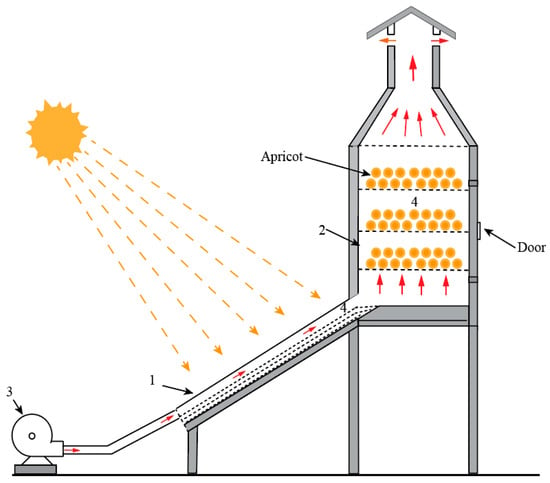
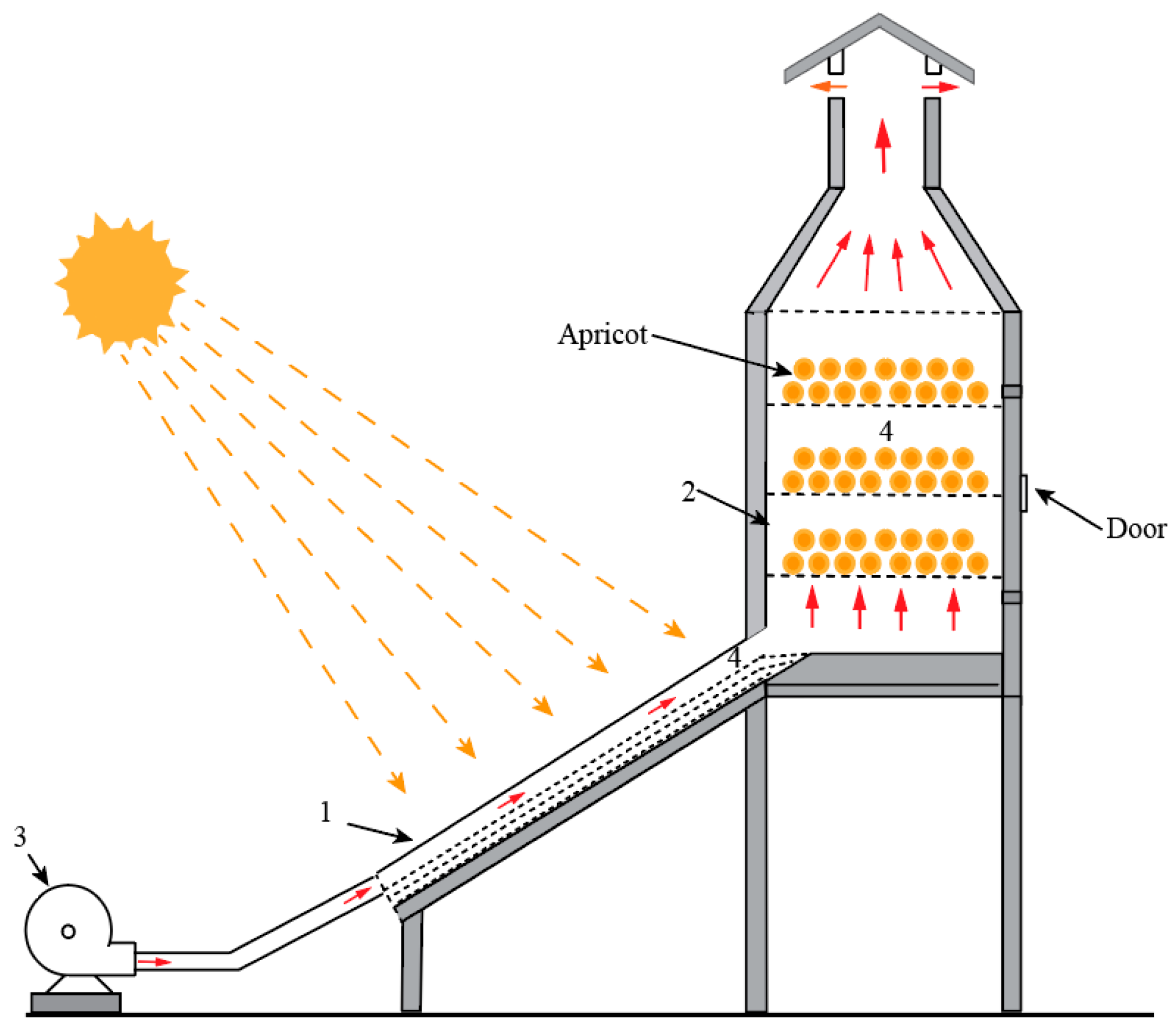
The system uses a neural predictive model and a real-time controller. It adjusts the airflow rate to keep the chamber temperature between 55 and 60 °C. The proposed method is validated using experimental datasets collected from a prototype solar dryer equipped with a 1.71 m2 solar air heater, a 1 × 1 × 0.5 m drying chamber loaded with 5 kg of apricots, and operating from 09:00 to 17:00 under natural climatic conditions (Figure 1) [4].
Figure 1.
Experimental indirect forced-convection solar dryer used for ANN-based temperature control: (1) solar air heater, (2) drying chamber, (3) airflow fan, (4) temperature and humidity sensors.
The experiment recorded three key process variables in real time at a sampling frequency of 1 Hz: the outlet air temperature T(k), the outlet air relative humidity H(k), and the air mass flow rate m(k). These measurements were simultaneously used for dynamic system identification and for training the neural-network-based predictive control model.
Temperature measurements were obtained using a digital temperature sensor (e.g., DS18B20, ±0.5 °C accuracy), while relative humidity was measured using a capacitive sensor (e.g., DHT22, ±2% RH accuracy). Prior to experiments, sensors were calibrated against a reference laboratory thermometer and hygrometer using a two-point calibration method.
2.2. Signal Conditioning and Statistical Normalization
Temperature and humidity have different physical units, magnitudes, and variances; therefore, statistical normalization was applied prior to model training to ensure numerical stability. Each variable was transformed using:
where , denote mean values, and , denote standard deviations of temperature and humidity, respectively.
The control input m(k) was normalized using the same procedure.
2.3. Composite Output Formation for SISO Neural Modeling
The drying process is inherently a SISO (single-input–single-output) system because the fan air-mass-flow simultaneously affects both chamber temperature and humidity. However, the NNPC framework requires a SISO representation. Therefore, the temperature and humidity channels were merged into a single composite output expressed as:
with the weighting constraint .
Weights were selected as , and because thermal stability plays a more dominant role in product quality and enzymatic deactivation.
The corresponding composite set-point was defined as:
This transformation preserves the physical influence of both variables while enabling NNPC in a classical SISO formulation [15].
The weighting factors and were selected based on a sensitivity analysis and technological considerations. Temperature has a more dominant influence on enzymatic inactivation, drying kinetics, and product safety; therefore, a higher weight was assigned to the thermal variable. Similar weighting strategies have been reported in multi-objective drying control studies.
The composite output keeps the dynamics of temperature and humidity. It provides a single signal suitable for SISO predictive control. The weighting factors ensure that the dominant thermal behavior, which directly governs drying kinetics and product quality, has a stronger influence on the control objective, while the humidity contribution accounts for moisture-related disturbances. As a result, the composite output preserves the essential dynamic characteristics of both variables. At the same time, it enables stable and computationally efficient neural network predictive control. This transformation does not affect the validity of the modeling deductions; instead, it improves controller robustness and convergence by avoiding conflicting multi-output optimization within a SISO control framework.
2.4. Software Environment
Among the various neural modeling approaches available for dynamic systems, the Nonlinear AutoRegressive with eXogenous input (NARX) structure was selected. This choice is motivated by its explicit capability to represent temporal dependencies and feedback dynamics. The solar drying process exhibits strong time-delay effects, thermal inertia, and nonlinear coupling between airflow, temperature, and moisture content, which cannot be adequately captured by static feedforward neural networks. The NARX model uses past inputs and outputs. This helps represent system memory and dynamic behavior more accurately. Furthermore, compared with alternative approaches such as ARX or state-space models, the NARX structure provides superior nonlinear approximation capability. It does not require explicit physical equations, which makes it particularly suitable for data-driven modeling of solar drying processes under variable environmental conditions.
The entire modeling and control design was implemented using MATLAB/Simulink 2014 in combination with the Neural Network Toolbox and the NNPC module. Experimental data were collected through an Arduino-based acquisition system equipped with calibrated temperature and humidity sensors as well as an anemometer. The sampling interval during data acquisition was 1 s. Optimization procedures within the control framework were carried out using MATLAB’s fmincon quadratic programming routines.
2.5. Controller Validation
The NNPC model was evaluated based on the stability of the drying-chamber temperature within the 55–60 °C range, the controller’s responsiveness to humidity-induced load variations, the smoothness and practical feasibility of the computed fan-speed trajectories, and the overall prediction accuracy expressed through R, RMSE, and MAE metrics. Experimental validation showed that ANN-based predictive control ensured significantly more stable temperature regulation, providing an improvement of approximately 12–18% compared with conventional control approaches.
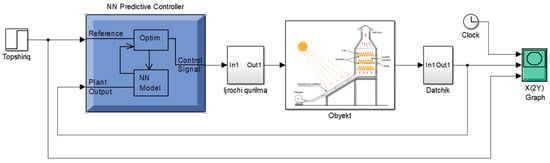
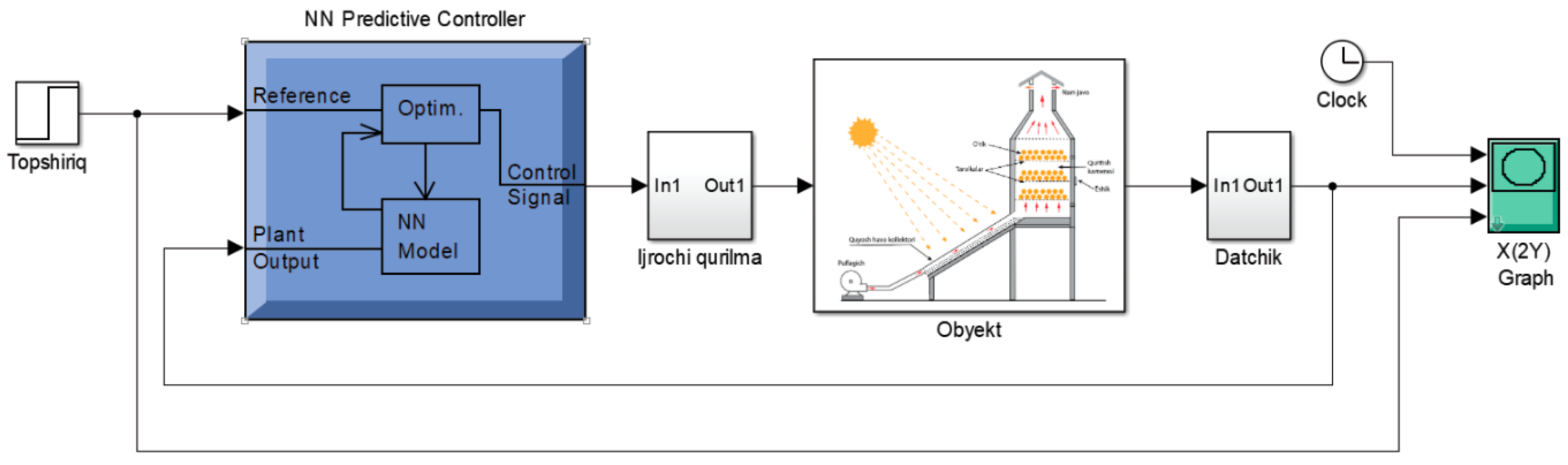
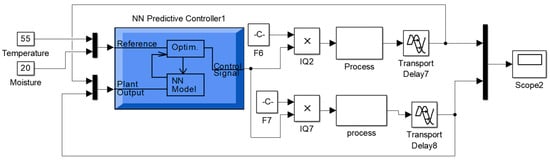
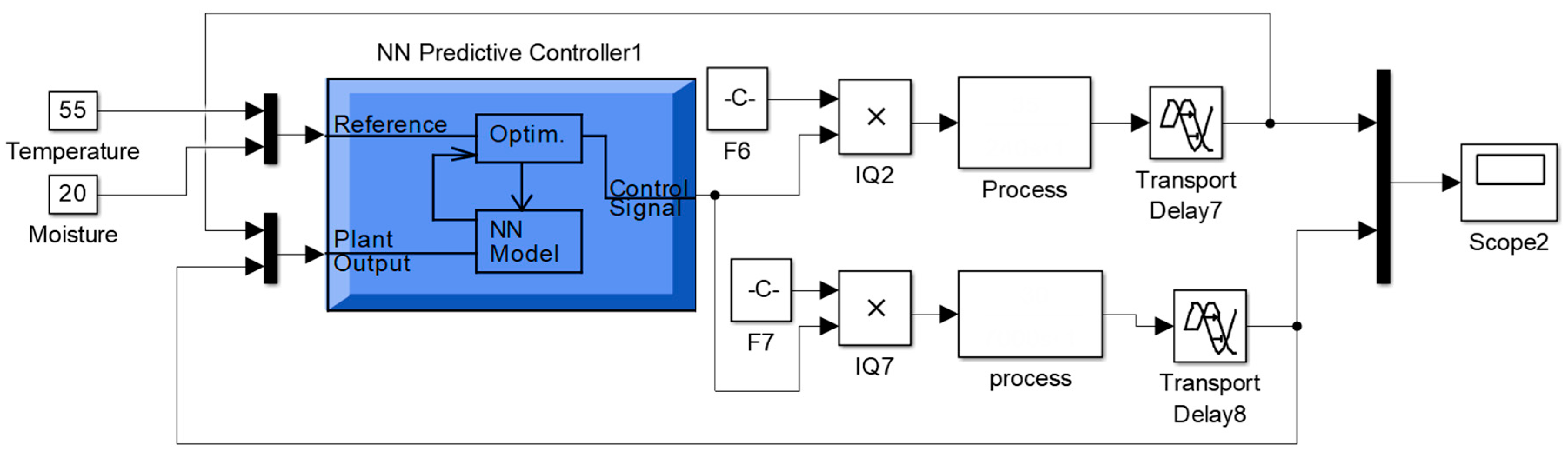
Based on the digital model of the controlled technological object, a complete control concept was developed, integrating intelligent control principles and an adaptive neural regulator to enhance temperature regulation performance. The predictive neural control system was implemented in MATLAB R2014a Simulink (Figure 2).
Figure 2.
Block diagram of the ANN-based predictive control system implemented in MATLAB/Simulink, showing the reference input, NN predictive controller (including the neural model and optimization block), actuator subsystem, solar dryer object, sensor module, and closed-loop feedback path.
The structure of the control system includes the process model, a neural predictive controller, a reference-signal generator, and real-time visualization modules. The predictive controller, available within the Neural Network Toolbox under the Control Systems section, performs adaptive control functions while forecasting the future behavior of the drying process.
In this structure, the input layer of the neural network receives both manipulated and controlled variables. A tapped delay line (TDL) block was employed to store past values of these signals, enabling the network to capture the temporal dynamics of the drying chamber. By incorporating delayed inputs, the neural model can forecast future system states. This capability is essential for dynamic thermal processes that involve slow heat transfer and nonlinear moisture–temperature interactions.
3. Result and Discussion
The second stage of the study involved designing the real-time neural predictive control algorithm for the drying process. To evaluate the advantages of the ANN-based predictive controller, its performance was compared with that of a conventional PID controller. For both controllers, the transient response curves were generated, and their effectiveness was evaluated under identical reference changes. The PID regulator was tuned according to the process parameters to ensure optimal operation conditions. The synthesis of the optimal PID controller involved selecting the regulator type, determining tuning parameters, and computing the optimal coefficients Kp, Ti, and Td. These values were determined using the dynamic response of the digital model.
After constructing the computational model, the main dynamic characteristics were incorporated, and the system was subsequently tested under various control configurations. Transition curves were generated for both control strategies, providing a basis for assessing dynamic behavior and identifying the most effective regulator. In determining the optimal control settings, criteria such as rise time, system stability, and minimal overshoot were prioritized. Ultimately, the set of parameters that ensured the shortest settling time and stable operation was selected as optimal. The structure of the NNPC regulator is presented in Figure 3.
Figure 3.
Internal structure of the NNPC, including prediction model, cost function, control horizon, and constraint-handling module.
A neural plant model was developed on the basis of 200 experimentally acquired input–output data samples. The model employs a Nonlinear Auto Regressive with eXogenous input (NARX) structure, in which the current output Y(k) is estimated using the regressors {m(k), m(k − 1), Y(k − 1), Y(k − 2)}. The network consists of a single hidden layer with ten neurons using a tansig activation function, while the output layer uses a linear activation function to ensure unrestricted output dynamics. Model training was performed using the Levenberg–Marquardt (trainlm) optimization algorithm over 50 epochs. The dataset was partitioned into 70% for training, 15% for validation, and 15% for testing, consistent with recommended practices for dynamic-system identification.
To guarantee robust model generalization, the air-mass-flow input was designed to be persistently exciting. The excitation sequence included an initial high plateau (approximately 0.033–0.035 kg/s), followed by a gradual decline (approximately 0.018–0.022 kg/s), and finally a return to a higher regime (around 0.033 kg/s). This type of structured excitation allows the model to capture nonlinear behavior across low, medium, and high operating conditions, thereby strengthening the identifiability of the drying-process dynamics.
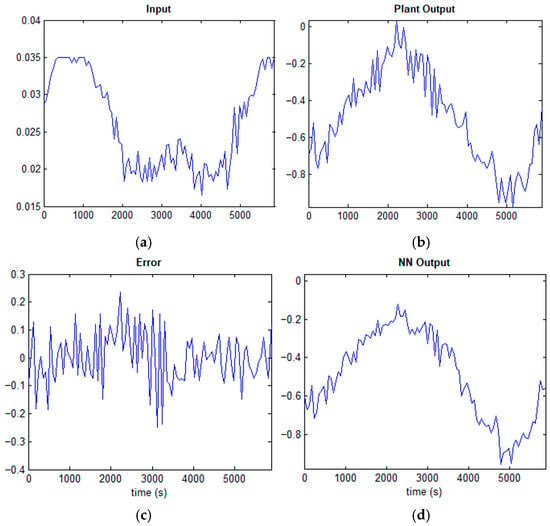
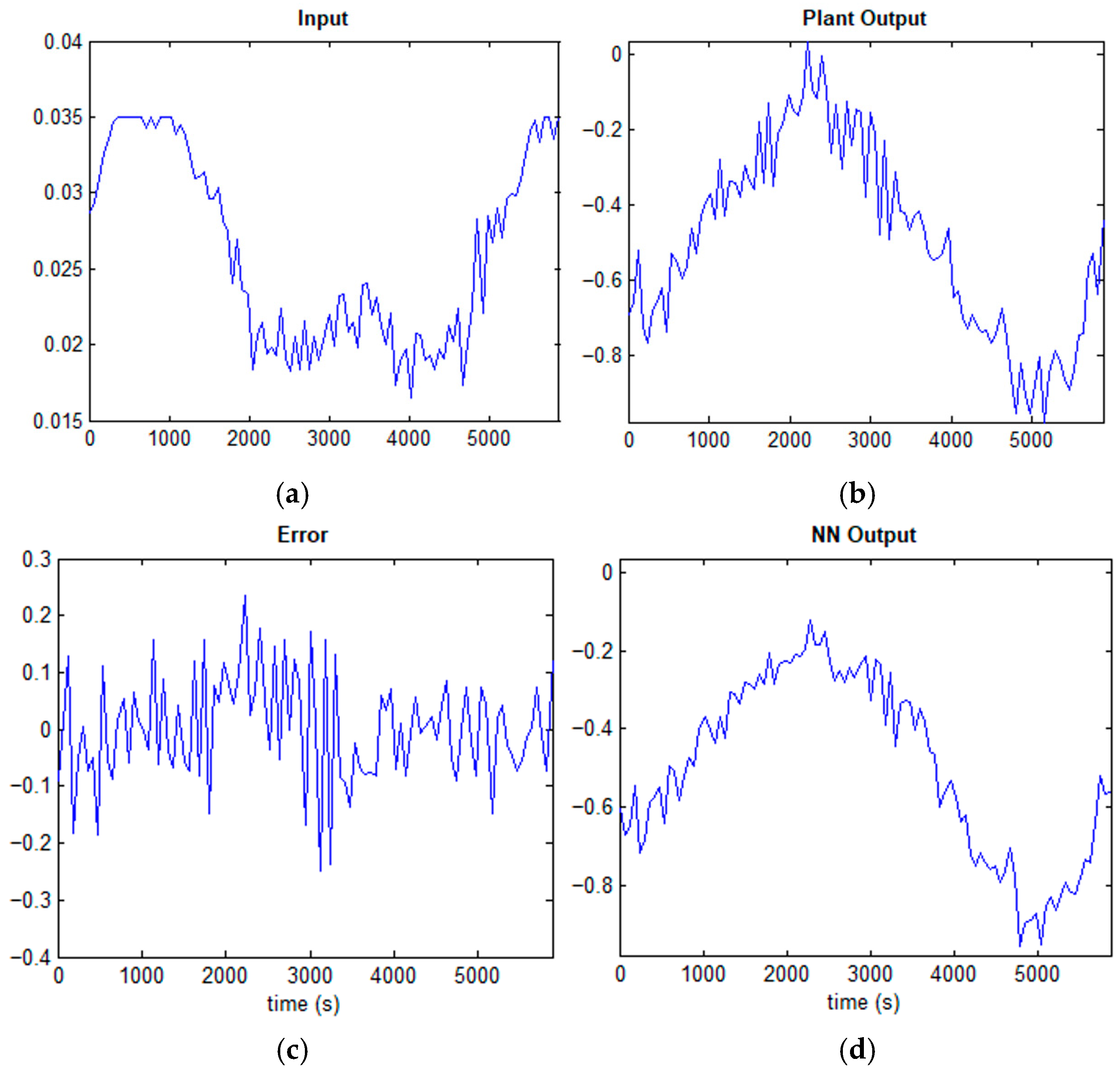
The training results, as illustrated in Figure 4 of the document, show that the NN-plant accurately reproduces the dynamic response of the system, with close correspondence between the predicted output and the measured data across all excitation segments.
Figure 4.
Time-domain identification results of the ANN-based plant model: (a) excitation input signal; (b) measured plant output; (c) residual error; (d) neural network predicted output.
This figure shows the time-domain identification results of the ANN-based plant model for the solar drying process. It compares the excitation input signal, measured plant output, neural network predicted output, and residual error. Figure 4a presents the input signal used for model excitation. The airflow rate changes over time to represent different operating conditions of the solar dryer. Figure 4b shows the measured plant output. It reflects the dynamic temperature response of the drying process under varying input conditions. Figure 4c illustrates the residual error between the measured output and the neural network prediction. The error remains within a limited range, indicating good model accuracy. Figure 4d presents the output predicted by the ANN model. The predicted signal follows the measured plant behavior closely. This confirms that the neural network successfully captures the nonlinear dynamics of the solar drying process and can be used for predictive control.
The analysis of the network output and residual behavior demonstrates that the neural model accurately tracks the plant response across the full operating range. The NN output reproduces the measured signal with high fidelity, exhibiting only a minor phase shift in certain intervals.
A slight phase shift is observed between the measured output and the neural network prediction in certain time intervals. This behavior can be attributed to a combination of physical and modeling-related factors. From a physical perspective, the solar drying process exhibits inherent thermal inertia and heat transfer delays caused by the thermal mass of the drying chamber and the agricultural product. These effects introduce a natural lag between changes in the control input and the corresponding temperature response. From a modeling perspective, the NARX neural network estimates system dynamics using delayed input–output regressors. During training, regularization is applied, which can lead to mild temporal smoothing of rapid transients. Additionally, sensor noise and abrupt variations in solar irradiance may contribute to localized discrepancies between predicted and measured signals. Importantly, the observed phase shift remains small and does not affect the overall predictive accuracy or stability of the control system, as confirmed by the low residual error and strong regression performance.
A slight smoothing near the extreme values is observed, which can be attributed to the regularization effect inherent in the Levenberg–Marquardt training algorithm. Most residual errors remain within the ±0.10–0.25 band, while occasional deviations of approximately ±0.3 occur mainly due to measurement noise and segments with high input gradients.
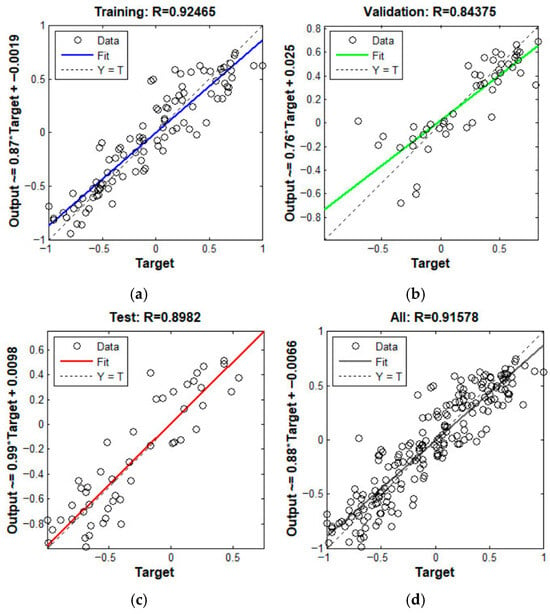
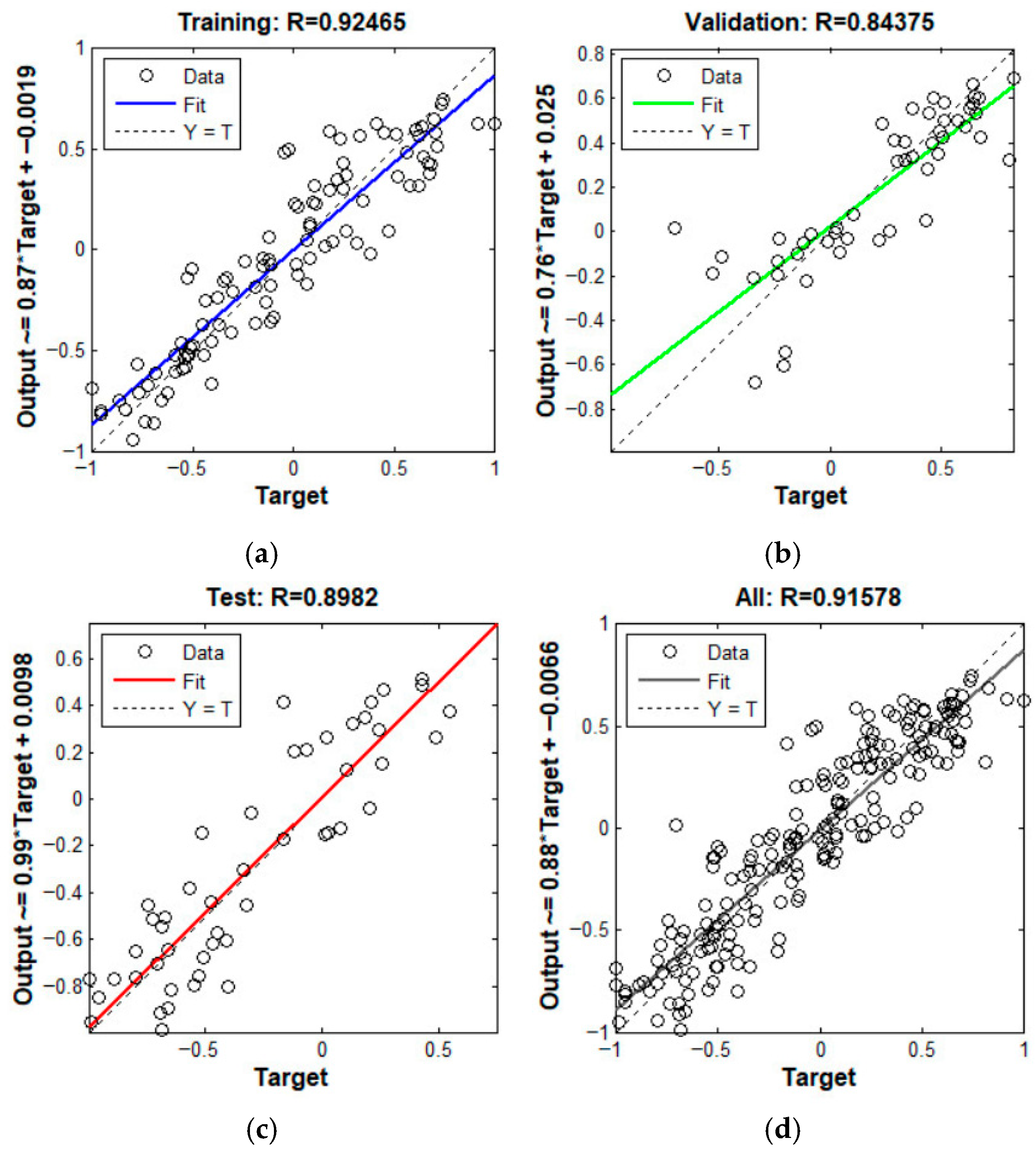
The regression evaluation (Figure 5 in the original document) further confirms the strong agreement between predicted and measured data. The data points cluster tightly around the ideal y = x line, indicating a strong linear correlation. The regression slope being slightly less than unity suggests a mild attenuation of extreme values, whereas the intercept remaining close to zero confirms the absence of systematic bias.
Figure 5.
Regression performance of the ANN model: (a) training stage; (b) validation stage; (c) testing stage; (d) overall regression for all data, demonstrating a strong correlation between predicted and measured values.
This figure presents the regression results of the ANN-based NARX model developed for temperature prediction in the solar drying process. It shows the relationship between the predicted outputs of the neural network and the measured target values. Figure 5a represents the regression results for the training dataset. The correlation coefficient R = 0.92465 indicates that the model learned the process dynamics with high accuracy. Most data points are located close to the ideal Y = T line, confirming good agreement between predicted and measured values. Figure 5b shows the validation results. This stage evaluates the model performance using unseen data. The correlation coefficient R = 0.84375 demonstrates acceptable generalization capability under variable operating conditions. Figure 5c illustrates the regression results for the testing dataset. The obtained value R = 0.8982 confirms that the neural model predicts the process behavior with high reliability. The distribution of data points near the reference line indicates stable predictive performance. Figure 5d presents the overall regression results combining training, validation, and testing datasets. The overall correlation coefficient R = 0.91578 confirms strong agreement between predicted and measured outputs. These results demonstrate that the ANN-based NARX model accurately captures the nonlinear dynamics of the solar drying process and can be used for reliable temperature prediction and control.
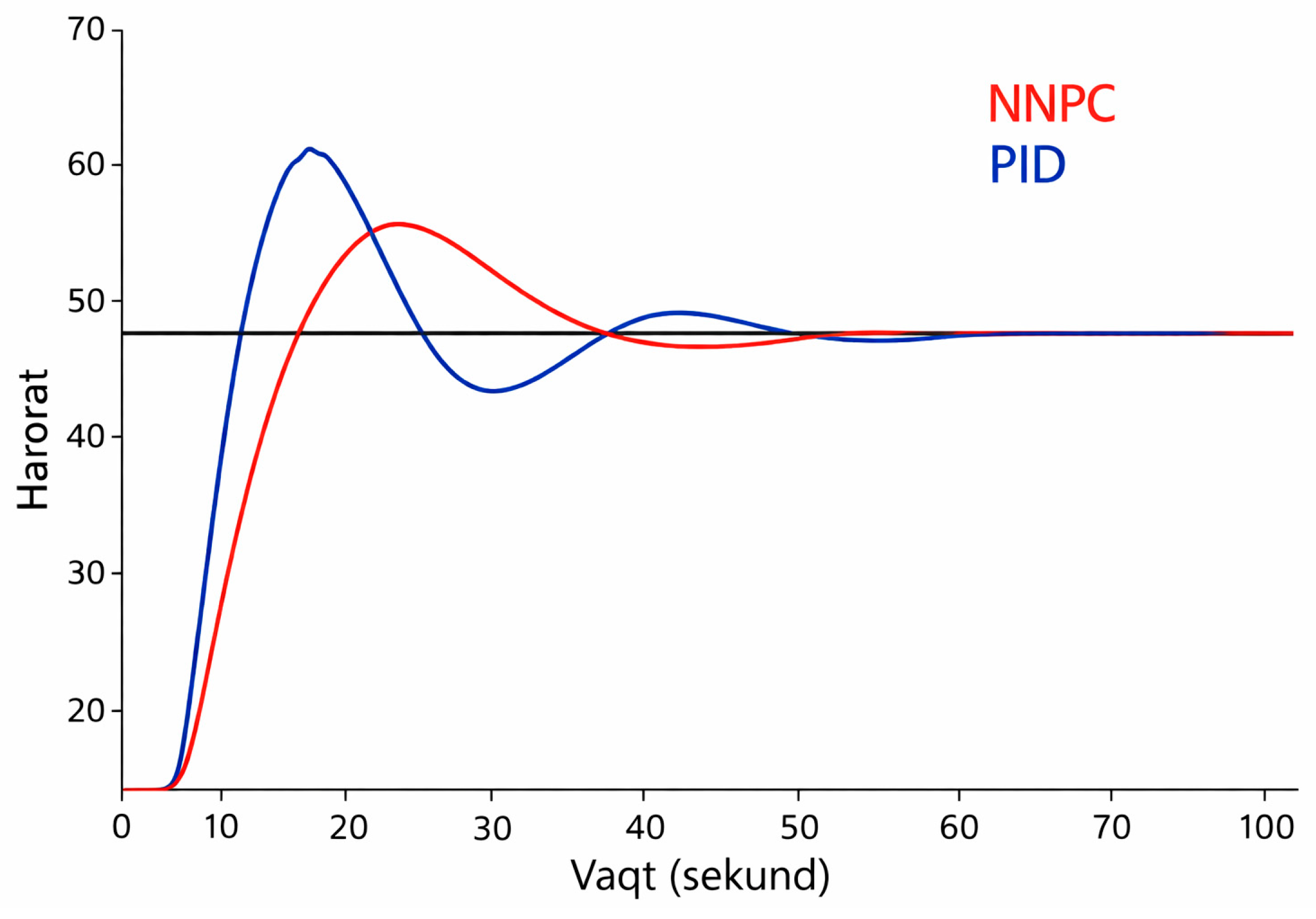
The comparison of PID and neural predictive control responses reveals substantial differences in performance. In the system controlled by the PID regulator, the settling time was approximately 250 s. Moreover, a significant overshoot occurred at the beginning of the transient response: the temperature rose above the reference value and only gradually declined toward the equilibrium point. This behavior indicates insufficient damping and results in additional oscillations, which significantly degrade the overall control quality. Such oscillatory characteristics are undesirable in drying processes, where precise temperature regulation directly influences product quality.
When the predictive neural controller was applied, the transient behavior improved considerably. The settling time decreased to approximately 160 s, demonstrating a faster approach to the desired temperature. Additionally, overshoot was significantly reduced, and the oscillatory behavior observed in the PID-controlled system was nearly eliminated. The simulation results clearly show that the neural-network-based controller provides smoother tracking, improved stability, and more accurate convergence to the setpoint. This superior performance can be attributed to the predictive capability of the ANN model. This capability allows the controller to anticipate the future state of the process and adjust the control signal proactively.
Although the proposed ANN-based predictive controller demonstrates clear performance advantages at the prototype scale, its direct transfer to industrial-scale solar dryers may require additional adaptation. Larger systems exhibit increased thermal inertia, airflow non-uniformity, and actuator constraints, which may affect control performance. Therefore, controller retuning, extended training datasets, and hardware-in-the-loop validation are necessary steps before large-scale deployment.
Unlike a classical PID controller, which reacts only to the present error, the neural predictive controller uses dynamic system characteristics. This allows it to generate optimal and timely control actions. Even when external disturbances shift the process away from equilibrium, the NN controller responds quickly and effectively, restoring stability. This demonstrates a key advantage of the proposed predictive approach—enhanced robustness and superior adaptability to nonlinearities and disturbances. Overall, the neural predictive control strategy significantly outperforms the PID controller, offering faster, more stable, and more precise temperature regulation—critical features for achieving high-quality and energy-efficient solar drying. A comparative analysis of PID and NNPC temperature responses is presented in Figure 6.
Figure 6.
Comparison of temperature transient responses under conventional PID and ANN-based neural network predictive control (NNPC), highlighting reduced settling time, minimized overshoot, and improved temperature stability achieved by the proposed intelligent controller.
A fundamental difference exists between the classical PID controller and the neural network-based predictive controller. This difference lies in their control philosophy and adaptability. The PID controller generates control actions solely based on the instantaneous error and its derivatives, assuming quasi-linear system behavior. As a result, its performance degrades under nonlinear dynamics, time delays, and external disturbances, which are characteristic of solar drying processes. In contrast, the neural network predictive controller exploits a data-driven dynamic model to anticipate future system behavior and generate proactive control actions. This predictive capability enables faster response, reduced overshoot, and improved temperature stability, as observed in the comparative results. Consequently, the NN-based controller demonstrates superior robustness and adaptability under variable operating conditions.
In recent studies, Adaptive Neuro-Fuzzy Inference Systems (ANFIS) have been widely applied to solar drying processes due to their capability to combine linguistic fuzzy rules with data-driven learning. ANFIS-based controllers are particularly effective in handling uncertainty and incorporating expert knowledge through membership functions. However, their performance strongly depends on the selection of membership function types, the number of rules, and the availability of sufficiently large and well-distributed datasets.
In comparison, the ANN-based predictive control strategy proposed in this study offers a simpler structure and lower computational complexity, which is advantageous for real-time implementation in embedded solar dryer control systems. Unlike ANFIS, which requires explicit rule base design and tuning of fuzzy parameters, the ANN model learns the nonlinear thermal dynamics directly from experimental data, enabling faster model development and easier scalability. Furthermore, the predictive nature of the ANN-based controller allows proactive adjustment of the airflow rate, resulting in reduced settling time and improved temperature stability.
Therefore, while ANFIS remains a powerful alternative for solar drying control, the proposed ANN-based predictive approach provides a more straightforward and computationally efficient solution for practical solar dryer automation under dynamically varying climatic conditions.
4. Conclusions
This study shows that data-driven control improves stability and energy efficiency in solar drying systems. The proposed control concept is particularly relevant for small- and medium-scale agricultural drying applications in regions with high solar potential. This study developed and validated an artificial neural network-based predictive temperature regulation system for an indirect forced-convection solar dryer operating under variable climatic conditions. By integrating a NARX-based ANN model within a neural network predictive control framework, the proposed approach effectively addressed the nonlinear and time-varying characteristics of the solar drying process. Comparative analysis demonstrated that the ANN-based controller clearly outperformed the conventional PID controller, providing faster convergence and improved temperature stability. These results confirm the suitability of data-driven intelligent control strategies. Such strategies are effective for improving dynamic performance and operational reliability in solar drying applications.
Despite the promising results, this study has certain limitations. The control strategy mainly focuses on temperature regulation and does not explicitly incorporate humidity dynamics or direct product quality indicators. In addition, validation was limited to short-term experiments on a prototype-scale dryer, which may not fully capture long-term seasonal variability.
Future research should therefore focus on multivariable predictive control strategies that simultaneously regulate temperature and humidity, incorporate real-time quality metrics, and enable online adaptive learning. Long-term field experiments and hardware-embedded implementation are essential to confirm the scalability and industrial applicability of the proposed approach.
Author Contributions
Conceptualization, K.U. and J.E.; methodology, B.S.U. and S.R.; formal analysis, B.S.U.; investigation, S.R., K.U. and M.Y.; resources, S.R.; data curation, K.U.; writing—original draft preparation, S.R. and J.E.; writing—review and editing, B.S.U. and M.Y.; visualization, S.R. and J.E.; supervision, B.S.U. and K.U. All authors have read and agreed to the published version of the manuscript.
Funding
This research received no external funding.
Institutional Review Board Statement
Not applicable.
Informed Consent Statement
Not applicable.
Data Availability Statement
The data presented in this study are available on request from the corresponding author.
Conflicts of Interest
The authors declare no conflicts of interest.
Abbreviations
| ANN | Artificial Neural Networks |
| PID | Proportional–Integral–Derivative |
| OSD | Open-Sun Drying |
| IFCSD | Indirect Forced-Convection Solar Dryers |
| ANFIS | Adaptive Neuro-Fuzzy Inference Systems |
| NNPC | Neural Network Predictive Control |
| SISO | Single-Input–Single-Output |
| R | Coefficient of Determination |
| RMSE | Root Mean Squared Error |
| MAE | Mean Absolute Error |
| TDL | Tapped Delay Line |
| NN | Neural Network |
| NARX | Nonlinear Auto Regressive with eXogenous |
References
- Hassanzai, R.G.; Naseri, A.K.; Ayobi, M.N. Advancement in Drying Technologies: Enhancing the Physicochemical, Nutritional and Sensory Properties of Apricot. ESRJ 2025, 63, 1–10. [Google Scholar]
- Kaviti, A.K.; Teja, M.; Madhukar, O.; Teja, P.B.; Aashish, V.; Gupta, G.S.; Sivaram, A.; Sikarwar, V.S. Productivity Augmentation of Solar Stills by Coupled Copper Tubes and Parabolic Fins. Energies 2023, 16, 6606. [Google Scholar] [CrossRef] [Scilit]
- Yakubova, N.; Istanbullu, A.; Siddiqov, I.; Usmanov, K. Hybrid Quantum-Fuzzy Control for Intelligent Steam Heating Management in Thermal Power Plants. Eng. Proc. 2026, 117, 33. [Google Scholar] [CrossRef] [Scilit]
- Rejabov, S.; Usmonov, B.; Usmanov, K.; Artikov, A. Experimental Comparison of Open Sun and Indirect Convection Solar Drying Methods for Apricots in Uzbekistan. Eng. Proc. 2024, 67, 26. [Google Scholar]
- Souad, B.; Salah, H.; Maamar, L.; Cherif, S.-M. Artificial Neural Network Models for Prediction of Density and Kinematic Viscosity of Different Systems of Biofuels and Their Blends with Diesel Fuel. Comparative Analysis. Kem. Ind. 2020, 69, 355–364. [Google Scholar] [CrossRef] [Scilit]
- Sharshir, S.W.; Joseph, A.; Peng, G.; Kandeal, A.W.; Abdullah, A.S.; Abdelaziz, G.B.; Edreis, E.M.A.; Yuan, Z. Recent Efforts in Developing Agricultural Product Drying Processes Using Solar Energy. Solar Energy 2023, 257, 137–154. [Google Scholar] [CrossRef] [Scilit]
- Madhankumar, S.; Viswanathan, K.; Taipabu, M.I.; Wu, W. A Review on the Latest Developments in Solar Dryer Technologies for Food Drying Process. Sustain. Energy Technol. Assess. 2023, 58, 103298. [Google Scholar] [CrossRef] [Scilit]
- Deng, Z.; Li, M.; Xing, T.; Zhang, J.; Wang, Y.; Zhang, Y. A Literature Research on the Drying Quality of Agricultural Products with Using Solar Drying Technologies. Sol. Energy 2021, 229, 69–83. [Google Scholar] [CrossRef] [Scilit]
- Li, S.; Li, Y.-Y. Neural Network Based Nonlinear Model Predictive Control for an Intensified Continuous Reactor. Chem. Eng. Process. Process Intensif. 2015, 96, 14–27. [Google Scholar] [CrossRef] [Scilit]
- Yang, T.; Zheng, X.; Xiao, H.; Shan, C.; Yao, X.; Li, Y.; Zhang, J. Drying Temperature Precision Control System Based on Improved Neural Network PID Controller and Variable-Temperature Drying Experiment of Cantaloupe Slices. Plants 2023, 12, 2257. [Google Scholar] [CrossRef] [Scilit] [PubMed]
- Eshbobaev, J.; Norkobilov, A.; Usmanov, K.; Khamidov, B.; Kodirov, O.; Avezov, T. Control of Wastewater Treatment Processes Using a Fuzzy Logic Approach. Eng. Proc. 2024, 67, 39. [Google Scholar]
- Turakulov, Z.; Kamolov, A.; Norkobilov, A.; Variny, M.; Fallanza, M. Enhancing Sustainability and Energy Savings in Cement Production via Waste Heat Recovery. Eng. Proc. 2024, 67, 11. [Google Scholar] [CrossRef] [Scilit]
- Ahmed, S.; Salah, H.; Maamar, L.; Ahmed, R. ANN-Based Approach to Model MC/DR of Some Fruits under Solar Drying. Kem. Ind. 2021, 70, 233–242. [Google Scholar] [CrossRef] [Scilit]
- Topal, M.E.; Şahin, B.; Vela, S. Artificial Neural Network Modeling Techniques for Drying Kinetics of Citrus Medica Fruit during the Freeze-Drying Process. Processes 2024, 12, 1362. [Google Scholar] [CrossRef] [Scilit]
- Ait Mohamed, L.; Ethmane Kane, C.S.; Kouhila, M.; Jamali, A.; Mahrouz, M.; Kechaou, N. Thin Layer Modelling of Gelidium Sesquipedale Solar Drying Process. Energy Convers. Manag. 2008, 49, 940–946. [Google Scholar] [CrossRef] [Scilit]
Disclaimer/Publisher’s Note: The statements, opinions and data contained in all publications are solely those of the individual author(s) and contributor(s) and not of MDPI and/or the editor(s). MDPI and/or the editor(s) disclaim responsibility for any injury to people or property resulting from any ideas, methods, instructions or products referred to in the content. |
© 2026 by the authors. Licensee MDPI, Basel, Switzerland. This article is an open access article distributed under the terms and conditions of the Creative Commons Attribution (CC BY) license (https://creativecommons.org/licenses/by/4.0/).